
Home Blog Page 22

Allegiant Stadium: A Technological Marvel in the Heart of Las Vegas

0

As the lights of Las Vegas shine brighter with anticipation, the city readies itself for an event of unparalleled grandeur – the NFL Super Bowl at the Allegiant Stadium. A modern coliseum that mirrors the sleekness and power of sportscars, the stadium is not just a venue; it’s a statement of innovation, design, and functionality, crafted to redefine the spectator experience.

The Genesis of an Icon

In the heart of Nevada, the Las Vegas Raiders found a new home in the Allegiant Stadium, a marvel designed by Manica Architecture. Conceived initially for California, the stadium’s journey to Las Vegas was marked by a vision that sought to blend the Raiders’ legacy with the futuristic allure of the desert city. The transition wasn’t just geographical but conceptual, transforming the stadium into an indoor arena tailored exclusively for the Raiders, complete with a retractable field and a roof to defy the high-desert climate.

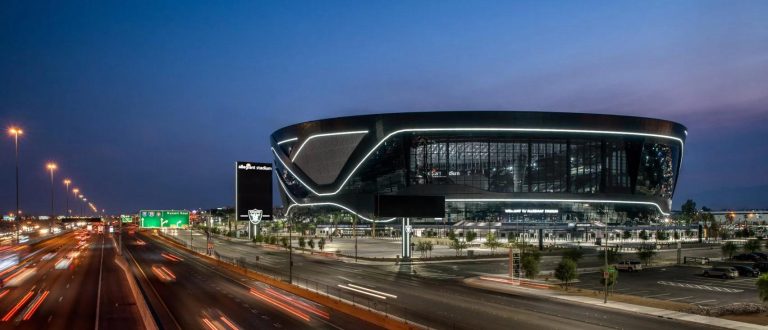
The Allegiant Stadium in Las Vegas is designed by Manica Architecture and will be the venue for the Super Bowl LVIII

Architectural Prowess

With its cylindrical form draped in swathes of black metal and glass, the stadium stands as a testament to innovation and elegance. The design, inspired by the aerodynamic grace of black sports cars, incorporates S-shaped bands of LED lights, a tilt, and a sleek black exterior that pays homage to the Raiders’ colors. This design not only challenges the norms of stadium aesthetics but also addresses the environmental demands of Las Vegas, utilizing black glass effectively to shield the interior from the relentless sun.

A Hub of Technology and Sustainability

Allegiant Stadium is distinguished by its technical features, from the world’s largest 3D-printed sculpture to a rainwater collection system adhering to strict water-management protocols. The interior spaces, dominated by a sleek, black aesthetic, resonate with the facade’s design, ensuring a cohesive visual experience that extends from the exterior to the very seats and detailing within.

The stadium boasts a retractable natural grass playing field, one of only two domed stadiums in the US to feature such innovation. This system, designed to roll the field outside for sunlight exposure, exemplifies the stadium’s commitment to providing an optimal playing surface while integrating flexibility for various events.

Economic and Social Impacts

Beyond its architectural and technological marvels, Allegiant Stadium has become a beacon of economic prosperity for Las Vegas. With an annual economic benefit of $62 million and the creation of 6,000 permanent jobs, the stadium is a powerhouse of opportunity, drawing fans and tourists alike to the vibrant city. Its capacity of 65,000, expandable by 7,000 for major events, makes it the largest entertainment venue in the city, ready to host not just football games but concerts and other significant events.

The interior is adorned with futuristic black design elements
The Al Davis Memorial Torch at Allegiant Stadium.

The Fast Track to Completion

The journey from concept to completion in just 40 months showcases the project’s ambitious timeline, achieved through a fast-track Design-Build delivery method. This approach, coupled with a collaborative effort between architects, engineers, and the Clark County Department of Building and Fire Prevention, ensured that Allegiant Stadium was ready to welcome fans for the 2020-21 football season, on budget and on time.

A New Era for the NFL

As Allegiant Stadium, dubbed “The Death Star,” prepares to host Super Bowl 58, it stands not just as the newest addition to the NFL’s roster of stadiums but as a symbol of the future. Its location, mere miles from the Las Vegas Strip, and its groundbreaking features, from the translucent roof to the climate-controlled environment, set a new standard for sporting venues worldwide.

Allegiant Stadium is more than a venue for the Super Bowl; it’s a technological marvel that embodies the spirit of innovation and excellence. As it gears up to host the Chiefs and the 49ers, it’s not just the game that will capture the world’s attention but the stadium itself – a beacon of architectural prowess, technological advancement, and sustainable design in the heart of Las Vegas.


By: Mary Rose
Originally published at: citi.io
Verizon’s Commitment To The Las Vegas Community Goes Far Beyond Supporting The Big Game

0

From laying out more than 547 miles of fiber across Las Vegas, to extensive work with first responders, businesses and community efforts, Verizon is ready for the Big Game

NEW YORK – After the bright lights of Allegiant Stadium fade and the millions of football fans depart, the city of Las Vegas will be left stronger than ever before, in large part due to the major commitment by Verizon to ensure the community stays connected and continues to thrive.

The Thriving Las Vegas Business Community

From working with businesses small and large in Las Vegas, to working hand-in-hand with the public safety community, Verizon is committed to the success of the local economy.

Verizon has reached over 1,500 small businesses across the Las Vegas area through the Small Business Digital Ready program – and over 250,000 small businesses across the nation. Community businesses like Braud’s Funnel Cake Cafe – an official vendor at this year’s Big Game – have used the free platform to access over 40 online courses, coaching opportunities with industry experts, peer networking events, and more. Additionally, anyone in the Las Vegas area can access Verizon’s robust skill training program, Skill Forward, which, in partnership with edX, offers over 250 tuition-free, technical and professional courses across in-demand industry sectors, with courses available in both English and Spanish.

“Las Vegas is a city and market that is booming from a business perspective, from major professional sports teams calling Vegas home, to the expansion and growth of businesses in both the large enterprise and SMB space,” said Kyle Malady, CEO, Verizon Business. “Today, markets cannot grow to their full potential without a few key things – high performing, reliable and secure connectivity for all businesses and residents, leaders in the community with a vision for technological innovation and the right partner in the community to not just provide the technology and solutions, but to share the vision and make it reality. Verizon’s super power is that we live, work and play in communities like Las Vegas and are deeply committed to prolonged growth and prosperity.”

Verizon Frontline enabling the Public Safety Community

Before, during and after this year’s big game, Verizon Frontline is helping keep first responders connected by working to ensure they have the mission-critical communications assets they need to achieve their mission. At the Big Game, one of the ways this is accomplished is through the Verizon Command Center, which is staffed by technicians and engineers monitoring and managing, around the clock, everywhere the Verizon network touches throughout Las Vegas and the surrounding communities.

Members of the Verizon Frontline team will also staff joint Emergency Operations Centers, sitting side-by-side with federal, state and local agencies to help ensure they have the technology, information and network support they need.

The Verizon Frontline team has been preparing for this year’s game, in close coordination with many of these agencies, for well over two years and is ready to help keep first responders in Las Vegas and Allegiant Stadium connected from the field to the front lines.

Verizon Frontline is the advanced network and technology built for first responders – developed over nearly three decades of partnership with public safety officials and agencies – to meet their unique and evolving needs.

Las Vegas Network Upgrades

Over the last three years, Verizon has invested significantly nearly tripling Las Vegas’ network capacity and readying it for the 40M+ tourists and business travelers who come to the city each year. Verizon has doubled down on its 5G network in Las Vegas, laying out more than 547 miles of fiber across the city – enough for a trip from Las Vegas to Los Angeles and back again – and lighting up C-band across 52 million square feet in and around casinos on the Las Vegas Strip, the equivalent of more than 900 football fields. Las Vegas residents and visitors can now use a full 160 MHz of spectrum, which allows Verizon to provide greater bandwidth and enable higher data speeds for its customers throughout Las Vegas.

Verizon has added unmatched large capacity connections (mmWave) at the most congested areas in Las Vegas, including the Las Vegas Strip, Fremont Street and Allegiant Stadium, as well as additional upgrades in high demand areas such as the Las Vegas Convention Center and Harry Reid International Airport. These are permanent upgrades that will remain a fixture of the Las Vegas network.

At Allegiant Stadium, Verizon is delivering an exceptional network experience so fans can capture and share every Super Bowl LVIII moment. By Super Bowl, Verizon will have deployed approximately 250 5G mmWave radios covering the stadium’s seating areas, back of house, suites, lounges, press box, concourse areas and entry ways, allowing fans to watch game highlights, keep tabs on players’ stats, and use their phones for concession payments with ease.

“At Verizon, we are obsessed with delivering game-changing connectivity and ensuring our customers have a superior network experience,” said Joe Russo, EVP & President, Global Networks & Technology. “These upgrades will provide a reliable, high performing and secure experience for the Super Bowl, offering the best for Las Vegas residents and visitors for years to come.”

Verizon in the Community 

Verizon is proud of its long-standing commitment to the Las Vegas community. With deep relationships with local partners, schools and small businesses, Verizon continues to strive to ensure they can thrive. Across Las Vegas, three Verizon Innovative Learning Schools reach more than 1,800 students and teachers with tablets, laptops, and up to four years of data,

empowering 24/7 learning in and out of the classroom. With Verizon Innovative Learning Labs in these schools, students have access to hands-on learning tools such as VR equipment, 3D printing stations, AR apps and more in a custom-designed, state-of-the-art experiential learning environment.

Verizon will also partner with Goodr, a certified B Corp using technology and logistics to fight hunger and food waste, to bring in its free mobile grocery store. The grocery store will stop at three locations across Las Vegas and provide each resident that visits with more than a week’s worth of groceries – all for free.

The Verizon Innovative Learning program, Small Business Digital Ready, Skill Forward and other long-term initiatives, in Las Vegas and across the country, are part of Citizen Verizon, the company’s responsible business plan for economic, environmental and social advancement. Through Citizen Verizon, the company has a goal to provide 10 million youths with digital skills training, prepare 500,000 individuals for the jobs of the future and provide 1 million small businesses with resources to help them thrive in the digital economy – all by 2030.

To see all of Verizon’s activity around the Las Vegas, visit: https://www.verizon.com/about/news/superbowl

Originally published at: Verizon

Source: cyberpogo.com

Higher, Faster: What Influences The Aerodynamics Of A Football?

0
In addition to a player’s ability to throw it, a number of factors will influence a ball’s flight, including its size, inflation pressure and texture.
(Shutterstock)

Giuseppe Di Labbio, École de technologie supérieure (ÉTS)

With 113 million viewers in the United States and 40 million more around the world, the Super Bowl is the most popular sports event in North America. This year’s event on Sunday – with the added attraction of a romance in the spotlight – promises to attract as many fans.

In Canada, the most recent Grey Cup final, last November, reached a record audience of 3.7 million viewers who tuned in to watch the Montréal Alouettes’ victory.

The two leagues definitely don’t enjoy the same popularity – far from it. Nor do they have the same rules. But there is another difference: although similar in appearance, the famous oval balls used in football have specific characteristics on both sides of the border that can affect their aerodynamics, i.e. the forces exerted by the air on the ball during its flight. The design and characteristics of the ball have an impact on the magnitude of these forces.

It might be news to football players, but their talent for throwing balls long distances is not the only thing that matters. A number of factors affect the ball’s aerodynamics, including the way it is made and its inflation pressure.

As a professor in the Department of Mechanical Engineering at Québec’s École de technologie supérieure, I am interested in experimental fluid dynamics. I study the physics of fluid flows and certain applications (e.g. propulsion of aquatic vehicles, aerodynamic applications). Fluid dynamics is a vast field and affects many aspects of our lives, such as the flow of blood in the heart, the flight of aircraft, the beautiful swirling patterns in Jupiter’s atmosphere or the perfect football pass for a touchdown.

Ball size affects flight stability

The NFL and CFL have the same rules regarding the dimensions of their balls. They must be between 11″ and 11.25″ long. They must also be inflated to between 12.5 psi and 13.5 psi, giving them a maximum circumference of between 28″ and 28.5″ around the length and between 21″ and 21.25″ around the width.

These dimensions are important. The football acts like a gyroscope. The higher the speed of rotation, the more stable the ball will be during its flight. Different dimensions can therefore have specific effects on the stability of the ball’s flight.

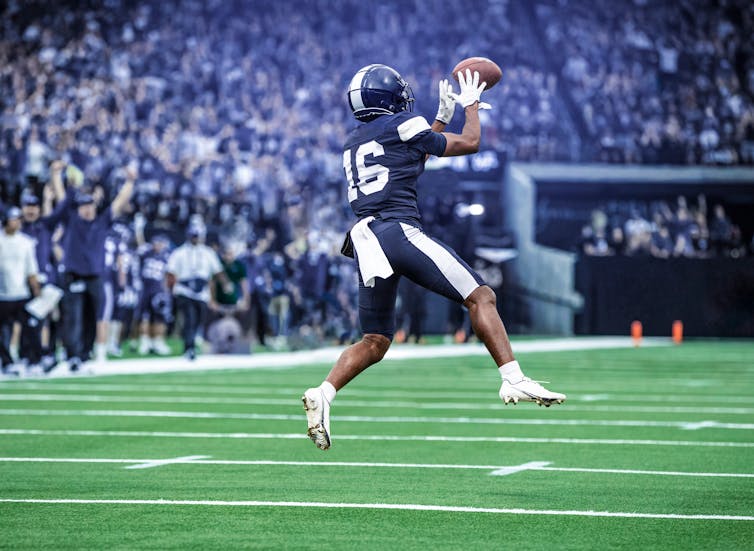
An American football player catches a ball in mid-flight on a field

The size of the football matters. The ball acts like a gyroscope. The higher the speed of rotation, the more stable the ball will be during its flight.
(Shutterstock)

A larger circumference suggests that more of the ball’s mass is located away from its centre line. This means that it will have a higher moment of inertia (resistance to rotation) and, therefore, that the same force applied to make it rotate will result in a lower speed of rotation.

Two stripes and laces make a difference

While there are two white stripes on the Canadian ball, as well as laces, American rules don’t mention these.

The differences between the Canadian and American balls can have an effect on their drag. A drag force is the resistance to a moving object in a fluid. In this case, it is mainly the resistance caused by the air (a fluid), which is called form or pressure drag.

Let’s take the example of a golf ball. Its dimples encourage turbulence, which allows the airflow to stick to the ball and reduce its total drag. Less drag means the ball can fly further with the same force applied.

The laces on a football and any other significant modification to its surface (a logo, a valve), in combination with the rotation of the ball, will to some extent have the same effect. It would be interesting to study how these differences between NFL and CFL footballs affect their respective drag.

NFL or CFL, which ball is better?

To do this, we could use a wind tunnel (an experimental installation in the form of a tunnel with a controlled airflow) to simulate the movement of air (fluid flow) around the two balls that will be fixed in space, put into rotation and subject to an airflow speed that would imitate the balls’ speed of flight.

An aerodynamic force balance could be used to measure the differences in drag between the two balls subjected to the same conditions. Ideally, to eliminate other factors of variability, the two balls would have the same dimensions.

The passage of air around the ball could be visualized using smoke or particle image/tracking velocimetry. The latter is a method in which the air is seeded with particles (helium-filled soap bubbles or oil droplets). The movement of these particles could then be captured using a camera to quantify the airspeed at all points around the ball. This would allow regions of flow separation and recirculation to be seen, and provide an idea of the distribution of aerodynamic forces around the ball.

A gloved hand holds a football on a grassy surface

A ball about to be kicked. A number of factors will influence the aerodynamics of the ball.
(Shutterstock)

Different rotation speeds and flight speeds could be examined, as there is always the possibility of developing flow instabilities, which would lead to a change in its behaviour around the ball.

This would help determine whether the NFL or CFL ball is better.

Ball texture influences drag

There is another type of drag, this one attributable to the friction between the air and the surface of the ball. This is called friction drag.

It depends mainly on the texture of the ball and its speed. The rougher the texture of the ball, the greater the friction drag for the same speed. Similarly, a faster ball speed will have a higher friction drag.

By reducing the form drag, we further reduce the total drag of the ball, which can therefore go further and faster on the football field.

And then there’s the weather!

The weather also plays a role in the aerodynamics of the football.

Cold or hot temperatures can affect the size of the ball by reducing or increasing the air pressure inside it.

Similarly, temperature can have some effect on the material properties of the ball, with colder temperatures making it stiffer and warmer temperatures making it softer.

Temperature and humidity also play a role in the physical properties of air, altering its density and viscosity.

Rain will also directly affect drag as, in a sense, it affects the texture of the ball’s surface as felt by the air.

But that won’t be an issue in Las Vegas on Feb. 11 for the Super Bowl game, since Allegiant Stadium is covered.The Conversation

Giuseppe Di Labbio, Professeur adjoint, École de technologie supérieure (ÉTS)

This article is republished from The Conversation under a Creative Commons license. Read the original article (https://theconversation.com/higher-faster-what-influences-the-aerodynamics-of-a-football-222853).

Source: cyberpogo.com

Watch Our New Pixel Ad Ahead Of The Big Game

0

As one of the over a billion people in the world with a disability, I’ve experienced how AI is revolutionizing the way we go through the world — from making captions more widely available across content to helping people who are blind or have low vision use their phones to identify information about their surroundings. Through my work in disability innovation at Google and on Live Caption before joining the company, I’ve seen firsthand the ways that the products and features we’ve designed with and for people with disabilities have worked to make the world a more accessible place. This year’s Super Bowl ad highlights one of those accessibility features on the Pixel camera, continuing Google’s tradition of sharing stories about the real people who are impacted by the work we do.

“Javier in Frame” is a story about a man who is blind as he documents his life — from finding love to starting a family. To take photos of each moment, he uses Guided Frame, our AI-powered accessibility feature for the Pixel camera that uses a combination of audio cues, high-contrast animations and haptic (tactile) feedback to help people who are blind and low-vision take photos. Launched in 2022 to help people take better selfies using their front camera, Guided Frame now works with your rear camera to recognize faces, pets, food and even objects. “Javier in Frame” follows in the footsteps of our 2023 spot “Fixed on Pixel” and 2022’s “Seen on Pixel,” which both highlight our ongoing efforts to make Pixel’s camera the world’s most inclusive and accessible.

To bring this story to life, Google partnered with Adam Morse, an award-winning filmmaker who’s also blind. Adam experimented with an unconventional technique, painting the camera lens with petroleum jelly to help viewers experience each scene from the perspective of Javier. This filmmaking approach helped Adam represent one of many unique experiences across the blind or low vision spectrum.

Working with the disabled community to design Pixel’s accessibility features has always been a guiding principle. We take this same approach in our creative work and are always working to field input from Googlers, subject-matter experts and community leaders to improve representation. Together, with the community, we will continue to do what we can to elevate disability innovation in our products, our creative and in society.

By: KR Liu (Head of Disability Innovation, Brand Studio)
Originally published at: Google Blog

Source: cyberpogo.com

Delivering Copilot For Everyone

0

As we approach Super Bowl weekend, we’re thrilled to be a part of the festivities for the first time in four years. This year, we’re proud to celebrate the transformative power of AI and Microsoft Copilot, showcasing peoples’ “watch me” moments with Copilot enabling people to do things previously unattainable. With a simple sentence or two, you will see a budding entrepreneur turn a fledgling idea for a new product into an actionable business plan, a filmmaker’s concept into a rich set of storyboards, and a fantasy football player’s team come to life with a mascot image they can edit inline.

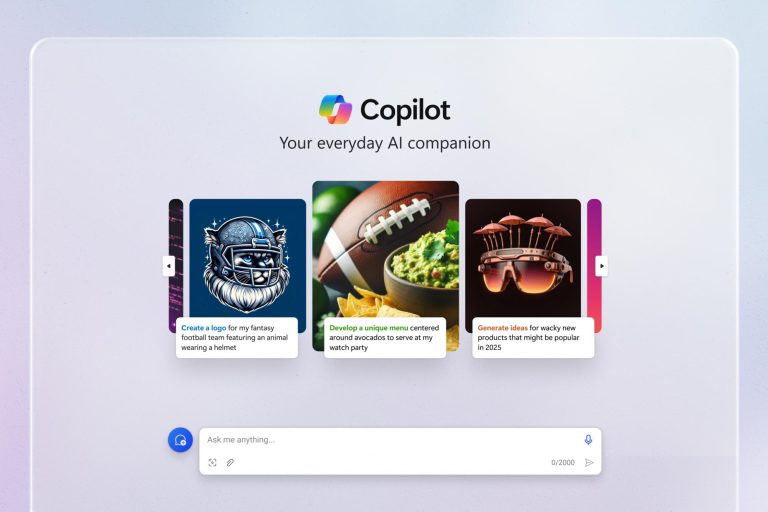
Coincident with the launch of our Super Bowl ad, we are also launching a significant new update to our Microsoft Copilot experience on copilot.microsoft.com and our Copilot app on iOS and Android app stores.  Today when you visit Copilot, you will see a more streamlined look and feel designed to help you bring your ideas to life and more easily gain understanding about the world. We have introduced a cleaner, sleeker look and feel for answers and a fun new carousel of suggested prompts to showcase the power of Copilot.

Today marks exactly one year since our entry into AI-powered experiences for people with Bing Chat. In that year we have learned so many new things and seen the use of our Copilot experiences explode with over 5 billion chats and 5 billion images created to date which have led to sustained growth in Edge and Bing share. Now with Copilot as our singular experience for people looking to get more out of AI creation, we are today introducing further image creation capabilities.

With Designer in Copilot, you can go beyond just creating images to now customize your generated images with inline editing right inside Copilot1, keeping you in the flow of your chat. Whether you want to highlight an object to make it pop with enhanced color, blur the background of your image to make your subject shine, or even reimagine your image with a different effect like pixel art,Copilot has you covered, all for free.  If you’re a Copilot Pro subscriber, in addition to the above, you can also now easily resize and regenerate images between square and landscape without leaving chat. Lastly, we will soon roll out our new Designer GPT inside Copilot, which offers an immersive, dedicated canvas inside of Copilot where you can visualize

Copilot is free to use and works on Microsoft Edge, Chrome, Firefox and Safari. Or download the Copilot mobile app on iOS or Android.

AI is the defining technology of our time. Microsoft’s advancements in AI align with our company mission to empower every person and organization on the planet to achieve more. With Copilot, we’re democratizing our breakthroughs in AI to help make the promise of AI real for everyone.

1Available in English in the United States, United Kingdom, Australia, India and New Zealand.

215 daily boosts included in Copilot, 100 daily boosts with a Copilot Pro subscription to be used for creative needs, faster image generation, and more detailed images.

By: Yusuf Mehdi – Executive Vice President, Consumer Chief Marketing Officer
Originally published at: Microsoft Blog

Source: cyberpogo.com

How Taylor Swift Unexpectedly Brought Fathers and Daughters Together Through Football

0

Inside are many long-assumed truths about fathers and daughters: that their interests inherently differ, conversations inevitably drift as girls grow older, and few common spaces exist to bridge divides as adulthood nears.

So when global pop icon Taylor Swift entered the stadium seats of Travis Kelce’s NFL games this past season, culture watchers scarcely expected the trickle-down bonding deluge now coursing from songstress to countless families nationwide. Yet here father-daughter duos now stand: football unexpectedly uniting them through new chatter, shared fandom and the magic of just existing in spaces jointly rather than apart. Tales abound of young fans peppering fathers with questions about the sport to better understand what they’re seeing Swift so joyfully taking part in each week.

goswifties-cetaphil-gametimeglow-cover

“I guarantee this is the first time she’ll be locked in, anticipating the game and probably even listening to podcasts and studying what’s going to happen,” says Maryland-based sports editor Kevin Van Valkenburg regarding his 14 year-old daughter, Molly. Once thoroughly disinterested in football Sundays, Swift’s outings sparked Molly to initiate questions about rules, players and inner workings alongside dad.

Social analysts trace the shift back to September 2022, when Swift appeared publicly at Kansas City Chiefs games and speculation on her ties to standout tight end Travis Kelce gained momentum. Google search interest in women’s pro football fandom notably jumped double digits as Swift grew visible in coming weeks.

By November, the NFL boasted a 53% rise in viewership among 12-17 year-old girls–with experts crediting the intrigue Swift brought by crossing into the traditionally masculine domain. Therapists too noticed teenage clients newly discussing games and stars with fathers, unearthing easy connection where little existed.

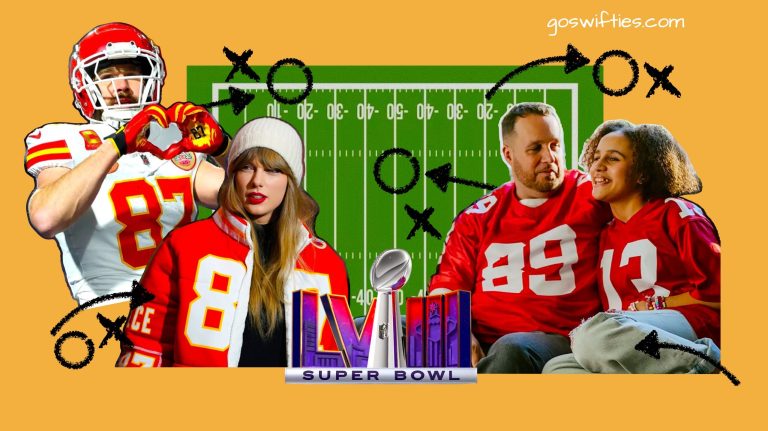
Taylor Swift and Travis Kelce
Travis Kelce #87 of the Kansas City Chiefs (L) celebrates with Taylor Swift after defeating the Baltimore Ravens in the AFC Championship Game

“Remembering her player details, asking follow-up questions, finding compromises between their different tastes – dads willing to meet daughters in the middle discover a payoff there,” notes family therapist Dr. O’Dell Carson of the swift-triggered thaw. Equally, daughters gain positive outlet for changing emotions, with role models extending beyond music charts or magazines alone.

“It’s just been very hard to get them to find interest in football,” admits Utah attorney Mitch Lawson of past tension with his girls. “Now, I get so many TikToks daily from them and texts saying, ’Oh, did you see Travis Kelce do this?’” Kelce and Swift memes, inside jokes and playful ribbing have become new lingua franca dissolving outdated walls.

Father-daughter bonding holds well-documented developmental and social benefits for girls. But the chance to simply discuss and enjoy a topic of mutual interest can be a profound gift, especially as kids grow older. Therapist Nicholette Leanza highlights modeling good sportsmanship and positive talk about Swift as key for dads to make watching games a healthy experience.

“There isn’t a better feeling — not because she is interested in football, but because she wants to spend time with me.”

Most importantly, these surprising moments have allowed connections that may not have existed otherwise. Whether daughters maintain diehard football fandom or not, dads have cherished discovering unexpected common ground through Swift’s inspiring influence. Sacramento teacher Anthony Muro perhaps sums it up best saying, “There isn’t a better feeling — not because she is interested in football, but because she wants to spend time with me.”

“What I’m hoping is with our Swifties and Kelce football connection, my daughter won’t be embarrassed or uncomfortable to talk to me about anything,” asserts California homemaker Peter Dunston of channeling fleeting moments toward deeper strength.

And as rival fanbases clash for Super Bowl glory, the state of father-daughter relations now feels undeniably elevated thanks to Taylor’s influence. Travis Kelce and the Chiefs now unexpectedly shoulder many families’ Super Bowl dreams. But win or lose, the team has already scored a far greater victory – bringing fathers, daughters, and Taylor Swift harmoniously together.


Republished with permission from goswifties.com

Astronomers Spot 18 Black Holes Gobbling Up Nearby Stars

0

The detections more than double the number of known tidal disruption events in the nearby universe.

Jennifer Chu | MIT News
https://news.mit.edu/2024/astronomers-spot-eighteen-black-holes-gobbling-nearby-stars-0129

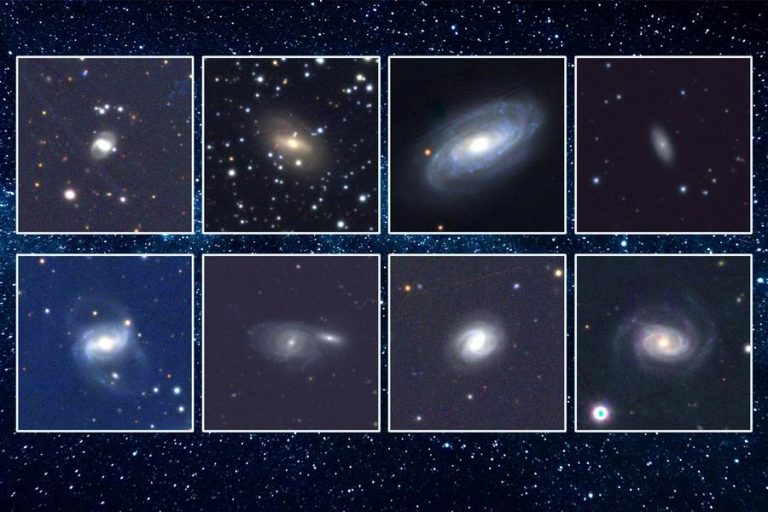
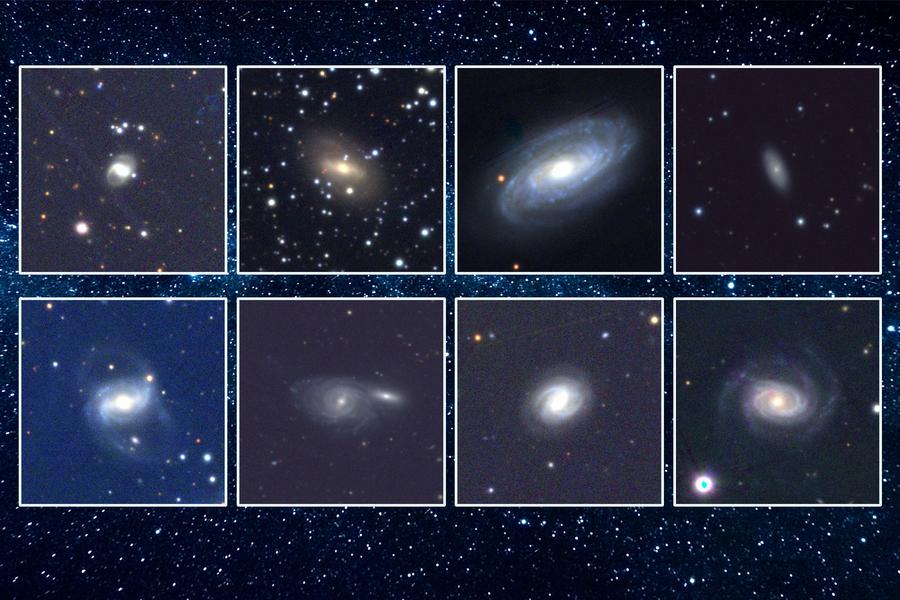
MIT scientists have identified 18 new tidal disruption events (TDEs) — extreme instances when a nearby star is tidally drawn into a black hole and ripped to shreds. The detections more than double the number of known TDEs in the nearby universe. Credits:Credit: Courtesy of the researchers, edited by MIT News

Star-shredding black holes are everywhere in the sky if you just know how to look for them. That’s one message from a new study by MIT scientists, appearing today in the Astrophysical Journal.

The study’s authors are reporting the discovery of 18 new tidal disruption events (TDEs) — extreme instances when a nearby star is tidally drawn into a black hole and ripped to shreds. As the black hole feasts, it gives off an enormous burst of energy across the electromagnetic spectrum.

Astronomers have detected previous tidal disruption events by looking for characteristic bursts in the optical and X-ray bands. To date, these searches have revealed about a dozen star-shredding events in the nearby universe. The MIT team’s new TDEs more than double the catalog of known TDEs in the universe.

The researchers spotted these previously “hidden” events by looking in an unconventional band: infrared. In addition to giving off optical and X-ray bursts, TDEs can generate infrared radiation, particularly in “dusty” galaxies, where a central black hole is enshrouded with galactic debris. The dust in these galaxies normally absorbs and obscures optical and X-ray light, and any sign of TDEs in these bands. In the process, the dust also heats up, producing infrared radiation that is detectable. The team found that infrared emissions, therefore, can serve as a sign of tidal disruption events.

By looking in the infrared band, the MIT team picked out many more TDEs, in galaxies where such events were previously hidden. The 18 new events occurred in different types of galaxies, scattered across the sky.

“The majority of these sources don’t show up in optical bands,” says lead author Megan Masterson, a graduate student in MIT’s Kavli Institute for Astrophysics and Space Research. “If you want to understand TDEs as a whole and use them to probe supermassive black hole demographics, you need to look in the infrared band.”

Other MIT authors include Kishalay De, Christos Panagiotou, Anna-Christina Eilers, Danielle Frostig, and Robert Simcoe, and MIT assistant professor of physics Erin Kara, along with collaborators from multiple institutions including the Max Planck Institute for Extraterrestrial Physics in Germany.

Heat spike

The team recently detected the closest TDE yet, by searching through infrared observations. The discovery opened a new, infrared-based route by which astronomers can search for actively feeding black holes.

That first detection spurred the group to comb for more TDEs. For their new study, the researchers searched through archival observations taken by NEOWISE — the renewed version of NASA’s Wide-field Infrared Survey Explorer. This satellite telescope launched in 2009 and after a brief hiatus has continued to scan the entire sky for infrared “transients,” or brief bursts.

The team looked through the mission’s archived observations using an algorithm developed by co-author Kishalay De. This algorithm picks out patterns in infrared emissions that are likely signs of a transient burst of infrared radiation. The team then cross-referenced the flagged transients with a catalog of all known nearby galaxies within 200 megaparsecs, or 600 million light years. They found that infrared transients could be traced to about 1,000 galaxies.

They then zoomed in on the signal of each galaxy’s infrared burst to determine whether the signal arose from a source other than a TDE, such as an active galactic nucleus or a supernova. After ruling out these possibilities, the team then analyzed the remaining signals, looking for an infrared pattern that is characteristic of a TDE — namely, a sharp spike followed by a gradual dip, reflecting a process by which a black hole, in ripping apart a star, suddenly heats up the surrounding dust to about 1,000 kelvins before gradually cooling down.

This analysis revealed 18 “clean” signals of tidal disruption events. The researchers took a survey of the galaxies in which each TDE was found, and saw that they occurred in a range of systems, including dusty galaxies, across the entire sky.

“If you looked up in the sky and saw a bunch of galaxies, the TDEs would occur representatively in all of them,” Masteron says. “It’s not that they’re only occurring in one type of galaxy, as people thought based only on optical and X-ray searches.”

“It is now possible to peer through the dust and complete the census of nearby TDEs,” says Edo Berger, professor of astronomy at Harvard University, who was not involved with the study. “A particularly exciting aspect of this work is the potential of follow-up studies with large infrared surveys, and I’m excited to see what discoveries they will yield.”

A dusty solution

The team’s discoveries help to resolve some major questions in the study of tidal disruption events. For instance, prior to this work, astronomers had mostly seen TDEs in one type of galaxy — a “post-starburst” system that had previously been a star-forming factory, but has since settled. This galaxy type is rare, and astronomers were puzzled as to why TDEs seemed to be popping up only in these rarer systems. It so happens that these systems are also relatively devoid of dust, making a TDE’s optical or X-ray emissions naturally easier to detect.

Now, by looking in the infrared band, astronomers are able to see TDEs in many more galaxies. The team’s new results show that black holes can devour stars in a range of galaxies, not only post-starburst systems.

The findings also resolve a “missing energy” problem. Physicists have theoreticially predicted that TDEs should radiate more energy than what has been actually observed. But the MIT team now say that dust may explain the discrepancy. They found that if a TDE occurs in a dusty galaxy, the dust itself could absorb not only optical and X-ray emissions but also extreme ultraviolet radiation, in an amount equivalent to the presumed “missing energy.”

The 18 new detections also are helping astronomers estimate the rate at which TDEs occur in a given galaxy. When they figure the new TDEs in with previous detections, they estimate a galaxy experiences a tidal disruption event once every 50,000 years. This rate comes closer to physicists’ theoretical predictions. With more infrared observations, the team hopes to resolve the rate of TDEs, and the properties of the black holes that power them.

“People were coming up with very exotic solutions to these puzzles, and now we’ve come to the point where we can resolve all of them,” Kara says. “This gives us confidence that we don’t need all this exotic physics to explain what we’re seeing. And we have a better handle on the mechanics behind how a star gets ripped apart and gobbled up by a black hole. We’re understanding these systems better.”

This research was supported, in part, by NASA.

Reprinted with permission of MIT News (http://news.mit.edu/)

MongoDB Announces Founding Membership In The U.S. Artificial Intelligence Safety Institute Consortium

0

New U.S. government AI safety institute brings together leaders from industry, government, academia, and non-profit organizations to develop standards for the responsible use of artificial intelligence

NEW YORK—Feb. 8, 2024—MongoDB, Inc. (NASDAQ: MDB) today announced that it is a founding member of the U.S. Artificial Intelligence Safety Institute Consortium (AISIC), which was established by the National Institute of Standards and Technology (NIST) under the U.S. Department of Commerce. Leaders from industry, government, academia, and non-profit organizations participating in the consortium will work together with NIST to support its efforts to create safe and trustworthy artificial intelligence (AI). The consortium will focus on the most advanced AI systems, such as state-of-the-art foundation models, to assess the risk and impact of current and next-generation AI technology on individuals and society. By defining a new measurement science to identify proven, scalable, and interoperable techniques and metrics for testing and verifying the impact of AI systems, the consortium will create standards and guidelines that promote the development and responsible use of AI.

“We believe that technology driven by software and data makes the world a better place, and we see our customers building modern applications achieving that every day,” said Lena Smart, Chief Information Security Officer at MongoDB. “New technology like generative AI can have an immense benefit to society, but we must ensure AI systems are built and deployed using standards that help ensure they operate safely and without harm across populations. By supporting the U.S. Artificial Intelligence Safety Institute Consortium as a founding member, MongoDB’s goal is to use scientific rigor, our industry expertise, and a human-centered approach to guide organizations on safely testing and deploying trustworthy AI systems without stifling innovation.”

As a founding member of the AISIC, MongoDB will draw on its extensive experience working with startups, enterprises, and governments that are continually building and deploying modern, mission-critical applications to provide expertise across multiple fields, including:

  • Globally distributed, multi-cloud software systems that are highly performant, reliable, and secure.
  • Vector embedding, storage, and retrieval technologies that power AI systems at scale.
  • Developer experience engineering that integrates AI models and frameworks across programming languages and hyperscale cloud providers.
  • First-of-its-kind encryption techniques, data governance, and cybersecurity technologies and methods that ensure data protection, lineage, and integrity.

“The U.S. government has a significant role to play in setting the standards and developing the tools we need to mitigate the risks and harness the immense potential of artificial intelligence. President Biden directed us to pull every lever to accomplish two key goals: set safety standards and protect our innovation ecosystem. That’s precisely what the U.S. AI Safety Institute Consortium is set up to help us do,” said Secretary of U.S. Department of Commerce Gina Raimondo. “Through President Biden’s landmark Executive Order, we will ensure America is at the front of the pack—and by working with this group of leaders from industry, civil society, and academia, together we can confront these challenges to develop the measurements and standards we need to maintain America’s competitive edge and develop AI responsibly.”

The AISIC includes more than 200 member organizations that are on the frontlines of developing and using AI systems, as well as teams from civil society and academia that are building the foundational understanding of how AI can and will transform our society. These stakeholders represent the nation’s largest companies and its innovative startups, creators of the world’s most advanced AI systems and hardware, key members of civil society and the academic community, and representatives of professions with deep engagement in AI’s use today. The consortium also includes state and local governments, as well as non-profit organizations. The consortium will also work with organizations from like-minded nations that have a key role to play in setting interoperable and effective AI safety standards around the world.

Additional information about the AISIC can be found on the consortium website.

About MongoDB
Headquartered in New York, MongoDB’s mission is to empower innovators to create, transform, and disrupt industries by unleashing the power of software and data. Built by developers, for developers, MongoDB’s developer data platform is a database with an integrated set of related services that allow development teams to address the growing requirements for today’s wide variety of modern applications, all in a unified and consistent user experience. MongoDB has tens of thousands of customers in over 100 countries. The MongoDB database platform has been downloaded hundreds of millions of times since 2007, and there have been millions of builders trained through MongoDB University courses. To learn more, visit mongodb.com.

MongoDB Public Relations
[email protected]

The Art Of The Tour: Technology And Digital Alchemy.

0

As the Technology and Digital Director for an international concert tour, your role is pivotal in ensuring the seamless integration of technology and digital operations both on and off stage. Your responsibilities span across ensuring reliability, fostering innovation, and managing operations effectively while catering to the needs of the main celebrity, other performers, support crews, and fans.


1.      Technological Framework And Adaptability.

1.1.    Dynamic Tech Infrastructure.

1.1.1.  Construct a flexible and robust technological framework capable of adapting to varying venue sites and technical capabilities across different countries.
1.1.2.  Prioritise redundancy systems to mitigate technical failures.

1.2.    Advanced Tech Solutions.

1.2.1.  Incorporate advanced technology in audio, visual, and special effects to elevate performance impact.
1.2.2.  Regularly update equipment to stay at the forefront of technological innovation.

1.3.    Local Compatibility And Integration.

1.3.1.  Ensure your tech stack is versatile enough to integrate seamlessly with local systems and standards.

2.      Digital Strategy And Security.

2.1.    Integrated Digital Experiences.

2.1.1.  Create a unified digital platform for fans, offering engaging content, interactive features, and virtual participation.
2.1.2.  Experiment with emerging technologies like AR/VR to provide unique fan experiences.

2.2.    Digital Content Management.

2.2.1.  Strategise for expansive digital reach through live streaming, social media engagement, and content marketing.
2.2.2.  Uphold stringent cybersecurity measures to safeguard digital assets and user privacy.

3.      Team Dynamics And Local Collaboration.

3.1.    Unified Team Approach.

3.1.1.  Efficiently manage a diverse team, balancing the core team's expertise with local tech crews' local knowledge.
3.1.2.  Conduct thorough training sessions to align everyone with the tour's technological standards and goals.

3.2.    Synergy With Local Authorities.

3.2.1.  Liaise with local authorities for technological assistance and ensure adherence to regional tech-related laws.

4.      Innovation And Custom Solutions.

4.1.    Customised Tech Approaches.

4.1.1.  Tailor tech and digital solutions to fit the specific requirements of each performance, considering factors like audience demographics and venue size.
4.1.2.  Stay informed about tech trends and integrate novel solutions that enhance the concert experience.

5.      Operational Excellence And Consistency.

5.1.    Efficient Tech Operations.

5.1.1.  Develop streamlined procedures for the assembly and disassembly of tech setups, ensuring swift transitions between tour locations.
5.1.2.  Focus on consistent operational excellence to reduce setup times and enhance performance reliability.

5.2.    Systematic Reliability Checks.

5.2.1.  Conduct routine checks and simulations to ensure all technological systems function optimally in diverse environments.

6.      Safety Standards And Regulatory Adherence.

6.1.    Rigorous Safety Measures.

6.1.1.  Implement and enforce strict safety protocols for all technological equipment to protect the crew, performers, and audience.
6.1.2.  Regularly inspect equipment for compliance with safety standards.

6.2.    Compliance With Global Standards.

6.2.1.  Keep abreast of and comply with international technology regulations and standards, particularly in data and digital operations.

7.      Audience Engagement And Accessibility.

7.1.    Maximising Audience Interaction.

7.1.1.  Use technology as a bridge to intensify audience interaction, both onsite and online.
7.1.2.  Explore features like live social media feeds, interactive kiosks, or audience-driven show elements.

7.2.    Inclusive Digital Access.

7.2.1.  Ensure that digital platforms are accessible to all audience segments, including those with disabilities.

8.      Performance Analysis And Adaptation.

8.1.    Continuous Tech Monitoring.

8.1.1.  Employ analytics and feedback mechanisms to gauge the effectiveness of your technological strategies.
8.1.2.  Adapt and evolve strategies based on real-time audience and performance data.

8.2.    Post-Tour Technological Assessment.

8.2.1.  Conduct a detailed post-tour analysis to identify successes and areas for improvement in the tour's technological and digital execution.

9.      Performance-Centric Technology And Systems Integration.

9.1.    Stage And Performance Technology.

9.1.1.  Implement advanced, programmable lighting systems and audio engineering software to create dynamic, immersive stage experiences. This includes LED screens, intelligent lighting, and high-fidelity sound systems.
9.1.2.  Utilise automated systems for special effects, such as pyrotechnics and fireworks, ensuring they are synchronised with the performance for maximum impact.

9.2.    Integration Of Operational Systems.

9.2.1.  Oversee the integration of logistics and financial management systems across the tour. This includes supply chain management software, budgeting and accounting platforms, and inventory tracking systems.
9.2.2.  Ensure these systems are interconnected for real-time data flow and decision-making, facilitating smooth operational transitions between tour locations.

9.3.    Ticketing And Audience Management Systems.

9.3.1.  Manage advanced ticketing platforms, incorporating features like digital ticketing, seat selection, and mobile entry. These systems should be capable of handling high traffic volumes and providing a seamless user experience.
9.3.2.  Implement crowd management software to enhance audience safety and experience, including ingress and egress flow management, and emergency evacuation planning.

9.4.    Facilities And Venue Management Technology.

9.4.1.  Utilise facilities management software for venue operations, including maintenance scheduling, venue readiness tracking, and utilities management.
9.4.2.  Ensure that the technology is adaptable to different venues and compliant with local regulations and infrastructure capabilities.

9.5.    IT Infrastructure And Support.

9.5.1.  Develop and maintain a robust IT infrastructure that supports all technology and digital operations. This includes server management, data storage solutions, and network systems ensuring high availability and security.
9.5.2.  Provide ongoing IT support to address technical issues swiftly, minimising downtime and ensuring the continuous operation of all systems.

9.6.    Collaborative Technology Environment.

9.6.1.  Foster a collaborative environment where the technology team, production crew, and other stakeholders can work together seamlessly. Utilise collaborative tools and platforms for communication, project management, and information sharing.
9.6.2.  Ensure that all team members are trained and familiar with the technology and systems in use, promoting efficient operation and quick problem resolution.

9.7.  Innovation And Future-Proofing.

9.7.1. Keep abreast of emerging technologies and trends in stage production, logistics, and audience engagement. Explore opportunities to incorporate these innovations into the tour to stay ahead of the curve.
9.7.2. Plan for future scalability and upgrades of systems and technology, ensuring the tour remains at the forefront of technological advancement.

Incorporating these elements under the vast umbrella of the technology team underscores the critical role of technology in every aspect of an international concert tour. From enhancing the performance itself to ensuring smooth operational workflows and audience satisfaction, technology stands as the backbone of modern touring. As the Technology and Digital Director, orchestrating this complex interplay of systems and software, you're not just managing technology; you're crafting an unforgettable experience for everyone involved.
In this role, your strategic vision and ability to harness technology's power will be key in delivering a seamless and immersive concert experience that resonates with audiences worldwide. Emphasising innovation, adaptability, and meticulous planning will ensure the tour's technological aspects are not just functional but also groundbreaking.

NASA Ames Hosts JAXA Leader To Discuss Space Science And Spaceflight

0

NASA/Don Richey

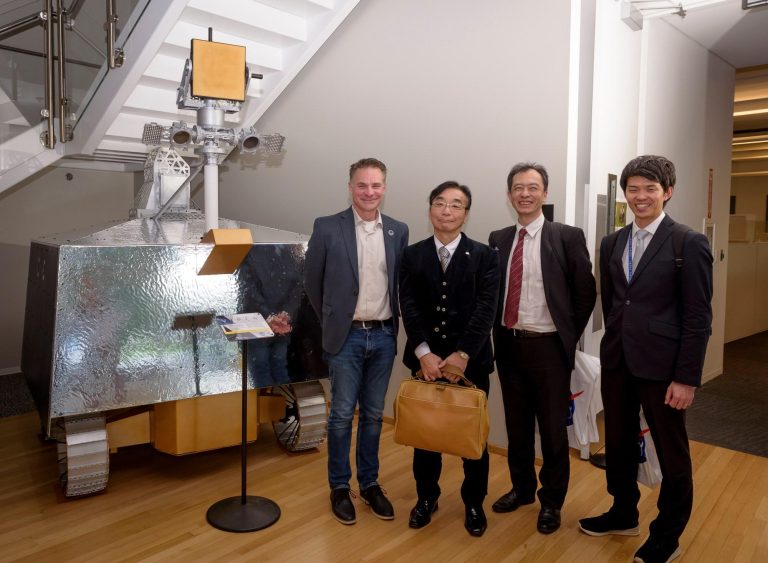
Daniel Andrews, project manager for NASA’s Volatiles Investigating Polar Exploration Rover (VIPER) (left), stands next to a full-scale model of the rover alongside visitors from the Japan Aerospace Exploration Agency (JAXA): Dr. Hitoshi Kuninaka, Vice President of JAXA and Director General of JAXA’s Institute of Space and Astronautical Science (ISAS); Nobuhiro Takahashi of the ISAS Management and Integration Department; and Shintaro Chofuku, a JAXA engineer on detail to NASA’s Ames Research Center in California’s Silicon Valley (right), during a visit to Ames on Feb. 1, 2024. 

Following briefings about both agencies’ space science and spaceflight missions, Kuninaka toured several Ames facilities supporting NASA and JAXA’s exploration of the solar system. The heat shield for JAXA’s Hayabusa2 mission, which delivered a sample of an asteroid to Earth in 2020, was tested in the center’s arc jet facility, and a portion of that sample is now being studied by Ames researchers. An upcoming JAXA mission to study the two moons of Mars, called Martian Moons eXploration (MMX), was also tested in the arc jet.

Present and future exploration of the Moon was a focus of the day, including a stop at Ames’ Lunar Imaging Lab following the VIPER briefing.  

VIPER will be delivered to Mons Mouton near the Moon’s South Pole in late 2024 to map water and other potential resources and explore the characteristics of the lunar environment where NASA plans to send future astronauts as part of the Artemis campaign.

Last month, JAXA’s Smart Lander for Investigating Moon (SLIM) arrived on the lunar surface, after reaching its targeted landing site with great accuracy. The mission aimed to demonstrate accurate lunar landing techniques by a small explorer, to help accelerate study of the Moon and planets using lighter exploration systems.

Japan is a significant partner for NASA and for Ames, specifically,” said Center Director Eugene Tu. “From testing with our teams the X-59 quiet supersonic aircraft design to JAXA’s contributions to Artemis and Gateway, where astronauts on future lunar missions will stay, our work together runs broad and deep. We look forward to many more fruitful collaborations.”

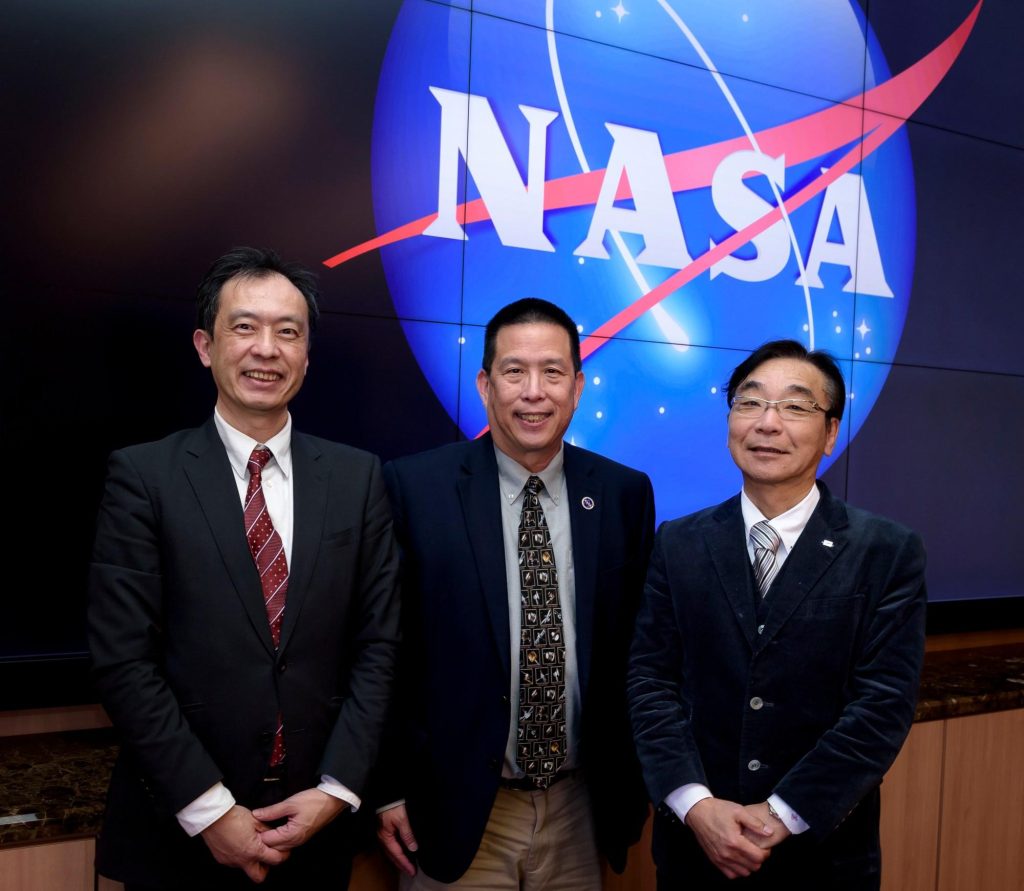
Nobuhiro Takahashi of the Japan Aerospace Exploration Agency’s (JAXA) Institute of Space and Astronautical Science (ISAS) Management and Integration Department (left), Dr. Eugene Tu, center director at NASA’s Ames Research Center in California’s Silicon Valley, and Dr. Hitoshi Kuninaka, vice president of JAXA and director general of ISAS gather for a photo during the JAXA representatives’ visit to Ames on Feb. 1, 2024. NASA/Don Richey

By: Abby Tabor
Originally published at: NASA