
Home Blog Page 28

Blue Origin Successfully Completes 24th Mission to Space

0

Blue Origin successfully completed its 24th New Shepard flight and 13th payload mission today from Launch Site One in West Texas.

The flight carried 33 payloads from NASA, academia, research institutions, and commercial companies, bringing the number of payloads flown on New Shepard to more than 150. Club for the Future, Blue Origin’s nonprofit, flew 38,000 postcards as part of its Postcards to Space program. Each postcard will be returned to its creator stamped “Flown to Space.” The Club recently added a digital method to create and send postcards, which can be found here (https://www.clubforfuture.org/postcards/digital-postcards).
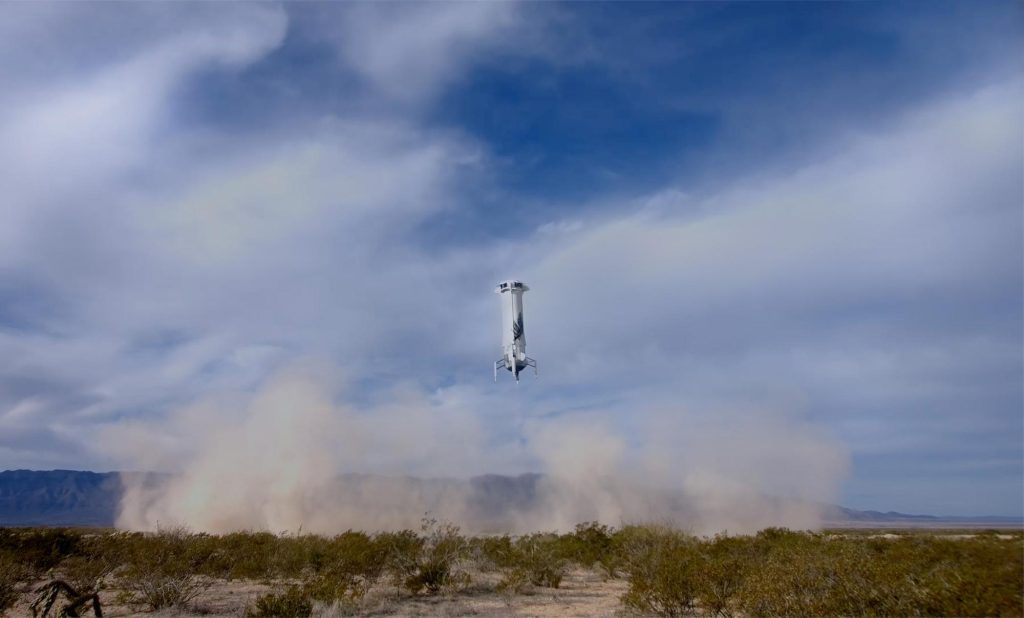
New Shepard’s booster lands on the pad during NS-24 (December 19, 2023).

Key mission statistics:

  • Official Launch Time: 10:42:28 AM CST / 16:42:28 UTC
  • Booster Apogee: 347,208 ft. AGL / 350,855 ft. MSL (106 km AGL / 107 km MSL)
  • Crew Capsule Apogee: 347,601 ft. AGL / 351,248 ft. MSL (106 km AGL / 107 km MSL)
  • Crew Capsule Landing Time: 10:52:41 AM CST / 16:52:41 UTC  
  • Mission Elapsed Time: 10 min 13 sec

“A special thank you to all of our customers who flew important science today and the students who contributed postcards to advance our future of living and working in space for the benefit of Earth,” said Phil Joyce, Senior Vice President, New Shepard. “Demand for New Shepard flights continues to grow and we’re looking forward to increasing our flight cadence in 2024.”

If you’re interested in purchasing an astronaut seat on New Shepard, please visit here (https://www.blueorigin.com/new-shepard/reserve-a-seat). For payload inquiries, please visit here (https://www.blueorigin.com/new-shepard/payloads/fly-a-payload-on-new-shepard).

A full replay of today’s flight is available below. 

December 18
3:55 PM CST / 21:55 UTC

Our next #NS24 launch window opens tomorrow, Dec. 19, at 10:37 AM CST / 16:37 UTC. Webcast starts T-20 minutes to launch on BlueOrigin.com.

9:30 AM CST / 15:30 UTC

We’re scrubbing #NS24 today due to a ground system issue the team is troubleshooting. We’ll provide a new launch target for this week soon.

8:00 AM CST / 14:00 UTC

Current T-0 time is no earlier than 09:30 CST / 15:30 UTC due to cold temperatures at Launch Site One. Webcast starts T-20 minutes to launch on BlueOrigin.com.

December 16

New Shepard’s 24th Mission Will Carry 33 Science Payloads to Space

New Shepard will fly its 24th mission on Monday, December 18. The manifest includes 33 payloads and 38,000 Club for the Future postcards from students around the world.

The NS-24 launch window opens at 8:30 AM CST / 14:30 UTC from Launch Site One in West Texas. The webcast starts at T-20 minutes on BlueOrigin.com. 

This mission will bring the number of payloads flown to space on New Shepard to more than 150. More than half of the payloads on this flight are developed and flown with support from NASA. Others come from K-12 schools, universities, and STEAM-focused organizations. 

This is New Shepard’s 24th flight and 13th payload mission. The program has also completed six astronaut missions and flown 31 humans above the Kármán line. From an environmental standpoint, nearly 99% of New Shepard’s dry mass is reused, including the booster, capsule, engine, landing gear, and parachutes. New Shepard’s engine is fueled by highly efficient liquid oxygen and hydrogen. During flight, the only byproduct is water vapor with no carbon emissions.

Follow Blue Origin on X, Instagram, Facebook, LinkedIn, Threads, and YouTube, and sign up on BlueOrigin.com to stay current on all mission details.

I Am Artemis: Bruce Askins

0

Bruce Askins

Growing up, Bruce Askins was passionate about space and oceanography. His desire to explore other worlds always made him want to be an astronaut. Though he did not become an astronaut, Askins has built a 42-year career at NASA, and, as the infrastructure management lead for NASA’s SLS (Space Launch System) Program at the agency’s Marshall Space Flight Center in Huntsville, Alabama, Askins is an integral part for the next generation of explorers.

Askins and his team are the gatekeepers and protectors of data and responsible for both cyber- security and physical security for the SLS Program. Under Askins’ leadership, his team ensures all data is stored properly, that information about the rocket shared outside NASA  is done with proper data markings, and access is given to those that need it.

Askins wasn’t always familiar with the world of infrastructure and cyber security. As a mechanical engineering graduate from the University of Alabama in Huntsville, Askins began his career as part of NASA’s internship program. He considered himself imaginative, or “creatively driven,” which is why Askins originally pursued a career at NASA.

“I always loved the design aspect of my early position in special test equipment,” Askins says. “Back then I drew everything by hand with a pencil before eventually transitioning to computers.”

His creativity and interest in underwater worlds, along with his scuba diver certification, led him to have a hand in designing early test elements for NASA’s Hubble Space Telescope. At the Neutral Buoyancy Simulator, a former underwater training facility at Marshall, Askins interacted with a crew of astronauts supporting Hubble and designed the flight simulation hardware used for crew training on the Canadarm2 robotic arm that is still a part of the International Space Station today.

Askins has been a part of the NASA family for almost half a century and is thrilled to be a part of the next era of space exploration to the Moon under Artemis.

“To explore is one of the greatest things that we can all do, and with the Artemis Generation the sky’s the limit,” Askins said.

SLS is part of NASA’s backbone for deep space exploration, along with the Orion spacecraft, advanced spacesuits and rovers, the Gateway in orbit around the Moon, and commercial human landing systems. SLS is the only rocket that can send Orion, astronauts, and supplies to the Moon in a single launch.

Check out some of our other “I am Artemis” features (https://www.nasa.gov/content/i-am-artemis).  

By: Lee Mohon
Originally published at: NASA

Armstrong Flight Research Center: A Year In Review

0

It was an abundant year of innovation, exploration, and inspiration for NASA’s Armstrong Flight Research Center in Edwards, California. NASA Armstrong continues to demonstrate America’s leadership in aeronautics, Earth and space science, and aerospace technology. Our researchers, engineers, and mission support teams continually seek to revolutionize aviation, add to mankind’s knowledge of the universe, and contribute to the understanding and protection of Earth.

The video above shows many of our achievements, below are a few special moments.

The X-59 achieved a major milestone when the supersonic research aircraft was moved from its construction site to the flight line for ground testing. At the same time, project teams were busy preparing for the aircraft’s first and subsequent flights, while also advancing shock wave photography, trained aircrew on upgraded life support systems, prepared to test updated ground microphone stations designed to measure the X-59’s quiet sonic thump, and began getting the aircraft painted in preparation for its unveiling.

NASA’s Advanced Air Mobility mission continued to work with industry partners who are building innovative new aircraft like electric air taxis and drones. The team explored how these new designs may help travelers and cargo move between and in cities. At NASA Armstrong, we built a custom virtual-reality flight simulator to explore the air taxi ride experience. We also collected data needed to allow for new self-flying technology, to help make our communities more connected than ever before.

Because wind affects all aircraft, our researchers measured wind at low altitudes to gather data needed to enhance air taxi safety. We tested atmospheric sensors that can monitor air quality and help uncrewed aircraft avoid dangerous wind shears.

To improve fuel efficiency, our Experimental Fabrication branch built a scale model of a unique aircraft wing that will be used to gather data for future, larger versions of the design.

In an effort to advance the use of alternative fuels in today’s planes we worked with aviation partners to study particle and gas emissions from passenger aircraft engines.

With the conclusion of the X-57 Maxwell this year, research from the X-57 Maxwell provided aviation researchers with hundreds of lessons learned, as well as revolutionary developments in areas ranging from battery technology to cruise motor control design.

Our crews flew above snowstorms to investigate how they form and flew over snow-covered regions to collect data on snowmelts and how they contribute to the water supply.

We conducted low-altitude flights over major cities and marine areas to study non-vehicular sources of pollution – like personal care and home products – and their impact on air quality in North America. To advance fire and smoke models, we participated in a multi-agency effort to collect measurements of fuels, fire behavior, fire energy, meteorology, smoke, and fire effects.

On the space front, we tested highly elastic strain sensors to help parachute designers construct better, more reliable parachutes to land rovers and equipment on Mars and enabled testing of an instrument designed to measure surface particles kicked up by a rocket-powered lander on the Moon or Mars.

Armstrong advanced NASA’s commitment to engage, inspire, and attract future generations of explorers. Students saw their experiments soar as payloads from the NASA TechRise Challenge launched high into the sky.  We celebrated the 15th anniversary of our summer internship program, offering undergraduate students hands-on experience during a real airborne science campaign. Our researchers, pilots, and mission support teams traveled the country, showcasing aviation-inspired technology and the latest in NASA aeronautics research, space exploration, science, and more.

We hunted for lightning and collected data on radiation generated by thunderclouds to better predict when storms could turn severe and we paved the way to improve autonomous observation capabilities for small spacecraft flying over Earth, the Moon, or other worlds. Finally, we forged a new partnership to build, test, and fly an experimental aircraft aimed at lowering emissions.

These are just some of Armstrong’s many innovative research efforts that support NASA’s mission to explore the secrets of the universe for the benefit of all.

By: Sarah Mann
Originally published at: NASA

Sierra Space’s Revolutionary Dream Chaser® Enters Final Test Campaign, Spaceplane Transitioning to Orbital Operations

0

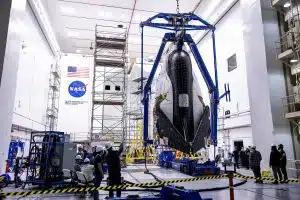
LOUISVILLE, Colo. – Dec. 15, 2023 – Sierra Space, a leading commercial space company building the first end-to-end business and technology platform in space to benefit of life on Earth, has delivered the first Dream Chaser spaceplane, Tenacity, to NASA’s Neil Armstrong Test Facility in Sandusky, Ohio.

Dream Chaser, the world’s only commercial spaceplane, has entered the final testing phase ahead of its first flight in 2024. The testing campaign will confirm the spacecraft’s resilience to the challenges of launch and the demanding conditions of space as it prepares for its inaugural mission to the International Space Station under a multi-mission NASA contract.

Dream Chaser joins Sierra Space’s cargo module, Shooting Star™, which arrived at the NASA test facility in November. The two vehicles are set to be stacked in launch configuration and undergo rigorous environmental testing starting in the Mechanical Vibration Facility. The test will subject them to the extreme conditions of launch vibrations on the world’s most powerful spacecraft shaker table.

Sierra Space is unwavering in its commitment to ensuring the utmost reliability of its cutting-edge technologies. Dream Chaser, crafted in tandem with the groundbreaking Shooting Star cargo module, will reinvent space transportation and usher in the burgeoning era of space commercialization known as the Orbital Age®.

“At Sierra Space, we are ushering in the next industrial revolution with a business and technology platform that provides our customers with a complete turn-key solution offering space as a service,” said Sierra Space CEO Tom Vice. “Our platform includes Dream Chaser, a revolutionary, highly reusable commercial spaceplane with global runway access, and the first business-ready commercial space station, leveraging the most advanced expandable structural architecture that will exponentially decrease the cost of product development and manufacturing in space.”

Sierra Space is Revolutionizing Space Transportation – Dream Chaser’s Unique Capabilities: 

  • No More Plunging into the Ocean – Dream Chaser Uses the World’s Global Commercial Runways
  • Designed To Be Highly Reusable – Minimum 15 Missions Per System
  • Fully Autonomous Operations
  • High-Capacity Up Mass and Down Mass Payloads (Pressurized & Unpressurized)
  • Low G Landings – Better for Science, Cargo and Crew
  • Fast Access to Payloads and Science Upon Landing – Easy to Integrate into Ground Logistics
  • Breakthrough Green Hydrogen Peroxide-Based Propulsion System
  • Second Dream Chaser Vehicle, Reverence, In Production

Selected by a NASA contract:

Dream Chaser was selected by NASA for cargo delivery, return and disposal service for the International Space Station under the Commercial Resupply Services-2 (CRS-2) contract.

High reusability and flexibility:

Dream Chaser’s highly customizable design makes it ideal for a range of applications, providing fast turnaround times to support various LEO needs. The fleet will provide greater efficiencies with high reusability and mark the beginning of a new era of space commercialization. The multi-mission spaceplane fleet is designed to transport crew and cargo to Low Earth Orbit (LEO) and can be customized for both domestic and international customers for global operations.

NASA’s Neil Armstrong Test Facility:

NASA’s Neil Armstrong Test Facility is part of NASA’s Glenn Research Center in Cleveland. Located on 6,400 acres in Sandusky, Ohio, it is home to some of the world’s largest and most capable space simulation test facilities, where ground tests are conducted for the U.S. and international space and aeronautics communities.

About Sierra Space

Sierra Space is a leading commercial space company at the forefront of innovation and the commercialization of space in the Orbital Age®, building an end-to-end business and technology platform in space to benefit life on Earth. With more than 30 years and 500 missions of space flight heritage, the company is reinventing both space transportation with Dream Chaser®, the world’s only commercial spaceplane, and the future of space destinations with the company’s inflatable and expandable space station technology. Highly scalable and flexible, this innovative “softgoods” technology will define a new generation of space stations. Sierra Space also builds and delivers a host of systems and subsystems across solar power, mechanics and motion control, environmental control, life support, propulsion and thermal control, offering myriad space-as-a-service solutions for the new space economy.

###

MEDIA CONTACTS:
Alex Walker, Sierra Space
(303) 803-2297 | [email protected]

The AI Gold Rush – How to Make Money With Generative AI

0

In a world increasingly driven by technological advancements, generative AI has emerged as a groundbreaking force, not only transforming industries but also offering lucrative opportunities for those who understand its potential. Whether you’re an entrepreneur, developer, or creative thinker, harnessing the power of generative AI can open doors to innovative and profitable ventures. In this article, we’ll explore how to make money with generative AI.

1. Content Generation and Marketing

One of the most accessible and rewarding ways to leverage generative AI is in content creation and marketing. AI-driven tools can generate high-quality written content, design visuals, and even produce music. Content creators can automate blog posts, social media updates, and email campaigns, saving time and resources while maintaining consistency and quality.

2. Art and Creativity

Generative AI has made waves in the art world, allowing artists to push the boundaries of creativity. AI-generated art pieces, music compositions, and even fashion designs are gaining recognition and fetching impressive prices. Entrepreneurs can explore opportunities in AI-powered art galleries or by collaborating with AI artists to create unique, marketable pieces.

3. Chatbots and Customer Service

Businesses are increasingly turning to AI-powered chatbots for customer support and sales. Building and selling custom chatbot solutions can be a profitable venture. These AI chatbots can handle inquiries, guide customers through the sales funnel, and provide round-the-clock assistance, ultimately enhancing customer satisfaction.

4. Personalized Recommendations

AI-driven recommendation engines have become integral to e-commerce and content platforms. Developing recommendation algorithms or platforms that offer tailored suggestions based on user preferences can be a lucrative endeavor. These systems are sought after by retailers, streaming services, and more.

5. Video Game Development

Generative AI can enhance video game experiences by creating dynamic content, levels, characters, and storylines. Indie game developers can use AI to generate game elements, reducing development time and costs while maintaining high-quality gameplay.

6. Financial Modeling and Trading

Sophisticated generative AI models are increasingly used for financial modeling and algorithmic trading. Entrepreneurs with a background in finance and AI can create AI-driven trading systems or offer consulting services to financial institutions.

7. Healthcare and Drug Discovery

The healthcare sector is ripe for AI innovation. Generative AI can be applied to drug discovery, medical imaging, and patient diagnostics. Entrepreneurs and researchers can explore partnerships with healthcare organizations or develop AI solutions to address specific medical challenges.

8. Content Translation and Localization

In an increasingly globalized world, the demand for content translation and localization services is soaring. AI-powered language models can streamline the translation process, making it faster and more cost-effective. Building a platform that offers automated translation services can be a profitable venture.

9. Intellectual Property and Licensing

If you’re an AI developer or researcher, consider licensing your generative AI models or algorithms. Many businesses are willing to pay for access to cutting-edge AI solutions. Licensing can provide a steady stream of income while allowing others to benefit from your innovations.

10. AI Education and Training

With the growing interest in AI, there’s a demand for AI education and training programs. Entrepreneurs can create online courses, workshops, or training materials to help individuals and businesses harness the power of generative AI.

Generative AI has unleashed a world of possibilities, offering innovative solutions across various industries. Whether you’re a tech enthusiast, creative thinker, or business-minded entrepreneur, there are numerous avenues to explore when it comes to making money with generative AI. Embrace the potential of AI-driven creativity, problem-solving, and automation, and you may find yourself at the forefront of the next big AI-driven venture.

The Most Desired Christmas Gifts in The U.S.

0

While it may not seem like the most romantic option, the useful gift of money is the most desired Christmas present in the United States this year. According to the latest data from Statista’s Consumer Insights (Christmas and Holiday Season: U.S.), when asked which gifts U.S. adults would personally most like to receive this year, 50 percent of women and 36 percent of men said cash or bank transfers. For both groups, vouchers came in second position, followed by clothing, textiles or shoes in third. Respondents could choose multiple options in the poll.

When looking at a breakdown of the data for men and women, however, while there is a fair bit of overlap, some slight differences do emerge. As our chart shows, smartphones, tablets and accessories were a fairly popular choice for both men and women, selected by 24 percent and 22 percent of the groups, respectively. Women showed slightly more interest in travel-related gifts (20 percent versus men at 13 percent) as well as event tickets (19 percent versus men at 11 percent), with the two options placing in rank nine and ten for women. Out of the polled options, ‘decoration articles’ were among the lowest scoring gifts, only desired by 7 percent of female respondents and 6 percent of men.

Chart

Source: Statista

What We Watched: A Netflix Engagement Report

0

Since launching our weekly Top 10 and Most Popular lists in 2021, Netflix has provided more information about what people are watching than any other streamer except YouTube. And now we believe it’s time to go further. 

Starting today we will publish What We Watched: A Netflix Engagement Report twice a year. This is a comprehensive report of what people watched on Netflix over a six month period1, including: 

  • Hours viewed for every title — original and licensed — watched for over 50,000 hours2
  • The premiere date3 for any Netflix TV series or film; and 
  • Whether a title was available globally. 

In total, this report covers more than 18,000 titles — representing 99% of all viewing on Netflix — and nearly 100 billion hours viewed. 

Over 60% of Netflix titles released between January and June 2023 appeared on our weekly Top 10 lists. So while this report is broader in scope, the trends reflected in it are very similar to those in the Top 10 lists, including: 

  • The strength of returning favorites like Ginny & Georgia, Alice in Borderland, The Marked Heart, Outer Banks, You, Queen Charlotte: A Bridgerton Story, XO Kitty and film sequels Murder Mystery 2 and Extraction 2
  • The popularity of new series like The Night Agent, The Diplomat, Beef, The Glory, Alpha Males, FUBAR and Fake Profile, which generate huge audiences and fandoms; 
  • The size of the audience of our films across every genre including The Mother, Luther: The Fallen Sun, You People, AKA, ¡Que viva México! and Hunger
  • The enthusiasm for non-English stories, which generated 30% of all viewing; 
  • The staying power of titles on Netflix, which extends well beyond their premieres. All Quiet on the Western Front, for example, debuted in October 2022 and generated 80M hours viewed between January and June; and 
  • The demand for older, licensed titles, which generates tremendous value for our members and for rights holders.  

When reading the report it’s important to remember:

  • Success on Netflix comes in all shapes and sizes, and is not determined by hours viewed alone. We have enormously successful movies and TV shows with both lower and higher hours viewed. It’s all about whether a movie or TV show thrilled its audience — and the size of that audience relative to the economics of the title; and
  • To compare between titles it’s best to use our weekly Top 10 and Most Popular lists, which take into account run times and premiere dates. 

This is a big step forward for Netflix and our industry. We believe the viewing information in this report — combined with our weekly Top 10 and Most Popular lists — will give creators and our industry deeper insights into our audiences, and what resonates with them. 

Download the report here (https://assets.ctfassets.net/4cd45et68cgf/1HyknFM84ISQpeua6TjM7A/97a0a393098937a8f29c9d29c48dbfa8/What_We_Watched_A_Netflix_Engagement_Report_2023Jan-Jun.xlsx).

See below for the video from our call with reporters.


1  January – June 2023.

2 The report is rounded to 100,000 hours viewed.

3 In Pacific time.

Coding Style for the Workweek Warrior

0

Work or play, our Monday through Friday shirt collection has your coding style locked for whatever the week may demand. Why blend in when you can stand out with these tech-tastic tees?

Monday: 1.4.1. The Real Main

Guzz Shirt

Kickstart your week in ‘The Real Main’ shirt. It’s not just a tee, it’s a statement. You’re the lead function in the code of life, and Monday is your domain. Own it, lead it, code it!

Tuesday: 1.4.2. Hello World

Guzz Shirt

Nothing says “Ready to Tackle Anything” like our ‘Hello World’ shirt. It’s a classic throwback and a modern-day mood. Embrace new challenges and debug your way to success. It’s coding nostalgia with a twist!

Wednesday: 1.4.3. Data Types

Guzz Shirt

Midweek calls for versatility, just like the varied ‘Data Types’ in your code. This shirt is for the adaptable, the dynamic, the polymorphic pros of programming. Be the wildcard in the deck of coders!

Thursday: 1.4.4. Breaking Maths Daily

Guzz Shirt

Crunch numbers and turn algorithms inside out with ‘Breaking Maths Daily’. This shirt is for the problem-solvers, the analytical minds, the heroes without capes. Be the envy of your coding crew!

Friday: 1.4.5. Back Home

Guzz Shirt

End the week on a high byte with ‘Back Home’. It’s a digital high-five for making it through the week. Perfect for coding, chilling, or anything in-between. You’ve coded hard, now it’s time to relax in style.

Guzz Shirt

It’s time to upgrade your geek wardrobe. Each day, a new shirt, a new mood, a new code to crack. These aren’t just shirts; they’re your daily drivers in the journey of code. Available in 5 colours: Black Heather, Black, Ocean Blue, Yellow, & Ash. These unisex shirts are soft and light with regular fit

So why not unlock statement apparel for all 5 days? Get the complete set today and use the promo code ‘CHANNELS10‘ to get 10% off on this collection. Mix, match and build that programming pro wardrobe from desktop to happy hour. For the hackers, coders and keyboard crusaders who want one less weekly outfit decision to make. The collection you’ve been coding for!

Artemis II Booster Surges Ahead At NASA’s Kennedy Space Center

0

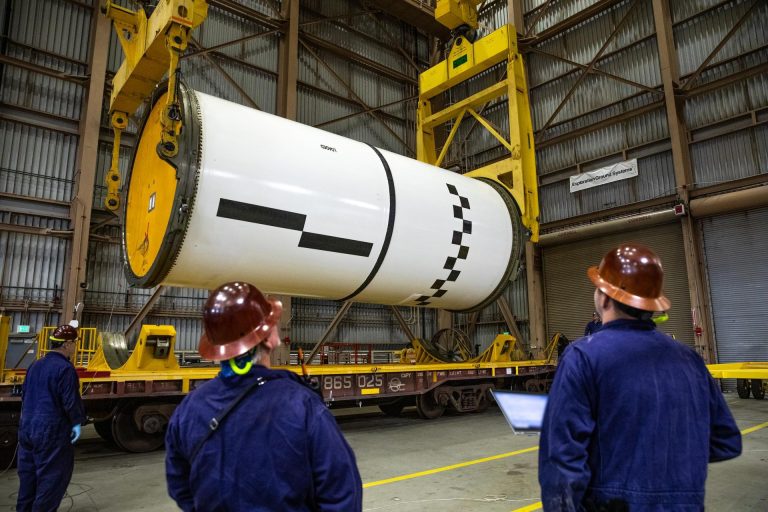
Engineers and technicians process the right forward center segment of the Space Launch System solid rocket boosters for the Artemis II mission inside the Rotation, Processing and Surge Facility (RPSF) at NASA’s Kennedy Space Center in Florida on Tuesday, Nov. 27, 2023.

Inside the Rotation, Processing and Surge Facility at NASA’s Kennedy Space Center in Florida, engineers and technicians process the right forward center segment of the SLS (Space Launch System) rocket on Nov. 28, 2023. The ongoing processing of the segments is the first step before stacking operations begin and the segments will form the twin solid rocket boosters for the SLS rocket that will power NASA’s Artemis II mission. After arriving via rail in September, the team has been inspecting each segment one-by-one and lifting them to a vertical position to ensure the solid propellant and segment are ready for integration and launch. 

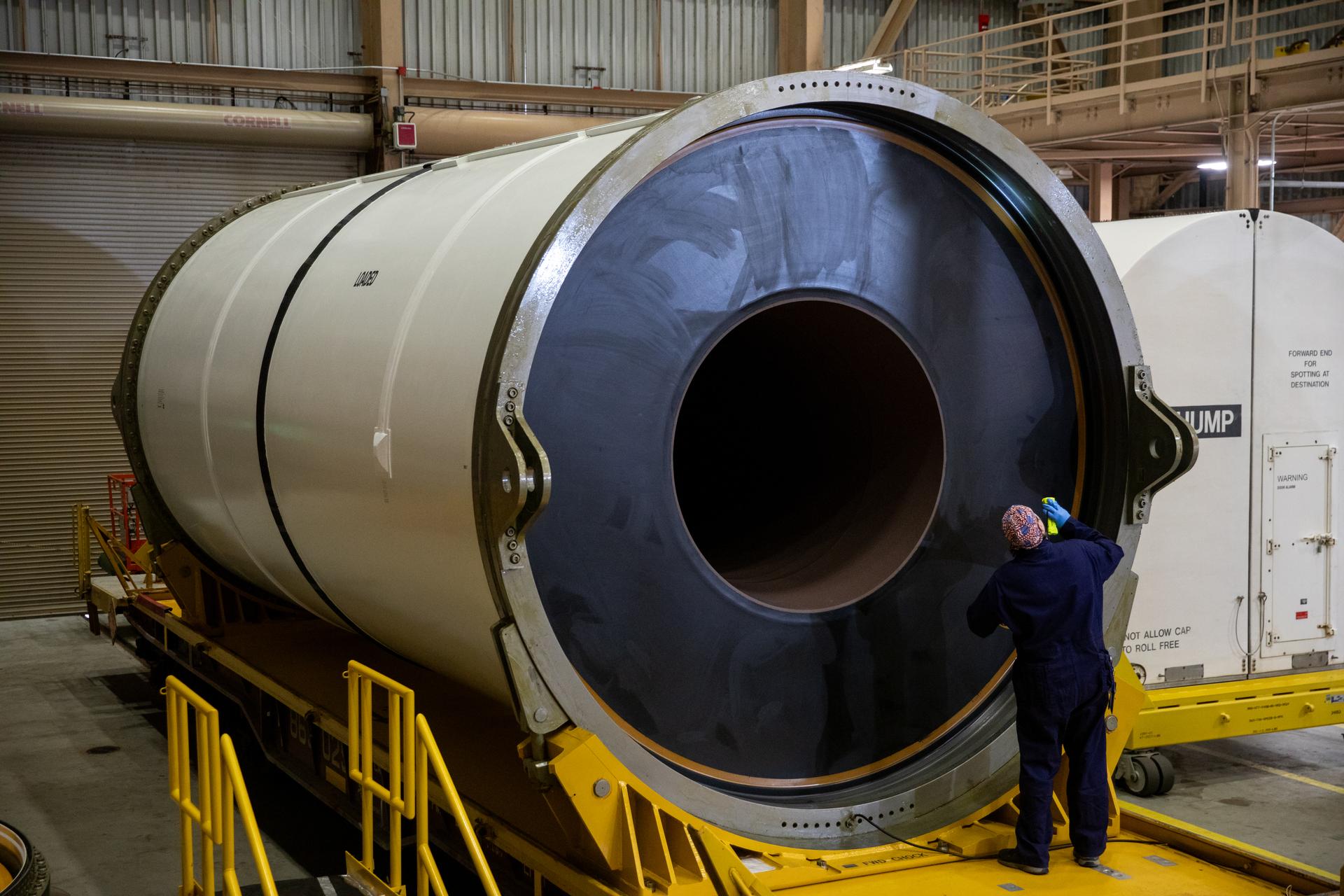
The right forward center segment of the Space Launch System solid rocket boosters is processed.

Engineers and technicians process and inspect the propellant of the right forward center segment of the Space Launch System solid rocket boosters for the Artemis II mission inside the Rotation, Processing and Surge Facility (RPSF) at NASA’s Kennedy Space Center in Florida on Monday, Nov. 27, 2023.

Once processing is complete for all 10 segments, they will be moved one at a time to the Vehicle Assembly Building for stacking atop the mobile launcher. Standing 17 stories tall and burning approximately six tons of propellant every second, each booster generates more thrust than 14 four-engine jumbo commercial airliners. Together, the twin boosters provide more than 75 percent of the total SLS thrust at launch. 

The Artemis II mission will send four astronauts around the Moon as part of the agency’s effort to establish a long-term science and exploration presence at the Moon, and eventually Mars. 

Photo credit: NASA/Kim Shiflett

By: Jamie Groh
Originally published at: NASA

The Longstanding Mystery Of Mars’ Moons – And The Mission That Could Solve It

0

NASA

Ben Rider-Stokes, The Open University

The two small moons of Mars, Phobos (about 22km in diameter) and Deimos (about 13km in diameter), have been puzzling scientists for decades, with their origin remaining a matter of debate. Some have proposed that they may be made up of residual debris produced from a planet or large asteroid smashing into the surface of Mars (#TeamImpact).

An opposing hypothesis (#TeamCapture), however, suggests the moons are asteroids that were captured by Mars’s gravitational pull and were trapped in orbit.

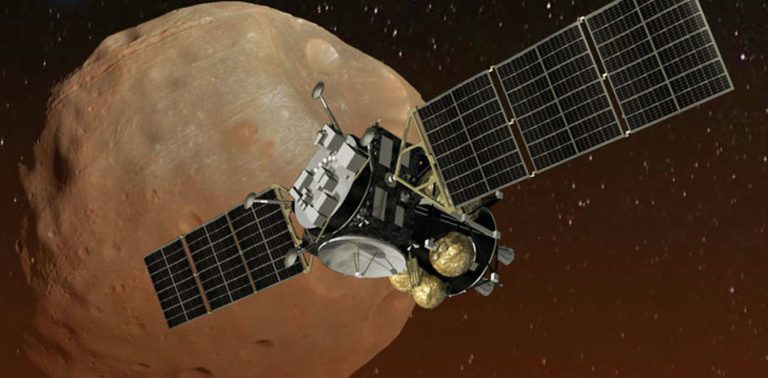
To solve the mystery, we’ll need material from the moons’ surfaces for analytical analyses on Earth. Luckily, the Japan Aerospace Exploration Agency (Jaxa) will launch a mission, named “Martian Moon eXploration” (MMX), to Phobos and Deimos in September 2024. The mission will be carried by a newly designed rocket, the H-3, which is still under development.

The spacecraft is expected to reach Martian orbit in 2025, after which it will orbit Phobos and finally collect material from its surface before returning to Earth by 2029.

This will make it the next in a series of recent missions bringing material from space back to Earth, following on from Jaxa’s successful mission to asteroid Ryugu (Hayabusa2), as well as Nasa’s Osiris-Rex mission to asteroid Bennu and the Chinese Space Agency’s Chang’e 5 mission to the Moon.

Giveaways

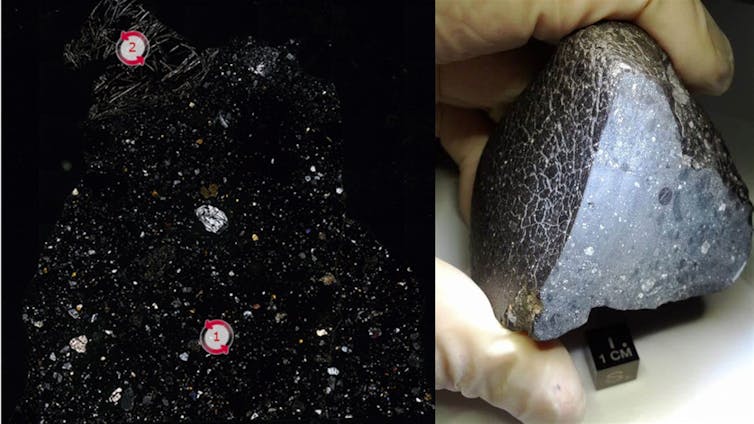
If an impact origin did indeed occur, we would expect to find similar material on Phobos to that which is found on Mars. While we do not have any material returned directly from Mars (yet), we are lucky enough to have rock that has been ejected off its surface which eventually found its way to Earth.

These meteorites may therefore be similar to the material returned from Phobos, providing a fantastic comparison.

A martian meteorite under the microscope and hand specimen.
Open University, CC BY-NC-SA

In the case of a captured asteroid origin, however, we are more likely to find material on Phobos that is found on other asteroids in our Solar System. The prevailing hypothesis in the #TeamCapture group is that the moons are made up of the same rock as meteorites, called carbonaceous chondrite. Thankfully, we have plenty of such meteorites and samples that we could compare with the Phobos material.

A carbonaceous chondrite meteorite under the microscope and hand specimen.
CC BY-NC-SA

Comparing meteorites and material brought back from Phobos will be a fantastic tool for helping us understand the origin of the two moons. Once we have material in the laboratory, rigorous analytical techniques can be applied to the samples.

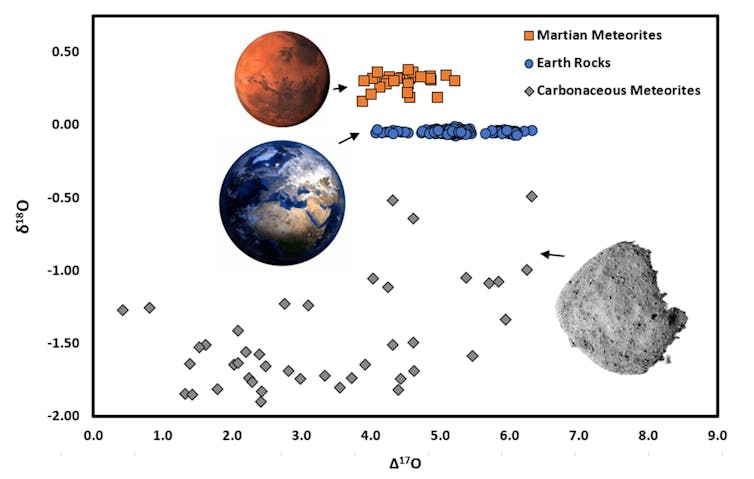
One such technique is oxygen isotope analysis. Isotopes are versions of elements whose nuclei have more or fewer particles called neutrons. Oxygen, for example, has three stable isotopes, with atomic masses of 16, 17 and 18.

The sum of the isotopic ratios of oxygen-17/oxygen-16 and oxygen-18/oxygen-16
is denoted as Δ17O, and is characteristic of specific parent objects. Depending on where in the Solar System a rocky body is formed, a distinct oxygen composition is acquired and retained in the rocks. For example, rocks from Earth have Δ17O of around 0, while meteorites from Mars have Δ17O of around ~0.3. Therefore, rocks from Earth and Martian meteorites can be readily separated from one another.

If Phobos formed in the same or at least similar location in the Solar System to Mars, we would expect the composition of the material brought back by MMX also to have Δ17O of around 0.3.

As mentioned previously, #TeamCapture suggest a carbonaceous chondrite-like origin for Phobos. All known carbonaceous chondrites studied by scientists have revealed negative isotopic Δ17O, ranging from -0.5 all the way down to -4. Oxygen can therefore be an extremely powerful tool in deciphering the origin of the moons of Mars, and should be a high priority for the mission once material is returned to Earth.

Oxygen isotope plot showing the stark differences in oxygen between the Earth, Mars and asteroids.
CC BY-NC-SA

If Phobos does indeed represent an ancient fragment of Mars, it could comprise the most primitive of Martian material. Mars has experienced a wide range of processes that have altered the rocks on its surface, including wind erosion and water alteration. Based on features such as dry river beds observed from orbiters such as Viking, it is clear that water on Mars once existed.

This water likely originated from a mix of asteroids and comets, and volcanic activity. Mars also retained a thick atmosphere, which allowed water to be present as a liquid on the planet’s surface.

Phobos, on the other hand, has remained an airless body where processes such as contamination from water have not occurred (though minor impact events may have taken place). This means that samples returned from Phobos could provide extremely important insights into the original water content of Mars, and a window to processes that occurred in the early Solar System.

MMX is one of the most exciting planned missions in space exploration. With less than a year to go, our fingers are already firmly crossed for a successful launch, sample acquisition, and sample return. Many scientists including myself would absolutely love the possibility of one day studying those samples.The Conversation

Ben Rider-Stokes, Post Doctoral Researcher in Achondrite Meteorites, The Open University

This article is republished from The Conversation under a Creative Commons license. Read the original article (https://theconversation.com/the-longstanding-mystery-of-mars-moons-and-the-mission-that-could-solve-it-219161).