
Home Blog Page 40

Introducing Code Llama, A State-Of-The-Art Large Language Model For Coding

0

Takeaways

  • Code Llama is a state-of-the-art LLM capable of generating code, and natural language about code, from both code and natural language prompts.
  • Code Llama is free for research and commercial use.
  • Code Llama is built on top of Llama 2 and is available in three models:
    • Code Llama, the foundational code model;
    • Codel Llama – Python specialized for Python;
    • and Code Llama – Instruct, which is fine-tuned for understanding natural language instructions.
  • In our own benchmark testing, Code Llama outperformed state-of-the-art publicly available LLMs on code tasks

Today, we are releasing Code Llama, a large language model (LLM) that can use text prompts to generate code. Code Llama is state-of-the-art for publicly available LLMs on code tasks, and has the potential to make workflows faster and more efficient for current developers and lower the barrier to entry for people who are learning to code. Code Llama has the potential to be used as a productivity and educational tool to help programmers write more robust, well-documented software.

The generative AI space is evolving rapidly, and we believe an open approach to today’s AI is the best one for developing new AI tools that are innovative, safe, and responsible. We are releasing Code Llama under the same community license as Llama 2.

How Code Llama works

Code Llama is a code-specialized version of Llama 2 that was created by further training Llama 2 on its code-specific datasets, sampling more data from that same dataset for longer. Essentially, Code Llama features enhanced coding capabilities, built on top of Llama 2. It can generate code, and natural language about code, from both code and natural language prompts (e.g., “Write me a function that outputs the fibonacci sequence.”) It can also be used for code completion and debugging. It supports many of the most popular languages being used today, including Python, C++, Java, PHP, Typescript (Javascript), C#, and Bash.

We are releasing three sizes of Code Llama with 7B, 13B, and 34B parameters respectively. Each of these models is trained with 500B tokens of code and code-related data. The 7B and 13B base and instruct models have also been trained with fill-in-the-middle (FIM) capability, allowing them to insert code into existing code, meaning they can support tasks like code completion right out of the box.

The three models address different serving and latency requirements. The 7B model, for example, can be served on a single GPU. The 34B model returns the best results and allows for better coding assistance, but the smaller 7B and 13B models are faster and more suitable for tasks that require low latency, like real-time code completion.

The Code Llama models provide stable generations with up to 100,000 tokens of context. All models are trained on sequences of 16,000 tokens and show improvements on inputs with up to 100,000 tokens.

Aside from being a prerequisite for generating longer programs, having longer input sequences unlocks exciting new use cases for a code LLM. For example, users can provide the model with more context from their codebase to make the generations more relevant. It also helps in debugging scenarios in larger codebases, where staying on top of all code related to a concrete issue can be challenging for developers. When developers are faced with debugging a large chunk of code they can pass the entire length of the code into the model.

Additionally, we have further fine-tuned two additional variations of Code Llama: Code Llama – Python and Code Llama – Instruct.

Code Llama – Python is a language-specialized variation of Code Llama, further fine-tuned on 100B tokens of Python code. Because Python is the most benchmarked language for code generation – and because Python and PyTorch play an important role in the AI community – we believe a specialized model provides additional utility.

Code Llama – Instruct is an instruction fine-tuned and aligned variation of Code Llama. Instruction tuning continues the training process, but with a different objective. The model is fed a “natural language instruction” input and the expected output. This makes it better at understanding what humans expect out of their prompts. We recommend using Code Llama – Instruct variants whenever using Code Llama for code generation since Code Llama – Instruct has been fine-tuned to generate helpful and safe answers in natural language.

We do not recommend using Code Llama or Code Llama – Python to perform general natural language tasks since neither of these models are designed to follow natural language instructions. Code Llama is specialized for code-specific tasks and isn’t appropriate as a foundation model for other tasks.

When using the Code Llama models, users must abide by our license and acceptable use policy.

Evaluating Code Llama’s performance

To test Code Llama’s performance against existing solutions, we used two popular coding benchmarks: HumanEval and Mostly Basic Python Programming (MBPP). HumanEval tests the model’s ability to complete code based on docstrings and MBPP tests the model’s ability to write code based on a description.

Our benchmark testing showed that Code Llama performed better than open-source, code-specific LLMs and outperformed Llama 2. Code Llama 34B, for example, scored 53.7% on HumanEval and 56.2% on MBPP, the highest compared with other state-of-the-art open solutions, and on par with ChatGPT.

As with all cutting edge technology, Code Llama comes with risks. Building AI models responsibly is crucial, and we undertook numerous safety measures before releasing Code Llama. As part of our red teaming efforts, we ran a quantitative evaluation of Code Llama’s risk of generating malicious code. We created prompts that attempted to solicit malicious code with clear intent and scored Code Llama’s responses to those prompts against ChatGPT’s (GPT3.5 Turbo). Our results found that Code Llama answered with safer responses.

Details about our red teaming efforts from domain experts in responsible AI, offensive security engineering, malware development, and software engineering are available in our research paper.

Releasing Code Llama

Programmers are already using LLMs to assist in a variety of tasks, ranging from writing new software to debugging existing code. The goal is to make developer workflows more efficient, so they can focus on the most human centric aspects of their job, rather than repetitive tasks.

At Meta, we believe that AI models, but LLMs for coding in particular, benefit most from an open approach, both in terms of innovation and safety. Publicly available, code-specific models can facilitate the development of new technologies that improve peoples’ lives. By releasing code models like Code Llama, the entire community can evaluate their capabilities, identify issues, and fix vulnerabilities.

Code Llama’s training recipes are available on our Github repository.

Model weights are also available.

Responsible use

Our research paper discloses details of Code Llama’s development as well as how we conducted our benchmarking tests. It also provides more information into the model’s limitations, known challenges we encountered, mitigations we’ve taken, and future challenges we intend to investigate.

We’ve also updated our Responsible Use Guide and it includes guidance on developing downstream models responsibly, including:

  • Defining content policies and mitigations.
  • Preparing data.
  • Fine-tuning the model.
  • Evaluating and improving performance.
  • Addressing input- and output-level risks.
  • Building transparency and reporting mechanisms in user interactions.

Developers should evaluate their models using code-specific evaluation benchmarks and perform safety studies on code-specific use cases such as generating malware, computer viruses, or malicious code. We also recommend leveraging safety datasets for automatic and human evaluations, and red teaming on adversarial prompts.

The future of generative AI for coding

Code Llama is designed to support software engineers in all sectors – including research, industry, open source projects, NGOs, and businesses. But there are still many more use cases to support than what our base and instruct models can serve.

We hope that Code Llama will inspire others to leverage Llama 2 to create new innovative tools for research and commercial products.

Try Code Llama today

Code Llama GitHub repository

Download the Code Llama Model

Read the research paper

Code Llama: Open foundation models for code

Originally published at Meta AI Blog

Source: cyberpogo.com
India Lands Spacecraft Near South Pole Of Moon In Historic First

0

Vikram lander touches down at lunar south pole shortly after 6pm India time

India has become the first country to successfully land a spacecraft near the south pole of the moon, in a historic moment that drew cheers at watching parties around the country.

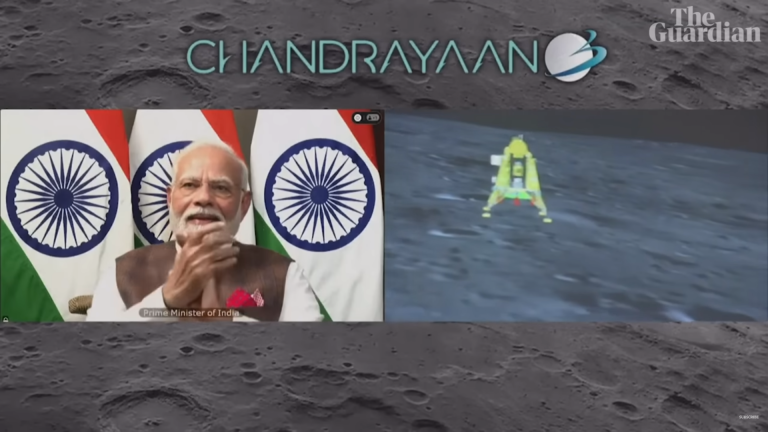
“India is on the moon,” Sreedhara Panicker Somanath, the chair of the Indian Space Research Organisation, said as the Chandrayaan-3 spacecraft’s Vikram lander touched down shortly after 6pm (1230 BST) near the little-explored lunar south pole in a world first for any space programme.

The successful landing marks India’s emergence as a space power as the government looks to spur investment in private space launches and related satellite-based businesses.

People across the country were glued to television screens as the spacecraft approached territory that scientists believe could hold vital reserves of frozen water and precious elements.

Guardian graphic. Source: Indian Space Research Organisation

“This is a victory cry of a new India,” said the prime minister, Narendra Modi, who was seen waving the Indian flag as he watched the landing from South Africa, where he is attending the Brics summit. “We are witnessing history.”

A wave of nervous excitement has gripped Indians in recent days as the scheduled descent approached. Temples and mosques held special prayers for a safe landing. On the banks of the River Ganges in Varanasi, Hindu monks bestowed blessings on the mission and blew conch shells.

At street parties on Wednesday evening, Indians celebrated the double triumph of being the first to land on the south pole and the fourth to land on the moon.

In the final few minutes before touchdown, the lander executed a complex manoeuvre, slowing down from 3,730 miles an hour to nearly zero and turning from a horizontal to a vertical position.

The right tilt and thrust at this moment were vital. If too much force was applied, the lander would have toppled. Too little force and it might have hit the lunar surface at the wrong place.

It was this end manoeuvre that went wrong in the final few minutes of India’s last moon mission in 2019, when the lander failed to change position and hurtled towards the surface during the final braking phase.

Chandrayaan-3 – “moon craft” in Sanskrit – took off from a launchpad in Sriharikota in southern India on 14 July, taking much longer to reach the moon than the Apollo missions in the 1960s and 70s, which arrived in a matter of days.

India is using rockets much less powerful than the US did back then. Instead, the probe orbited Earth several times to gain speed before embarking on its month-long lunar trajectory.

If all goes to plan, a rover called Pragyaan, the Sanskrit word for wisdom, will roll out of the belly of the lander on a ramp then roam around the moon’s surface for two weeks. It has been designed to take pictures, conduct experiments on the geology and the origins of the Earth, and investigate the presence of water ice.

Chandrayaan-3 – “moon craft” in Sanskrit – took off from a launchpad in Sriharikota in southern India on 14 July, taking much longer to reach the moon than the Apollo missions in the 1960s and 70s, which arrived in a matter of days.

India is using rockets much less powerful than the US did back then. Instead, the probe orbited Earth several times to gain speed before embarking on its month-long lunar trajectory.

If all goes to plan, a rover called Pragyaan, the Sanskrit word for wisdom, will roll out of the belly of the lander on a ramp then roam around the moon’s surface for two weeks. It has been designed to take pictures, conduct experiments on the geology and the origins of the Earth, and investigate the presence of water ice.

Isro staff celebrate the successful landing of Chandrayaan-3 on the moon at the command facility in Bengaluru. Photograph: Aijaz Rahi/AP

If found in significant quantities, water ice could allow future crew missions to set up base there as it could be used to extract oxygen and fuel. Some scientists believe that the south pole, which is hidden from Earth’s view and is full of craters and trenches, may be the most promising site for a future base.

India’s successful landing comes days after Russia said its first moon mission in 47 years, which also targeted the south pole, had failed after its Luna-25 spacecraft spun out of control and crashed. Russia’s head of the state-controlled space corporation, Roscosmos, attributed the failure to lack of expertise due to the long break in lunar research that followed the last Soviet mission to the moon in 1976.

The former Soviet Union, the US and China have already achieved a soft landing on the moon but in another region, near the moon’s equator.

With nuclear-armed India emerging as the world’s fifth-largest economy last year, Modi’s nationalist government is eager to showcase the country’s rising standing as a technology and space powerhouse. A successful moon mission dovetails with Modi’s image of an ascendant India asserting its place among the global elite and would help bolster his popularity ahead of a crucial general election next year.

The anticipation for a successful landing rose after Russia’s failed attempt and as India’s regional rival China reaches for new milestones in space. In May, China launched a three-person crew for its orbiting space station and hopes to put astronauts on the moon before the end of the decade.

By: Amrit Dhillon
Originally published at The Guardian

India Lands A Spacecraft Near The Moon’s South Pole, A First For The World As It Joins Elite Club

0

NEW DELHI (AP) — India became the first country to land a spacecraft near the moon’s south pole on Wednesday — a historic voyage to uncharted territory that scientists believe could hold vital reserves of frozen water, and a technological triumph for the world’s most populous nation.

After a failed attempt to land on the moon in 2019, India now joins the United States, the Soviet Union and China as only the fourth country to achieve this milestone. A lander with a rover inside touched down on the lunar surface at 6:04 p.m. local time, sparking celebrations around India, including in the southern Indian city of Bengaluru, where space scientists watching the landing erupted in cheers and applause.

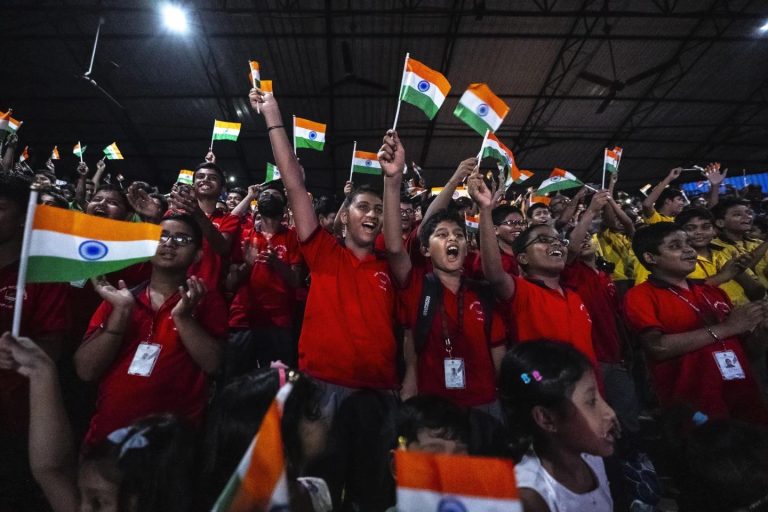
Schoolchildren celebrate the successful landing of spacecraft Chandrayaan-3 on the moon, in a school in Guwahati, India, Wednesday, Aug. 23, 2023. (AP Photo/Anupam Nath)

The successful mission showcases India’s rising standing as a technology and space powerhouse and dovetails with the image of the country that Prime Minister Narendra Modi is trying to project: an ascendant country asserting its place among the global elite.

“India is now on the moon. India has reached the south pole of the moon — no other country has achieved that. We are witnessing history,” Modi said as he waved the Indian tri-colored flag while watching the landing from South Africa, where he is participating in the BRICS nations summit.

The lunar rover will slide down a flap from the lander within hours or a day and conduct experiments, including an analysis of the mineral composition of the lunar surface, said S. Somnath, chairman of the state-run Indian Space Research Organization.

The mission, which began more than a month ago at an estimated cost of $75 million, is expected to last another two weeks. Somnath said that India would next attempt a manned lunar mission.

Nuclear-armed India grew to become the world’s fifth-largest economy last year, and the success of the lunar mission will likely help Modi’s popularity ahead of a crucial general election next year.

India’s success comes just days after Russia’s Luna-25, which was aiming for the same lunar region, spun into an uncontrolled orbit and crashed. It would have been the first successful Russian lunar landing after a gap of 47 years. Russia’s head of the state-controlled space corporation Roscosmos attributed the failure to the lack of expertise due to the long break in lunar research that followed the last Soviet mission to the moon in 1976.

Excited and anxious people across India crowded around televisions in offices, shops, restaurants and homes. Thousands prayed Tuesday for the success of the mission with oil lamps on the river banks, temples and religious places, including the holy city of Varanasi in northern India.

Indian Space Research Organization (ISRO) staff watch prime minister Narendra Modi speak after the successful landing of spacecraft Chandrayaan-3 on the moon at ISRO’s Telemetry, Tracking and Command Network facility in Bengaluru, India, Wednesday, Aug. 23, 2023. (AP Photo/Aijaz Rahi)

As the lander approached the lunar surface, dozens of people in a government-run planetarium started praying with folded hands. They switched to cheering and clapping once the lander touched down.

A man waved a banner reading ’’The Moon in India’s arms.”

Shrini Singh, a New Delhi resident, said she got goosebumps. ’’It’s a very happy moment … you can see the energy. It’s beyond words.”

Mitakshi Sinha, a student, said the successful mission motivated her. “And now I also want to be part of ISRO,” she said, referring to the country’s space agency.

Congratulations poured in from around the world, cementing India’s emergence as a modern space power.

“Your success will power the imagination and light the future of people around the world,” the U.S. State Department’s Bureau of Oceans and International Environmental and Scientific Affairs posted on X, formerly known as Twitter.

“Incredible!” European Space Agency’s director general Josef Aschbacher tweeted.

NASA’s former science mission chief, Thomas Zurbuchen, who now works at ETH Zurich, a public research university in Switzerland where he is leading its space initiative, said he felt proud of the achievement.

India’s Chandrayaan-3 — “moon craft” in Sanskrit — took off from a launchpad in Sriharikota in southern India on July 14.

Many countries and private companies are interested in the south pole region because permanently shadowed craters may hold frozen water that could help future astronaut missions use it as a potential source of drinking water or to make rocket fuel.

The six-wheeled lander and rover module of Chandrayaan-3 is configured with payloads that would provide data to the scientific community on the properties of lunar soil and rocks, including chemical and elemental compositions.

India’s previous attempt to land a robotic spacecraft near the moon’s little-explored south pole ended in failure in 2019. It entered the lunar orbit but lost touch with its lander, which crashed while making its final descent to deploy a rover to search for signs of water. According to a failure analysis report submitted to the ISRO, the crash was caused by a software glitch.

Indian Space Research Organization (ISRO) Chairman S. Somanath addresses the media after the successful landing of spacecraft Chandrayaan-3 on the moon at ISRO’s Telemetry, Tracking and Command Network facility in Bengaluru, India, Wednesday, Aug. 23, 2023. (AP Photo/Aijaz Rahi)

The $140-million mission in 2019 was intended to study permanently shadowed moon craters that are thought to contain water deposits and were confirmed by India’s Chandrayaan-1 orbiter mission in 2008.

But India’s space program has been steadily advancing for years.

Active since the 1960s, India has launched satellites for itself and other countries, and successfully put one in orbit around Mars in 2014. India is planning its first mission to the International Space Station next year, in collaboration with the United States.

The anticipation for a successful landing rose after Russia’s failed attempt and as India’s regional rival China reaches for new milestones in space. In May, China launched a three-person crew for its orbiting space station and hopes to put astronauts on the moon before the end of the decade. Relations between India and China have plunged since deadly border clashes in 2020.

People watch the landing of Chandrayaan-3, or “moon craft” at Omani University in Hyderabad, India, Wednesday, Aug. 23, 2023. (AP Photo/Mahesh Kumar A.)

Numerous countries and private companies are racing to successfully land a spacecraft on the lunar surface. In April, a Japanese company’s spacecraft apparently crashed while attempting to land on the moon. An Israeli nonprofit tried to achieve a similar feat in 2019, but its spacecraft was destroyed on impact.

Japan plans to launch a lunar lander to the moon over the weekend as part of an X-ray telescope mission, and two U.S. companies also are vying to put landers on the moon by the end of the year, one of them at the south pole. In the coming years, NASA plans to land astronauts at the lunar south pole, taking advantage of the frozen water in craters.

People celebrate as they watch a live telecast of the landing og Chandrayaan-3, or “moon craft” in Sanskrit, in Mumbai, India, Wednesday, Aug. 23, 2023. (AP Photo/Rajanish Kakade)
Indians celebrate the successful landing of Chandrayaan-3, or “moon craft” in Sanskrit, at the Nehru Planetarium in New Delhi, India, Wednesday, Aug. 23, 2023. (AP Photo/Manish Swarup)
Schoolchildren celebrate the successful landing of spacecraft Chandrayaan-3 on the moon, in a school in Guwahati, India, Wednesday, Aug. 23, 2023. (AP Photo/Anupam Nath)
Schoolchildren cheer as they watch the successful landing of Chandrayaan-3, or “moon craft” in Sanskrit, at the Nehru Planetarium in New Delhi, India, Wednesday, Aug. 23, 2023. (AP Photo/Manish Swarup)
Schoolchildren celebrate the successful landing of spacecraft Chandrayaan-3 on the moon, in a school in Guwahati, India, Wednesday, Aug. 23, 2023. (AP Photo/Anupam Nath)
The moon shines over Indian Space Research Organization (ISRO) Telemetry, Tracking and Command Network facility in Bengaluru, India, Wednesday, Aug. 23, 2023. (AP Photo/Aijaz Rahi)

Pallava Bagla, a science writer and co-author of books on India’s space exploration, said the Russian failure days earlier did not put India off. He also said lessons learned from India’s failed mission four years ago were incorporated and a flawless mission was executed on Wednesday.

“Indians didn’t get derailed. They continued the journey with strength and confidence that paid off,” he said.

By: KRUTIKA PATHIOriginally published at AP News

Source: cyberpogo.com

Neptune’s Disappearing Clouds Linked to the Solar Cycle

0

As Sunspots Come and Go, So Does the Cloudy Weather on the Blue Giant Planet

Weather forecast for Neptune: After sunny weather for the past few Earth years, we’ll see increasingly more clouds over the next few years.

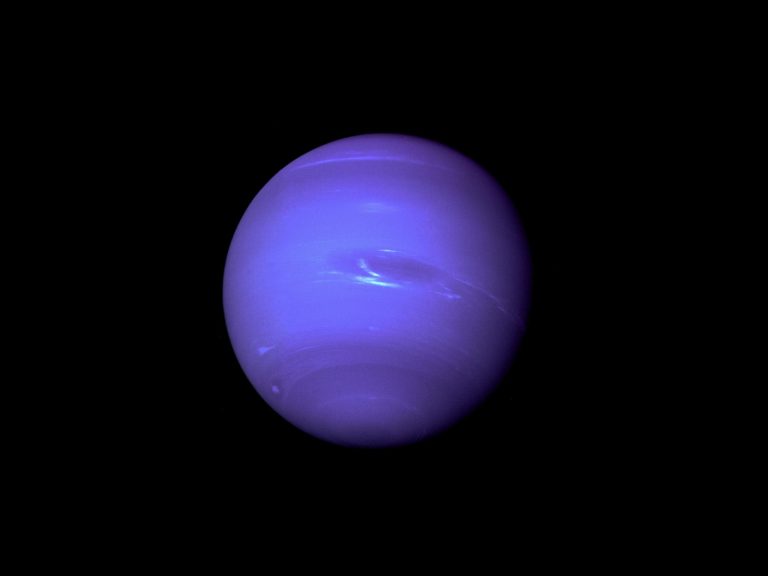
In 1989, NASA’s Voyager 2 spacecraft provided the first close-up images of linear, bright clouds, reminiscent of cirrus clouds on Earth, seen high in Neptune’s atmosphere. They form above most of the methane in Neptune’s atmosphere and reflect all colors of sunlight, which makes them white.

On that frozen frontier the Sun is still influential regarding the Neptunian weather that produces cloud cover. At Neptune’s distance of nearly 3 billion miles, the Sun appears starlike at 1/30th the diameter of the full Moon. This feeble radiation is 1% the amount of starlight as received on Earth.

Yet the Sun’s influence on Neptune became increasingly obvious when astronomers looked at 30 years of Neptune observations with the Hubble and Keck telescopes. Neptune’s abundance of clouds waxes and wanes over an 11-years cycle. The Sun also has an 11-year cycle where it becomes stormy as its magnetic fields become entangled, increasing sunspot number and rate of violent outbursts.

Full Article

Astronomers have uncovered a link between Neptune’s shifting cloud abundance and the 11-year solar cycle, in which the waxing and waning of the Sun’s entangled magnetic fields drives solar activity.

This discovery is based on three decades of Neptune observations captured by NASA’s Hubble Space Telescope and the W. M. Keck Observatory in Hawaii, as well as data from the Lick Observatory in California.

The link between Neptune and solar activity is surprising to planetary scientists because Neptune is our solar system’s farthest major planet and receives sunlight with about 0.1% of the intensity Earth receives. Yet Neptune’s global cloudy weather seems to be driven by solar activity, and not the planet’s four seasons, which each last approximately 40 years.

At present, the cloud coverage seen on Neptune is extremely low, with the exception of some clouds hovering over the giant planet’s south pole. A University of California (UC) Berkeley-led team of astronomers discovered that the abundance of clouds normally seen at the icy giant’s mid-latitudes started to fade in 2019.

“I was surprised by how quickly clouds disappeared on Neptune,” said Imke de Pater, emeritus professor of astronomy at UC Berkeley and senior author of the study. “We essentially saw cloud activity drop within a few months,” she said.

“Even now, four years later, the most recent images we took this past June still show the clouds haven’t returned to their former levels,” said Erandi Chavez, a graduate student at the Center for Astrophysics | Harvard-Smithsonian (CfA) in Cambridge, Massachusetts, who led the study when she was an undergraduate astronomy student at UC Berkeley. “This is extremely exciting and unexpected, especially since Neptune’s previous period of low cloud activity was not nearly as dramatic and prolonged.”

To monitor the evolution of Neptune’s appearance, Chavez and her team analyzed Keck Observatory images taken from 2002 to 2022, the Hubble Space Telescope archival observations beginning in 1994, and data from the Lick Observatory in California from 2018 to 2019.

In recent years, the Keck observations have been complemented by images taken as part of the Twilight Zone program and by Hubble’s Outer Planet Atmospheres Legacy (OPAL) program.

The images reveal an intriguing pattern between seasonal changes in Neptune’s cloud cover and the solar cycle – the period when the Sun’s magnetic field flips every 11 years as it becomes more tangled like a ball of yarn. This is evident in the increasing number of sunspots and increasing solar flare activity. As the cycle progresses, the Sun’s tempestuous behavior builds to a maximum, until the magnetic field beaks down and reverses polarity. Then the Sun settles back down to a minimum, only to start another cycle.

When it’s stormy weather on the Sun, more intense ultraviolet (UV) radiation floods the solar system. The team found that two years after the solar cycle’s peak, an increasing number of clouds appear on Neptune. The team further found a positive correlation between the number of clouds and the ice giant’s brightness from the sunlight reflecting off it.

“These remarkable data give us the strongest evidence yet that Neptune’s cloud cover correlates with the Sun’s cycle,” said de Pater. “Our findings support the theory that the Sun’s UV rays, when strong enough, may be triggering a photochemical reaction that produces Neptune’s clouds.”

Scientists discovered the connection between the solar cycle and Neptune’s cloudy weather pattern by looking at 2.5 cycles of cloud activity recorded over the 29-year span of Neptunian observations. During this time, the planet’s reflectivity increased in 2002 then dimmed in 2007. Neptune became bright again in 2015, then darkened in 2020 to the lowest level ever observed, which is when most of the clouds went away.

The changes in Neptune’s brightness caused by the Sun appear to go up and down relatively in sync with the coming and going of clouds on the planet. However there is a two-year time lag between the peak of the solar cycle and the abundance of clouds seen on Neptune. The chemical changes are caused by photochemistry, which happens high in Neptune’s upper atmosphere and takes time to form clouds.

“It’s fascinating to be able to use telescopes on Earth to study the climate of a world more than 2.5 billion miles away from us,” said Carlos Alvarez, staff astronomer at Keck Observatory and co-author of the study. “Advances in technology and observations have enabled us to constrain Neptune’s atmospheric models, which are key to understanding the correlation between the ice giant’s climate and the solar cycle.”

However, more work is necessary. For example, while an increase in UV sunlight could produce more clouds and haze, it could also darken them, thereby reducing Neptune’s overall brightness. Storms on Neptune rising up from the deep atmosphere affect the cloud cover, but are not related to photochemically produced clouds, and hence may complicate correlation studies with the solar cycle. Continued observations of Neptune are also needed to see how long the current near-absence of clouds will last.

The research team continues to track Neptune’s cloud activity. “We have seen more clouds in the most recent Keck images that were taken during the same time NASA’s James Webb Space Telescope observed the planet; these clouds were in particular seen at northern latitudes and at high altitudes, as expected from the observed increase in the solar UV flux over the past approximately 2 years,” said de Pater.

The combined data from Hubble, the Webb Space Telescope, Keck Observatory, and the Lick Observatory will enable further investigations into the physics and chemistry that lead to Neptune’s dynamic appearance, which in turn may help deepen astronomers’ understanding not only of Neptune, but also of exoplanets, since many of the planets beyond our solar system are thought to have Neptune-like qualities.

The findings are published in the journal Icarus.

The Hubble Space Telescope is a project of international cooperation between NASA and ESA. NASA’s Goddard Space Flight Center in Greenbelt, Maryland, manages the telescope. The Space Telescope Science Institute (STScI) in Baltimore conducts Hubble science operations. STScI is operated for NASA by the Association of Universities for Research in Astronomy, in Washington, D.C.

About This Release

Credits

Release

NASA, ESA, STScI, UC Berkeley, Keck Observatory

Media Contact

Ray Villard
Space Telescope Science Institute, Baltimore, Maryland

Mari-Ela Chock
W. M. Keck Observatory, Mauna Kea, Hawaii

Robert Sanders
University of California, Berkeley, Berkeley, California

Originally published at Hubble Site

Mobile Launcher Arrives at Launch Pad 39B for Artemis ll Preps

0

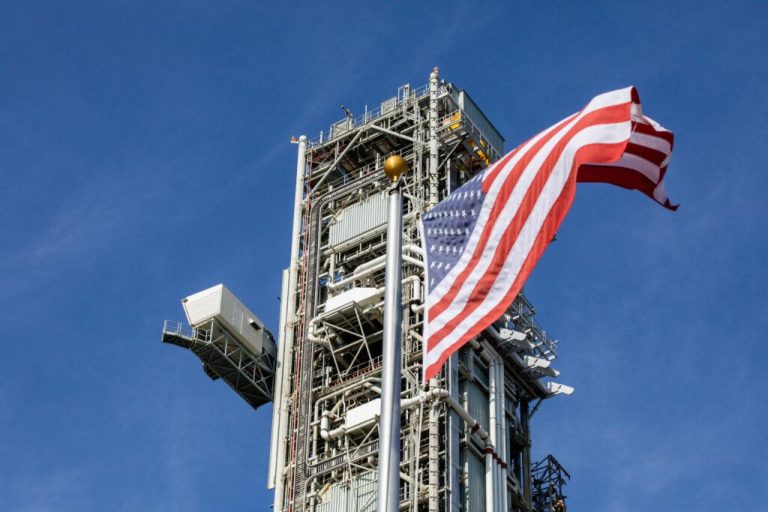
The mobile launcher, carried by the crawler-transporter 2, rolls out from its park site location to Launch Pad 39B at NASA’s Kennedy Space Center in Florida on Aug. 16, 2023. While at the pad, it will undergo testing for the agency’s Artemis II mission. Under Artemis, the mobile launcher will transport NASA’s Space Launch System rocket and Orion spacecraft to pad 39B for liftoff. Photo credit: NASA/Ben Smegelsky

After an approximately four-mile journey over the course of two days, mobile launcher 1 arrived on Aug. 17 at Launch Pad 39B from its park site location at NASA’s Kennedy Space Center in Florida. It will remain at the pad for several months as teams with NASA’s Exploration Ground Systems Program prepare for Artemis ll, the first crewed mission under Artemis.

Teams will conduct a variety of tests and continue ground systems upgrades on both structures. These preparations include testing the pad’s new 1.4-million-gallon liquid hydrogen sphere and emergency egress system.

After testing at the pad is complete, the mobile launcher will travel to the Vehicle Assembly Building in preparation for rocket stacking operations ahead of launching Artemis ll.

By: Antonia Jaramillo Botero
Originally published at NASA Blog

The Trinity Of Global Power Unfolding The New World Order

0

In an ever-changing geopolitical landscape, one question endures: “Who runs the world?” Historically, the answer to this question has swung like a pendulum between different power centres. Those of us over 45 will recall a time when the world was essentially divided between two titans: the United States and the Soviet Union. This bipolar world order was straightforward; each superpower ruled its half of the world with iron fists and concrete ideologies.

For the generation below 45, however, the narrative changed. Following the collapse of the Soviet Union, the US emerged as the undisputed global power—a unipolar world. However, over the past 15 years, this narrative has grown more intricate as America shows signs of weariness from playing global policeman and economic architect, and emerging nations challenge the old order.

“Who runs the world?”

Three key developments have fueled this shift. First, Russia, once a formidable power, now dwindles on the periphery of Western integration, a state of affairs met with resentment. Second, China, despite integration into Western economic structures, retained its core values and ideologies, surprising those who anticipated Westernisation in exchange for wealth. Third, globalisation’s disillusioned victims—citizens of prosperous democracies—have expressed growing discontent, feeling marginalised by a system that benefits only the elites.

These elements provide the backdrop for over 90% of today’s geopolitical tension and conflict, creating a world without clear leadership. However, this leaderless world is merely a transient phase. The question now is: what comes next?

The forthcoming decade will not simply be a return to a bipolar, unipolar, or even multipolar world. Instead, we will navigate through three distinct, overlapping orders, each wielding significant implications for our lives, aspirations, and how we perceive and interact with the world.

Firstly, there is the Global Security Order. Here, the United States and its allies hold the reins. America’s unmatched military capability results in a unipolar security order, a situation likely to endure for the next decade.

Next, we have the Global Economic Order. Unlike the security sphere, economic power is dispersed. The US, despite its military prowess, cannot dictate the economic trajectory of other nations. Economic interdependence between the US and China means neither can impose its will on the other. Meanwhile, the EU, India, and Japan hold significant stakes in the global economic arena, creating a multipolar economic order.

Tensions naturally arise between these two orders. The US leverages its national security prowess to attract more economies into its orbit, while China uses its economic might to tilt global diplomacy in its favour. Countries caught in the middle strive to maintain equilibrium, ensuring neither order suppresses the other.

However, beyond these two orders emerges a third: the Digital Order. Here, technology companies, not nations, are the prime movers. These digital behemoths shape global events, influence identities, and hold sway over discourse. They hold the power to dictate who can communicate with millions in real-time, defend nations from cyber threats, and ultimately determine our identities in an increasingly digital world.

These technology titans aren’t just corporate entities; they are global influencers with unprecedented power. As we advance into a new era, they face tough questions on accountability, data privacy, monetisation of user information, and their role in propagating hate and misinformation.

We find ourselves in an age where tech giants have the power to either bolster or undermine democracy. As we navigate this new reality, we must ask: Are these tech leaders content being the principal exporters of tools that can potentially subvert democracy, or will they act responsibly to preserve it?

The future of our world order hinges on the answers to these questions. As we sail into uncharted territory, we must scrutinise the actions of these technology companies, recognising their power to shape not just markets, but our collective destiny.

The Architect’s Arsenal – Must-Have Tools To Level Up Your Career

0

While Engineers and Architects have some common tools with each other. Architects specialize in design and the aesthetics. With these in mind we have selected a few items that every architect should have in order to save time and focus on more important matters.

01. Fineliner Pens (Sakura)

Fineliner pen

These pens give fine control while writing. They are great for calligraphy and any art that involves detailed work.

02. T-Square (Mr. Pen)

T-Square

Best suited for drawing straigt lines but can be used in tandem with triangles in drawing diagonal lines. An engineer and architect best friend.

03. Drafting Set (Mr. Pen.)

Drafting set

A complete drafting set. It includes 2 Compasses, 2 triangles, 1 6-inch ruler, 1 protractor, 2 pencils for compass, 2 fineliners, 1 metal mechanical pencil, 1 pencil sharpener, 1 eraser, and 2 pencil lead refills. 

04. Tracing Paper Pad (Bachmore)

Tracing paper pad

An essential supply when making overlays to design and fine line drawings.

05. Drawing templates (BetyBedy)

Drawing templates

A huge timer saver, drawing templates can serve as guides for drawing on plans. While you can still draw using the usual rulers, compass and protractors, these can be used for quick drafts.

06. Surface Pro Go Laptop (Microsoft)

Surface Pro Go

Dual use between a laptop and tablet. These laptop is both portable and powerful. It comes with Windows 10 S operating system. Has a sufficient memory of 4 GB, 64GB of hard disk and Intel HD Graphics. 

07. Backpack Bag (Samsonite)

Backpack bag

Architects needs spacious bag that won’t allow crumples or damage to their work. A squarish backpack would do well in this situation.


Student life is busy enough without hassles like paying for shipping. That’s why Amazon Prime Student is a must-have for you. For just $14.99 $7.49/month, Prime Student gets you free two-day shipping on over 100 million items, unlimited photo storage, exclusive deals, and more. Better still, it comes with a six-month free trial so you can make sure Prime Student fits your lifestyle. Join today to take advantage of membership benefits and perks

More Than Math – The Must-Have Non-Technical Skills for Data Pros

0

There are a lot of skills that will help to become a data scientist. These includes technical skills such as machine learning, deep learning, mathematics, programming and others. But in all these, there are also some non-technical skills or principles that data pros should learn.

Talking to subject matter experts

As a data scientist or one aspiring to become a decent one, you should have the courage to talk to people. Information is king. And in different lines of work, there will be various people who specialise or experts in their own fields. Make it a point to talk to these individuals, they are valuable resource persons.

Cognitive empathy

You will not have access to experts all the time, during these periods you should try and put yourself in the shoes of others. With cognitive empathy, we are not trying to put ourselves directly in their situation but understand the thought process on how certain decisions and data came to be. 

If you are a fan of detective literally works like Sherlock Holmes, you would be familiar with this process. Where the detective will try to trace the steps on how crimes happened.

Skeptical attitude

Do not trust the data. Doubt the data. Even if you try to trace how the decision came to be and arrived at the same result, you might want to question it. There is a saying that “Sometimes the data lies to you”. While this is not always the case, in some instance it could just be incomplete. Or you are looking at a different time frame that is outdated. You must nurture a skeptical mindset. A bit of knowledge in statistics will help. 

Curios mind

There is a saying that curiousity killed the cat. But remember that the cat has 9 lives. We are not saying you commit 8 mistakes and leave it at that. Try to have a creative thinking when you don’t have access to data. That is to check what variables or missing information could be missing. Ask why the data is like that. There might be a missing attribute that is actually there but was not given to you thinking it might be irrelevant.

Management skills

Your job is not only the data aspect of the project. Remember that you would need to communicate not just with the members that are part of the data science team, but also to upper management. You would need to be able to explain without using technical jargon. If it is unavoidable to use these terms, explain it further by giving examples or something to relate to.

Communication skills

Another common phrase is “Communication is the key”. They are not wrong, and this applicable to the line of work of being a data scientist. Communicating with the management, team mates and those that are of subject experts are crucial. A misstep that conveys the wrong information to everyone could derail the project in levels you could not imagine. 

Having a scheduled discussion will help consolidate ideas and information. Schedule it regularly but not too frequent that it might disrupt everyone. This will provide clarity and understanding on what the status and direction of the project is. Before these meetings, think of possible questions that could be asked, and prepare for answers and possible solutions that you are considering. The most common question is the data integrity. Back these up with data and be honest with everyone.

Thank you for Z/O Digital

An Artist’s Concept Of The Apollo 11 Lunar Module Landing

0

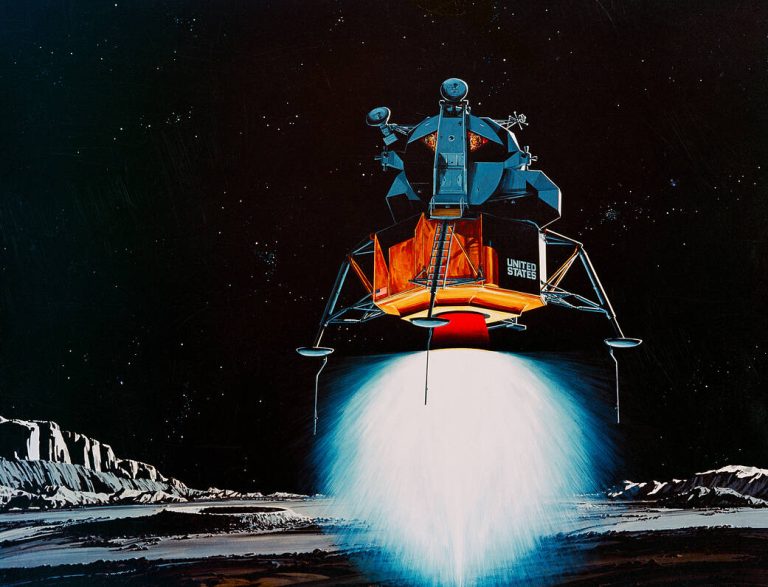
This artist’s concept from July 11, 1969, depicts the Apollo 11 lunar module Eagle landing on the surface of the Moon.

Apollo 11 launched from Cape Kennedy on July 16, 1969, carrying commander Neil Armstrong, command module pilot Michael Collins, and lunar module pilot Edwin “Buzz” Aldrin. On July 20, the Eagle landed in the Sea of Tranquility with Aldrin and Armstrong inside, about four miles downrange from the predicted touchdown point and almost one-and-a-half minutes earlier than scheduled. Four hours later, Armstrong emerged from the Eagle and deployed the TV camera for the transmission of the event to Earth.

Image Credit: TRW Incorporated

By: Monika Luabeya
Originally published at NASA

Coverage Set For NASA’s SpaceX Crew-7 Events, Broadcast, Launch

0

Editor’s Note: This media advisory was updated on Aug. 26, 2023, to reflect a change in the post-launch news conference participant from SpaceX. 

Editor’s Note: This media advisory was updated on Aug. 25, 2023, to reflect new times for crew arrival and docking, as well as a change in the post-launch news conference participant from SpaceX. 

Editor’s note: This media advisory was updated on Aug. 24, 2023, to reflect new dates for launch and docking, as well as NASA TV coverage.

Editor’s Note: This media advisory was updated on Aug. 23, 2023, to reflect a new target launch time of 3:50 a.m. EDT on Friday, Aug. 25.

Editor’s Note: This media advisory was updated on Aug. 20, 2023, to reflect the NASA administrator joining the crew arrival event on Sunday, Aug. 20, 5 p.m. EDT start time for the Monday, Aug. 21 media teleconference, and an updated title for Kristin Fabre in the NASA Social Panel.

NASA will provide coverage of the upcoming prelaunch and launch activities for the agency’s SpaceX Crew-7 mission with astronauts to the International Space Station.

The launch now is targeted for 3:27 a.m. EDT Saturday, Aug. 26, from Launch Complex 39A at NASA’s Kennedy Space Center in Florida. The Dragon spacecraft, named Endurance, is scheduled to dock to the space station at 8:50 a.m. Sunday, Aug. 27.

Crew arrival, launch, the postlaunch news conference, and mission coverage through docking will air live on NASA Television, the NASA app, and the agency’s website. NASA also will host an audio-only post-Flight Readiness Review news teleconference. Follow all live events at:

https://www.nasa.gov/live

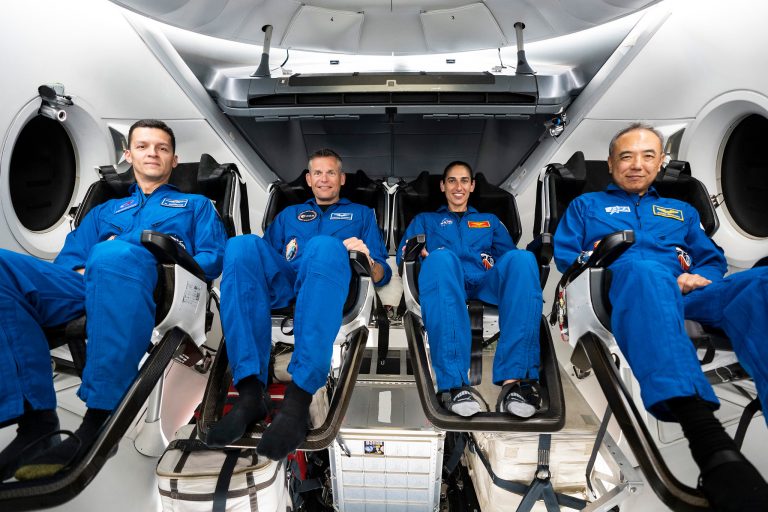
The Crew-7 launch will carry NASA astronaut Jasmin Moghbeli, ESA (European Space Agency) astronaut Andreas Mogensen, JAXA (Japan Aerospace Exploration Agency) astronaut Satoshi Furukawa, and Roscosmos cosmonaut Konstantin Borisov.

As part of the agency’s Commercial Crew Program, Crew-7 marks the eighth human spaceflight mission supported by a SpaceX Dragon spacecraft and the seventh crew rotation mission to the space station since 2020 for NASA.

The deadline for media accreditation for in-person coverage of this launch has passed. The agency’s media credentialing policy is available online. For questions about media accreditation, please email: [email protected].

All media participation in the following news conferences will be remote except where specifically listed below.

NASA’s SpaceX Crew-7 mission coverage is: (all times Eastern and subject to change based on real-time operations)

Sunday, Aug. 20

12:15 p.m.  – Crew arrival media event at Kennedy on NASA TV

  • Bill Nelson, NASA administrator 
  • Bob Cabana, associate administrator, NASA
  • Janet Petro, director, NASA Kennedy
  • Dana Hutcherson, deputy manager, Commercial Crew Program, NASA Kennedy
  • Eric van der Wal, lead, International Space Station Program Houston Office, ESA
  • Junichi Sakai, program manager, International Space Station, JAXA
  • NASA astronaut Jasmin Moghbeli
  • ESA astronaut Andreas Mogensen
  • JAXA astronaut Satoshi Furukawa
  • Roscosmos cosmonaut Konstantin Borisov

The event is limited to in-person media only. Follow Commercial Crew and Kennedy Space Center for the latest arrival updates.

Monday, Aug. 21

5 p.m. (approximately) – Flight Readiness Review media teleconference (no earlier than one hour after completion of the Flight Readiness Review) with the following participants:

  • Ken Bowersox, associate administrator, Space Operations Mission Directorate, NASA Headquarters
  • Steve Stich, manager, Commercial Crew Program, Kennedy
  • Joel Montalbano, manager, International Space Station Program, Johnson
  • William Gerstenmaier, vice president, Build and Flight Reliability, SpaceX
  • Frank De Winne, program manager, International Space Station, ESA
  • Junichi Sakai, program manager, International Space Station, JAXA
  • Amer AlSayegh AlGhaferi, assistant director general, Aerospace Engineering Sector, Mohammed Bin Rashid Space Center

Media may ask questions via phone only. For the dial-in number and passcode, please contact the Kennedy newsroom no later than 3 p.m. Monday, Aug. 21, at: [email protected].

Wednesday, Aug. 23

9:30 a.m. – NASA Social Panel Live Stream event at Kennedy with the following participants:

  • Tom Engler, Center Planning and Development Director, NASA Kennedy
  • Samantha Testa, recovery director, Commercial Crew Program, Kennedy
  • Kristin Fabre, deputy chief scientist, NASA’s Human Research Program 
  • Luca Parmitano, ESA astronaut

Members of the public may ask questions online by posting questions to the YouTube, Facebook, and X livestreams using #AskNASA.

11:30 a.m. –  One-on-one media interviews at Kennedy with various mission subject matter experts. Sign-up information will be emailed to media accredited to attend this launch in-person.

Friday, Aug. 25

11:30 p.m. – NASA TV launch coverage begins

Saturday, Aug. 26

3:27 a.m. – Launch

Following conclusion of launch and ascent coverage on NASA TV, coverage of the Crew-7 flight to the space station will continue audio only on mission audio circuits and on YouTube until coverage of rendezvous, docking, hatch opening, and welcoming remarks resumes on NASA TV.

For NASA TV downlink information, schedules, and links to streaming video, visit: http://www.nasa.gov/live.

5 a.m. (approximately) – Postlaunch News Conference on NASA TV

  • Ken Bowersox, associate administrator, Space Operations Mission Directorate, NASA Headquarters
  • Steve Stich, manager, Commercial Crew Program, Kennedy
  • Joel Montalbano, manager, International Space Station Program, Johnson
  • Benji Reed, senior director, Human Spaceflight Program, SpaceX
  • Hiroshi Sasaki, vice president, JAXA
  • Josef Aschbacher, director general, ESA

Media may ask questions in-person and via phone. Limited auditorium space will be available for in-person participation. For the dial-in number and passcode, please contact the Kennedy newsroom no later than 2:30 a.m. Saturday, Aug. 26, at [email protected].

Sunday, Aug. 27

6:45 a.m. – NASA TV arrival coverage begins

8:39 a.m. – Docking to the space-facing port of the station’s Harmony module

10:33 a.m. – Hatch opening

11:30 a.m. – Welcome ceremony

Audio Only Coverage

Audio only of the news conferences and launch coverage will be carried on the NASA “V” circuits, which may be accessed by dialing 321-867-1220, -1240 or -7135. On launch day, “mission audio,” countdown activities without NASA TV launch commentary, will be carried on 321-867-7135.

Launch audio also will be available on Launch Information Service And Amateur Television System’s VHF radio frequency 146.940 MHz and KSC Amateur Radio Club’s UHF radio frequency 444.925 MHz, FM mode, heard within Brevard County on the Space Coast.

Live Video Coverage Prior to Launch

NASA will provide a live video feed of Launch Complex 39A approximately 48 hours prior to the planned liftoff of the Crew-7 mission. Pending unlikely technical issues, the feed will be uninterrupted until the prelaunch broadcast begins on NASA TV, approximately four hours prior to launch. Once live, the video is available on NASA Kennedy’s Newsroom YouTube.

NASA Website Launch Coverage

Launch day coverage of NASA’s SpaceX Crew-7 mission will be available on the agency’s website. Coverage will include live streaming and blog updates beginning no earlier than 11:30 p.m. Friday, Aug. 25, as the countdown milestones occur. On-demand streaming video and photos of the launch will be available shortly after liftoff.

For questions about countdown coverage, contact the Kennedy newsroom at 321-867-2468. Follow countdown coverage on the commercial crew or Crew-7 blog.

Attend the Launch Virtually

Members of the public can register to attend this launch virtually. NASA’s virtual guest program for this mission also includes curated launch resources, notifications about related opportunities or changes, and a stamp for the NASA virtual guest passport following a successful launch.

Watch and Engage on Social Media

Let people know you’re following the mission on X, Facebook, and Instagram by using the hashtags #Crew7 and #NASASocial. You can also stay connected by following and tagging these accounts:

Facebook: NASANASAKennedyISSISS National Lab

Instagram: @NASA@NASAKennedy@ISS@ISSNationalLab@SpaceX

X: @NASA@NASAKennedy@NASASocial@Space_Station@ISS_Research@ISS National Lab@SpaceX@Commercial_Crew

Coverage en Espanol

Did you know NASA has a Spanish section called NASA en Espanol? Make sure to check out NASA en Espanol on X, Instagram, Facebook and YouTube for more coverage on Crew-7.

Para obtener información sobre cobertura en español en el Centro Espacial Kennedy o si desea solicitar entrevistas en español, comuníquese con Antonia Jaramillo: 321-501-8425; [email protected]; o Messod Bendayan: 256-930-1371; [email protected].

NASA’s Commercial Crew Program has delivered on its goal of safe, reliable, and cost-effective transportation to and from the International Space Station from the United States through a partnership with American private industry. This partnership is changing the arc of human spaceflight history by opening access to low Earth orbit and the International Space Station to more people, science, and commercial opportunities. The space station remains the springboard to NASA’s next great leap in space exploration, including future missions to the Moon and, eventually, to Mars.

For NASA’s launch blog and more information about the mission, visit:

https://www.nasa.gov/commercialcrew

-end-​

Joshua Finch / Lora Bleacher
Headquarters, Washington
202-358-1100
[email protected] / [email protected]

Steven Siceloff / Heather Scott
Kennedy Space Center, Florida
321-867-2468
[email protected] / [email protected]

Leah Cheshier
Johnson Space Center, Houston
281-483-5111
[email protected]