
Home Blog Page 104

Construction Begins On NASA’s Next-Generation Asteroid Hunter

0
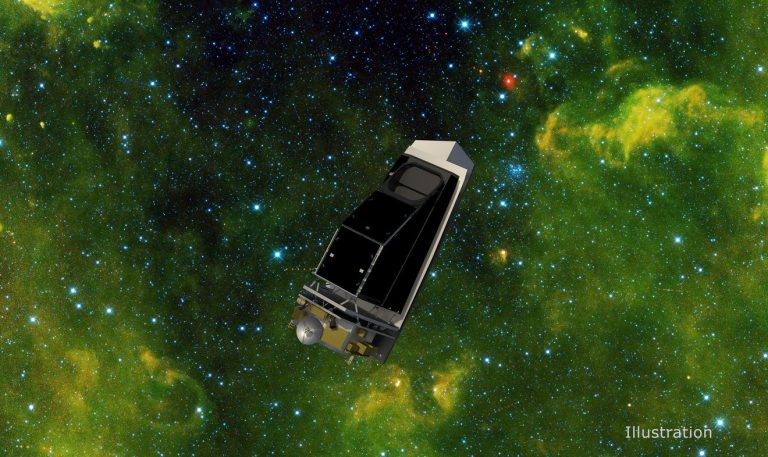
NASA’s NEO Surveyor is seen in this illustration against an infrared observation of a starfield made by the agency’s WISE mission. Credit: NASA/JPL-Caltech/University of Arizona Full Image Details

NEO Surveyor is the first purpose-built space telescope that will advance NASA’s planetary defense efforts by finding and tracking hazardous near-Earth objects.

A space telescope designed to search for the hardest-to-find asteroids and comets that stray into Earth’s orbital neighborhood, NASA’s Near-Earth Object Surveyor (NEO Surveyor) recently passed a rigorous technical and programmatic review. Now the mission is transitioning into the final design-and-fabrication phase and establishing its technical, cost, and schedule baseline.

The mission supports the objectives of NASA’s Planetary Defense Coordination Office (PDCO) at NASA Headquarters in Washington. The NASA Authorization Act of 2005 directed NASA to discover and characterize at least 90% of the near-Earth objects more than 140 meters (460 feet) across that come within 30 million miles (48 million kilometers) of our planet’s orbit. Objects of this size are capable of causing significant regional damage, or worse, should they impact the Earth.

“NEO Surveyor represents the next generation for NASA’s ability to quickly detect, track, and characterize potentially hazardous near-Earth objects,” said Lindley Johnson, NASA’s Planetary Defense Officer at PDCO. “Ground-based telescopes remain essential for us to continually watch the skies, but a space-based infrared observatory is the ultimate high ground that will enable NASA’s planetary defense strategy.”

Find Them First

Managed by NASA’s Jet Propulsion Laboratory in Southern California, NEO Surveyor will journey a million miles to a region of gravitational stability – called the L1 Lagrange point – between Earth and the Sun, where the spacecraft will orbit during its five-year primary mission.

From this location, the NEO Surveyor will view the solar system in infrared wavelengths – light that is invisible to the human eye. Because those wavelengths are mostly blocked by Earth’s atmosphere, larger ground-based observatories may miss near-Earth objects that this space telescope will be able to spot by using its modest light-collecting aperture of nearly 20 inches (50 centimeters).

NEO Surveyor’s cutting-edge detectors are designed to observe two heat-sensitive infrared bands that were chosen specifically so the spacecraft can track the most challenging-to-find near-Earth objects, such as dark asteroids and comets that don’t reflect much visible light. In the infrared wavelengths to which NEO Surveyor is sensitive, these objects glow because they are heated by sunlight.

In addition, NEO Surveyor will be able to find asteroids that approach Earth from the direction of the Sun, as well as those that lead and trail our planet’s orbit, where they are typically obscured by the glare of sunlight – objects known as Earth Trojans.

“For the first time in our planet’s history, Earth’s inhabitants are developing methods to protect Earth by deflecting hazardous asteroids,” said Amy Mainzer, the mission’s survey director at the University of Arizona in Tucson. “But before we can deflect them, we first need to find them. NEO Surveyor will be a game-changer in that effort.”

The mission will also help to characterize the composition, shape, rotation, and orbit of near-Earth objects. While the mission’s primary focus is on planetary defense, this information can be used to better understand the origins and evolution of asteroids and comets, which formed the ancient building blocks of our solar system.

When it launches, NEO Surveyor will build upon the successes of its predecessor, the Near-Earth Object Wide-field Infrared Survey Explorer (NEOWISE). Repurposed from the WISE space telescope after that mission ended in 2011, NEOWISE proved highly effective at detecting and characterizing near-Earth objects, but NEO Surveyor is the first space mission built specifically to find large numbers of these hazardous asteroids and comets.

Already in the Works

After the mission passed this milestone on Nov. 29, key instrument development got under way. For instance, the large radiators that will allow the system to be passively cooled are being fabricated. To detect the faint infrared glow of asteroids and comets, the instrument’s infrared detectors need to be much cooler than the spacecraft’s electronics. The radiators will perform that important task, eliminating the need for complex active cooling systems.

Additionally, construction of the composite struts that will separate the telescope’s instrumentation from the spacecraft has begun. Designed to be poor heat conductors, the struts will isolate the cold instrument from the warm spacecraft and sunshield, the latter of which will block sunlight that might otherwise obscure the telescope’s view of near-Earth objects and heat up the instrument.

Progress has also been made developing the instrument’s infrared detectors, beam splitters, filters, electronics, and enclosure. And work has begun on the space telescope’s mirror, which will be formed from a solid block of aluminum and shaped by a custom-built diamond-turning machine.

“The project team, including all of our institutional and industrial collaborators, is already very busy designing and fabricating components that will ultimately become flight hardware,” said Tom Hoffman, NEO Surveyor project manager at JPL. “As the mission enters this new phase, we’re excited to be working on this unique space telescope and are already looking forward to our launch and the start of our important mission.”

More About the Mission

The mission is tasked by NASA’s Planetary Science Division within the Science Mission Directorate; program oversight is provided by the PDCO, which was established in 2016 to manage the agency’s ongoing efforts in planetary defense. NASA’s Planetary Missions Program Office at Marshall Space Flight Center provides program management for NEO Surveyor.

The project is being developed by JPL and is led by survey director Amy Mainzer at the University of Arizona. Established aerospace and engineering companies have been contracted to build the spacecraft and its instrumentation, including Ball Aerospace , Space Dynamics Laboratory, and Teledyne. The Laboratory for Atmospheric and Space Physics at the University of Colorado, Boulder will support operations, and IPAC-Caltech in Pasadena, California, is responsible for processing survey data and producing the mission’s data products. Caltech manages JPL for NASA.

More information about NEO Surveyor is available at: https://solarsystem.nasa.gov/missions/neo-surveyor
Webb Space Telescope Views Star Formation In NGC 7469

0
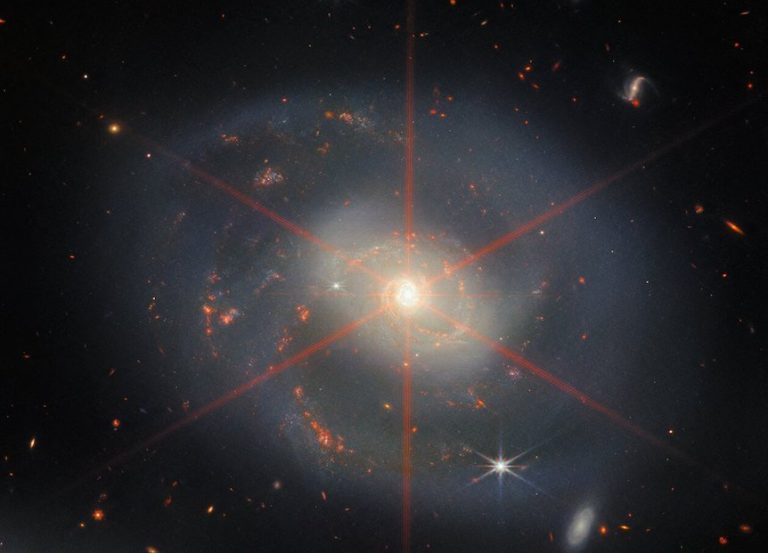
This image is dominated by NGC 7469. ESA.

This image is dominated by NGC 7469, a luminous, face-on spiral galaxy approximately 90 000 light-years in diameter that lies roughly 220 million light-years from Earth in the constellation Pegasus. Its companion galaxy IC 5283 is partly visible in the lower left portion of this image.

By Keith Cowing
Source SpaceRef

A Close Glimpse Of A Black Hole Devouring A Star

0
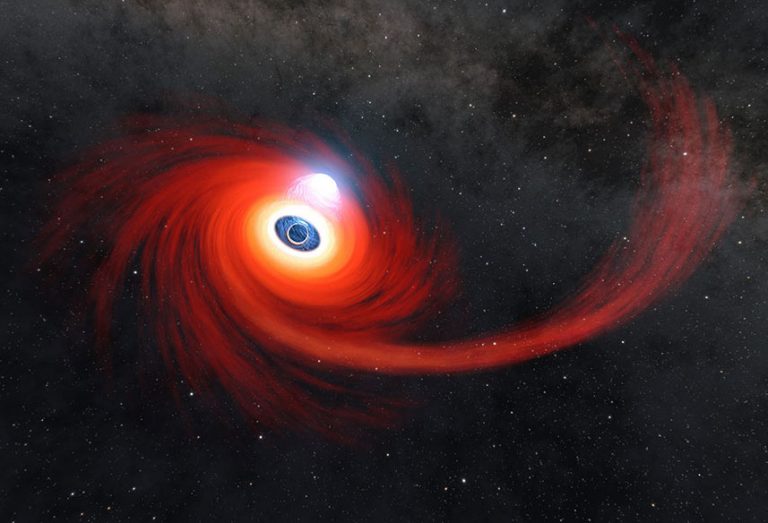
A disk of hot gas swirls around a black hole in this illustration. The stream of gas stretching to the right is what remains of a star that was pulled apart by the black hole. A cloud of hot plasma (gas atoms with their electrons stripped away) above the black hole is known as a corona. Credits: NASA/JPL-Caltech

Recent observations of a black hole devouring a wandering star may help scientists understand more complex black hole feeding behaviors.

Multiple NASA telescopes recently observed a massive black hole tearing apart an unlucky star that wandered too close. Located about 250 million light-years from Earth in the center of another galaxy, it was the fifth-closest example of a black hole destroying a star ever observed.

Once the star had been thoroughly ruptured by the black hole’s gravity, astronomers saw a dramatic rise in high-energy X-ray light around the black hole. This indicated that as the stellar material was pulled toward its doom, it formed an extremely hot structure above the black hole called a corona. NASA’s NuSTAR (Nuclear Spectroscopic Telescopic Array) satellite is the most sensitive space telescope capable of observing these wavelengths of light, and the event’s proximity provided an unprecedented view of the corona’s formation and evolution, according to a new study published in the Astrophysical Journal.

The work demonstrates how the destruction of a star by a black hole – a process formally known as a tidal disruption event – could be used to better understand what happens to material that’s captured by one of these behemoths before it’s fully devoured.

Most black holes that scientists can study are surrounded by hot gas that has accumulated over many years, sometimes millennia, and formed disks billions of miles wide. In some cases, these disks shine brighter than entire galaxies. Even around these bright sources, but especially around much less active black holes, a single star being torn apart and consumed stands out. And from start to finish, the process often takes only a matter of weeks or months. The observability and short duration of tidal disruption events make them especially attractive to astronomers, who can tease apart how the black hole’s gravity manipulates the material around it, creating incredible light shows and new physical features.

“Tidal disruption events are a sort of cosmic laboratory,” said study co-author Suvi Gezari, an astronomer at the Space Telescope Science Institute in Baltimore. “They’re our window into the real-time feeding of a massive black hole lurking in the center of a galaxy.”

When a star wanders too close to a black hole, the intense gravity will stretch the star out until it becomes a long river of hot gas, as shown in this animation. The gas is then whipped around the black hole and is gradually pulled into orbit, forming a bright disk. Credits: Science Communication Lab/DESY

A Surprising Signal

The focus of the new study is an event called AT2021ehb, which took place in a galaxy with a central black hole about 10 million times the mass of our Sun (about the difference between a bowling ball and the Titanic). During this tidal disruption event, the side of the star nearest the black hole was pulled harder than the far side of the star, stretching the entire thing apart and leaving nothing but a long noodle of hot gas.

Scientists think that the stream of gas gets whipped around a black hole during such events, colliding with itself. This is thought to create shock waves and outward flows of gas that generate visible light, as well as wavelengths not visible to the human eye, such as ultraviolet light and X-rays. The material then starts to settle into a disk rotating around the black hole like water circling a drain, with friction generating low-energy X-rays. In the case of AT2021ehb, this series of events took place over just 100 days.

The event was first spotted on March 1, 2021, by the Zwicky Transient Facility (ZTF), located at the Palomar Observatory in Southern California. It was subsequently studied by NASA’s Neil Gehrels Swift Observatory and Neutron star Interior Composition Explorer (NICER) telescope (which observes longer X-ray wavelengths than Swift).

Then, around 300 days after the event was first spotted, NASA’s NuSTAR began observing the system. Scientists were surprised when NuSTAR detected a corona – a cloud of hot plasma, or gas atoms with their electrons stripped away – since coronae usually appear with jets of gas that flow in opposite directions from a black hole. However, with the AT2021ehb tidal event, there were no jets, which made the corona observation unexpected. Coronae emit higher-energy X-rays than any other part of a black hole, but scientists don’t know where the plasma comes from or exactly how it gets so hot.

“We’ve never seen a tidal disruption event with X-ray emission like this without a jet present, and that’s really spectacular because it means we can potentially disentangle what causes jets and what causes coronae,” said Yuhan Yao, a graduate student at Caltech in Pasadena, California, and lead author of the new study. “Our observations of AT2021ehb are in agreement with the idea that magnetic fields have something to do with how the corona forms, and we want to know what’s causing that magnetic field to get so strong.”

Yao is also leading an effort to look for more tidal disruption events identified by ZTF and to then observe them with telescopes like Swift, NICER, and NuSTAR. Each new observation offers the potential for new insights or opportunities to confirm what has been observed in AT2021ehb and other tidal disruption events. “We want to find as many as we can,” Yao said.

More About the Mission

A Small Explorer mission led by Caltech and managed by NASA’s Jet Propulsion Laboratory in Southern California for the agency’s Science Mission Directorate in Washington, NuSTAR was developed in partnership with the Danish Technical University and the Italian Space Agency (ASI). The spacecraft was built by Orbital Sciences Corp. in Dulles, Virginia. NuSTAR’s mission operations center is at the University of California, Berkeley, and the official data archive is at NASA’s High Energy Astrophysics Science Archive Research Center at NASA’s Goddard Space Flight Center. ASI provides the mission’s ground station and a mirror data archive. Caltech manages JPL for NASA.

For more information about the NuSTAR mission, visit: https://www.nustar.caltech.edu/

By Keith Cowing
Source SpaceRef

Saying ‘Farewell’ To InSight Mars Lander

0

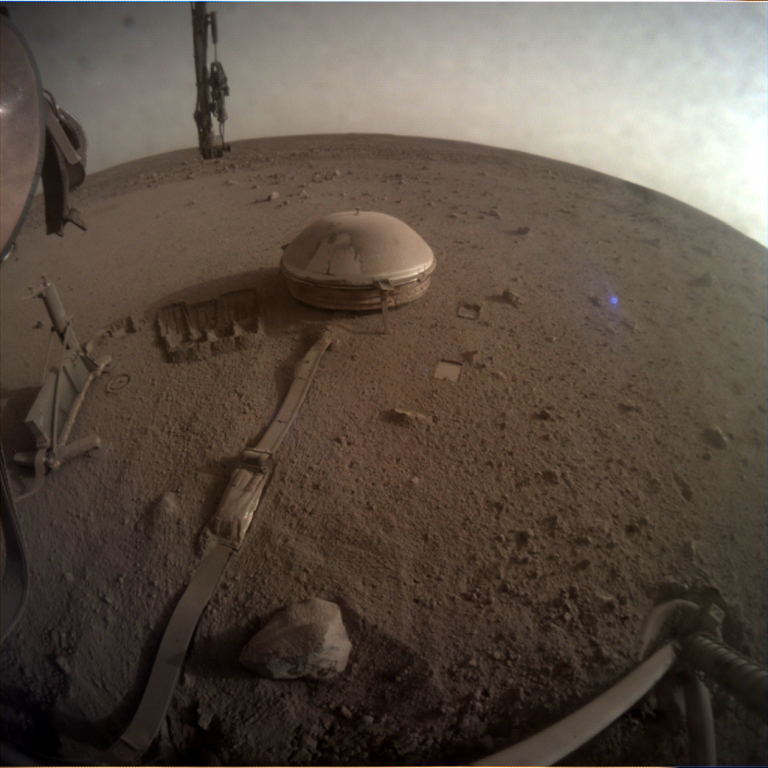
On Dec. 18, 2022,  InSight did not respond to communications from Earth. As expected, the lander’s power has been declining for months, and it’s assumed InSight may have reached its end of operations. NASA will declare the mission over when InSight misses two consecutive communication sessions with the spacecraft orbiting Mars, part of the Mars Relay Network – but only if the cause of the missed communication is the lander itself. After that, NASA’s Deep Space Network will listen for a time, just in case.

InSight launched from Vandenberg Air Force Base in California on May 5, 2018. After a six-month cruise, InSight landed on Mars on Nov. 26, 2018, and immediately began surface operations at Elysium Planitia, but science data collection didn’t start fully until about 10 weeks after landing. That’s because InSight’s science goals and instruments are very different from other Mars landers or rovers. In some ways, InSight’s science activities were designed to be more like a marathon than a sprint. Over the past four years, the lander data has yielded details about Mars’ interior layers, its liquid core, the surprisingly variable remnants beneath the surface of its mostly extinct magnetic field, weather on this part of Mars, and lots of quake activity.

Learn more about InSight, the first mission to explore Mars’ deep interior.

Credit: NASA/JPL-Caltech

By Dacia Massengill
Source NASA

Artemis I Orion Spacecraft Departs Naval Base San Diego 

0


The Artemis I Orion spacecraft is on its way back to NASA’s Kennedy Space Center in Florida.  After completing a 25.5-day, 1.4-million-mile journey beyond the Moon and back Dec. 11, the spacecraft was recovered from the Pacific Ocean and transported to U.S. Naval Base San Diego, where engineers prepared the spacecraft for its trek by truck to Kennedy. Orion is scheduled to arrive to Kennedy’s Multi Payload Processing Facility by the end of the year.  

Once at Kennedy, technicians will open the hatch and unload several payloads, including Commander Moonikin Campos, zero-gravity indicator Snoopy, and the official flight kit as part of de-servicing operations. In addition to removing the payloads, Orion’s heat shield and other elements will be removed for analysis, and remaining hazards will be offloaded.  

NASA also has released new aerial footage of Orion’s descent through the clouds and splashdown taken from an Unmanned Aircraft System or drone. View the new imagery of spacecraft’s return to Earth here.  


By Antonia Jaramillo Botero
Source NASA

Building The Space Infrastructure Of Tomorrow: Sierra Space Recruits Proven Executive To Lead Expansion Of Space Applications Business

0
Former Lockheed Martin and Boeing Executive Erik Daehler Named Vice President of Orbital Systems and Services

Sierra Space, a leading pure play space company building the first end-to-end business and technology platform in space, announced today a key hire for its expanding space applications line of business. Erik Daehler becomes the company’s Vice President of Orbital Systems and Services, a role that highlights Sierra Space’s commitment to expanding its growth and diversified offerings within a business unit that has already accrued more than 30 years and 500 missions of space flight heritage.

In his new role, Daehler will be responsible for the innovation, development, production and operation of Sierra Space’s satellite products and services. He brings more than two decades of aerospace and defense experience to the company, with a broad background in program management, business development and product innovation.

Erik Daehler Headshot

“Our innovative and rapidly expanding space applications business is accelerating toward a position as a key prime system and services provider for the space industry,” said Sierra Space CEO Tom Vice. “Erik brings a wealth of knowledge and proven execution experience to our team across not only satellite products and services but also in space systems engineering with applications in communication systems, space protection, re-entry vehicles and exquisite Earth Observation systems. Sierra Space is committed to bringing our customers affordable, resilient, and responsive systems that meet their commercial and national security needs.”

Most recently at Lockheed Martin Space, Daehler served as Senior Director of Protected Communication, where he led development of next-generation satellite communications product offerings, technology solutions, satellite design and system architectures for the U.S. Space Force, U.S. Navy and the Space Development Agency. Prior to that role, he was Director of Product Innovation for Boeing Space, and worked on new satellite platforms such as the first-of-a-kind 702SP all-electric, dual-stacked satellite and the 502 Phoenix remote sensing and servicing satellites. He also developed next-generation space systems at Boeing Space, including the X-37B.

Daehler has a strong background in optical physics with broad applications in communication and space remote sensing missions. He first joined Lockheed Martin at NASA’s John C. Stennis Space Center in 2000, where he performed radiometric calibrations of space and aircraft based multispectral and hyperspectral earth observation systems.

About Sierra Space

Sierra Space (www.sierraspace.com) is a leading commercial space company at the forefront of innovation and the commercialization of space in the Orbital AgeTM, building platforms in space to benefit life on Earth. With more than 30 years and 500 missions of space flight heritage, the company is enabling the future of space transportation with Dream Chaser®, the world’s only winged commercial spaceplane. Under construction at its Colorado headquarters and expected to launch in 2023 on the first of a series of NASA missions to the International Space Station, Dream Chaser can safely carry cargo – and eventually crew – to on-orbit destinations, returning to land on compatible commercial airport runways worldwide. Sierra Space is also building an array of in-space destinations for low-Earth orbit (LEO) commercialization including the LIFE™ habitat (Large Integrated Flexible Environment), a three-story commercial habitation and science platform designed for LEO. Both Dream Chaser and LIFE are central components to Orbital Reef, a mixed-use business park in LEO being developed by principal partners Sierra Space and Blue Origin, which is expected to be operational by the end of the decade.

NASA To Air Live Coverage Of US Spacewalk For Solar Array Installation

0
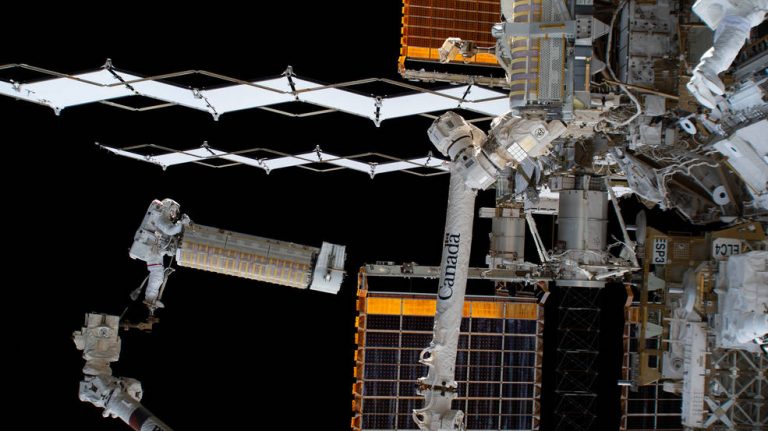
NASA astronaut and Expedition 68 Flight Engineer Josh Cassada is photographed on Dec. 3, holding a roll-out solar array as he rides the Canadarm2 robotic arm toward the Starboard-4 truss segment installation site. Credits: NASA

NASA astronauts aboard the International Space Station will conduct a spacewalk on Wednesday, Dec. 21, to install a rollout solar array to increase electrical power in support of operations and scientific research. The spacewalk is scheduled to begin at 7:45 a.m. EST and last about seven hours.

The agency will provide live coverage of the spacewalk beginning at 6:30 a.m. on NASA Television, the app, and the agency’s website.

Expedition 68 Flight Engineers Frank Rubio and Josh Cassada will exit the station’s Quest airlock to install an International Space Station Roll-Out Solar Array (iROSA) to augment power generation for the 4A power channel on the station’s port truss.

Rubio will serve as extravehicular crew member 1 (EV 1) and will wear a suit with red stripes. Cassada will serve as extravehicular crew member 2 (EV 2) and will wear an unmarked suit. The spacewalk will be the third in both Cassada and Rubio’s careers.

If more time is needed to complete the iROSA installation, a second spacewalk may be conducted on Tuesday, Dec. 27.

This will be the fourth iROSA installed on station out of a total six planned for installation. Overall, the iROSAs will increase power generation capability by up to 30%, increasing the station’s total available power from 160 kilowatts to up to 215 kilowatts.

The iROSA arrived at the space station Nov. 27, following a launch aboard the agency’s 26th SpaceX Dragon commercial resupply mission Nov. 26.

Cassada and Rubio are in the midst of a science mission living and working aboard the microgravity laboratory to advance scientific knowledge and demonstrate new technologies for future human and robotic exploration missions, including NASA’s Artemis missions to the Moon.

Get breaking news, images and features from the space station on InstagramFacebook, and Twitter.

Learn more about the International Space Station and its crew at: https://www.nasa.gov/station

Lora Bleacher
Headquarters, Washington
202-358-1100
[email protected]

Sandra Jones
Johnson Space Center, Houston
281-483-5111
[email protected]

By Gerelle Dodson
Source NASA

40-Year Study Finds Mysterious Patterns In Temperatures At Jupiter

0
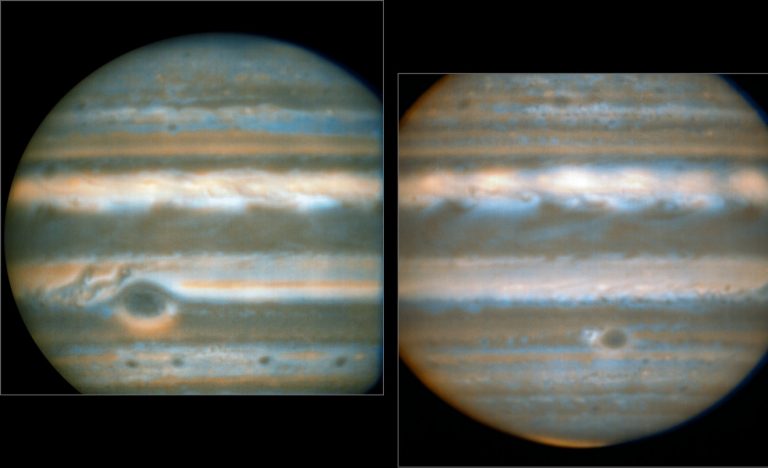
These infrared images of Jupiter with color added were obtained by the European Southern Observatory’s Very Large Telescope in 2016 and contributed to the new study. The colors represent temperatures and cloudiness: The bluer areas are cold and cloudy, and the orange areas are warmer and cloud-free. Credit: ESO / L.N. Fletcher

Based partly on data from generations of NASA missions, including NASA’s Voyager and Cassini, the work could help scientists determine how to predict weather on Jupiter.

Scientists have completed the longest-ever study tracking temperatures in Jupiter’s upper troposphere, the layer of the atmosphere where the giant planet’s weather occurs and where its signature colorful striped clouds form. The work, conducted over four decades by stitching together data from NASA spacecraft and ground-based telescope observations, found unexpected patterns in how temperatures of Jupiter’s belts and zones change over time. The study is a major step toward a better understanding of what drives weather at our solar system’s largest planet and eventually being able to forecast it.

Jupiter’s troposphere has a lot in common with Earth’s: It’s where clouds form and storms churn. To understand this weather activity, scientists need to study certain properties, including wind, pressure, humidity, and temperature. They have known since NASA’s Pioneer 10 and 11 missions in the 1970s that, in general, colder temperatures are associated with Jupiter’s lighter and whiter bands (known as zones), while the darker brown-red bands (known as belts) are locations of warmer temperatures.

But there weren’t enough data sets to understand how temperatures vary over the long-term. The new research, published Dec. 19 in Nature Astronomy, breaks ground by studying images of the bright infrared glow (invisible to the human eye) that rises from warmer regions of the atmosphere, directly measuring Jupiter’s temperatures above the colorful clouds. The scientists collected these images at regular intervals over three of Jupiter’s orbits around the Sun, each of which lasts 12 Earth years.

In the process, they found that Jupiter’s temperatures rise and fall following definite periods that aren’t tied to the seasons or any other cycles scientists know about. Because Jupiter has weak seasons – the planet is tilted on its axis only 3 degrees, compared to Earth’s jaunty 23.5 degrees – scientists didn’t expect to find temperatures on Jupiter varying in such regular cycles.

The study also revealed a mysterious connection between temperature shifts in regions thousands of miles apart: As temperatures went up at specific latitudes in the northern hemisphere, they went down at the same latitudes in the southern hemisphere – like a mirror image across the equator.

“That was the most surprising of all,” said Glenn Orton, senior research scientist at NASA’s Jet Propulsion Laboratory and lead author of the study. “We found a connection between how the temperatures varied at very distant latitudes. It’s similar to a phenomenon we see on Earth, where weather and climate patterns in one region can have a noticeable influence on weather elsewhere, with the patterns of variability seemingly ‘teleconnected’ across vast distances through the atmosphere.”

The next challenge is to find out what causes these cyclical and seemingly synchronized changes.

“We’ve solved one part of the puzzle now, which is that the atmosphere shows these natural cycles,” said co-author Leigh Fletcher of the University of Leicester in England. “To understand what’s driving these patterns and why they occur on these particular timescales, we need to explore both above and below the cloudy layers.”

One possible explanation became apparent at the equator: The study authors found that temperature variations higher up, in the stratosphere, seemed to rise and fall in a pattern that is the opposite of how temperatures behave in the troposphere, suggesting changes in the stratosphere influence changes in the troposphere and vice versa.

Decades of Observations

Orton and his colleagues began the study in 1978. For the duration of their research, they would write proposals several times a year to win observation time on three large telescopes around the world: the Very Large Telescope in Chile as well as NASA’s Infrared Telescope Facility and the Subaru Telescope at the Maunakea Observatories in Hawaii.

During the first two decades of the study, Orton and his teammates took turns traveling to those observatories, gathering the information on temperatures that would eventually allow them to connect the dots. (By the early 2000s, some of the telescope work could be done remotely.)

Then came the hard part – combining multiple years’ worth of observations from several telescopes and science instruments to search for patterns. Joining these veteran scientists on their long-duration study were several undergraduate interns, none of whom had been born when the study began. They are students at Caltech in Pasadena, California; Cal Poly Pomona in Pomona, California; Ohio State University in Columbus, Ohio; and Wellesley College in Wellesley, Massachusetts.

Scientists hope the study will help them eventually be able to predict weather on Jupiter, now that they have a more detailed understanding of it. The research could contribute to climate modeling, with computer simulations of the temperature cycles and how they affect weather – not just for Jupiter, but for all giant planets across our solar system and beyond.

“Measuring these temperature changes and periods over time is a step toward ultimately having a full-on Jupiter weather forecast, if we can connect cause and effect in Jupiter’s atmosphere,” Fletcher said. “And the even bigger-picture question is if we can someday extend this to other giant planets to see if similar patterns show up.”

News Media Contact

Gretchen McCartney
Jet Propulsion Laboratory, Pasadena, Calif.
818-393-6215
[email protected]

Karen Fox / Alana Johnson
NASA Headquarters, Washington
301-286-6284 / 202-358-1501
[email protected] / [email protected]

Kepler’s First Exoplanet Is Spiraling Toward Its Doom

0
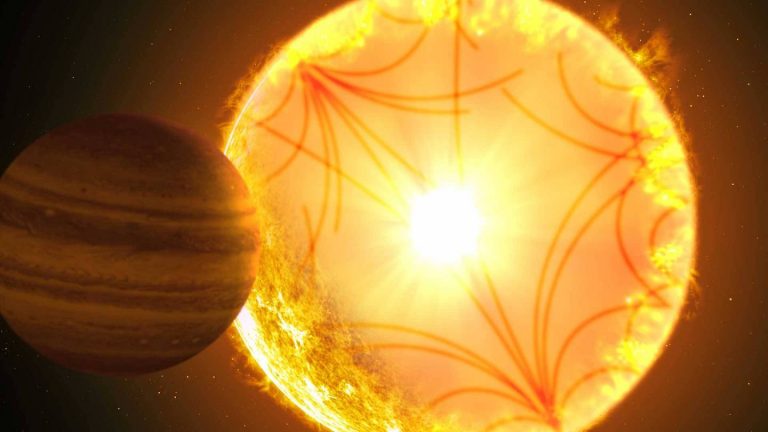
Kepler-1658b, orbiting with a period of just 3.8 days, was the first exoplanet candidate discovered by the Kepler space telescope in 2009. In 2019, astrophysicist Ashley Chontos used sound waves ricocheting through the star to confirm that this was an exoplanet, and she is now part of the team that identified that its orbit is collapsing. Image by Gabriel Perez Diaz/Instituto de Astrofísica de Canarias

For the first time, astronomers have spotted an exoplanet whose orbit is decaying around an aging star. The doomed world appears destined to spiral closer and closer to its expanding star until they collide, obliterating the first exoplanet discovered by the Kepler space telescope.

The discovery offers new insights into the slow process of planetary orbital decay by providing the first look at a solar system this late in its life cycle. Death-by-star is a fate thought to await many worlds — including Earth, in about 5 billion years. Exoplanet Kepler-1568b has less than 3 million years left, say scientists.

“We’ve had theorists predict the fates of stars and their planets for decades, but we’ve never before had observations to test them against,” said Ashley Chontos, the Henry Norris Russell Postdoctoral Fellow in Astrophysics at Princeton. “We can also think about this in terms of our own solar system. How long will Earth survive once the sun fuses all its hydrogen into helium? We have some ideas, but ultimately it’s hard to say for certain. These single-planet systems are really important for helping anchor these different theories.”

Chontos is the second author on a new study in the Astrophysical Journal Letters describing the researchers’ observations of the doomed exoplanet.

The first author is Shreyas Vissapragada, a 51 Pegasi b Fellow at Harvard University and the Smithsonian Institution. “We’ve previously detected evidence for exoplanets in-spiraling toward their stars, but we have never before seen such a planet around an evolved star,” he said.

For stars similar to the sun, “evolved” refers to those that have fused all their hydrogen into helium and moved into the next stage of their life. In this case, the star has begun expanding into a subgiant. “Theory predicts that evolved stars are very effective at sapping energy from their planets’ orbits, and now we can test those theories with observations,” Vissapragada said.

The ill-fated exoplanet is designated Kepler-1658b. As its name indicates, astronomers discovered it with the Kepler space telescope, a pioneering planet-hunting mission that launched in 2009. This world was the very first new exoplanet candidate Kepler ever observed, at which point it was dubbed KOI 4.01 — the 4th Object of Interest identified by Kepler. (KOIs 1, 2 and 3 had been identified before Kepler’s launch.)

Early on, KOI 4.01 was dismissed as a false positive. A decade would pass before Chontos, looking at seismic waves moving through its star, realized that the reason the data didn’t fit the model was that the scientists thought they were modeling a Neptune-sized object around a sun-sized star. Chontos and her colleagues showed that this planet and its star are both much larger than first predicted, at which time the object entered Kepler’s catalogue officially as the 1658th entry.

Kepler-1658b is a so-called hot Jupiter, the nickname given to exoplanets on par with Jupiter’s mass and size but in scorchingly ultra-close orbits about their host stars. For Kepler-1658b, that distance is merely an eighth of the space between our sun and its tightest orbiting planet, Mercury. And unlike Mercury’s 88-day orbit, Kepler-1658b whips around its star in just 3.8 days.

For hot Jupiters and other planets very close to their stars, orbital decay and collision look inevitable. But measuring how exoplanets circle down the drains of their host stars has proven challenging because the process is excruciatingly gradual. In the case of Kepler-1658b, the new study reports that its orbital period is decreasing at about 131 milliseconds (thousandths of a second) per year.

Detecting this decline required many years of careful observation. The watch started with Kepler and then was picked up by the Palomar Observatory’s Hale Telescope in Southern California and finally the Transiting Exoplanet Survey Telescope, or TESS, which launched in 2018. All three instruments captured transits, the term for when an exoplanet crosses the face of its star and causes a very slight dimming of the star’s brightness. Over the past 13 years, the interval between Kepler-1658b’s transits has slightly but steadily decreased.

Why? The same phenomenon responsible for the daily rise and fall of Earth’s oceans: tides.

Tides are generated by when orbiting bodies tug on each other, whether Earth and the moon or Kepler-1658b and its star. Both bodies exert gravitational pulls on each other, but the bigger body always wins, meaning that the smaller body flexes more.

The tugging distorts each body’s shape, and as the planet and star respond to these changes, energy is released. Depending on the distances between them, their sizes and their rotation rates, these tidal interactions can result in bodies pushing each other away — the case for the Earth and the slowly outward-spiraling Moon — or inward, as with Kepler-1658b toward its star.

There is still a lot researchers do not understand about these dynamics, particularly in star-planet scenarios, so the astrophysicists are eager to learn more from the Kepler-1658 system.

Chontos, who came to Princeton only a few months ago, said that she is looking forward to discussing her findings with the theorists and other astrophysicists here.

“I’m a first-generation, non-traditional student,” Chontos said. “I didn’t apply to Princeton for undergrad or grad school, because I had this vision in my head of what people would be like — and I couldn’t have been more wrong, in the best possible way. They’re doing everything right. There’s a reason why our department has something like 60 postdocs. And at coffee hours and colloquia, I have the opportunity to talk with the people who wrote the theory papers that inspire me.’”

Kepler-1658b’s star has evolved to the point in its stellar life cycle where it has started to expand, just as our sun is expected to, and it has entered into what astronomers call a subgiant phase. Theorists have predicted that the internal structure of evolved stars should more readily lead to dissipation of tidal energy taken from hosted planets’ orbits compared to hydrogen-rich stars like our Sun. This would accelerate the orbital decay process, making it easier to study on human timescales.

“Even though physically, this exoplanet’s system is very dissimilar to our solar system — our home — it can still tell us a lot about the efficiency of these tidal dissipation processes, and how long these planets can survive,” said Chontos.

Kepler-1658b is about 2 billion years old and is in the last 1% of its life, she said. She and her colleagues predict that the planet will collide with its star in about 3 million years.

The Possible Tidal Demise of Kepler’s First Planetary System,” by Shreyas Vissapragada, Ashley Chontos, Michael Greklek-McKeon, Heather A. Knutson, Fei Dai, Jorge Pérez González, Sam Grunblatt, Daniel Huber and Nicholas Saunders, appears in the current issue of the Astrophysical Journal Letters (DOI: 10.3847/2041-8213/aca47e). The research comes from data collected by the TESS mission, which is funded by NASA’s Science Mission Directorate.


By Keith Cowing
Source SpaceRef

Boldly Going: Planet And The Roddenberry Foundation Collaborate To Launch Satellites Celebrating Star Trek Creator Gene Roddenberry

0
Boldly Going

Planet Labs PBC (NYSE: PL), a leading provider of daily data and insights about Earth, and the Roddenberry Foundation are partnering to launch a fan art-inspired flock of Planet’s SuperDove satellites into space aboard a SpaceX Falcon 9 rocket during the Transporter-6 mission.

Select Planet SuperDoves on this upcoming launch will be adorned with artwork and quotes that celebrate the legacy of hope and inclusiveness of Star Trek and its creator, Gene Roddenberry.

The Roddenberry Foundation launched the Boldly Go Campaign in 2021, Gene Roddenberry’s centennial year, to celebrate Gene’s hopeful vision of humanity’s future—one of inclusion, scientific progress, and co-operation across our differences. Planet was a natural partner for the Roddenberry Foundation given the company shares a similar mission of accelerating humanity to a more sustainable, secure and prosperous world by illuminating environmental and social change.

The campaign asked people around the world to share what gives them hope for humanity’s future via online submissions. The 1,500+ submissions to the Boldly Go Campaign shared common themes of Gene’s vision, such as the value of diversity, the wonder of space, and optimism. These values were reflected in the quotes chosen to be laser-etched onto a select number of Planet’s SuperDove satellites launching later this year. This launch represents the culmination of the partnership between Planet and The Roddenberry Foundation on the Boldly Go Campaign.

“Star Trek showed us a future where diverse peoples come together across differences to work for the common good,” said Rod Roddenberry, son of Gene Roddenberry and co-founder of the Roddenberry Foundation. “We are thrilled to celebrate that vision with Planet by taking the Boldly Go campaign to space, the final frontier.”

Planet’s satellite constellation captures a daily snapshot of our changing Earth. This unprecedented capability provides governments, NGOs, and companies with the insights needed to drive business, power scientific research, and more sustainably manage our Earth.

“Launches are always a special milestone for Planet, but this one particularly so. Through Star Trek, Gene Roddenberry inspired the world to look to the stars in wonder and hopeful curiosity. In a similar vein, we at Planet look to space to help life here on Earth and are thrilled to partner with The Roddenberry Foundation to use space to help celebrate his legacy,” said Planet CEO, Will Marshall.

Follow Planet and the Roddenberry Foundation on Twitter for updates as we near the launch window. Learn more about the Boldly Go Campaign here.

About Planet

Planet is a leading provider of global, daily satellite imagery and geospatial solutions. Planet is driven by a mission to image the world every day, and make change visible, accessible and actionable. Founded in 2010 by three NASA scientists, Planet designs, builds, and operates the largest Earth observation fleet of imaging satellites, capturing over 30 TB of data per day. Planet provides mission-critical data, advanced insights, and software solutions to over 800 customers, comprising the world’s leading agriculture, forestry, intelligence, education and finance companies and government agencies, enabling users to simply and effectively derive unique value from satellite imagery. Planet is a public benefit corporation trading on the New York Stock Exchange as PL. To learn more visit www.planet.com and follow us on Twitter.

About The Roddenberry Foundation

Inspired by the life and legacy of Gene Roddenberry, the Foundation supports innovation, risk-taking, and experimentation to disrupt existing dynamics, inspire action, and discover new ways to help the world move towards a better future. By supporting remarkable risk-takers and unlikely changemakers, the Foundation strives for a more equitable, inclusive, and harmonious society. Learn more at www.roddenberryfoundation.org.

Planet’s Forward-looking Statements

Except for the historical information contained herein, the matters set forth in this press release are forward-looking statements within the meaning of the “safe harbor” provisions of the Private Securities Litigation Reform Act of 1995, including, but not limited to: whether the satellites will successfully launch on the expected timeline, or at all; whether the satellites will successfully replenish Planet’s existing SuperDove fleet; Planet’s constellation of satellites, being able to meet its customers’ needs; and whether Planet’s constellation of satellites will be able to provide insights for customers and strategic partners in accordance with their design, or at all. Forward-looking statements are based on Planet’s management’s beliefs, as well as assumptions made by, and information currently available to them. Because such statements are based on expectations as to future events and results and are not statements of fact, actual results may differ materially from those projected. Factors which may cause actual results to differ materially from current expectations include, but are not limited to: the interruption or failure of Planet’s satellite operations; whether Planet experiences any adverse events, such as delayed launches, launch failures, its satellites failing to reach their planned orbital locations, its satellites failing to operate as intended, being destroyed or otherwise becoming inoperable, the cost of satellite launches significantly increasing and/or satellite launch providers not having sufficient capacity; Planet’s satellites not being able to capture Earth images due to weather, natural disasters or other external factors, or as a result of its constellation of satellites having restrained capacity; and the other risk factors and disclosures about Planet and its business included in Planet’s periodic reports, proxy statements, and other disclosure materials filed from time to time with the Securities and Exchange Commission (SEC) which are available online at www.sec.gov, and on Planet’s website at www.planet.com. All forward-looking statements reflect Planet’s beliefs and assumptions only as of the date such statements are made. Planet undertakes no obligation to update forward-looking statements to reflect future events or circumstances.

Contacts
Sarah Bates
[email protected]

Stratton Kirton
[email protected]

By Keith Cowing
Source SpaceRef