Home Blog Page 112

Orion Approaches Moon For Outbound Powered Flyby

0

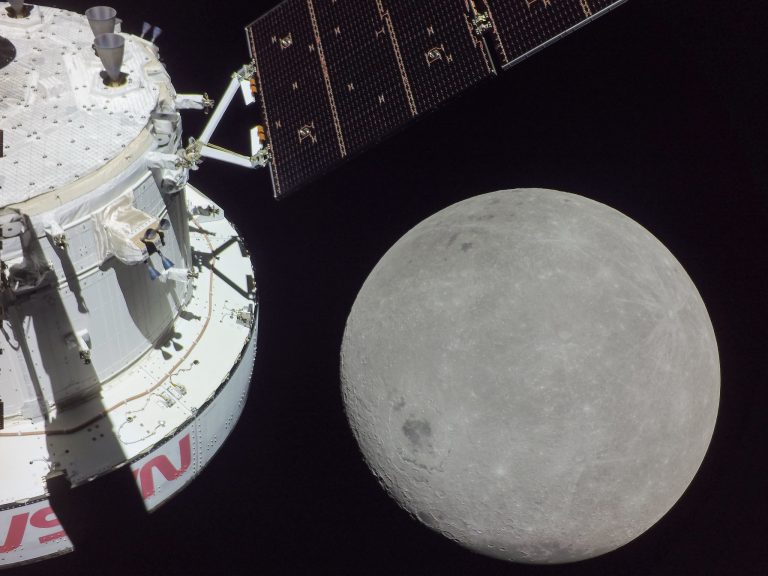
A portion of the far side of the Moon looms large just beyond the Orion spacecraft in this image taken Monday, Nov. 21, the sixth day of the Artemis I mission, by a camera on the tip of one of Orion’s solar arrays. The darkest spot visible near the middle of the image is Mare Orientale.

Image Credit: NASA

See more images from Orion’s flight in our Flickr gallery.

Get daily mission updates from our Artemis I blog.

By Michael Bock

NASA, ICON Advance Lunar Construction Technology For Moon Missions

0
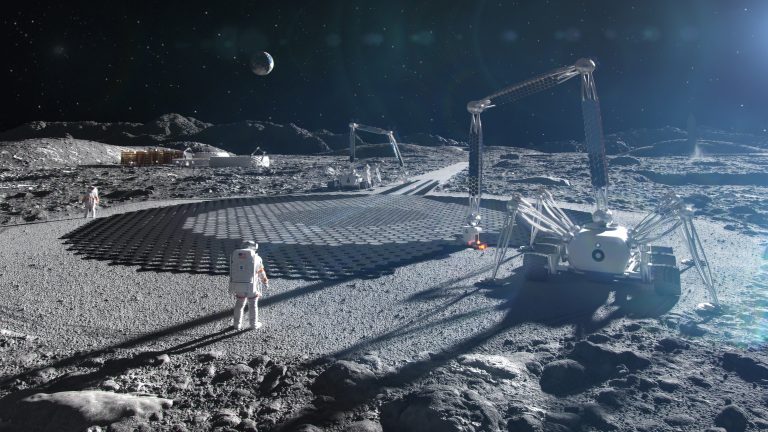
A new award from NASA will support ICON in developing construction technology that could be used on the Moon and Mars. Credits: ICON

As NASA plans for long-term human exploration of the Moon under Artemis, new technologies are required to meet the unique challenges of living and working on another world.

NASA has awarded ICON, located in Austin, a contract to develop construction technologies that could help build infrastructure such as landing pads, habitats, and roads on the lunar surface.

“In order to explore other worlds, we need innovative new technologies adapted to those environments and our exploration needs,” said Niki Werkheiser, director of technology maturation in NASA’s Space Technology Mission Directorate (STMD). “Pushing this development forward with our commercial partners will create the capabilities we need for future missions.”

The award is a continuation of ICON’s work under a Small Business Innovation Research (SBIR) dual-use contract with the U.S. Air Force, partly funded by NASA. The new NASA SBIR Phase III award will support the development of ICON’s Olympus construction system, which is designed to use local resources on the Moon and Mars as building materials. The contract runs through 2028 and has a value of $57.2 million.

ICON will work with NASA’s Marshall Space Flight Center in Huntsville, Alabama, under STMD’s Moon to Mars Planetary Autonomous Construction Technologies (MMPACT) project. NASA is partnering with industry, government, and academic institutions under the MMPACT project.

The award will build on ICON’s commercial activities and other work with NASA.

ICON 3D printed a 1,700-square-foot simulated Martian habitat, called Mars Dune Alpha, that will be used during NASA’s Crew Health and Performance Analog, or CHAPEA, analog mission starting in 2023.

ICON also competed in NASA’s 3D Printed Habitat Challenge. The company partnered with the Colorado School of Mines in Golden, and the team won a prize for 3D printing a structure sample that was tested for its ability to hold a seal, for strength, and for durability in temperature extremes.

MMPACT is part of the Game Changing Development program within NASA’s STMD.

To learn more about NASA’s space technology development, visit:

https://nasa.gov/spacetech

-end-

Sarah Frazier
Headquarters, Washington
202-853-7191
[email protected]

Last Updated: Nov 29, 2022

By Roxana Bardan

Did Climate Change Kill Life On Early Mars?

0
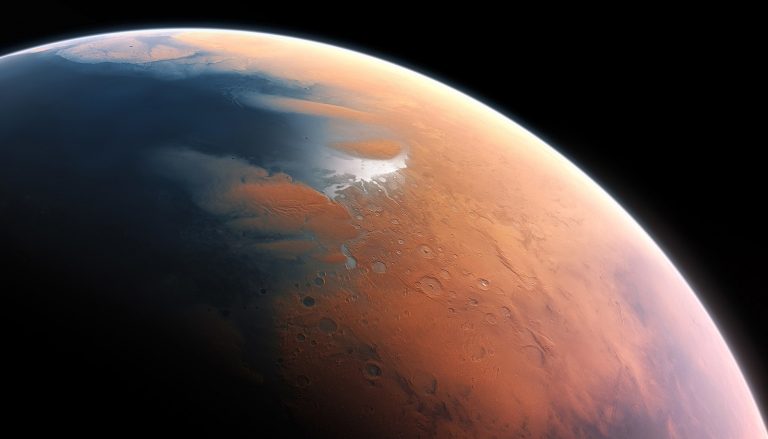
This artist’s impression shows how Mars may have looked about four billion years ago. (Credit: M. Kornmesser/ESO via Wikimedia Commons)

If life ever existed on Mars—and that’s a huge “if”—conditions during the planet’s infancy most likely would have supported it, according to a new study.

Early in its history, the red planet likely would have been habitable to methanogens, microbes that make a living in extreme habitats on Earth, according to the study that simulated the conditions on a young Mars.

Dry and extremely cold, with a tenuous atmosphere, today’s Mars is extremely unlikely to sustain any form of life at the surface. But 4 billion years ago, Earth’s smaller, red neighbor may have been much more hospitable, according to the study in Nature Astronomy.

Most Mars experts agree that the planet started out with an atmosphere that was much denser than it is today. Rich in carbon dioxide and hydrogen, it would have likely created a temperate climate that allowed water to flow and, possibly, microbial life to thrive, according to Regis Ferrière, a professor in the University of Arizona’s department of ecology and evolutionary biology and one of two senior authors of the paper.

The authors are not arguing that life existed on early Mars, but if it did, Ferrière says, “our study shows that underground, early Mars would very likely have been habitable to methanogenic microbes.”

Such microbes, which make a living by converting chemical energy from their environment and releasing methane as a waste product, are known to exist in extreme habitats on Earth, such as hydrothermal vents along fissures in the ocean floor. There, they support entire ecosystems adapted to crushing water pressures, near-freezing temperatures, and total darkness.

The research team tested a hypothetical scenario of an emerging Martian ecosystem by using state-of-the-art models of Mars’ crust, atmosphere, and climate, coupled with an ecological model of a community of Earthlike microbes metabolizing carbon dioxide and hydrogen.

On Earth, most hydrogen is tied up in water and not frequently encountered on its own, other than in isolated environments such as hydrothermal vents. Its abundance in the Martian atmosphere, however, could have provided an ample supply of energy for methanogenic microbes about 4 billion years ago, at a time when conditions would have been more conducive to life, the authors suggest. Early Mars would have been very different from what it is today, Ferrière says, trending toward warm and wet rather than cold and dry, thanks to large concentrations of hydrogen and carbon dioxide—both strong greenhouse gases that trap heat in the atmosphere.

“We think Mars may have been a little cooler than Earth at the time, but not nearly as cold as it is now, with average temperatures hovering most likely above the freezing point of water,” he says. “While current Mars has been described as an ice cube covered in dust, we imagine early Mars as a rocky planet with a porous crust, soaked in liquid water that likely formed lakes and rivers, perhaps even seas or oceans.”

That water would have been extremely salty, he adds, according to spectroscopic measurements of rocks exposed on the Martian surface.

To simulate the conditions early lifeforms would have encountered on Mars, the researchers applied models that predict the temperatures at the surface and in the crust for a given atmospheric composition. They then combined those data with an ecosystem model that they developed to predict whether biological populations would have been able to survive in their local environment and how they would have affected it over time.

“Once we had produced our model, we put it to work in the Martian crust—figuratively speaking,” says the paper’s first author, Boris Sauterey, a former postdoctoral fellow in Ferrière’s group who is now a postdoctoral fellow at Sorbonne Université in Paris. “This allowed us to evaluate how plausible a Martian underground biosphere would be. And if such a biosphere existed, how it would have modified the chemistry of the Martian crust, and how these processes in the crust would have affected the chemical composition of the atmosphere.”

“Our goal was to make a model of the Martian crust with its mix of rock and salty water, let gases from the atmosphere diffuse into the ground, and see whether methanogens could live with that,” says Ferrière, who holds a joint appointment at Paris Sciences & Lettres University in Paris. “And the answer is, generally speaking, yes, these microbes could have made a living in the planet’s crust.”

The researchers then set out to answer an intriguing question: If life thrived underground, how deep would one have had to go to find it? The Martian atmosphere would have provided the chemical energy that the organisms would have needed to thrive, Sauterey explains—in this case, hydrogen and carbon dioxide.

“The problem is that even on early Mars, it was still very cold on the surface, so microbes would have had to go deeper into the crust to find habitable temperatures,” he says. “The question is how deep does the biology need to go to find the right compromise between temperature and availability of molecules from the atmosphere they needed to grow? We found that the microbial communities in our models would have been happiest in the upper few hundreds of meters.”

By modifying their model to take into account how processes occurring above and below ground influence each other, they were able to predict the climatic feedback of the change in atmospheric composition caused by the biological activity of these microbes. In a surprising twist, the study revealed that while ancient Martian life may have initially prospered, its chemical feedback to the atmosphere would have kicked off a global cooling of the planet, ultimately rendering its surface uninhabitable and driving life deeper and deeper underground, and possibly to extinction.

“According to our results, Mars’ atmosphere would have been completely changed by biological activity very rapidly, within a few tens or hundreds of thousands of years,” Sauterey says. “By removing hydrogen from the atmosphere, microbes would have dramatically cooled down the planet’s climate.”

Early Mars’ surface would soon have become glacial as a consequence of the biological activity. In other words, climate change driven by Martian life might have contributed to making the planet’s surface uninhabitable very early on.

“The problem these microbes would have then faced is that Mars’ atmosphere basically disappeared, completely thinned, so their energy source would have vanished and they would have had to find an alternate source of energy,” Sauterey says. “In addition to that, the temperature would have dropped significantly, and they would have had to go much deeper into the crust. For the moment, it is very difficult to say how long Mars would have remained habitable.”

Future Mars exploration missions may provide answers, but challenges will remain, according to the authors. For example, while they identified Hellas Planitia, an extensive plain carved out by an impact of a large comet or asteroid very early in the history of Mars, as a particularly promising site to scour for evidence of past life, the location’s topography generates some of Mars’ most violent dust storms, which could make the area too risky to be explored by an autonomous rover.

However, once humans begin to explore Mars, such sites could make it back onto the shortlist for future missions to the planet, Sauterey says. For now, the team focuses its research on modern Mars. NASA’s Curiosity rover and the European Space Agency’s Mars Express satellite have detected elevated levels of methane in the atmosphere, and while such spikes could result from processes other than microbial activity, they do allow for the intriguing possibility that lifeforms such as methanogens may have survived in isolated pockets on Mars, deep underground—oases of alien life in an otherwise hostile world.

Source: University of Arizona

Original Study DOI: 10.1038/s41550-022-01786-w

By Daniel Stolte-Arizona, Futurity

Artemis I — Flight Day 13: Orion Goes The (Max) Distance

0
A spacecraft is seen in space with the Moon in the distance
art001e000479 (Nov. 24, 2022) – On flight day 9, NASA’s Orion spacecraft captured imagery looking back at the Moon from a camera mounted on one of its solar arrays. The spacecraft is enroute to a distant retrograde orbit around the Moon.

On the 12th day of the Artemis I mission, team members conducted another planned test of the star trackers aboard Orion as it continued along a distant retrograde orbit of the Moon, and began another reaction control thruster flight test. 

Engineers hope to characterize the alignment between the star trackers and the Orion inertial measurements units, both of which are part of the guidance, navigation and control system, by exposing different areas of the spacecraft to the Sun and activating the star trackers in different thermal states. Star trackers are navigation tools that measure the positions of stars to help the spacecraft determine its orientation. The inertial measurement units contain three devices, called gyros, used to measure spacecraft body rotation rates, and three accelerometers used to measure spacecraft accelerations.  

Together, the star tracker and inertial measurement unit data are used by Orion’s vehicle management computers to compute spacecraft position, velocity, and attitude. The measurements will help engineers understand how thermal states affect the accuracy of the navigation state, which ultimately affects the amount of propellant needed for spacecraft maneuvers. Read more about Orion’s guidance, navigation, and control system in the Artemis I reference guide

Engineers began a development flight test objective today that changed the minimum jet firing time for the reaction control thrusters over a period of 24 hours. This test objective is designed to exercise the reaction control system jets in a different configuration to model how thruster jets will be used for the crewed Artemis II mission. 

Teams also activated and interacted with the Callisto payload, a technology demonstration from Lockheed Martin in collaboration with Amazon and Cisco. Callisto is located in the Orion cabin and will test voice activated and video technology in the deep space environment. 

Monday, Nov. 28, Orion will reach its farthest distance from Earth when it is nearly 270,000 miles from our home planet. 

As of 4:30 p.m. CST, Orion was over 264,000  miles from Earth and 45,600  miles from the Moon, cruising at 1,750 miles per hour. 

To follow the mission real-time, you can track Orion during its mission around the Moon and back, and check the NASA TV schedule for updates on the next televised events. The latest imagery and videos can be found on the Johnson Space Center Flickr. 

By Leah Cheshier
Source NASA

New Targeted Launch Dates For Flights VV22 And VA259

0

After the discovery of a defective equipment when arming the Vega C launcher for the Flight VV22, Arianespace has taken the decision to postpone the launch.

In order to replace the equipment, the upper composite of the launcher will be taken back to the payload preparation facilities and the payload fairing will be opened for the intervention.

All the operations will be handled, in respect of the environmental requirements of the two Pléiades Neo satellites and in accordance with Arianespace’s quality policy.

In order to secure both launch dates for Ariane 5 flight VA259 and Vega C flight VV22, Arianespace decided to update its manifest, swapping the two missions:

  • The new targeted launch date for VV22 now is December 20;
  • The new targeted launch date for VA259 – initially scheduled for December 14 – now is December 13.

About Arianespace

Arianespace uses Space to make life better on Earth by providing launch services for all types of satellites into all orbits. It has orbited over 1,100 satellites since 1980. Arianespace is responsible for operating the new-generation Ariane 6 and Vega C launchers, developed by ESA, with respectively ArianeGroup and Avio as industrial primes. Arianespace is headquartered in Evry, near Paris, and has a technical facility at the Guiana Space Center in French Guiana, plus local offices in Washington, D.C., Tokyo and Singapore. Arianespace is a subsidiary of ArianeGroup, which holds 74% of its share capital, with the balance held by 15 other shareholders from the Ariane and Vega European launcher industry, and ESA and CNES as censors.

UK Experiment To Create Materials For Metal And Medicine Launches

0

A UK experiment to find new ways of creating materials to be used for medicines and metal alloys launched to the International Space Station (ISS).

Hands working on Particle Vibration experiment
Image Credit: University of Strathclyde

A UK experiment to find new ways of creating materials that could be used to produce medicines and metal alloys started its journey to the International Space Station (ISS).

The Particle Vibration experiment, led by the University of Strathclyde and built by UK-firm QinetiQ, took off from the Kennedy Space Center in Florida on-board a SpaceX Falcon 9 rocket at 19:20 UTC on 26 November 2022.

Science Minister George Freeman said:

This experiment paves the way for exciting scientific discoveries that could transform methods of manufacturing, demonstrating just how valuable a resource space can be for growth and industry in the UK and around the world.

The organisations behind the experiment, QinetiQ and University of Strathclyde, provide two examples of the diversity of expertise across the UK space sector, which is already worth £16.5 billion to our economy. I look forward to seeing the next steps for this innovative work.

Astronauts on the ISS will use the equipment in an experiment that involves heating and shaking complex fluids – liquids that contain fine solid particles or other liquid droplets – in space’s microgravity environment to create new materials. This cannot be achieved on Earth, as the planet’s gravity tends to separate complex fluids into their individual components, according to their weight.

This results in a concentrated layer of particles on the bottom or on the top of the container, which would then prevent the production of these materials with the desired properties.

This method, using precise vibrations to allow contact-less control of dispersed particles, could lead to improved or completely new, types of metal alloys, non-metallic conductors, plastics, and “macromolecular” substances that can be used to produce medicines, such as protein crystals for use in vaccine delivery. The fluid flow produced by vibrations could also be used to define new methods to effectively cool nuclear reactors and electronics.

The UK Space Agency provided £1.6 million funding for the build of the Particle Vibration experiment, which will be launched and operated by the European Space Agency (ESA) Human and Robotic Exploration programme through UK membership of the agency.

Libby Jackson, Head of Space Exploration at the UK Space Agency, said:

Particle Vibration shows how investing in space exploration, and the research in space that it enables, can benefit us here on Earth.

In-space manufacturing harnesses the benefits of the space environment to create materials that are of much higher quality that those we can create on Earth, and that can be used to improve production of all sorts of materials crucial to our health and growth.

The third in a series of experiments on the ISS that have been built with UK Space Agency funds, Particle Vibration showcases two UK organisations that are breaking new ground in space science and technology.

Dr Marcello Lappa, leading the project at the University of Strathclyde, said:

With these experiments we will investigate how, by shaking a fluid-solid-particle mixture in microgravity, we can create materials with structures that we cannot make on Earth.

It will lead to new advanced techniques and nanotechnologies for the production in space of advanced materials and alloys with properties that can only be obtained in space.

Minister for Scotland John Lamont said:

This is hugely exciting research, with the potential to deliver transformational changes to the daily lives of people all around the world. It’s fantastic that this is being led by a team based in Scotland, with UK Government support, and another excellent example of the way in which Scotland is playing a key role in the UK’s thriving space sector industries: from building and launching satellites, to developing truly innovative technologies.

Particle Vibration is the third experiment funded directly by the UK Space Agency to fly to the ISS. The first, called Molecular Muscle 2, launched in June 2021 and saw scientists from Nottingham and Exeter University send thousands of tiny worms to live on board the space station for several days to help understand spaceflight-induced muscle decline.

The second, called MicroAge, launched in December 2021, with scientists from the University of Liverpool, sending tiny human muscle cells, the size of a grain of rice, into space to understand what happens to human muscles as we age, and why.

For more information about this or other UK Space Agency missions and programmes, please contact [email protected].

Source UK Space Agency

Using Satellites For Faster Flood Information

0
Using Satellites For Faster Flood Information
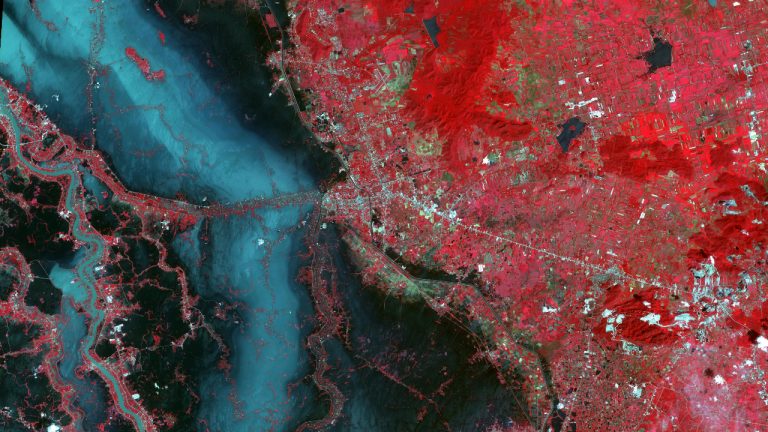
Map of inundated western Brisbane suburbs on 28 February 2022 derived from PlanetScope (purple) and Capella (pink) satellite data. CREDIT The University of Queensland

Researchers at The University of Queensland have used satellites with radar imaging sensors to see through clouds and map flooding and say the technique could provide faster, more detailed information to keep communities safe.

Professor Noam Levin from UQ’s School of Earth and Environmental Sciences said the project combined images from optical satellites with information from imaging radar satellites.

“Monitoring floods in towns and cities is challenging, with flood waters often rising and then receding in a few days,” Professor Levin said.

“While large satellites in the past provided images every 7-14 days, now groups of small satellites can collect several images a day over the same location.

“Radar imaging sensors can provide images at night or on days with thick cloud cover – a huge advantage in stormy conditions.

“They use a flash, like on a camera, and the light is sent at wavelengths between 1mm and 1.0m, which can pass through clouds and smoke.”

During Brisbane’s February 2022 floods, researchers combined satellite day-time pictures showing the extent of the flood with imaging radar and optical night-time data of the lights associated with human activity.

“We could see which areas became dark as the flood waters encroached,” Professor Levin said.

“We matched this with data from river gauges operated by the Bureau of Meteorology, and with changes in electricity loads reported by Energex, the power supplier.”

Professor Stuart Phinn said the technique could play a vital role in protecting Australians during future flooding events.

“In combination with existing flood monitoring and modelling technologies, satellites could change the way we monitor major flood events, understand how they occur, and direct emergency and other responses,” Professor Phinn said.

“With faster update times – at least twice a day – and more accurate and timely data, agencies monitoring the floods can assess changes and alert people in at-risk areas.

“This technique can also be used post-disaster to assess the extent of damage, direct recovery efforts and for the assessment of insurance claims.”

The team used optical satellites from Planet Inc. and from NASA’s VIIRS, as well as imaging radar satellites from Capella.

By Keith Cowing
Source SpaceRef

Artemis I – Flight Day 12: Orion Star Trackers, Reaction Control Thrusters Tested 

0
A spacecraft is seen in space with the Moon in the distance
art001e000479 (Nov. 24, 2022) – On flight day 9, NASA’s Orion spacecraft captured imagery looking back at the Moon from a camera mounted on one of its solar arrays. The spacecraft is enroute to a distant retrograde orbit around the Moon.

On the 12th day of the Artemis I mission, team members conducted another planned test of the star trackers aboard Orion as it continued along a distant retrograde orbit of the Moon, and began another reaction control thruster flight test. 

Engineers hope to characterize the alignment between the star trackers and the Orion inertial measurements units, both of which are part of the guidance, navigation and control system, by exposing different areas of the spacecraft to the Sun and activating the star trackers in different thermal states. Star trackers are navigation tools that measure the positions of stars to help the spacecraft determine its orientation. The inertial measurement units contain three devices, called gyros, used to measure spacecraft body rotation rates, and three accelerometers used to measure spacecraft accelerations.  

Together, the star tracker and inertial measurement unit data are used by Orion’s vehicle management computers to compute spacecraft position, velocity, and attitude. The measurements will help engineers understand how thermal states affect the accuracy of the navigation state, which ultimately affects the amount of propellant needed for spacecraft maneuvers. Read more about Orion’s guidance, navigation, and control system in the Artemis I reference guide

Engineers began a development flight test objective today that changed the minimum jet firing time for the reaction control thrusters over a period of 24 hours. This test objective is designed to exercise the reaction control system jets in a different configuration to model how thruster jets will be used for the crewed Artemis II mission. 

Teams also activated and interacted with the Callisto payload, a technology demonstration from Lockheed Martin in collaboration with Amazon and Cisco. Callisto is located in the Orion cabin and will test voice activated and video technology in the deep space environment. 

Monday, Nov. 28, Orion will reach its farthest distance from Earth when it is nearly 270,000 miles from our home planet. 

As of 4:30 p.m. CST, Orion was over 264,000  miles from Earth and 45,600  miles from the Moon, cruising at 1,750 miles per hour. 

To follow the mission real-time, you can track Orion during its mission around the Moon and back, and check the NASA TV schedule for updates on the next televised events. The latest imagery and videos can be found on the Johnson Space Center Flickr. 

By Sandra Jones
Source NASA

Moon Microscope, Solar Arrays Launch On NASA’s SpaceX Cargo Ship

0

SpaceX’s 26th commercial resupply mission for NASA is on its way to the International Space Station.

Carrying more than 7,700 pounds of science experiments, crew supplies, and other cargo, the SpaceX Dragon spacecraft launched on the Falcon 9 rocket at 2:20 p.m. EST Saturday from NASA’s Kennedy Space Center in Florida.

The cargo spacecraft is scheduled to autonomously dock at the space station around 7:30 a.m. Sunday, Nov. 27, and remain at the station for about 45 days. Coverage of arrival will begin at 6 a.m. on NASA Television, the agency’s website, and the NASA app.

Among the science experiments Dragon is delivering to the space station are:

Picture of Health

Moon Microscope tests a kit for in-flight medical diagnosis that includes a portable hand-held microscope and a small self-contained blood sample staining device. An astronaut collects and stains a blood sample, obtains images with the microscope, and transmits images to the ground, where flight surgeons use them to diagnose illness and prescribe treatment.

The kit could provide diagnostic capabilities for crew members in space or on the surface of the Moon or Mars, as well as the ability to test water, food, and surfaces for contamination. The hardware also may enable improved medical monitoring on upcoming Artemis missions.

Adding Solar Power

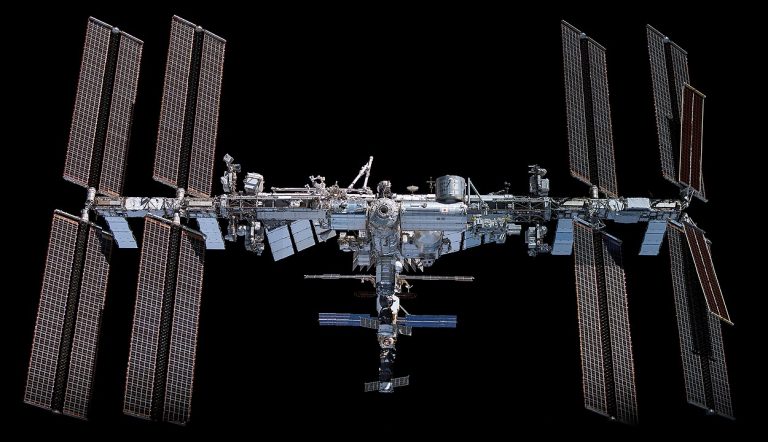
Two International Space Station Roll-Out Solar Arrays, or iROSAs, launched aboard SpaceX’s 22nd commercial resupply mission for the agency and were installed in 2021. These solar panels, which roll out using stored kinetic energy, expand the energy-production capabilities of the space station. The second set launching in the Dragon’s trunk, once installed, will be a part of the plan to provide a 20% to 30% increase in power for space station research and operations.

These arrays, the second of three packages, will complete the upgrade of half the station’s power channels. iROSA technology was first tested on the space station in 2017. Roll-out solar array technology was used on NASA’s Double Asteroid Redirection Test mission and is planned for use on Gateway, a future lunar space station and vital component of NASA’s Artemis program. The iROSA upgrades use the space station as a proving ground for the technology and research needed to explore farther into space.

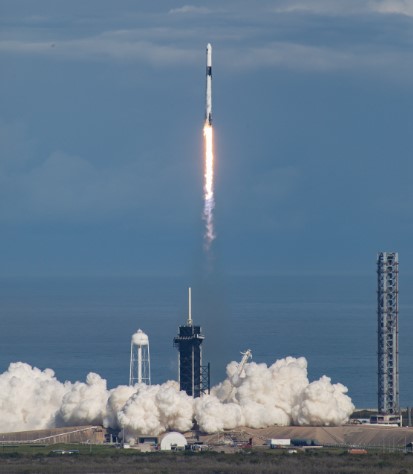
The SpaceX Falcon 9 rocket carrying the Dragon cargo spacecraft lifts off from Launch Complex 39A at NASA’s Kennedy Space Center in Florida on Nov. 26, 2022.
The SpaceX Falcon 9 rocket carrying the Dragon cargo spacecraft lifts off from Launch Complex 39A at NASA’s Kennedy Space Center in Florida on Nov. 26, 2022, on the company’s 26th commercial resupply services mission for the agency to the International Space Station. Liftoff was at 2:20 p.m. EST. Dragon will deliver more than 7,700 pounds of cargo, including a variety of NASA investigations, supplies, and equipment to the crew aboard the space station, including the next pair of ISS Roll Out Solar Arrays (iROSAs). The spacecraft is expected to spend about a month attached to the orbiting outpost before it returns to Earth with research and return cargo, splashing down off the coast of Florida.
Credits: NASA/Kim Shiflett

Big Hopes for Small Tomatoes

A continuous source of nutritious food is essential for long-duration exploration missions, and the typical pre-packaged astronaut diet may need to be supplemented by fresh foods produced in space. Researchers have been testing a plant growth unit on station known as Veggie and have successfully grown a variety of leafy greens. Veg-05, the next step in that work, focuses on growing dwarf tomatoes.

Building Bigger Structures

On Earth, gravity deforms large objects such as the beams used in large-scale construction. Microgravity enables fabrication of longer and thinner structures without this deformation. Extrusion demonstrates a technology using liquid resin to create shapes and forms that cannot be created on Earth. Photocurable resin, which uses light to harden the material into its final form, is injected into pre-made flexible forms and a camera captures footage of the process. The capability for using these forms could enable in-space construction of structures such as space stations, solar arrays, and equipment.

The Space Exploration Initiative supports a range of microgravity and lunar research across science, engineering, art, and design. The experiment is packed inside a Nanoracks Black Box with several other experiments from the Massachusetts Institute of Technology Media Lab and is sponsored by the ISS National Lab.

On-Demand Nutrients

Supplying adequate nutrition is a major challenge to maintaining crew health on future long-duration space missions. Many vitamins, nutrients, and pharmaceuticals have limited shelf-life, and the ability to make such compounds on-demand could help maintain crew health and well-being. BioNutrients-2 tests a system for producing key nutrients from yogurt, a fermented milk product known as kefir, and a yeast-based beverage.

The investigation kicks off phase two of the five-year BioNutrients program, headed by NASA’s Ames Research Center and managed by Game Changing Development in NASA’s Space Technology Mission Directorate. The program began with the launch of BioNutrients-1 in 2019. BioNutrients-2 employs a smaller system with a heated incubator that promotes growth of beneficial organisms.

The researchers also are working to find efficient ways to use local resources to make bulk products such as plastics, construction binders, and feedstock chemicals. Such technologies are designed to reduce launch costs and increase self-sufficiency, extending the horizons of human exploration.

Easing Gravity Transitions

Travelers to space all face the transition from one gravity field to another. On future exploration missions, astronauts may encounter three different gravity fields: weightlessness while traveling in space, the gravity of another planet, and Earth’s gravity when they return. These transitions can affect spatial orientation, head-eye and hand-eye coordination, balance, and locomotion, and cause some crew members to experience space motion sickness.

The Falcon Goggles hardware captures high-speed video of a subject’s eyes, providing precise data on ocular alignment and balance.

These are just a few of the hundreds of investigations currently conducted aboard the orbiting laboratory in the areas of biology and biotechnology, physical sciences, and Earth and space science. Advances in these areas will help keep astronauts healthy during long-duration space travel and demonstrate technologies for future human and robotic exploration beyond low-Earth orbit to the Moon and Mars.

Get breaking news, images and features from the space station on InstagramFacebook, and Twitter.

Subscribe and get the latest NASA news on this mission and many others with a weekly update in your inbox:

https://www.nasa.gov/subscribe

Kiana Raines
Headquarters, Washington
202-358-1100
[email protected]

Sandra Jones
Johnson Space Center, Houston
281-483-5111
[email protected]

Editor: Sean Potter

A Young Gas Giant Exoplanet Has Astronomers Puzzled

0

A team of astronomers led by Olga Zakhozhay from the MPIA discovered a giant exoplanet around the Sun-like star HD 114082. With an age of only 15 million years, this super-Jupiter is the youngest exoplanet of its kind for which astronomers managed to determine its radius and mass. While its size matches Jupiter’s diameter, the mass of HD 114082 b amounts to eight times Jupiter’s value. Combining these quantities is hard to reconcile with the widely accepted models of planet formation. A possible solution to this riddle may require an update of the formation models to allow for an unusually large solid planetary core. The results appear as a Letter to the Editor in the journal Astronomy & Astrophysics.

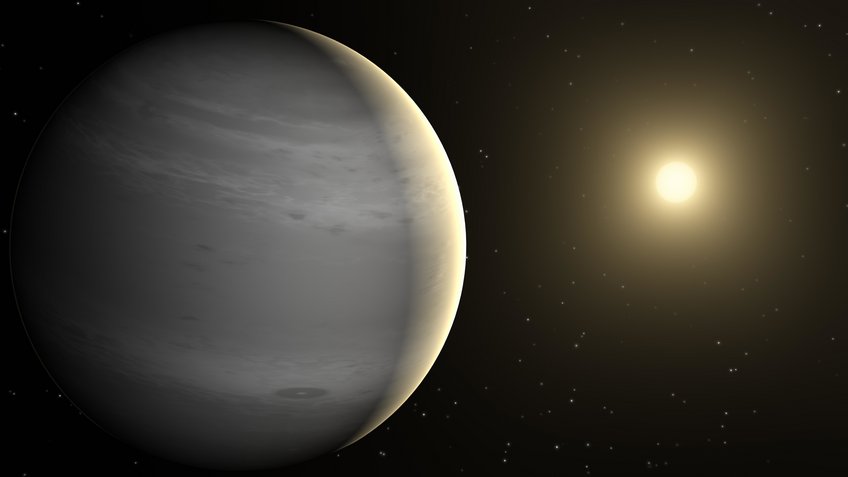
In the background: a black surface with isolated bright small dots representing stars.
In the foreground: the left half of the image consists of a grey sphere with various shades and stripes, illuminated from a distance by a yellow light source.
Artist’s conception of a gas giant exoplanet orbiting around a Sun-like star. The young exoplanet HD 114082 b revolves… [more]© NASA/JPL-Caltech

Astronomers have discovered more than 5000 exoplanets, of which about 15% are gas giants with masses of at least that of Jupiter. Now a group of astronomers led by Olga Zakhozhay (Max Planck Institute for Astronomy, Heidelberg, Germany and Main Astronomical Observatory, National Academy of Sciences of Ukraine, Kyiv, Ukraine) discovered an exoplanet named HD 114082 b with a peculiar set of properties that lets scientists scratch their heads.

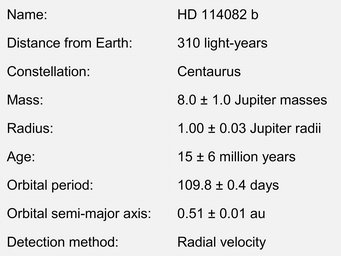
Name:	HD 114082 b
Distance from Earth:	310 light-years
Constellation:	Centaurus
Mass:	8.0 ± 1.0 Jupiter masses
Radius:	1.00 ± 0.03 Jupiter radii
Age:	15 ± 6 million years
Orbital period:	109.8 ± 0.4 days
Orbital semi-major axis:	0.51 ± 0.01 au
Detection method:	Radial velocity
Properties of the exoplanet HD 114082 b.

The planet is about as big as Jupiter, but its mass reaches eight Jupiter masses. “Compared to currently accepted models, HD 114082 b is about two to three times too dense for a young gas giant with only 15 million years of age,” says Olga Zakhozhay, the principal author of the study. The resulting mean density of that gas planet amounts to twice that of Earth – which is truly remarkable. After all, Earth is a rocky planet with an iron-nickel core, and not made of hydrogen and helium, the lightest elements in the Universe that make up Jupiter almost entirely.

HD 114082 b is currently the youngest known gas giant planet with an established mass and radius,” Zakhozhay points out. As a result, it promises to teach astronomers something about the formation of gas giants in general.

Two different mechanisms of planet formation

We think that giant planets can form in two possible ways,” Ralf Launhardt, a co-author from MPIA, says. “Both occur inside a protoplanetary disk of gas and dust distributed around a young central star.” The first process, known as “core accretion”, involves in a first stage, accumulating a solid core of rocky material. Once it attains a critical mass, its gravitational force attracts the surrounding gas, leading to the accretion of hydrogen and helium in a runaway process to form a giant planet. The second mode, named “disk instability”, features gravitationally unstable parcels of dense gas that collapse directly to grow into a giant planet without a rocky core.

Depending on the assumptions made for those two scenarios, the gas should cool down at different rates, determining the temperature of young gas giant planets. Hence, the new planets may experience a “cold start” or a “hot start”, leading to observable differences that can potentially distinguish between those models, especially at a young age.

The preferred models don’t fit

Currently, astronomers prefer a core accretion scenario with a hot start for giant planets sich as HD 114082 b. Since hot gas encompasses a larger volume than cold gas, one should measure notable differences in the sizes of the observed planets. This contrast in size is more pronounced for young planets. However, it becomes less pronounced during the initial hundreds of millions of years of cooling after formation.

At face value, HD 114082 b defies the astronomers’ expectations. Its combination of mass and size is incompatible with the hot start picture. Instead, it seems to match the cold-start scenario better. Interestingly, other, slightly older candidates cited in other studies show the same behaviour. “It’s much too early to abandon the notion of a hot start,” Ralf Launhardt explains. “All we can say is that we still don’t understand the formation of giant planets very well.” It is clear that compared to the current models, HD 114082 b is too small for its mass. Either it has an unusually large solid core, or the models are incorrect and underestimate the rate by which those gas giants can cool – or both.

The benefit of long-term projects

HD 114082 b’s discovery results from an extensive observational program named RVSPY (Radial Velocity Survey for Planets around Young stars). Currently, it consists of 775 hours of observing time with the MPIA-operated ESO/MPG 2.2-metre telescope at the European Southern Observatory’s (ESO) La Silla site in Chile, spread out across 4.5 years. RVSPY is a good example of high-yield astronomical research carried out at telescopes with sustained access over a long period. Such studies would hardly be possible with the latest telescopes, as the observation time per project is severely limited due to the high demand.

RVSPY aims to uncover the population of (hot, warm, and cold) giant planets around young stars. To do this, the astronomers obtain time series of spectra of 111 young stars, meaning splitting the starlight into its fundamental colour components, similar to what we see in a rainbow. Tiny periodic shifts in the stellar spectra may indicate a tumbling movement of the observed star caused by the gravitational pull of an orbiting planet. In principle, the stars’ activity, like pulsations or flares, may compromise the measurements, particularly in young stars like HD 114082. However, the RVSPY data quality is good enough to detect the signal from the wobbling star beyond any doubt. The team also included older archival data from other telescopes to extend the coverage into the past.

A transit event completes the analysis

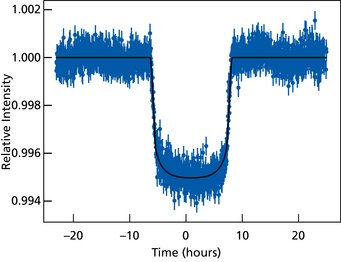
Diagram with horizontal (time in hours, from -20 to +20) and vertical axis (relative intensity, from 0.994 to 1.002). A black curve runs from left to right, starting and ending at the value 1.000 and dropping to the value 0.995 in the middle. Blue dots with short vertical lines (data points) are arranged around the curve.
Light curve of the exoplanet’s transit across its parent star. It shows the relative reduction in stellar intensity due… [more]© Zakhozhay et al. (2022) / MPIA

While astronomers apply this so-called radial velocity (RV) method to infer a planet’s mass and duration of one revolution around its central star, the orbital period, they must rely on a different technique to determine its size. Suppose that the planetary orbit is oriented in such a way to us that, by chance, it crosses the central star. Astronomers call such an event a “transit”. When that happens, the periodic tiny reduction in the received light during transits can be directly translated into the planet’s radius and helps refine its orbital period.

We already suspected a nearly edge-on configuration of the planetary orbit from a ring of dust around HD 114082 discovered several years ago,” says Olga Zakhozhay. “Still, we felt lucky to find an observation in the TESS data with a beautiful transit light curve that improved our analysis.” TESS (Transiting Exoplanet Survey Satellite) is a NASA space probe searching for exoplanets around stars relatively close to Earth.

Combining these measurements, Zakhozhay and her colleagues found HD 114082 b to orbit its Sun-like parent star within 110 days at a distance of approximately 0.5 astronomical units. One astronomical unit is the mean distance between the Sun and Earth. It thus resembles the orbit of Mercury around our sun.

In need of better models

HD 114082 b is one of only three young giant planets with ages up to 30 million years with known masses and sizes. And all of them are probably inconsistent with the most commonly adopted hot-start models. Although the astronomers are looking at low-number statistics with three out of three, it seems unlikely those planets are all outliers. “While more such planets are needed to confirm this trend, we believe that theorists should begin re-evaluating their calculations,” Zakhozhay points out. “It’s exciting how our observational results feed back into planet formation theory. They help improve our knowledge about how these giant planets grow and tell us where the gaps of our understanding lie.

Background information

The MPIA researchers involved in this study are Olga V. Zakhozhay (also Main Astronomical Observatory, National Academy of Sciences of Ukraine, Kyiv, Ukraine), Ralf Launhardt, Trifon Trifonov, Martin Kürster, Thomas Henning, and Gabriel-Dominique Marleau (also University Duisburg-Essen, Germany; Tübingen University, Germany; Bern University, Switzerland).

Dr. Markus Nielbock

Press and public relations officer +49 6221 528-134 pr@…
Markus Nielbock / MPIA
Max Planck Institute for Astronomy, Heidelberg

Dr. Olga V. Zakhozhay

+49 6221 528-292 zakhozhay@…
Max Planck Institute for Astronomy, Heidelberg