
Home Blog Page 111

Mysteriously Bright Flash Is A Black Hole Jet Pointing Straight Toward Earth, Astronomers Say

0
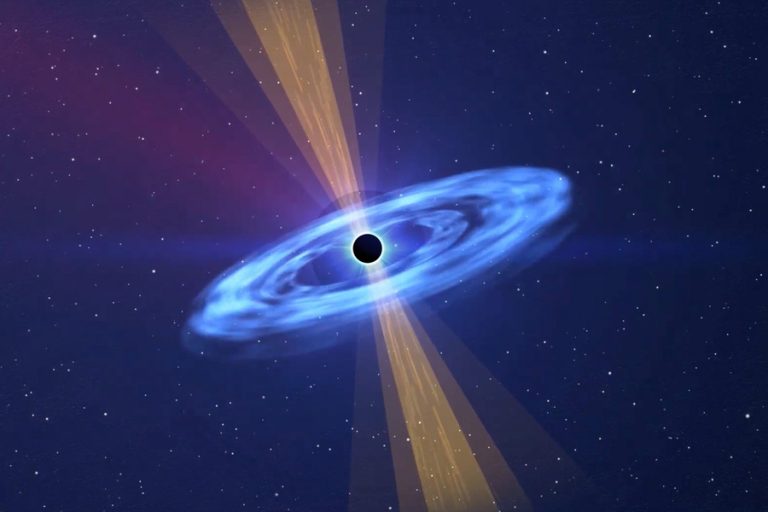
Astronomers identified an extremely bright black hole jet, halfway across the universe, pointing straight toward Earth. Credit: Dheeraj Pasham, Matteo Lucchini, and Margaret Trippe.

Earlier this year, astronomers were keeping tabs on data from the Zwicky Transient Facility, an all-sky survey based at the Palomar Observatory in California, when they detected an extraordinary flash in a part of the sky where no such light had been observed the night before. From a rough calculation, the flash appeared to give off more light than 1,000 trillion suns.

The team, led by researchers at NASA, Caltech, and elsewhere, posted their discovery to an astronomy newsletter, where the signal drew the attention of astronomers around the world, including scientists at MIT. Over the next few days, multiple telescopes focused in on the signal to gather more data across multiple wavelengths in the X-ray, ultraviolet, optical, and radio bands, to see what could possibly produce such an enormous amount of light.

Now, the MIT astronomers along with their collaborators have determined a likely source for the signal. In a study appearing today in Nature Astronomy, the scientists report that the signal, named AT 2022cmc, likely comes from a relativistic jet of matter streaking out from a supermassive black hole at close to the speed of light. They believe the jet is the product of a black hole that suddenly began devouring a nearby star, releasing a huge amount of energy in the process.

Astronomers have observed other such “tidal disruption events,” or TDEs, in which a passing star is torn apart by a black hole’s tidal forces. AT 2022cmc is brighter than any TDE discovered to date. The source is also the farthest TDE ever detected, at some 8.5 billion lights years away — more than halfway across the universe.

How could such a distant event appear so bright in our sky? The team says the black hole’s jet may be pointing directly toward Earth, making the signal appear brighter than if the jet were pointing in any other direction. The effect is “Doppler boosting” and is similar to the amped-up sound of a passing siren.

AT 2022cmc is the fourth Doppler-boosted TDE ever detected and the first such event that has been observed since 2011. It is also the first TDE discovered using an optical sky survey.

As more powerful telescopes start up in the coming years, they will reveal more TDEs, which can shed light on how supermassive black holes grow and shape the galaxies around them.

“We know there is one supermassive black hole per galaxy, and they formed very quickly in the universe’s first million years,” says co-author Matteo Lucchini, a postdoc in MIT’s Kavli Institute for Astrophysics and Space Research. “That tells us they feed very fast, though we don’t know how that feeding process works. So, sources like a TDE can actually be a really good probe for how that process happens.”

Lucchini’s MIT co-authors include first author and Research Scientist Dheeraj “DJ” Pasham, postdoc Peter Kosec, Assistant Professor Erin Kara, and Principal Research Scientist Ronald Remillard, along with collaborators at universities and institutions around the world.

Animated video of the discovery of a relativistic jet, launched by a black hole. The new AT2022cmc signal was detected by researchers at MIT and elsewhere. This video was produced by MIT, with the collaboration of Dheeraj Reddy (MIT), Tomás E. Müller Bravo (ICE-CSIC and IEEC) and Noel Castro Segura (University of Southampton), among others. Credit: Dheeraj Pasham, Matteo Lucchini, and Margaret Trippe.

Feeding frenzy

Following AT 2022cmc’s initial discovery, Pasham and Lucchini focused in on the signal using the Neutron star Interior Composition ExploreR (NICER), an X-ray telescope that operates aboard the International Space Station.

“Things looked pretty normal the first three days,” Pasham recalls. “Then we looked at it with an X-ray telescope, and what we found was, the source was too bright.”

Typically, such bright flashes in the sky are gamma-ray bursts — extreme jets of X-ray emissions that spew from the collapse of massive stars.

“This particular event was 100 times more powerful than the most powerful gamma-ray burst afterglow,” Pasham says. “It was something extraordinary.”

The team then gathered observations from other X-ray, radio, optical, and UV telescopes and tracked the signal’s activity over the next few weeks. The most remarkable property they observed was the signal’s extreme luminosity in the X-ray band. They found that X-ray emissions from AT 2022cmc swung widely by a factor of 500 over a few weeks,

They suspected that such extreme X-ray activity must be powered by an “extreme accretion episode” — an event that generates a huge churning disk, such as from a tidal disruption event, in which a shredded star creates a whirlpool of debris as it falls into a black hole.

Indeed, the team found that AT 2022cmc’s X-ray luminosity was comparable to, though brighter than, three previously detected TDEs. These bright events happened to generate jets of matter pointing straight toward Earth. The researchers wondered: If AT 2022cmc’s luminosity is the result of a similar Earth-targeting jet, how fast must the jet be moving to generate such a bright signal? To answer this, Lucchini modeled the signal’s data, assuming the event involved a jet headed straight toward Earth.

“We found that the jet speed is 99.99 percent the speed of light,” Lucchini says.

To produce such an intense jet, the black hole must be in an extremely active phase — what Pasham describes as a “hyper-feeding frenzy.”

“It’s probably swallowing the star at the rate of half the mass of the sun per year,” Pasham estimates. “A lot of this tidal disruption happens early on, and we were able to catch this event right at the beginning, within one week of the black hole starting to feed on the star.”

“We expect many more of these TDEs in the future,” Lucchini adds. “Then we might be able to say, finally, how exactly black holes launch these extremely powerful jets.”

Reprinted with permission of MIT News

By Jennifer Chu | MIT News Office
Source MIT
Arianespace Ariane 6 To launch Intelsat Satellites

0

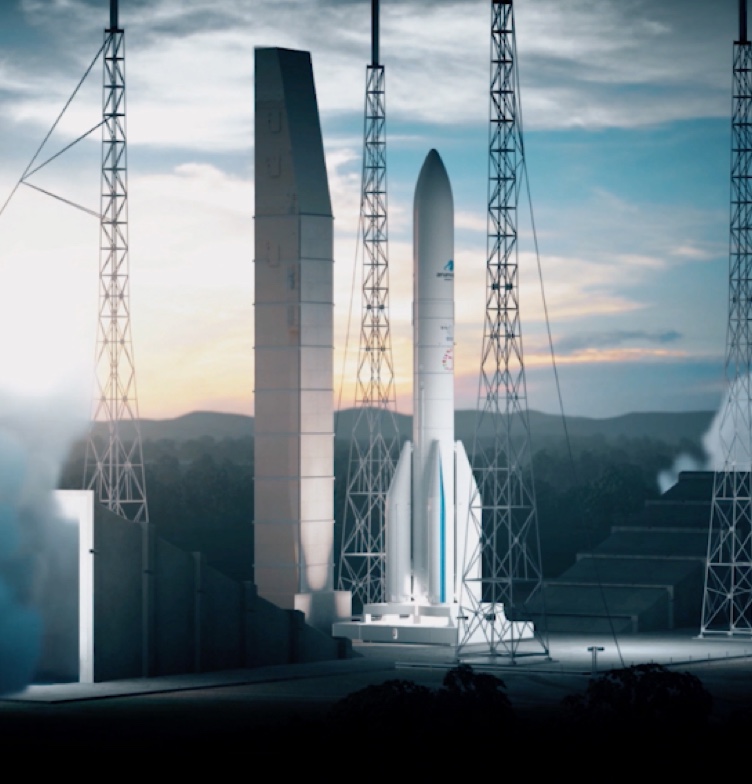
Arianespace signed a contract with longtime customer Intelsat to launch two satellite payloads, IS-41 and IS-44, using the heavy-lift Ariane 64 from Europe’s Spaceport in French Guiana in 2025. This agreement repurposes a previous launch contract and adds one additional satellite.

“We are honored, yet again, by our faithful longtime partner Intelsat with another significant contract,” said Stéphane Israël, CEO of Arianespace. “Intelsat is entrusting us with two highly sophisticated payloads for flight aboard our next generation heavy lift vehicle, the Ariane 64. What a tremendous vote of confidence in our team and our launcher! This special relationship goes back four decades and spans the entire Ariane line.”

“Launched with the Ariane 6, these innovative satellites will extend Intelsat’s 5G global reach and Media neighborhoods with high-speed, dynamically-allocated connectivity across Africa, Europe, the Middle East and Asia for commercial and government mobility customers, as well as cellular network backhaul,” said David C. Wajsgras, CEO of Intelsat. “Without world-class, international aerospace partners like Arianespace, Intelsat would not be the global leader it is today.”

Thales Alenia Space is manufacturing the IS-41 and IS-44 satellites, which are based on the innovative and flexible Space Inspire product line. The two software-defined satellites, fully reconfigurable in orbit, will collectively weigh close to 8000 kg at launch and will be placed into the requested geostationary transfer orbit.

Ariane 6 has been designed from the outset to be scalable and able to integrate, during its life and on a regular basis, new technologies. Ariane 6’s incremental development is intended to regularly improve the performance of the launch solutions offered by Arianespace and always better fulfil the needs of both institutional and commercial customers. These developments are funded and managed by the European Space Agency (ESA) and implemented by Ariane 6’s launcher system prime contractor ArianeGroup.

About Arianespace

Arianespace uses Space to make life better on Earth by providing launch services for all types of satellites into all orbits. It has orbited over 1,100 satellites since 1980. Arianespace is responsible for operating the new-generation Ariane 6 and Vega C launchers, developed by ESA, with respectively ArianeGroup and Avio as industrial primes. Arianespace is headquartered in Evry, near Paris, and has a technical facility at the Guiana Space Center in French Guiana, plus local offices in Washington, D.C., Tokyo and Singapore. Arianespace is a subsidiary of ArianeGroup, which holds 74% of its share capital, with the balance held by 15 other shareholders from the Ariane and Vega European launcher industry, and ESA and Cnes as censors.

TI Expands Space-Grade Product Portfolio With Radiation-Hardened And Radiation-Tolerant Plastic Packages For Missions From New Space To Deep Space

0

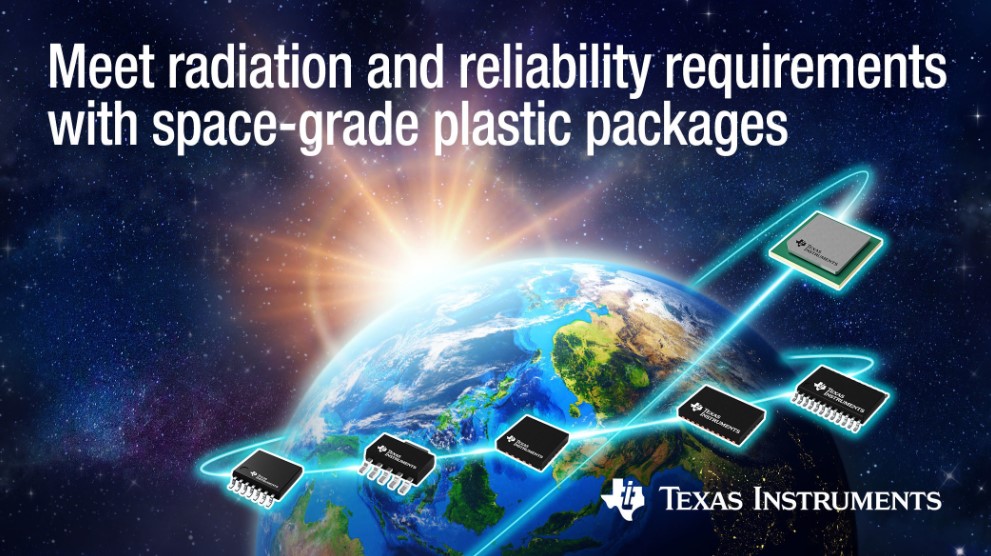
Texas Instruments (TI) (Nasdaq: TXN) announced an expansion in its portfolio of space-grade analog semiconductor products in highly reliable plastic packages for a diverse range of missions. TI developed a new device screening specification called space high-grade in plastic (SHP) for radiation-hardened products and introduced new analog-to-digital converters (ADCs) that meet the SHP qualification. TI also introduced new product families to the radiation-tolerant Space Enhanced Plastic (Space EP) portfolio. Compared to traditional ceramic packages, plastic packages offer a smaller footprint that enables designers to reduce system-level size, weight and power, and thus help reduce launch costs.

In the past, space applications and programs used hermetically sealed, ceramic Qualified Manufacturers List (QML) Class V devices to ensure reliability. Today, applications like those in new space, designed to increase commercial access to space programs through short-term missions in low Earth orbit (LEO), are helping expand communication and connectivity. For new space applications, there is a growing need for smaller components that help reduce system size and weight – and therefore lower the cost required to launch an application into space. Plastic substrate ball-grid array (PBGA) and plastic-encapsulated devices offer an alternative to traditional space semiconductor packages.

Meet radiation and reliability requirements with space-grade plastic packages

New SHP ADCs improve thermal efficiency and increase bandwidth in a smaller size

TI’s SHP specification indicates integrated circuits (ICs) that meet the rigorous design requirements of deep space missions with extremely harsh environmental conditions. The SHP specification includes both PBGA and plastic-encapsulated packages for radiation-hardened semiconductors. The 10-mm-by-10-mm-by-1.9-mm ADC12DJ5200-SP and ADC12QJ1600-SP ADCs in flip-chip BGA SHP packages are the first products from TI that meet the SHP specification. These ADCs help enable designs as much as seven times smaller than those using equivalent ceramic-packaged devices, maximize data communication speeds with SerDes rates up to 17.1 Gbps, and reduce thermal resistance. Learn more about TI’s SHP specification by reading “How SHP in Plastic Packaging Addresses 3 Key Space Application Design Challenges.”

Space EP product families increase power efficiency and save board space for new space missions

TI’s Space EP portfolio is the industry’s largest plastic, radiation-tolerant power management and signal-chain portfolio, with devices specifically designed for smaller, high-volume LEO satellite applications. Space EP devices can help save as much as 50% board space compared to traditional ceramic packages, and deliver high-performance power supplies with rail-to-rail input/output operation. The TPS7H5005-SEP family of pulse-width modulation (PWM) controllers are the newest products in TI’s Space EP portfolio, and support multiple power-supply topologies and field-effect transistor (FET) architectures. TPS7H5005-SEP PWM controllers minimize power loss through synchronous rectification, enabling at least 5% higher power efficiency compared to equivalent devices. Learn more about TI’s Space EP products by reading the application note, “Reduce the Risk in Low-Earth Orbit Missions with Space Enhanced Plastic Products.”

With over 60 years in the space market, TI continues to develop radiation-hardened and radiation-tolerant products and packaging that enable designers to meet mission-critical requirements with increased power density, performance capabilities and reliability.

Availability

Space EP and SHP devices are available for purchase on TI.com and through authorized distributors. Full and custom-quantity reels are available on TI.com and through other channels. Manufacturers can select specific date and lot codes before placing their order on TI.com. Each QML lot ships with a certificate of conformance – a quality conformance inspection and a processing conformance report summarizing traceability and testing performed – per Military Performance Specification (MIL-PRF)-38535. See these and all of TI’s products for space at TI.com/space.

About Texas Instruments

Texas Instruments Incorporated (Nasdaq: TXN) is a global semiconductor company that designs, manufactures, tests and sells analog and embedded processing chips for markets such as industrial, automotive, personal electronics, communications equipment and enterprise systems. Our passion to create a better world by making electronics more affordable through semiconductors is alive today, as each generation of innovation builds upon the last to make our technology smaller, more efficient, more reliable and more affordable – making it possible for semiconductors to go into electronics everywhere. We think of this as Engineering Progress. It’s what we do and have been doing for decades. Learn more at TI.com.

Trademarks

All registered trademarks and other trademarks belong to their respective owners.

SOURCE Texas Instruments

“Amelia Earhart” Departs Buckley Space Force Base

0
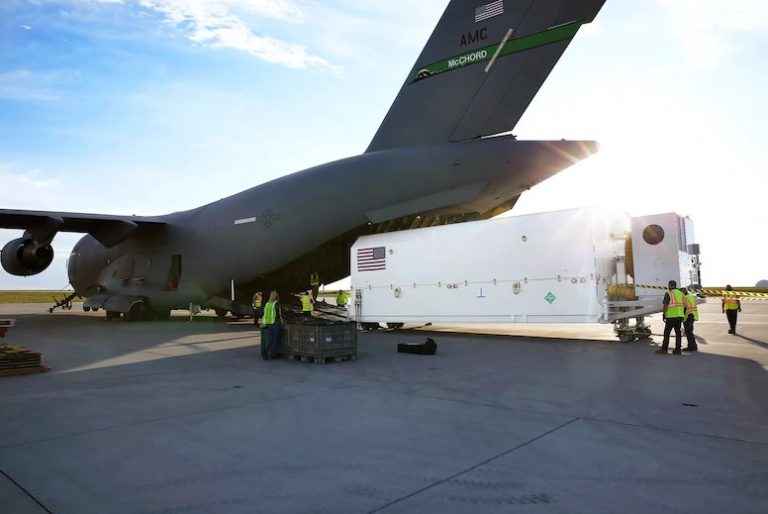
The USSF and Missile Systems Center deliver a GPS III satellite to Cape Canaveral Air Force Station, Florida. Credit: US Space Force/Los Angles Air Force Base.

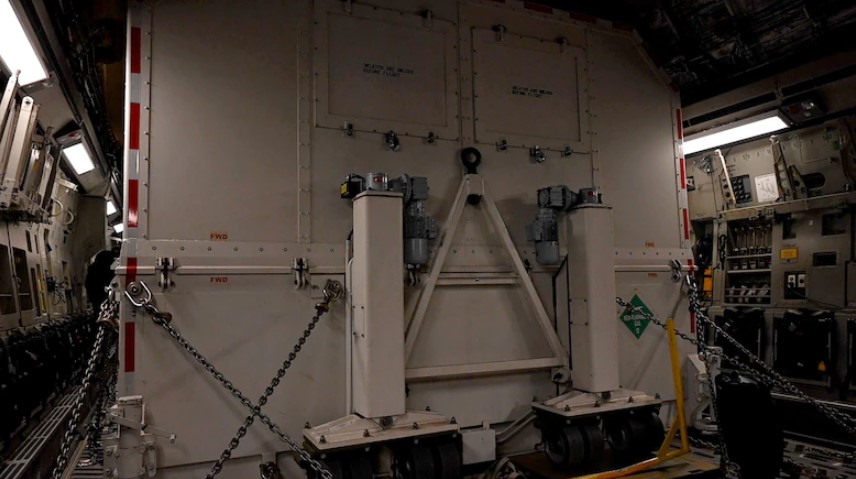
GPS III Space Vehicle (SV) 06 named “Amelia Earhart” for the United States Space Force was successfully moved from a Lockheed Martin facility in Denver, Colorado via the Buckley Space Force Base flightline, enroute to Cape Canaveral Space Force Station, Florida on Oct. 24, 2022.

After being declared “Available for launch” by U.S. Space Force’s Space Systems Command SV06, is the sixth of 10 GPS III satellites that will be joining the operational constellation consisting of 31 GPS satellites.

“The Total Force Airmen and Space Force Guardians of Buckley are prepared to assist in any movements or support to the Department of Defense,” said Col. Marcus Jackson, BSFB installation commander. “I am proud of the coordination, community partnership, and logistical efforts of our service members to continue creating a lean and agile service.”

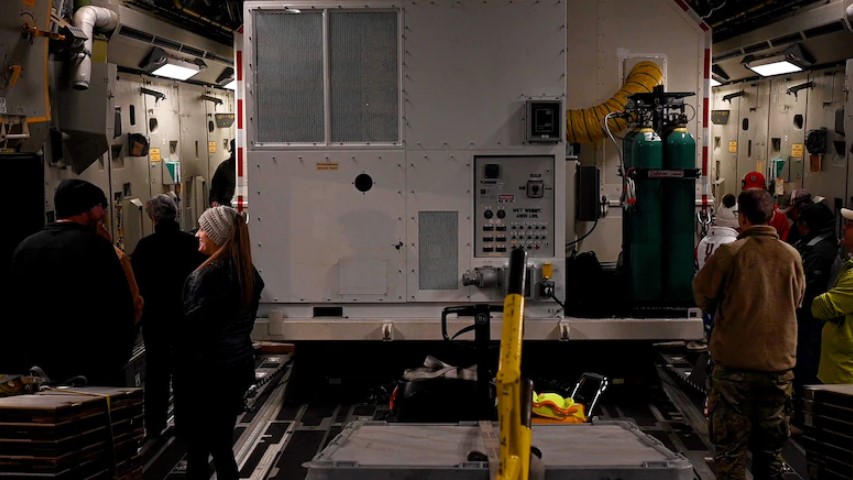
Members in support of GPS III Space Vehicle (SV) 06 “Amelia Earhart” come together to travel with the satellite to Cape Canaveral Space Force Station, Fla., from Buckley Space Force Base, Colo., Oct. 24, 2022. GPS III will be processed at the Astrotech Space Operations facility in Titusville, Fla., where it will undergo final post-ship functional testing, be loaded with its onboard propellant, and then encapsulated for launch in January. (U.S. Space Force photo by Airman 1st Class Shaun Combs)

GPS III SV06 will deliver enhances performance and accuracy through a variety of improvements, including increased signal protection and improved accuracy. The GPS III constellation will also expand the civilian L5 signal, dubbed the “safety-of-life” signal.

GPS III SV06 will be processed at the Astrotech Space Operations facility in Titusville, Florida.

While at Astrotech, it will undergo final post-ship functional testing, be loaded with its onboard propellant, and then encapsulated for launch aboard a Space X Falcon 9 vehicle at Cape Canaveral, Florida in January 2023.

Once launched and set healthy, GPS III SV06 will enhance operational capability support to Space Delta 4. The addition of the new satellite will increase the resiliency of the operating system, ensuring long lasting readiness into the foreseeable future.

“GPS III supports all of Delta 4 missions as a provider of precisions timing and is a key asset supporting satellite positioning,” Lyon said. “Having a GPS capability, allows our Guardians to provide real-time synchronization with our Space Based Infrared Systems’ constellations, securing our readiness in Space.”

GPS III Space Vehicle (SV)06 “Amelia Earhart” is being prepared for takeoff from Buckley Space Force Base, Colo., enroute to Cape Canaveral Space Force Station, Fla., Oct. 24, 2022. GPS III will deliver some capability improvements, including increased signal protection, and the addition of a new civilian GPS signal. (U.S. Space Force photo by Airman 1st Class Shaun Combs)

As a crucial technological foundation for internet, financial, transportation, and agricultural operations, GPS delivers the gold standard in positioning, navigation, and timing services supporting U.S. and allied operations worldwide.

Artemis I Flight Day 15 – Team Polls “Go” For Distant Retrograde Orbit Departure

0
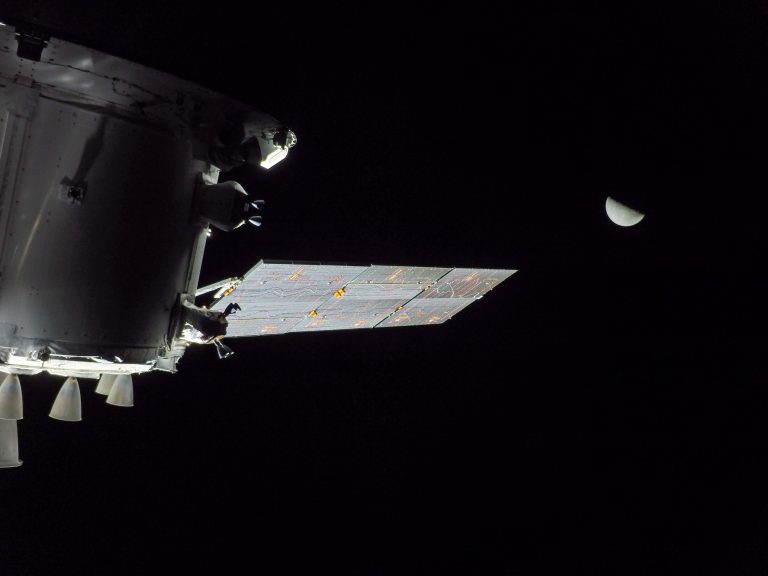
art001e000669 (Nov. 27, 2022) On flight day 12 of the 25.5-day Artemis I mission, a camera on the tip of one of Orion’s solar arrays captured the Moon as Orion travels in distant retrograde orbit around the Moon.

The Artemis I mission management team met today to review the overall status of the flight test and polled “go” for Orion to depart from its distant retrograde orbit, where it has been since Nov. 25. Orion will conduct a burn to depart the orbit at 3:53 p.m. CST Thurs., Dec. 1 and begin its trek back toward Earth.  

“We are continuing to collect flight test data and buy down risk for crewed flight,” said Mike Sarafin, Artemis mission manager. “We continue to learn how the system is performing, where our margins are, and how to operate and work with the vehicle as an integrated team.” 

On Flight Day 15, Orion also performed a planned orbit maintenance burn to maintain the spacecraft’s trajectory and decrease its velocity ahead of its Thursday departure from a distant lunar orbit. During the burn, Orion used six of its auxiliary thrusters on the European Service module to fire for 95 seconds. The burn was initially planned for a shorter duration but was lengthened as part of the team’s effort to add test objectives to the mission. The 95-second burn provided additional data to characterize the thrusters and the radiative heating on the spacecraft’s solar array wings to help inform Orion’s operational constraints. All previous thruster burns were 17 seconds or less.  

Orion’s European-built service module has provided the propulsive capabilities to adjust the spacecraft’s course in space via its 33 engines of various types, and serves as Orion’s powerhouse, supplying it will electricity, thermal control, and air and water for future crews, in addition to propulsion. Artemis I is the first time NASA is using a European-built system as a critical element to power an American spacecraft. Provided by ESA (European Space Agency) and its partner Airbus Defence and Space, the service module extends NASA’s international cooperation from the International Space Station into deep space exploration.  

NASA is continuing to extend its relationships with its international partners to explore the Moon under Artemis. The agency’s Gateway, a multi-purpose outpost in development to orbit the Moon that will provide essential support for long-term lunar exploration, includes contributions from ESA as well as the Canadian Space Agency and the Japan Aerospace Exploration Agency. Agencywide, NASA has more than 600 active international agreements with organizations and space agencies around the world. 

Teams also elected to add four additional test objectives to Orion’s return trip to Earth to gather additional data on the spacecraft’s capabilities. Two will evaluate whether opening and closing a valve the pressure control assembly affects a slow leak rate in that system; a third will demonstrate Orion’s ability to perform attitude maneuvers at the rate that will be necessary for a test on Artemis II; and the fourth will test its capability to fly in a three degree of freedom attitude control mode, as opposed to the six degree of freedom mode it typically flies in.

Prior to today’s orbital maintenance burn, a total of 5,681 pounds of propellant had been used, 203 pounds less than values expected before launch. Some 2,004 pounds of margin is available beyond what is planned for use during the mission, a 94-pound increase above prelaunch expected values. 

Just after 4 p.m. CST on Nov. 30, Orion was traveling 253,079 miles from Earth and 50,901 miles from the Moon, cruising at 2,052 mph. 

Coverage of the distant retrograde orbit departure burn will begin Thursday at 3:30 p.m. CST, with the burn scheduled to occur at 3:53 p.m. Watch live on NASA TV, the agency’s website, and the NASA app. 

View the latest imagery of the Moon, Earth, and Orion on NASA’s Johnson Space Center Flickr account and Image and Video Library. When bandwidth allows, views of the mission are available in real-time

By Shaneequa Vereen
Source NASA

Airbus Reveals Hydrogen-Powered Zero-Emission Engine

0

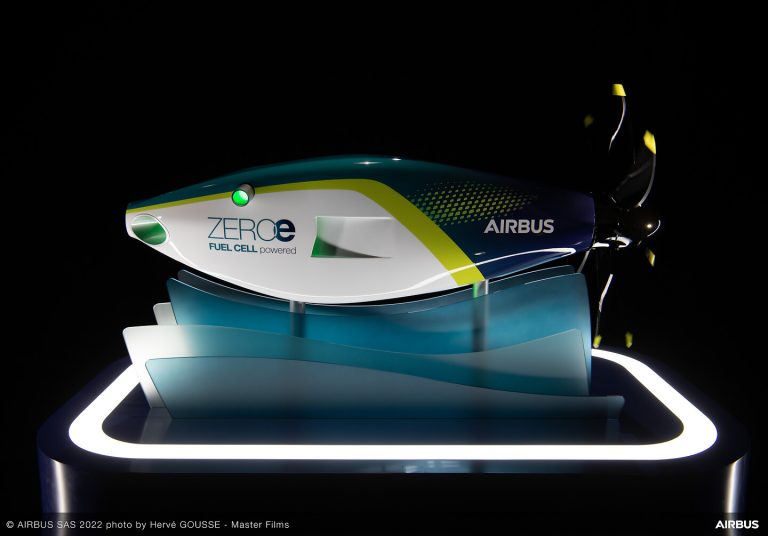
Airbus has revealed that it is developing a hydrogen-powered fuel cell engine. The propulsion system is being considered as one of the potential solutions to equip its zero-emission aircraft that will enter service by 2035. 

Airbus will start ground and flight testing this fuel cell engine architecture onboard its ZEROe demonstrator aircraft towards the middle of the decade. The A380 MSN1 flight test aircraft for new hydrogen technologies is currently being modified to carry liquid hydrogen tanks and their associated distribution systems. 

“Fuel cells are a potential solution to help us achieve our zero-emission ambition and we are focused on developing and testing this technology to understand if it is feasible and viable for a 2035 entry-into-service of a zero-emission aircraft,” said Glenn Llewellyn, VP Zero-Emission Aircraft, Airbus. “At scale, and if the technology targets were achieved, fuel cell engines may be able to power a one hundred passenger aircraft with a range of approximately 1,000 nautical miles. By continuing to invest in this technology we are giving ourselves additional options that will inform our decisions on the architecture of our future ZEROe aircraft, the development of which we intend to launch in the 2027-2028 timeframe.”

Airbus identified hydrogen as one of the most promising alternatives to power a zero-emission aircraft, because it emits no carbon dioxide when generated from renewable energy, with water being its most significant by-products. 

There are two ways hydrogen can be used as a power source for aircraft propulsion. First via hydrogen combustion in a gas turbine, second, by using fuel cells to convert hydrogen into electricity in order to power a propeller engine. A hydrogen gas turbine can also be coupled with fuel cells instead of batteries in a hybrid-electric architecture.

Hydrogen fuel cells, especially when stacked together, increase their power output allowing scalability. In addition, an engine powered by hydrogen fuel cells produces zero NOx emissions or contrails thereby offering additional decarbonisation benefits.

Airbus has been exploring the possibilities of fuel cell propulsion systems for aviation for some time. In October 2020, Airbus created Aerostack, a joint venture with ElringKlinger, a company with over 20 years of experience as both a fuel cell systems and component supplier. In December 2020, Airbus presented its pod-concept which included six removable fuel cell propeller propulsion systems. 

To find more about Airbus’ fuel cell engine and demonstrator, click here.

Click on the following links to find out more about fuel cell technology, and the ZEROe demonstrator.

Orion, Earth, And The Moon

0

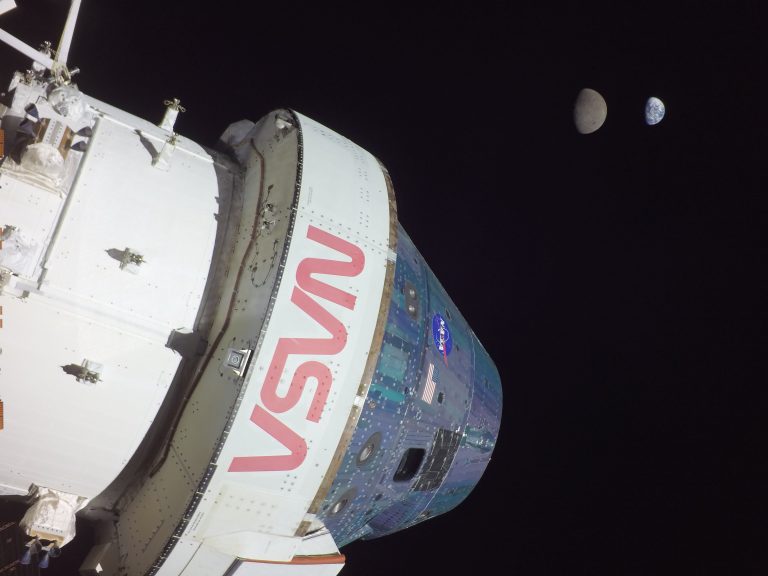
On Monday, Nov. 28, 2022, NASA’s Orion spacecraft reached its maximum distance from Earth during the Artemis I mission—268,563 miles away from our home planet, farther than any spacecraft designed to send humans to space and back has gone before. In this image, Orion captures a unique view of Earth and the Moon, seen from a camera mounted on one of the spacecraft’s solar arrays.

Image credit: NASA

Watch a live video stream from the Orion spacecraft.

Track NASA’s Artemis I mission in real time.

By Michael Bock

NASA To Cancel GeoCarb Mission, Expands Greenhouse Gas Portfolio

0

NASA announced Monday it intends to cancel development of its GeoCarb mission, and instead implement a plan for pursuing alternate options to measure and observe greenhouse gases.

Newer options to make key greenhouse gas measurements are emerging that were not previously available for the agency when considering GeoCarb. For example, NASA’s newest instrument that launched in July to the International Space Station, the Earth Surface Mineral Dust Source Investigation (EMIT), can measure methane.

“Decisions like this are difficult, but NASA is dedicated to making careful choices with the resources provided by the people of the United States” said Thomas Zurbuchen, the associate administrator for science at NASA Headquarters in Washington. “We look forward to accomplishing our commitment to state-of-the-art climate observation in a more efficient and cost-effective way.”

NASA plans to augment its greenhouse gas observations by prioritizing a greenhouse gas mission as the first Earth System Explorers mission, obtaining greenhouse gas data from international and commercial partners, extending the Orbiting Carbon Observatory-3 mission aboard the orbital laboratory, and conducting additional airborne observations.

Additionally, NASA’s Earth System Observatory, slated to launch by the end of the decade, is the next generation of missions to observe Earth, and will provide a 3D, holistic view of our planet to help better understand what its changes mean for humanity.  

“NASA prioritizes understanding how our home planet is changing — and greenhouse gases play a central role in that understanding,” said Karen St. Germain, NASA Earth Science division director at the agency’s headquarters in Washington.  “We are committed to making key methane and carbon dioxide observations, integrating them with measurements collected by other national, international, and private sector missions, and making actionable information available to communities and organizations who need it to inform their decisions.”

NASA reached the decision about GeoCarb because of technical concerns, cost performance, and availability of new alternative data sources, as well as to keep the Earth Science portfolio aligned with overall science priorities. GeoCarb sought to probe the natural sources and exchange processes that control carbon dioxide, carbon monoxide, and methane in the atmosphere over the Americas. NASA will collaborate with the principal investigator team at the University of Oklahoma to plan an orderly close out the project.

The current estimated life cycle cost estimate for GeoCarb is over $600 million. This estimate is more than three times the life cycle cost at the time of selection, which was capped at $170.9 million. The increased costs and delays of GeoCarb would have a detrimental impact on NASA’s Earth Science portfolio, including delays of up to two years for the Earth System Observatory which addresses the highest priorities for Earth Science as described by the National Academies.

For decades, NASA’s satellite missions in space, airborne and field campaigns have provided information about climate change, including melting glaciers, sea level rise, and greenhouse gas emissions. NASA remains committed to being a world leader in studying greenhouse gases, understanding how the planet is changing, helping communities understand that information, and how to apply it in a changing climate.

For more about the full range of NASA’s Earth science and climate research, visit:

https://www.nasa.gov/earth

-end-

Tylar Greene / Karen Fox
Headquarters, Washington
202-358-0030 / 202-358-1275
[email protected] / [email protected]

By Roxana Bardan

Artemis I — I Flight Day 14: Deep Space Testing Continues

0
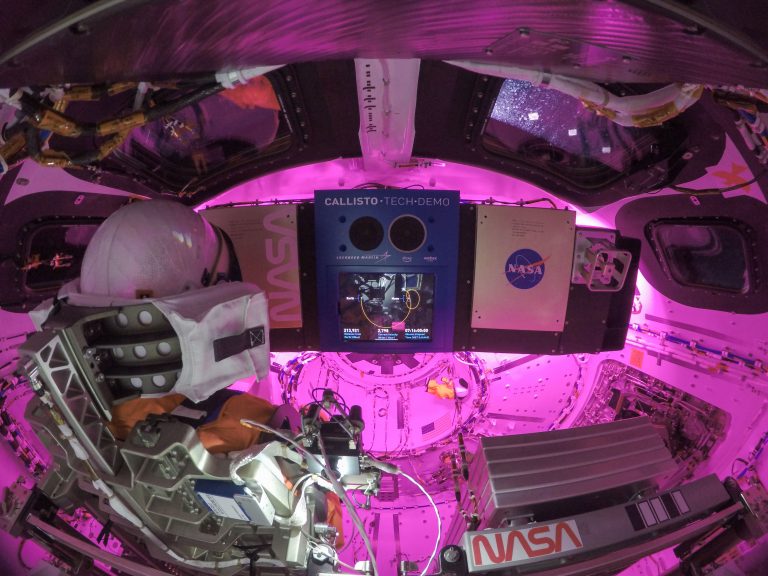
art001e000606 (Nov. 24, 2022) On flight day 9, the inside of Orion shows the display of the Callisto payload. Callisto is Lockheed Martin’s technology demonstration in collaboration with Amazon and Cisco, testing voice-activated and video technology that may assist future astronauts on deep space missions.

Engineers continued with the jet firing development flight test objective that began on flight day 12. Today, teams demonstrated the “low” portion of the reaction control thruster firing time range. This test objective is designed to exercise the reaction control system jets in a different configuration to model how thruster jets will be used during the Artemis II mission, furthering our understanding of spacecraft operations before we have crew onboard. 

As part of planned testing throughout the mission, the guidance, navigation, and control officer, also known as GNC, performed the sixth of eight planned tests of the star trackers that support Orion’s navigation system. Star trackers are a navigation tool that measure the positions of stars to help the spacecraft determine its orientation. The star trackers continue to provide excellent data to develop our required navigation solutions. 

Engineers will characterize the alignment between the star trackers that are part of the guidance, navigation and control system and the Orion inertial measurements units, by exposing different areas of the spacecraft to the Sun and activating the star trackers in different thermal states to determine if the temperature differences induce any changes. The inertial measurement units contain three devices, called gyros, used to measure spacecraft body rotation rates, and three accelerometers used to measure spacecraft accelerations.   

A new flight test objective was added to flight day 14 to collect additional information on the thermal characterization of Orion. During a majority of the mission Orion is typically in a tail-to-sun attitude, meaning that the solar arrays face toward the sun to generate power. This flight test objective purposefully orients Orion outside of a perfect tail-to-sun attitude by up to 20 degrees in order to evaluate the spacecraft and gather additional data. Currently, when Orion is out of the tail-to-sun attitude for more than three hours, a ten-hour tail-to-sun recovery period is required. This additional flight test objective will help engineers understand the range of Orion’s thermal performance to incorporate into Artemis II and beyond. 

Time in distant retrograde orbit allows engineers to test the spacecraft and its systems in a deep-space environment ahead of future missions with crew. Distant retrograde orbit is a highly stable orbit where little fuel is required to stay for an extended period. While visiting a distant retrograde orbit allows engineers to capitalize on an orbit that was comprehensively studied as part of mission planned for earlier agency efforts, future Artemis mission will visit different orbits.  

On Artemis II, four astronauts in Orion will travel around the Moon and fly several thousand miles above the lunar far side before trekking back to Earth. On Artemis III, the first Artemis mission to the lunar surface, Orion will venture to near-rectilinear halo orbit, an orbit balanced between the Earth’s and Moon’s gravity that hangs almost like a necklace from the Moon. The orbit provides access to the Moon’s South Pole, where 13 candidate landing regions have been identified for future Artemis missions.   

Just after 4 p.m. CST, Orion was over 264,000 miles from Earth and nearly 46,000 miles from the Moon, cruising at 1,790 mph. 

Watch the latest episode of Artemis All Access to learn more about Orion’s journey so far. 

On Wednesday, Nov. 30 at 5 p.m. EST, NASA will host a briefing to preview distant retrograde departure on Thurs., Dec. 1 and how the recovery teams are preparing for entry and splashdown. The briefing will be live on NASA TV, the agency’s website, and the NASA app

By Sandra Jones
Source NASA

Baby Star ‘Burps’ Tell Tales Of Frantic Feeding, NASA Data Shows

0
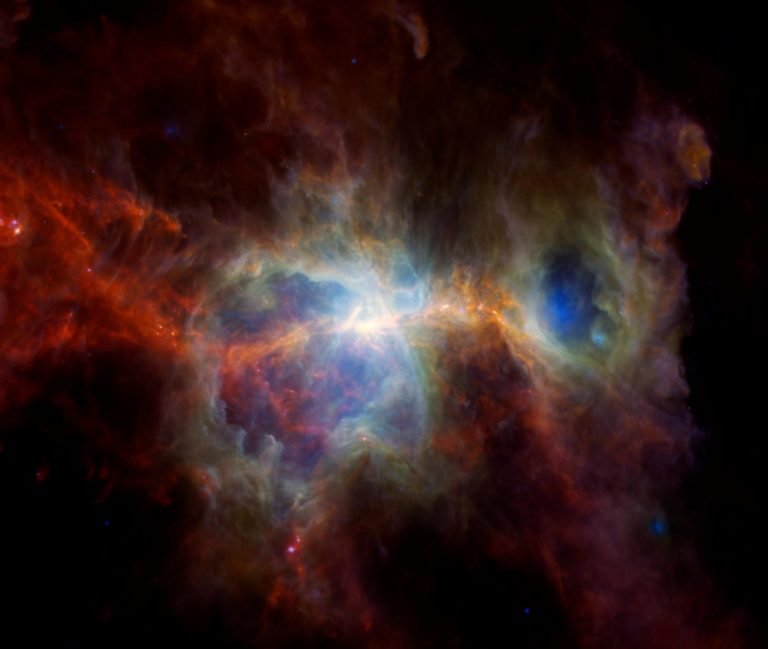
Space telescope images captured in infrared light reveal otherwise unseen details, as in this image of star-forming regions in the Orion Nebula. A recent study that relied on infrared data tracked frequent outbursts from baby stars as they gathered mass from surrounding disks of gas and dust. Credit: ESA/NASA/JPL-Caltech Full Image Details

The youngest stars often shine in bright bursts as they consume material from surrounding disks.

Newborn stars “feed” at a furious rate and grow through surprisingly frequent feeding frenzies, a recent analysis of data from NASA’s retired Spitzer Space Telescope shows.

Outbursts from stellar babies at the earliest stage of development – when they’re about 100,000 years old, or the equivalent of a 7-hour-old infant – occur roughly every 400 years, the analysis found. These eruptions of luminosity are signs of feeding binges as the young, growing stars devour material from the disks of gas and dust that surround them.

“When you’re watching star formation, clouds of gas collapse to form a star,” said University of Toledo astronomer Tom Megeath. “It’s literally the process of star creation in real time.”

Megeath is a co-author of the study, which was published earlier this year in the Astrophysical Journal Letters and led by Wafa Zakri, a professor at Jazan University in Saudi Arabia. It represents a major step forward in understanding stars’ formative years. Until now the formation and early development of the very youngest stars have been challenging to study, since they’re mostly hidden from view inside the clouds from which they form.

Swaddled in thick envelopes of gas, these young stars – less than 100,000 years old, known as “class 0 protostars” – and their outbursts are especially difficult to observe using ground-based telescopes. The first such outburst was detected nearly a century ago, and they’ve rarely been seen since.

But Spitzer, which ended its 16-year run of observations from orbit in 2020, viewed the universe in the infrared, beyond what human eyes can see. That, and its long-lasting gaze, allowed Spitzer to see through gas and dust clouds and pick up bright flares from the stars nestled inside.

The study team searched Spitzer data for protostar outbursts between 2004 and 2017 in the star-forming clouds of the Orion constellation – a long-enough “stare” to catch baby stars in the act of making an outburst. Among 92 known class 0 protostars, they found three – with two of those outbursts previously unknown. The data revealed likely burst rate for the youngest baby stars of roughly every 400 years, much more frequent than the rate measured from the 227 older protostars in Orion.

They also compared the Spitzer data with that from other telescopes, including the space-based Wide-field Infrared Survey Explorer (WISE), the now-retired ESA (European Space Agency) Herschel Space Telescope, and the now-retired airborne Stratospheric Observatory for Infrared Astronomy (SOFIA). That allowed them to estimate that the bursts typically last about 15 years. Half or more of a baby star’s bulk is added during the early class 0 period.

“By cosmic standards, stars grow rapidly when they are very young,” Megeath said. “It makes sense that these young stars have the most frequent bursts.”

The new findings will help astronomers better understand how stars form and accumulate mass, and how these early bouts of mass consumption might affect the later formation of planets.

“The disks around them are all raw material for planet formation,” he said. “Bursts can actually influence that material,” perhaps triggering the appearance of molecules, grains, and crystals that can stick together to form larger structures.

It’s even possible that our own Sun once was one of these burping babies.

“The Sun is a bit bigger than most stars, but there’s no reason to think that it didn’t undergo bursts,” Megeath said. “It probably did. When we witness the process of star formation, it is a window into what our own solar system was doing 4.6 billion years ago.”

More About the Mission

The entire body of scientific data collected by the Spitzer Space Telescope during its lifetime is available to the public via the Spitzer data archive, housed at the Infrared Science Archive at IPAC at Caltech in Pasadena, California. NASA’s Jet Propulsion Laboratory, a division of Caltech, managed Spitzer mission operations for the agency’s Science Mission Directorate in Washington. Science operations were conducted at the Spitzer Science Center at IPAC at Caltech. Spacecraft operations were based at Lockheed Martin Space in Littleton, Colorado.

News Media Contact

Calla Cofield
Jet Propulsion Laboratory, Pasadena, Calif.
626-808-2469
[email protected]
Written by Pat Brennan