
Home Blog Page 114

Space Exploration Goes Underground

0

Is there life in Martian caves?

It’s a good question, but it’s not the right question—yet. An international collaboration of scientists led by NAU researcher Jut Wynne has dozens of questions we need asked and answered. Once we figure out how to study caves on the Moon, Mars and other planetary bodies, then we can return to that question.

Wynne, an assistant research professor of cave ecology, is the lead author of two related studies, both published in a special collection of papers on planetary caves by the Journal of Geophysical Research Planets. The first, Fundamental Science and Engineering Questions in Planetary Cave Research,” was done by an interdisciplinary team of 31 scientists, engineers and astronauts who produced a list of 198 questions that they, working with another 82 space and cave scientists and engineers, narrowed down to the 53 most important. Harnessing the knowledge of a considerable swath of the space science community, this work is the first study designed to identify the research and engineering priorities to advance the study of planetary caves. The team hopes their work will inform what will ultimately be needed to support robotic and human missions to a planetary cave—namely on the Moon and/or Mars.

The second, Planetary Caves: A Solar System View of Products and Processes,” was born from the first study. Wynne realized there had been no effort to catalog planetary caves across the solar system, which is another important piece of the big-picture puzzle. He assembled another team of planetary scientists to tackle that question.

“With the necessary financial investment and institutional support, the research and technological development required to achieve these necessary advancements over the next decade are attainable,” Wynne said. “We now have what I hope will become two foundational papers that will help propel planetary cave research from an armchair contemplative exercise to robots probing planetary subsurfaces.”
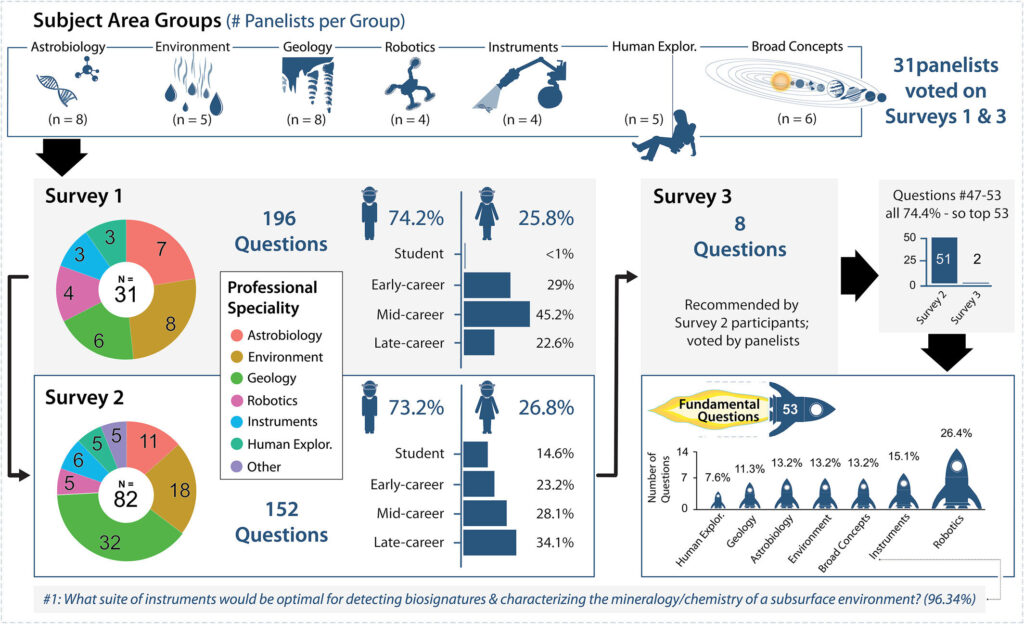
Summary by subject area groups, workflow, statistics of panelists (Surveys 1 and 3) and the broader community (Survey 2), and breakdown of the 53 fundamental questions in planetary cave science and engineering by subject area group. Credit: Journal of Geophysical Research: Planets (2022)

What we know about extraterrestrial caves

There are a lot of them. Scientists have identified at least 3,545 potential caves on 11 different moons and planets throughout the solar system, including the Moon, Mars and moons of Jupiter and Saturn. Cave formation processes have even been identified on comets and asteroids. If the surrounding environment allows for access into the subsurface, that presents an opportunity for scientific discovery that’s never been available before.

The discoveries in these caves could be massive. Caves may one day allow scientists to “peer into the depths” of these rocky and icy bodies, which will provide insights into how they were formed (but also can provide further insights into how Earth was formed). They could also, of course, hold secrets of life.

“Caves on many planetary surfaces represent one of the best environments to search for evidence of extinct or perhaps extant lifeforms,” Wynne said. “For example, as Martian caves are sheltered from deadly surface radiation and violent windstorms, they are more likely to exhibit a more constant temperature regime compared to the surface, and some may even contain water ice. This makes caves on Mars one of the most important exploration targets in the search for life.”

And it’s not just finding life—these same factors make caves good locations for astronaut shelters on Mars and the Moon when crewed missions are able to explore.

“Radiation shielding will be essential for human exploration of the Moon and Mars,” said Leroy Chiao, a retired astronaut, former commander of the International Space Station and co-author of the first paper. “One possible solution is to utilize caves for this purpose. The requirements for astronaut habitats, EVA suits and equipment should take cave exploration and development into consideration, for protection from both solar and galactic cosmic radiation.”

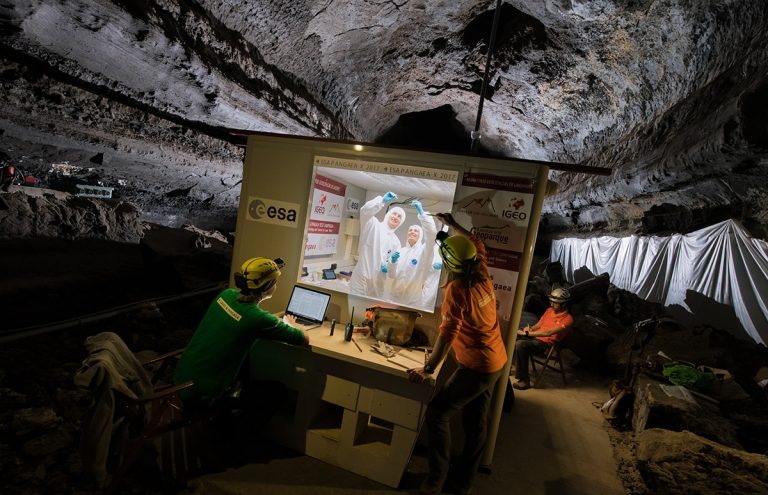
Planetary bodies for which possible cave entrances have been identified with number of features per body provided in parentheses (at top). Global locations for possible cave entrances for the Moon (center) and Mars (bottom). From Wynne et al. 2022b. Photo credit: AGU and Journal of Geophysical Research-Planets. Top photo: Real-time DNA sequencing in a lab installed in the Corona Lava Tube (Lanzarote, Canary Islands, Spain) in the framework of the ESA PANGAEA-X 2017 Astronaut training program. ESA astronaut Matthias Maurer is inside the lab module with co-author Ana Miller. Photo credit: ESA.

What Earth can tell us about other planets

Wynne, whose primary research is in terrestrial caves, said planetary cave research has long been a parallel research question to the earthly variety for nearly two decades. Caves support unique ecosystems that are sometimes quite divorced from the surface ecosystem in the same area. Who’s to say a cave on the Moon or Mars would not be similar? So, many questions he’s investigated about caves on Earth, he’s wondered how it could apply on other planets.

He’s not the only one making the connection. Wynne has done multiple research projects with NASA to help advance detection technologies, and his modeling of cave habitats does not much care if a cave is terrestrial or extraterrestrial. There are enough similarities in the cave environment to make reasonable predictions that will factor prominently into the selection of cave targets for exploration.

“Tellurian caves at depth are often characterized by complete darkness, a stable temperature approximating the average annual surface temperature, low to no air flow and a near-water-saturated atmosphere,” he said. “The caves of other planetary bodies likely exhibit similar environmental conditions, but these will also be influenced by the surface conditions of the planetary body and the internal structure of the cave.”

Keith Cowing, editor of SpaceRef.com  and  NASAWatch.com, said using the existing infrastructure of a planet’s surface and subsurface may help humans get to other planets sooner than if we had to bring everything needed to survive with us.

“Humans have been living in caves for hundreds of thousands of years. Then they built their own when none were available,” he said. “As such, it is only natural to assume that caves will offer similar utility as humanity expands to other worlds. While planet-wide terraforming may be an end goal, the use of large, pre-existing structures such as caves and lava tubes may be a more practical way to bootstrap the technology to the maturity needed to tackle the surface of an entire planet.”

Space suit designer and co-author Pablo de Leon testing the NDX-3 Planetary Space Suit in Antarctica. Development of drilling and excavation tools will be of critical importance for research, habitation, and rescue operations in planetary caves. Photo credit: Human Spaceflight Laboratory, University of North Dakota

.

Where are we now?

While much of this research is forward-looking, there’s also a need to consider what resources, research and support currently exist. Numerous robotic platforms and instrumentation suites are being tested, but the roadblock comes where it so often does—the lack of funding. With sufficient support, a robotic exploration mission to a lunar or Martian cave could be possible in the next five to 10 years.

This research builds on past work to form a road map of sorts to move forward; Wynne sees it as a to-do list for that same process. The questions the scientists and engineers answered identify the tasks needed to prepare for that robotic exploration; it also looks even further ahead to the advancements needed in spacesuit technology, habitation modules and hardware that will enable humans to live and work safely underground on the Moon and Mars.

“This is an untapped area of inquiry in planetary science, and its importance in the search for life should not be overlooked,” he said. “In our lifetime, it is quite possible that we will peer into underground Mars to address the age-old question, ‘Does life exist beyond Earth?’”

Jut Wynne (at right) with JPL roboticist Brett Kennedy field testing an early prototype of the rock climbing robot, LEMUR in a lava tube cave, Mojave Desert, California. Of note, Wynne is the first human to belay a robot. Courtesy NASA JPL/Caltech.

By Keith Cowing
Source SpaceRef
The Planetary Society’s LightSail 2 Mission Reenters Atmosphere, Completes Mission

0

LightSail 2, The Planetary Society’s crowdfunded, solar sailing spacecraft, has reentered Earth’s atmosphere, successfully completing its mission to demonstrate flight by light for small spacecraft. Orbital predictions showed that LightSail 2 reentered sometime on Nov. 17.

The reentry completes a mission of nearly three-and-a-half years, during which LightSail 2 showed that it could change its orbit using the gentle push of sunlight, a technique known as solar sailing. LightSail 2 demonstrated that small spacecraft can carry, deploy, and utilize relatively large solar sails for propulsion.

“LightSail 2 is gone after more than three glorious years in the sky, blazing a trail of lift with light, and proving that we could defy gravity by tacking a sail in space,” said Bill Nye, CEO of The Planetary Society. “The mission was funded by tens of thousands of Planetary Society members, who want to advance space technology.”

LightSail 2 hitched a ride to space in June 2019 aboard a SpaceX Falcon Heavy rocket. It began operations at an altitude of about 720 kilometers (450 miles), where Earth’s atmosphere is still thick enough to create drag and slow down a spacecraft. For reference, the International Space Station orbits at an altitude of roughly 400 kilometers (250 miles).

As atmospheric drag slowly pulled LightSail 2 back towards Earth, the spacecraft successfully used solar sailing to lower its decay rate and on occasion overcome drag completely. After 18,000 orbits and 8 million kilometers (5 million miles) traveled, drag finally won out, bringing the mission to a close.

“During its extended mission LightSail 2 continued to teach us more about solar sailing and achieved its most effective solar sailing, but that was followed by an increase in atmospheric drag in part from increasing solar activity,” said Bruce Betts, LightSail program manager and chief scientist for The Planetary Society. “The spacecraft is gone, but data analyses and sharing of results will continue.”

LightSail 2 launched as a shoebox-sized spacecraft with its sails tucked together like origami. Using four tape measure-like booms, the spacecraft unfurled a four-section Mylar sail with an area of 32 square meters (244 square feet) — about the size of a boxing ring.

Light has no mass, but it has momentum that can be transferred to a reflective solar sail. The resulting push is small but continuous, allowing a spacecraft like LightSail 2 to change its orbit.

The LightSail mission team will continue to analyze data collected during the mission, publishing peer-reviewed journal articles, making conference presentations, and conducting public outreach. Images from the mission can be viewed online.

Results will continue to be shared with other upcoming solar sail missions such as NEA Scout and ACS3. In a fitting bookend to the LightSail 2 mission, NEA Scout launched on Nov. 16 aboard NASA’s Artemis I mission to the Moon. The Planetary Society shares data with the NEA Scout team through a Space Act Agreement.

NEA Scout will use an 86-square-meter (926 square-feet) solar sail to leave lunar orbit and perform a slow flyby of asteroid 2020 GE, which measures just 18 meters (60 feet) across. The images NEA Scout captures will be the first up-close pictures of such a small world.

LightSail 2 was an entirely crowdfunded mission that aimed to help democratize space exploration. More 50,000 Planetary Society members, Kickstarter backers, private citizens, foundations, and corporate partners funded the mission. A miniature DVD attached to the spacecraft contained selfies from space fans and the names of Planetary Society members and supporters.

The Smithsonian Institution displayed two models of LightSail 2 in 2021 and 2022. The mission was named one of TIME’s 100 Best Inventions of 2019, and won a Popular Science Best of What’s New award for 2019.

The LightSail program’s roots date back to the mid-1970s, when Planetary Society co-founder Louis Friedman developed a NASA concept for a solar sail that would have visited Halley’s Comet. Society co-founder Carl Sagan showed off a model of the spacecraft on The Tonight Show with Johnny Carson.

While LightSail 2 operations have come to an end, the mission will live on as a new era of solar sailing begins.

“We have braved the harbor of Earth and found that a small craft can sail and steer,” said Betts. “Best wishes to those who sail similar craft into the vast ocean of space – we look forward to an exciting future of exploration, proud that we have played a role. Sail on!”

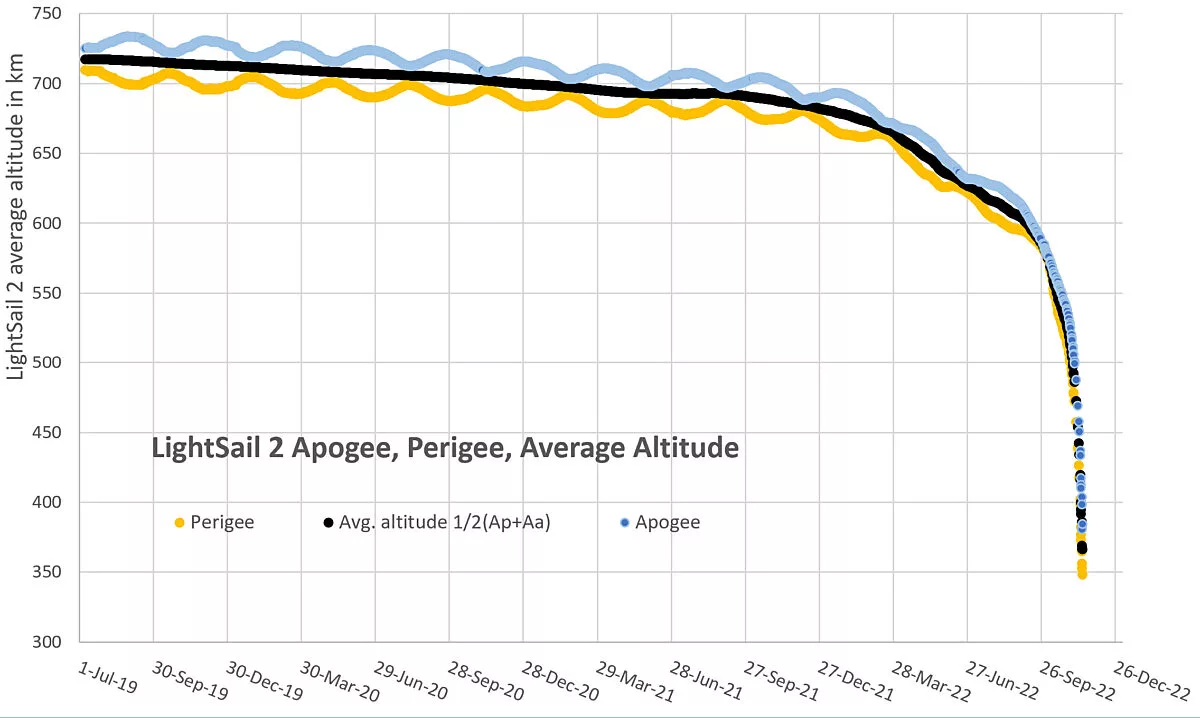
LightSail 2's altitude with time
LIGHTSAIL 2’S ALTITUDE WITH TIME LightSail 2’s average altitude with time is shown in black. Its apogee, the highest point in its orbit around the Earth, as shown in blue. Its perigee, the lowest point in its orbit around the Earth, as shown in orange. The right side of the graph shows the rapid descent occurring as it gets lower in the atmosphere. This plot shows data as of Nov. 16, 2022.Image: The Planetary Society
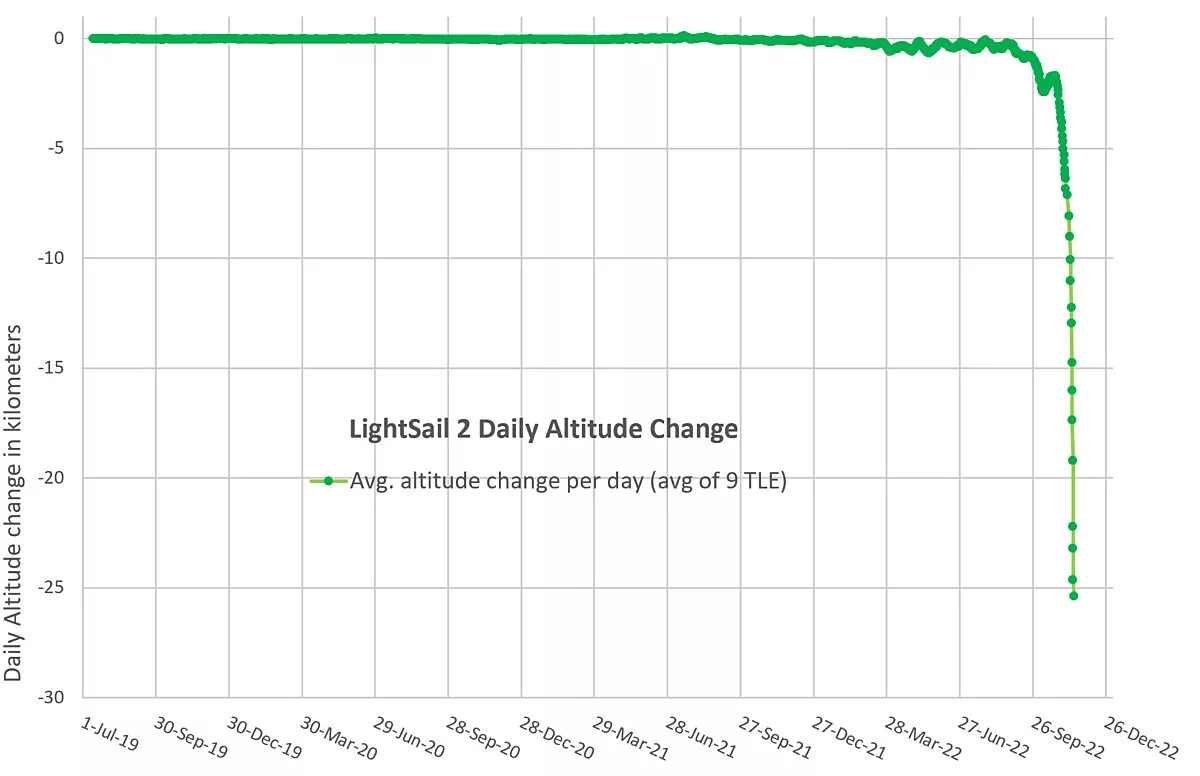
LightSail 2’s average daily change in altitude with time
LIGHTSAIL 2’S AVERAGE DAILY CHANGE IN ALTITUDE WITH TIME LightSail 2’s average daily change in altitude with time is shown in green. The last several weeks show the spacecraft dropping faster and faster due to increasing atmospheric density as it gets lower. This plot shows data as of Nov. 16, 2022.Image: The Planetary Society
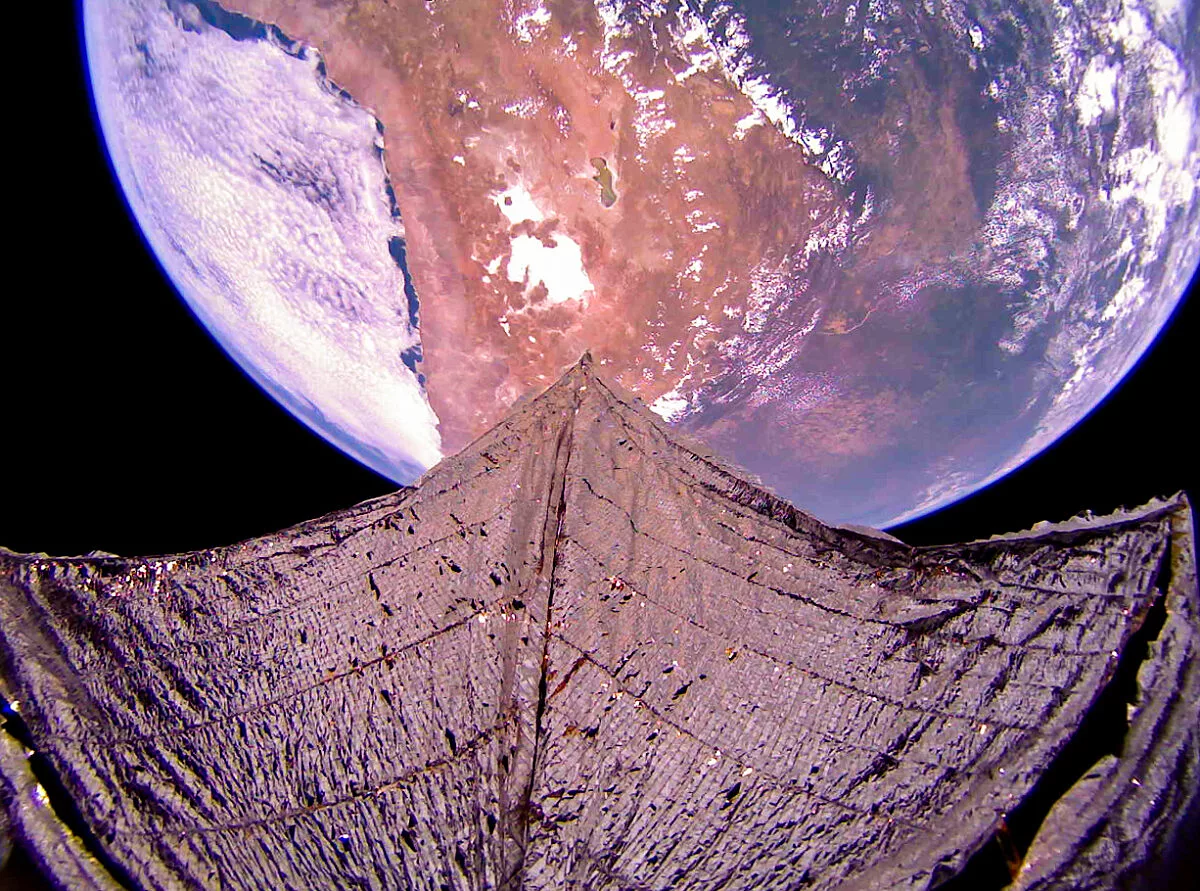
LightSail 2's Final Image
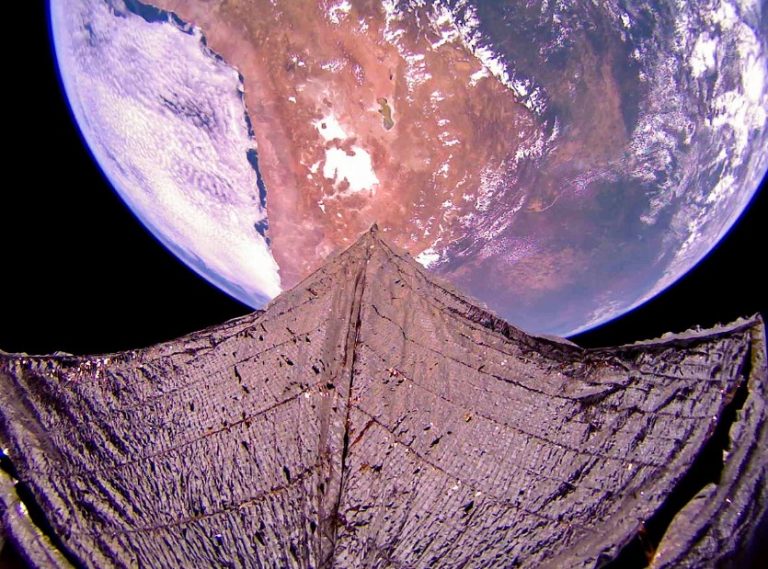
LIGHTSAIL 2’S FINAL IMAGE This image taken by The Planetary Society’s LightSail 2 spacecraft on October 24, 2022 was the final image returned from the spacecraft before atmospheric reentry. It shows the central portion of South America centered approximately on Bolivia including the large, white Uyuni Salt Flats. North is approximately at top. This image has been color-adjusted and some distortion from the camera’s 180-degree fisheye lens has been removed.Image: The Planetary Society

CONTACT
Danielle Gunn
Email: [email protected]
Phone: +1-626-793-5100

Lockheed Martin, NVIDIA To Build Digital Twin Of Current Global Weather Conditions For The National Oceanic And Atmospheric Administration

0

Lockheed Martin (NYSE: LMT) and NVIDIA announced a collaboration to build an Artificial Intelligence (AI)-driven Earth Observations Digital Twin that will provide the National Oceanic and Atmospheric Administration (NOAA) with an efficient and centralized approach to monitor current global environmental conditions, including extreme weather events.

The two companies expect to fully integrate and demonstrate one of the variable data pipelines – sea surface temperature — by September 2023, one year after initial contract award.

Presently, NOAA receives terabytes of data about its five earth systems domains – the cryosphere, land, atmosphere, space weather and ocean – from numerous space and Earth-based sensor sources. NOAA administrators and researchers have to collect, combine and analyze that information to observe and understand environmental conditions and changes.

The new Earth Observations Digital Twin – developed under contract with Lockheed Martin Space – working with NVIDIA – will provide NOAA with a high-resolution, accurate and timely depiction of global conditions, using current satellite and ground-based observations.

For the project, Lockheed Martin’s OpenRosetta3D™ platform will utilize AI and Machine Learning (ML) to ingest, format and fuse observations from multiple sources into a gridded data product and detect anomalies. NVIDIA Omniverse Nucleus, the collaboration and database engine of its Omniverse world simulation platform, will convert data into the Universal Scene Description framework, enabling data-sharing across multiple tools and between researchers. Agatha, a Lockheed Martin-developed visualization platform, will ingest this incoming data from Omniverse Nucleus and allow users to interact with it in an Earth-centric 3D environment.

“At Lockheed Martin we regularly use digital twins and AI to provide our government customers with the clearest, current situational picture and actionable intelligence for their important missions,” said Matt Ross, senior program manager at Lockheed Martin Space. “We’re pleased that we can use our technology experience to collaborate with NVIDIA on this project to provide NOAA a timely, global visualization for their own important missions.”

“Digital twins will help us solve the world’s hardest scientific and environmental challenges,” said Dion Harris, lead product manager of accelerated computing at NVIDIA. “The combination of Lockheed Martin’s AI technology with NVIDIA Omniverse will give NOAA researchers a powerful system to improve weather predictions at a global scale.”

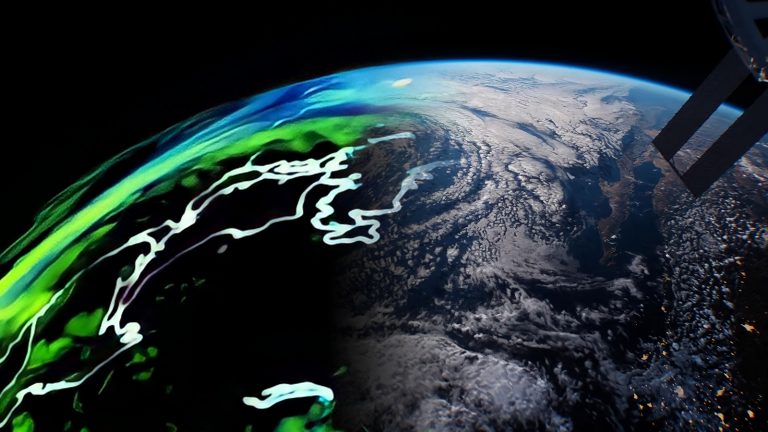
Global Weather (notional image courtesy of NVIDIA)

Lockheed Martin and NVIDIA are already collaborating on an effort to help fight wildfires, which have burned more than 7.2 million U.S. acres this year. By pairing Lockheed Martin’s AI/ML platforms and joint all domain command and control capabilities with NVIDIA’s Omniverse, the two companies are demonstrating how firefighters can use advanced technology to help better detect, predict and suppress wildfires.

About Lockheed Martin
Headquartered in Bethesda, Maryland, Lockheed Martin Corporation is a global security and aerospace company that employs approximately 114,000 people worldwide and is principally engaged in the research, design, development, manufacture, integration and sustainment of advanced technology systems, products and services.

Please follow @LMNews and @LMSpace on Twitter for the latest announcements and news across the corporation.

About NVIDIA
Since its founding in 1993, NVIDIA (NASDAQ: NVDA) has been a pioneer in accelerated computing. The company’s invention of the GPU in 1999 sparked the growth of the PC gaming market, redefined computer graphics, ignited the era of modern AI and is fueling the creation of the metaverse. NVIDIA is now a full-stack computing company with data-center-scale offerings that are reshaping industry. More information at https://nvidianews.nvidia.com/.

N° 61–2022: Forward To The Moon: Lunar Mission Artemis I Begins

0

16 November 2022. At 07:47 CET (06:47 BST, 01:47 local time), the Artemis I mission started its voyage to the Moon as NASA’s new Moon rocket lifted off from the Kennedy Space Center in Florida, USA, and put the Orion spacecraft and its European Service Module into Earth orbit.

The spacecraft spent two hours circling Earth before being boosted towards the Moon. The spacecraft is performing as expected as it now begins its ten-day cruise to our natural satellite.

NASA’s Space Launch System is the most powerful rocket ever built and is designed for the Orion spacecraft to ferry astronauts and Gateway modules to the Moon. The Artemis I test-flight is uncrewed, but the next three spacecraft are already in production with hardware delivered by more than 20 companies in ten European countries.

“The European Service Module and Orion spacecraft comes from decades of excellent collaboration between ESA and NASA,” says ESA’s Director General Josef Aschbacher.

“From the Hubble and Webb telescopes and the Earth-observing Sentinel-6 satellite, through to the International Space Station and now Artemis, ESA is proud to be NASA’s preferred partner and, with this launch, to be taking humankind to the Moon together.”

ESA designed and oversaw the development of Orion’s service module, the part of the spacecraft that supplies air, electricity and propulsion. Much like a train engine pulls passenger carriages and supplies power, the European Service Module is now taking Orion to the Moon and back.

“We announced the Orion and European Service Module collaboration in 2013 and although today’s launch is a highlight of the mission, it marks only the start of the Artemis I mission and our larger lunar ambitions,” says ESA’s Director for Human and Robotic Exploration David Parker.

“In the coming years we will see European modules being launched to build up the international lunar Gateway and ESA astronauts venturing farther from Earth than ever before, with a European on the Moon by the end of the decade.”

Flying to the Moon and back

The Artemis I mission will see Orion and the European Service Module on a 26-day mission to the Moon and back. It will spend around a week orbiting the Moon, with the European Service Module firing its 33 engines to keep the spacecraft on course and in the best position to receive sunlight on the four 7 m long solar arrays.

The European Service Module also keeps the spacecraft operating at correct temperatures and holds all the fuel tanks for the engines. In future Artemis missions, the European Service Module will deliver air and water to the astronauts working in the Orion’s crew module.

Throughout the mission, personnel based at ESA’s technical heart ESTEC in The Netherlands are on-hand to provide expertise and in-depth knowledge of the European Service Module to the main mission control at NASA’s Johnson Space Center, in Houston, USA.

Artemis I will end with a splashdown in the Pacific Ocean, off the coast of California, USA. The European Service Module separates and burns up harmlessly in the atmosphere shortly before the Orion crew module splashes down.

About the European Space Agency

The European Space Agency (ESA) provides Europe’s gateway to space.

ESA is an intergovernmental organisation, created in 1975, with the mission to shape the development of Europe’s space capability and ensure that investment in space delivers benefits to the citizens of Europe and the world.

ESA has 22 Member States: Austria, Belgium, the Czech Republic, Denmark, Estonia, Finland, France, Germany, Greece, Hungary, Ireland, Italy, Luxembourg, the Netherlands, Norway, Poland, Portugal, Romania, Spain, Sweden, Switzerland and the United Kingdom. Slovenia, Latvia and Lithuania are Associate Members.

ESA has established formal cooperation with five Member States of the EU. Canada takes part in some ESA programmes under a Cooperation Agreement.

By coordinating the financial and intellectual resources of its members, ESA can undertake programmes and activities far beyond the scope of any single European country. It is working in particular with the EU on implementing the Galileo and Copernicus programmes as well as with Eumetsat for the development of meteorological missions.

Learn more about ESA at www.esa.int

ESA Newsroom and Media Relations Office – Ninja Menning
Email: [email protected]
Phone: +31 71 565 6409

Model Explains Two Mysteries About Planet Size

0

A new model can explain two puzzling observations that have cropped up repeatedly among the more than 3,800 planetary systems cataloged to date.

One puzzle known as the “radius valley” refers to the rarity of exoplanets with a radius about 1.8 times that of Earth. NASA’s Kepler spacecraft observed planets of this size about 2-3 times less frequently than it observed super-Earths with radii about 1.4 times that of Earth and mini-Neptunes with radii about 2.5 times Earth’s.

The second mystery, known as “peas in a pod,” refers to neighboring planets of similar size that have been found in hundreds of planetary systems. Those include TRAPPIST-1 and Kepler-223, which also feature planetary orbits of near-musical harmony.

“I believe we are the first to explain the radius valley using a model of planet formation and dynamical evolution that self-consistently accounts for multiple constraints of observations,” says Rice University’s André Izidoro, corresponding author of a study in Astrophysical Journal Letters.

“We’re also able to show that a planet-formation model incorporating giant impacts is consistent with the peas-in-a-pod feature of exoplanets.”

Izidoro, a postdoctoral fellow at Rice University’s NASA-funded CLEVER Planets project, and colleagues used a supercomputer to simulate the first 50 million years of the development of planetary systems using a planetary migration model.

In the model, protoplanetary disks of gas and dust that give rise to young planets also interact with them, pulling them closer to their parent stars and locking them in resonant orbital chains. The chains are broken within a few million years, when the disappearance of the protoplanetary disk causes orbital instabilities that lead two or more planets to slam into one another.

Planetary migration models have been used to study planetary systems that have retained their resonant orbital chains. For example, Izidoro and CLEVER Planets colleagues used a migration model in 2021 to calculate the maximum amount of disruption TRAPPIST-1’s seven-planet system could have withstood during bombardment and still retained its harmonious orbital structure.

“The migration of young planets towards their host stars creates overcrowding and frequently results in cataclysmic collisions that strip planets of their hydrogen-rich atmospheres,” Izidoro says. “That means giant impacts, like the one that formed our moon, are probably a generic outcome of planet formation.”

The research suggests planets come in two “flavors,” super-Earths that are dry, rocky, and 50% larger than Earth, and mini-Neptunes that are rich in water ice and about 2.5 times larger than Earth. Izidoro says new observations seem to support the results, which conflict with the traditional view that both super-Earths and mini-Neptunes are exclusively dry and rocky worlds.

Based on their findings, the researchers made predictions that can be tested by NASA’s James Webb Space Telescope. They suggest, for instance, that a fraction of planets about twice Earth’s size will both retain their primordial hydrogen-rich atmosphere and be rich in water.

In the new study, Izidoro partnered with CLEVER Planets’ investigators Rajdeep Dasgupta and Andrea Isella, both of Rice, Hilke Schlichting of the University of California, Los Angeles, and Christian Zimmermann and Bertram Bitsch of the Max Planck Institute for Astronomy in Heidelberg, Germany.

Funding for the research came from NASA, the Welch Foundation, and the European Research Council.

Source: Rice University

Original Study DOI: 10.3847/2041-8213/ac990d

By Jade Boyd-Rice
Source Futurity

Who is Artemis? NASA’s latest mission to the Moon is named after an ancient lunar goddess turned feminist icon

0

NASA launched the Artemis I moon rocket on the morning of Nov. 16, 2022, after several delays earlier this year. This first flight is without a crew and expected to last four to six weeks. The program aims to increase women’s participation in space exploration – 30% of its engineers are women. In addition, the Artemis I mission is carrying two mannequins designed to study the effects of radiation on women’s bodies so that NASA can learn how to protect female astronauts better.

Diana by Augustus Saint Gaudens, 1928, Metropolitan Museum of Art, New York.
Postdlf via Wikimedia Commons, CC BY-SA

Female astronauts are currently less likely to be selected for missions than men because their bodies tend to hit NASA’s maximum acceptable threshold of radiation earlier. NASA expects to bring the first woman and person of color to the Moon on Artemis III sometime after 2024.

As a scholar of Greek mythology, I find the name of the mission quite evocative: The Greeks and Romans associated Artemis with the Moon, and she has also become a modern-day feminist icon.

Greek goddess Artemis with a mass of curls along her face that flow down her neck.
Bust of Artemis with crescent moon headband.
Museum of Fine Arts, Boston

Artemis was a major deity in ancient Greece, worshiped at least as early as the beginning of the first millennium B.C., or even earlier. She was a daughter of Zeus, the chief god of the Olympians, who ruled the world from the summit of Mount Olympus. She was also the twin sister of Apollo, god of the Sun and oracles.

Artemis was a virgin goddess of the wilderness and hunting. Her independence and strength have long inspired women in a wide range of activities. For example, in a poem titled “Artemis,” author Allison Eir Jenks writes: “I’m no longer your god-mother … your chef, your bus-stop, your therapist, your junk-drawer,” emphasizing women’s freedom and autonomy.

As the goddess of animals and the wilderness, Artemis has also inspired environmental conservancy programs, in which the goddess is viewed as an example of a woman exercising her power by caring for the planet.

However, while the Greek Artemis was strong and courageous, she wasn’t always kind and caring, even toward women. Her rashness was used to explain a woman’s sudden death, especially while giving birth. This aspect of the goddess has faded away with time. With the rise of feminism, Artemis has become an icon of feminine power and self-reliance.

NASA has a long history of naming its missions after mythological figures. Starting in the 1950s, many rockets and launch systems were named after Greek sky deities, like Atlas and Saturn, whose Greek name is Cronos.

Atlas and Saturn weren’t just gods, they were Titans. In Greek mythology, Titans represent the untamed, primordial forces of nature, and so they evoke the prodigious vastness of space exploration. Although the Titans were known for their immense strength and power, they were also rebellious and dangerous and were eventually defeated by the Olympians, who represent civilization in Greek mythology.

Following the advent of human space flight, NASA began naming missions after children of Zeus who are associated with the sky. The Mercury program, active from 1958 to 1963, was named after Hermes’ Roman counterpart, the messenger god who flies between Olympus, Earth and the underworld with his winged sandals.

Starting in 1963, the three-year-long Gemini program featured a capsule designed for two astronauts and was named after the twin sons of Zeus – Castor and Pollux, known as the Dioscuri in Greek – who were cast in the stars as the constellation of Gemini. They were regularly represented with a star above their heads in Greek and Roman art.

The space shuttle program, which lasted from 1981 to 2011, diverted from mythological monikers, and the names Columbia, Challenger, Discovery, Atlantis and Endeavour were meant to evoke a spirit of innovation.

With Artemis, NASA is nodding back to the Apollo program, which lasted from 1963 to 1972 and put the first men on the Moon in 1969. Over 50 years later, Artemis picks up where her twin brother left off, ushering in a more diverse era of human space flight.

A bronze coin showing two engraved faces.
A coin showing the Dioscuri, also known as the Gemini in Latin (Castor and Pollux) with a star above their heads.
American Numismatic Society, Bequest of E.T. Newell

Marie-Claire Beaulieu, Associate Professor of Classical Studies, Tufts University

This article is republished from The Conversation under a Creative Commons license. Read the original article.

NASA’s Artemis 1 mission to the Moon sets the stage for routine space exploration beyond Earth’s orbit – here’s what to expect and why it’s important

0

NASA’s Space Launch System rocket lifted off from the Kennedy Space Center in Cape Canaveral, Florida, in the early hours of Nov. 16, 2022. The rocket carried the Orion Crew Capsule as the centerpiece of the Artemis 1 mission. The journey to the Moon and back is a shakedown cruise with no people aboard – it will test how the Orion Crew Capsule holds up in space. The mission is a key step toward returning humans to the Moon after a half-century hiatus. The launch was initially scheduled for the morning of Aug. 29, 2022, but was postponed three times, twice for technical reasons and once for Hurricane Ian.

NASA is going back to the Moon. NASA/Bill Ingalls

The spacecraft is scheduled to travel to the Moon, deploy some small satellites and then settle into orbit. NASA aims to practice operating the spacecraft, test the conditions crews will experience on and around the Moon, and assure everyone that the spacecraft and any occupants can safely return to Earth.

The Conversation asked Jack Burns, a professor and space scientist at the University of Colorado Boulder and former member of the Presidential Transition Team for NASA, to describe the mission, explain what the Artemis program promises to do for space exploration, and reflect on how the space program has changed in the half-century since humans last set foot on the lunar surface.

How does Artemis 1 differ from the other rockets being launched routinely?

Artemis 1 is the first flight of the new Space Launch System. This is a “heavy lift” vehicle, as NASA refers to it. It is the most powerful rocket engine ever flown to space, even more powerful than Apollo’s Saturn V system that took astronauts to the Moon in the 1960s and ‘70s.

It’s a new type of rocket system, because it has both a combination of liquid oxygen and hydrogen main engines and two strap-on solid rocket boosters derived from the space shuttle. It’s really a hybrid between the space shuttle and Apollo’s Saturn V rocket.


You can listen to more articles from The Conversation, narrated by Noa, here.


Testing is very important, because the Orion Crew Capsule is going to be getting a real workout. It will be in the space environment of the Moon, a high-radiation environment, for a month. And, very importantly, it will be testing the heat shield, which protects the capsule and its occupants, when it comes back to the Earth at 25,000 miles per hour. This will be the fastest capsule reentry since Apollo, so it’s very important that the heat shield function well.

This mission is also carrying a series of small satellites that will be placed in orbit of the Moon. Those will do some useful precursor science, everything from looking further into the permanently shadowed craters where scientists think there is water to just doing more measurements of the radiation environment, seeing what the effects will be on humans for long-term exposure.

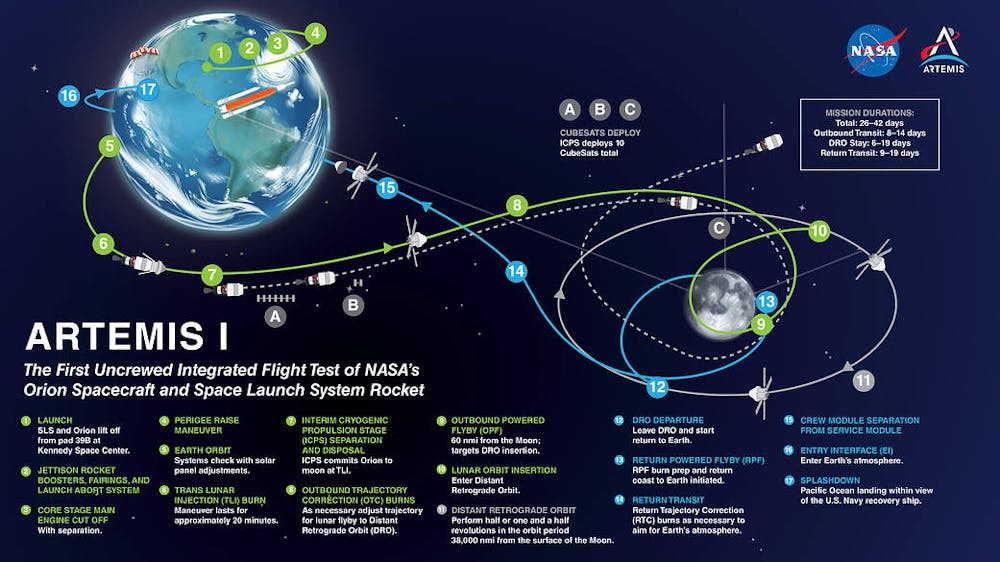
A diagram showing the earth, moon and flight path of a spacecraft
The plan is for Artemis 1 to lift off, travel to the Moon, deploy satellites, orbit the Moon, return to Earth, safely enter the atmosphere and splash down in the ocean. NASA

What’s the goal of the Artemis project? What’s coming up in the series of launches?

The mission is a first step toward Artemis 3, which is going to result in the first human missions to the Moon in the 21st century and the first since 1972. Artemis 1 is an uncrewed test flight.

Artemis 2, which is scheduled to launch a few years after that, will have astronauts on board. It, too, will be an orbital mission, very much like Apollo 8, which circled the Moon and came back home. The astronauts will spend a longer time orbiting the Moon and will test everything with a human crew.

And, finally, that will lead to a journey to the surface of the Moon in which Artemis 3 – sometime middecade – will rendezvous with the SpaceX Starship and transfer crew. Orion will remain in orbit, and the lunar Starship will take the astronauts to the surface. They will go to the south pole of the Moon to look at an area scientists haven’t explored before to investigate the water ice there.

Artemis is reminiscent of Apollo. What has changed in the past half-century?

The reason for Apollo that Kennedy envisioned initially was to beat the Soviet Union to the Moon. The administration didn’t particularly care about space travel, or about the Moon itself, but it represented an audacious goal that would clearly put America first in terms of space and technology.

The downside of doing that is the old saying “You live by the sword, you die by the sword.” When the U.S. got to the Moon, it was basically game over. The United States beat the Russians. So it put some flags down and did some science experiments. But pretty quickly after Apollo 11, within a few more missions, Richard Nixon canceled the program because the political objectives had been met.

a large rocket with two boosters attached to its sides standing between two massive gantries
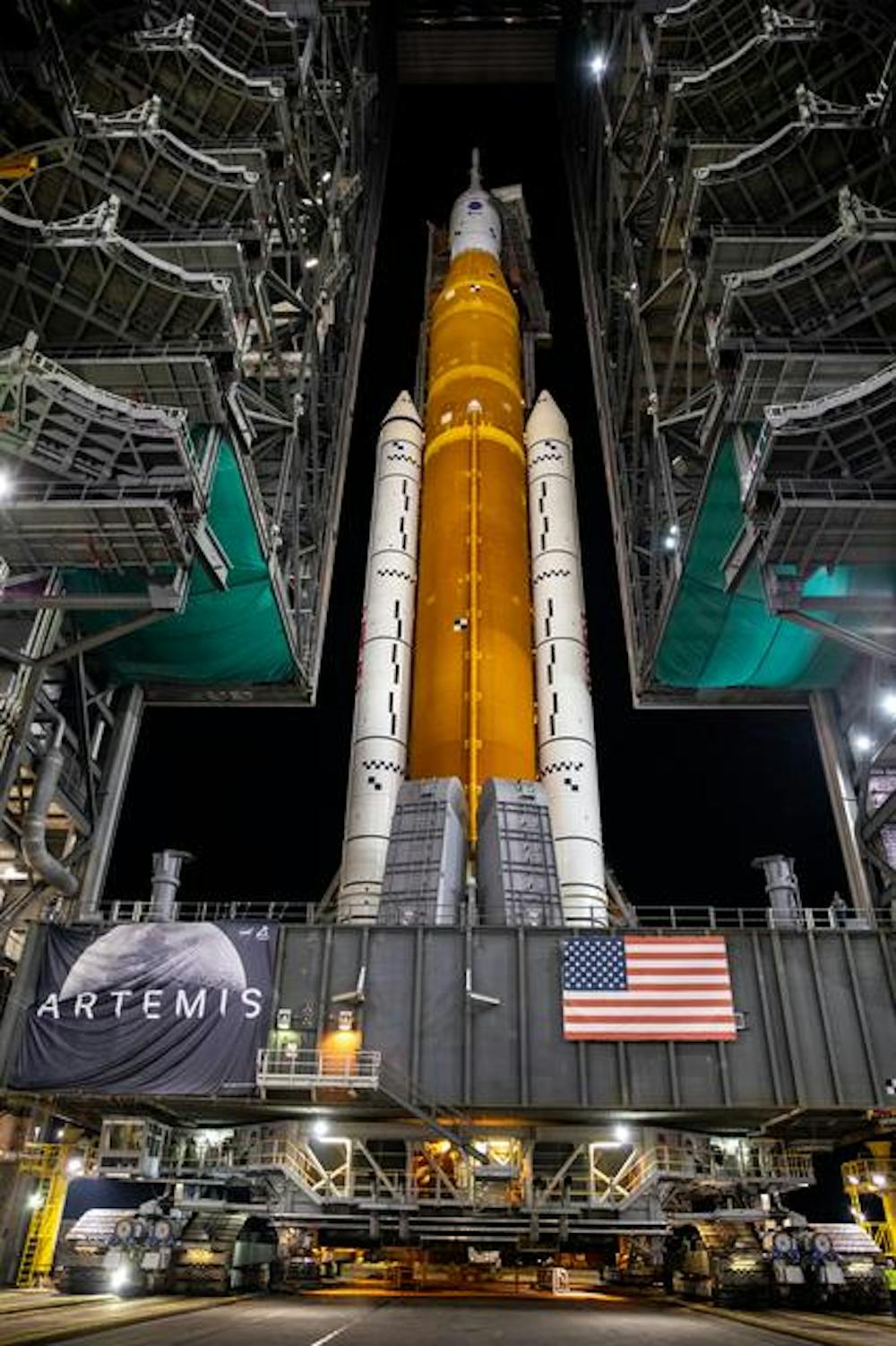
NASA’s new Space Launch System is seen here being moved from the rocket assembly building to a launchpad. NASA

So fast-forward 50 years. This is a very different environment. The U.S. is not doing this to beat the Russians or the Chinese or anybody else, but to begin a sustainable exploration beyond Earth’s orbit.

The Artemis program is driven by a number of different goals. It includes in situ resource utilization, which means using resources at hand like water ice and lunar soil to produce food, fuel and building materials.

The program is also helping to establish a lunar and space economy, starting with entrepreneurs, because SpaceX is very much part of this first mission to the surface of the Moon. NASA doesn’t own the Starship but is buying seats to allow astronauts to go to the surface. SpaceX will then use the Starship for other purposes – to transport other payloads, private astronauts and astronauts from other countries.

Fifty years of technology development means that going to the Moon now is much less expensive and more technologically feasible, and much more sophisticated experiments are possible when you just figure the computer technology. Those 50 years of technological advancement have been a complete game-changer. Almost anybody with the financial resources can send spacecraft to the Moon now, though not necessarily with humans.

NASA’s Commercial Lunar Payload Services contracts private companies to build uncrewed landers to go to the Moon. My colleagues and I have a radio telescope that’s scheduled to go to the Moon on one of the landers in March. That just wouldn’t have been possible even 10 years ago.

Artemis is an ambitious program, but technology has advanced tremendously in the 50 years since humans last went to the Moon.

What other changes does Artemis have in store?

The administration has said that in that first crewed flight, on Artemis 3, there will be at least one woman and very likely a person of color. They may be one and the same. There may be several.

I’m looking forward to seeing more of that diversity, because young kids today who are looking up at NASA can say, “Hey, there’s an astronaut who looks like me. I can do this. I can be part of the space program.”


Jack Burns, Professor of Astrophysical and Planetary Sciences, University of Colorado Boulder

This article is republished from The Conversation under a Creative Commons license. Read the original article.

NASA’s Artemis I Cameras to Offer New Views of Orion, Earth, Moon

0

During Artemis I, NASA’s Space Launch System (SLS) rocket will send the agency’s Orion spacecraft on a trek 40,000 miles beyond the Moon before returning to Earth. To capture the journey, the rocket and spacecraft are equipped with cameras that will collect valuable engineering data and share a unique perspective of humanity’s return to the Moon.

There are 24 cameras on the rocket and spacecraft – eight on SLS and 16 on Orion – to document essential mission events including liftoff, ascent, solar array deployment, external rocket inspections, landing and recovery, and capture images of Earth and the Moon.

On the rocket, four cameras around the engine section point up toward Orion, two cameras at the intertank by the top of boosters will capture booster separation, and two cameras on the launch vehicle stage adapter will capture core stage separation. The eight cameras will cycle through a preprogrammed sequence during launch and ascent.

On Orion, an external camera mounted on the crew module adapter will show the SLS rocket’s ascent, providing the “rocket cam” view the public often sees during launches. Another camera will provide a view of service module panel jettison and solar array wing deployment. Four cameras attached to the spacecraft’s solar array wings on the service module will help engineers assess the overall health of the outside of Orion and can capture a selfie view of the spacecraft with the Earth or Moon in the background.

“Each of Orion’s four solar array wings has a commercial off-the-shelf camera mounted at the tip that has been highly modified for use in space, providing a view of the spacecraft exterior,” said David Melendrez, imagery integration lead for the Orion Program at NASA’s Johnson Space Center in Houston.

The arrays can adjust their position relative to the rest of the spacecraft, which will optimize the collection of sunlight converted into electricity to power Orion. This also allows flight controllers in the Mission Control Center at NASA Johnson to point the cameras at different parts of the spacecraft for inspections and to document its surroundings, including the Earth and Moon.

Graphic showing the cameras on NASA's Orion spacecraft.

The cameras on NASA’s Orion spacecraft.

A specialized camera on the crew module adapter used for optical navigation and to help pinpoint Orion’s location in deep space will be used to collect imagery of the Moon during Orion’s closest approach to the lunar surface. Also affixed to the crew module adapter but pointed inward, another camera is positioned to capture imagery of Orion’s heat shield after the crew module separates from the service module before its re-entry into Earth’s atmosphere.

Inside the spacecraft, three more wireless cameras can capture the perspectives astronauts will have on future Artemis missions, with one camera looking out the front pilot window and a second looking over the shoulder of the commander seat, where the instrument panel will be located on future missions. A third in-cabin camera will look out the top hatch window to provide views of launch abort system jettison during ascent as well as parachute deployment during landing and recovery.

There are also two external high-speed cameras dedicated to monitoring parachute operations, which technicians will download and process after the flight.

The images and video collected by the Orion cameras will come in a variety of formats, ranging from standard-definition to high-definition and up to 4K. Each is tailored for a specific use and dependent on the bandwidth available during the mission to send to Earth or recorded on board to be analyzed after the mission ends. Due to bandwidth limitations on the spacecraft that prioritize transmitting critical data to the ground, livestream video quality will be lower than the onboard recordings. As a result, some of the highest quality views may not be received until well after they are recorded and can be downlinked.

The field of view of each camera has been optimized to look at the spacecraft, not deep space, and imagery for the Artemis I flight will depend on a variety of factors such as lighting, spacecraft orientation, and communication capabilities during different mission phases.

“A lot of folks have an impression of Earthrise based on the classic Apollo 8 shot,” Melendrez said. “Images captured during the mission will be different than what humanity saw during Apollo missions, but capturing milestone events such as Earthrise, Orion’s farthest distance from Earth, and lunar flyby will be a high priority.”

Orion also will carry cameras that are part of a technology demonstration, called Callisto. The Callisto payload includes three in-cabin cameras that will be used to test video conferencing capabilities and may enhance the public’s ability to imagine themselves inside Orion.

Through Artemis missions, NASA will land the first woman and the first person of color on the Moon, paving the way for a long-term lunar presence, and serving as a steppingstone to send astronauts to Mars.

Erika Peters

NASA’s Johnson Space Center

Source: NASA

Liftoff! NASA’s Artemis I Mega Rocket Launches Orion to Moon

0

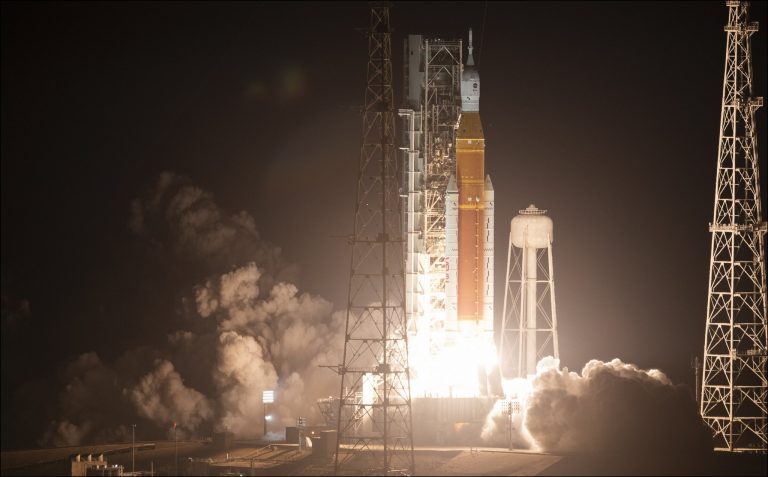
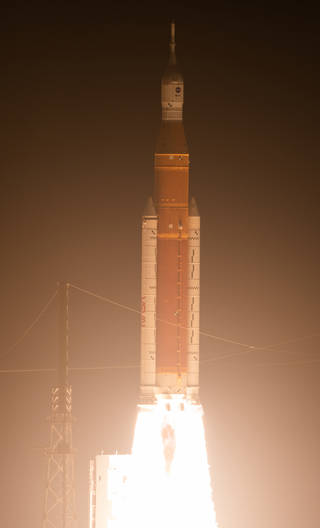
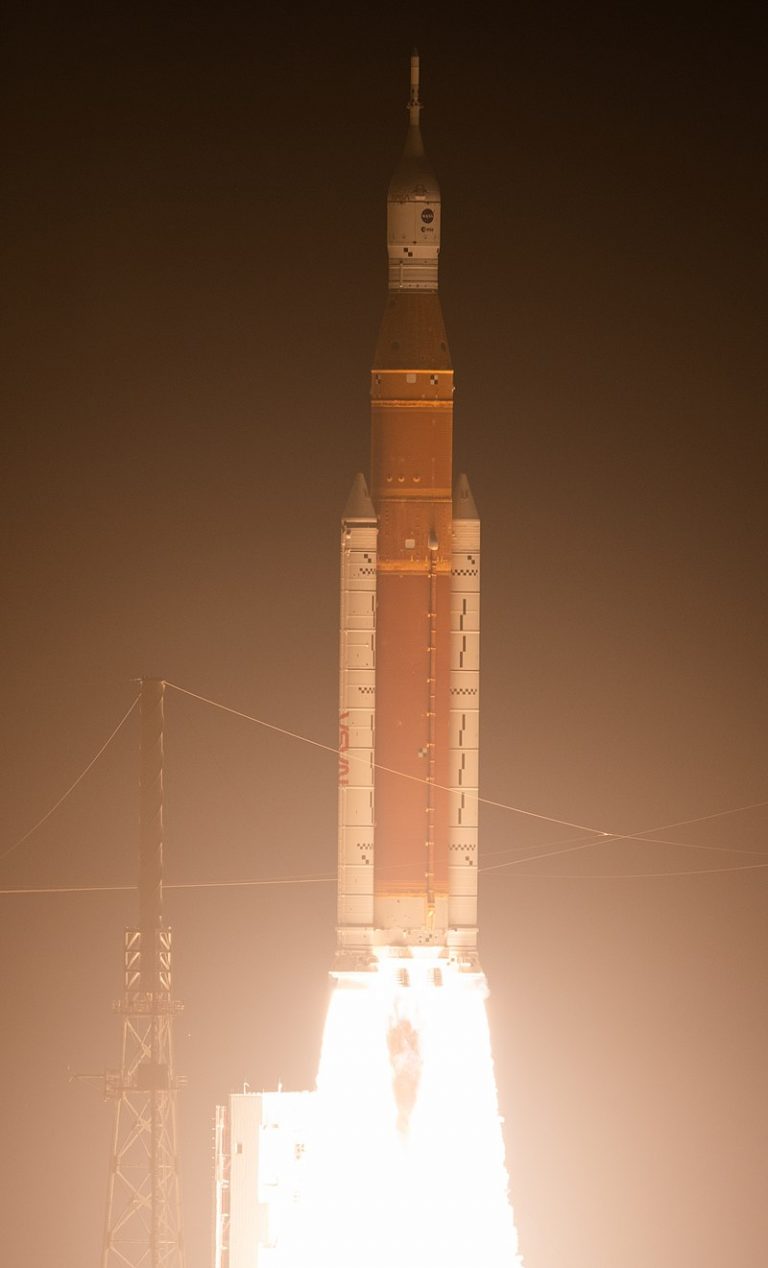
Following a successful launch of NASA’s Space Launch System (SLS), the most powerful rocket in the world, the agency’s Orion spacecraft is on its way to the Moon as part of the Artemis program. Carrying an uncrewed Orion, SLS lifted off for its flight test debut at 1:47 a.m. EST Wednesday from Launch Pad 39B at NASA’s Kennedy Space Center in Florida.

The launch is the first leg of a mission in which Orion is planned to travel approximately 40,000 miles beyond the Moon and return to Earth over the course of 25.5 days. Known as Artemis I, the mission is a critical part of NASA’s Moon to Mars exploration approach, in which the agency explores for the benefit of humanity. It’s an important test for the agency before flying astronauts on the Artemis II mission.

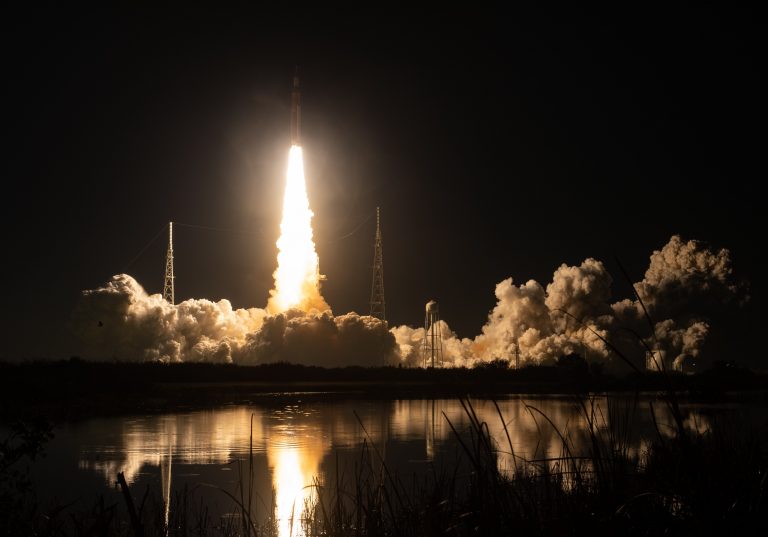
NASA’s Space Launch System rocket carrying the Orion spacecraft launches on the Artemis I flight test, Wednesday, Nov. 16, 2022, from Launch Complex 39B at NASA’s Kennedy Space Center in Florida. NASA’s Artemis I mission is the first integrated flight test of the agency’s deep space exploration systems: the Orion spacecraft, Space Launch System (SLS) rocket, and ground systems. SLS and Orion launched at 1:47am ET from Launch Pad 39B at the Kennedy Space Center.
Credits: NASA/Bill Ingalls
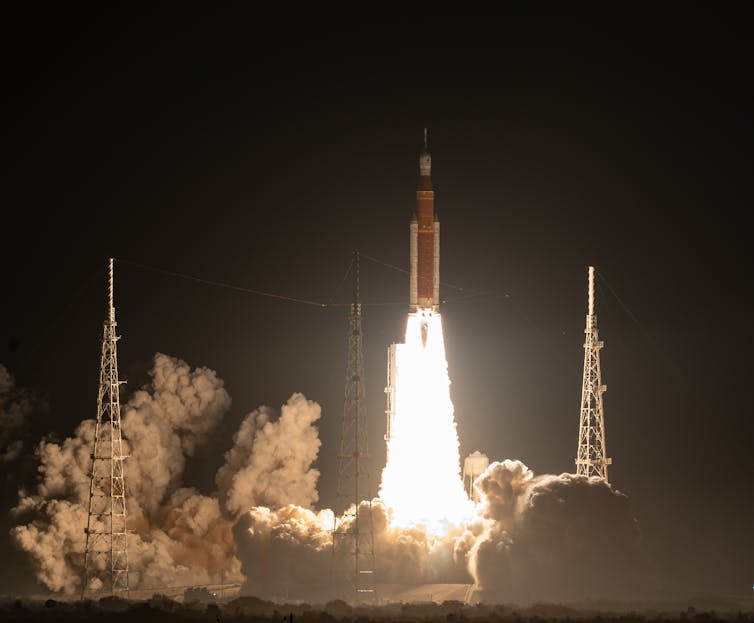
NASA’s Space Launch System rocket carrying the Orion spacecraft launches on the Artemis I flight test, Wednesday, Nov. 16, 2022, from Launch Complex 39B at NASA’s Kennedy Space Center in Florida. NASA’s Artemis I mission is the first integrated flight test of the agency’s deep space exploration systems: the Orion spacecraft, Space Launch System (SLS) rocket, and ground systems. SLS and Orion launched at 1:47 a.m. EST, from Launch Pad 39B at the Kennedy Space Center. Photo Credit: (NASA/Bill Ingalls)

“What an incredible sight to see NASA’s Space Launch System rocket and Orion spacecraft launch together for the first time. This uncrewed flight test will push Orion to the limits in the rigors of deep space, helping us prepare for human exploration on the Moon and, ultimately, Mars,” said NASA Administrator Bill Nelson. 

After reaching its initial orbit, Orion deployed its solar arrays and engineers began performing checkouts of the spacecraft’s systems. About 1.5 hours into flight, the rocket’s upper stage engine successfully fired for approximately 18 minutes to give Orion the big push needed to send it out of Earth orbit and toward the Moon.  

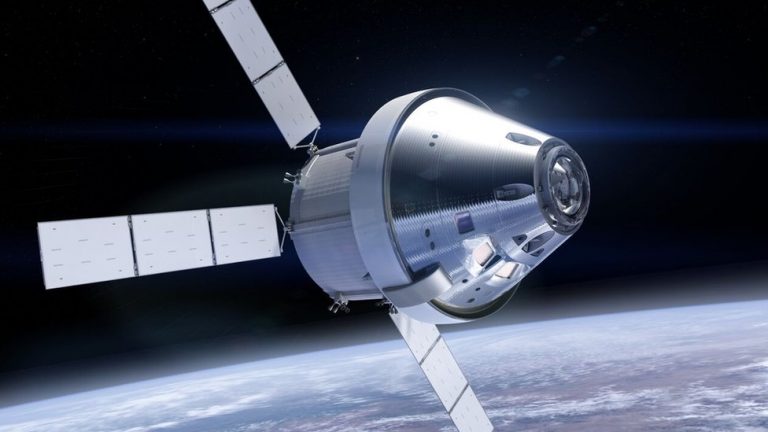
Orion has separated from its upper stage and is on its outbound coast to the Moon powered by its service module, which is the propulsive powerhouse provided by ESA (European Space Agency) through an international collaboration. 

“It’s taken a lot to get here, but Orion is now on its way to the Moon,” said Jim Free, NASA deputy associate administrator for the Exploration Systems Development Mission Directorate. “This successful launch means NASA and our partners are on a path to explore farther in space than ever before for the benefit of humanity.”

Over the next several hours, a series of 10 small science investigations and technology demonstrations, called CubeSats, will deploy from a ring that connected the upper stage to the spacecraft. Each CubeSat has its own mission that has the potential to fill gaps in our knowledge of the solar system or demonstrate technologies that may benefit the design of future missions to explore the Moon and beyond. 

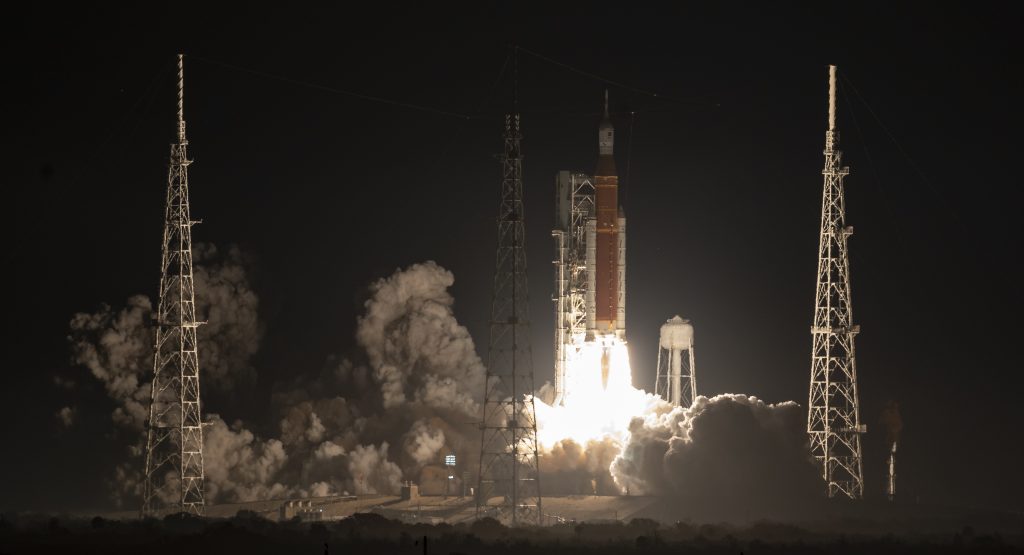
NASA’s Space Launch System rocket carrying the Orion spacecraft launches on the Artemis I flight test, Wednesday, Nov. 16, 2022, from Launch Complex 39B at NASA’s Kennedy Space Center in Florida. NASA’s Artemis I mission is the first integrated flight test of the agency’s deep space exploration systems: the Orion spacecraft, Space Launch System (SLS) rocket, and ground systems. SLS and Orion launched at 1:47 a.m. EST, from Launch Pad 39B at the Kennedy Space Center. Credits: NASA/Joel Kowsky
NASA’s Space Launch System rocket carrying the Orion spacecraft launches on the Artemis I flight test, Wednesday, Nov. 16, 2022, from Launch Complex 39B at NASA’s Kennedy Space Center in Florida. NASA’s Artemis I mission is the first integrated flight test of the agency’s deep space exploration systems: the Orion spacecraft, Space Launch System (SLS) rocket, and ground systems. SLS and Orion launched at 1:47 a.m. EST, from Launch Pad 39B at the Kennedy Space Center. Photo Credit: (NASA/Joel Kowsky)

Orion’s service module will also perform the first of a series of burns to keep Orion on course toward the Moon approximately eight hours after launch. In the coming days, mission controllers at NASA’s Johnson Space Center in Houston will conduct additional checkouts and course corrections as needed. Orion is expected to fly by the Moon on Nov. 21, performing a close approach of the lunar surface on its way to a distant retrograde orbit, a highly stable orbit thousands of miles beyond the Moon.  

“The Space Launch System rocket delivered the power and performance to send Orion on its way to the Moon,” said Mike Sarafin, Artemis I mission manager. “With the accomplishment of the first major milestone of the mission, Orion will now embark on the next phase to test its systems and prepare for future missions with astronauts.”  

The SLS rocket and Orion spacecraft arrived at Kennedy’s Launch Pad 39B on Nov. 4 where they rode out Hurricane Nicole. Following the storm, teams conducted thorough assessments of the rocket, spacecraft, and associated ground systems and confirmed there were no significant impacts from the severe weather.

Engineers previously rolled the rocket back to the Vehicle Assembly Building (VAB) Sept. 26 ahead of Hurricane Ian and after waving off two previous launch attempts Aug. 29 due to a faulty temperature sensor, and Sept. 4 due to a liquid hydrogen leak at an interface between the rocket and mobile launcher. Prior to rolling back to the VAB, teams successfully repaired the leak and demonstrated updated tanking procedures. While in the VAB, teams performed standard maintenance to repair minor damage to the foam and cork on the thermal protection system and recharge or replace batteries throughout the system. 

Artemis I is supported by thousands of people around the world, from contractors who built Orion and SLS, and the ground infrastructure needed to launch them, to international and university partners, to small businesses supplying subsystems and components.  

Through Artemis missions, NASA will land the first woman and the first person of color on the surface of the Moon, paving the way for a long-term lunar presence and serving as a steppingstone for astronauts on the way to Mars. 

View more photos of Artemis I at:

https://flic.kr/s/aHBqjzG1pG

Source: NASA

NASA’s Webb Catches Fiery Hourglass as New Star Forms

0

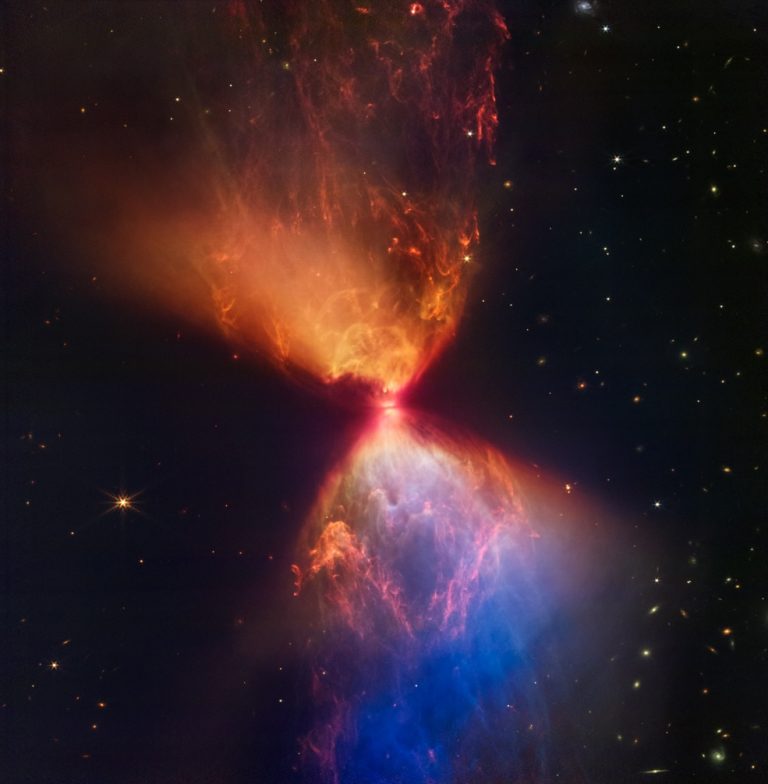
NASA’s James Webb Space Telescope has revealed the once-hidden features of the protostar within the dark cloud L1527, providing insight into the beginnings of a new star. These blazing clouds within the Taurus star-forming region are only visible in infrared light, making it an ideal target for Webb’s Near-Infrared Camera (NIRCam).

The protostar itself is hidden from view within the “neck” of this hourglass shape. An edge-on protoplanetary disk is seen as a dark line across the middle of the neck. Light from the protostar leaks above and below this disk, illuminating cavities within the surrounding gas and dust.

The protostar within the dark cloud L1527, shown in this image from NASA’s James Webb Space Telescope Near-Infrared Camera (NIRCam), is embedded within a cloud of material feeding its growth. Ejections from the star have cleared out cavities above and below it, whose boundaries glow orange and blue in this infrared view. The upper central region displays bubble-like shapes due to stellar “burps,” or sporadic ejections.
Credits: NASA, ESA, CSA, and STScI. Image processing: J. DePasquale, A. Pagan, and A. Koekemoer (STScI)
Download the full-resolution image from the Space Telescope Science Institute.
The protostar within the dark cloud L1527, shown in this image from NASA’s James Webb Space Telescope Near-Infrared Camera (NIRCam), is embedded within a cloud of material feeding its growth. Ejections from the star have cleared out cavities above and below it, whose boundaries glow orange and blue in this infrared view. The upper central region displays bubble-like shapes due to stellar “burps,” or sporadic ejections. Credits: NASA, ESA, CSA, and STScI. Image processing: J. DePasquale, A. Pagan, and A. Koekemoer (STScI) Download the full-resolution image from the Space Telescope Science Institute.

The region’s most prevalent features, the clouds colored blue and orange in this representative-color infrared image, outline cavities created as material shoots away from the protostar and collides with surrounding matter. The colors themselves are due to layers of dust between Webb and the clouds. The blue areas are where the dust is thinnest. The thicker the layer of dust, the less blue light is able to escape, creating pockets of orange.

Webb also reveals filaments of molecular hydrogen that have been shocked as the protostar ejects material away from it. Shocks and turbulence inhibit the formation of new stars, which would otherwise form all throughout the cloud. As a result, the protostar dominates the space, taking much of the material for itself.

Despite the chaos that L1527 causes, it’s only about 100,000 years old – a relatively young body. Given its age and its brightness in far-infrared light as observed by missions like the Infrared Astronomical Satellite, L1527 is considered a class 0 protostar, the earliest stage of star formation. Protostars like these, which are still cocooned in a dark cloud of dust and gas, have a long way to go before they become full-fledged stars. L1527 doesn’t generate its own energy through nuclear fusion of hydrogen yet, an essential characteristic of stars. Its shape, while mostly spherical, is also unstable, taking the form of a small, hot, and puffy clump of gas somewhere between 20 and 40% the mass of our Sun.

As the protostar continues to gather mass, its core gradually compresses and gets closer to stable nuclear fusion. The scene shown in this image reveals L1527 doing just that. The surrounding molecular cloud is made up of dense dust and gas being drawn to the center, where the protostar resides. As the material falls in, it spirals around the center. This creates a dense disk of material, known as an accretion disk, which feeds material to the protostar. As it gains more mass and compresses further, the temperature of its core will rise, eventually reaching the threshold for nuclear fusion to begin.

The disk, seen in the image as a dark band in front of the bright center, is about the size of our solar system. Given the density, it’s not unusual for much of this material to clump together – the beginnings of planets. Ultimately, this view of L1527 provides a window into what our Sun and solar system looked like in their infancy.

The James Webb Space Telescope is the world’s premier space science observatory. Webb will solve mysteries in our solar system, look beyond to distant worlds around other stars, and probe the mysterious structures and origins of our universe and our place in it. Webb is an international program led by NASA with its partners, ESA (European Space Agency) and the Canadian Space Agency.

Source: NASA