Home Blog Page 117

Solar Orbiter Heads For Closest Point To The Sun

0

Never before has the space probe been this close to the Sun: In a few days, Solar Orbiter will venture to within 48 million kilometers of our star.

After two years in space, ESA’s spacecraft Solar Orbiter, to which NASA is also contributing, is heading for the best vantage point of its flight path so far. Next Saturday, March 26, only about 48 million kilometers will separate the probe from the Sun. That is less than a third of the distance between Earth and Sun. In the days around the so-called perihelion passage, the space probe is expected to record its most valuable data to date; the images of the hot solar corona will have the highest resolution of all times. Solar Orbiter will be able to exploit one of its key advantages: the simultaneous view into different layers of the Sun. The scientists involved hope that among other things this will provide new insights into how the smallest bursts of radiation in the corona arise from the magnetic fields of the visible solar surface. The Max Planck Institute for Solar System Research (MPS) in Germany has contributed to four of the mission’s ten scientific instruments.

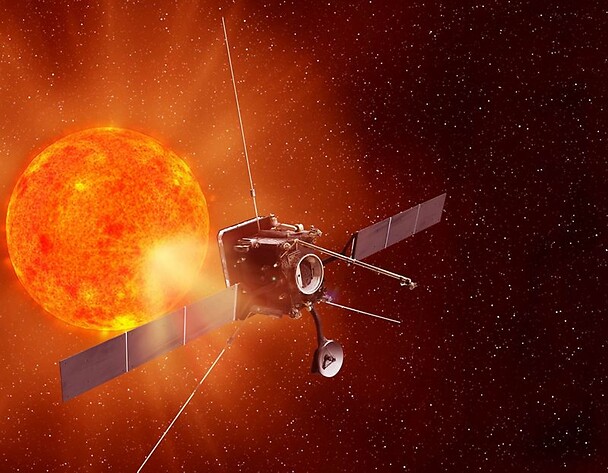
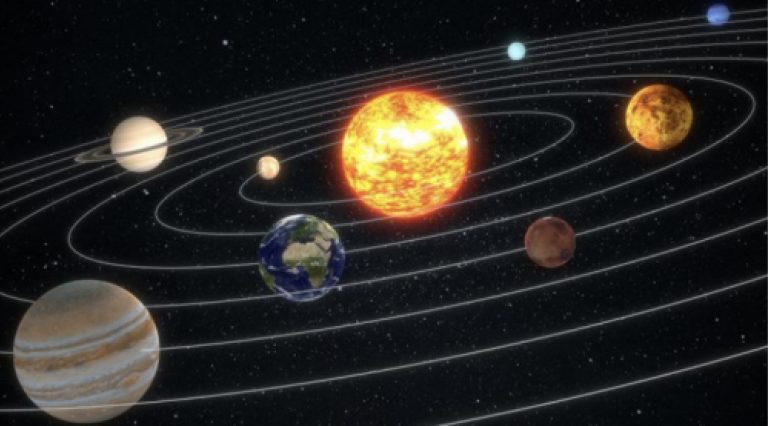
Only 48 million kilometers will lie between Solar Orbiter an the Sun on March 26th.
Only 48 million kilometers will lie between Solar Orbiter an the Sun on March 26th.© ESA/ATG medialab

An enormous span of 150 million kilometers lie between Earth and Sun. Only few space probes have so far ventured within less than a third of this distance from our central star. From the end of March, Solar Orbiter will join this exclusive group: On Saturday, March 26, the spacecraft will fly past the Sun at a distance of about 48 million kilometers. This is only a few million kilometers more than the distance reached by the twin probes Helios A and B in the 1970s. Only NASA’s Parker Solar Probe has flown closer to the Sun, reaching a distance of just 8.5 million kilometers last year.

“Unlike its predecessors, Solar Orbiter is equipped with unusually comprehensive instrumentation,” explains MPS Director Prof. Dr. Sami K. Solanki.

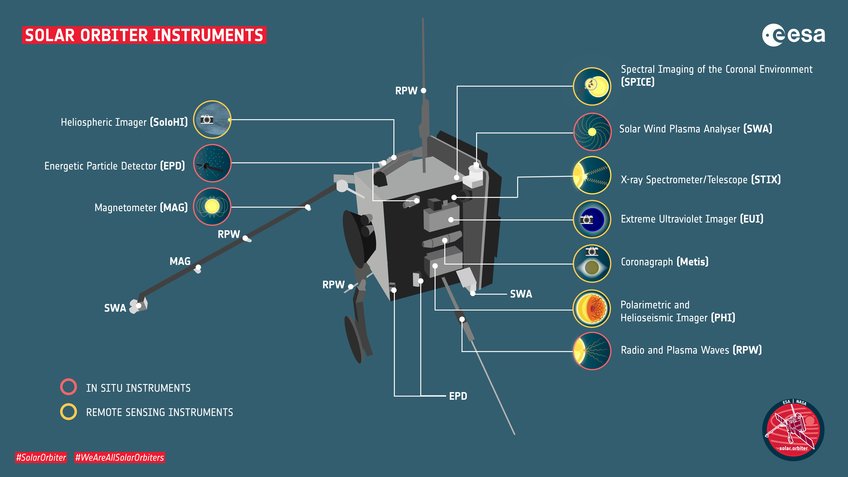
The ten scientific instruments not only analyze the electromagnetic fields and solar particles that flow around the spacecraft, but for the first time can look at the Sun itself from a great proximity. For example, the instrument PHI (Polarimetric and Helioseismic Imager), which was developed and built under the lead of the MPS, observes the magnetic fields and flow velocities at the solar surface; EUI (Extreme-Ultraviolet Imager), SPICE (Spectral Imaging of the Coronal Environment) and the coronagraph Metis, to which the MPS contributed, provide information from the hot solar corona.

Radiation bursts and solar wind

There, EUI’s telescopes have in recent months been able to detect tiny bursts of radiation known as “campfires”. The phenomenon occurs more frequently than previously thought and could help to explain how the puzzlingly high temperatures of about one million degrees in the solar corona are generated. The visible solar surface is much “cooler” at about 6000 degrees. Data taken by PHI and EUI during their commissioning in 2020 and 2021 show that often closely adjacent regions of different magnetic polarity on the solar surface are the origin of this phenomenon. There is much to suggest that structural changes in these spatially confined magnetic fields are instrumental in supplying energy to the “campfires.” “According to our evaluations, however, other yet unknown processes must also play a role,” says MPS scientist Dr. Fatima Kahil, who analyzed these data. “We very much hope that the better-resolved data from the upcoming perihelion transit will help us better understand these processes,” she adds.

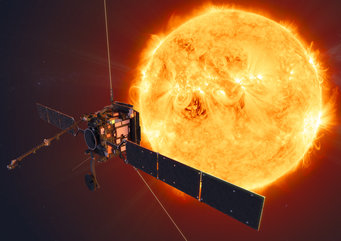
© ESA / S. Poletti
© ESA / S. Poletti

During the days around March 26, Solar Orbiter will also look at the Sun’s polar regions. So far, the spacecraft has left the orbital plane in which Earth and the other planets orbit the Sun by four degrees; by the end of the mission, that number is expected to rise to more than 30 degrees. This will make it possible to look at the Sun’s poles for the first time.

“Although Solar Orbiter’s view of the poles is not yet optimal, the timing is particularly favorable for such observations at the moment,” explains MPS scientist Prof. Dr. Hardi Peter, a member of the SPICE, EUI and Metis teams. In its approximately eleven-year cycle, the Sun’s activity has not yet reached its maximum. During this comparatively quiet phase, the fast solar wind emerges rather frequently from regions near the poles. With supersonic speeds of about 750 kilometers per second, these solar particles chase through space. Joint measurements by Solar Orbiter’s in situ instruments, which analyze these particles at the spacecraft’s location, and instruments looking at the Sun could provide insight into the acceleration mechanism. At the next perihelion transit in about six months, the fast solar wind should have already decreased further. Then, however, spontaneous eruptions of solar particles will occur more frequently.

And yet closer

Solar Orbiter’s current, highly elliptical orbit will change little over the next three years: About every six months, the spacecraft will reach its closest point to the Sun. However, with its next perihelion transit, due in October of this year, Solar Orbiter will move yet a little closer to the Sun, to 42 million kilometers. By then, Solar Orbiter will also have surpassed the Helios A and B probes.

Source: MPS

See The First-Ever Image Of A Black Hole In The Heart Of The Milky Way

0

Observation with the Event Horizon Telescope improves our understanding of the processes at the galactic centre

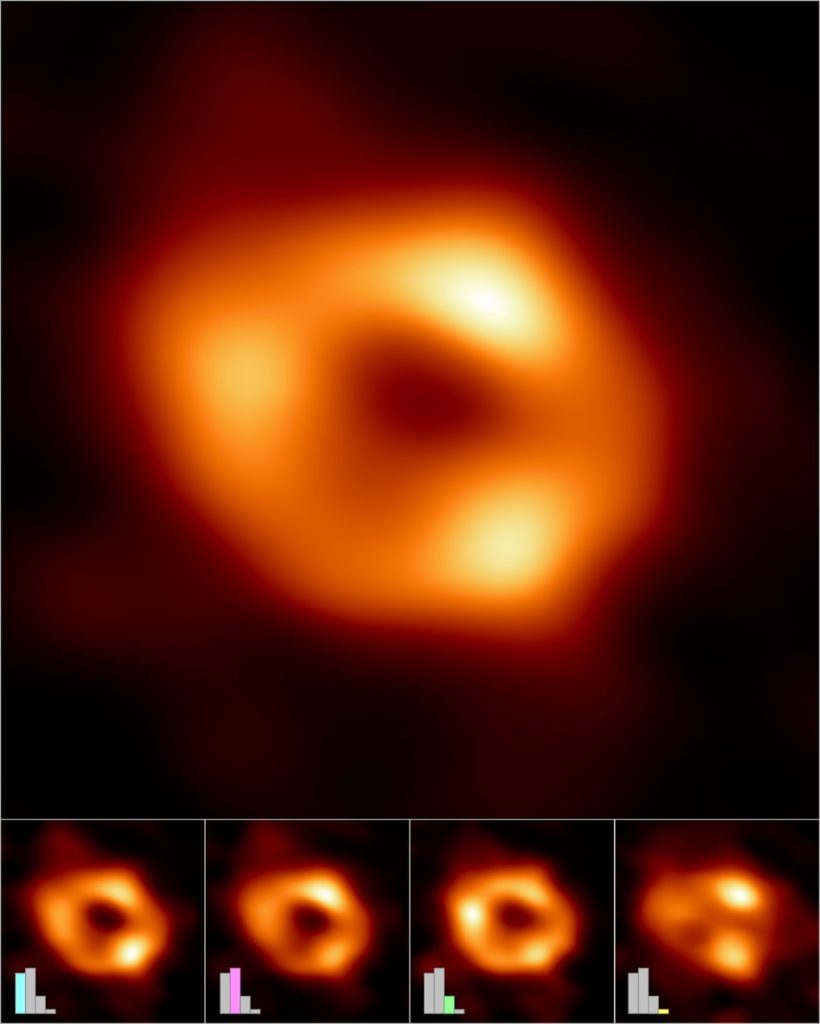
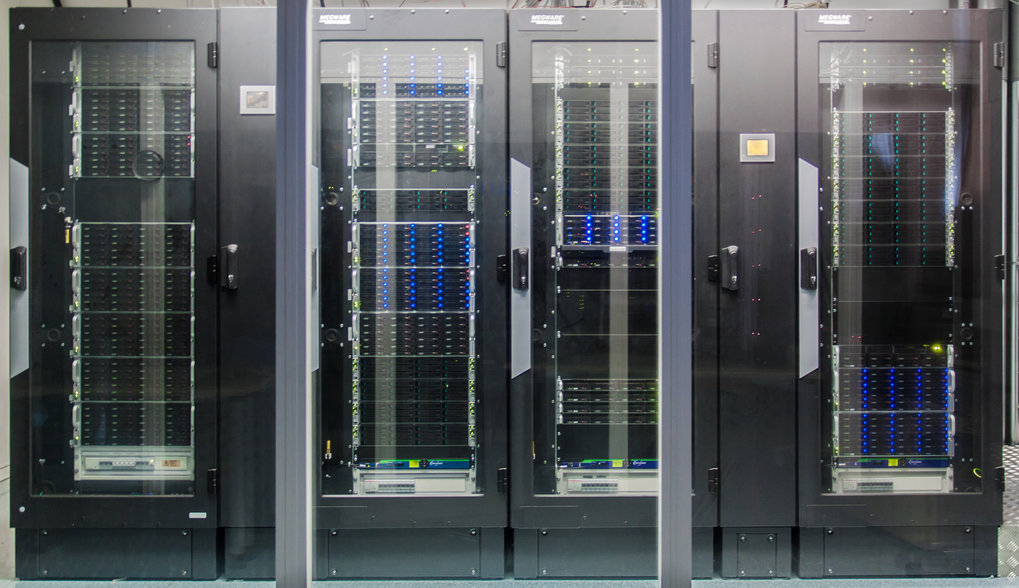
It sits deep in the heart of the Milky Way, is 27,000 light years from Earth, and resembles a doughnut. This is how the black hole at the centre of our galaxy appears in the image obtained by researchers using the Event Horizon Telescope (EHT). The team has thus provided evidence that, as suspected, this object belongs to the family of cosmic gravity traps. The radio data from the observatories connected in the worldwide EHT network were obtained from two supercomputers: one at the Max Planck Institute for Radio Astronomy in Bonn and one at the Haystack Observatory in Massachusetts. The Apex telescope of the Bonn Institute and the 30-metre antenna of the Institut de Radioastronomie Millimétrique (IRAM), which belongs to the Max Planck Society, were also involved in the observation.

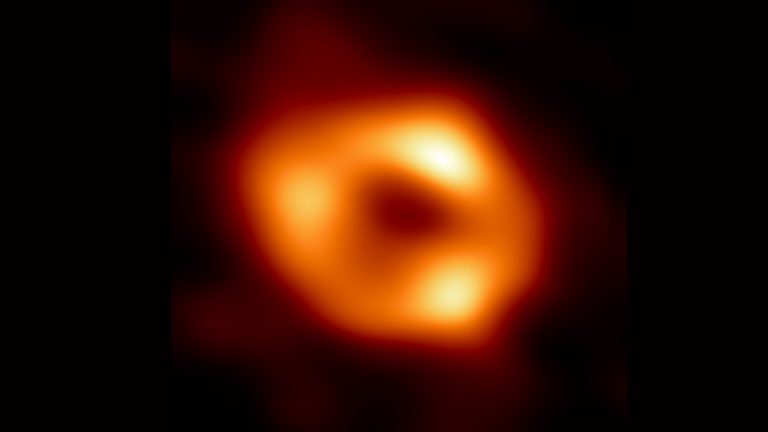
Cosmic ring of fire: This is the first image of Sagittarius A*, the supermassive black hole at the centre of the Milky Way. It was taken by the Event Horizon Telescope (EHT), a network that combines radio observatories around the world into a single virtual telescope the size of the Earth. The EHT is named after the “event horizon”, the boundary of the black hole beyond which no light can escape. Although the event horizon itself is not visible because it does not emit light, glowing gas swirling around the black hole shows a tell-tale signature: a dark central region (shadow) surrounded by a bright ring-shaped structure. The image captures light bent by the strong gravity of the black hole and is four million times more massive than the sun. The image is an average of the various images extracted by the EHT collaboration from their observations in April 2017. The images can also be clustered into four groups based on similar features. An averaged, representative image for each of the four clusters is shown in the bottom row. Three of the clusters show a ring structure but, with differently distributed brightness around the ring. The fourth cluster contains images that also fit the data but do not appear ring-like. The bar graphs show the relative number of images belonging to each cluster. Thousands of images fell into each of the first three clusters, while the fourth and smallest cluster contains only hundreds of images. The heights of the bars indicate the relative contributions of each cluster to the averaged image at top.  © EHT collaboration
Cosmic ring of fire: This is the first image of Sagittarius A*, the supermassive black hole at the centre of the Milky Way. It was taken by the Event Horizon Telescope (EHT), a network that combines radio observatories around the world into a single virtual telescope the size of the Earth. The EHT is named after the “event horizon”, the boundary of the black hole beyond which no light can escape. Although the event horizon itself is not visible because it does not emit light, glowing gas swirling around the black hole shows a tell-tale signature: a dark central region (shadow) surrounded by a bright ring-shaped structure. The image captures light bent by the strong gravity of the black hole and is four million times more massive than the sun. The image is an average of the various images extracted by the EHT collaboration from their observations in April 2017. The images can also be clustered into four groups based on similar features. An averaged, representative image for each of the four clusters is shown in the bottom row. Three of the clusters show a ring structure but, with differently distributed brightness around the ring. The fourth cluster contains images that also fit the data but do not appear ring-like. The bar graphs show the relative number of images belonging to each cluster. Thousands of images fell into each of the first three clusters, while the fourth and smallest cluster contains only hundreds of images. The heights of the bars indicate the relative contributions of each cluster to the averaged image at top. © EHT collaboration

The recently published image is the long-awaited direct view of the object at the centre of our galaxy known as Sagittarius A*. For many years, researchers have been examining this area of the Milky Way and observing stars that orbit an invisible, compact, and massive object. For this work, Andrea Ghez from the University of California and Reinhard Genzel from the Max Planck Institute for Extraterrestrial Physics in Garching were awarded the Nobel Prize in 2020.

“Our discovery shows that the object at the galactic centre is indeed a black hole”, says Anton Zensus, Director at the Max Planck Institute for Radio Astronomy and founding chair of the Supervisory Board of the EHT. The image is the first direct visual proof of this. The black hole itself is not visible in the image because it does not emit any radiation. But the glowing gas around it shows a tell-tale signature – a dark central region (shadow) surrounded by a bright ring-like structure. Their light is bent by the immense gravity of the black hole.

“We were amazed at how well the size of the observed ring matched the predictions of Einstein’s general theory of relativity”, says EHT project scientist Geoffrey Bower from the Institute of Astronomy and Astrophysics at Academia Sinica in Taipei. The observations would greatly have improved the understanding of the physical processes taking place at the centres of galaxies and would provide insights into how such giant gravity traps interact with their surroundings.

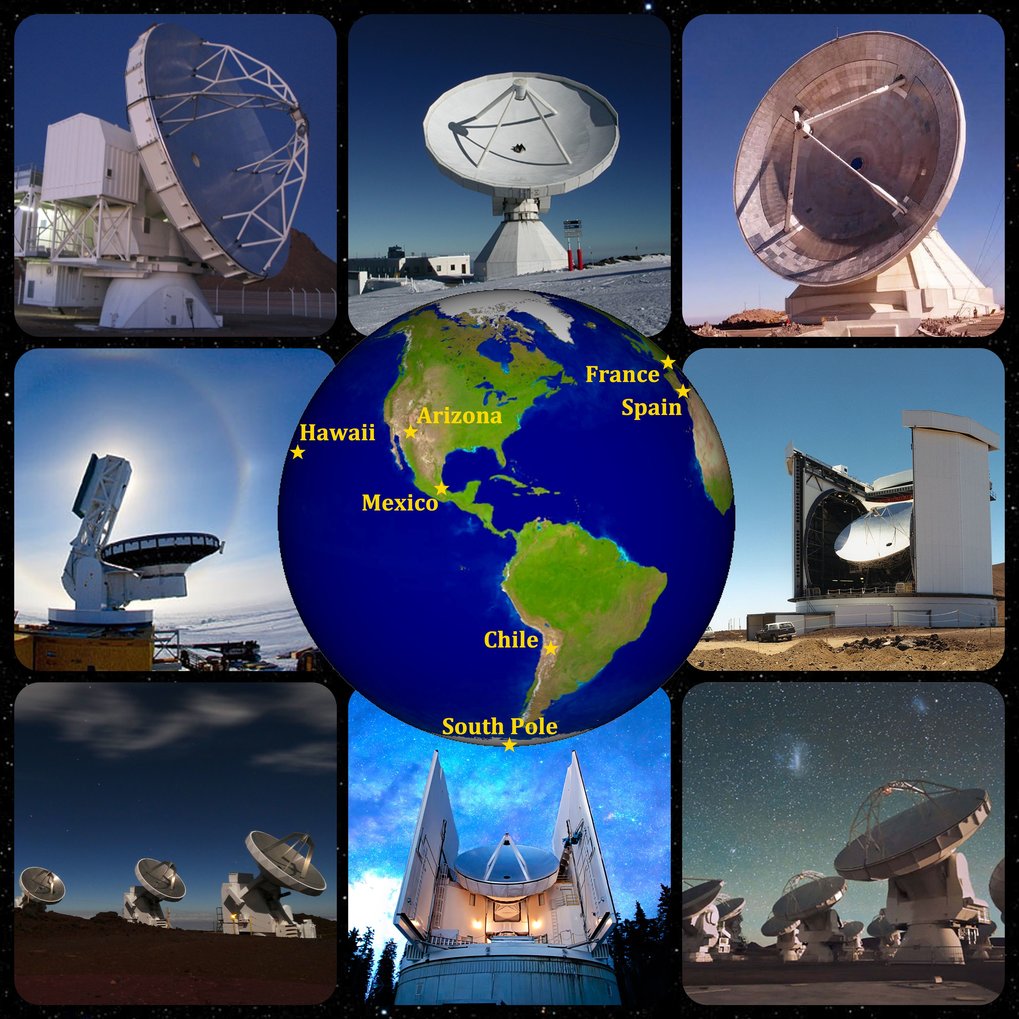
Because the black hole at the centre of the Milky Way is 27,000 light years away from Earth, it appears to us in the sky about as big as a doughnut on the moon. In order to image it, the team created the powerful EHT, which links eight (now 11) radio observatories around the world into a single Earth-sized virtual telescope. Using interferometry, the astronomers observed the object Sagittarius A* during several nights in April 2017. At a wavelength of 1.3 millimetres, they collected data for many hours at a time – similar to the long exposure time of a camera. These data were analysed by two correlators – high-performance computers located at the Max Planck Institute for Radio Astronomy and the Haystack Observatory.

The Max Planck Institute was also involved in the campaign with an antenna. “The contribution of our Apex telescope was essential for perfectly calibrating the changing brightness of the source and providing definitive proof of the black hole shadow at the galactic centre”, says Director Karl Menten.

Worldwide network: When the researchers collected the data from the centre of the Milky Way in 2017, the Event Horizon Telescope consisted of eight observatories spread across the globe.  © EHT collaboration
Worldwide network: When the researchers collected the data from the centre of the Milky Way in 2017, the Event Horizon Telescope consisted of eight observatories spread across the globe. © EHT collaboration

The current observation follows the 2019 image of a black hole (M 87*) at the centre of the galaxy Messier 87, which lies at a much greater distance from Earth. The two black holes are similar – although the one at the centre of the Milky Way is more than one thousand times smaller and much lighter than M 87*. “We are dealing with two completely different types of galaxies and two different masses of black holes. But near their edges, they look amazingly similar”, says Sera Markoff, co-chair of the Council of Sciences of the EHT and professor of theoretical astrophysics at the University of Amsterdam.

This time, the evaluation of the data was much more difficult than with the galaxy M 87, 55 million light years away – even though the centre of the Milky Way is much closer (27,000 light years). The gas swirls around the two black holes at practically the same speed – almost as fast as light. But while it takes days to weeks to orbit the larger object M 87*, it orbits of the much smaller Sagittarius A* in just a few minutes. “The brightness and appearance of the gas around Sagittarius A* thus changed rapidly during our observation”, says Chi-kwan Chan from the University of Arizona. “It’s like trying to take a sharp image of a dog vigorously wagging its tail”.

The researchers had to develop sophisticated new methods in order to explain the gas movements around the Sagittarius A* black hole, which “weighs” around four million solar masses. In contrast, M 87*, weighing six and a half billion solar masses, was an easier and more stable target. In addition, Earth is in the galactic plane; this causes a scattering effect in the radio measurements. Hot gas with charged particles and magnetic fields in the line of sight also complicate the analysis.

The image of Sagittarius A* is thus an average of various images that the team extracted from the data. Maciek Wielgus and Michael Janßen, both from the Max Planck Institute for Radio Astronomy, played a major role in the calibration. For tests of general relativity and proof of an event horizon, their colleague Gunther Witzel compiled the results of other observations.

Concentrated computing power: The scientists used this high-performance computer at the Max Planck Institute for Radio Astronomy to analyse the data from the Event Horizon Telescope. A second correlator is located at the Haystack Observatory in the US.  © MPIfR
Concentrated computing power: The scientists used this high-performance computer at the Max Planck Institute for Radio Astronomy to analyse the data from the Event Horizon Telescope. A second correlator is located at the Haystack Observatory in the US. © MPIfR

The EHT collaboration includes more than 300 researchers from 80 institutes worldwide. Over the past five years, the team has developed complex instruments and compiled a unique library of numerically simulated black holes to compare with observations. Among other things, these serve to test the theories of gravitation.

According to Michael Kramer, Director at the Max Planck Institute and one of the project leaders of the Black Hole Cam project, the earlier image of M 87* was only partially suitable for this purpose. “For Messier 87, we had no reliable prior knowledge about the mass of the black hole. In the current case, it is quite different. Thanks to previous measurements such as those by Reinhard Genzel, we know both the distance and the mass of Sagittarius A* quite precisely. We were thus able to calculate the expected shadow size in order to compare it with the observations. And it fits quite well.” The Black Hole Cam project was funded by the European Research Council (ERC) and plays an important role within the EHT collaboration.

Using the images of the two differently-sized black holes, the researchers can compare the two objects and check how they differ. The new data can also be used to test theories and models about how gravity and matter behave in the extreme environment of supermassive black holes. This is not yet fully understood but apparently plays a key role in the formation and evolution of galaxies.

IRAM Director Karl Schuster emphasizes the many years of joint pioneering work between the Max Planck Institute for Radio Astronomy and his institute in Grenoble, France. “The results from the Event Horizon Telescope are an ideal complement to the results obtained by Reinhard Genzel’s group at the Max Planck Institute for Extraterrestrial Physics in the infra-red range with the Gravity instrument”. Meanwhile, measurements with the Event Horizon Telescope continue. Eleven observatories were involved in a major campaign in March 2022. “Of course, we are all quite excited to see what the EHT observations in 2021 and 2022 will reveal with the participation of our powerful Noema observatory”, says Schuster.

ER / HOR / NJ

Source: Max-Planck-Gesellschaft

Every Moment And Blink Of An Eye, The Universe Does These

0

How long do we spend blinking? And how many times do we blink a day?

According to technology research, blinks last on average about a tenth of a second which is 100 milliseconds and we blinks about 518,017,359 times in our entire life. We know that the average person blinks 15 to 20 times a minute.

“A LOT CAN HAPPEN IN THE BLINK OF AN EYE.”

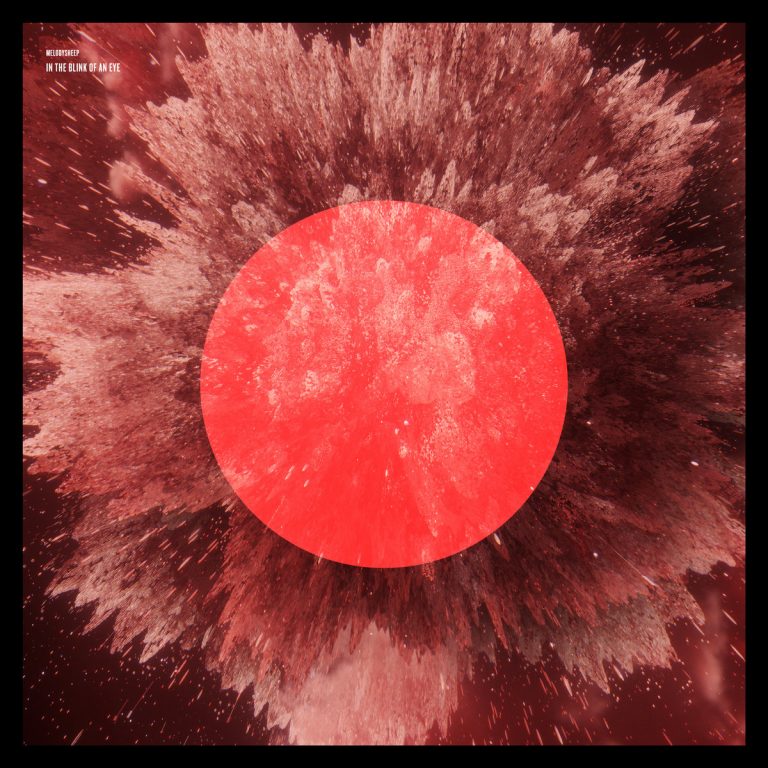
Source: melodysheep

When we look up at night, the universe seems pretty quiet. But that perspective is an illusion; in reality, there are millions of world-shattering events happening every instant across the cosmos. This short film explores just how much is going on every moment in our ridiculously enormous universe.

In the fraction of a second it takes to blink your eyes, thousands of stars will be born, hundreds will explode and die, millions of planets will form, and our universe will expand by half a million kilometers in diameter. And these numbers only account for the observable universe — not for what could be happening beyond, where some scientists believe there could be an infinite expanse of space.

THINK NEXT TIME YOU BLINK.

The Secret History of the Moon

0

Where did the moon come from?

The Moon has drawn out our sense of wonder since before we were fully human. Where did it come from? What secrets are written in its rocks?

In this epic video, filmmaker John D. Boswell explores the secret history of the moon—what we think we know, what still puzzles us, and how new theory may help reconcile the two.

Where did the moon come from?

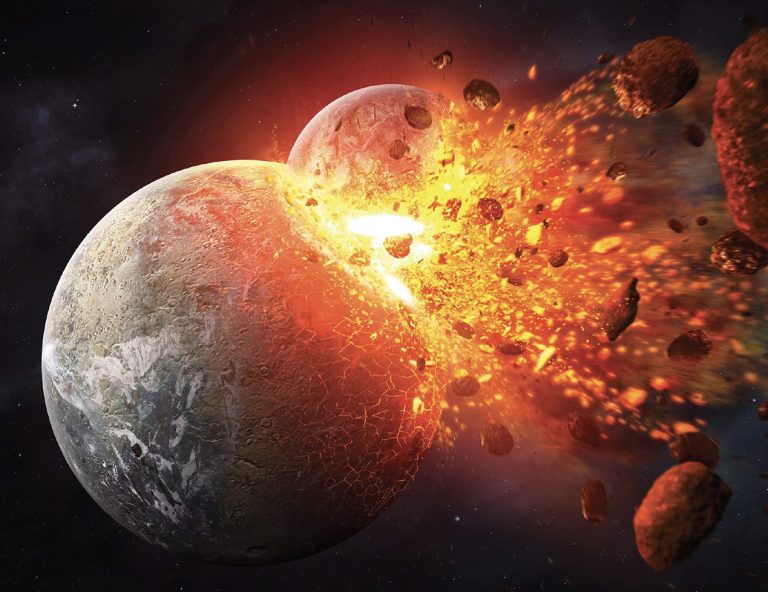
The leading theory suggests the moon was formed after a massive collision between a Mars-sized planet Theia and Earth in the early days of the solar system. Theia was smashed apart and reformed in Earth’s orbit as the moon. Called the giant impact theory, the general idea is solid but the exact details remain a work in progress. In recent years, scientists have proposed new ideas to further sharpen science’s best lunar creation story.

For most of our history, its story was cloaked in myth and mystery. Only now are the vivid details coming into focus. This video takes you back 4.5 billion years to witness the dramatic ways which the moon could have formed, according to the latest mind-blowing theories. By reading the clues written in Moon rocks, we are closer than ever to knowing its full story. But the Moon still holds its secrets close. What else is it hiding?

As the moon is the only substantial body in the solar system that we have travelled to and retrieved rocks from, its samples are valuable to scientists. Dr Snape has studied the ratios of isotopes of lead and uranium in rocks returned by the Apollo missions and from lunar meteorites. This ratio acts as a deep-time clock that he has used to calculate when a rock formed. 

‘The moon has a record and acts as a beautiful lab for understanding early planetary processes. This will be applicable to Mars, Mercury or Venus, places that are hard for us to access, and it can even tell us about our own planet,’ said Dr Snape.

Earth is not quite so useful because plate tectonics bury and recycle rocks. 

‘This is why we love the moon so much,’ he said. ‘It is a treasure trove, geologically speaking.’

The Origin Of Chaos In The Solar System Through Computer Algebra

0

Shedding new light on planetary chaos

Are the orbits of the solar system planets stable? This question has arisen several times in history, especially when Henri Poincaré, at the end of the 19th century, highlights chaotic zones. Until recently the origin of this chaos has given rise to controversy. A publication in press in Astronomy & Astrophysics Letters, by Mogavero and Laskar, develops a systematic study of all the resonances present in the inner solar system. It is indeed the entanglement of resonances which is the source of the chaotic behavior of these orbits.

The question of the stability of the solar system arose since the enunciation of the law of universal gravitation by Newton. Newton’s law allows to recover Kepler’s fixed ellipses for a single planet around the sun, Jupiter, for example. But as soon as we consider a second planet, Saturn, the law also announces that Saturn disturbs the orbit of Jupiter. The big question, which Newton already poses in the preface to his optical volume (1706), is then whether these disturbances between the planets will destabilize the system. This problem will be solved in a first approximation by Laplace and Lagrange at the end of the 18th century. Laplace shows that the size of planetary orbits is invariant on average. Lagrange introduces the formalism that allows him to calculate their long-term evolution. Planetary ellipses rotate slowly in their plane and in space, with notable variations in their eccentricity and inclination, but which do not allow planetary collisions. The system is stable and predictable over an infinite time. This triumph was of short duration, because at the end of the XIXth century, Henri Poincaré shows that the problem of the three bodies is not integrable. He highlighted the zones that are now called chaotic, in which the orbits can show a very high sensitivity to their initial conditions. After Poincaré, mathematicians and astronomers continued their quest for stability for the solar system. The famous KAM theorem (Kolmogorov, Arnold, Moser) shows that despite the areas of instability highlighted by Poincaré, there remains a large number of regular solutions provided that the planetary masses are small enough. The application of this result to the motion of the planets by Vladimir Arnold in 1963 will again be considered as a proof of the stability of the solar system, even if Michel Hénon then pointed out that its application requires planetary masses much lower than the mass of the electron.

Due to the gravitational perturbations between the planets, the orbits of these planets deform over time. These variations are chaotic, limiting the predictions to 60 million years. Credits Y. Gominet/IMCCE (NASA textures)

More than thirty years ago, using computer algebra methods coupled with numerical integrations, Jacques Laskar (Institut de Mécanique Céleste et de Calcul des Éphémérides (IMCCE), CNRS, Observatoire de Paris, Université Paris Sciences et Lettres) showed that the motion of the planets in the solar system is chaotic and not regular, as had been widely assumed until then. One of the first outcomes of this result is the impossibility of predicting the movement of the planets in the solar system over a period of more than 60 million years (Ma). The uncertainty on the trajectories of the planetary orbits diverge exponentially with a characteristic time of 5 Ma. In other words, this uncertainty is multiplied by 10 every 10 Ma. This limits the possibilities of calculating variations in insolation on the Earth’s surface resulting from variations in the Earth’s orbit, themselves due to disturbances from other planets. This then also limits the possibility of establishing geological time scales based on the correlation between the sedimentary series which testify of the climatic variations of the past and the insolation computations of celestial mechanics. Over longer periods of the order of the age of the solar system, the planets can even collide, among themselves or with the sun, with, for Mercury, a probability of collision of the order of 1%.

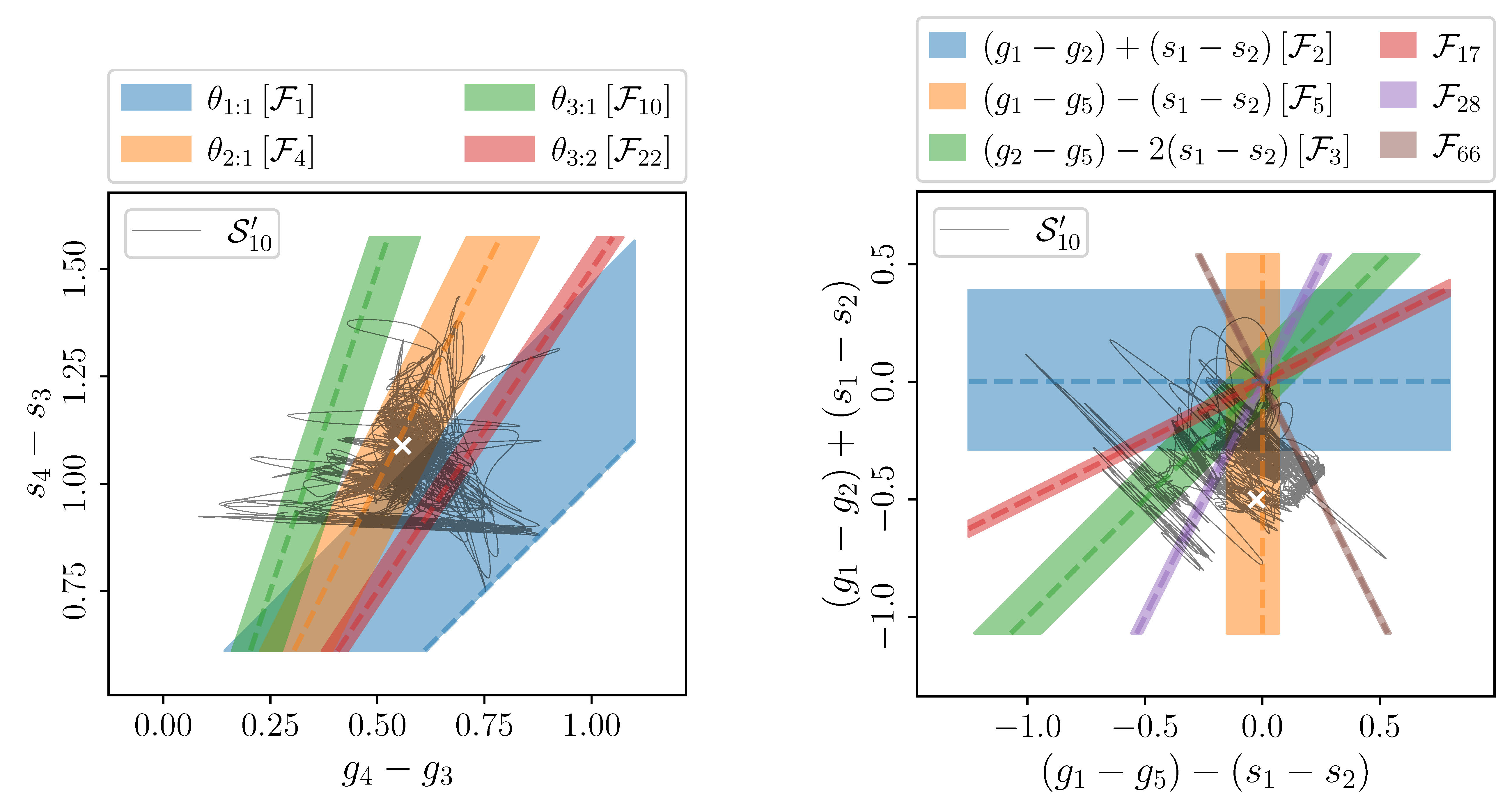
These results are now well accepted, but the origin of this chaotic motion remained a source of controversy. J. Laskar had highlighted a major role played by two resonances between the precessional movements of the planetary orbits. One involving the modes associated with the planets Mercury, Venus, Jupiter ((g1-g5)-(s1-s2)), and another linked to Earth and Mars (2(g4-g3)-(s4-s3)). The latter had been challenged by American researchers when they had reproduced the results of J. Laskar through numerical calculations on computers. Since then, these doubts have been taken up in the scientific literature until very recently. On the other hand, no one has so far reproduced the analytical calculations that led to the discovery of the chaotic motion of the planets.

To put an end to this controversy, Federico Mogavero and J. Laskar used the computer algebra software TRIP developed over thirty years within the IMCCE team, to conduct a systematic study of all the resonances present in the inner solar system. These calculations, which have just been published as a Letter in the journal Astronomy and Astrophysics, involve developments of several million analytical terms. After analysis, these terms are classified by decreasing amplitude. Among the very first, we find the resonances discovered thirty years ago by J. Laskar. At the same time, a multidimensional network of new resonances, strongly coupling the inner planets, is revealed. The researchers show that taking into account the most important resonances of this network makes it possible to account for the characteristic time of 5 Ma for the exponential divergence of the planetary orbits. The application of computer algebra at the basis of this study has therefore made it possible to overcome the great complexity of the dynamics of the planets, by revealing the entanglement of resonances which is the source of the chaotic behavior of their orbits.

In a joint study of more than 100,000 solutions, the IMCCE team also confirms that the probability of collision of Mercury over 5 billion years (Ga) is indeed of the order of 1%. This probability reaches more than 90% if these calculations are extended over 100 Ga, forgetting that the life expectancy of the sun is probably only 5 Ga.

Figure: The solar system (white cross) is in a tangle of resonances represented here by dotted lines associated with a band whose width represents the amplitude of the resonance. The superposition of these resonant zones is at the origin of the chaotic motion of the solar system. The dynamics of this multidimensional system is complex and these figures must be considered as cuts in the most unstable directions (Mogavero & Laskar, 2022).

5 Big Questions About The Science Of ‘Star Wars’

0

As Star Wars: The Force Awakens cleaned up at the box office, researchers from Georgia Tech took a closer look at the science of the films. They answered five big questions about the worlds depicted in the movies and what’s possible in reality. We’re revisiting their responses to celebrate the release of the 2018 installment in the series, Solo: A Star Wars Story.

"Didn't we learn from physics classes about Newton's third law? For every action, there is an equal and opposite reaction," says Nepomuk Otte. "If true, it would mean that when Yoda exerts a force on the X-wing, Luke Skywalker's spaceship should also exert the same amount of force on Yoda. So why doesn't the little fella get squished like a mosquito?" (Credit: Thomas Hawk/Flickr)
“Didn’t we learn from physics classes about Newton’s third law? For every action, there is an equal and opposite reaction,” says Nepomuk Otte. “If true, it would mean that when Yoda exerts a force on the X-wing, Luke Skywalker’s spaceship should also exert the same amount of force on Yoda. So why doesn’t the little fella get squished like a mosquito?” (Credit: Thomas Hawk/Flickr)

1. IS LIGHT SPEED EVEN POSSIBLE?

Han Solo isn’t a bashful hero. So it’s no surprise that it took him only a few moments after we first met him to brag that his Millennium Falcon was the “fastest ship in the galaxy.” But how fast is fast? Solo said his ship can go .5 past light speed.

Deirdre Shoemaker, associate professor in the Georgia Tech School of Physics, explains in this video how fast light speed really is, why it’s not fast enough, and what needs to happen for something to actually travel 186,000 miles per second:

2. COULD THESE NEW WORLDS EXIST IN OUR UNIVERSE?

The Star Wars universe depicts a diverse set of worlds containing a variety of inhabitants. John Wise, assistant professor in the School of Physics, studies early galaxies and distant objects in the universe. He wonders if there are planets somewhere out there that resemble the ones imagined by George Lucas:

“Until 1991, the only planets known to humans were in our Solar System. In that same year, astronomers discovered the first extrasolar planet, now dubbed as exoplanets, by measuring the Doppler shift of stellar spectral lines, effectively witnessing the planet play gravitational tug-of-war with its parent star as it orbits. Over the next decade or so, astronomers refined their planet hunting skills and found more than 30 exoplanets.

“IMAGINE HOW MANY PLANETS ARE LITTERED AMONG THE 100 BILLION GALAXIES IN THE OBSERVABLE UNIVERSE. PERHAPS PLANETS FROM A LONG TIME AGO IN A GALAXY FAR, FAR AWAY?”

“This all changed with the launch of NASA’s Kepler Mission, which continually monitored a patch of sky for brightness variations in 150,000 stars. Any dip in brightness can be caused by a planet passing in front of its star, blocking a small fraction of its light. In its four-year run, Kepler detected and confirmed nearly 2,000 planetary systems, ranging from “Hot Jupiters” to frozen, rocky worlds. Intriguingly, a select few lie within the Goldilocks zone where liquid water could exist because the planet isn’t too hot or too cold.

“This planetary diversity is also seen in Star Wars—Endor, the home of the Ewoks, that orbits a gaseous giant planet; Hoth, where Luke Skywalker almost froze to death; Alderaan, a blue-green orb not unlike our Earth until it was destroyed by the Death Star; and Tatooine, Luke and Anakin Skywalker’s home planet. One of the most vivid scenes of Episode IV happens when Luke gazes toward the horizon at a binary sunset. When the original was released in 1977, such a scene was restricted to the sci-fi realm, but this is no longer the case. Kepler has now discovered 10 planets that orbit binary star systems, whose possible inhabitants see a similar sight every day.

“The Kepler Mission was just the first step in humankind’s discovery of planetary systems in the Milky Way. It only observed 1/400th of the sky. It could only detect planets out to 3,000 light years, which is tiny compared to the Milky Way’s size of 100,000 light years. Using Kepler’s detections, astronomers have estimated that there could be as many as 40 billion planets in our galaxy. But that is only one galaxy! Imagine how many planets are littered among the 100 billion galaxies in the observable universe. Perhaps planets from a long time ago in a galaxy far, far away?”

r2-d2 and c3po watch sunset
(Credit: Michael Li/Flickr)

3. ARE C-3PO AND R2-D2 COMING SOON?

Even though C-3PO and R2-D2 lived (in a galaxy) a long time ago, today’s roboticists still haven’t found a way to create their current-day cousins. The College of Computing’s Sonia Chernova is one of many on campus trying to bring robots out of the lab and into the world so that people can have their own droids. She says:

“Robots tend to be on one extreme or the other these days. One kind is found on Mars, battlefields, and in operating rooms. These robots are extensions of humans—they’re rarely autonomous because a human is always in the loop.

“AS FOR R2-D2 AND HIS FRIENDS, WE’RE NOT THAT FAR FROM PERSONAL ROBOTS.”

“Others are autonomous. We see this mostly on manufacturing floors, where machines are programmed to do the same repetitive task with extreme precision. Not only are they limited by what they can do, but they’re also often separated from people for safety reasons.

“I’m focused on something in the middle. Full autonomy for personal robots would be great, but it’s not yet practical given today’s technology. Humans are too unpredictable and environments are ever changing. Rather than setting 100 percent autonomy as the goal for getting robots into our lives, we should deploy them when they’re simply “good enough.” Once they’re with us, they can learn the rest.

“Here’s an example: in hospitals, a delivery robot could pass out towels and medication. If it were to get stuck leaving a room, the machine could call a command center where a human technician would figure out the problem and free the robot. Here’s the key: every time a person made a fix, the robot would keep that new information and use it to perform differently the next time it leaves the room. With humans in the mix, this robot could learn from its mistakes and continually push toward 100 percent autonomy.

“As for R2-D2 and his friends, we’re not that far from personal robots. I don’t think we’ll have to clean our houses in 20 years because we’ll have robot helpers. I’m not sure what they’ll cost or if people will psychologically be ready to give up that part of their lives, but we’ll have the software and hardware in place to make it happen.

4. WHAT WOULD IT BE LIKE TO MASTER THE FORCE?

Imagine lifting a spaceship with the tip of your finger like Yoda in The Empire Strikes Back. Nepomuk Otte of the School of Physics says there are a few things you might want to consider: 

“Didn’t we learn from physics classes about Newton’s third law? For every action, there is an equal and opposite reaction. If true, it would mean that when Yoda exerts a force on the X-wing, Luke Skywalker’s spaceship should also exert the same amount of force on Yoda. So why doesn’t the little fella get squished like a mosquito?

“Violating action and reaction would shatter one of the most sacred laws in physics—momentum conservation. But Yoda moves the spacecraft with ease and shuffles away unscathed. The Jedi Master must be surrounded by some sort of shield that absorbs the reaction part of the force. When you attempt to use the Force, make sure you have one of those shields, too, or you might suffer the consequences.”

5. CAN THE FORCE BE A NEW INTERACTION THAT WE HAVEN’T DISCOVERED YET?

Flavio Fenton of the School of Physics responds—and offers a few questions of his own:

“When the Death Star’s superlaser destroyed Princess Leia’s home planet of Alderaan, Obi-Wan Kenobi delivered one of the saga’s most famous quotes: ‘I felt a great disturbance in the Force, as if millions of voices suddenly cried out in terror and were suddenly silenced. I fear something terrible has happened.’

“…IF WE WERE TO STUDY THE FORCE FROM A SUBATOMIC LEVEL, WE SHOULD CONSIDER THAT, LIKE ANY OTHER INTERACTION WE KNOW IN NATURE, THERE EXIST FORCE CARRIERS.”

“The death of the entire planet sent shock waves through the Force, weakening those who were able to feel them. That included Obi-Wan, who briefly became faint. This action at a distance is explained in physics by what is called a field. For example, we are well aware of gravitational and electromagnetic fields. Objects that are affected by a field carry “something” that allows them to interact. For gravity, it is mass. For electricity, it is charge.

“Because there is a Light and a Dark Side of the Force, a field would require that we assume two types of charges, similar to positive and negative charges in the electromagnetic force. Here’s an example: Darth Vader can strangle people by using the Force without physical contact. That means his victims would have to carry both types of charges in equal amounts, and the effects of the two types cancel each other. How does it happen?

“One explanation is that the dark force Vader unleashes attracts the light charge of his victim, leaving the person unbalanced with an excess of dark charge. In this case, all the dark charges then try to come together along the neck, squeezing and nearly choking the person to death. This means that unlike electric charge, particles with equal force charges attract and repel when they have different charges. This could explain why a neutral force charge is common to all objects. It could also explain why the Dark Side has an addictive aspect: when a Jedi turns to the Dark Side, it’s a slippery slope filled with continuous evil.

“Going just a bit deeper for my fellow physics fanatics—if we were to study the Force from a subatomic level, we should consider that, like any other interaction we know in nature, there exist force carriers. These are particles that give rise to forces between other particles. For example, the electromagnetic force between two electrons can be explained by the exchange of virtual photons and gravitation by the exchange of virtual gravitons. Therefore the two Force charges should have a carrier. Should we call them Jedi-nos? Should the Large Hadron Collider search for these new particles now that it has found the Higgs particle?”

Source: Georgia Tech (Originally published December 30, 2015)

Republished from Futurity

How Plausible Are The Planets In Star Wars?

0

Could Star Wars really happen? Experts on planetary formation, processes, and habitability discuss the science behind the saga.

Space discoveries are in the news almost every week—but they may not make as big an impression as the legend of Star Wars. December 20 marks the release of the final installment of the Skywalker saga, The Rise of Skywalker. The film raises questions about the fate of the inhabitants of that faraway galaxy. And beyond the plot, there are plenty of questions we can ask about the science: How did those planets form? Could they exist in our universe? Is any of this possible?

At the Stanford University School of Earth, Energy & Environmental Sciences, researchers use geological and geophysical techniques to both investigate Earth and explore other planetary bodies:

  • Dustin Schroeder, an assistant professor of geophysics, works on the use of ice-penetrating radar in observing and understanding the interaction of ice and water in the solar system.
  • Laura Schaefer, an assistant professor of geological sciences, studies planetary atmospheres and their formation.
  • Mathieu Lapôtre, assistant professor of geological sciences, focuses on the physics behind sedimentary and geomorphic processes that shape planetary surfaces.
  • Sonia Tikoo-Schantz, an assistant professor of geophysics, uses paleomagnetism and fundamental rock magnetism as tools to investigate problems in the planetary sciences.

Here, the four experts answer questions about the plausibility of Star Wars:

Q

On the volcanic planet Mustafar, Anakin duels with Jedi Master Obi-Wan Kenobi, ends up nearly submerged in lava, and must turn into a cyborg to survive. What kinds of forces would cause a planet to form like that? What would we need to survive?

A

Tikoo-Schantz: Such a volcanic planet can exist from tidal heating. A comparable world would be Jupiter’s moon Io, which gets flexed on the inside by the gravitational pull of Jupiter and other Jovian moons. The resulting stress releases a lot of heat. However, the gases in the atmosphere of such a volcanic world would be noxious and surface temperatures would likely be too hot for anything to survive, much less get in a fight.

Schaefer: We have also found some exoplanets that orbit their stars so closely that they have permanent dayside magma oceans. But as Sonia said, the temperatures are so hot that you’d burn to a crisp before you got to have your Jedi duel.


Q

The icy planet Hoth hosts a temporary Rebel base where the heroes have to defeat Imperial walkers in order to escape. How would you explore the snow-covered orb? What subsurface processes form a rocky vs. icy planet?

A

Schroeder: Ice-penetrating radar would be the ideal geophysical technique for exploring Hoth. It would allow Rebel Alliance scientists and engineers to determine the thickness and properties of Hothian ice and snow. This would be useful for creating icy infrastructure like fortifications and ice-roads that avoid or exploit crevasses as well as for investigating the climate and history of the planet itself.

In terms of platforms, you could do a global survey from space if you had enough power (probably not a problem for a spacecraft with the power to approach light speed), unless snow-processes on Hoth produce problematic clutter reflections for the radar. Rebel airspeeders travel too fast to be an ideal airborne platform for ice-penetrating radar, so you’d probably go orbital for large-scale surveys and then tauntaun-pulled sleds for very local fine-scale studies.

Lapôtre: Because icy worlds form far from their host star(s) where temperature is low, ice essentially behaves like rock. At depth, viscous ice may convect like Earth’s mantle, leading to some kind of tectonics and even forming reservoirs of “magma” which create volcanoes when the magma finds its way to the surface. At the surface of planets without giant atmospheres, the ice is really cold and behaves like granite on Earth. On Titan, for example, rivers of methane and ethane erode a crust of water-ice rock.

Hoth, in contrast with the icy worlds of our solar system, is not technically an icy planet—it is a rocky planet covered in snow and ice. In that sense, it is more analogous to Snowball Earth, when our own planet was entirely frozen. This happened a few times in Earth’s history, through a runaway process in which an increasing snow cover led to more and more of the sunlight being reflected back to space, leading to further cooling. The last Snowball Earth episode is thought to have happened just before the explosive diversification of life in the oceans.


Q

After escaping Hoth, Han Solo attempts to navigate an asteroid field that surrounds the planet, eventually landing on one of the rocks, which they discover is home to a giant space slug. Is this what asteroid fields are really like? What happens when they hit the surface of Hoth? Could an asteroid support life?

A

Tikoo-Schantz: This scene is totally unrealistic. Asteroids are not even remotely close enough to each other for a spacecraft like the Millennium Falcon to have to dodge around them. The average distance between two asteroids in our asteroid belt is 600,000 miles! If you flew in a random straight line through the asteroid belt, you are almost certain to NOT hit anything at all.

I looked up the “canon” description for this asteroid field and it says that it was formed by the collision of two rocky planets. In reality, these types of planetary collisions primarily happen at the beginning of a solar system’s lifetime, and the resulting debris would have either come together to re-form a new planet or be gravitationally perturbed and ejected to other parts of the solar system.

Our asteroid belt is made up of many, many planetesimals that were gravitationally “herded” into their current position—mostly by the gravitational forcing of giant planets like Jupiter—and is not related to the breakup of a single planetary body. But if the Star Wars asteroid field was real, the objects hitting Hoth would vaporize upon impact. If these impacts are large enough or occur frequently enough, they could pose a serious threat to life forms living on Hoth.

Schaefer: An asteroid would be an unlikely place to find life, especially giant space slugs. The largest object in our own asteroid belt (Ceres, now classified as a dwarf planet) is only 7% the size of Earth and about the size of Texas. Its gravity is much too low to allow it to hold onto an atmosphere, which is vital to make liquid water stable at the surface.

Tiny bacteria could possibly survive in the subsurface brines of Ceres (if they somehow managed the space journey to get there), but it’s unlikely they would thrive and evolve into a large organism because the environment is so inhospitable and energy-limited.

Microscopic tardigrades (also known as waterbears) on Earth are possibly the only multicellular animal that could survive such conditions (again, if they somehow got delivered there), but they would be in a dormant hibernation state, and also not likely to evolve into a giant space slug.


Q

The heroes in Star Wars embark on many solo missions to other planets, as well as large-scale efforts to move the entire Rebel fleet to new operation bases. What goes into space missions from Earth? How have you been involved?

A

Schroeder: Space missions that we organize from Earth include hundreds of people. They play a wide range of roles from science and engineering to management and leadership. Planetary missions take years to decades to develop and operate. As a science team member on the REASON instrument (Radar for Europa Assessment and Sounding: Ocean to Near Surface) on NASA’s upcoming Europa Clipper Mission, I’ve had an opportunity to help with the requirements, design, and scientific planning for the instrument. Once the mission arrives at Europa, we’ll use the radar data to investigate the geophysical processes and potential habitability of the moon’s ice shell.

Lapôtre: I was a science team member for the Curiosity rover that is currently investigating an ancient lake environment on Mars. I participated in daily operations with hundreds of other scientists and engineers, and had the opportunity to lead the rover’s investigation of a modern dune field. On a daily basis, we would all convene by teleconference to discuss the latest data sent back to Earth, and decide where to go next before the engineers implement our plan and send instructions to Mars. With so many scientists on the team, it can be very difficult to get the rover to go where you want it to—you have to make a pretty compelling case to convince others your idea has more merit than theirs!


Q

In one of the most iconic scenes from the original Star Wars movie, Luke Skywalker walks outside his uncle’s moisture farm to gaze at two suns on the horizon of his home planet of Tatooine. What makes it possible for a planet to orbit two stars? What do we know about binary systems in the universe?

A

Schaefer: About half of all stars like the sun are actually in binary systems. We have currently found 143 planets in 97 binary systems. In 22 of these systems, the planets orbit both stars, but in the remaining systems, the planets orbit only one of the stars in the system. In most of these binary systems, one of the stars is often much bigger than the other, so having two stars that are about the same size is a little unusual.

Most of these systems also seem to be coplanar: The planets and the stars all orbit in the same plane, indicating that they formed from the same protoplanetary disk. To make two stars, the disk would have had to be much more massive than the protoplanetary disk for a single-star system, but otherwise the process of planet formation would work much the same way as it does for other systems, except that planets that formed too close to the binary pair might end up being ejected from the system. Planets far enough away from the binary pair have stable orbits and may be habitable.


Q

What has been the most exciting discovery you’ve witnessed since you started your research in planetary sciences?

A

Lapôtre: To name just a few of my favorites, I’d say (1) the diverse landscapes of Pluto, with mountains, glaciers, plains, and even possibly dunes; (2) the active migration of ripples at the surface of the 67P/Churyumov Gerasimenko comet; a comet has no atmosphere, and as such, the formation of ripples, let alone the detection of their motion during a short-lived mission, was very surprising and exciting; (3) the discovery of a type of Martian ripples that does not exist on Earth; (4) the possible detection of a subglacial lake beneath Mars’ polar cap.

Tikoo-Schantz: One thing that really excites me is that new developments in technology have enabled us to study the physical and chemical properties of extremely small samples of extraterrestrial materials (even things that are less than a tenth of a millimeter across) and learn about large-scale processes that were going on in the early solar system. For example, we can retrieve paleomagnetic records from individual chondrules (tiny spherules that are some of the first solid materials in the solar system) and learn about magnetic fields that were present in the disk of gas and dust that orbited the protosun before the planets formed. But perhaps the thing that most excites me is the discoveries we are making in other solar systems.

Schaefer: The variety of exoplanets discovered around other stars continues to astonish me. We don’t have examples of the most common types of planets (super-Earths and sub-Neptunes) in our own solar system, suggesting that our home system is unusual—not just for hosting life. There have also been amazing new observations of proto-planetary disks around other stars showing gaps in the disks where we think large planets like Jupiter are forming: This level of detail had never been seen before until the last 7-10 years with the ALMA telescope and is really starting to change the way we think about planet formation.


Q

How has Star Wars influenced your ideas, aspirations, or career choices?

A

Tikoo-Schantz: I am a lifelong science fiction nerd. As a kid, all of the “Stars” (Star WarsStar TrekStargate) presented me with this vision of a universe filled with innumerable worlds waiting to be explored and a sense that we are not alone on our little blue dot in space. A great motivator for me as a planetary scientist is the idea that perhaps someday I will be able to fact-check some of these fantastical planets I read about via my research and see whether or not aspects of these worlds could exist in reality.

Schroeder: In academic science, as in any career, you encounter people, processes, and cultures doing things out of “anger, fear, or aggression” (which, as Yoda explains, belong to the “Dark Side” of the force). Star Wars is a good reminder to do our best to keep things like this out of science; to appreciate rather than tear down the work of our colleagues, to work on projects because of intrinsic interest instead of a fear that others may do them first, and to reject the temptation to keep a record of real or perceived scholarly slights. Star Wars challenges us to be Science Jedi not Science Sith.

Source: Stanford University

Republished from Futurity

NASA’s Mega Moon Rocket, Spacecraft Complete First Roll to Launch Pad

0

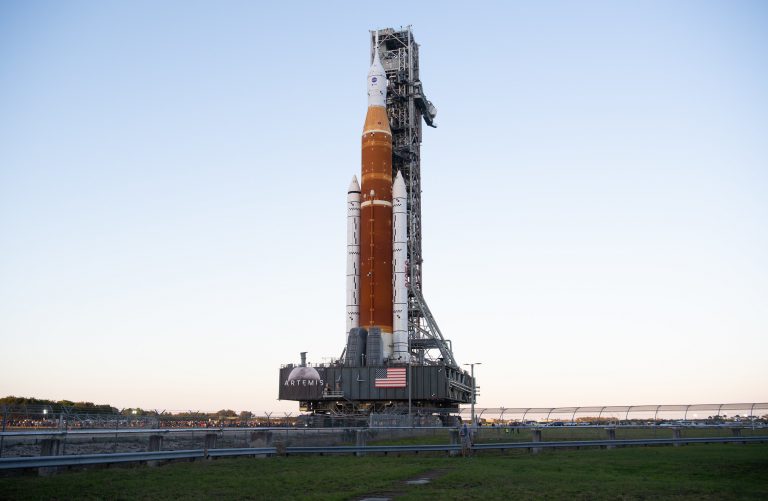
NASA’s Space Launch System (SLS) rocket with the Orion spacecraft atop arrived at Launch Pad 39B at the agency’s Kennedy Space Center in Florida Friday in preparation for a final test before its Artemis I Moon mission.

The Moon rises behind NASA's Space Launch System rocket and Orion spacecraft.

The Moon is seen rising behind NASA’s Space Launch System (SLS) rocket with the Orion spacecraft aboard atop a mobile launcher as it rolls out to Launch Complex 39B for the first time, Thursday, March 17, 2022, at NASA’s Kennedy Space Center in Florida. Ahead of NASA’s Artemis I flight test, the fully stacked and integrated SLS rocket and Orion spacecraft will undergo a wet dress rehearsal at Launch Complex 39B to verify systems and practice countdown procedures for the first launch.Credits: NASA

The uncrewed flight test will pave the way for missions to land the first woman and first person of color on the Moon under Artemis, and the rocket rolled to the pad for a final test before launch.

“From this sacred and historical place, humanity will soon embark on a new era of exploration,” said NASA administrator Bill Nelson. “Artemis I will demonstrate NASA’s commitment and capacity to extend humanity’s presence on the Moon – and beyond.”

Stacked on the mobile launcher and mounted on the crawler-transporter for a journey from the Vehicle Assembly Building to Launch Pad 39B, it took 10-hours and 28 minutes for SLS and Orion to reach the launch pad four miles away. The trip began at 5:47 p.m. Thursday, March 17, and the 322-foot tall, 3.5-million-pound rocket and spacecraft arrived at the pad at 4:15 a.m. on March 18.

The upcoming final test, known as the wet dress rehearsal, will run the Artemis I launch team through operations to load propellant into the rocket’s tanks, conduct a full launch countdown, demonstrate the ability to recycle the countdown clock, and also drain the tanks to practice the timelines and procedures the team will use for launch.

“Rolling out of the Vehicle Assembly Building is an iconic moment for this rocket and spacecraft, and this is a key milestone for NASA,” said Tom Whitmeyer, deputy associate administrator for Common Exploration Systems Development at NASA Headquarters in Washington. “Now at the pad for the first time, we will use the integrated systems to practice the launch countdown and load the rocket with the propellants it needs to send Orion on a lunar journey in preparation for launch.”

Before the test, SLS, Orion, and the associated ground systems will undergo checkouts at the pad. After the rehearsal, NASA will review data from the test before setting a specific target launch date for the upcoming Artemis I launch. The integrated rocket and spacecraft will roll back to the Vehicle Assembly Building several days after the test to remove sensors used during the rehearsal, charge system batteries, stow late-load cargo, and run final checkouts. Orion and SLS will then roll to the launch pad for a final time about a week before launch.

With Artemis, NASA will establish long-term exploration at the Moon in preparation for human missions to Mars. SLS and NASA’s Orion spacecraft, along with the human landing system and the Gateway in orbit around the Moon, are NASA’s foundation for deep space exploration.

Artemis I Moon Rocket Arrives at Launch Pad for First Time

0

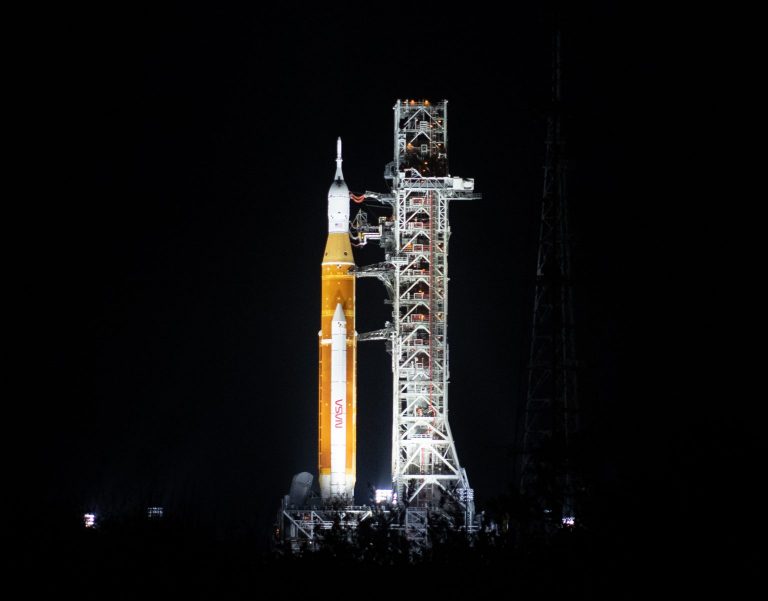
Around 4:15 a.m. ET the Space Launch System rocket and Orion Spacecraft for the Artemis I mission arrived atop Launch Complex 39B after a nearly 11-hour journey from the Vehicle Assembly Building at NASA’s Kennedy Space Center in Florida.

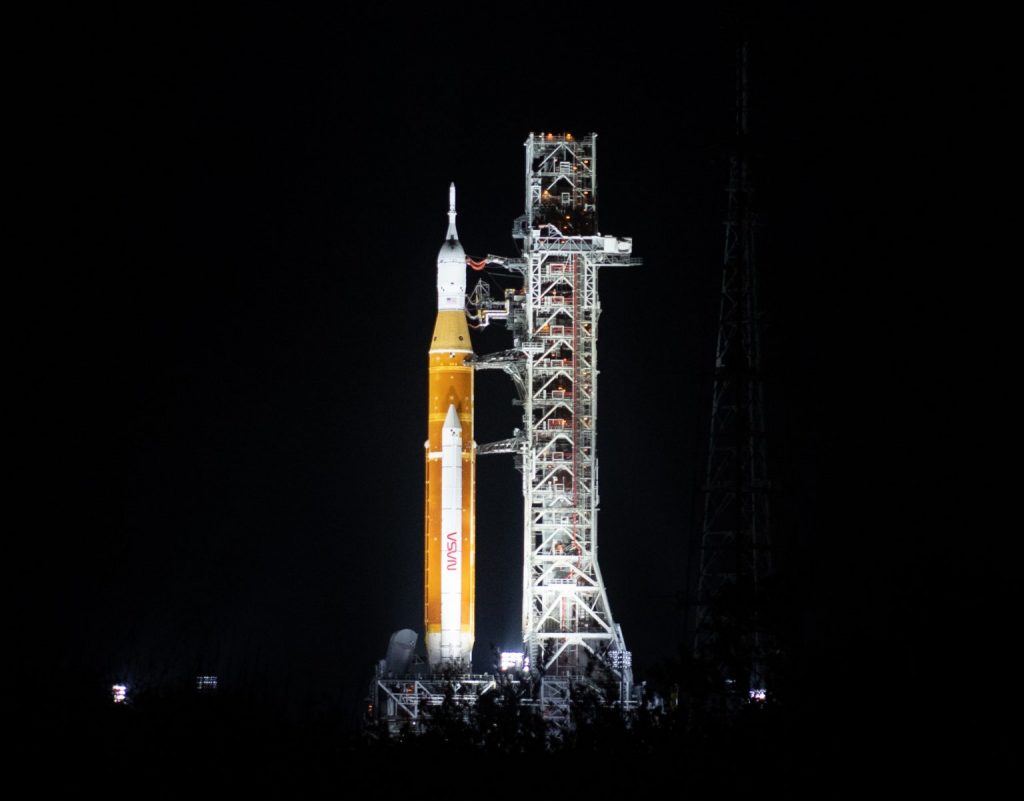
NASA’s Space Launch System (SLS) rocket with the Orion spacecraft aboard is seen illuminated by spotlights atop a mobile launcher at Launch Complex 39B, Friday, March 18, 2022, after being rollout out to the launch pad for the first time at NASA’s Kennedy Space Center in Florida. Photo Credit: (NASA/Joel Kowsky)

In the coming days, engineers and technicians will prepare the Artemis I rocket for its final major test – the wet dress rehearsal. The approximately two-day test will demonstrate the team’s ability to load cryogenic, or super-cold, propellants into the rocket, conduct a launch countdown, and practice safely removing propellants at the launch pad.  After wet dress rehearsal, engineers will roll the rocket and spacecraft back to the Vehicle Assembly Building for final checkouts before launch.

We can begin an interstellar mission today – and we should

0

Fifty-five years ago, Yuri Gagarin rocketed into orbit and began to break our bonds to our planet. To mark the occasion, the nonprofit Breakthrough Institute just announced plans to free us from an even more formidable set of bonds and send a fleet of small spacecraft beyond our solar system, off to the stars. News of the ‘Breakthrough Starshot’ plan was met with great enthusiasm, but also with more than a little skepticism. The distance between stars is vast. Our closest neighbour, the Alpha Centauri system, is 4.4 light years away – roughly 25 trillion miles. The Voyager 1 spacecraft, the fastest object ever created by humans, would take 70,000 years to travel that far. Many reporters greeted the Breakthrough Starshot as an idea grounded more in fantasy than in reality.

breakthrough-initiatives-idea_SIZED-2016-04-12t180659z_835429780_gf10000380251_rtrmadp_3_space-milner1

The reaction was understandable. All previous plans for interstellar flight relied on non-existent or impractical technologies such as antimatter, wormholes and warp drives. But now we have a concrete path forward, which I have published in detail. It is possible to begin the journey to the stars today.

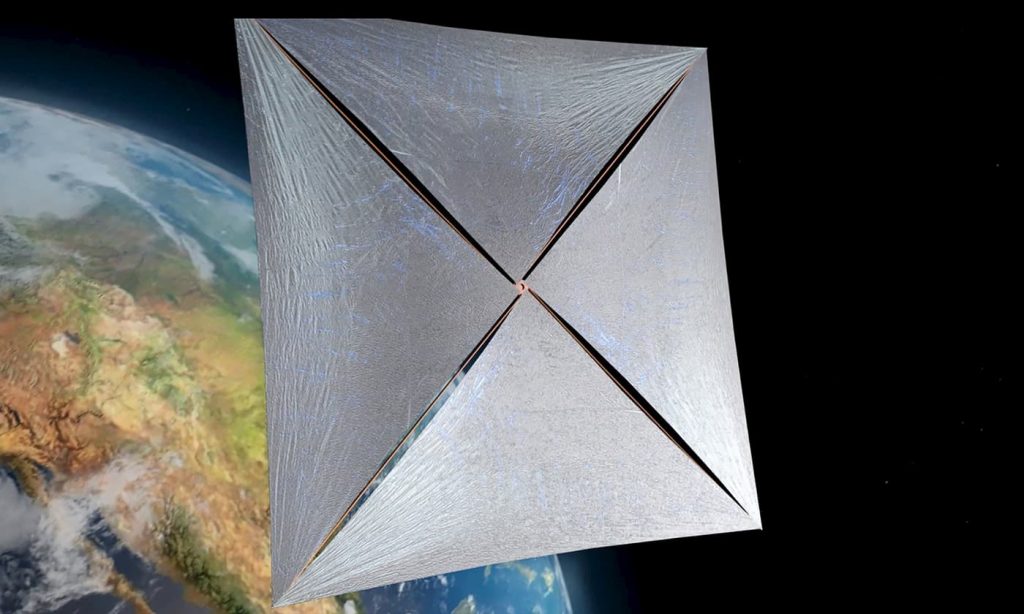
Drawing on recent advances in photonics and electronics, we could use arrays of lasers to accelerate miniature probes (the size and mass of a semiconductor wafer, weighing less than one ounce) to unprecedented velocities. Particles of light, or photons, have no rest mass but they carry energy and momentum. Just as a sailboat can be propelled by the wind, light sails can ride the momentum of photons by reflecting a wind of intense laser light. We call such focused beams of light ‘directed energy’.

On modest scales, directed-energy systems are already becoming available with continuous power levels around 100 kilowatts. A greatly scaled-up version could propel a small spacecraft to velocities exceeding 20 per cent the speed of light, nearly 4,000 times what Voyager 1 achieved. Doing so would require kilometre-size arrays of synchronised, or ‘phased’, photonic amplifiers, each similar to but far more powerful than the signal boosters used today to drive internet data through fibre-optic cables. Although it would be extremely challenging, building such an array should be feasible within 30 years, judging from the current rate of technological development. Directed-energy propulsion could send a probe to Alpha Centauri in about 20 years, with another four years required for data to return, or could reach Tau Ceti (which has a system of five known planets) in about 60 years with a 12-year return message.

Better yet, we will send a whole fleet of probes. Almost all the development costs will go into building the directed-energy launch system. The probes themselves would be small devices tethered to reflective sails, cheap to build. The total cost of launching 100 probes would be scarcely any greater than launching one. Potentially, we could build millions of probes of many different masses, from ‘wafer’ spacecraft the size of an iPhone (but much thinner) to much larger probes, all carrying sophisticated cameras, sensors and a laser-communication system powered by a compact (RTG), similar to the one aboard the New Horizons probe that flew past Pluto last summer. The probes would store up energy between communication bursts, and draw additional power from solar cells when they near their destination stars.

The smallest and most challenging of these are the wafer-scale spacecraft, which would require miniaturised accelerometers and gyros, star trackers, photon thrusters for attitude control, computers and memory, magnetic-field and radiation sensors, dust-impact sensors, spectrometers, and the critical laser communications system. The communications system would use a chip-level laser diode and data-encoding system with a burst power of a few watts; it would direct data to Earth by bouncing a laser beam off the same sail that propels the probe. Back home, the laser-phased array used to propel the wafer probe would run in reverse as a phased-array telescope, acting as a square-kilometre receiving system to receive the weak laser signal from our interstellar traveller. After the directed-energy propulsion array, the data-communication system probably poses the greatest technological challenge.

Once we master directed-energy propulsion, a breathtaking range of possibilities open before us. Laser-array technology is modular and scalable, allowing us to send ever-larger and more capable systems to nearby stars. It would enable rapid travel to any destination in the solar system, linked back to Earth via high data-rate laser communications. Focused beams of laser energy could protect our planet by deflecting any hazardous near-Earth objects such as asteroids and comets. Used as a remote-sensing probe, the laser array could determine the composition of distant bodies in the solar system. The same basic tech could be configured as extremely large, high-precision, phased-array telescopes for specialised studies in astronomy and cosmology. If we so desired, we could even beam messages to potential alien civilisations that would be detectable across the entire visible Universe. More important, other intelligent life presumably could do the same thing, and thus we should be able to detect them. I recently published a paper on this possibility.

No longer are we limited by chemical rocket technology that has changed little since its invention centuries ago. With directed-energy photonic propulsion, we face no speed limits except that of light itself, and spacecraft can be radically miniaturised since their main propulsion system stays at home. And a single photonic driver could power an essentially unlimited number of probes, so the cost for each launch could drop sharply. No longer would we need to wait years or decades between major space missions.

Right now, directed-energy technology is poorly appreciated outside a small community, but it is progressing rapidly. The power output of laser systems and the ability to synchronise and ‘parallel-process’ with them are doubling approximately every 18 months, similar in pace to ‘Moore’s Law’, which transformed the semiconductor industry. At that rate, we can expect greatly expanded capabilities to emerge over the coming decades. In the current concept, the fastest interstellar probes are designed to be flyby missions; farther in the future, an interplanetary transport network might use a second, decelerating laser array at the destination – Mars, for example – to shuttle a steady flow of passengers and cargo back and forth between the two stops.

Inconceivable as it might seem, people alive today could some day see direct pictures of planets around nearby stars, perhaps glimpsing lands that will be colonised by later generations. There is a lot of work ahead. We need to build larger and more powerful laser arrays; understand the associated problems; and fold this knowledge into next-generation systems until we reach our goal. At the same time, we need to develop wafer-scale spacecraft, low-mass sails and laser communication systems. Doing all this will cost billions of dollars, but we already spend billions of dollars on space exploration every year (not to mention the hundreds of billions on defence and technology development).

Our published ‘roadmap’ to interstellar flight shows the way. The Breakthrough Starshot programme allows us to start developing the key technology. We can achieve this future, and we can begin now.

This article was originally published at Aeon and has been republished under Creative Commons.