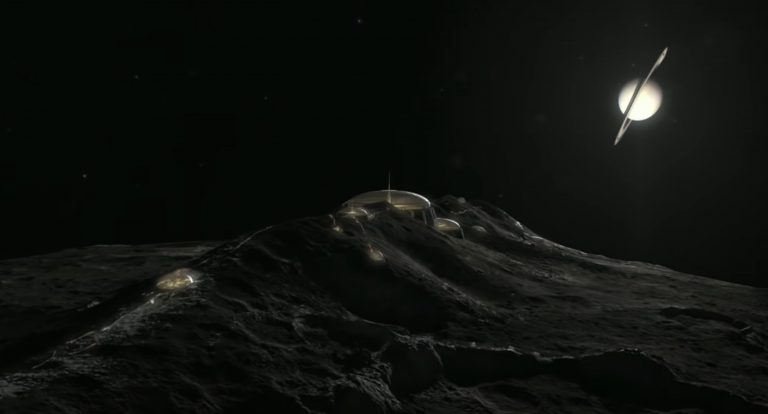
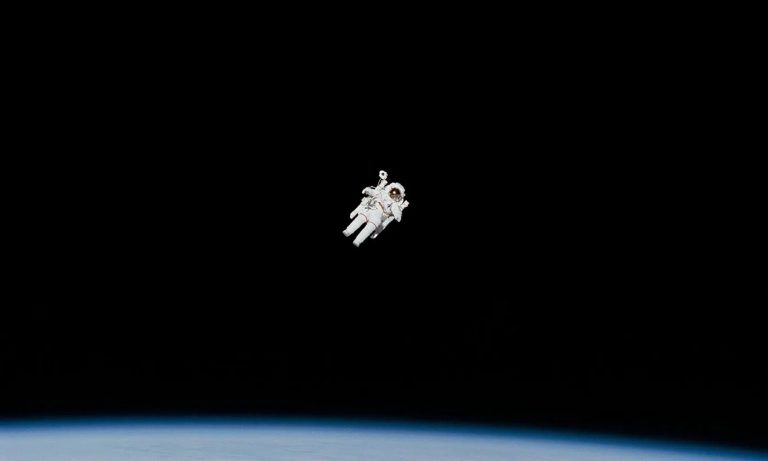
If the Universe is born and no one is present to hear it, does it still make a sound? Well, theoretically, yes. As this video from the US filmmaker John D Boswell (also known as Melodysheep) explores, where a ‘thick soup of atoms’ is present, sound is possible. Made in collaboration with the podcast Twenty Thousand Hertz, this short documentary deploys dramatic CGI visuals, a pulsing score and the voices of prominent scientists to explore the sounds of space – from those humanity has recorded to those we can only speculate about. While ostensibly an interplanetary journey, The Sounds of Space is perhaps most intriguing when viewed as an exploration of the physics of sound, and the science of how we’ve evolved to receive soundwaves right here on Earth.
The dawn of a new era in astronomy is here as the world gets its first look at the full capabilities of NASA’s James Webb Space Telescope, a partnership with ESA (European Space Agency) and CSA (Canadian Space Agency).
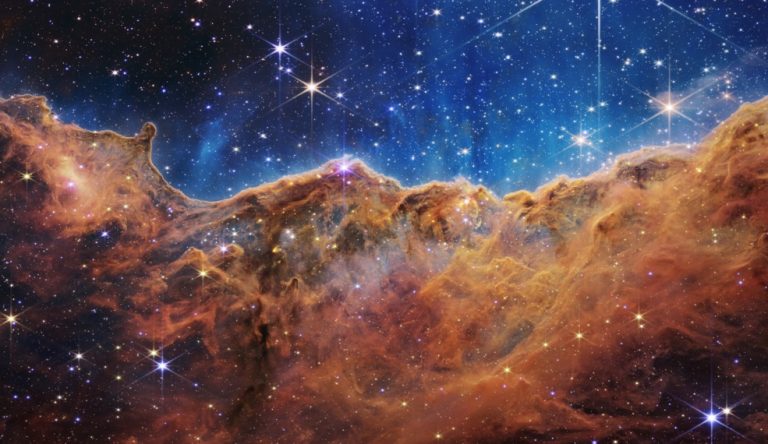
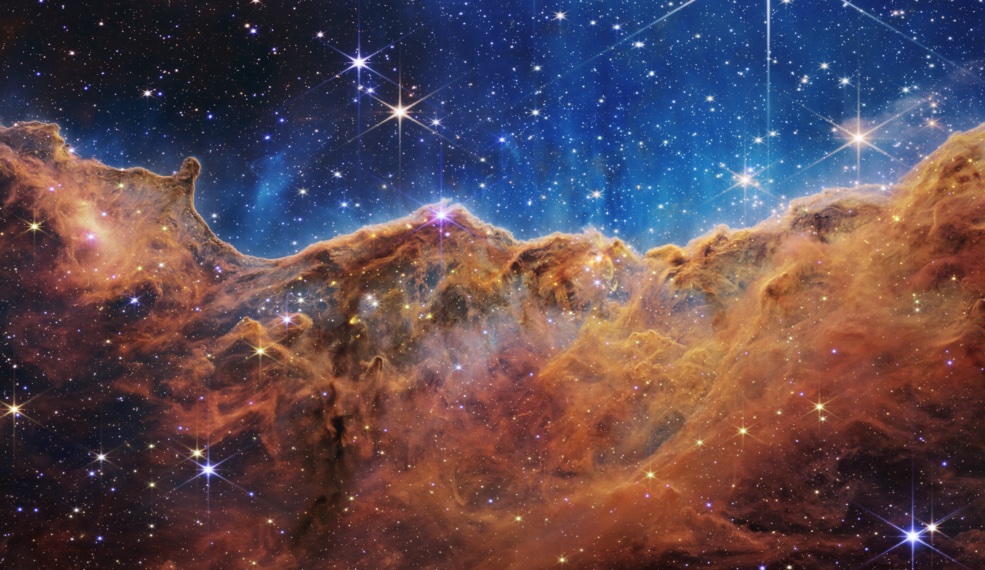
This landscape of “mountains” and “valleys” speckled with glittering stars is actually the edge of a nearby, young, star-forming region called NGC 3324 in the Carina Nebula. Captured in infrared light by NASA’s new James Webb Space Telescope, this image reveals for the first time previously invisible areas of star birth. Credits: NASA, ESA, CSA, and STScI Learn more about this image.
The full set of the telescope’s first full-color images and spectroscopic data, which uncover a collection of cosmic features elusive until now, released Tuesday, are available at:
“Today, we present humanity with a groundbreaking new view of the cosmos from the James Webb Space Telescope – a view the world has never seen before,” said NASA Administrator Bill Nelson. “These images, including the deepest infrared view of our universe that has ever been taken, show us how Webb will help to uncover the answers to questions we don’t even yet know to ask; questions that will help us better understand our universe and humanity’s place within it.
“The Webb team’s incredible success is a reflection of what NASA does best. We take dreams and turn them into reality for the benefit of humanity. I can’t wait to see the discoveries that we uncover – the team is just getting started!”
NASA explores the unknown in space for the benefit of all, and Webb’s first observations tell the story of the hidden universe through every phase of cosmic history – from neighboring planets outside our solar system, known as exoplanets, to the most distant observable galaxies in the early universe.
“This is a singular and historic moment,” said Thomas Zurbuchen, associate administrator for NASA’s Science Mission Directorate. “It took decades of drive and perseverance to get us here, and I am immensely proud of the Webb team. These first images show us how much we can accomplish when we come together behind a shared goal, to solve the cosmic mysteries that connect us all. It’s a stunning glimpse of the insights yet to come.”
“We are elated to celebrate this extraordinary day with the world,” said Greg Robinson, Webb program director at NASA Headquarters. “The beautiful diversity and incredible detail of the Webb telescope’s images and data will have a profound impact on our understanding of the universe and inspire us to dream big.”
NASA revealed the first five full-color images and spectrographic data from the world’s most powerful space telescope, the James Webb Space Telescope, a partnership with ESA (European Space Agency), and CSA (Canadian Space Agency). The world got its first look at the full capabilities of the mission at a live event streamed from the agency’s Goddard Space Flight Center in Greenbelt, Maryland, on July 12, 2022. Credits: NASA
Webb’s first observations were selected by a group of representatives from NASA, ESA, CSA, and the Space Telescope Science Institute. They reveal the capabilities of all four of Webb’s state-of-the-art scientific instruments:
SMACS 0723: Webb has delivered the deepest and sharpest infrared image of the distant universe so far – and in only 12.5 hours. For a person standing on Earth looking up, the field of view for this new image, a color composite of multiple exposures each about two hours long, is approximately the size of a grain of sand held at arm’s length. This deep field uses a lensing galaxy cluster to find some of the most distant galaxies ever detected. This image only scratches the surface of Webb’s capabilities in studying deep fields and tracing galaxies back to the beginning of cosmic time.
WASP-96b (spectrum): Webb’s detailed observation of this hot, puffy planet outside our solar system reveals the clear signature of water, along with evidence of haze and clouds that previous studies of this planet did not detect. With Webb’s first detection of water in the atmosphere of an exoplanet, it will now set out to study hundreds of other systems to understand what other planetary atmospheres are made of.
Southern Ring Nebula: This planetary nebula, an expanding cloud of gas that surrounds a dying star, is approximately 2,000 light years away. Here, Webb’s powerful infrared eyes bring a second dying star into full view for the first time. From birth to death as a planetary nebula, Webb can explore the expelling shells of dust and gas of aging stars that may one day become a new star or planet.
Stephan’s Quintet: Webb’s view of this compact group of galaxies, located in the constellation Pegasus, pierced through the shroud of dust surrounding the center of one galaxy, to reveal the velocity and composition of the gas near its supermassive black hole. Now, scientists can get a rare look, in unprecedented detail, at how interacting galaxies are triggering star formation in each other and how the gas in these galaxies is being disturbed.
Carina Nebula: Webb’s look at the ‘Cosmic Cliffs’ in the Carina Nebula unveils the earliest, rapid phases of star formation that were previously hidden. Looking at this star-forming region in the southern constellation Carina, as well as others like it, Webb can see newly forming stars and study the gas and dust that made them.
“Absolutely thrilling!” said John Mather, Webb senior project scientist at NASA’s Goddard Space Flight Center in Greenbelt, Maryland. “The equipment is working perfectly, and nature is full of surprising beauty. Congratulations and thanks to our worldwide teams that made it possible.”
The release of Webb’s first images and spectra kicks off the beginning of Webb’s science operations, where astronomers around the world will have their chance to observe anything from objects within our solar system to the early universe using Webb’s four instruments.
The James Webb Space Telescope launched Dec. 25, 2021, on an Ariane 5 rocket from Europe’s Spaceport in French Guiana, South America. After completing a complex deployment sequence in space, Webb underwent months of commissioning where its mirrors were aligned, and its instruments were calibrated to its space environment and prepared for science.
The public can also view the new Webb images Tuesday on several digital screens in New York City’s Times Square and in London’s Piccadilly Circus beginning at 5:30 p.m. EDT and 10:30 p.m. GMT, respectively.
The James Webb Space Telescope is the world’s premier space science observatory. Webb will solve mysteries in our solar system, look beyond to distant worlds around other stars and probe the mysterious structures and origins of our universe and our place in it.
NASA Headquarters oversees the mission for the agency’s Science Mission Directorate. NASA’s Goddard Space Flight Center in Greenbelt, Maryland, manages Webb for the agency and oversees work on the mission performed by the Space Telescope Science Institute, Northrop Grumman, and other mission partners. In addition to Goddard, several NASA centers contributed to the project, including the agency’s Johnson Space Center in Houston, Jet Propulsion Laboratory in Southern California, Marshall Space Flight Center in Huntsville, Alabama, Ames Research Center in California’s Silicon Valley, and others.
For a full array of Webb’s first images and spectra, including downloadable files, visit:
Believe it or not, there is a lot of stuff in space. In fact, our atmosphere is filled with more than 11,000 objects that have been launched since the foray into space began.
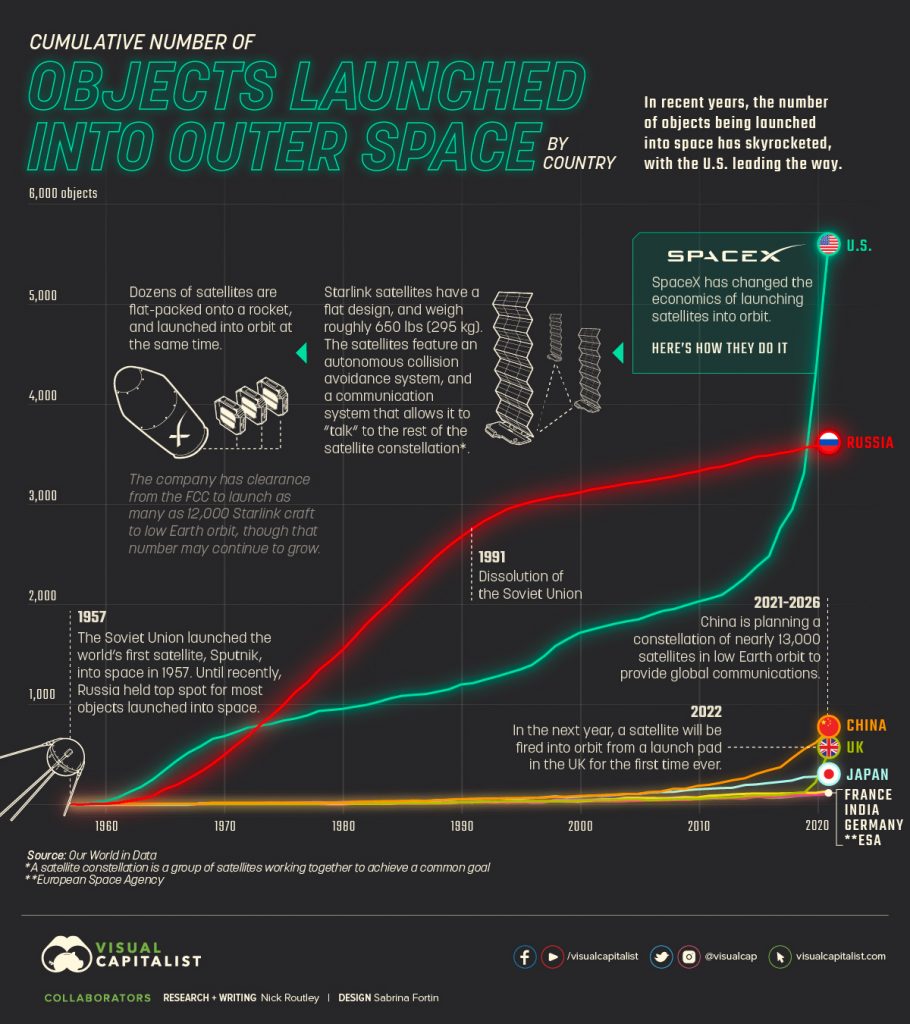
The Space Race started during the Cold War, and early on the Soviet Union dominated when it came to the amount of devices and objects launched into our atmosphere. But a few years ago, the U.S. took back that title with Elon Musk’s SpaceX helping lead the charge.
This visual, using data from Our World in Data, breaks down the amount of objects launched into space by country over time.
What Gets Launched Into Space?
What are the objects being sent into our atmosphere and why are they so important? Here’s a look at just a few:
Satellites
Crewed spacecraft
Probes
Space station flight equipment
Probes and landers like the Mars Rover, for example, have helped scientists explore other planets. Satellites provide us with everyday necessities like cell phone service, far reaching television signals, satellite imagery, and GPS.
As of late 2021, there were around 4,852 operational satellites in orbit—2,944 belonging to the United States. Here’s a quick look at what the U.S. uses its satellites for:
Commercial: 2,516
Military: 230
Government: 168
Civil: 30
Many satellites in orbit, however, are no longer functional. In fact, there is a lot of junk in space—according to NASA, there are over 27,000 pieces of space debris in orbit.
The Space Race, by Country
The venture into outer space began during the Cold War when the USSR launched the first satellite, Sputnik 1 in 1957. After this, the U.S. and Soviet Union entered a definitive competition between technological advancements and scientific exploration into space—an extension of the battle between political ideologies.
Few countries have come close in matching either the U.S. or Russia so far. Here’s a look at the cumulative number of objects different countries have launched into orbit and beyond.Show 102550100 entriesSearch:
Rank
Country
Cumulative Number of Objects Launched into Space
#1
United States
5,534
#2
Russia
3,611
#3
China
731
#4
UK
515
#5
Japan
300
#6
France
130
#7
India
127
#8
Germany
114
#9
Canada
82
#10
Luxembourg
53
One important disclaimer here is that not all of these countries have orbital launch capabilities, meaning that although the satellite in space may belong to a certain country, that doesn’t mean that it was launched by said country. For example, the UK’s first launch in 1971 was out of Australia and France’s first launch took place in Algeria in 1965.
In total, around 86 countries have attempted some kind of entry into space. However, as of 2022, only 11 countries have the ability to send objects into space using their own launch vehicles, and only three—the U.S., Russia, and China—have ever launched people into outer space.
The Future of Space
With corporations beginning to take the lead in this new frontier, the landscape of space launches is changing. In 2019 Starlink, a constellation of satellites which provides 36 countries with internet access, was launched. With over 2,200 Starlink satellites in the sky and counting, SpaceX’s ultimate goal is global internet coverage; China is planning a similar venture.
Beyond useful satellites and scientific exploration, other potential space industries are emerging.
As one example, the business of commercial space tourism is no longer a futuristic concept. In late 2021, famous billionaire and founder of Virgin Galactic, Richard Branson flew briefly into space on a private flight. Jeff Bezos, having founded Blue Origin, followed shortly after.
Today, both Blue Origin and Virgin Galactic are licensed by the Federal Aviation Administration for passenger space travel. However, if you want to be launched into space, it will cost you around $250,000-$500,000.
Nothing is fixed in time or space. Everything – from quantum particles to people, planets and galaxies – is in constant motion, and part of a constellation of inextricably interwoven systems.
That might seem like a strictly academic observation with little bearing on your day-to-day life, but, as Thomas Nail, a professor of philosophy at the University of Denver, argues in this short video, overlooking this fact can have real-world consequences. Instead of understanding the Universe in terms of inflexible objects, Nail proposes that we view our world in terms of processes subject to constant change. This, he argues, will lead to improvements in science, public policy and even interpersonal relationships.
A little-known meteorological phenomenon makes a tiny village in Arctic Sweden one of the best places on Earth to consistently see the Aurora Borealis.
“I’m not so sure we’ll see them,” said my videographer colleague Erik Jaråker, as he looked at the fog all around. I was driving us up the single-lane highway towards one of Sweden’s northernmost villages, Abisko, located 250km north of the Arctic Circle. We were caught in the middle of a snowstorm with zero visibility, and all around us, the mountains of Abisko National Park had become a sea of white.
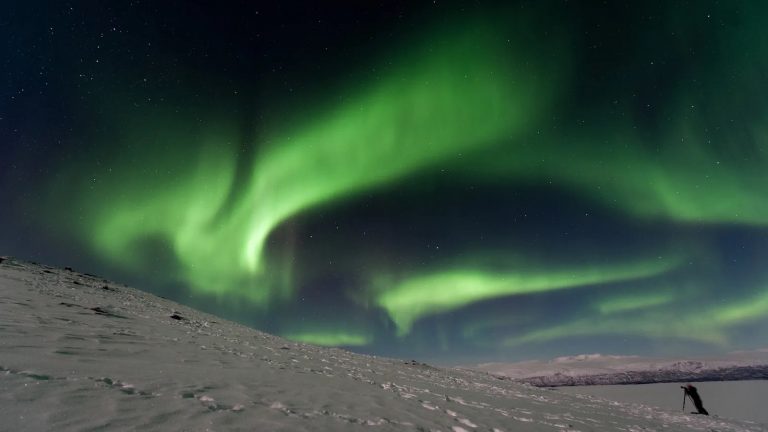
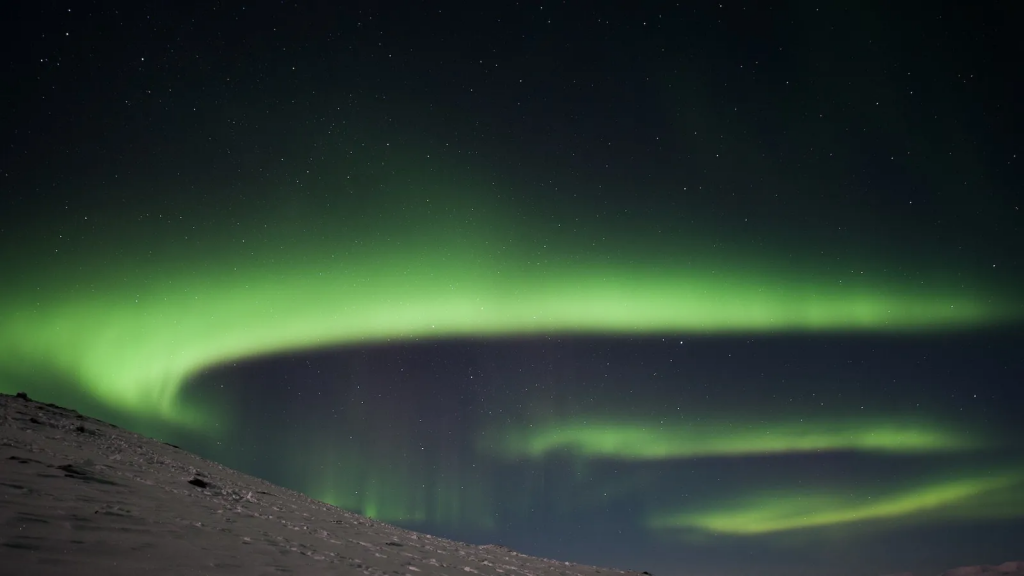
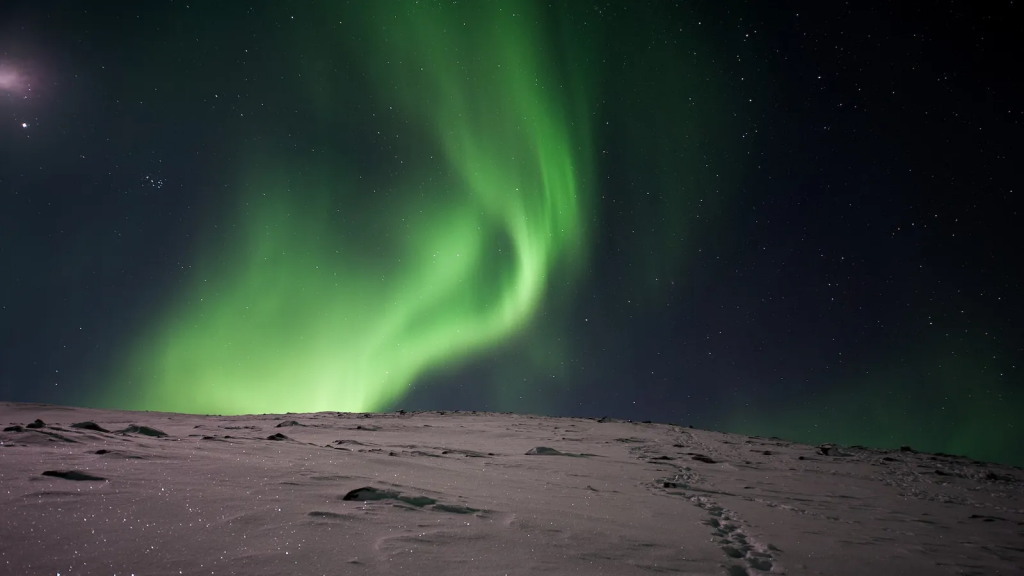
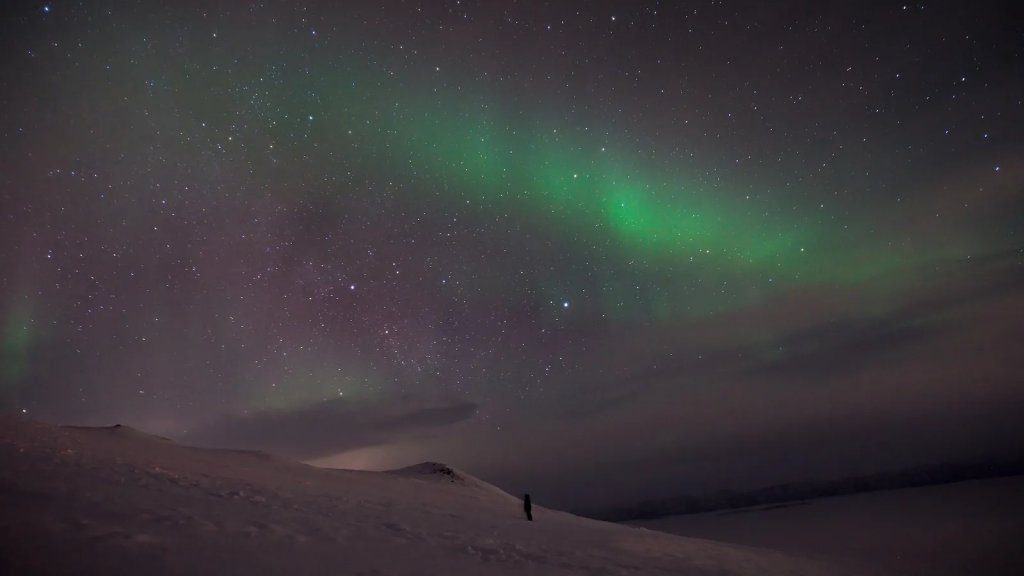
We were heading up to photograph the elusive Northern Lights – nature’s spectacular light show, also known as the Aurora Borealis. The displays occur when explosions on the sun’s surface, called solar flares, collide with gases in the Earth’s atmosphere to create shimmering bands of red, green and purple. To witness this Aurora activity, we needed frigid, clear, cloudless skies, not the winter storm we were currently slogging through.
“Trust me,” I assured him confidently. “We’ll see them.”
I’d been here before under similar storm conditions, and I’d quickly learned that Abisko is home to a “blue hole“, a patch of sky that extends 10 to 20 sq km over the village, Lake Torneträsk and Abisko National Park and that remains clear regardless of surrounding weather patterns. This phenomenon makes Abisko one of the best places in the world to consistently witness the Aurora Borealis.
“Abisko, and northern Sweden, is indeed an ideal place to watch it,” said Erik Kjellström, professor in climatology at the Swedish Meteorological and Hydrological Institute, in an email. “This is due to the fact that it lies within the Auroral oval and it has a very long dark season – auroral observations are reported from mid-August to April – so there are plenty of Northern Lights around. The only thing needed is cloud-free conditions.” And, he added, Abisko has those in spades thanks to its position on the eastern side of the Scandinavian Mountain Range, which runs along the Norway-Sweden border.
Auroral observations are reported from mid-August to April in Abisko (Credit: Lola Akinmade Åkerström)
Håkan Grudd, research support coordinator and deputy station manager of the Abisko Scientific Research Station, explained further. “The dominating wind direction in this area is from the west, which means that moist air masses from the Atlantic have to rise to higher (colder) altitudes to pass over the Scandinavian Mountains. When this happens, clouds form and the air loses moisture through precipitation. In Abisko, on the leeside of the mountains, the air is now drier and sinks to lower altitudes – clouds disintegrate, hence the ‘blue hole’.”
So, it’s no wonder Abisko draws professional photographers like me and Erik, as well as travellers who want to check off their bucket-list item of seeing the Aurora Borealis.
That’s what drew photographer and entrepreneur Chad Blakley too. In 2008, as young newlyweds, he and his Swedish wife, Linnea, wanted a change from their corporate lives in the US. Combining his love for the outdoors with an opportunity to better understand Linnea’s culture, Blakely found work as part of the cleaning staff at the popular STF Abisko Turiststation hotel in the national park.
“I learned about the blue hole by experiencing it,” said Blakley, who, in the early days of his career, spent every night possible photographing the Northern Lights in the national park. “You could see a hole in the clouds directly over the village, while the sky on the horizon in all directions was often cloudy and full of snow.”
Abisko is home to a “blue hole” – a patch of sky that remains clear regardless of surrounding weather patterns (Credit: Lola Akinmade Åkerström)
In 2010, he and Linnea started an Aurora Borealis tourism company, Lights Over Lapland. And for those who couldn’t make it up to the remote region of Sweden, they set up a still-camera webcam that has been running for more than a decade and takes a picture every five minutes for an annual viewership of between 8 and 10 million. The company later added a live HD video camera, so that people could watch the lights in real time.
“We have seen Auroras consistently, nearly every single clear night, for more than 10 years,” Blakley shared. “And I am proud to say that the blue hole has helped Abisko gain a reputation for Aurora sightings.”
Blakley is in the process of installing the world’s first real-time, 8k, 360-degree Aurora webcam that will allow viewers to watch the Auroras live using a virtual reality (VR) camera and VR glasses next season.
Rosen: “Seeing how people express their feelings after seeing the lights makes me feel I have the best job in the world” (Credit: Lola Akinmade Åkerström)
The Northern Lights are Abisko’s main draw during the winter months, but the microclimate also provides other spectacular weather events too, such as very rare “moonbows”, also known as lunar rainbows and lunar halos, which occur when moonlight reflects and refracts through water droplets and ice crystals in the air surrounding the blue hole.
However, for Anette Niia and Ylva Sarri, who are members of Sweden’s indigenous Sámi community, Abisko is much more than its blue hole. There are about 70,000 Sámi living in the Arctic and subarctic parts of Norway, Sweden, Finland and the Kola Peninsula in Russia – a region collectively known as Sápmi. Both women have spent time in Abisko since childhood because it is also a reindeer herding area for their families. Niia explained that the area’s microclimate results in thinner snow during winter, which means spring arrives early here – and therefore food for reindeer and other animals. “The blue hole is something tourism companies talk about,” she said. “For us Sámi, Abisko is special for different reasons.”
Still, she and Sarri also have a connection to tourism here – their families’ ancestors were mountain guides for visitors starting in the early 1900s. Today, the women are the cofounders of Scandinavian Sami Photoadventures, which leads several outdoor experiences in Abisko, including Northern Lights tours. “We as guides know that when we arrive at Miellejohka stream, which flows down from Cuonjavaggi [valley], and go past it, you can go from a full snowstorm to clear skies within 100m,” said Niia. “That’s magic!”
And that was exactly what happened when Erik and I finally arrived in Abisko: dense snow clouds hovered over the mountains encircling us, but we saw clear blue skies directly overhead.
On my first trip to Abisko several years ago, I remember scientist-turned-photographer Peter Rosén telling me that children were not supposed to look at or whistle at the dancing Auroras, or point at them in awe, otherwise the lights would come down and take them away.
Folktales said children were not supposed to look at the Auroras, otherwise the lights would come down and take them away (Credit: Lola Akinmade Åkerström)
Born and bred in Sweden, Rosén had grown up with these stories. Then in 1998, his career as an environmental researcher with the Climate Impacts Research Centre of Umeå University brought him to Abisko. He spent 13 years studying climate change in the Arctic through the Abisko Scientific Research Station. (In 2021, it was recognised as a Centennial Observing Station by the World Meteorological Organization.)
When he arrived in Abisko, Rosén quickly learned about the blue hole and became fascinated by the Northern Lights. He produced his first photographs of the Auroras in 2001, which are now part of permanent installations in galleries around northern Sweden, including the ICEHOTEL in the town of Jukkasjärvi. “My colleagues used to call me a ‘free-time researcher, full-time photographer’,” he joked.
By 2012, Rosén had quit his work in environmental science to become a full-time photographer and run Lappland Media, teaching travellers how to properly photograph the lights. He recalls one of his guests, who had dreamed of seeing the lights since she was five years old. She had sought them across Canada, Norway and Finland, but to no avail. On her first night in Abisko, she broke down and cried after seeing what Rosén considered a really weak Aurora. Over the coming nights, they witnessed strong spectacular displays together.
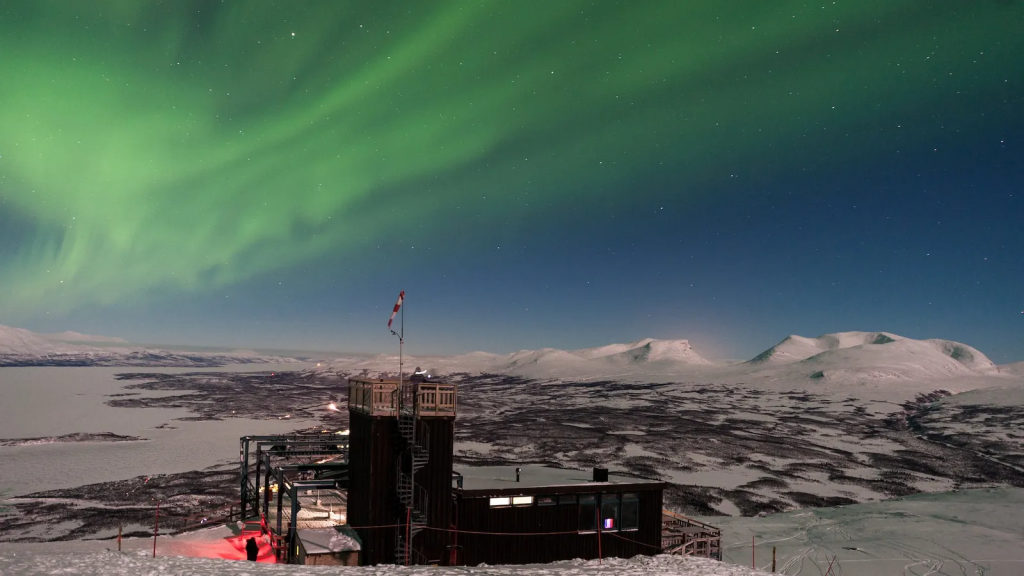
Perched close to the summit is the remote Aurora Sky Station, a 20-minute chairlift ride up from its base (Credit: Lola Akinmade Åkerström)
“Seeing how people express their feelings after seeing the lights makes me feel I have the best job in the world,” added Rosén. “I’ve never regretted leaving my life as a researcher, because I’m now living my dream.”
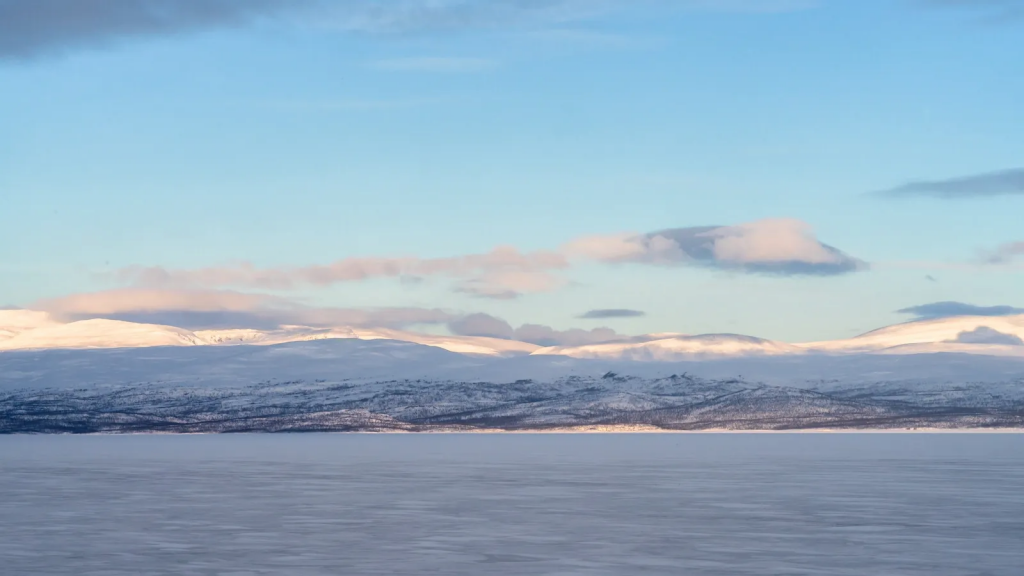
I remember my own feeling of awe my first time I saw the lights in Abisko, at the foothills of Mount Nuolja, 900m above sea level. Perched close to the summit is the remote Aurora Sky Station, a 20-minute chairlift ride up from its base. There’s no better location to see the blue hole spread over the sparkling lights of Abisko and frozen Lake Torneträsk in the valley below.
This time, as Erik and I ascended the mountain, finally riding the chairlift into pitch darkness after driving through that storm, the experience evoked a feeling of reverence for what we were about to witness: ethereal green lights dancing and folding in the heavens like curtains above us.
Physicists are building neural networks out of vibrations, voltages and lasers, arguing that the future of computing lies in exploiting the universe’s complex physical behaviors.
Inside a soundproofed crate sits one of the world’s worst neural networks. After being presented with an image of the number 6, it pauses for a moment before identifying the digit: zero. Peter McMahon, the physicist-engineer at Cornell University who led the development of the network, defends it with a sheepish smile, pointing out that the handwritten number looks sloppy. Logan Wright, a postdoc visiting McMahon’s lab from NTT Research, assures me that the device usually gets the answer right, but acknowledges that mistakes are common. “It’s just this bad,” he said.
Despite the underwhelming performance, this neural network is a groundbreaker. The researchers tip the crate over, revealing not a computer chip but a microphone angled toward a titanium plate that’s bolted to a speaker. Other neural networks operate in the digital world of 0s and 1s, but this device runs on sound. When Wright cues up a new image of a digit, its pixels get converted into audio and a faint chattering fills the lab as the speaker shakes the plate. Metallic reverberations do the “reading” rather than software running on silicon. That the device often succeeds beggars belief, even to its designers.
“Whatever the function of the shaking metal is, it shouldn’t have anything to do with classifying a handwritten digit”.
Peter McMahon
The primitive reading ability of the device, which the Cornell group unveiled in a paper in Nature in January, gives McMahon and others hope that its distant descendants could revolutionize computing.
When it comes to conventional machine learning, computer scientists have discovered that bigger is better. Stuffing a neural network with more artificial neurons — nodes that store numerical values — improves its ability to tell a dachshund from a Dalmatian, or to succeed at myriad other pattern recognition tasks. Truly tremendous neural networks can pull off unnervingly human undertakings like composing essays and creating illustrations. With more computational muscle, even grander feats may become possible. This potential has motivated a multitude of efforts to develop more powerful and efficient methods of computation.
McMahon and a band of like-minded physicists champion an unorthodox approach: Get the universe to crunch the numbers for us. “Many physical systems can naturally do some computation way more efficiently or faster than a computer can,” McMahon said. He cites wind tunnels: When engineers design a plane, they might digitize the blueprints and spend hours on a supercomputer simulating how air flows around the wings. Or they can stick the vehicle in a wind tunnel and see if it flies. From a computational perspective, the wind tunnel instantly “calculates” how wings interact with air.
Peter McMahon and Tatsuhiro Onodera are members of a team at Cornell that has programmed a variety of physical systems to accomplish learning tasks.Dave Burbank for Cornell University
A wind tunnel is a single-minded machine; it simulates aerodynamics. Researchers like McMahon are after an apparatus that can learn to do anything — a system that can adapt its behavior through trial and error to acquire any new ability, such as classifying handwritten digits or distinguishing one spoken vowel from another. Recent work has shown that physical systems like waves of light, networks of superconductors and branching streams of electrons can all learn.
“We are reinventing not just the hardware,” said Benjamin Scellier, a mathematician at the Swiss Federal Institute of Technology Zurich in Switzerland who helped design a new physical learning algorithm, but “also the whole computing paradigm.”
Learning to Think
Learning is an exotic process; until about a decade ago, brains were the only systems that did it well. It was the structure of the brain that loosely inspired computer scientists to design deep neural networks, now the most popular artificial learning models.
A deep neural network is a computer program that learns through practice. The network can be thought of as a grid: Layers of nodes called neurons, which store values, are connected to neurons in adjacent layers by lines, or “synapses.” Initially, these synapses are just random numbers known as “weights.”
When you want the network to read a digit — 4, say — you make the first layer of neurons represent a raw image of the 4, perhaps storing the shade of each pixel as a value in a corresponding neuron. Then the network “thinks,” moving layer by layer, multiplying the neuron values by the synaptic weights to populate the next layer of neurons. The neuron with the highest value in the final layer indicates the network’s answer. If it’s the second neuron, for instance, the network guesses that it saw a 2.
To teach the network to make smarter guesses, a learning algorithm works backward. After each trial, it calculates the difference between the guess and the correct answer (which, in our example, would be represented by a high value for the fourth neuron in the final layer and low values elsewhere). Then an algorithm steps back through the network layer by layer, calculating how to tweak the weights in order to get the values of the final neurons to rise or fall as needed. This procedure, known as backpropagation, lies at the heart of deep learning.
Through many guess-and-tweak repetitions, backpropagation guides the weights to a configuration of numbers that will, through a cascade of multiplications initiated by an image, spit out the digit written there.
Merrill Sherman/Quanta Magazine
But compared to whatever goes on in the brain, the digitized version of learning that happens in artificial neural networks looks dramatically inefficient. On less than 2,000 calories a day, a human child learns to talk, read, play games, and much more in a few years. On such a restricted energy diet, the groundbreaking GPT-3, a neural network capable of fluent conversation, would have taken a millennium to learn to chat.
From a physicist’s perspective, a large digital neural network is simply trying to do too much math. Today’s biggest behemoths must record and manipulate more than half a trillion numbers. The universe, meanwhile, constantly pulls off tasks far beyond the limits of computers’ meager bookkeeping abilities. A room might have trillions of trillions of air molecules bouncing around; that’s an impossible number of moving pieces for a computer to track in a full-fledged simulation of collisions, but the air itself has no trouble deciding how to behave from moment to moment.
The challenge is to build physical systems that can naturally pull off both of the processes needed for AI — the “thinking” involved in (say) classifying an image, and the “learning” needed to classify such images correctly. A system that mastered both tasks would leverage the universe’s ability to act mathematically without actually doing math.
“We never compute 3.532 times 1.567 or something,” Scellier said. “It’s done, but implicitly, just by the laws of physics directly.”
The Thinking Part
McMahon and his collaborators have made progress on the “thinking” half of the puzzle.
While setting up his lab at Cornell in the final months of the pre-pandemic world, McMahon mulled over a curious finding. For years, the top-performing image-recognition neural networks had been getting ever deeper. That is, networks with more layers were better able to take in a bunch of pixels and put out a label, such as “poodle.” The trend inspired mathematicians to study the transformation (from pixels to “poodle”) that the networks were achieving, and in 2017 severalgroupsproposed that the networks were acting like approximate versions of a smooth mathematical function. In math, a function turns an input (often a position along the x-axis) into an output (the y-value, or height, of a curve at that position). In a specific type of neural network, more layers do better because the function is less jagged, moving closer to some ideal curve.
The research got McMahon thinking. Perhaps with a smoothly changing physical system, one could sidestep the blockiness inherent in the digital approach.
The trick was to find a way to domesticate a complicated system — to adapt its behavior with training. McMahon and collaborators chose the titanium plate as one such system because its many patterns of vibrations blend incoming sound in convoluted ways. To make the plate act like a neural network, they fed in one sound that encoded the input image (a handwritten 6, for example), and another representing the synaptic weights; peaks and troughs needed to hit the titanium plate at precisely the right moments for the device to merge the sounds and give the answer — such as a new sound that’s loudest in the sixth millisecond, representing the classification “6.”
A team at Cornell University has trained three different physical systems to “read” handwritten digits: From left, a vibrating titanium plate, a crystal and an electronic circuit. Rob Kurcoba for Cornell University (left and center); Charlie Wood for Quanta Magazine (right)
The group also implemented their scheme in an optical system — where the input image and weights are encoded in two beams of light that get jumbled together by a crystal — and in an electronic circuit capable of similarly shuffling inputs. In principle, any system with Byzantine behavior will do, though the researchers believe the optical system holds particular promise. Not only can a crystal blend light extremely quickly, but light also contains abundant data about the world. McMahon imagines miniaturized versions of his optical neural network someday serving as the eyes of self-driving cars, identifying stop signs and pedestrians before feeding that information to the vehicle’s computer chip, much as our retinas perform some basic visual processing on incoming light.
The Achilles heel of these systems, however, is that training them requires a return to the digital world. Backpropagation involves running a neural network in reverse, but plates and crystals don’t readily unmix sounds and light. So the group constructed a digital model of each physical system. Reversing these models on a laptop, they could use the backpropagation algorithm to calculate how to adjust the weights to give accurate answers.
With this training, the plate learned to classify handwritten digits correctly 87% of the time. The circuit and laser reached 93% and 97% accuracy, respectively. The results showed “that not only standard neural networks can be trained through backpropagation,” said Julie Grollier, a physicist at the French National Center for Scientific Research (CNRS). “That’s beautiful.”
The group’s quivering metal plate has not yet brought computing closer to the shocking efficiency of the brain. It doesn’t even approach the speed of digital neural networks. But McMahon views his devices as striking, if modest, proof that you don’t need a brain or computer chip to think. “Any physical system can be a neural network,” he said.
The Learning Part
Ideas abound for the other half of the puzzle — getting a system to learn all by itself.
Florian Marquardt, a physicist at the Max Planck Institute for the Science of Light in Germany, believes one option is to build a machine that runs backward. Last year, he and a collaborator proposed a physical analogue of the backpropagation algorithm that could run on such a system.
To show that it works, they digitally simulated a laser setup somewhat like McMahon’s, with the adjustable weights encoded in a light wave that mixes with another input wave (encoding, say, an image). They nudge the output to be closer to the right answer and use optical components to unmix the waves, reversing the process. “The magic,” Marquardt said, is that “when you try the device once more with the same input, [the output] now has a tendency to be closer to where you want it to be.” Next, they are collaborating with experimentalists to build such a system.
But focusing on systems that run in reverse limits the options, so other researchers are leaving backpropagation behind entirely. They take encouragement from knowing that the brain learns in some other way than standard backpropagation. “The brain doesn’t work like this,” said Scellier. Neuron A communicates with neuron B, “but it’s only one-way.”
Julie Grollier, a physicist at the French National Center for Scientific Research, has implemented a physical learning algorithm that’s seen as a promising alternative to backpropagation.Christophe Caudroy
In 2017, Scellier and Yoshua Bengio, a computer scientist at the University of Montreal, developed a unidirectional learning method called equilibrium propagation. To get a sense of how it works, imagine a network of arrows that act like neurons, their direction indicating a 0 or 1, connected in a grid by springs that act as synaptic weights. The looser a spring, the less the linked arrows tend to snap into alignment.
First, you twist arrows in the leftmost row to reflect the pixels of your handwritten digit and hold them fixed while the disturbance ripples out through the springs, flipping other arrows. When the flipping stops, the rightmost arrows give the answer.
Crucially, you don’t have to train this system by un-flipping the arrows. Instead, you connect another set of arrows showing the correct answer along the bottom of the network; these flip arrows in the upper set, and the whole grid settles into a new equilibrium. Finally, you compare the new orientations of the arrows with the old orientations and tighten or loosen each spring accordingly. Over many trials, the springs acquire smarter tensions in a way that Scellier and Bengio have shown is equivalent to backpropagation.
“It was thought that there was no possible link between physical neural networks and backpropagation,” said Grollier. “Very recently that’s what changed, and that’s very exciting.”
Initial work on equilibrium propagation was all theoretical. But in an upcoming publication, Grollier and Jérémie Laydevant, a physicist at CNRS, describe an execution of the algorithm on a machine called a quantum annealer, built by the company D-Wave. The apparatus has a network of thousands of interacting superconductors that can act like arrows linked by springs and naturally calculate how the “springs” should be updated. The system cannot update these synaptic weights automatically, though.
Closing the Circle
At least one team has gathered the pieces to build an electronic circuit that does all the heavy lifting — thinking, learning and updating weights — with physics. “We’ve been able to close the loop for a small system,” said Sam Dillavou, a physicist at the University of Pennsylvania.
Sam Dillavou, a physicist at the University of Pennsylvania, tinkers with a circuit that can modify itself as it learns.Jacob F. Wycoff
The goal for Dillavou and his collaborators is to emulate the brain, a literal smart substance: a relatively uniform system that learns without any single structure calling the shots. “Every neuron is doing its own thing,” he said.
To this end, they built a self-learning circuit, in which variable resistors act as the synaptic weights and neurons are the voltages measured between the resistors. To classify a given input, it translates the data into voltages that are applied to a few nodes. Electric current courses through the circuit, seeking the paths that dissipate the least energy and changing the voltages as it stabilizes. The answer is the voltage at specified output nodes.
Their major innovation came in the ever-challenging learning step, for which they devised a scheme similar to equilibrium propagation called coupled learning. As one circuit takes in data and “thinks up” a guess, an identical second circuit starts with the correct answer and incorporates it into its behavior. Finally, electronics connecting each pair of resistors automatically compare their values and adjust them to achieve a “smarter” configuration.
The group described their rudimentary circuit in a preprint last summer, showing that it could learn to distinguish three types of flowers with 95% accuracy. Now they’re working on a faster, more capable device.
Even that upgrade won’t come close to beating a state-of-the-art silicon chip. But the physicists building these systems suspect that digital neural networks — as mighty as they seem today — will eventually appear slow and inadequate next to their analog cousins. Digital neural networks can only scale up so much before getting bogged down by excessive computation, but bigger physical networks need not do anything but be themselves.
“It’s such a big, fast-moving and varied field that I find it hard to believe that there won’t be some pretty powerful computers made with these principles,” Dillavou said.
The US astrophysicist and author Carl Sagan was able to make complex scientific questions thoroughly arresting and human – at times even poetic. Set to awe-inspiring digital recreations of strange yet not unfamiliar worlds elsewhere in our solar system, Wanderers takes Sagan’s timeless words on the human instinct for exploration, and imagines what the next stage might look like: to Mars and beyond into space.
The human future in the cosmos could be all but limitless, if we don’t destroy ourselves first. The same would be true of intelligent aliens elsewhere in the Universe, assuming they exist: how far they travel depends strongly on how long they survive as a species. That survival variable, which the US astronomer Frank Drake incorporated into his famous equation on the likelihood of technological civilisations beyond Earth, is unknowable at present because we are the only such civilisation yet identified.
Let’s be optimistic and assume that humans are persistent, working their way through the manifest problems of mastering their tools – or at least mastering them long enough to plant colonies off-world, so that our destruction in one place doesn’t mean the death of the species.
There’s a lot of real estate to consider across the star lanes of the Milky Way. Take a sphere 100 light-years in radius, with the Earth at its centre: within it, there exist about 14,000 stars. Beyond that, we don’t know the frequency of habitable planets in our entire home galaxy of 200 billion stars, but current indications are that they’re plentiful, with some estimates running into the tens of billions. If we can begin planting even a few colonies elsewhere in our solar system, and eventually on planets around other suns, our species becomes ferociously hard to eliminate. Kill off one branch and the others persist: learning (we hope) from the sad experience of their forebears; trying new social experiments; pushing technologies to ever higher levels of sophistication; finding out about life elsewhere; and continuing to explore.
Our expansion into the galaxy will begin slowly, for the stars are immensely distant. Scatter 200 billion grains of salt – each representing a single star – into an approximation of the Milky Way and, in our neighbourhood, each grain of salt would be seven miles from its nearest counterpart. To reach Alpha Centauri, the triple-star system closest to our own, with a human crew we need to travel at least at 10 per cent of lightspeed (about 30,000 kilometres per second), making for a four-decade crossing. With the help of some form of suspended animation, the journey might be made easier.
Ten per cent of lightspeed is an attractive goal. It’s fast enough to reach the nearest stars in a single human lifetime, but not so fast that collisions with interstellar gas and dust cannot be protected against. We’ll need to tune up those technologies and learn to shield our crews from galactic cosmic rays. Deceleration at the destination is a huge problem, but possibilities exist. Perhaps the most plausible of these is using a magnetic field generated by a superconducting loop, a so-called ‘magsail’, that can open in the latter phases of the mission to brake over years against the stream of charged particles emitted by the target stars.
As to how to get to 10 per cent of lightspeed in the first place, numerous ideas are bruited about. If we had to make a choice right now, the technology with the highest likelihood of success is probably a vast sail. This would be a ‘lightsail’, driven by a powerful laser or microwave station in close proximity to the Sun; it would ride photons from the beam, acquiring their momentum. Strategies exist to tighten, or ‘collimate’, the beam through a huge lens in the outer solar system, or through a series of smaller lenses that can keep the beam on the departing spacecraft long enough for it to reach its substantial percentage of lightspeed. There are other possible interstellar propulsion strategies, from antimatter to fusion to interstellar ramjets.
To help the crew survive the journey, we can explore nanotechnology, artificial intelligence, and uploaded consciousness.
Whether it takes one or five or 20 centuries to make it happen, an outpost around another star could eventually grow into its own culture of star-faring. Now the timeframe widens. Give each colony 1,000 years to reach the point where it can begin building starships of its own. The species not only survives but begins to branch out from colonies around the nearby stars, one hop at a time, a slow spread across the Milky Way that is achievable within the known laws of physics.
No Star Trek engines here, although we can’t assume that future breakthroughs will not happen. The point is that even if they don’t, expansion into the galaxy is still feasible. If we’re willing to take our incessant drive to make everything happen in our own lifetimes off the table, then an even slower, and perhaps more likely, form of expansion is possible. Our experience building human habitats in space points to huge future space ‘arcologies’ – self-sustaining, city-size ships of the kind once imagined by the US physicist and futurist Gerard O’Neill, with thousands of people living in artificial, Earth-like environments.
A kilometres-long ‘worldship’ of this sort might travel much more slowly than our lightsail, perhaps a mere half a per cent of lightspeed (which is still 1,500 kilometres per second). Many of its inhabitants, living through generations aboard the vessel, might well decide after exploration of a new system that planet-based life is less appealing than a habitat they can control at all levels. Our descendants could one day explore planets but choose not to settle on them, living off space-based resources.
Our galaxy is 100,000 light-years across. Will we encounter other civilisations as we hop from star to star? Perhaps, and there might be numerous worlds we need to bypass as a result. The US astrophysicist Michael Hart has argued that a slow wave of expansion could cross the Milky Way within a few million years. By then, our spreading descendants probably would have differentiated so much from each other that we would no longer recognise them. They might no longer even be biological. Yet each of them would be a direct result of our civilisation, having embarked upon a celestial migration that can be, if we choose, all but unbounded.
In opposition to this optimistic scenario, the original question of survival persists. There are Sun-like stars billions of years older than our own. If it were possible to spread throughout the Milky Way, wouldn’t some civilisation have already done it? The rough passage through technological immaturity might be impassable. Still, we have no choice but to try, to stay alive long enough to get off-world in meaningful numbers before war or accident does us in. Above all else, interstellar flight is a human back-up strategy.
This article was originally published at Aeon and has been republished under Creative Commons.
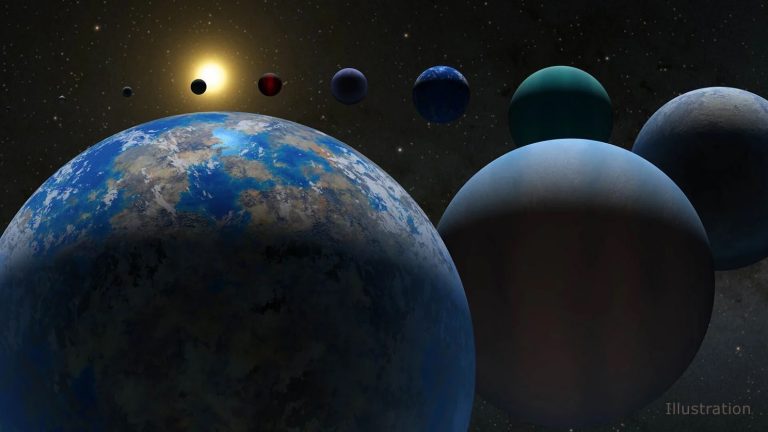
What do planets outside our solar system, or exoplanets, look like? A variety of possibilities are shown in this illustration. Scientists discovered the first exoplanets in the 1990s. As of 2022, the tally stands at just over 5,000 confirmed exoplanets.
This week, the NASA Exoplanet Archive logged the 5,000th confirmed planet outside of our solar system. This marks a huge advance since the first exoplanet discovery in 1992, when astronomers Aleksander Wolszczan and Dale Frail announced the discovery of two planets orbiting the pulsar PSR 1257+12. Now, the Archive contains confirmed sightings of planets in a wide range of shapes and sizes—from “hot Jupiters” to “super Earths”—but they still haven’t found any solar systems just like our own. In many cases, all astronomers know about these distant planets is their size and how far away from their stars they orbit.
Astronomer Jessie Christiansen, the NASA Exoplanet Archive Project science lead, joins John Dankosky to talk about what we know about planets around distant suns, and how researchers are working to learn more about these far-off worlds.
Forty years ago, artist Rick Guidice teamed up with NASA scientists to envision the space civilizations of the future.
Before computer-illustrating software, aerospace engineers and astronomers turned to the skillful hands of technical illustrators to depict future space missions. Los Gatos-based artist Rick Guidice was among them. In 1971, he went from drawing earthbound buildings at an architectural design firm to painting celestial bodies and space settlements for NASA Ames Research Center in Mountain View, California.
Guidice was born and raised in San Jose, California, not far from the tech start-up companies sprouting across Silicon Valley. He began doing architectural illustrations when he was just 16-years-old, later studying fine art at the Academy of Art College in San Francisco. Between stints illustrating game advertisements for Atari and military maneuvers for the United States Air Force, Guidice worked for more than a decade alongside NASA scientists, illustrating missions and research so that their work could be shared with the public.
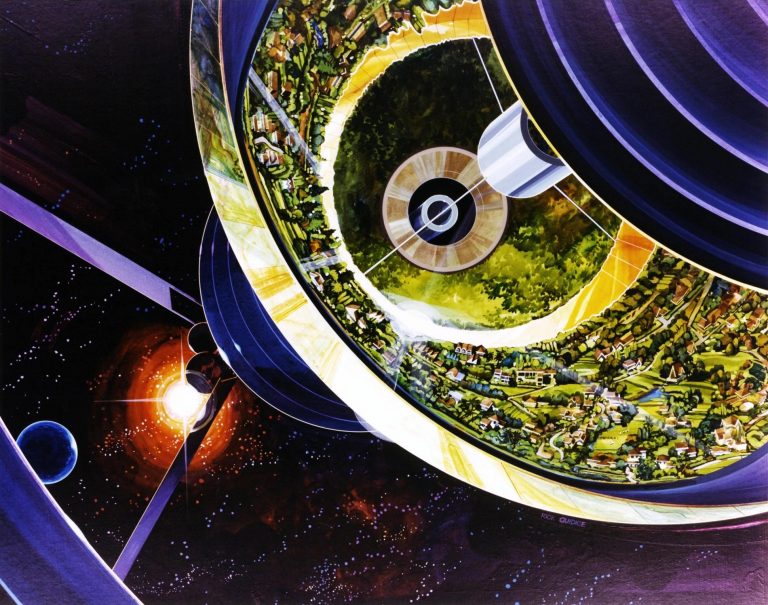
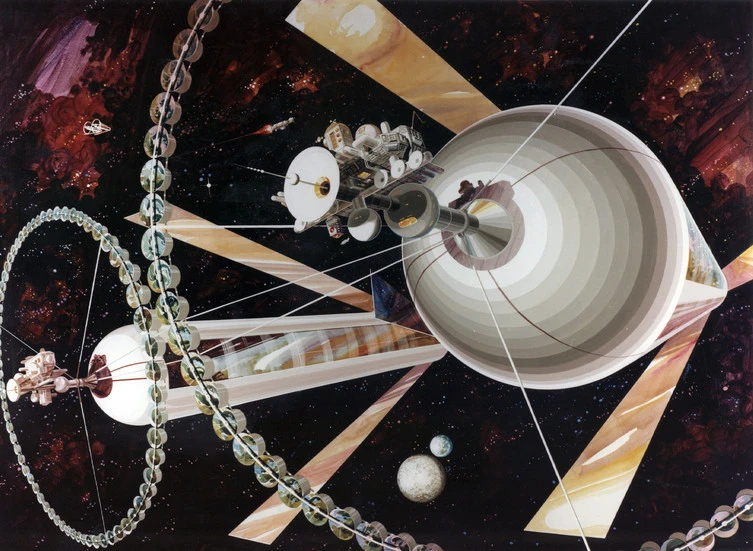
“Exterior of Double Cylinder Settlement,” by Rick Guidice, 1975. The structure has three long mirrors that revolve around the two cylinders (each is 20 miles long and four miles in diameter) to recreate day and night. The pods circling the ends of the cylinders are miniature environments ideal for growing the different types of crops that would be needed to support the million inhabitants of the colony. Image courtesy of NASA Ames Research Center and New Museum Los Gatos
Sometimes that meant filling in the details of a picture when the science was still developing. For example, Guidice remembers receiving fuzzy photos of Jupiter and Saturn—the source material available at the time—and being asked to paint NASA’s Pioneer probes zooming past the planets. “I drew paintings of these missions and what these planets would possibly look like without them being seen before,” he says.
Now a selection of Guidice’s work is on display at New Museum Los Gatos in California. The exhibit, which runs through February 14, 2016, focuses on his depictions of space settlements.
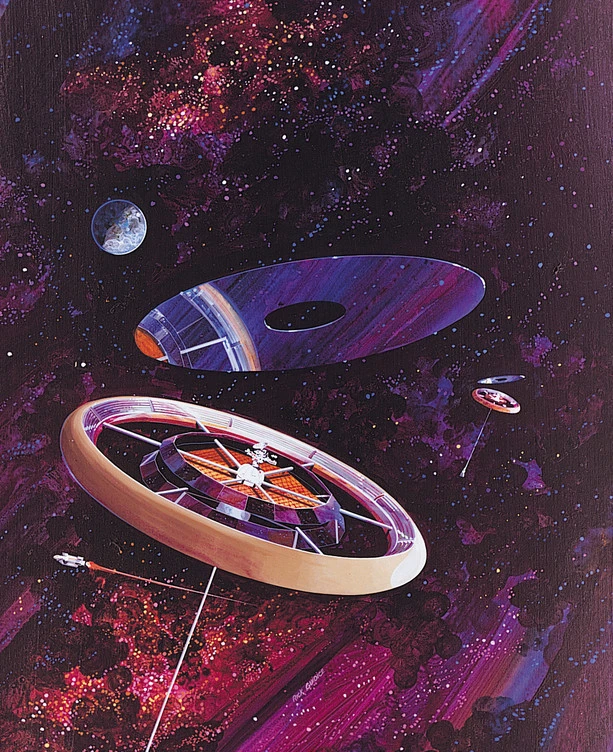
“Torus Wheel Settlement,” by Rick Guidice, 1976. The Stanford Torus Wheel Settlement is a ring-shaped colony meant to orbit Earth (there are two pictured here, one in the foreground and one in the distance). The habitat is a tube, 427 feet in diameter, bent in a wheel shape. The six inner spokes connect the sides of the tube across a distance of more than a mile. The tube spins once per minute to create gravity at levels similar to Earth’s and has a large mirror that can tilt to adjust sunlight levels. Image courtesy of NASA Ames Research Center and New Museum Los Gatos
In the 1970s, NASA was building up the space shuttle program to send humans beyond Earth’s atmosphere. That got some researchers thinking big about what could come next, such as structures capable of supporting whole cities and civilizations in space. During the summers of 1975-1977, scientists gathered at NASA Ames and Stanford University to design space settlements that incorporated only existing technology. The researchers asked how people would grow food, generate energy, and build colony infrastructures in outer space.
“The scientists wanted to know what would it be like if this earth became uninhabitable, and we had to turn to space,” says April Gage, an archivist working at NASA Ames. “What would it look like?”
It was Guidice’s job to illustrate several space colony concepts discussed in the Stanford sessions, including the O’Neill Double Cylinder (1975), the Bernal Sphere (1976), and the Stanford Torus Wheel (1976). While some colonies were intended to accommodate about 10,000 to 20,000 people, the O’Neill Double Cylinder could house on the order of a million, and was designed to generate its own gravitational pull, as well as simulate weather patterns found on Earth.
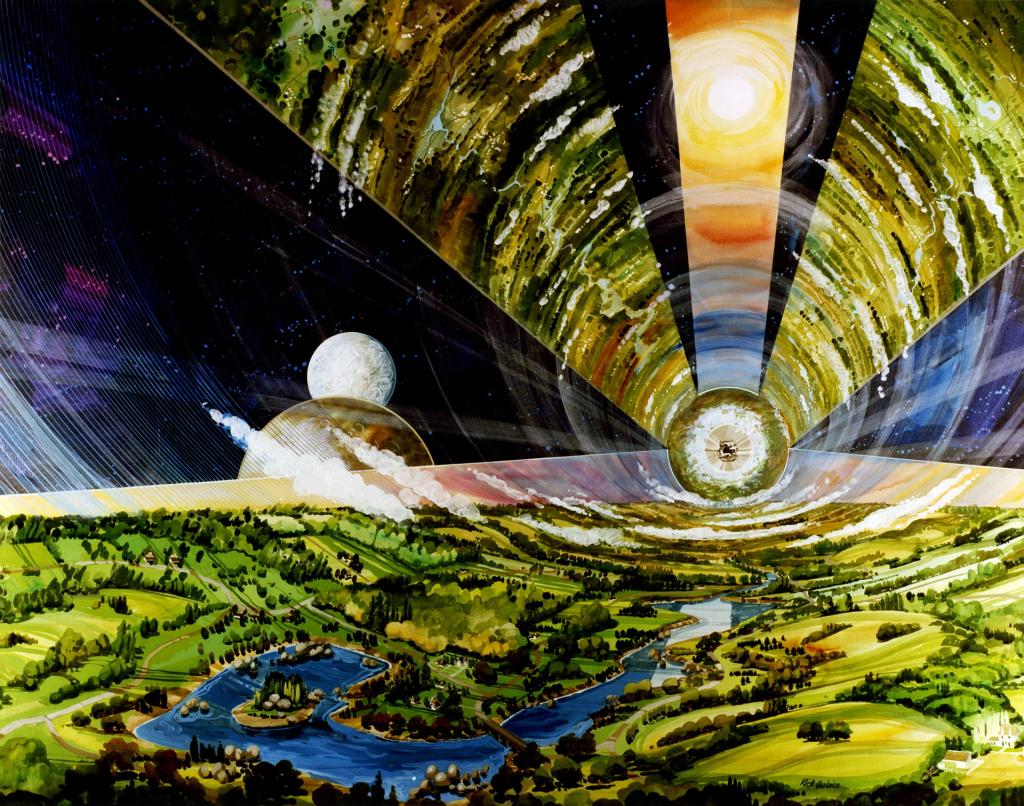
“Double Cylinder Settlement Interior,” by Rick Guidice, 1975. The tunneled interior of the O’Neill Double Cylinder was the first painting that Guidice was commissioned to produce. It remains his favorite among the collection partly because he was able to work with one of the fathers of space settlements, Princeton University physicist Gerard O’Neill. O’Neill requested that the interior have 500 square miles of sprawling green fields, designed to resemble an idyllic French countryside. Image courtesy of NASA Ames Research Center and New Museum Los Gatos
“If you think about the International Space Station, maybe four to five people are on that station,” says Gage. “When you look at these colonies, they are about 100 times larger. [The researchers] were looking at this using the technology of 1975. It’s fascinating to think about.”
While Guidice had no formal science training, he attended meetings with NASA’s mission directors and scientists to make sure he accurately reflected the technology discussed in the sessions. His depictions of gargantuan, space-roaming colonies might resemble the CGI-generated machines and hovercrafts seen in today’s science fiction movies. But back then, everything had to be done by hand, he says. “It was just drawn on paper with pencil [and paint], but it was done a long time ago in a very romantic fashion, you might say.” Each painting took him about three weeks to complete.
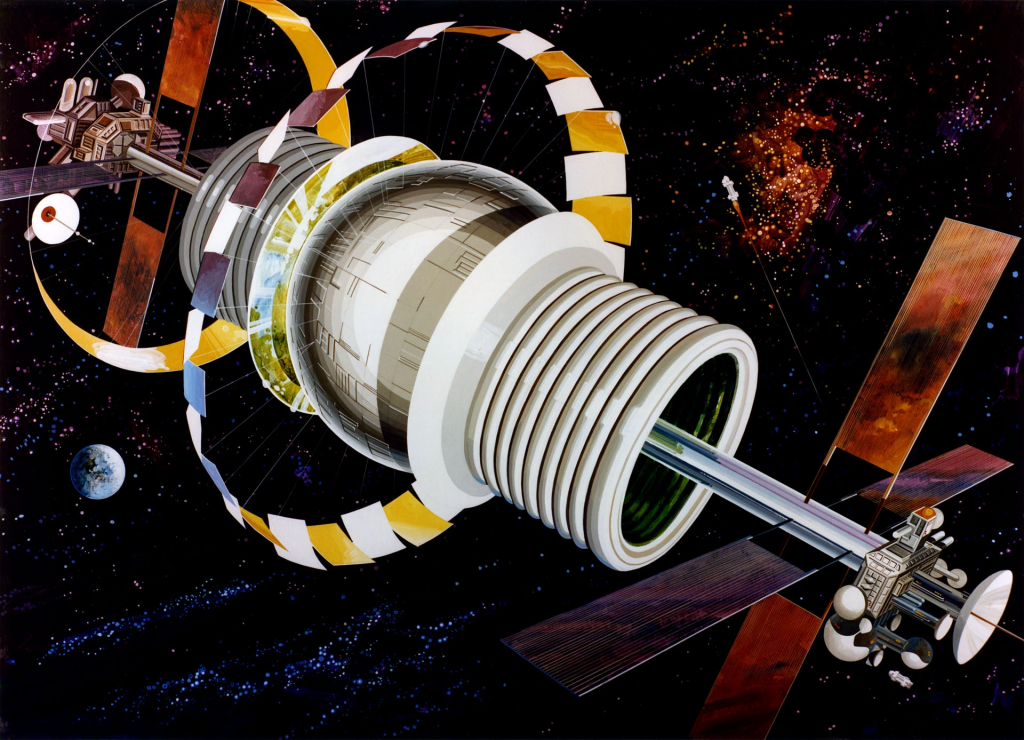
“Bernal Sphere,” by Rick Guidice, 1976. The Bernal Sphere was named after physicist and futurist John Desmond Bernal, who described an iteration of a spherical space ark in his 1929 book, “The World, the Flesh and the Devil.” Image courtesy of NASA Ames Research Center and New Museum Los Gatos
Guidice liked to paint with acrylics and often used warm, bold colors to give a luster to gases and stars. When Marianne McGrath, the curator of the space settlement exhibit at New Museum Los Gatos, came across his paintings, she was struck by how he transformed the science behind the designs into beautiful visions. “It’s not so cold or dark or vast,” she says. “The stars are almost within reach in these paintings.”
The three different colonies don’t appear as tin cans floating in outer space, but as a second home where people would want to live, McGrath says.
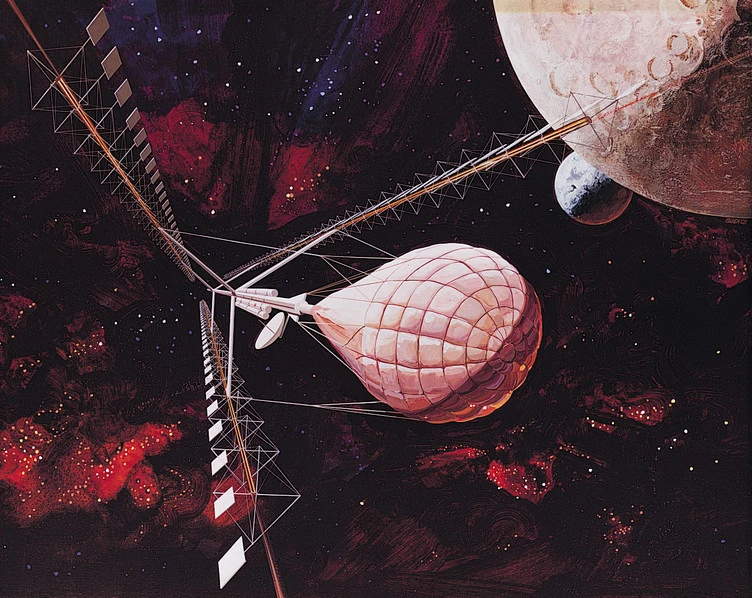
“Electromagnetic Mass Driver,” by Rick Guidice, 1977. In addition to illustrating space settlements, Guidice depicted the electromagnetic mass drivers that might one day make the mining of asteroids and moons possible. The mined material would be used to construct the colonies. Image courtesy of NASA Ames Research Center and New Museum Los Gatos
None of these settlements were ever constructed, but the colony concept lives on in NASA Ames’ annual Space Settlement Contest, which asks students up to 18-years-old from around the world to design their own space colonies. Recent research papers have also proposed scaled-down iterations of these colonies, residing within Earth’s orbit.
When Guidice’s paintings were first revealed to the public in the late 1970s, many people were surprised by how similar living in space seemed to how we live on Earth. That was by design, says Guidice. This portrayal of space colony life “is pleasurable to look at,” he says. What’s more, “it’s still something that looks into the future. When you look at it today, you get the same feeling and reaction of possibility as we did back then.”


 United States
 Russia
 China
China UK
UK Japan
Japan France
 India
India Germany
 Canada
 Luxembourg