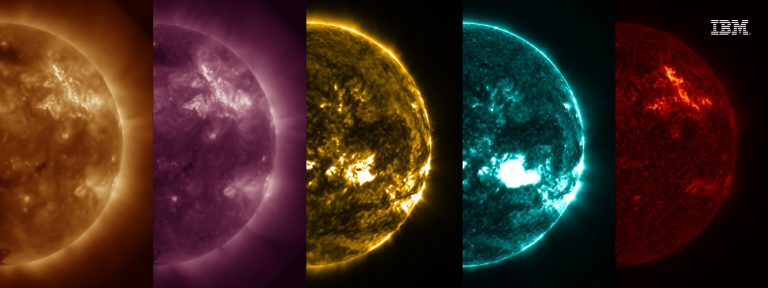
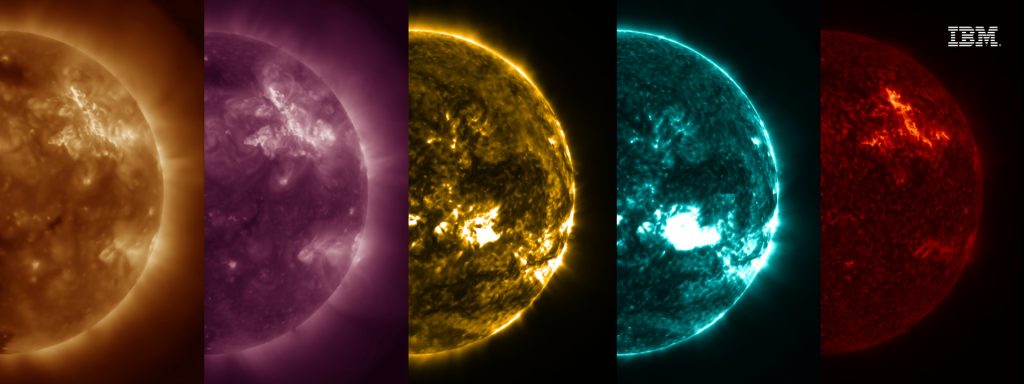
The first heliophysics AI foundation model trained on high resolution solar observation data offers insights into the Sun’s dynamic surface, helping plan for solar weather that can disrupt technology on Earth and in space
Openly available on Hugging Face, the model was built to speed up scientific discovery and democratize AI for the global research and technology community
Researchers also release the largest known curated heliophysics dataset to advance data driven space weather research
YORKTOWN HEIGHTS, N.Y., Aug. 20, 2025 /PRNewswire/ — IBM (NYSE: IBM) and NASA today unveiled the most advanced open-source foundation model designed to understand high resolution solar observation data and predict how solar activity affects Earth and space-based technology. Surya, named for the Sanskrit word for the Sun, represents a significant advancement in applying AI to solar image interpretation and space weather forecasting research, providing a novel tool to help protect everything from GPS navigation to power grids to telecommunications from the Sun’s ever-changing nature.
The Sun may be 93 million miles away, but its impact on modern life is immediate and growing. Solar flares and coronal mass ejections can knock out satellites, disrupt airline navigation, trigger power blackouts, and pose serious radiation risks to astronauts. With humanity’s increasing dependence on space-based technology and plans for deeper space exploration, accurate solar weather prediction has become critical.
As humanity’s technological dependence grows, so does our vulnerability to space weather. According to a systemic risk scenario created by Lloyd’s, the global economy could be exposed to losses of $2.4 trillion over a five-year period, with the expected loss of $17 billion from the threat of a hypothetical solar storm. Recent solar events1 have already demonstrated the risk, disrupting GPS services, forcing flight diversions, and damaging satellites. The effects of solar storms can cause:
Damage to satellites, spacecraft and/or astronauts that are stationed beyond Earth
Loss of satellite hardware, damaging solar panels and circuits
Impact to airline travel, due to navigational errors and potential risk of radiation for airline crew and passengers
Lowered food production as agriculture can be impacted by disrupted GPS navigation
The implications include both academic research and operational preparedness. The new model will provide tools to help experts plan for solar storms, which can disrupt the Earth’s technological infrastructure.
“Think of this as a weather forecast for space,” said Juan Bernabe-Moreno, Director of IBM Research Europe, UK and Ireland. “Just as we work to prepare for hazardous weather events, we need to do the same for solar storms. Surya gives us unprecedented capability to anticipate what’s coming and is not just a technological achievement, but a critical step toward protecting our technological civilization from the star that sustains us.”
Traditional solar weather prediction relies on partial satellite views of the Sun’s surface, historically making accurate forecasting extremely difficult. Surya addresses this typical limitation by training on the largest curated high resolution heliophysics dataset. This dataset is designed to help researchers better study and evaluate critical space weather prediction tasks. Examples of these tasks, which Surya has been tested on, include predicting solar flares, the speed of solar winds, solar EUV spectra prediction and the emergence of active regions on the Sun.
In early testing, researchers report achieving a 16 percent improvement in solar flare classification accuracy, which researchers report as a very substantial improvement compared to previous methods. In addition to the binary solar flare classification task, Surya is built to visually predict solar flares for the first time, providing a high resolution image of where the flare is predicted to occur up to two hours out.
The technical challenges were immense. Surya was trained on nine years of high-resolution solar observation data from NASA’s Solar Dynamics Observatory. These solar images are 10 times larger than typical AI training data, requiring a custom multi-architecture solution to handle the massive scale while maintaining efficiency. The result is a model with unprecedented spatial resolution that can resolve solar features at scales and contexts not previously captured in large-scale AI training workflows.
“We are advancing data-driven science by embedding NASA’s deep scientific expertise into cutting-edge AI models,” said Kevin Murphy, chief science data officer at NASA Headquarters in Washington. “By developing a foundation model trained on NASA’s heliophysics data, we’re making it easier to analyze the complexities of the Sun’s behavior with unprecedented speed and precision. This model empowers broader understanding of how solar activity impacts critical systems and technologies that we all rely on here on Earth.”
Surya is part of a broader effort at IBM to embrace generative and automated approaches that empower algorithms to be discovered, tested, and evolved at scale. Surya is one example of how IBM is positioning AI not just as a tool, but as a driver of scientific discovery. By releasing Surya on Hugging Face, IBM and NASA are democratizing access to advanced tools for understanding and forecasting solar weather and scientific exploration. Researchers worldwide can now build upon this foundation to develop specialized applications for their regions and industries.
This model is part of a larger collaboration between IBM and NASA to use AI technology to explore our planet and solar system. It joins the Prithvi family of foundation models, which includes a geospatial model and a weather model. Last year, IBM and NASA released the Prithvi weather model on Hugging Face for scientists and the broader community to develop short- and long-term weather and climate projections.
About IBM IBM is a leading provider of global hybrid cloud and AI, and consulting expertise. We help clients in more than 175 countries capitalize on insights from their data, streamline business processes, reduce costs and gain the competitive edge in their industries. Thousands of government and corporate entities in critical infrastructure areas such as financial services, telecommunications and healthcare rely on IBM’s hybrid cloud platform and Red Hat OpenShift to affect their digital transformations quickly, efficiently and securely. IBM’s breakthrough innovations in AI, quantum computing, industry-specific cloud solutions and consulting delivers open and flexible options to our clients. All of this is backed by IBM’s long-standing commitment to trust, transparency, responsibility, inclusivity and service.
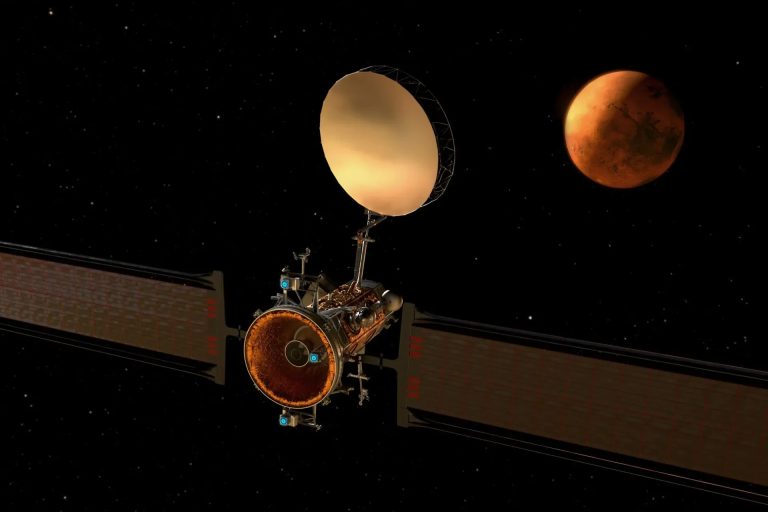
Blue Origin designs and manufactures heavy-lift rockets, transporters, landers, and orbiters to explore the Red Planet efficiently and affordably. Built upon our existing and affordable Blue Ring platform, our Mars Telecommunications Orbiter (MTO) is ready to support NASA’s Mars mission in 2028. MTO is designed to establish a high-speed communications relay network for continuous coverage between Earth and Mars with the flexibility to meet future NASA robotic and human exploration needs. The orbiter builds upon Blue Origin’s Mars Next-Generation Relay and Mars Sample Return architecture commercial proposals.
MTO provides continuous high-speed communications between Earth and Mars through multiple, steerable high-rate links supported by a broad beam that offers wide-area coverage. This coverage is supplemented with a small number of deployable UHF relay satellites in low Mars orbit, providing UHF coverage to legacy assets and future entry, descent, and landing demonstrations.
MTO’s hybrid (electric + chemical) propulsion, maneuvering capability, and capacity greatly expand the windows to get to Mars, reducing mission risk. This system can reach Mars under challenging conditions by efficiently supplementing launch energy with electric propulsion, which is not possible with chemical systems alone. MTO’s solar electric propulsion provides highly efficient delta-v, allowing for more payload mass dedicated to high-performance communications. The platform can carry over 1,000 kg of payload to Mars orbit, depending on specific mission requirements. Additionally, MTO offers powerful edge processing, data storage, and AI capabilities to meet future Mars science and exploration demands.
The small satellite was to map lunar water, but operators lost contact with the spacecraft the day after launch and were unable to recover the mission.
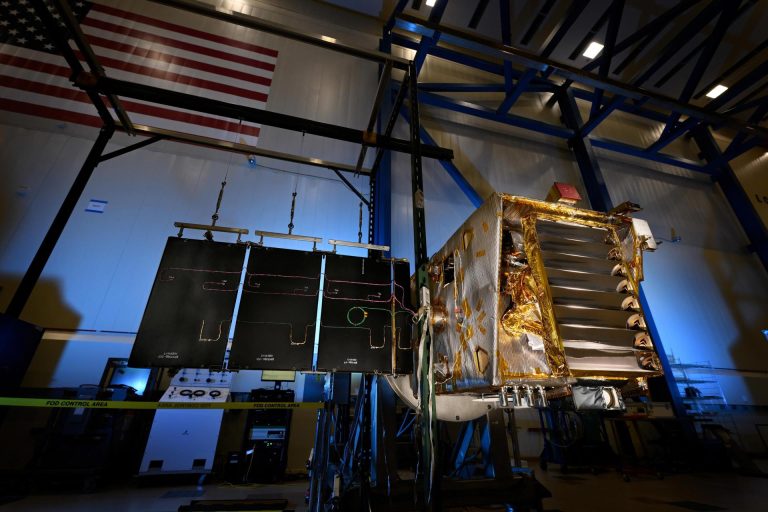
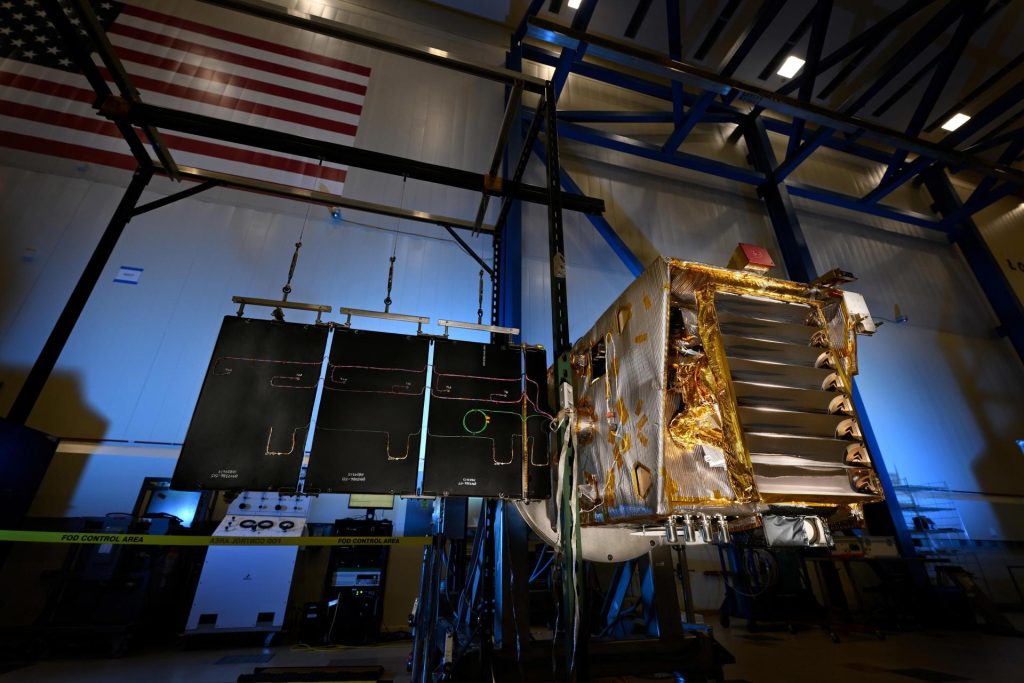
With one of its solar arrays deployed, NASA’s Lunar Trailblazer sits in a clean room at Lockheed Martin Space in Colorado during testing in August 2024. The mission was to investigate the nature of the Moon’s water, but controllers lost contact with the spacecraft a day after launch in February 2025.
Lockheed Martin Space
NASA’s Lunar Trailblazer ended its mission to the Moon on July 31. Despite extensive efforts, mission operators were unable to establish two-way communications after losing contact with the spacecraft the day following its Feb. 26 launch.
The mission aimed to produce high-resolution maps of water on the Moon’s surface and determine what form the water is in, how much is there, and how it changes over time. The maps would have supported future robotic and human exploration of the Moon as well as commercial interests while also contributing to the understanding of water cycles on airless bodies throughout the solar system.
Lunar Trailblazer shared a ride on the second Intuitive Machines robotic lunar lander mission, IM-2, which lifted off at 7:16 p.m. EST on Feb. 26 aboard a SpaceX Falcon 9 rocket from the agency’s Kennedy Space Center in Florida. The small satellite separated as planned from the rocket about 48 minutes after launch to begin its flight to the Moon. Mission operators at Caltech’s IPAC in Pasadena established communications with the small spacecraft at 8:13 p.m. EST. Contact was lost the next day.
Without two-way communications, the team was unable to fully diagnose the spacecraft or perform the thruster operations needed to keep Lunar Trailblazer on its flight path.
“At NASA, we undertake high-risk, high-reward missions like Lunar Trailblazer to find revolutionary ways of doing new science,” said Nicky Fox, associate administrator, Science Mission Directorate at NASA Headquarters in Washington. “While it was not the outcome we had hoped for, mission experiences like Lunar Trailblazer help us to learn and reduce the risk for future, low-cost small satellites to do innovative science as we prepare for a sustained human presence on the Moon. Thank you to the Lunar Trailblazer team for their dedication in working on and learning from this mission through to the end.”
The limited data the mission team had received from Lunar Trailblazer indicated that the spacecraft’s solar arrays were not properly oriented toward the Sun, which caused its batteries to become depleted.
For several months, collaborating organizations around the world — many of which volunteered their assistance — listened for the spacecraft’s radio signal and tracked its position. Ground radar and optical observations indicated that Lunar Trailblazer was in a slow spin as it headed farther into deep space.
“As Lunar Trailblazer drifted far beyond the Moon, our models showed that the solar panels might receive more sunlight, perhaps charging the spacecraft’s batteries to a point it could turn on its radio,” said Andrew Klesh, Lunar Trailblazer’s project systems engineer at NASA’s Jet Propulsion Laboratory in Southern California. “The global community’s support helped us better understand the spacecraft’s spin, pointing, and trajectory. In space exploration, collaboration is critical — this gave us the best chance to try to regain contact.”
However, as time passed, Lunar Trailblazer became too distant to recover as its telecommunications signals would have been too weak for the mission to receive telemetry and to command.
Technological Legacy
The small satellite’s High-resolution Volatiles and Minerals Moon Mapper (HVM3) imaging spectrometer was built by JPL to detect and map the locations of water and minerals. The mission’s Lunar Thermal Mapper (LTM) instrument was built by the University of Oxford in the United Kingdom and funded by the UK Space Agency to gather temperature data and determine the composition of silicate rocks and soils to improve understanding of why water content varies over time.
“We’re immensely disappointed that our spacecraft didn’t get to the Moon, but the two science instruments we developed, like the teams we brought together, are world class,” said Bethany Ehlmann, the mission’s principal investigator at Caltech. “This collective knowledge and the technology developed will cross-pollinate to other projects as the planetary science community continues work to better understand the Moon’s water.”
Some of that technology will live on in the JPL-built Ultra Compact Imaging Spectrometer for the Moon (UCIS-Moon) instrument that NASA recently selected for a future orbital flight opportunity. The instrument, which has has an identical spectrometer design as HVM3, will provide the Moon’s highest spatial resolution data of surface lunar water and minerals.
More About Lunar Trailblazer
Lunar Trailblazer was selected by NASA’s SIMPLEx (Small Innovative Missions for Planetary Exploration) competition, which provides opportunities for low-cost science spacecraft to ride-share with selected primary missions. To maintain the lower overall cost, SIMPLEx missions have a higher risk posture and less-stringent requirements for oversight and management. This higher risk acceptance bolsters NASA’s portfolio of targeted science missions designed to test pioneering mission approaches.
Caltech, which manages JPL for NASA, led Lunar Trailblazer’s science investigation, and Caltech’s IPAC led mission operations, which included planning, scheduling, and sequencing of all spacecraft activities. Along with managing Lunar Trailblazer, NASA JPL provided system engineering, mission assurance, the HVM3 instrument, and mission design and navigation. Lockheed Martin Space provided the spacecraft, integrated the flight system, and supported operations under contract with Caltech. The University of Oxford developed and provided the LTM instrument, funded by the UK Space Agency. Lunar Trailblazer, a project of NASA’s Lunar Discovery and Exploration Program, was managed by NASA’s Planetary Missions Program Office at Marshall Space Flight Center in Huntsville, Alabama, for the agency’s Science Mission Directorate in Washington.
Diving is a fascinating activity that takes you into an entirely different world beneath the surface. Freediving, for example, is a challenging experience as it relies on your ability to hold your breath while exploring underwater. Scuba diving takes it in to another level as you will now need to use specialised breathing equipment. Beyond diving, there are also water sports below and above the surface.
For beginners who would like to try out underwater diving, whether scuba diving or free diving there are certain essentials you need to be aware of. This includes learning from certified instructor, using proper equipment like BCD or Buoyancy Control Device, communication and basic equipment.
Here we have some suit options that have been carefully catered by our reviewers and customers alike. Some basics when choosing between Wetsuit and Drysuit.
Drysuit vs Wetsuit
Drysuit has a steeper learning curve. This is due to the Buoyancy Control Device, air movement inside the suit.
Drysuits are a larger investments, they do offer better comfort and protection in cold-water diving. They also last longer in terms of durability when compared to wetsuits.
Wetsuit are more common for casual or recreational diving. Choose this if you are not yet invested on it.
Drysuit keeps you warm depending on the undargarment you are wearing undeneath it. While wetsuit provides warmth by trapping a thin layer of water between your skin and the suit, which your body then heats up.
Wetsuits and Drysuits
Note that all of the wetsuit and drysuits here have various size to choose from. A size chart or mapping of body measurement is available on their respective pages. These suits are also priced according to their available sizes.
Generally, we recommend that you chose Dry Suit for long term investment especially for colder and more frequent dives. Whichever suit you go for, make sure to select the right size based on your accurate body measurements for both comfort and performance. While looks may not be the most important factor, picking a suit that makes you feel confident can definitely enhance the experience.
Student life is busy enough without hassles like paying for shipping. That’s why Amazon Prime Student is a must-have for you. For just $14.99 $7.49/month, Prime Student gets you free two-day shipping on over 100 million items, unlimited photo storage, exclusive deals, and more. Better still, it comes with a six-month free trial so you can make sure Prime Student fits your lifestyle. Join today to take advantage of membership benefits and perks tailored specifically for students! Click here to sign up now.
A baby planet is shrinking from the size of Jupiter with a thick atmosphere to a small, barren world, according to a new study from NASA’s Chandra X-ray Observatory.
This transformation is happening as the host star unleashes a barrage of X-rays that is tearing the young planet’s atmosphere away at an enormous rate.
The planet, named TOI 1227 b, is in an orbit around a red dwarf star about 330 light-years from Earth. TOI 1227 b orbits very close to its star — less than a fifth the distance that Mercury orbits the Sun. The new study shows this planet outside our solar system, or exoplanet, is a “baby” at a mere 8 million years old. By comparison, the Earth is about 5 billion years old, or nearly a thousand times older. That makes it the second youngest planet ever to be observed passing in front of its host star (also called a transit). Previously the planet had been estimated by others to be about 11 million years old.
A research team found that X-rays from its star are blasting TOI 1227 b and tearing away its atmosphere at such a rate that the planet will entirely lose it in about a billion years. At that point the planet will have lost a total mass equal to about two Earth masses, down from about 17 times the mass of Earth now.
“It’s almost unfathomable to imagine what is happening to this planet,” said Attila Varga, a Ph.D. student at the Rochester Institute of Technology (RIT) in New York, who led the study. “The planet’s atmosphere simply cannot withstand the high X-ray dose it’s receiving from its star.”
It is probably impossible for life to exist on TOI 1227 b, either now or in the future. The planet is too close to its star to fit into any definition of a ‘habitable zone,’ a term astronomers use to determine if planets around other stars could sustain liquid water on their surface.
The star that hosts TOI 1227 b, which is called TOI 1227, is only about a tenth the mass of the Sun and is much cooler and fainter in optical light. In X-rays, however, TOI 1227 is brighter than the Sun and is subjecting this planet, in its very close orbit, to a withering assault. The mass of TOI 1227 b, while not well understood, is likely similar to that of Neptune, but its diameter is three times larger than Neptune’s (making it similar in size to Jupiter).
“A crucial part of understanding planets outside our solar system is to account for high-energy radiation like X-rays that they’re receiving,” said co-author Joel Kastner, also of RIT. “We think this planet is puffed up, or inflated, in large part as a result of the ongoing assault of X-rays from the star.”
The team used new Chandra data to measure the amount of X-rays from the star that are striking the planet. Using computer models of the effects of these X-rays, they concluded the X-rays will have a transformative effect, rapidly stripping away the planet’s atmosphere. They estimate that the planet is losing a mass equivalent to a full Earth’s atmosphere about every 200 years.
“The future for this baby planet doesn’t look great,” said co-author Alexander Binks of the Eberhard Karls University of Tübingen in Germany. “From here, TOI 1227 b may shrink to about a tenth of its current size and will lose more than 10 percent of its weight.”
The researchers used different sets of data to estimate the age of TOI 1227 b. One method exploits measurements of how TOI 1227 b’s host star moves through space compared to nearby populations of stars with known ages. A second method compared the brightness and surface temperature of the star with theoretical models of evolving stars.
Of all the exoplanets astronomers have found with ages less than 50 million years, TOI 1227 b stands out for having the longest year and the host planet with the lowest mass.
A paper describing these results has been accepted publication in The Astrophysical Journal, and a preprint is available here.
NASA’s Marshall Space Flight Center in Huntsville, Alabama, manages the Chandra program. The Smithsonian Astrophysical Observatory’s Chandra X-ray Center controls science operations from Cambridge, Massachusetts, and flight operations from Burlington, Massachusetts.
Visual Description
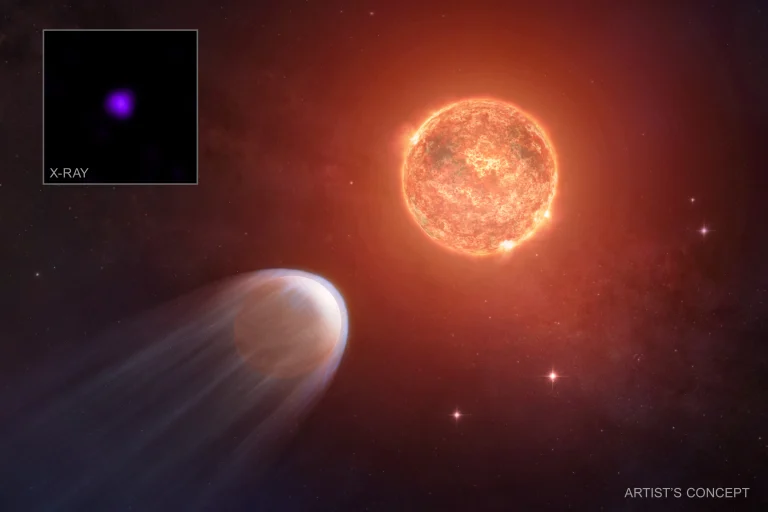
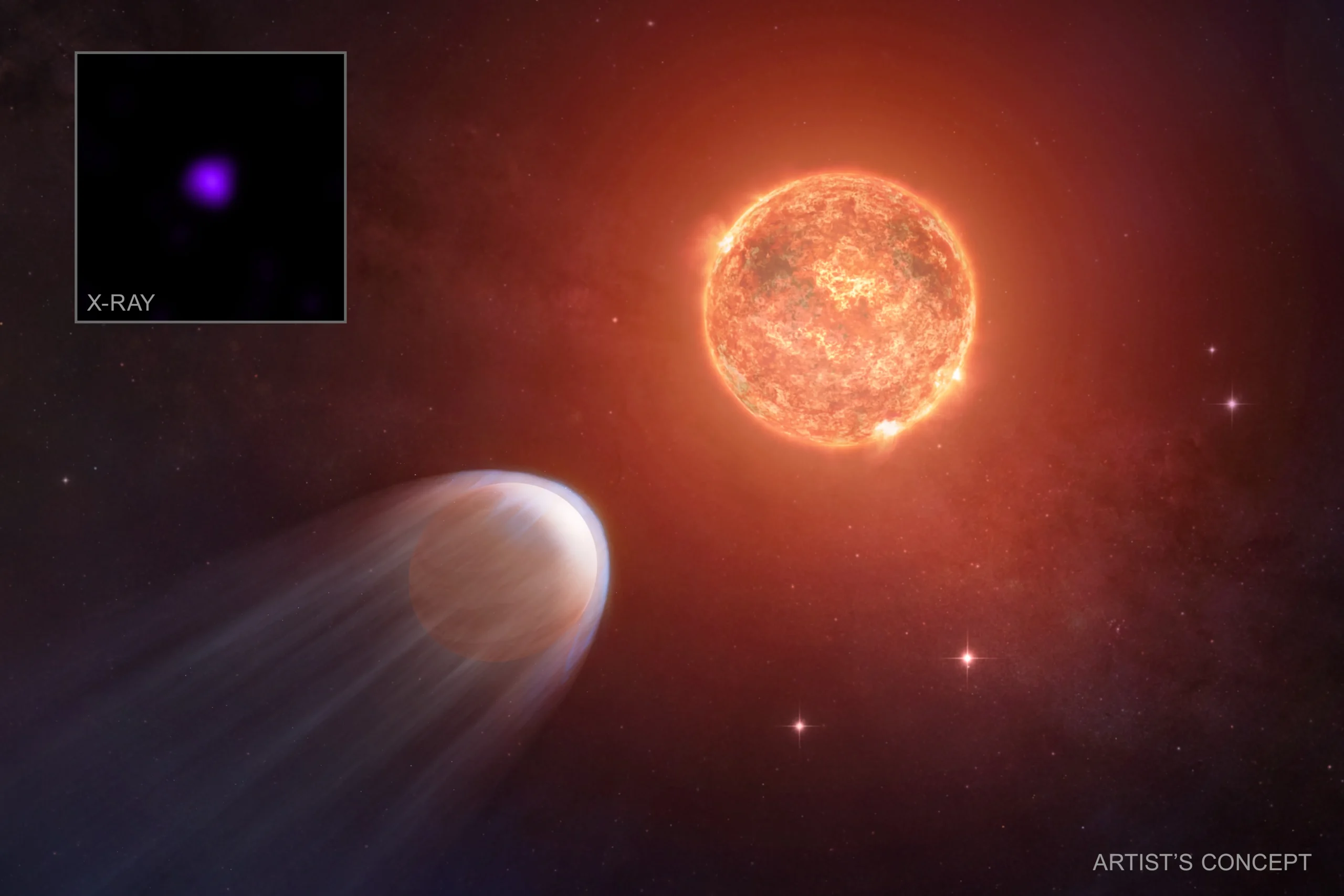
This release features an artist’s illustration of a Jupiter-sized planet closely orbiting a faint red star. An inset image, showing the star in X-ray light from Chandra, is superimposed on top of the illustration at our upper left corner.
At our upper right, the red star is illustrated as a ball made of intense fire. The planet, slightly smaller than the star, is shown at our lower left. Powerful X-rays from the star are tearing away the atmosphere of the planet, causing wisps of material to flow away from the planet’s surface in the opposite direction from the star. This gives the planet a slight resemblance to a comet, complete with a tail.
X-ray data from Chandra, presented in the inset image, shows the star as a small purple orb on a black background. Astronomers used the Chandra data to measure the amount of X-rays striking the planet from the star. They estimate that the planet is losing a mass equivalent to a full Earth’s atmosphere about every 200 years, causing it to ultimately shrink from the size of Jupiter down to a small, barren world.
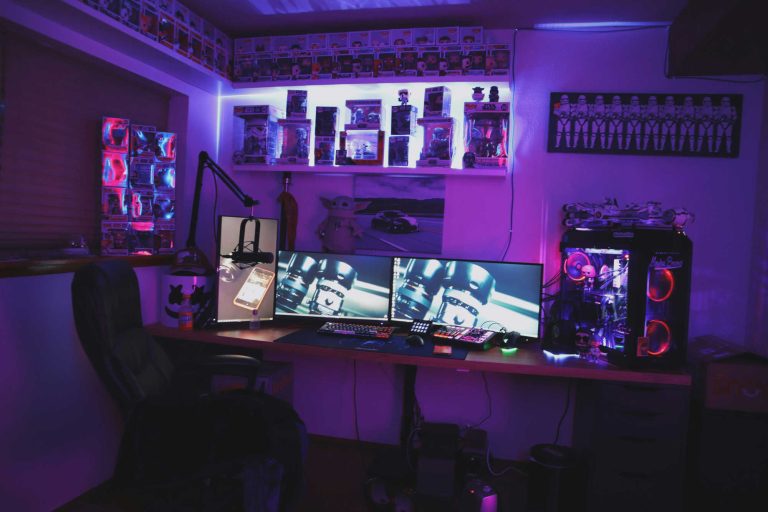
While streaming is defined as broadcasting a video and most of the time includes audio to a wide audience over the internet. Some consider it as a full-time job. From professional chess players to carpenters teaching woodwork skills. Streaming now spans a wide range of content creators. This includes those who have careers as streamers and hobbyists alike.
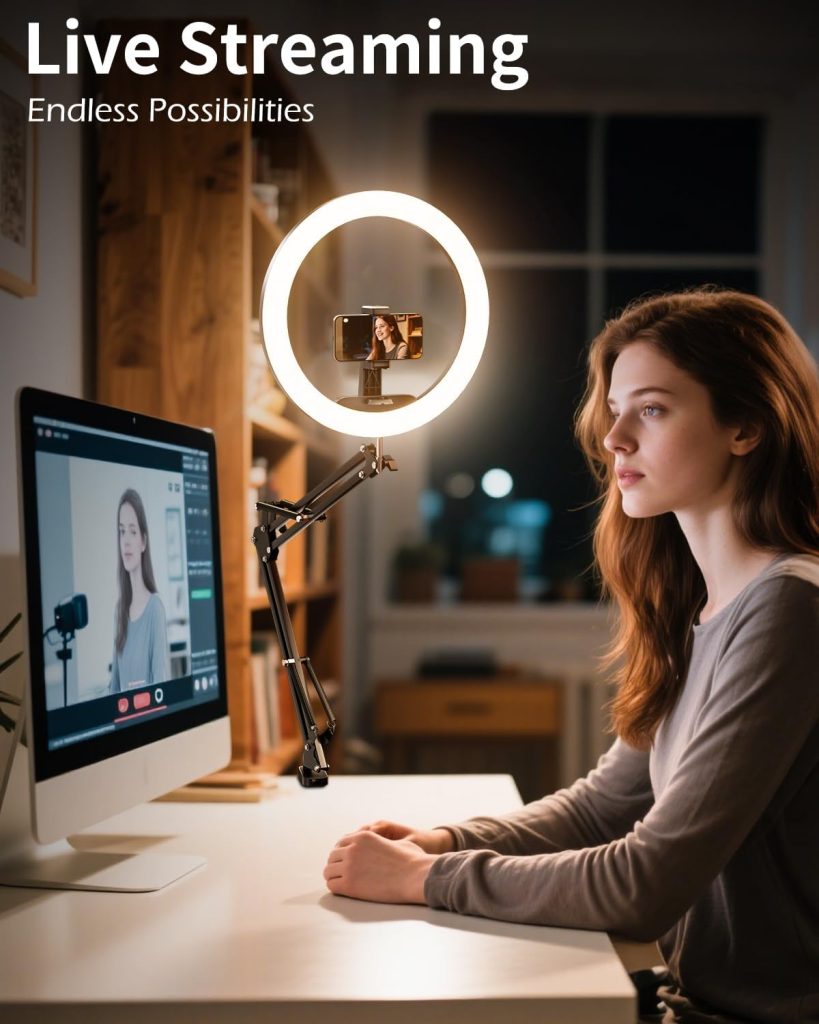
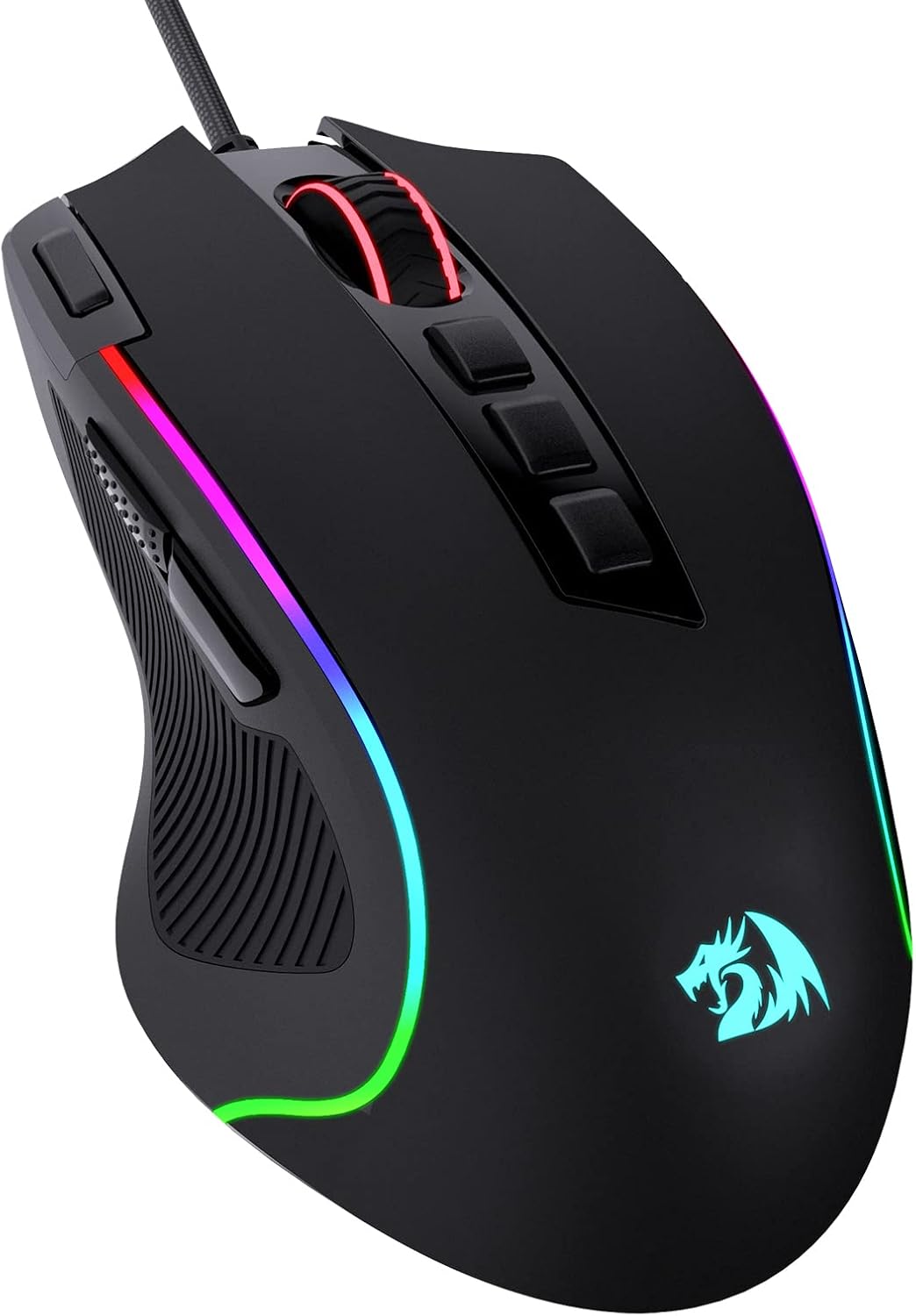
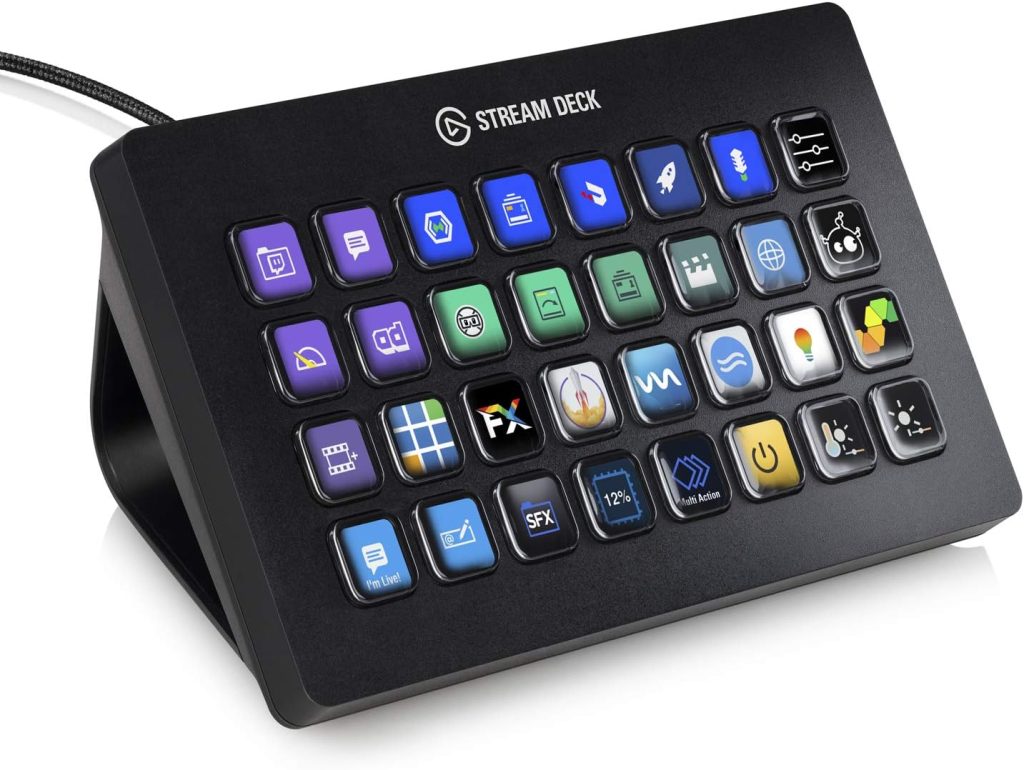
We’ve now put together the equipment you would need to start the journey as a content creator. Gaming in particular will require a high-end gear depending on the game you are playing. A good rule of thumb is to aim for hardware that exceeds the “recommended requirements” by at least one level of the game. Since streaming software like OBS Studio adds additional workload to your system.
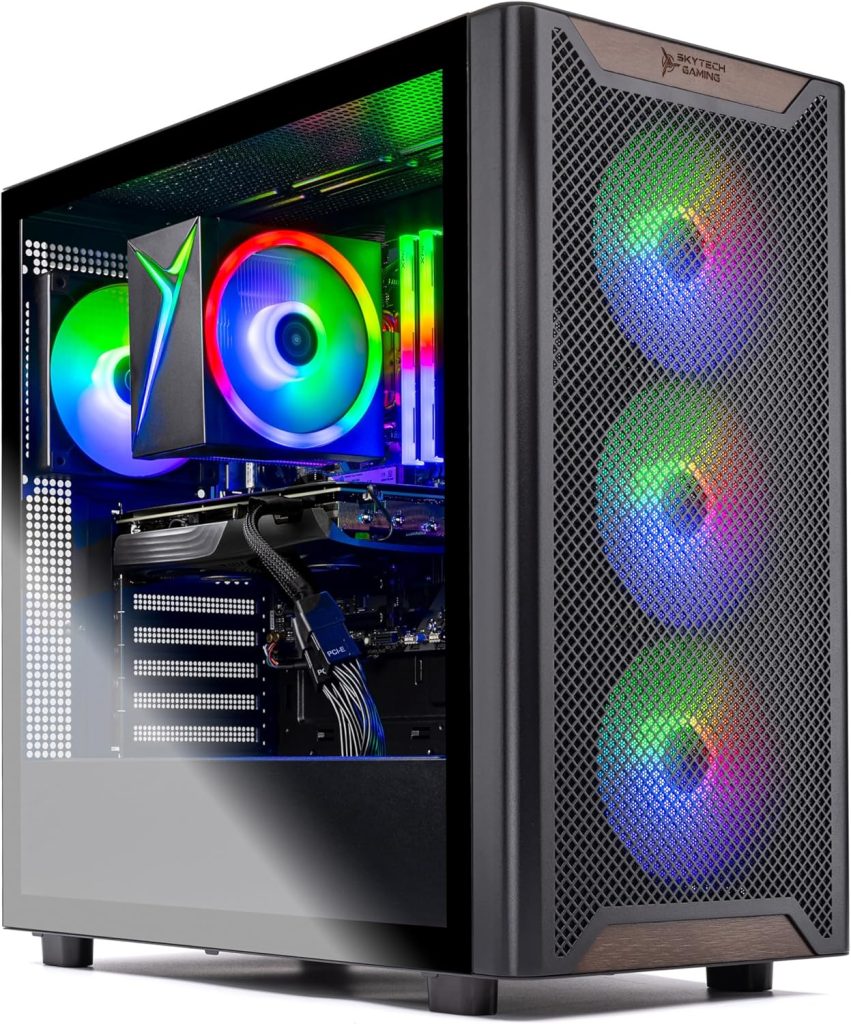
AMD Ryzen 7 7700 3.8GHz CPU, 2 TB hard disk, 32GB DDR5 memory and AMD Radeon RX 9070
Best for those who also plays video game or requires a large computing power
Provides ambiant LED light
This computer can easily play Elden Ring and Cyberpunk 2077 4K Ultra with no issues. Or run multiple IDEs, run your web application and perform small to medium training models for Machine Learning.
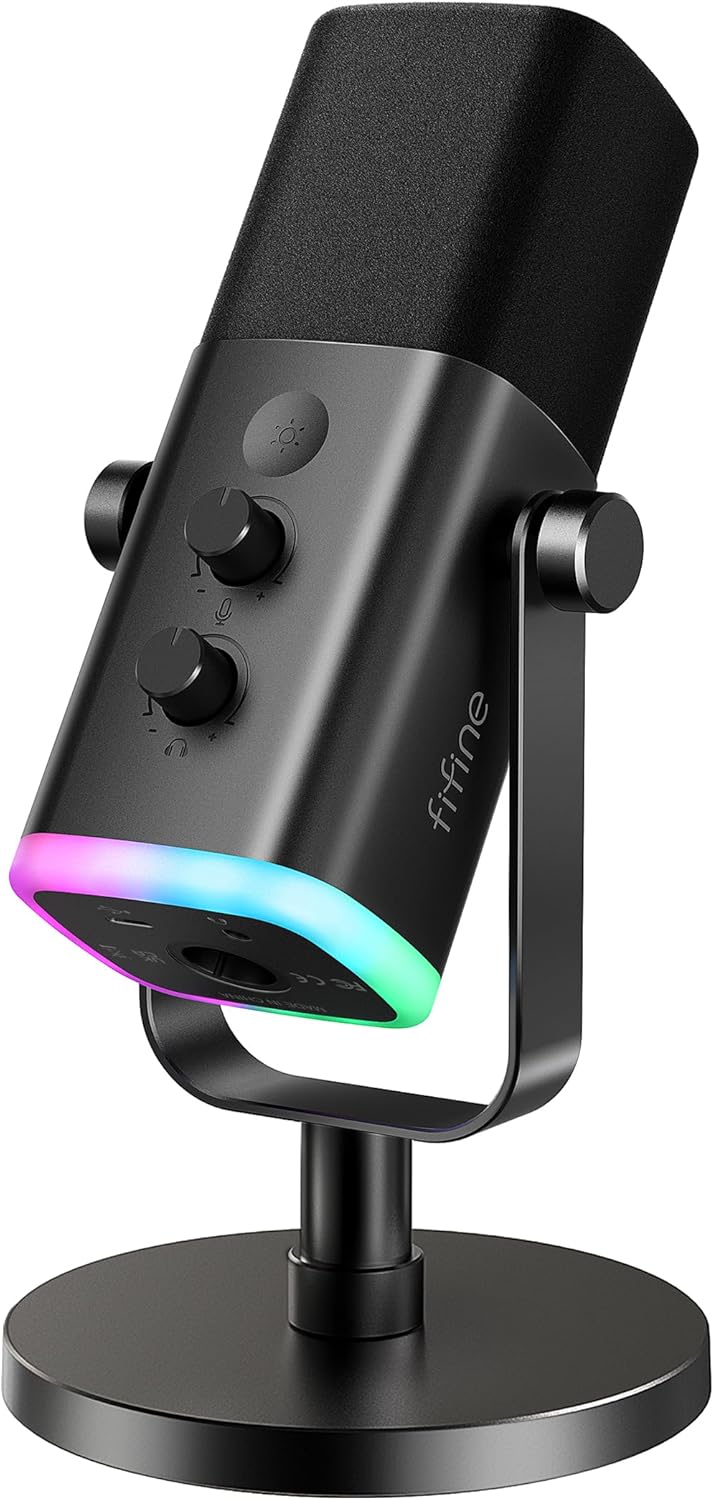
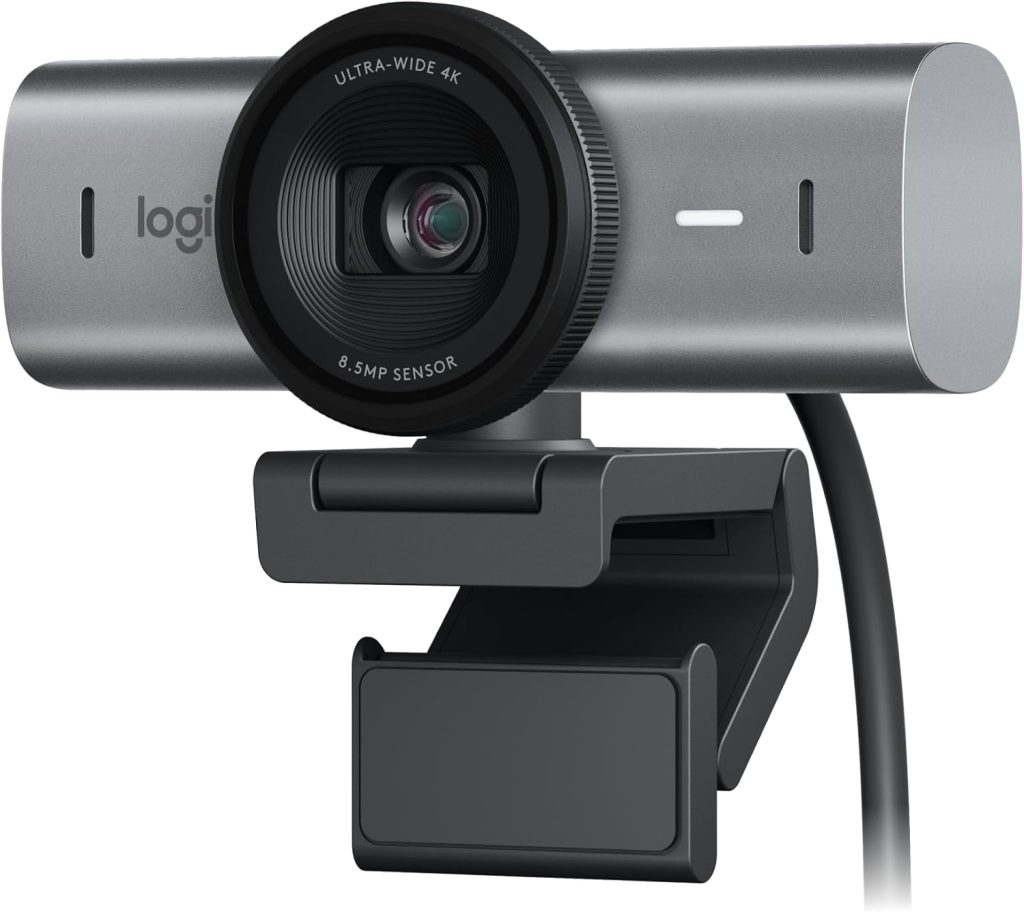
For providing full video experience to viewers while also giving privacy
Machine and hand washable
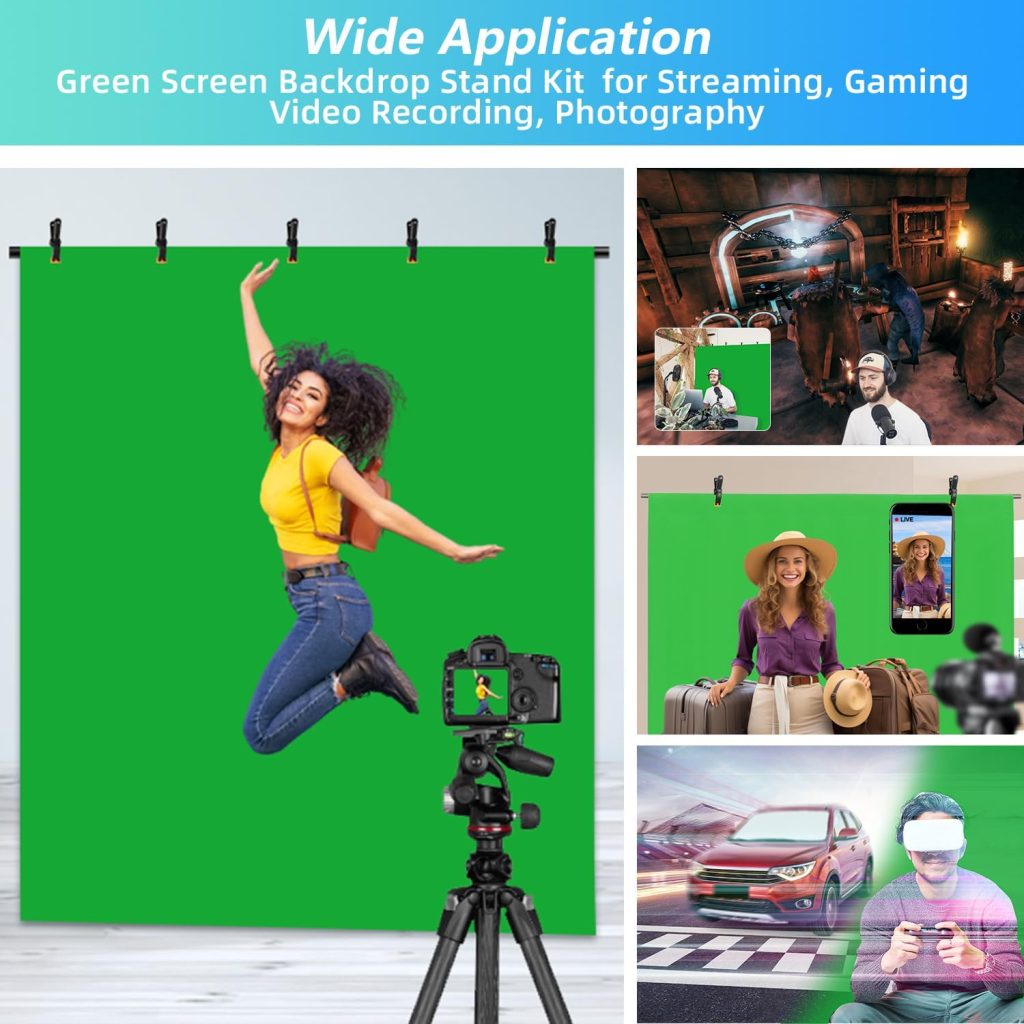
A green screen is really situational. If your room shows a scenic place and it adds something to your character, then this is really not required. But if you are playing a game and want to keep the focus on the gameplay without distractions, then this is essential.
With these tools, you’ll be ready to dive into streaming and content creation. If you are just starting out, don’t overthink it. Just start.
Student life is busy enough without hassles like paying for shipping. That’s why Amazon Prime Student is a must-have for you. For just $14.99 $7.49/month, Prime Student gets you free two-day shipping on over 100 million items, unlimited photo storage, exclusive deals, and more. Better still, it comes with a six-month free trial so you can make sure Prime Student fits your lifestyle. Join today to take advantage of membership benefits and perks tailored specifically for students! Click here to sign up now.
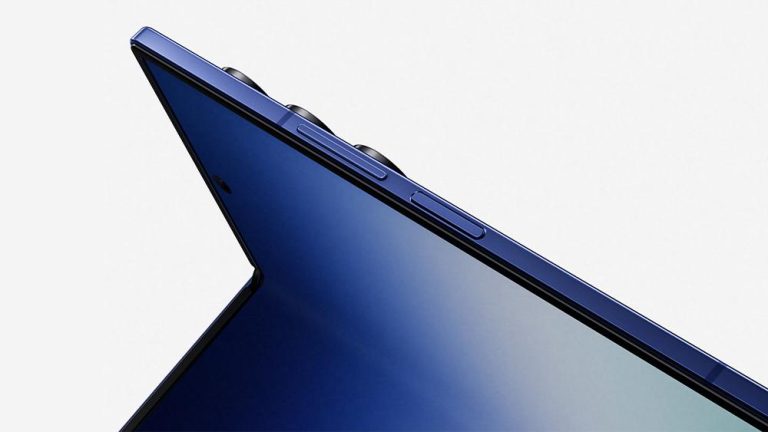
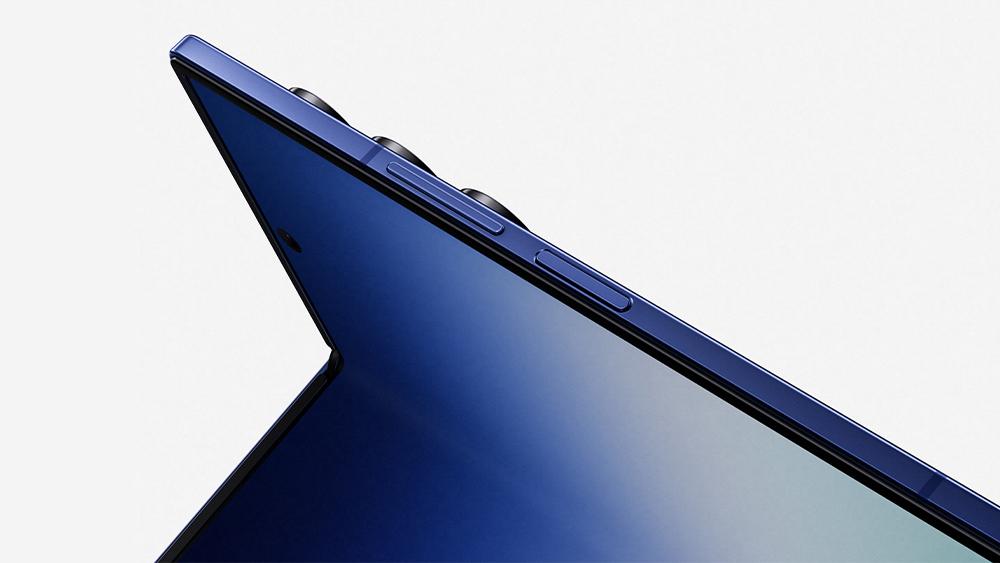
The most advanced Galaxy Z series yet, seamlessly blending precision engineering and powerful intelligence to elevate everyday interactions – all in its thinnest and lightest design to date
Samsung Electronics today announced Galaxy Z Fold7, a device that brings together the best of Galaxy design, camera functionality and AI innovation in the thinnest and lightest Galaxy Z Fold series to date. It delivers the premium performance and experience of an ultra smartphone, while unlocking new levels of efficiency and productivity with a larger, more immersive display when unfolded. And with the new One UI 8 as its foundation, it seamlessly integrates intelligent, multimodal agents optimized for the foldable form factor.
“Galaxy Z Fold7 combines Galaxy AI with powerful hardware to deliver our most advanced smartphone experience yet,” said TM Roh, President and Acting Head of the Device eXperience (DX) Division at Samsung Electronics. “This next chapter of foldables brings together design and engineering, with AI built specifically for the foldable form. It gives people the ultra experience they want — powerful, immersive, intelligent, and portable all in one.”
Ultra Sleek, Ultra Powerful
Thinnest, Lightest Galaxy Z Fold
Galaxy Z Fold7 is crafted for those who want the everyday portability and intuitive feel of a traditional smartphone, combined with the enhanced power and flexibility of a larger, unfolded display — all in one device. With its ultra-thin and light design and wider cover display, Galaxy Z Fold7 delivers a seamless on-the-go experience that makes typing and browsing effortless when it is folded.
At just 215 grams,1 Galaxy Z Fold7 is even lighter than Galaxy S25 Ultra.
It is just 8.9 mm thick when folded and 4.2 mm thick when unfolded.2
The device comes with a 6.5-inch3 Dynamic AMOLED 2X cover display, a wider screen4 with a new 21:9 aspect ratio.
Most Expansive Screen on Galaxy Smartphone
When unfolded, Galaxy Z Fold7 becomes more than just a smartphone. It transforms into another device entirely and reveals an expansive screen that expands the workspace for editing, multitasking and immersive viewing — getting more out of Galaxy AI. The main display on Galaxy Z Fold7 is 11% larger than the previous generation, providing even more screen real estate for content editing and multitasking across multiple apps.
The 8-inch5 Dynamic AMOLED 2X main display offers ultra-rich contrast, true blacks and vibrant detail that makes everything pop — from movies to tabs open while multitasking.
With Vision Booster and up to 2,600 nits of peak brightness, Galaxy Z Fold7 stays brilliantly visible even in direct sunlight.
Looks Sleek, Built Tough
Thin and light, Galaxy Z Fold7 is built to move with users, confidently. From repeated folding to being tossed in a bag, it’s engineered for everyday durability and built to last longer, with a restructured hinge and foldable display.
The Armor FlexHinge is thinner and lighter,6 thanks to an enhanced water droplet design and newly implemented multi-rail structure that reduces visible creasing and strengthens durability by evenly dispersing stress.
The cover display is made with Corning® Gorilla® Glass Ceramic 2, a new glass ceramic that has crystals intricately embedded within its glass matrix.7 This secures the screen’s durability and crack deflection capabilities and delivers protection in a remarkably thin form factor.
Advanced Armor Aluminum8 in the frame and hinge housing increases strength and hardness by 10%.
The main display is restructured to be thinner and lighter — yet stronger. This was achieved by implementing the Titanium plate layer. Additionally, Ultra-Thin Glass (UTG) was increased to be 50% thicker, making the display tougher.
The Most Powerful Processor Customized for Galaxy
Under the hood, Galaxy Z Fold7 is powered by the best-in-class processor used in Galaxy devices. It’s uniquely customized and makes on-device AI processing tasks — like real-time language translation and Generative Edit — faster and more seamless.
The Snapdragon 8 Elite for Galaxy9 delivers performance boosts of 41% in NPU, 38% in CPU, and 26% in GPU10 compared to the previous generation. This power fuels Galaxy Z Fold7’s ability to process more AI experiences on-device without compromise.
Ultra 200MP Camera
Ultra Detailed, Ultra Clear Photos11
Galaxy Z Fold7 now brings the best of the Galaxy’s pro-grade camera experience to a foldable, combining advanced hardware with intelligent processing for consistently stunning results. Its high-resolution camera captures incredible detail, vibrant color and rich texture, pulling users back into every moment. AI-enhanced imaging automatically optimizes lighting, detail and realism, so photos and videos stay sharp and vivid, even in low light settings such as milestone dinners and late-night café scenes.
Featuring the first200MP wide-angle camera in the Galaxy Z series, it captures 4x more detail, producing images that are 44% brighter.
The 10MP 100° camera on the main display expands the frame, so when users unfold their phone, it’s easy to capture group selfies, valuable moments and more of the world in a single shot.
Samsung’s next-generation ProVisual Engine processes images faster, enabling every photo and video to be more crisp, vibrant and full of detail.
With Night Video, intelligent motion detection now separates moving subjects from still backgrounds to reduce noise.
10-bit HDR provides more color depth. The result is videos with richer color, deeper contrast and more lifelike detail, no matter the time of day.
Creative Editing with Big Screen
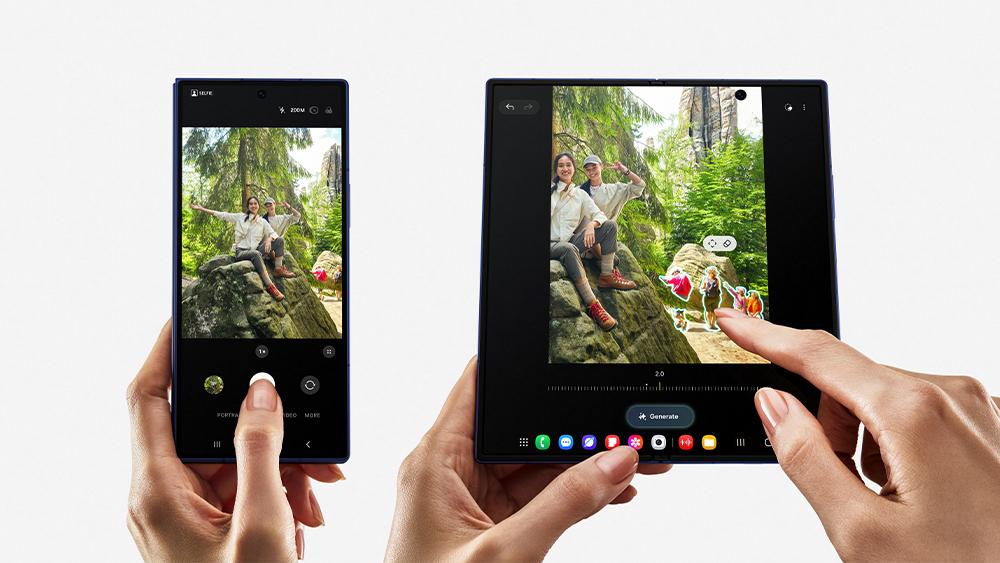
Galaxy Z Fold7 puts a pro-grade creative studio in users’ pocket, with AI-powered tools optimized for its large display. Users can capture stunning photos and videos and then edit with ease. From cleaning up clutter in product shots to removing background noise from café recordings, studio-quality enhancements can be done in a few easy steps. The intuitive and intelligent features on the Galaxy Z Fold7 make it effortless to transform photos and videos into pro-level content, with no extra tools required.
Shots look flawless with Photo Assist,12 which moves, erases or enlarges objects and adjusts angles and fills in backgrounds with AI-powered precision. Users can seize vibrant expressions, including pet profiles with Portrait Studio13 and refine their photos using Galaxy’s enhanced Generative Edit. The ability to seamlessly remove distractions and fill in backgrounds has made Generative Edit a fan favorite, and now it’s even smarter. It offers proactive suggestions with the new Suggest Erases, which automatically detects passersby with the tap of a button.
Side-by-Side Editing and Show Original enables real-time comparison of original images and edited versions on the large screen, making it easier to decide what to modify and what to keep.
Audio Eraser14 has also been upgraded to be more intelligent and convenient. There’s a new toggle in Gallery, and it now proactively detects and removes unwanted background noise like wind or traffic from video recordings.
Ultra AI Experience
The Next Era of Galaxy AI15 on the Large Screen
Galaxy Z Fold7 harnesses the power of the foldable display to amplify the power and convenience of AI, delivering experiences that are instinctive, adaptive and effortlessly efficient. With the new One UI 8 that is context-aware and naturally responsive, optimized for Galaxy Z Fold7’s flexible format and expansive screen offer a more intuitive and immersive way to interact with AI. There’s less jumping between apps and screens and more frictionless creativity and productivity happening seamlessly in one place.
Designed as a true multimodal agent, One UI 816 seamlessly combines large-screen multitasking with intelligent tools that understand what users type, say and even see. And with an AI-powered camera and privacy built into every layer, Galaxy Z Fold7 becomes a smart and secure personal assistant, ready to help anytime, anywhere.
Launching with the all-new One UI 8on Android 16, Galaxy Z Fold7 debuts Samsung’s latest AI-powered platform on foldables, delivering the latest Android experience straight out of the box.
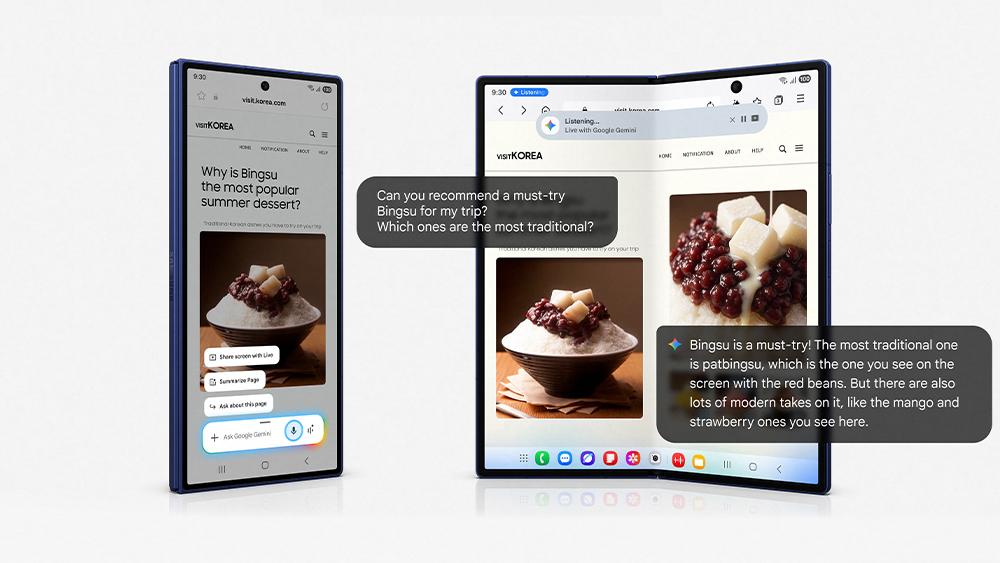
Gemini Live17 is now enhanced with multimodal AI that understands what users see, say and do, making it possible to seamlessly type or speak contextual questions and get answers without having to toggle back and forth between apps. And with screen sharing on Gemini Live or camera sharing on Gemini Live, you can simply show Gemini what users are looking at on the screen or on the camera, then ask questions to get instant insights.
With Circle to Search,18 gaming tips appear exactly when and where you need them. Just circle an item on screen and get instant results, tips or tactics in a floating view that ensures a smooth, uninterrupted experience.
With Galaxy AI Optimized for Large Screens, Galaxy Z Fold7 delivers experiences that maximize the benefits of the expansive foldable display to boost productivity. AI Results View displays results from AI features in a separate Split View or in a Floating View, so the user’s original content remains unobstructed and visible. Users can be more efficient with Drag & Drop AI-generated content, including images and text, directly from Multi Window. With tools like Drawing Assist19 or Writing Assist,20 it’s easier than ever to move ideas and visuals, enabling a smoother creative process.
Future-Ready Mobile Security
As mobile experiences grow ever more intelligent and interconnected, Samsung is reinforcing the foundations that protect them – unveiling new protections for on-device AI, expanding cross-device threat detection and enhancing network security with quantum-resistant encryption. One UI 8 brings enhanced privacy to personalized AI experiences with the new Knox Enhanced Encrypted Protection (KEEP21). KEEP creates encrypted, app-specific storage environments within the device’s secure storage area, ensuring each app can access only its own sensitive information and nothing more. With One UI 8, Samsung is advancing Knox Matrix to deliver more proactive and user-friendly protection across the Galaxy ecosystem. Furthermore, as part of its ongoing commitment to quantum-safe security, Samsung is integrating post-quantum cryptography into Secure Wi-Fi.22 This enhancement secures the key exchange process at the core of encrypted connections, helping ensure robust privacy even over public networks.
Availability & Offers
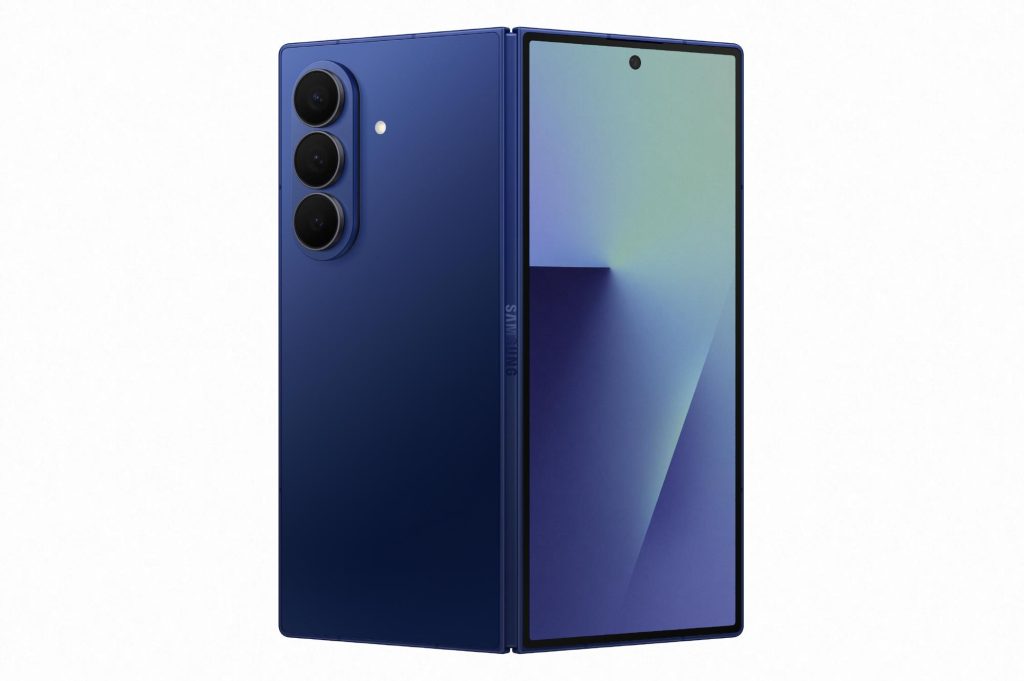
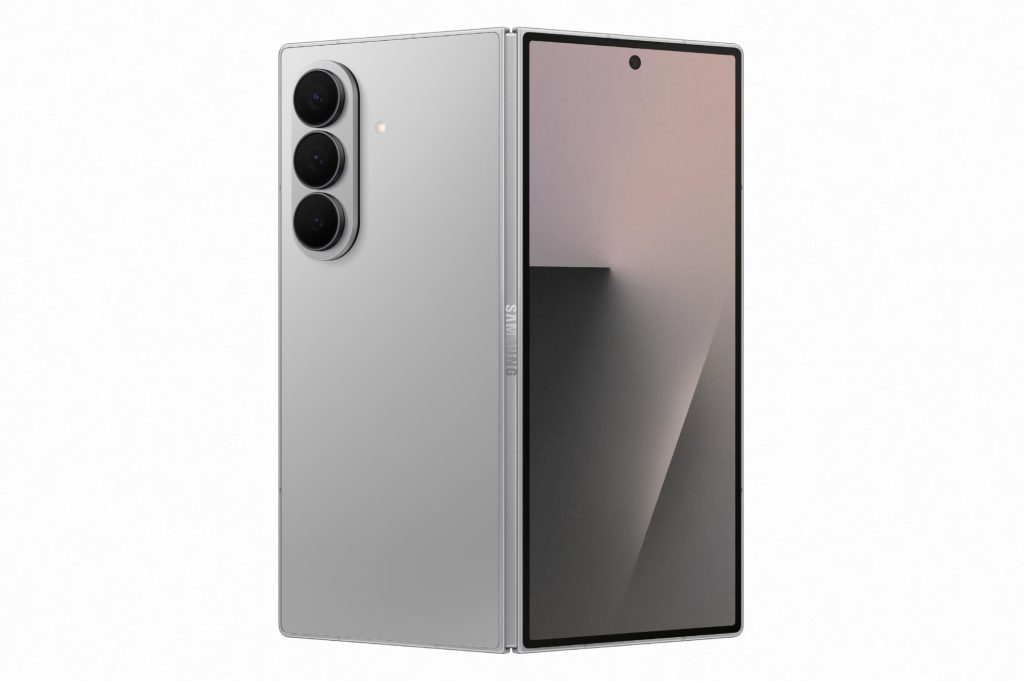
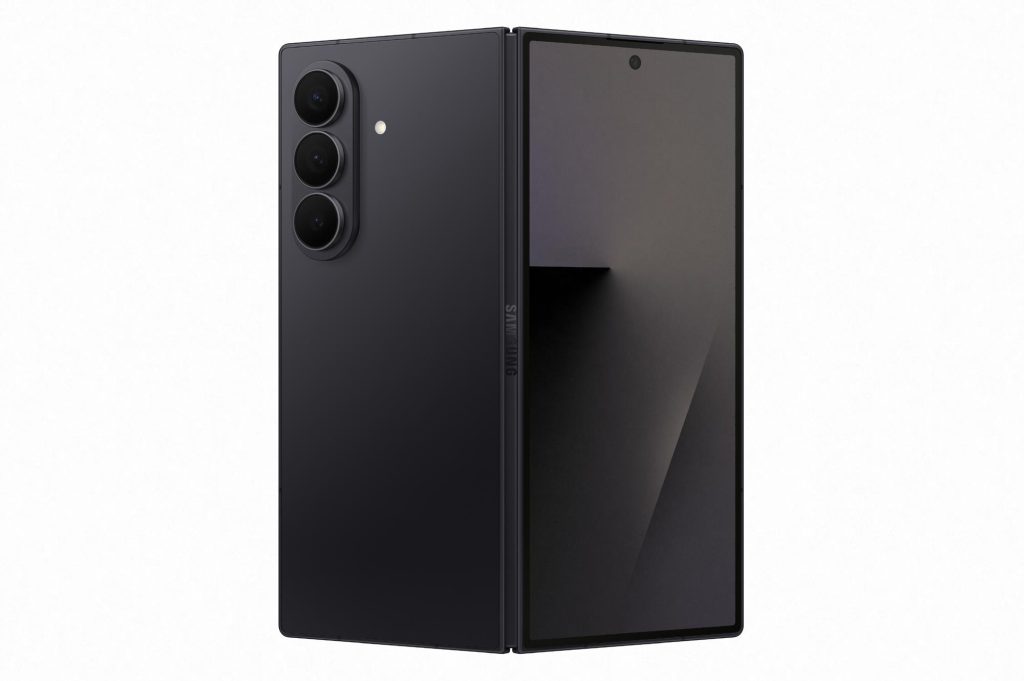
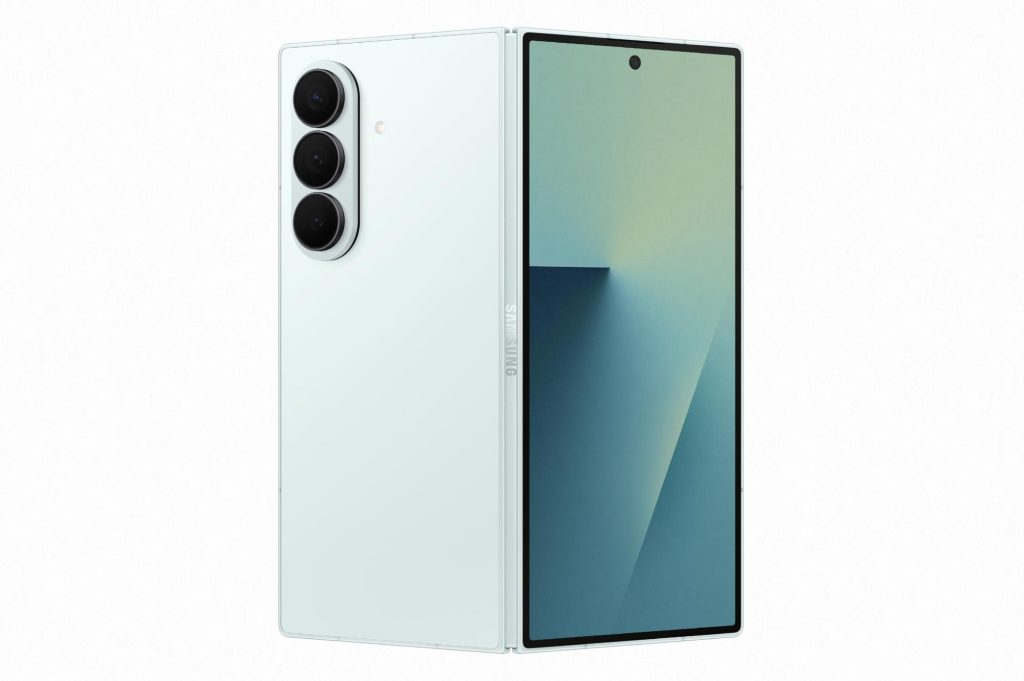
Galaxy Z Fold7 will be available for pre-order starting July 9, with general availability beginning July 25. Galaxy Z Fold7 comes in23 Blue Shadow, Silver Shadow, Jetblack and Mint24 (online exclusive) color options.
For your peace of mind, Samsung Care+25 offers comprehensive coverage for accidental damage, repairs, and replacements. Plus, for users who love having the latest technology, Samsung is introducing the New Galaxy Club.
Get expanded access to Google AI Pro26and 2TB of cloud storage for 6 months at no cost with Galaxy Z Fold7.
For more information about the Galaxy Z Fold7, Galaxy Z Flip7 and Galaxy Z Flip7 FE, please visit: Samsung Global Newsroom or Samsung.com.
*Measured diagonally, Galaxy Z Fold7’s Main Screen size is 8.0-inch in the full rectangle and 8.0-inch accounting for the rounded corners; actual viewable area is less due to the rounded corners.
*Measured diagonally, Galaxy Z Fold7’s Cover Screen size is 6.5-inch in a full rectangle and 6.5-inch accounting for the rounded corners. The actual viewable area is smaller due to the rounded corners and camera hole.
Dimension & Weight
Folded
72.8 x 158.4 x 8.9mm
*Thickness of Galaxy Z Fold7 when folded measured from top to bottom of the glasses of Galaxy Z Fold7.
Unfolded
143.2 x 158.4 x 4.2mm
*The thickness of Galaxy Z Fold7 when unfolded does not include the frame of the Main Screen.
*30X Space Zoom includes 3x Optical Zoom and 10x digital zoom with AI Super Resolution technology. Zooming in past 3x may cause some image deterioration
AP
Snapdragon® 8 Elite for Galaxy
*Snapdragon is a product of Qualcomm Technologies, Inc. and/or its subsidiaries. Snapdragon is a trademark or registered trademark of Qualcomm Incorporated.
Memory & Storage
16GB Memory with 1TB internal storage12GB Memory with 512GB internal storage12GB Memory with 256GB internal storage
*Availability may vary by market or channel. Actual storage space may vary by market, model, file size and format.
Battery
4,400mAh (typical) dual battery
*Typical value tested under third-party laboratory condition. Typical value is the estimated average value considering the deviation in battery capacity among the battery samples tested under IEC 61960 standard. Rated capacity is 4272mAh for Galaxy Z Fold7. Actual battery life may vary depending on network environment, usage patterns and other factors.
Charging
Wired Charging*: Up to 50% charge in around 30 min. with 25W Adapter** and 3A USB-C cable*** Fast Wireless Charging 2.0**** Wireless PowerShare*****
*Wired charging compatible with QC2.0 and AFC. Results from internal Samsung lab tests, conducted with 25W Travel Adapter while it has 0% of power remaining, with all the services, features and screen turned off. Actual charging speed may vary depending on the actual usage, charging conditions and other factors.**25W Power Adapter sold separately. Use only Samsung-approved chargers and cables.***Wireless charging compatible with WPC.****Wireless PowerShare is limited to Samsung or other brand smartphones with WPC Qi wireless charging, such as Galaxy Z Fold7, Z Flip6, Galaxy Z Fold5, Z Flip5, Galaxy Z Fold4, Z Flip4, S22 series, Z Fold3 5G, Z Flip3 5G, S21 FE 5G, S21 series, Z Fold2, Note20 series, S20 series, Z Flip, Note10 series, S10 series, S9 series, S8 series, S7 series, S6 series, Note9, Note8, Note FE, Note5, and wearables such as Galaxy Buds2 Pro, Buds2, Buds Pro, Buds Live, Watch6, Watch6 Classic, Watch5, Watch5 Pro, Watch4, Watch4 Classic, Watch3, Watch Active2, Watch Active, Gear Sport, Gear S3, Galaxy Watch, and Galaxy Buds. May not work with certain accessories, covers, or other brand devices. May affect call reception or data services, depending on your network environment.
Water Resistance
IP48
*Based on lab test conditions for submersion in up to 1.5 meters of freshwater for up to 30 minutes. Not advised for beach or pool use. Rinse residue/dry if wet. Water resistance of device is not permanent and may diminish over time because of normal wear and tear.
Glass/Metal
Cover
Corning® Gorilla® Glass Ceramic 2
Back
Corning® Gorilla® Glass Victus® 2
Frame
Advanced Armor Aluminum
OS
Android 16One UI 8
Network & Connectivity
5G*, LTE**, Wi-Fi 7***, Bluetooth® v5.4
*Requires optimal 5G network connection, available in select markets. Check with your carrier for availability and details. Download and streaming speeds may vary based on content provider, server connection and other factors.**Availability of LTE model varies by market and carrier. Actual speed may vary depending on market, carrier, and user environment.***Wi-Fi 7 network availability may vary by market, network provider and user environment. Requires optimal connection and a Wi-Fi 7 router.
*SIM card sold separately. Availability may vary depending on market and carrier.**eSIM availability may vary depending on software version, region and carrier. Check with your carrier if your mobile network plan supports eSIM.
Colors
Blue Shadow, Silver Shadow, Jet-black* [Samsung.com Exclusive] Mint**
*Availability of color may vary by market, region or carrier.**Online exclusive colors only available on Samsung.com.
1 Weight may vary by country or region. 2 The thickness of Galaxy Z Fold7 when unfolded does not include the frame of the Main Screen. 3 Measured diagonally, Galaxy Z Fold7’s Cover Screen size is 6.5-inch in the full rectangle and 6.5-inch accounting for the rounded corners; actual viewable area is smaller due to the rounded corners and camera hole. 4 Compared to previous Galaxy Z Fold series. 5 Measured diagonally, Galaxy Z Fold7’s Main Screen size is 8.0-inch in the full rectangle and 8.0-inch accounting for the rounded corners; actual viewable area is less due to the rounded corners. 6 Compared to previous Galaxy Z Fold series. 7 Corning® Gorilla® Glass Ceramic 2 is applied to the front of the device and Corning® Gorilla® Glass Victus® 2 is applied to the rear. 8 Advanced Armor Aluminum frame does not include volume and side keys, SIM tray or camera lens barrel. 9 Snapdragon branded products are products of Qualcomm Technologies, Inc. and/or its subsidiaries. 10 AP performance improvements shown compared to Galaxy Z Fold6. Actual performance will depend on user environment, conditions and pre-installed software and applications. 11 Results may vary depending on shooting conditions including multiple subjects, being out of focus or moving subjects. 12 Generative Edit feature for Photo Assist requires a network connection and Samsung Account login. Editing with Generative Edit may result in a resized photo. A visible watermark is overlaid on the image output upon saving in order to indicate that the image is generated by AI. The accuracy and reliability of the generated output is not guaranteed. 13 Portrait Studio feature for Photo Assist requires a network connection and Samsung Account login. Editing with Portrait Studio results in a resized photo. A visible watermark is overlaid on the image output upon saving in order to indicate that the image is generated by AI. The accuracy and reliability of the generated output is not guaranteed. 14 Audio Eraser results may vary per video depending on how sounds present in the video. Samsung Account login required. Certain types of sound can be detected such as voices, music, wind, nature, crowd and noise. Compatible with common video/audio formats accessible in Gallery, Samsung Notes, Video Player, Voice Recorder, Call transcription. The actual sound detection may vary depending on audio source, and the condition of the video. Accuracy of results is not guaranteed. 15 Samsung Account login may be required to use certain AI features. Samsung does not make any promises, assurances or guarantees as to the accuracy, completeness or reliability of the output provided by AI features. Availability of Galaxy AI features may vary depending on the region/country, OS/One UI version, device model and phone carrier. 16 Some functional widgets may require a network connection and/or Samsung Account login. Availability of functions supported within the apps may vary by country. 17 Gemini is a trademark of Google LLC. Results for illustrative purposes. Gemini Live feature requires internet connection and Google Account login. Service availability may vary by country, language, device model. Features may differ depending on subscription and results may vary. Compatible with certain features and certain accounts. Currently, you can use a personal Google Account that you manage on your own, or a work or school account for which your administrator has enabled access to Gemini. You must be 13 (or the applicable age in your country) or over to use Gemini with a personal or school Google Account and 18 or over to use Gemini with a work account. 18 Circle to Search is a trademark of Google LLC. Sequences shortened and simulated. Results for illustrative purposes only. Service availability may vary by country, language, device model. Requires internet connection. Users may need to update Android and Google app to the latest version. Works on compatible apps and surfaces. Results may vary depending on visual matches. Accuracy of results is not guaranteed. 19 Drawing assist feature requires a network connection and Samsung Account login. A visible watermark is overlaid on the image output upon saving in order to indicate that the image is generated by AI. The accuracy and reliability of the generated output is not guaranteed. Drawing assist feature requires a network connection and Samsung Account login. A visible watermark is overlaid on the image output upon saving in order to indicate that the image is generated by AI. The accuracy and reliability of the generated output is not guaranteed. 20 Writing Assist requires a network connection and Samsung Account login. Must meet length requirements to activate feature. Service availability may vary by language. Accuracy of results is not guaranteed. 21 Available on Galaxy smartphones and tablets with One UI 8 or later. 22 Secure Wi-Fi offers free protection of up to 1024MB per month for Android OS 13 or later, and 250MB per month for Android OS 12 or earlier versions. Availability details may vary by market or network provider and connectivity is subject to applicable network environments. 23 Color availability may vary depending on country or carrier. 24 Exclusively available on Samsung.com 25 Terms and conditions apply. Samsung Care+ coverage, service type and promotion details may vary by country/region and deductible (service fee) may apply. To be eligible for Samsung Care+ promotion benefit, registration may be required. For detailed Samsung Care+ information, please visit https://www.samsung.com/samsung-care-plus/. 26 Google AI Pro is a trademark of Google LLC. Google AI Pro and Gemini for Gmail, Docs, and more are only available for ages 18+. Gemini for Gmail, Docs and more is available in select languages. Rate limits may apply.
The possibility of terraforming Mars to make it habitable by humans has captured recent headlines and the imagination — but is there science to support it? In a recent perspective paper in Nature Astronomy, a team of planetary scientists, led by Pioneer Research Labs and the University of Chicago, look at what would be needed to make the Martian surface environment more Earth-like — and what needs to be done now if there’s a hope of the Red Planet someday being able to sustain human life.
“Believe it or not, no one has really addressed whether it’s feasible to terraform Mars since 1991,” said Nina Lanza, a planetary scientist at Los Alamos National Laboratory and a co-author on the paper. “Yet since then, we’ve made great strides in Mars science, geoengineering, launch capabilities and bioscience, which give us a chance to take a fresh look at terraforming research and ask ourselves what’s actually possible.”
Terraforming Mars would require warming the atmosphere to enable engineered microbes to create oxygen through photosynthesis, which would further allow for slow oxygen build-up to support liquid water and more complex life. “Before we can assess whether warming Mars is worthwhile, relative to the alternative of leaving Mars as a pristine wilderness, we must confront the practical requirements, cost, and possible risks,” the authors write.
The article addresses current knowledge of Mars’ water, carbon dioxide and soil composition, and possible approaches to warming the surface temperature of Mars and raising atmospheric pressure and oxygen abundance. New techniques have emerged that could raise Mars’ average global temperature by tens of degrees within a few decades. Research priorities can focus on understanding fundamental physical, chemical, and biological constraints that will shape any future decisions about Mars. Such research would drive advances in Mars exploration, bioscience, and atmospheric engineering.
The authors also note that this research could ultimately help maintain “oasis Earth.” They argue that technologies developed for Mars habitation, such as desiccation-resistant crops, efficiently remediating soil, and improved ecosystem modeling, will likely benefit our home planet.
“Mars terraforming research offers a vital testbed for planetary science, potentially validating theories or exposing knowledge gaps,” they write. “Continued research promises significant scientific progress, regardless of whether full-scale terraforming occurs.”
Until that research is done, they write, “We don’t even know what’s physically or biologically possible. … If people can learn how to terraform a world such as Mars, this may be the first step to destinations beyond.”
Paper: “The case for Mars terraforming research.” Nature Astronomy. DOI: 10.1038/s41550-025-02548-0
LA-UR-25-24029
Originally published at: Los Alamos National Laboratory
If the smoldering heat is bothering you, better make some plans for some quality time spending with family or friends. A camping trip on the nearest national park, official camp sites, or wild camping is another activity you can enjoy. Bonding with nature to cool off your head and release some pent up stress through fishing and other calming or even exciting recreation are some of the things you can do.
Readiness
While we mentioned that you should be aware of the weather, announcements on the location along with who you are going with in our previous posts. Here are some additional things you should consider.
Availability – Make sure camping is allowed in your chosen location. Some areas have designated camping zones for your safety and to protect the local wildlife
Rules and regulations – Campfires on some location are banned. Check with the local authorities or management.
Wildlife Awareness – Being aware that there could possibly be bears or aggressive birds in the area you should prepare for these wildlife animals
Don’t feed wild animals. Doing so can encourage them to approach campsites, which may lead to dangerous encounters for both you and the animals
Store your food in lockers or containers or wild animals like bears can trace it back to your camp
Waste Management – If you need to dispose of trash in the area, ensure it’s biodegradable and eco-friendly. Ideally, take your waste with you to minimize environmental impact.
Gear
As with any adventure, a backpack or backpacks is essential. It would be hard to survive or enjoy if carrying all your supply and equipment with just a shopping bag. While that is still possible.
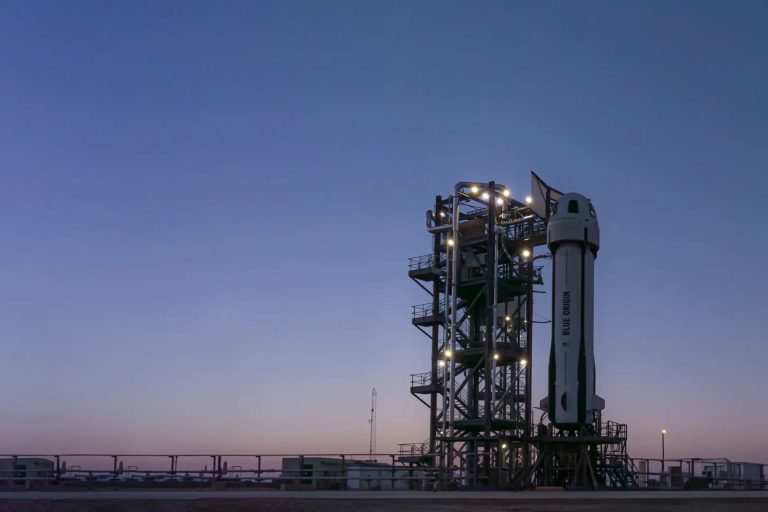
Blue Origin announced its next New Shepard crewed flight, NS-33, will lift off from Launch Site One in West Texas on Saturday, June 21. The launch window opens at 8:30 AM CDT / 13:30 UTC. The webcast on BlueOrigin.com will start at T-30 minutes.
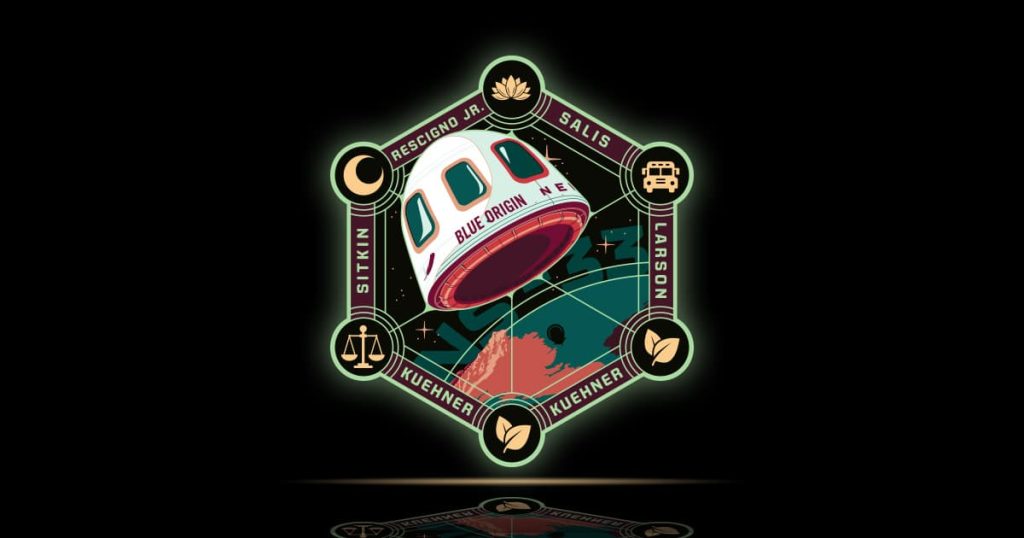
The mission patch for NS-33.
Additionally, Blue Origin released the NS-33 mission patch. A few of the symbols embedded include:
The leaves symbolize Allie and Carl Kuehner’s commitment to environmental stewardship.
The school bus symbolizes Leland Larson’s family businesses.
The Moon symbolizes Freddie Rescigno, Jr.’s passion for archeological discoveries.
The scales of justice represent Jim Sitkin’s work in employment law.
The lotus flower symbolizes Owolabi Salis’ spiritual journey.
Each symbol is connected to the Crew Capsule by a thin green line representing each crew member’s unique journey.
There are two green lines circling Earth. The first represents the horizon and the second represents the Kármán line.
For more information on the crew, please see our previous blog post below.
Conservationists Join Blue Origin’s Next New Shepard Flight, NS-33
June 13, 2025
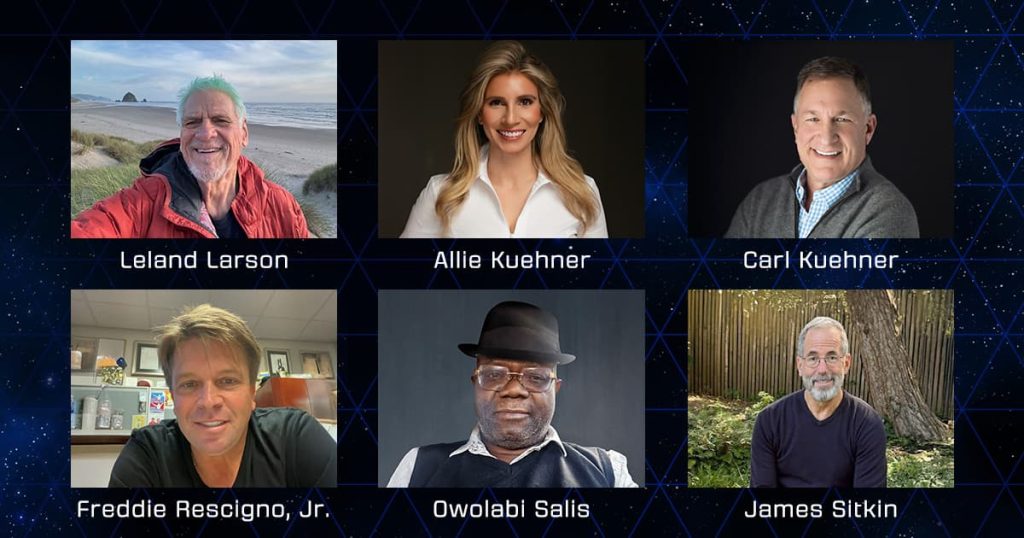
Blue Origin today announced the six people flying on its NS-33 mission. The crew includes: Allie Kuehner and her husband, Carl Kuehner, Leland Larson, Freddie Rescigno, Jr., Owolabi Salis, and James (Jim) Sitkin.
This mission is the 13th human flight for the New Shepard program and the 33rd in its history. The flight date will be announced soon. On launch day, the live webcast will start 30 minutes before liftoff.
Meet the Crew
Allie Kuehner
Allie is an environmentalist and dedicated conservationist with a passion for protecting natural ecosystems and wildlife for future generations. She serves on the board of Nature is Nonpartisan, a nonprofit organization advocating for bipartisan solutions to environmental challenges. Allie is an avid adventurer and explorer driven by a profound respect for nature and a desire to experience the wild places they work to protect. From remote landscapes to rugged terrain, she believes that firsthand exploration strengthens the case for thoughtful environmental stewardship.
Carl Kuehner
Carl serves as Chairman of Building and Land Technology (BLT), a real estate development, investment, and property management firm dedicated to building communities and ecosystems that promote long-term growth and sustainability. Under his leadership, BLT has redefined urban development by integrating innovative design with a deep commitment to environmental responsibility and community impact. Deeply committed to conservation, Carl champions efforts to sustain, restore, and enhance wildlife and natural habitats, sustainable food systems, and environmental restoration projects through business strategy and philanthropic initiatives. His work reflects a belief that responsible development and social stewardship go hand in hand, creating a legacy that balances progress with purpose.
Leland Larson
Leland is a philanthropist and former CEO of School Bus Services, Inc. and Larson Transportation Services. Both are family-owned businesses based in Oregon focused on public transportation systems regionally and nationally. In 1997, Leland co-founded the Larson Legacy, a philanthropic foundation focused on supporting hundreds of progressive nonprofits domestically and internationally. Early in his career, Leland was a teacher, worked in the Army counseling soldiers on their educational aspirations, and served as a Delegate to the Constitutional Convention of 1968, which wrote the present-day Constitution of Hawaii. Leland is a passionate gardener and beekeeper, raises koi fish and chickens, and cherishes spending time with monks in the high mountains of Tibet.
Freddie Rescigno, Jr.
Freddie is an Italian-American entrepreneur, business owner, and competitive golfer based in Suwanee, Georgia. He is President and CEO of Commodity Cables, a company he founded in 2001 that services the electrical distribution market for wire and cable needs. His passion for archeological discoveries is at the heart of his interest in space. A lifelong golfer, Freddie has competed as an amateur at the state and national levels for 20 years. He is a father of three boys, who have inherited his same love for golf and Italian culture.
Owolabi Salis
Owolabi is an attorney and a financial consultant. He is the author of Equitocracy, which presents a vision for democracy that prioritizes equity among diverse groups. Owolabi is also a key member of The Soul Maker Ministry, which preaches diversity given the diverse nature of the universe. He is dedicating this mission to victims of discrimination and civil rights violations.
Jim Sitkin
Jim practiced law in California for four decades before retirement. His expertise focused on employment class actions on behalf of non-unionized employees, challenging industries that traditionally had rejected application of various employee protections. Jim is a volunteer for a global NGO, facilitating meetings with government and community leaders in Central Europe and sub-Saharan Africa. A lifelong adventurer, Jim has explored seven continents and has dreamt of space since he was a child growing up watching Star Trek. Jim and his wife, Sue, live in California with their very fat cat, Hickory.
Follow Blue Origin on X, Instagram, Facebook, LinkedIn, Threads, and YouTube, and sign up on BlueOrigin.com to stay current on all mission details.
New Shepard Astronauts by Mission
To date, the program has flown 64 humans and more than 175 scientific payloads above the Kármán line, the internationally recognized boundary of space. Blue Origin astronauts include:
NS-32 (May 31, 2025): K-12 STEM teacher Aymette Medina Jorge; radiologist and explorer Dr. Gretchen Green; former Panamanian ambassador to the United States Jaime Alemán; entrepreneur Jesse Williams; aerospace executive Mark Rocket; and entrepreneur Paul Jeris.
NS-31 (April 14, 2025): Entrepreneur and global STEM advocate Aisha Bowe; bioastronautics research scientist and civil rights activist Amanda Nguyễn; CBS Mornings co-host and Oprah Daily editor-at-large Gayle King; global pop superstar Katy Perry; film producer Kerianne Flynn; and New York Times bestselling author, pilot, and philanthropist Lauren Sánchez.
NS-30 (February 25, 2025): Entrepreneur Elaine Hyde; Spanish adventurer and TV host Jesús Calleja; Bess Ventures Founder and NS-19 Astronaut Lane Bess; reproductive endocrinologist Dr. Richard Scott; quantitative researcher Tushar Shah; and an undisclosed sixth crew member.
NS-28 (November 22, 2024): Business professional Austin Litteral; MIT engineer and TV host Emily Calandrelli; Bayshore Capital CEO Henry Wolfond; entrepreneur James (J.D.) Russell; and philanthropists Sharon Hagle and her husband, Marc, who both previously flew on NS-20.
NS-26 (August 29, 2024): Cardiologist Dr. Eiman Jahangir; entrepreneur Ephraim Rabin; entrepreneur Eugene Grin; Orbitelle founder Karsen Kitchen; entrepreneur Nicolina Elrick; and University of Florida Professor Rob Ferl.
NS-25 (May 19, 2024): Retired CPA Carol Schaller; former Air Force Captain and first Black astronaut candidate Ed Dwight; pilot Gopi Thotakura; Family Tree Maker founder Ken Hess; Industrious Ventures investor Mason Angel; and French entrepreneur Sylvain Chiron.
NS-22 (August 4, 2022): Technology leader Clint Kelly III; Dude Perfect cofounder Coby Cotton; Portuguese entrepreneur Mário Ferreira; Egyptian mechanical and biomedical engineer Sara Sabry; telecommunications executive Steve Young; and British-American mountaineer Vanessa O’Brien.
NS-21 (June 4, 2022): Investor and NS-19 Astronaut Evan Dick; pilot and Action Aviation Chairman Hamish Harding; adventurer and Dream Variation Ventures Co-Founder Jaison Robinson; electrical engineer and former NASA test lead Katya Echazarreta; civil production engineer Victor Correa Hespanha; and Insight Equity Founder and explorer Victor Vescovo, Commander, USN (Ret.).
NS-20 (March 31, 2022): New Shepard Chief Architect Gary Lai; president of Commercial Space Technologies, LLC, and former associate administrator for the Federal Aviation Administration Office of Commercial Space Transportation Dr. George Nield; entrepreneur and adventurer Jim Kitchen; real estate executive Marc Hagle; executive and investor Marty Allen; and SpaceKids Global Founder Sharon Hagle.
NS-19 (December 11, 2021): Content creator Cameron Bess, space industry executive and philanthropist Dylan Taylor; investor Evan Dick; Bess Ventures Founder Lane Bess; the eldest daughter of Alan Shepard, the first American to fly to space, and the namesake of New Shepard Laura Shepard Churchley, and Good Morning America host Michael Strahan.
NS-18 (October 13, 2021): Blue Origin’s Vice President, New Shepard Mission & Flight Operations Audrey Powers; entrepreneur and Planet Labs Co-Founder Dr. Chris Boshuizen; entrepreneur Glen de Vries; and actor William Shatner.
NS-16 (July 20, 2021): Blue Origin founder Jeff Bezos; volunteer firefighter and co-founder of HighPost Capital Mark Bezos; student Oliver Daemen; and aviator Wally Funk.