
Home Blog Page 7

New Shepard’s Crewed NS-33 Mission Targets Liftoff on Saturday, June 21

0

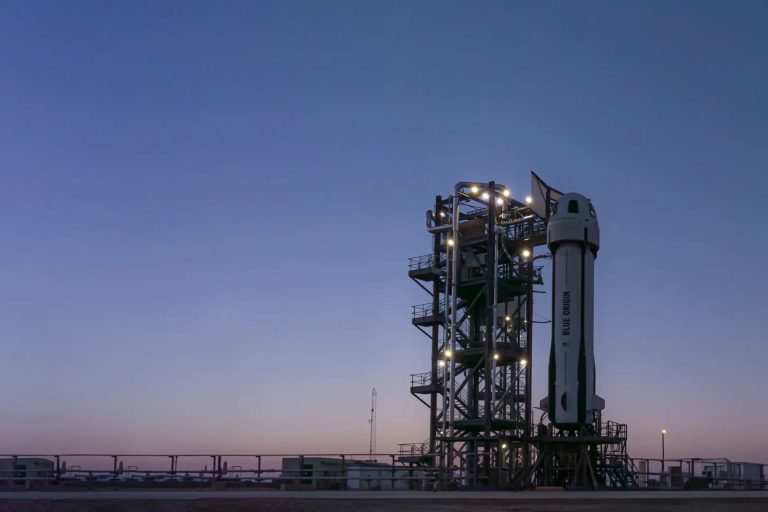
Blue Origin announced its next New Shepard crewed flight, NS-33, will lift off from Launch Site One in West Texas on Saturday, June 21. The launch window opens at 8:30 AM CDT / 13:30 UTC. The webcast on BlueOrigin.com will start at T-30 minutes.
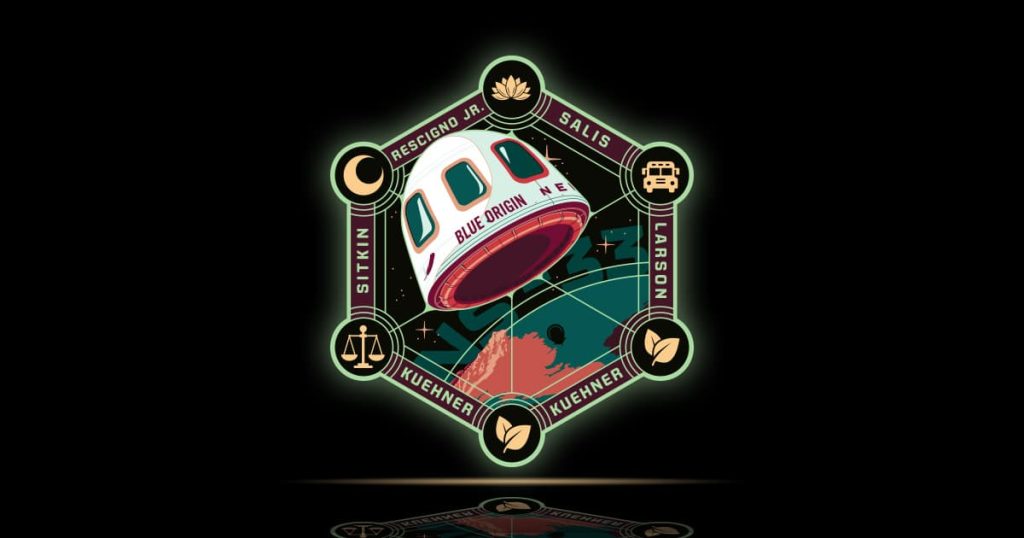
The mission patch for NS-33.

Additionally, Blue Origin released the NS-33 mission patch. A few of the symbols embedded include: 

  • The leaves symbolize Allie and Carl Kuehner’s commitment to environmental stewardship. 
  • The school bus symbolizes Leland Larson’s family businesses. 
  • The Moon symbolizes Freddie Rescigno, Jr.’s passion for archeological discoveries. 
  • The scales of justice represent Jim Sitkin’s work in employment law. 
  • The lotus flower symbolizes Owolabi Salis’ spiritual journey. 
  • Each symbol is connected to the Crew Capsule by a thin green line representing each crew member’s unique journey. 
  • There are two green lines circling Earth. The first represents the horizon and the second represents the Kármán line. 

For more information on the crew, please see our previous blog post below. 

Conservationists Join Blue Origin’s Next New Shepard Flight, NS-33

June 13, 2025

Blue Origin today announced the six people flying on its NS-33 mission. The crew includes: Allie Kuehner and her husband, Carl Kuehner, Leland Larson, Freddie Rescigno, Jr., Owolabi Salis, and James (Jim) Sitkin. 

This mission is the 13th human flight for the New Shepard program and the 33rd in its history. The flight date will be announced soon. On launch day, the live webcast will start 30 minutes before liftoff. 

Meet the Crew 

Allie Kuehner 

Allie is an environmentalist and dedicated conservationist with a passion for protecting natural ecosystems and wildlife for future generations. She serves on the board of Nature is Nonpartisan, a nonprofit organization advocating for bipartisan solutions to environmental challenges. Allie is an avid adventurer and explorer driven by a profound respect for nature and a desire to experience the wild places they work to protect. From remote landscapes to rugged terrain, she believes that firsthand exploration strengthens the case for thoughtful environmental stewardship. 

Carl Kuehner 

Carl serves as Chairman of Building and Land Technology (BLT), a real estate development, investment, and property management firm dedicated to building communities and ecosystems that promote long-term growth and sustainability. Under his leadership, BLT has redefined urban development by integrating innovative design with a deep commitment to environmental responsibility and community impact. Deeply committed to conservation, Carl champions efforts to sustain, restore, and enhance wildlife and natural habitats, sustainable food systems, and environmental restoration projects through business strategy and philanthropic initiatives. His work reflects a belief that responsible development and social stewardship go hand in hand, creating a legacy that balances progress with purpose. 

Leland Larson  

Leland is a philanthropist and former CEO of School Bus Services, Inc. and Larson Transportation Services. Both are family-owned businesses based in Oregon focused on public transportation systems regionally and nationally. In 1997, Leland co-founded the Larson Legacy, a philanthropic foundation focused on supporting hundreds of progressive nonprofits domestically and internationally. Early in his career, Leland was a teacher, worked in the Army counseling soldiers on their educational aspirations, and served as a Delegate to the Constitutional Convention of 1968, which wrote the present-day Constitution of Hawaii. Leland is a passionate gardener and beekeeper, raises koi fish and chickens, and cherishes spending time with monks in the high mountains of Tibet.   

Freddie Rescigno, Jr. 

Freddie is an Italian-American entrepreneur, business owner, and competitive golfer based in Suwanee, Georgia. He is President and CEO of Commodity Cables, a company he founded in 2001 that services the electrical distribution market for wire and cable needs. His passion for archeological discoveries is at the heart of his interest in space. A lifelong golfer, Freddie has competed as an amateur at the state and national levels for 20 years. He is a father of three boys, who have inherited his same love for golf and Italian culture.    

Owolabi Salis 

Owolabi is an attorney and a financial consultant. He is the author of Equitocracy, which presents a vision for democracy that prioritizes equity among diverse groups. Owolabi is also a key member of The Soul Maker Ministry, which preaches diversity given the diverse nature of the universe. He is dedicating this mission to victims of discrimination and civil rights violations.  

Jim Sitkin 

Jim practiced law in California for four decades before retirement. His expertise focused on employment class actions on behalf of non-unionized employees, challenging industries that traditionally had rejected application of various employee protections. Jim is a volunteer for a global NGO, facilitating meetings with government and community leaders in Central Europe and sub-Saharan Africa. A lifelong adventurer, Jim has explored seven continents and has dreamt of space since he was a child growing up watching Star Trek. Jim and his wife, Sue, live in California with their very fat cat, Hickory. 

Follow Blue Origin on X, Instagram, Facebook, LinkedIn, Threads, and YouTube, and sign up on BlueOrigin.com to stay current on all mission details. 

New Shepard Astronauts by Mission 

To date, the program has flown 64 humans and more than 175 scientific payloads above the Kármán line, the internationally recognized boundary of space. Blue Origin astronauts include:    

  • NS-32 (May 31, 2025): K-12 STEM teacher Aymette Medina Jorge; radiologist and explorer Dr. Gretchen Green; former Panamanian ambassador to the United States Jaime Alemán; entrepreneur Jesse Williams; aerospace executive Mark Rocket; and entrepreneur Paul Jeris. 
  • NS-31 (April 14, 2025): Entrepreneur and global STEM advocate Aisha Bowe; bioastronautics research scientist and civil rights activist Amanda Nguyễn; CBS Mornings co-host and Oprah Daily editor-at-large Gayle King; global pop superstar Katy Perry; film producer Kerianne Flynn; and New York Times bestselling author, pilot, and philanthropist Lauren Sánchez.  
  • NS-30 (February 25, 2025): Entrepreneur Elaine Hyde; Spanish adventurer and TV host Jesús Calleja; Bess Ventures Founder and NS-19 Astronaut Lane Bess; reproductive endocrinologist Dr. Richard Scott; quantitative researcher Tushar Shah; and an undisclosed sixth crew member.  
  • NS-28 (November 22, 2024): Business professional Austin Litteral; MIT engineer and TV host Emily Calandrelli; Bayshore Capital CEO Henry Wolfond; entrepreneur James (J.D.) Russell; and philanthropists Sharon Hagle and her husband, Marc, who both previously flew on NS-20.  
  • NS-26 (August 29, 2024): Cardiologist Dr. Eiman Jahangir; entrepreneur Ephraim Rabin; entrepreneur Eugene Grin; Orbitelle founder Karsen Kitchen; entrepreneur Nicolina Elrick; and University of Florida Professor Rob Ferl.  
  • NS-25 (May 19, 2024): Retired CPA Carol Schaller; former Air Force Captain and first Black astronaut candidate Ed Dwight; pilot Gopi Thotakura; Family Tree Maker founder Ken Hess; Industrious Ventures investor Mason Angel; and French entrepreneur Sylvain Chiron.  
  • NS-22 (August 4, 2022): Technology leader Clint Kelly III; Dude Perfect cofounder Coby Cotton; Portuguese entrepreneur Mário Ferreira; Egyptian mechanical and biomedical engineer Sara Sabry; telecommunications executive Steve Young; and British-American mountaineer Vanessa O’Brien.  
  • NS-21 (June 4, 2022): Investor and NS-19 Astronaut Evan Dick; pilot and Action Aviation Chairman Hamish Harding; adventurer and Dream Variation Ventures Co-Founder Jaison Robinson; electrical engineer and former NASA test lead Katya Echazarreta; civil production engineer Victor Correa Hespanha; and Insight Equity Founder and explorer Victor Vescovo, Commander, USN (Ret.).  
  • NS-20 (March 31, 2022): New Shepard Chief Architect Gary Lai; president of Commercial Space Technologies, LLC, and former associate administrator for the Federal Aviation Administration Office of Commercial Space Transportation Dr. George Nield; entrepreneur and adventurer Jim Kitchen; real estate executive Marc Hagle; executive and investor Marty Allen; and SpaceKids Global Founder Sharon Hagle.  
  • NS-19 (December 11, 2021): Content creator Cameron Bess, space industry executive and philanthropist Dylan Taylor; investor Evan Dick; Bess Ventures Founder Lane Bess; the eldest daughter of Alan Shepard, the first American to fly to space, and the namesake of New Shepard Laura Shepard Churchley, and Good Morning America host Michael Strahan.  
  • NS-18 (October 13, 2021): Blue Origin’s Vice President, New Shepard Mission & Flight Operations Audrey Powers; entrepreneur and Planet Labs Co-Founder Dr. Chris Boshuizen; entrepreneur Glen de Vries; and actor William Shatner.  
  • NS-16 (July 20, 2021): Blue Origin founder Jeff Bezos; volunteer firefighter and co-founder of HighPost Capital Mark Bezos; student Oliver Daemen; and aviator Wally Funk.


A Father’s Day Gift for Every Pop and Papa

0

It’s Father’s day and also Men’s Health Month. What better way to appreciate these than take care of our dear father (or father figure). There are many ways to show appreciation, from thoughtful gifts and going far beyond.

Power Tools

While most likely they have one of these and will be reluctant to replace what they already have. Power tools are a safe choice, specially if their tools are already worn out. But in all seriousness, even if worn out, I’d still use my old trusty toolset. Just in case though.

Headphones

Entertainment or listening to music is a past time most will understand. Whether it’s tuning in to your favorite podcast to instrumentals that lets you focus. A good pair of Bluetooth headphones is recommended. Aside from giving much mobility and not being restricted to the length of the wires, the quality of these portable boom box are something you can’t deny.

Dashcam

A huge hole in your vehicle security if you don’t have one. In today’s standard a dashcam is just as important as insurance, probably even more. It has the power to protect you from “crash-for-cash” scam, accident evidence and an overall monitoring for your ride. If your father doesn’t have one yet, this will be a perfect present already.

Chiller

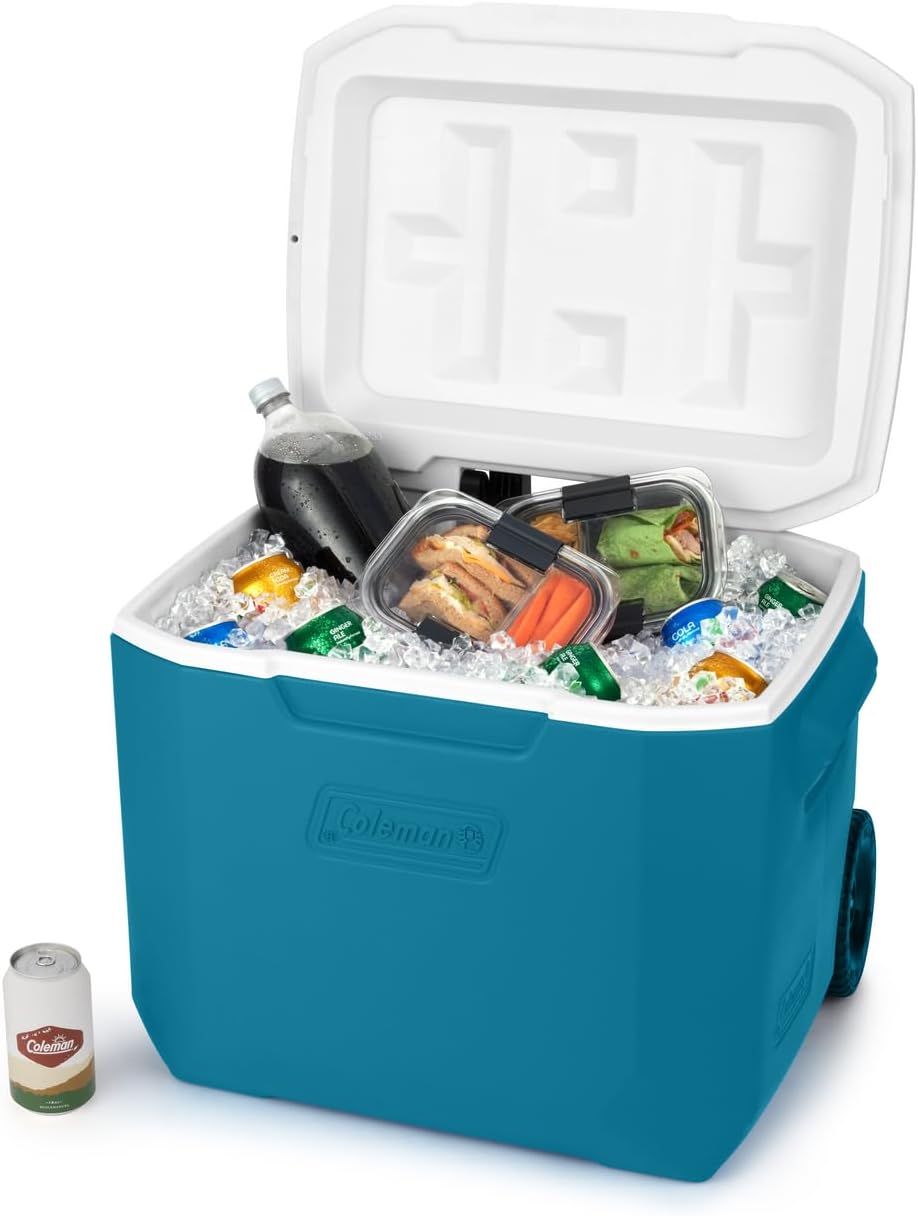
Let’s be honest here. Sometimes all we want is a little peace and a cold drink. A gift like a comfy chair, a quiet spot and a few frosty brews. Just make sure there’s a chiller nearby to keep the moment going.

Quality Time

Spending some quality time with your father or parents in general is always (almost) a welcome one. A visit with food in tow is one thing you could do. While a surprise visit might be an inconvenience for some, you might want to give a heads-up.

Cheers to all the fathers and father-figure out there!

Future Engineers Shine at NASA’s 2025 Lunabotics Robotics Competition

0

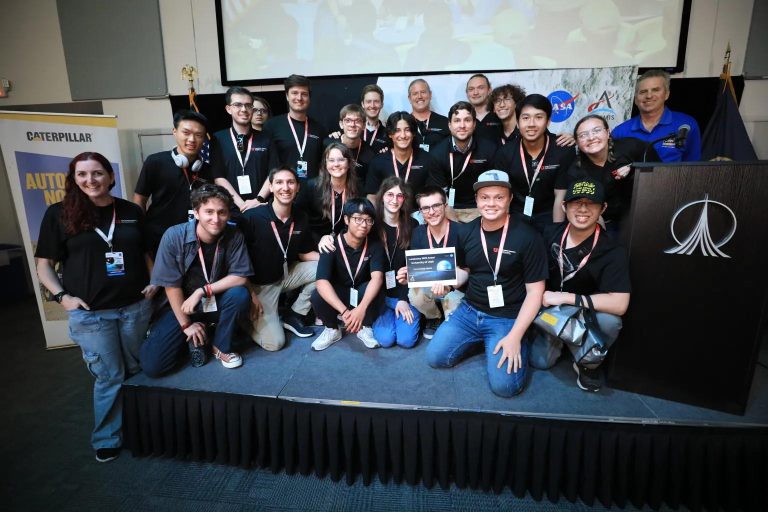
And the winner is… the University of Utah in Salt Lake City. The Utah Student Robotics Club won the grand prize Artemis Award on May 22 for NASA’s 2025 Lunabotics Challenge held at The Astronauts Memorial Foundation’s Center for Space Education at the Kennedy Space Center Visitor Complex in Florida. 

“Win was our motto for the whole year,” said Brycen Chaney, University of Utah, president of student robotics. “We had a mission objective to take our team and competition a step further, but win was right up front of our minds.”

Lunabotics is an annual challenge where students design and build an autonomous and remote-controlled robot to navigate the lunar surface in support of the Artemis campaign. The students from the University of Utah used their robot to excavate simulated regolith, the loose, fragmented material on the Moon’s surface, as well as built a berm. The students, who competed against 37 other teams, won grand prize for the first time during the Lunabotics Challenge.

“During the 16th annual Lunabotics University Challenge the teams continued to raise the bar on excavating, transporting, and depositing lunar regolith simulant with clever remotely controlled robots,” said Robert Mueller, senior technologist at NASA Kennedy for Advanced Products Development in the agency’s Exploration Research and Technology Programs Directorate, and lead judge and co-founder of the original Lunabotics robotic mining challenge. “New designs were revealed, and each team had a unique design and operations approach.”

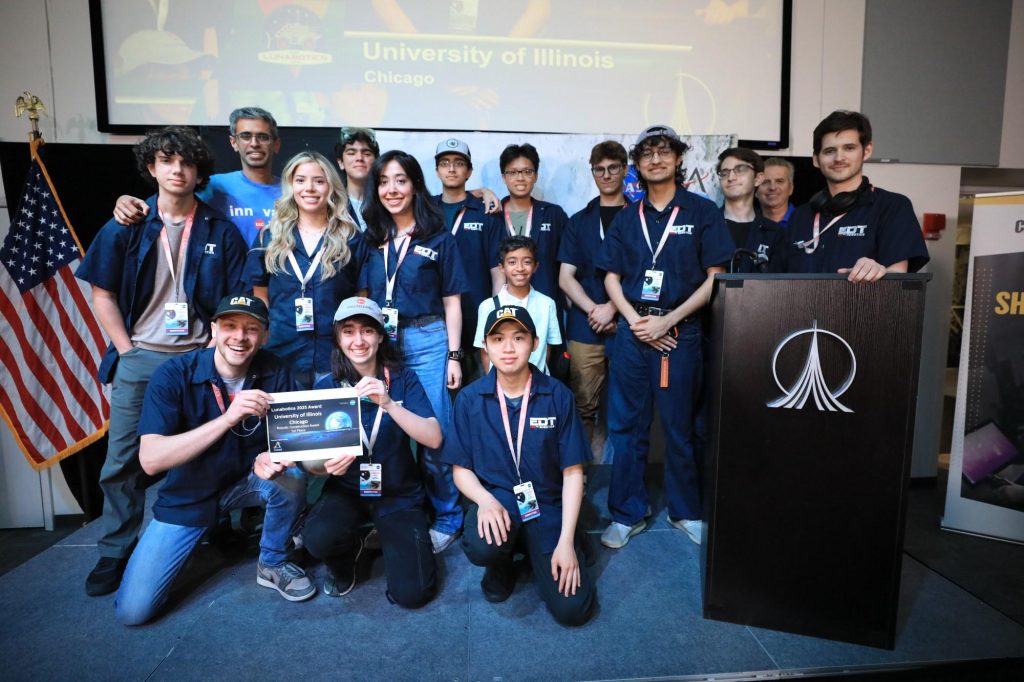
Students from University of Illinois Chicago receive first place for the Robotic Construction Award during the 2025 Lunabotics Challenge. NASA/Isaac Watson

Other teams were recognized for their achievements: The University of Illinois Chicago placed first for the Robotic Construction Award. “It’s a total team effort that made this work,” said Elijah Wilkinson, senior and team captain at the University of Illinois Chicago. “Our team has worked long and hard on this. We have people who designed the robot, people who programmed the robot, people who wrote papers, people who wired the robot; teamwork is really what made it happen.”

The University of Utah won second and the University of Alabama in Tuscaloosa came in third place, respectively. The award recognizes the teams that score the highest points during the berm-building operations in the Artemis Arena. Teams are evaluated based on their robot’s ability to construct berms using excavated regolith simulant, demonstrating effective lunar surface construction techniques.

To view the robots in action from the Robot Construction Award winners, please click on the following links: University of Illinois Chicago, University of Utah, University of Alabama in Tuscaloosa.

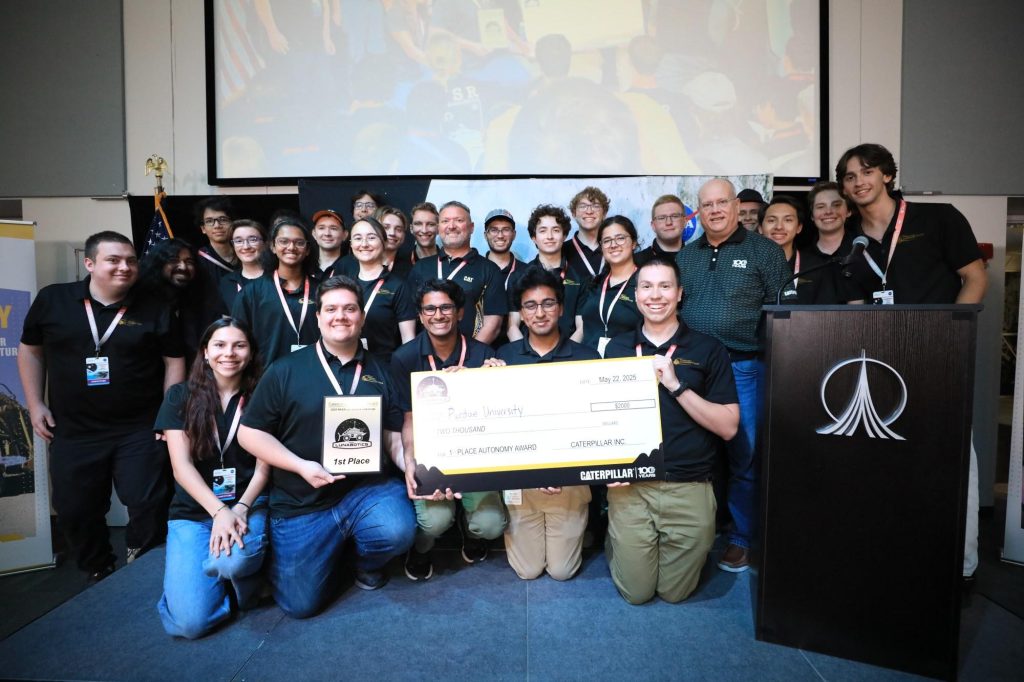
Students from Purdue University in Lafayette, Indiana received the Caterpillar Autonomy Award during the 2025 Lunabotics Challenge. NASA/Isaac Watson

Students from Purdue University in Lafayette, Indiana received the Caterpillar Autonomy Award for their work. The University of Alabama placed second, followed by the University of Akron in Ohio. Michigan Technological University came in fourth, followed by the University of Illinois Chicago, and the University of North Carolina in Charlotte. This award honors teams that successfully complete competition activities autonomously. It emphasizes the development and implementation of autonomous control systems in lunar robotics, reflecting real-world applications in remote and automated operations.

An Artemis I flag flown during the Nov. 16, 2022, mission was presented to the University of Illinois Chicago, as well as the University of Virginia in Charlottesville as part of the Innovation Award. The recognition is given to teams for their original ideas, creating efficiency, effective results, and solving a problem.

Dr. Eric Meloche from the College of DuPage in Glen Ellyn, Illinois, and Jennifer Erickson, professor from the Colorado School of Mines in Golden each received an Artemis Educator Award, a recognition for educators, faculty, or mentors for their time and effort inspiring students.

The University of Utah received the Effective Use of Communications Power Award and the University of Virginia the agency’s Center for Lunar and Asteroid Surface Science Award.

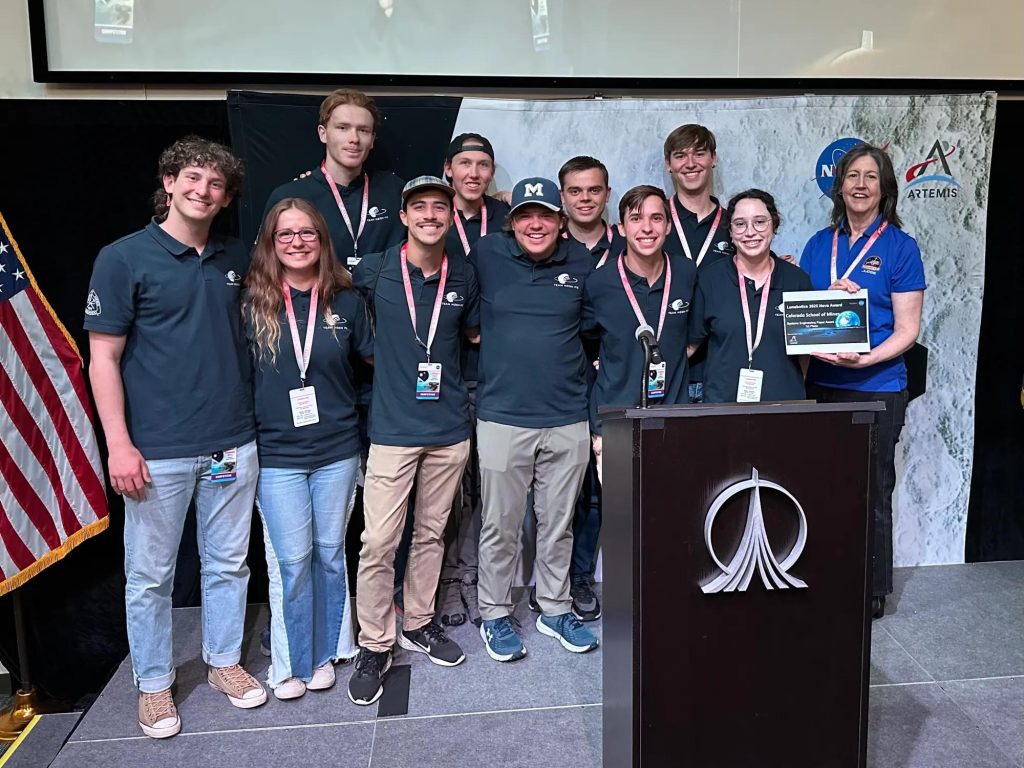
Students from the Colorado School of Mines pose for a photo after receiving a Systems Engineering Award during the 2025 Lunabotics Competition. NASA/Isaac Watson

Students from the Colorado School of Mines placed first receiving a Systems Engineering Award. University of Virginia in Charlottesville and the College of DuPage in Glen Ellyn, Illinois, came in second and third places.

This is truly a win-win situation. The students get this amazing experience of designing, building, and testing their robots and then competing here at NASA in a lunar-like scenario while NASA gets the opportunity to study all of these different robot designs as they operate in simulated lunar soil. Lunabotics gives everyone involved new technical knowledge along with some pretty great experience.”

Kurt Leucht
Commentator, Lunabotics Competition and Software Development team lead

Below is a list of other awards given to students:

  • Systems Engineering Paper Award Nova Award: Liberty University in Lynchburg, Virginia; Boise State University; Texas A&M University in College Station
  • Best Use of Systems Engineering Tools: The University of Utah
  • Best Use of Reviews as Control Gates: The University of Alabama
  • Systems Engineering Paper Award Leaps and Bounds Award: The University of Miami in Florida
  • Best presentation award by a first year team: University of Buffalo in New York
  • Presentations and Demonstrations Awards: University of Utah; Colorado School of Mines; University of Miami
  • STEM Engagement Awards: The University of Utah placed first, followed by the University of Virginia and Embry Riddle Aeronautical University in Daytona Beach
  • NASA SSERVI Center for Lunar and Asteroid Surface Science: The University of Virginia
  • Efficient use of Communications Power Award: The University of Utah

By: Elyna Niles-Carnes
Originally published at: NASA

The Summer Adventures : Hiking and Nature Walks Essentials

0

Summer is almost here. Or we should say, that summer is here, but the actual weather must’ve been late to wake up.

As with any change in season, its also accompanied with a change in possible activities. The increase in temperature also comes with changes in nature. Some of these activities are popular to many. Like hiking along nature trails, walking along the country side or strolling around the shore.

Here we have some of the essentials while going on hiking and nature walks. From what to bring in your leisurely walk to an adventure in the forest and mountains. 

Preparation

  • Weather : Check the weather forecast in advance. Prediction has largely improved and is considerably more accurate compared to years ago.
  • Company : Who you are going with. Check with them, confirm if it’s a go or no go. If you are going alone, make sure to tell someone in case of emergency. This includes the location and possibly how long you are going to be gone.
  • Destination : Check for announcements on the location of your activity. If there are emergencies like closure, wildflife dangers and other similar events you might want to postpone it.

Essentials / What to Bring

  • Hiking and camping gear
  • Clothing
  • Footwear
  • Food and water. Specially water. Summer, while good for long walks, you have to be aware and keep yourself hydrated.
  • Emergency and first aid kit. This might include signal flares aside from the usual medicine kit.
  • Bug spray or insect repellent. Depending on location, this can be an issue. Allergic reactions to bees is no joke.

Choosing the right backpack

The right backpack can be tricky sometimes. While it heavily depends on how long you are going out. Sometimes, it can also be about the nature of the items and the length of the activity.

Maelstrom Hiking Backpack

Highly durable with plenty of pockets. These two things are most of the time enough for someone to buy a bag. Specially children, they love pockets, the more the merrier. Another thing this bag has going for it is the comfortable cushion it provides the shoulder, making long walks at ease as you focus on the adventure instead of the discomfort. While we received some feedback on the straps about making it stronger, this also depends on how much you fill it with.

MOLLE Assault Pack

You might think this pack is rigid, judging from its squarish design. But it’s designed like that for “tactical” purpose. For critical features such as durability, adaptability, and functionality. With it’s main compartment being able to open like a suitcase, you could easily take in or out equipment and gears. When you talk about this backpack, it’s more on the functional side rather than the fashion. But since fashion is subjective, who could say this isn’t.

Woogwin Travel Duffel Bag

A bag purpose-built for storage and is waterproof. In short, for the beach and the pool, or any place with water, water that you don’t want inside your bag. With a 60-liter capacity and a shoe compartment, you could not only bring it to the beach but also at the gym.

Deploying a practical solution to space debris

0

Researchers share the design and implementation of an incentive-based Space Sustainability Rating.

Department of Aeronautics and Astronautics | Media Lab
MIT News (https://news.mit.edu/2025/deploying-practical-solution-space-debris-0514)

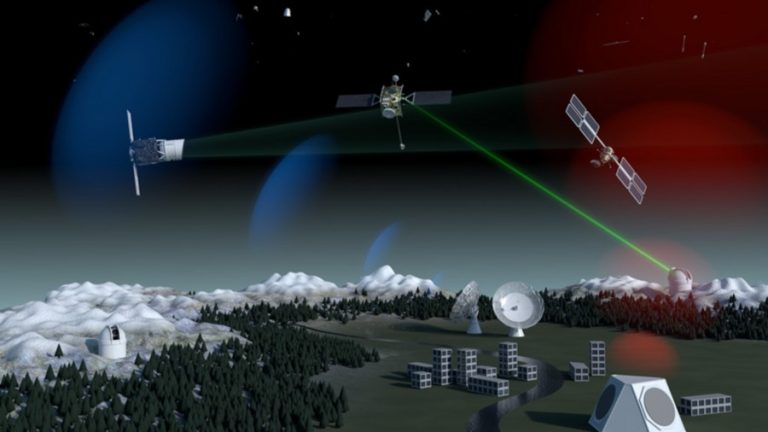
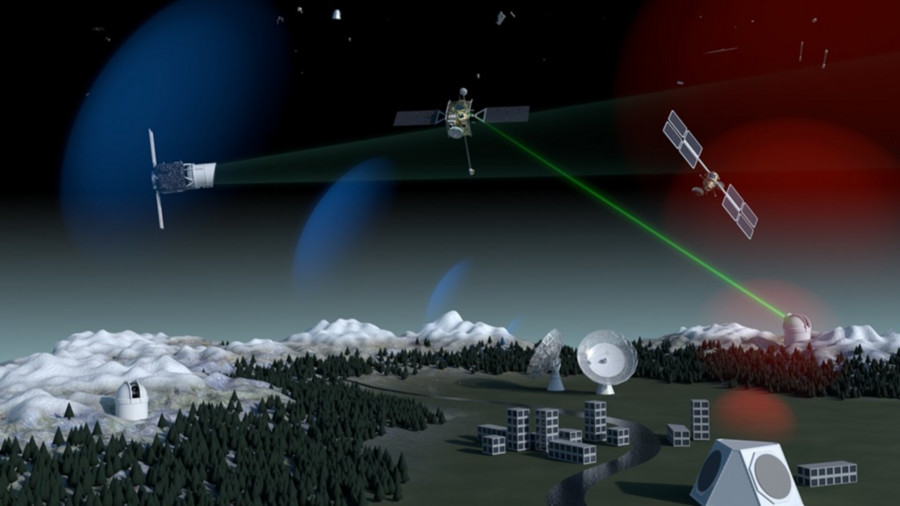
Caption:A team co-led by MIT Associate Professor Danielle Wood’s Space Enabled research group has developed and launched the Space Sustainability Rating (SSR), a system for scoring space mission operators on their launch and de-orbit plans, collision-avoidance measures, debris generation, and data sharing.

At this moment, there are approximately 35,000 tracked human-generated objects in orbit around Earth. Of these, only about one-third are active payloads: science and communications satellites, research experiments, and other beneficial technology deployments. The rest are categorized as debris — defunct satellites, spent rocket bodies, and the detritus of hundreds of collisions, explosions, planned launch vehicle separations, and other “fragmentation events” that have occurred throughout humanity’s 67 years of space launches. 

The problem of space debris is well documented, and only set to grow in the near term as launch rates increase and fragmentation events escalate accordingly. The clutter of debris — which includes an estimated 1 million objects over 1 centimeter, in addition to the tracked objects — regularly causes damage to satellites, requires the repositioning of the International Space Station, and has the potential to cause catastrophic collisions with increasing frequency. 

To address this issue, in 2019 the World Economic Forum selected a team co-led by MIT Associate Professor Danielle Wood’s Space Enabled Research Group at the MIT Media Lab to create a system for scoring space mission operators on their launch and de-orbit plans, collision-avoidance measures, debris generation, and data sharing, among other factors that would allow for better coordination and maintenance of space objects. The team has developed a system called the Space Sustainability Rating (SSR), and launched it in 2021 as an independent nonprofit. 

“Satellites provide valuable services that impact everyone in the world by helping us understand the environment, communicate globally, navigate, and operate our modern infrastructure. As innovative new missions are proposed that operate thousands of satellites, a new approach is needed to provide space traffic management. National governments and space operators need to design coordination approaches to reduce the risk of losing access to valuable satellite missions,” says Wood, who is jointly appointed in the Program in Media Arts and Sciences and the Department of Aeronautics and Astronautics (AeroAstro). “The Space Sustainability Rating plays a role by compiling internationally recognized responsible on-orbit behaviors, and celebrating space actors that implement them.” 

France-based Eutelsat Group, a geostationary Earth orbit and low Earth orbit satellite operator, signed on as the first constellation operator with a large deployment of satellites to undergo a rating. Eutelsat submitted a mission to SSR for assessment, and was rated on a tiered scoring system based on six performance modules. Eutelsat earned a platinum rating with a score exceeding 80 percent, indicating that the mission demonstrated exceptional sustainability in design, operations, and disposal practices.

As of December 2024, SSR has also provided ratings to operators such as OHB Sweden AB, Stellar, and TU Delft. 

In a new open-access paper published in Acta Astronautica, lead author Minoo Rathnasabapathy, Wood, and the SSR team provide the detailed history, motivation, and design of the Space Sustainability Rating as an incentive system that provides a score for space operators based on their effort to reduce space debris and collision risk. The researchers include AeroAstro alumnus Miles Lifson SM ’20, PhD ’24; University of Texas at Austin professor and former MIT MLK Scholar Moriba Jah; and collaborators from the European Space Agency, BryceTech, and the Swiss Institute of Technology of Lausanne Space Center (eSpace).

The paper provides transparency about the inception of SSR as a cross-organizational collaboration and its development as a composite indicator that evaluates missions across multiple quantifiable factors. The aim of SSR is to provide actionable feedback and a score recognizing operators’ contributions to the space sustainability effort. The paper also addresses the challenges SSR faces in adoption and implementation, and its alignment with various international space debris mitigation guidelines. 

SSR draws heavily on proven rating methodologies from other industries, particularly Leadership in Energy and Environmental Design (LEED) in the building and manufacturing industries, Sustainability Assessment of Food and Agriculture systems (SAFA) in the agriculture industry, and Sustainability Tracking, Assessment and Rating System (STARS) in the education industry. 

“By grounding SSR in quantifiable metrics and testing it across diverse mission profiles, we created a rating system that recognizes sustainable decisions and operations by satellite operators, aligned with international guidelines and industry best practices,” says Rathnasabapathy. 

The Space Sustainability Rating is a nongovernmental approach to encourage space mission operators to take responsible actions to reduce space debris and collision risk. The paper highlights the roles for private sector space operators and public sector space regulators to put steps in place to ensure such responsible actions are pursued. 

The Space Enabled Research Group continues to perform academic research that illustrates the benefits of space missions and government oversight bodies enforcing sustainable and safe space practices. Future work will highlight the need for a sustainability focus as practices such as satellite service and in-space manufacturing start to become more common. 

Reprinted with permission of MIT News
http://news.mit.edu/

The Definitive Who’s Who of the 2025 Papal Conclave

0

As the Catholic Church prepares for one of its most sacred traditions, all eyes turn to the Vatican where the College of Cardinals gathers to elect the next Supreme Pontiff. This infographic provides an essential guide to the key players who will shape this historic decision.

From influential Cardinals representing diverse theological perspectives to regional power brokers and potential papal candidates, we’ve mapped the most significant figures in this upcoming conclave. Understand their backgrounds, positions on critical issues facing the Church, and the alliances that may determine who emerges as the next leader of over 1.3 billion Catholics worldwide.

Whether you’re following Vatican politics closely or simply curious about this ancient process unfolding in modern times, this guide offers vital context for the momentous selection ahead. For more details on the Conclave process, check out this infographic explainer.

astercaster.com-conclave-2025-college-of-cardinals

The World Is Revalidating Itself

0

We’re barely into the second quarter of 2025, and it already feels like we’ve been collectively thrust into the world’s most consequential election season. Not content with the usual anxiety-inducing chaos of a single nation’s democratic process, the universe has decided to give us a simultaneous masterclass in global democracy—or whatever passes for it these days.

Canada has just ushered in Mark Carney, the former central banker whose technocratic expertise apparently convinced voters he could steer the country through economic rapids better than his predecessors. Meanwhile, Singapore is experiencing what qualifies as a political earthquake in its tightly controlled system, with the People’s Action Party facing unprecedented challenges to its 60-year dominance. The PAP, which has run Singapore since before Singapore was even Singapore, is discovering that even the most meticulously engineered political systems eventually develop cracks.

Then there’s the Philippines, that fascinating study in democratic contradictions—a vibrant economy whose political class seems determined to sabotage progress through endless power struggles. The latest round of political infighting makes “Succession” look like a children’s television show. One wonders if the country’s politicians have considered that economic growth becomes rather difficult when you’re busy sharpening knives for your colleagues’ backs.

But the most fascinating electoral spectacle isn’t happening at a ballot box at all. The Catholic Church is preparing for its conclave to select Pope Francis’s successor after twelve years of his relatively progressive papacy.

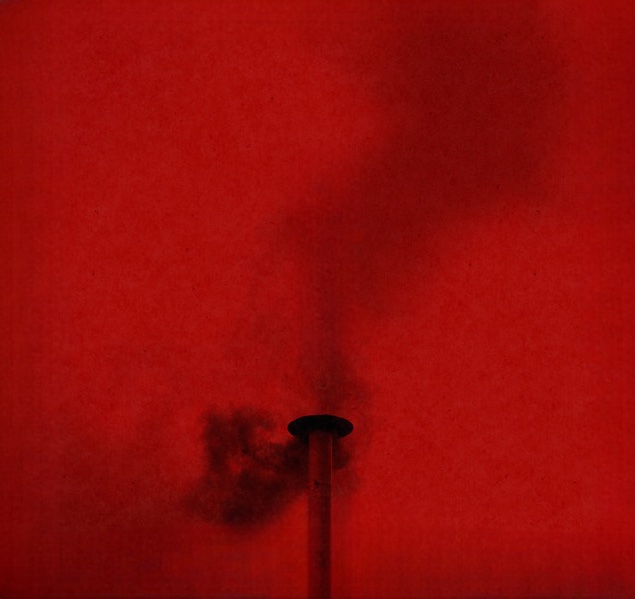
conclave-poster-black-smoke

What makes this convergence of global elections particularly striking is the backdrop against which they’re occurring. We’ve got tariff wars that make family holiday arguments seem civilized, and actual wars—in Ukraine, Gaza, and other places—that continue to remind us that humans excel at turning disagreements into tragedy. Climate change isn’t just knocking at our door anymore; it’s kicked it down and is rearranging the furniture. It’s almost as if the world is trying to set fire to itself while simultaneously attempting to decide who gets to hold the extinguisher.

What we’re witnessing isn’t just a series of elections; it’s humanity at a crossroads, collectively voting on its future while that future seems increasingly unstable. It’s against this dystopian backdrop that citizens around the world are being asked to make decisions about leadership. In a very real sense, the world is revalidating itself with its new leaders. 

The irony, of course, is that as these existential threats mount, many democratic systems are simultaneously facing internal erosion. Populist movements continue to challenge institutional guardrails, disinformation flourishes in digital ecosystems designed to prioritize engagement over accuracy, and voter apathy grows in proportion to the sense that the game is rigged.

Either way, these elections across the globe share a common thread: they’re not just about who governs for the next few years, but potentially deciding the fate of our species. Climate change doesn’t care whether Canada’s government leans left or right. The melting Arctic doesn’t distinguish between PAP voters and opposition supporters in Singapore. The consequences of war don’t stop at the Philippines’ territorial waters.  Even the papal conclave, archaic as it seems, will select someone whose moral authority extends to over a billion Catholics worldwide, potentially influencing everything from reproductive rights to climate action. The Church might move at a glacial pace, but then again, so do actual glaciers—until suddenly they don’t.

Maybe that’s the most human thing of all: the persistent belief that we can fix this mess, even as we continue making it worse.

What’s particularly disturbing is how normal this all feels now. We’ve become accustomed to headline whiplash—climate disaster next to election results next to war updates next to celebrity gossip. The world is always in a state of flux, certainly, but the current level of chaos has become our baseline. Like the proverbial frog in slowly heating water, we’ve adjusted to conditions that should be setting off alarm bells.

And yet, there’s something oddly reassuring about watching millions of people around the world still participating in democratic processes, however flawed. Despite everything—the corruption, the disinformation, the sense that individual votes matter little against the tide of corporate influence and geopolitical forces—people still line up to cast ballots. There’s a stubborn hope embedded in that act, a refusal to surrender agency entirely.

Perhaps that’s what these elections really represent: not so much a solution to our problems as a collective assertion that we still believe solutions are possible. That despite the overwhelming evidence that our systems are buckling under the weight of 21st-century challenges, we haven’t yet abandoned the idea that human agency matters.

Is that naive? Possibly. Is it our only option? Almost certainly. Because the alternative—surrendering to fatalism in the face of mounting crises—guarantees the worst outcomes. At least with democracy, however imperfect, we maintain the possibility of change, the chance that somewhere in the global constellation of elections happening now, voters might select leaders equal to the moment.

So as ballots are counted from Ottawa to Manila, as white smoke eventually rises from the Vatican, perhaps what we’re really watching isn’t just democracy in action but humanity’s stubborn insistence on having a say in its own future—even as that future grows increasingly uncertain. In a world that seems to be coming apart at the seams, that small act of collective determination might be the thread that holds us together.

Conclave: How A New Pope Is Chosen

0

The passing of Pope Francis has triggered one of the oldest traditions in the Catholic Church: the conclave. The election of the new Pope is one of Catholicism’s most ancient traditions.

Here is our infographic explaining the process:

Historical Significance

This ritual has evolved since the 11th century yet maintains its core purpose: ensuring the divine guidance of the Holy Spirit in selecting the successor to St. Peter, the Church’s first pope. The conclave’s secrecy and ceremonial aspects underscore the profound spiritual significance of this transition of power within the world’s oldest continuously functioning institution.

Indicators of alien life may have been found – astrophysicist explains what the new research means

0
Darryl Fonseka/Shutterstocl

Ian Whittaker, Nottingham Trent University

What do you think of when it comes to extra terrestrial life? Most popular sci-fi books and TV shows suggest humanoid beings could live on other planets. But when astronomers are searching for extra-terrestrial life, it is usually in the form of emissions from bacteria or other tiny organisms.

A new research paper in the Astrophysical Journal suggests that Cambridge scientists have managed to find this type of emission with a certainty of 99.7% from a planet called K2-18b, 124 light years away. They used Nasa’s James Webb Space Telescope to analyse the chemical composition of the planet’s atmosphere and say they found promising evidence K2-18b could host life.

It’s an exciting breakthrough but it doesn’t confirm alien life.

Let’s look at why scientists largely do not accept the paper as proof of alien life.

Why it’s so hard to detect to alien life

Exoplanet hunting fell out of public interest quickly due to the staggering number of planets scientists are discovering. The first convincing exoplanet around a sun-like star was discovered in 1995 via radial velocity, where you don’t look at the planet but instead observe its effect on its nearest star. As the star wobbles back and forth it causes a tiny shift in the wavelength of the light it emits, which we can measure. We already know of roughly 7,500 planets.

Only 43 (to date) have been observed directly (about 0.5% of them). Most are discovered through indirect means, such as radial velocity or the transit method. The transit method is where you look at how the brightness of the star decreases as the planet passes in front of it. It will block a tiny amount of the light.

An exoplanet atmosphere

Looking at the atmosphere of an exoplanet is even more difficult. Scientists use spectroscopy to do this. The light coming out of the star can be observed directly and a small amount of it will also pass through the atmosphere of the planet. Researchers can estimate what an exoplanet’s atmosphere is made of by studying which light from the star is emitted or absorbed in the atmosphere.

Let’s try an analogy. You have a desk lamp at one end of a long table and you are standing at the other end, looking at the lamp. There is a glass of liquid in between you and the lamp. In very simple terms, the glass of liquid acting as the exoplanet and atmosphere, looks slightly blue, which allows you to identify it as water. In reality for scientists though, it’s more like the glass of water is a tiny glass bead which is rolling around while someone is messing around with a dimmer switch on the lamp. Then, freak weather results in a gentle mist forming on the table. The liquid is 99% pure water and 1% mineral water and the scientist is trying to see what minerals are in the water.

You can see that the expertise required to be perform this work is incredible. They observed molecules with a 99.7% confidence rate, which is a remarkable achievement.

The data from JWST and K2-18b

The key data in this study is in a graph fitting light absorption rates to which kind of molecules could be there and working out how abundant they are. It features in this short film about the discovery.

The graph produced by the study’s authors shows evidence for dimethyl sulphide and dimethyl disulphide (DMS).

Some scientists think of DMS as a biomarker – a molecular indicator of life on Earth. However DMS is not only produced by bacteria, but has also been found on comet 67P and in the gas and dust of the interstellar medium, the space between stars. It can even be generated by shining UV light onto a simulated atmosphere. The authors acknowledge this and claim the amount they determined was present cannot be produced by any of these conditions.

Similar to other claims of life?

Multiple studies have shown indicators for DMS and life in general on K2-18b and there are many other claims for other exoplanets.

The most recent is the idea that phosphine (another biomarker) was discovered in the Venusian atmosphere, so there must be bacteria in the clouds. This claim was quickly refuted by other researchers. Scientists pointed that a tiny error in the matching of data created results that showed a larger abundance of phosphine than was accurate. The Cambridge study is more rigorous and has more certainty in the result. But it is still not strong enough to convince the academic community, which needs 99.999% certainty.

The study authors suggest their findings indicate liquid oceans and a hydrogen atmosphere but others have countered it could be a gas giant, or a volcanic planet full of magma.

The Cambridge study is not proof of life, but it is an important step forward to characterising what other planets might be like and determining if we are alone or not. The study presented the best result yet and should inspire other scientists to take up the challenge.The Conversation

Ian Whittaker, Senior Lecturer in Physics, Nottingham Trent University

This article is republished from The Conversation under a Creative Commons license. Read the original article (https://theconversation.com/indicators-of-alien-life-may-have-been-found-astrophysicist-explains-what-the-new-research-means-254843 ) .

Tariffs, Trump, and Other Things That Start With T – They’re Not The Problem, It’s How We Use Them

0

Let’s be honest: talking about tariffs is about as sexy as discussing different types of dental floss. But here we are, because tariffs have somehow become the economic equivalent of a Taylor Swift album drop – everyone has an opinion, especially if they’ve never actually studied economics.

The Problem Isn’t Tariffs, It’s Trump

Trump’s approach to tariffs isn’t inherently wrong – shocking, I know. The issue isn’t the economic theory but the chaotic implementation. It’s like saying “exercise is good for you” and then immediately demonstrating by attempting to deadlift a car. The principle? Sound. The execution? A trip to the emergency room.

We’ve seen this movie before with Brexit and we all know how that went, don’t we? There was nothing fundamentally wrong with the concept of Britain reclaiming sovereignty (well, debatable), but doing Brexit without any actual plans, templates, or trade deals was like jumping out of a plane and then shouting, “Wait, does anyone know how to make a parachute?” No trade deals, no templates, no transition plan – just vibes and nationalism.

Screenshot

Tariffs Have Always Been A Thing (Just With Fancier Names)

Here’s the thing about tariffs that no one seems to mention: they’ve always been around. We’ve just called them different things – customs duties, import taxes, that mysterious extra fee when you order something from abroad. Acting like tariffs are some radical new invention is like pretending avocado toast wasn’t just guacamole on bread all along.

The distinction matters because it shifts our conversation from “tariffs: yes or no?” to “how and when should we use tariffs?” One is a pointless binary; the other might actually lead somewhere useful.

The real issue isn’t the tariff itself – it’s who’s wielding it. When Trump slaps tariffs around, he comes across like that guy at a party who keeps challenging everyone to arm-wrestling matches. Suddenly, what could be a boring economic tool becomes international drama worthy of Netflix.

Follow the Money (Or Lack Thereof)

At its core, the American economy has a cash flow problem, not unlike that friend who’s always “just about to” pay you back. The US is swimming in debt while China sits on a dragon’s hoard of American dollars. Tariffs provide an immediate injection of cash – like financial espresso for a hungover economy.

But there’s a bigger strategy at play: forcing companies to rethink their supply chains. When your CFO realizes that manufacturing in China now costs more than doing it in Michigan, suddenly that abandoned factory in Detroit starts looking attractive again. Reshoring manufacturing isn’t just about jobs – it’s about reducing dependency on countries whose values increasingly diverge from our own.

The Laffer Curve: Not Just a Funny Name

Economists have a concept called the Laffer Curve, which sounds like a ride at an economist’s theme park but is actually about how taxation and tariffs works. It illustrates how taxation generates more revenue – but only up to a point. Push too far, and it’s like squeezing an empty toothpaste tube: you look increasingly desperate and get diminishing returns.

The same applies to tariffs. A 10% tariff might achieve your goals, but a 50% tariff could destroy global supply chains, spark retaliation, and make everything from iPhones to underpants unaffordable. There’s a sweet spot somewhere in between – the challenge is finding it without breaking everything first.

It’s Not About Canada, It’s About China

When Trump started tariff wars with Canada and Mexico, it was like picking a fight with your roommates when you’re actually mad at your boss. These weren’t the real targets – they were collateral damage in a strategy aimed squarely at China.

The China-Russia axis represents the actual concern for American policymakers. As these autocracies cozy up to each other, the U.S. is desperately trying to reduce its dependence on their economies while pressuring allies to do the same. Tariffs are just one tool in what’s becoming a full-scale economic cold war.

The Distribution Problem No One Wants to Talk About

Here’s the dirty secret about American capitalism that both parties avoid addressing: if you keep consolidating wealth at the top while gutting the middle class, eventually you run out of customers who can afford your products. Henry Ford understood this when he paid his workers enough to buy the cars they built. Today’s corporations seem to have forgotten this lesson.

If tariff-induced price increases hit consumers already stretched thin by inflation, housing costs, and stagnant wages, we risk accelerating a downward economic spiral. There’s no AI economy coming to save us – AI doesn’t buy products, people do. And people need money to buy things.

Where Do We Go From Here?

Honestly? I have no idea. I’m not an economist – I just play one in op-eds. But maybe the answer isn’t “tariffs bad” or “tariffs good” but “can we please stop implementing major economic policies the way a toddler decorates a birthday cake?” The tariff debate needs nuance, not absolutism. We should be asking:

  1. What specific industries genuinely need protection for national security?
  2. How can we implement tariffs with clear metrics, sunset provisions, and adjustment periods?
  3. What complementary policies might offset consumer price increases?
  4. How do we coordinate with allies to prevent easy circumvention?

Instead of treating tariffs as either economic salvation or the apocalypse, we should see them as tools in a complicated economic toolkit – useful in specific circumstances, dangerous when misapplied, and always requiring precision.

The Bottom Line

Trump isn’t wrong that America needs to reconsider its trade relationships, especially with authoritarian regimes. But slapping tariffs around like a drunk person with a fly swatter isn’t strategy – it’s tantrum-as-policy.

Effective tariff policy requires planning, coordination, and clear objectives. It means balancing short-term pain against long-term gain. Most importantly, it demands recognizing that in a global economy, there are no simple solutions – just complicated trade-offs.

Maybe instead of asking whether tariffs are good or bad, we should be asking a different question: How do we build an economy that works for everyone, not just those at the top? Until we answer that, we’re just rearranging deck chairs on the Titanic – with or without tariffs.