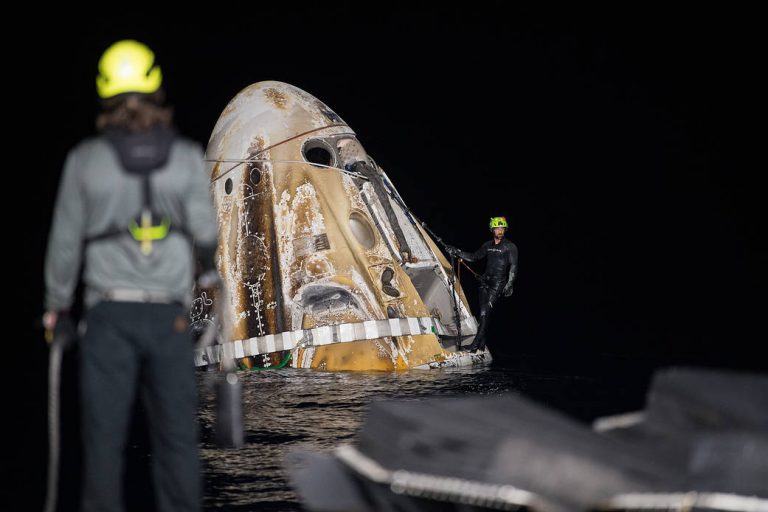
Support teams work around the SpaceX Crew Dragon Endurance spacecraft shortly after it landed on Friday, May 6, 2022 with Crew-3 NASA astronauts Raja Chari, Kayla Barron, Tom Marshburn, and European Space Agency astronaut Matthias Maurer aboard.
To protect the health and safety of the astronauts, the recovery teams, and the general public, highly trained rescue and recovery personnel are pre-positioned for launch and return to react quickly. Mission teams also establish safety zones in the water to protect the boating public around the area of splashdown.
This photo was chosen by the NASA Headquarters photographers as one of the best from 2022. See the rest on Flickr.
The milestone comes after a Mar. 1, 2022, launch and post-launch testing of the satellite’s instruments, systems, and data. GOES-18 replaces GOES-17 as GOES West, located 22,236 miles above the equator over the Pacific Ocean. GOES-17 will become an on-orbit standby.
The milestone comes after a Mar. 1, 2022, launch and post-launch testing of the satellite’s instruments, systems, and data. GOES-18 replaces GOES-17 as GOES West, located 22,236 miles above the equator over the Pacific Ocean. GOES-17 will become an on-orbit standby.
In its new role, GOES-18 will serve as NOAA’s primary geostationary satellite for detecting and monitoring Pacific hurricanes, atmospheric rivers, coastal fog, wildfires, volcanic eruptions, and other environmental phenomena that affect the western contiguous United States, Alaska, Hawaii, Mexico, and Central America.
The satellite delivers high-resolution visible and infrared imagery, atmospheric measurements, and real-time mapping of lightning activity. It is ideally located to monitor the northeastern Pacific Ocean, where many weather systems that affect the continental U.S. originate. GOES-18 also watches the sun and detects approaching space weather hazards.
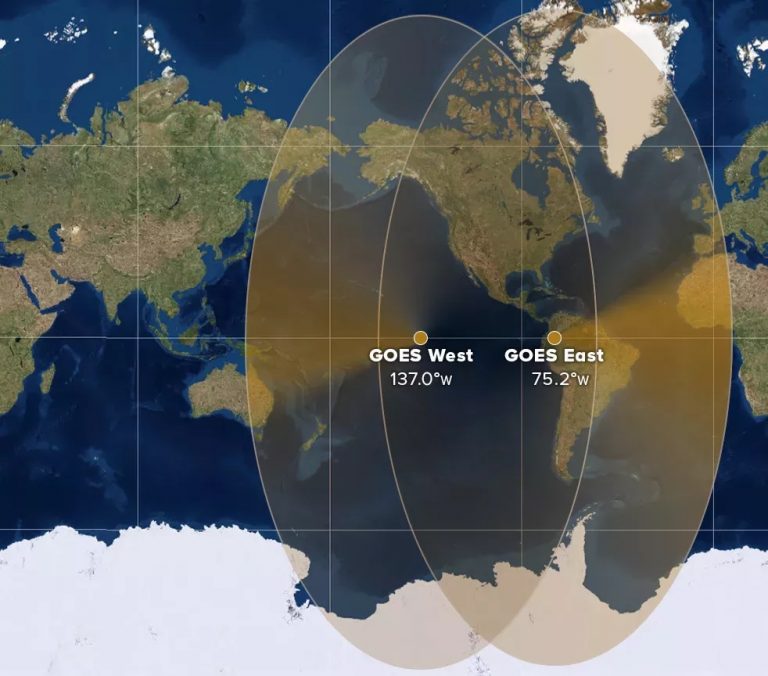
GOES-18 joins GOES-16 (GOES East) in operational service. Together the two satellites watch over more than half the globe, from the west coast of Africa to New Zealand and from near the Arctic Circle to the Antarctic Circle. Their data assists weather forecasters, emergency managers, first responders, the aviation and shipping industries, and more.
While GOES-18 has just officially entered operational service, the satellite has been assisting NOAA National Weather Service forecasters for months. Usually, GOES satellites complete post-launch testing in a location over the central U.S., but GOES-18’s early successes allowed NOAA to move it to its future operational location early. GOES-18 began sending imagery from its new location in June.
Due to an issue with the cooling system on GOES-17’s Advanced Baseline Imager (ABI) instrument, some GOES-17 imagery was degraded during certain times of the year. In August, NOAA implemented a unique solution to mitigate the loss of some GOES-17 imagery during these “warm” periods. From Aug. 1 to Sept. 8 and from Oct. 13 to Nov. 16, NOAA provided data from the GOES-18 ABI to GOES West data users. This was accomplished through a data “interleave” that delivered GOES-18 ABI data alongside GOES-17 lightning mapper and space weather data. This allowed forecasters to utilize GOES-18 imagery during the height of the Pacific hurricane season.
Now that GOES-18 is operating as GOES West, GOES-17 will be moved to a central location between GOES East and GOES West to serve as a backup for the operational constellation.
The GOES-R Series Program is a four-satellite mission that includes GOES-R (GOES-16, launched in 2016), GOES-S (GOES-17, launched in 2018), GOES-T (GOES-18), and GOES-U, which is scheduled to launch in 2024. The program is a collaborative effort between NOAA and NASA. NASA builds and launches the satellites for NOAA, which operates them and distributes their data to users worldwide.
GOES-R Series satellites are planned to operate into the 2030s. NOAA and NASA have already begun work on the next-generation geostationary mission called Geostationary Extended Observations (GeoXO). The Department of Commerce formally approved the GeoXO Program on Dec. 14, 2022. GeoXO will continue observations provided by GOES-R and bring new capabilities to address our changing planet and the evolving needs of NOAA’s data users.
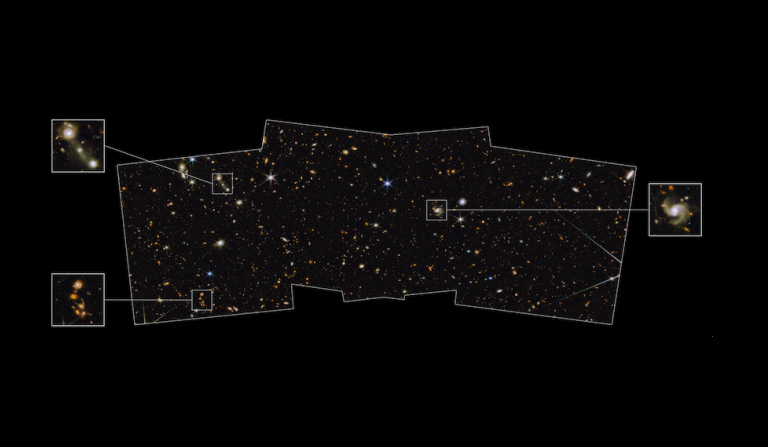
Medium-deep Field View Of The North Ecliptic Pole. NASA.
The NASA/ESA/CSA James Webb Space Telescope has captured one of the first medium-deep wide-field images of the cosmos, featuring a region of the sky known as the North Ecliptic Pole.
The image, which accompanies a paper published in the Astronomical Journal, is from the Prime Extragalactic Areas for Reionization and Lensing Science (PEARLS) GTO program.
“Medium-deep” refers to the faintest objects that can be seen in this image, which are about 29th magnitude (1 billion times fainter than what can be seen with the unaided eye), while “wide-field” refers to the total area that will be covered by the program, about one-twelfth the area of the full moon. The image is composed of eight different colors of near-infrared light captured by Webb’s Near-Infrared Camera (NIRCam), augmented with three colors of ultraviolet and visible light from the NASA/ESA Hubble Space Telescope.
This beautiful color image unveils in unprecedented detail and to exquisite depth a universe full of galaxies to the furthest reaches, many of which were previously unseen by Hubble or the largest ground-based telescopes, as well as an assortment of stars within our own Milky Way galaxy. The NIRCam observations will be combined with spectra obtained with Webb’s Near-Infrared Imager and Slitless Spectrograph (NIRISS), allowing the team to search for faint objects with spectral emission lines, which can be used to estimate their distances more accurately.
A swath of sky measuring 2% of the area covered by the full moon was imaged here with NIRCam instrument in eight filters and with Hubble’s Advanced Camera for Surveys (ACS) and Wide-Field Camera 3 (WFC3) in three filters that together span the 0.25 – 5-micron wavelength range. This image represents a portion of the full PEARLS field, which will be about four times larger. Thousands of galaxies over an enormous range in distance and time are seen in exquisite detail, many for the first time. Light from the most distant galaxies has traveled almost 13.5 billion years to reach us. Because this image is a combination of multiple exposures, some stars show additional diffraction spikes.
This representative-color image was created using Hubble filters F275W (purple), F435W (blue), and F606W (blue); and Webb filters F090W (cyan), F115W (green), F150W (green), F200W (green), F277W (yellow), F356W (yellow), F410M (orange), and F444W (red).
[Image Description: This image shows a medium-deep field of countless galaxies that appear throughout the field. Callouts are used to highlight three specific galaxies.] Larger image
ORPHANED STARS WERE LOST INTO INTERGALACTIC SPACE LONG AGO
In the 1960s sci-fi television show “Lost in Space” a small family of would-be planetary colonists get off course and lost in our galaxy. But truth is stranger than fiction when it comes to Hubble Space Telescope discoveries. Thanks to Hubble, astronomers now know about entire families of stars – and presumably their planetary systems – that don’t even have a galaxy to call home. We are nestled inside the sprawling Milky Way galaxy, an empire of stars. But there are many stars wandering about inside giant clusters of hundreds or thousands of galaxies. These stars are not gravitationally tied to any one galaxy in a cluster. The nighttime sky would appear inky black and starless to any inhabitants orbiting their parent sun, save for the feeble soft glow of neighboring galaxies peppering the sky.
Collectively, the dim dispersed glow from these wayward stars forms a background called intracluster light that is evidence they are lurking around. Although the first clues came in 1951, Hubble can easily detect this light even though it’s 1/10,000th the glow of the night sky as seen from the ground-based telescopes. Billions of years ago galaxies would have been smaller than seen today, and they probably shed stars pretty easily because of a weaker gravitational pull. (The escape velocity from our Milky Way is over 1 million miles per hour). Understanding the origin of intracluster light could give astronomers new insights into the assembly history of entire galaxy clusters.
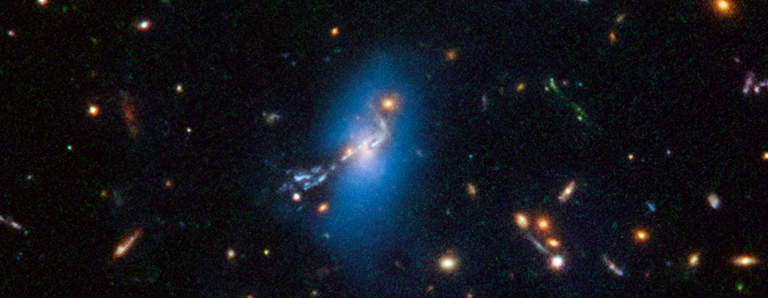
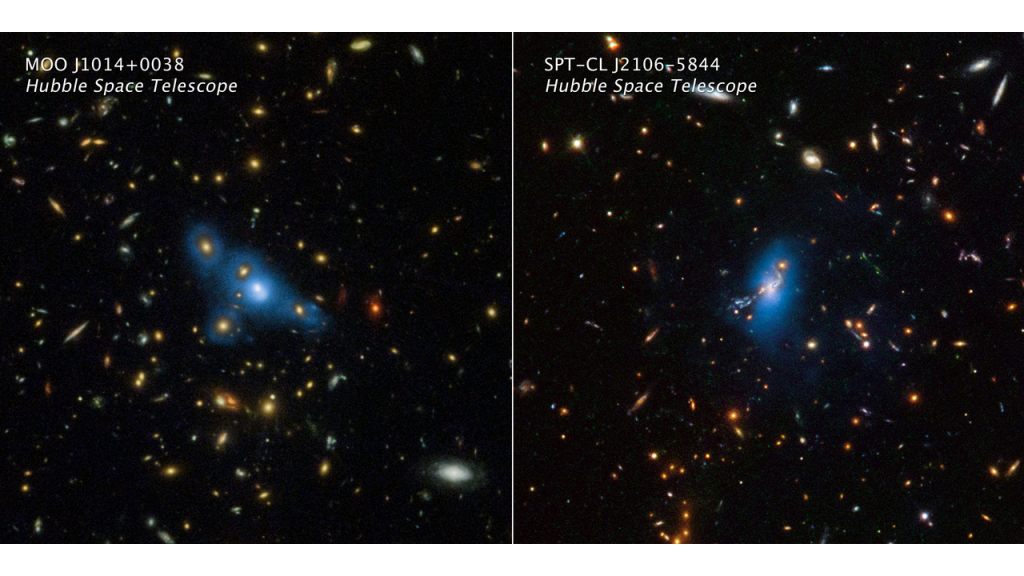
In giant clusters of hundreds or thousands of galaxies, innumerable stars wander among the galaxies like lost souls, emitting a ghostly haze of light. These stars are not gravitationally tied to any one galaxy in a cluster.
The nagging question for astronomers has been: how did the stars get so scattered throughout the cluster in the first place? Several competing theories include the possibility that the stars were stripped out of a cluster’s galaxies, or they were tossed around after mergers of galaxies, or they were present early in a cluster’s formative years many billions of years ago.
A recent infrared survey from NASA’s Hubble Space Telescope, which looked for this so-called “intracluster light” sheds new light on the mystery. The new Hubble observations suggest that these stars have been wandering around for billions of years, and are not a product of more recent dynamical activity inside a galaxy cluster that would strip them out of normal galaxies.
The survey included 10 galaxy clusters as far away as nearly 10 billion light-years. These measurements must be made from space because the faint intracluster light is 10,000 times dimmer than the night sky as seen from the ground.
The survey reveals that the fraction of the intracluster light relative to the total light in the cluster remains constant, looking over billions of years back into time. “This means that these stars were already homeless in the early stages of the cluster’s formation,” said James Jee of Yonsei University in Seoul, South Korea. His results are bei ng published in the January 5 issue of Nature magazine.
Stars can be scattered outside of their galactic birthplace when a galaxy moves through gaseous material in the space between galaxies, as it orbits the center of the cluster. In the process, drag pushes gas and dust out of the galaxy. However, based on the new Hubble survey, Jee rules out this mechanism as the primary cause for the intracluster star production. That’s because the intracluster light fraction would increase over time to the present if stripping is the main player. But that is not the case in the new Hubble data, which show a constant fraction over billions of years.
“We don’t exactly know what made them homeless. Current theories cannot explain our results, but somehow they were produced in large quantities in the early universe,” said Jee. “In their early formative years, galaxies might have been pretty small and they bled stars pretty easily because of a weaker gravitational grasp.”
“If we figure out the origin of intracluster stars, it will help us understand the assembly history of an entire galaxy cluster, and they can serve as visible tracers of dark matter enveloping the cluster,” said Hyungjin Joo of Yonsei University, the first author of the paper. Dark matter is the invisible scaffolding of the universe, which holds galaxies, and clusters of galaxies, together.
If the wandering stars were produced through a comparatively recent pinball game among galaxies, they do not have enough time to scatter throughout the entire gravitational field of the cluster and therefore would not trace the distribution of the cluster’s dark matter. But if the stars were born in the cluster’s early years, they will have fully dispersed throughout the cluster. This would allow astronomers to use the wayward stars to map out the dark matter distribution across the cluster.
This technique is new and complementary to the traditional method of dark matter mapping by measuring how the entire cluster warps light from background objects due to a phenomenon called gravitational lensing.
Intracluster light was first detected in the Coma cluster of galaxies in 1951 by Fritz Zwicky, who reported that one of his most interesting discoveries was observing luminous, faint intergalactic matter in the cluster. Because the Coma cluster, containing at least 1,000 galaxies, is one of the nearest clusters to Earth (330 million light-years), Zwicky was able to detect the ghost light even with a modest 18-inch telescope.
NASA’s James Webb Space Telescope’s near-infrared capability and sensitivity will greatly extend the search for intracluster stars deeper into the universe, and therefore should help solve the mystery.
The Hubble Space Telescope is a project of international cooperation between NASA and ESA. NASA’s Goddard Space Flight Center in Greenbelt, Maryland, manages the telescope. The Space Telescope Science Institute (STScI) in Baltimore, Maryland, conducts Hubble and Webb science operations. STScI is operated for NASA by the Association of Universities for Research in Astronomy, in Washington, D.C.
MEDIA CONTACT:
Ray Villard Space Telescope Science Institute, Baltimore, Maryland
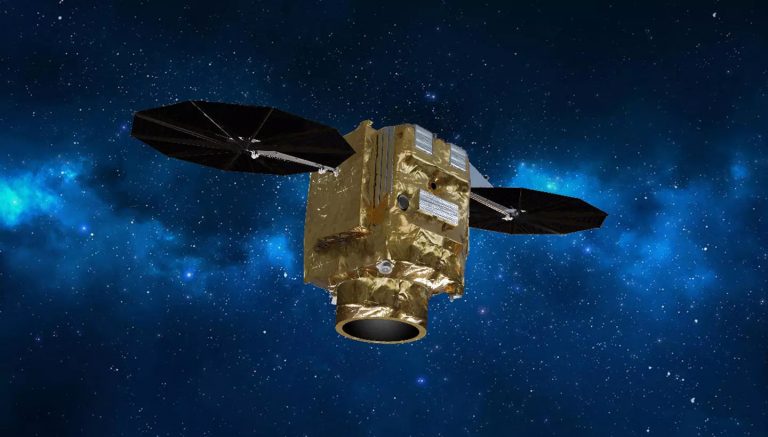
Airbus Defence and Space has signed a contract with Poland to provide a geospatial intelligence system including the development, manufacture, launch and delivery in orbit of two high-performance optical Earth observation satellites. The contract also covers the associated ground segment, including Direct Receiving Station in Poland, launch services, training for the Polish team, maintenance and technical support for the space and ground systems.
Furthermore, the agreement encompasses the delivery of Very High Resolution (VHR) imagery from the Airbus Pléiades Neo constellation as early as 2023.
This contract is the first export success, achieved with the support of the French government, for the Airbus S950 VHR optical satellite which stems from the development of the Pléiades Neo constellation, already operating in orbit with two satellites since 2021. This latest generation system offers a cutting-edge performance of VHR optical capabilities accompanied by a very high agility in orbit.
Jean-Marc Nasr, head of Space Systems at Airbus said: “This contract will provide Poland with one of the world’s most sophisticated satellite Earth observation systems. It strengthens Europe and gives the Polish nation a truly sovereign space capability. We look forward to further developing our cooperation with Poland under the umbrella of the strategic partnership between France and Poland”.
Following the launch of the satellites from the European Space Centre in Kourou, French Guiana, the imagery coming from the Polish satellites will be directly received in Poland by the infrastructure of the national satellite system, ensuring full autonomy.
This announcement consolidates Airbus’ position as world leader in the export of Earth observation satellite systems and is a major show of confidence in the company’s technology. It is also an endorsement of Airbus’ strategy to invest in the Pléiades Neo constellation, the benchmark for VHR geo-information systems. The satellites’ assembly, integration and tests will be carried out in Airbus’ clean rooms in Toulouse and launch is planned by 2027. Starting in 2023, Poland will have access to Pléiades Neo imagery directly from Airbus.
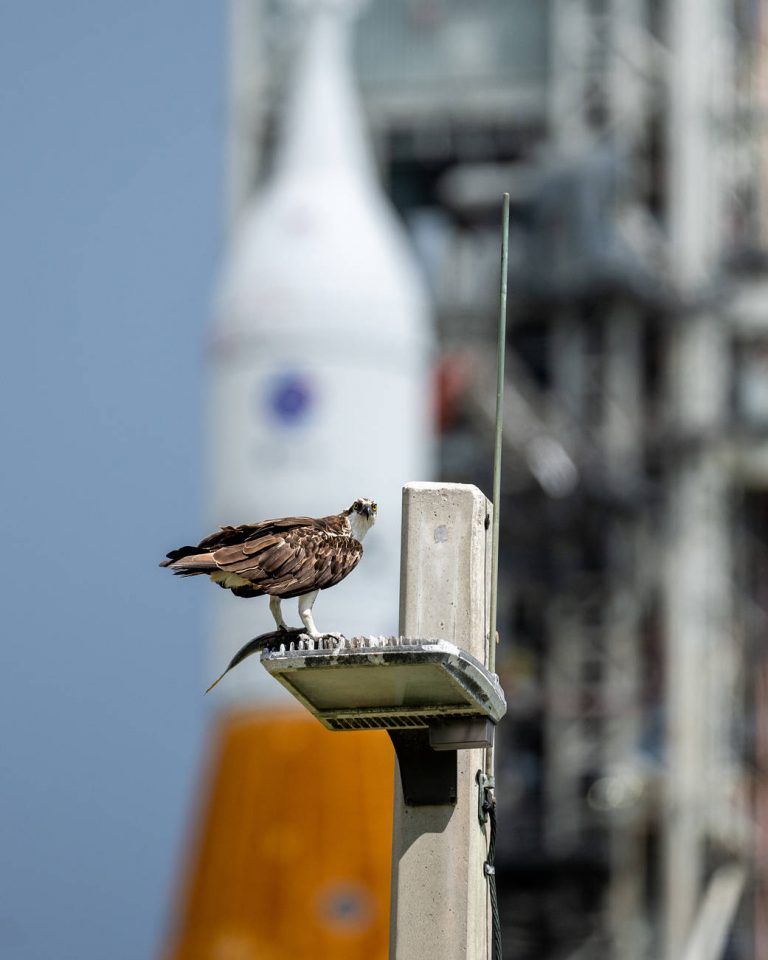
An osprey is seen in front of NASA’s Space Launch System rocket with the Orion spacecraft aboard as launch preparations continued Friday, Sept. 2, 2022, at NASA’s Kennedy Space Center in Florida. This photo was chosen by the NASA Headquarters photographers as one of the best from 2022. See the rest on Flickr.
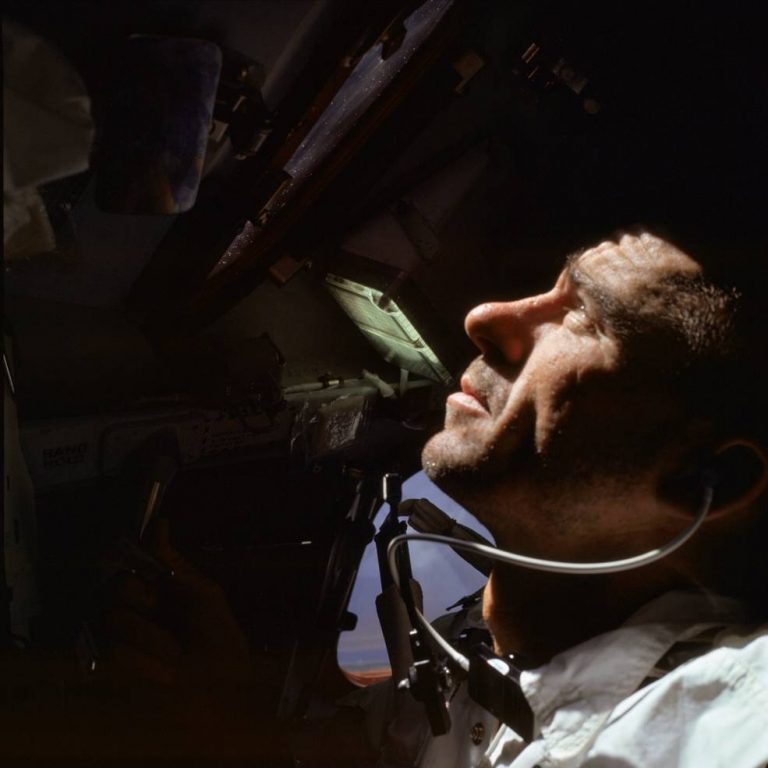
NASA astronaut Walter Cunningham, Apollo 7 lunar module pilot, is photographed during the Apollo 7 mission. Credits: NASA
Former astronaut Walter Cunningham, who flew into space on Apollo 7, the first flight with crew in NASA’s Apollo Program, died early Tuesday morning in Houston. He was 90 years old.
“Walt Cunningham was a fighter pilot, physicist, and an entrepreneur – but, above all, he was an explorer. On Apollo 7, the first launch of a crewed Apollo mission, Walt and his crewmates made history, paving the way for the Artemis Generation we see today,” said NASA Administrator Bill Nelson. “NASA will always remember his contributions to our nation’s space program and sends our condolences to the Cunningham family.”
Cunningham was born March 16, 1932, in Creston, Iowa. He graduated from Venice High School, in Venice, California, before going on to receive a Bachelor of Arts with honors in physics in 1960 and a Master of Arts with distinction in physics in 1961 from the University of California at Los Angeles. He then completed a doctorate in physics with exception of thesis at the Advanced Management Program in the Harvard Graduate School of Business in 1974.
The Cunningham family offered the following statement: “We would like to express our immense pride in the life that he lived, and our deep gratitude for the man that he was – a patriot, an explorer, pilot, astronaut, husband, brother, and father. The world has lost another true hero, and we will miss him dearly.”
He joined the Navy in 1951 and served on active duty with the U.S. Marine Corps, retiring with the rank of colonel. He flew 54 missions as a night fighter pilot in Korea. He worked as a scientist for the Rand Corporation for three years. While with Rand, he worked on classified defense studies and problems related to the Earth’s magnetosphere. Cunningham has accumulated more than 4,500 hours of flying time in 40 different aircraft, including more than 3,400 in jet aircraft.
Cunningham was selected as an astronaut in 1963 as part of NASA’s third astronaut class.
“On behalf of NASA’s Johnson Space Center, we are beholden to Walt’s service to our nation and dedication to the advancement of human space exploration,” said Vanessa Wyche, center director. “Walt’s accomplished legacy will continue to serve as an inspiration to us all.”
Prior to his assignment to the Apollo 7 crew, Cunningham was on the prime crew for Apollo 2 until it was cancelled and the backup lunar module pilot for Apollo 1.
Cunningham was designated the lunar module pilot for the 11-day flight of Apollo 7, which launched on Oct. 11, 1968 and was the first human flight test of the Apollo spacecraft. With Walter M. Schirra, Jr. and Donn F. Eisele, he tested maneuvers necessary for docking and lunar orbit rendezvous using the third stage of their Saturn IB launch vehicle. The crew successfully completed eight tests, igniting the service module engine, measuring the accuracy of performance of all spacecraft systems, and providing the first live television transmission of onboard crew activities. The 263-hour, 4.5-million-mile flight splashed down Oct. 22, 1968, in the Atlantic Ocean.
Cunningham’s last assignment at NASA Johnson was chief of the Skylab branch of the Flight Crew Directorate. In this capacity, he was responsible for the operational inputs for five major pieces of manned space hardware, two different launch vehicles and 56 major experiments that comprised the Skylab Program.
Cunningham retired from NASA in 1971 and would go on to lead multiple technical and financial organizations. He served in senior leadership roles with Century Development Corp., Hydrotech Development Company, and 3D International. Cunningham also was a longtime investor and entrepreneur, organizing small businesses and private investment firms. He also was a frequent keynote speaker and radio talk show host.
His numerous awards include the NASA Exceptional Service Medal and NASA Distinguished Service Medal. For his service he was inducted into the Astronaut Hall of Fame, International Space Hall of Fame, Iowa Aviation Hall of Fame, San Diego Air and Space Museum Hall of Fame, and Houston Hall of Fame. Cunningham and the Apollo 7 crew also earned an Emmy in the form of the National Academy of Television Arts and Sciences Special Trustee Award.
Cheryl Warner Headquarters, Washington 202-358-1600 [email protected]
Dan Huot Johnson Space Center, Houston 281-483-5111 [email protected]
Editor’s Note: This release was updated on Jan. 3, 2023 to clarify Cunningham’s official designation in the Apollo 7 mission.
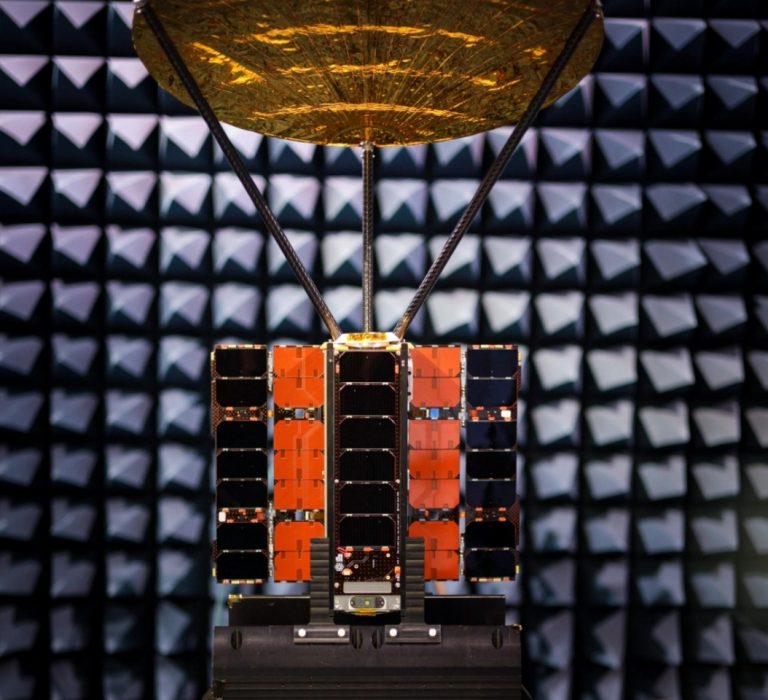
Space Systems Command successfully launched its Electro-Optical/Infrared (EO/IR) Weather Systems (EWS) cubesat technical demonstration this morning onboard the SpaceX Transporter-6 mission at 9:56 a.m. (Eastern, 6:56 a.m. Pacific) from Cape Canaveral Space Force Station, Florida.
This one-year EWS cubesat technical demonstration will prove out emerging space-based EO/IR radiometric imaging technology, using a smaller sensor to provide timely weather imagery data from low Earth orbit (LEO).
“The EWS cubesat technical demonstration effort represents SSC’s continued commitment to working with non-traditional partners to broaden the competitive industrial base. If successful, this will provide an innovative option to deliver Space-Based Environmental Monitoring data to the warfighter at an operationally relevant speed,” said Lt Col Joe Maguadog, EWS Materiel Leader and Program Manager. “This demonstration will inform our transition toward a more affordable, scalable, and resilient EO/IR weather constellation.”
In February 2002, the EWS program competitively selected two vendors to develop and launch two separate sensor prototypes. Orion Space Solutions, a non-traditional government contractor, delivered the cubesat for this demonstration. General Atomics Electromagnetic Systems Group will deliver the second prototype by 2025.
This launch satisfies the FY20 National Defense Authorization Act (NDAA) Congressional mandate to launch a weather EO/IR pathfinder prototype by FY23. The program expects the first transmittal of data early in the new year.
Many factors can limit the size of a group, including external ones that members have no control over. Astronomers have found that groups of stars in certain environments, however, can regulate themselves.
A new study has revealed stars in a cluster having “self-control,” meaning that they allow only a limited number of stars to grow before the biggest and brightest members expel most of the gas from the system. This process should drastically slow down the birth of new stars, which would better align with astronomers’ predictions for how quickly stars form in clusters.
This study combines data from several telescopes including NASA’s Chandra X-ray Observatory, NASA’s now-retired Stratospheric Observatory for Infrared Astronomy (SOFIA), the APEX (the Atacama Pathfinder EXperiment) telescope, and ESA’s (European Space Agency’s) retired Herschel telescope.
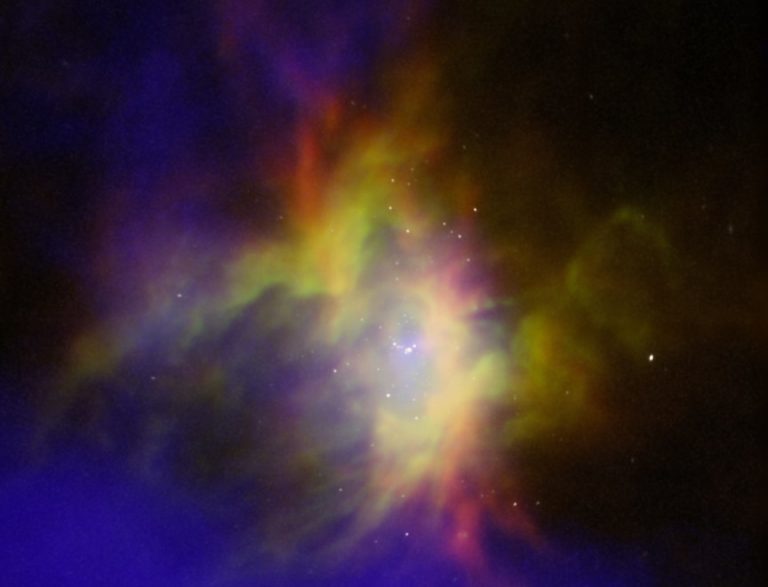
The target of the observations was RCW 36, a large cloud of gas called an HII (pronounced “H-two”) region mainly composed of hydrogen atoms that have been ionized — that is, stripped of their electrons. This star-forming complex is located in the Milky Way about 2,900 light-years from Earth. Infrared data from Herschel is shown in red, orange, and green, and X-ray data is blue, with point sources in white. North is 32 degrees left of vertical.
Image credit: X-ray: Chandra: NASA/CXC/U.Wisc-Madison/S. Heinz et al.; Swift: NASA/Swift/Univ. of Leicester/A. Beardmore; Optical: DSS; Sonification: NASA/CXC/SAO/K.Arcand, SYSTEM Sounds (M. Russo, A. Santaguida) Larger image
BeetleSat (the Company), formerly known as NSLComm, a fast-growing satellite technology start-up, today announced the successful launch of its second nanosatellite from Cape Canaveral, Florida, onboard a SpaceX Falcon 9 rocket.
Now in Sun-synchronous orbit (SSO) at 550Km altitude, the nanosatellite will provide BeetleSat’s public sector customer with store and forward, very high throughput satellite communication services. Today’s launch is another step forward in the Company’s strategy to become one of the world’s leading satellite service operators through the creation of a groundbreaking low-Earth orbit (LEO) constellation that will enable secure, low-latency, high-throughput, and cost-effective point-to-point communications from anywhere on earth.
With a payload designed by BeetleSat, the fully-digital nanosatellite weighs approximately 9 kg and transmits data at up to 2 Gbps. Using innovative Software Defined Radio (SDR) and a deployable antenna communication payload, it delivers a bit-rate performance level equal to a much larger satellite at a substantially lower capital expenditure.
BeetleSat’s LEO constellation will provide global and regional satellite operators, mobile network operators, and internet service providers high-quality global Ka-band connectivity for commercial and government applications, including point-to-point secure communications, mobility, and cellular backhaul/trunking services.
“Today’s successful launch provides important communication services to one of our public sector clients and marks a meaningful step forward in our mission to become a top LEO constellation operator delivering the highest-quality and most cost-effective satellite-based communication services,” said BeetleSat Executive President Patricio Northland. “We’re excited to explore new insights from all the data we’ll collect from this mission, but equally important, we’re eager to hear directly from our client how we can further enhance their experience with our company and technology.”
About BeetleSat
BeetleSat, formerly NSLComm, is a fast-growing satellite technology startup building a new low-Earth orbit (LEO) constellation that delivers exceptionally low-latency, high-throughput and cost-effective point-to-point secure communications, cellular backhaul/trunking, mobility and other services. Comprised of approximately 250 communication satellites equipped with BeetleSat’s proprietary Ka-band deployable antennas, the groundbreaking constellation promises to revolutionize the way satellite communication networks are designed and operated, providing commercial and public sector customers with truly global Ka-band connectivity, better performance and increased flexibility at a fraction of the cost of traditional systems. Deployed in partnership with ARQUIMEA and with service to commence in 2026, BeetleSat’s constellation will provide a premium complementary LEO layer for terrestrial and MEO/GEO networks suitable for global and regional operators and telecom service providers looking to enhance their existing solutions. For more information, visit www.BeetleSat.com.