Home Blog Page 57

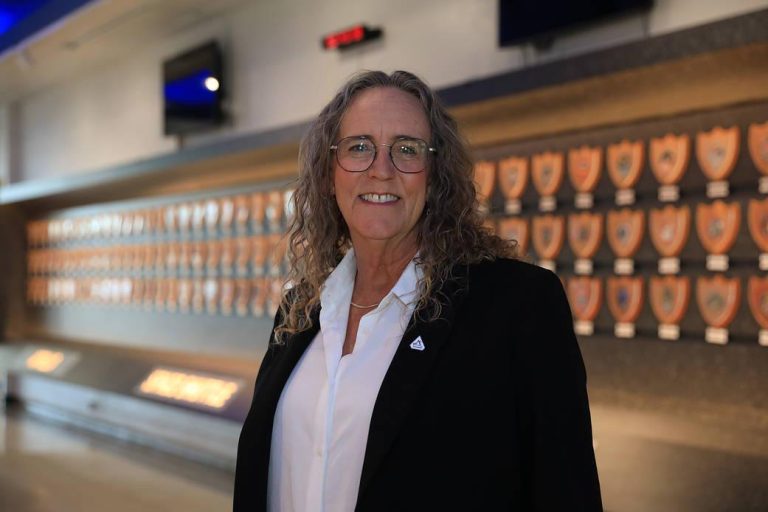
Systems Engineering Supervisor Amy Lendian

0

“When I was a kid, I grew up watching the Moon landings. I remember watching Neil Armstrong land on the Moon, step on the lunar surface. … And so, as a kid, I wanted to be an astronaut. That was the thing – everybody wanted to be an astronaut. As I grew up, I kind of lost track of that between everything, living life and whatnot.

“And so, a few years ago, when the pandemic hit, I was working for a construction contractor. Work stopped. There was nothing for me, and they laid me off. And I decided that I was due for a career change, and I wanted to get into aerospace. And I targeted, I worked very hard to find this job and to come work here.

“So here I am, a transgender woman, an engineer, working at Kennedy Space Center, and I get to work around these really smart, wonderful people, supporting the Artemis mission, sitting in the control room during the launch. And as a member of the LGBTQ community, I work with the LGBTQ+ Employee Resource Group and I try to be visible, to show folks who may still be in the closet that one can live their authentic life and be a part of something so amazing.

“I came across a picture of me when I was probably 10. … I’ve lived in Florida most of my life, so I [would] come over here on Scouting trips. I have a picture of me as a kid standing out [on] – it’s probably pad A – and the best I can figure, it’s Apollo 14 sitting on the pad behind me. So, I get a picture of me as a kid with [an] Apollo rocket behind me and I’ve had several pictures of me with the Artemis I rocket. … Just being able to be a part of this is amazing.”

— Amy Lendian, Systems Engineering Supervisor, Amentum Spaceport, NASA’s Kennedy Space Center

Image Credit: NASA / Kim Shiflett
Interviewer: NASA / Michelle Zajac

By: Thalia Patrinos
Originally published at NASA

3Q: Exploring The Universe’s “First Light”

0

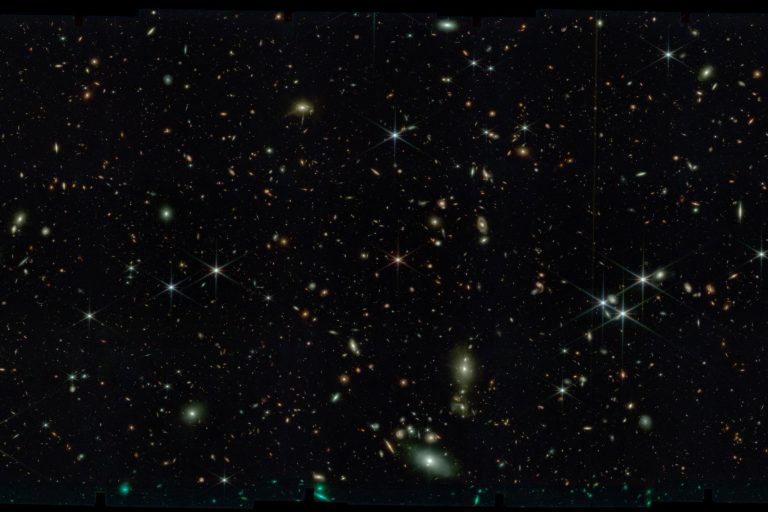
This image, taken by NASA’s James Webb Space Telescope in August 2022, features a small part of the sky (only the size of about one tenth of the diameter of the moon) around the brightest quasar that is known to date in the very distant universe. This quasar’s light has travelled more than 13 billion light years through our universe before it fell onto the mirrors of JWST. Credits: Credit: EIGER team

After the James Webb Space Telescope’s first year in service, astronomers are awash in new observations that illuminate the oldest stars and galaxies.

Jennifer Chu | MIT News Office

In its first year on the job, NASA’s James Webb Space Telescope has performed in ways that can only been described as stellar.

Launching at the tail end of 2021 after years of delays, the observatory — NASA’s largest and most expensive space telescope to date — has been living up to its hype. Last July, the public got a first look at the telescope’s power, when astronomers released one of the first images taken by the observatory, showing a cluster of spinning galaxies, each one captured in spectacular, luminous detail from 4.6 billion light years away.

Since then, JWST has peeled back more layers of cosmic dust to reveal stars, planets, galaxies, and other astrophysical structures with unprecedented clarity, both in our immediate galaxy and out to the farthest, earliest moments in time.

As JWST approaches its one-year anniversary, scientists are marking the milestone this week with a five-day conference at MIT dubbed “First Light.” The meeting brings together more than 150 astronomers from around the world, many of whom have worked directly with JWST data, looking for signs of the universe’s earliest light. The meeting will include a public event at the MIT Museum, where astronomers will share their experiences of working with the telescope. Conference organizer Anna-Christina Eilers, a Pappalardo Fellow in MIT’s Kavli Institute for Astrophysics and Space Research, gave MIT News some highlights of what astronomers have learned in JWST’s first year of observations, and what more the telescope could reveal in the coming years.

Q: What have astronomers seen so far of the universe’s “first light”?

A: Looking for the first light means that we are trying to look back in time at the very distant universe to try to see the light from the first objects that existed in the universe. And JWST has really allowed us to push this limit further back in time, so we are now able to pierce through the universe further than before.

JWST revealed a whole range of really surprising discoveries about the early universe. For instance, we found massive galaxies within the first few hundred million years of cosmic time. So, you’re looking back more than 13 billion years in time. We found galaxies that are a lot more massive, have a lot more stars, and are more evolved than what we had anticipated from our models for galaxy evolution. Similarly, we find supermassive black holes, which reside in the center of every galaxy, that are a lot more massive than our current models predict they could be at this very early cosmic time. These findings have opened more questions than they gave answers, because now we are trying to figure out how these galaxies and black holes can evolve to grow so rapidly in a very short amount of available cosmic time.

One of the major results that JWST has enabled is that we can now, for the first time, actually see the light of the host galaxies of quasars. Quasars are supermassive black holes in the center of galaxies that are actively growing and accreting material from their surroundings, and that accretion process makes these black holes incredibly luminous. Therefore, quasars are the most luminous objects that we know in the universe, and we can observe them at the largest distances and see them at the very beginning of cosmic time. A question that has always been unanswered is: What does the host galaxy of those quasars look like? Are they already really massive, which poses some challenges to the formation of these objects? Are the black holes growing first, and then the galaxies catch up later? That’s something we can study now for the first time.

Overall, it’s surprising that we have these very evolved objects at a time when we expected the universe to be in its infancy and to not have very many evolved objects at all. I don’t think anyone had expected to see so much stuff at such early cosmic times.

Q: What have people learned about how the telescope works in its first year?

A: The telescope is really outperforming on almost every level. It’s a lot more sensitive and has a lot more capabilities than people had imagined. For instance, for the program I’ve been working on in the past year, we were looking at quasar fields in the early universe, and we were expecting to find a few tens of galaxies in the field. The telescope allowed us to detect more than 100 galaxies in these fields, which is almost a factor of 10 higher than we anticipated.

It allows us to think more ambitiously and more adventurously in how we can use the telescope. The science proposals for the next year of observing are more creative and ambitious in what we want to try.

Q: What are you hoping to see in the second year of observations?

A: The program that I’m particularly excited about is aiming to understand how these very early supermassive black holes form. The question of how these black holes evolve from very small stellar remnants to these billion-solar-mass black holes, in a very short amount of cosmic time, has been really puzzling us. And now we find with JWST even more supermassive black holes in the very early universe, which is making the problem more challenging to explain.

The whole community had been waiting for decades for the instrument to launch, and now JWST is really revolutionizing our field. For this week, it’s a great time to bring people together to understand what the telescope’s first data looks like and what people have learned about how the instruments work. I hope that we will have a lot of good discussions about new ideas and results at this conference.

Reprinted with permission of MIT News (https://news.mit.edu/2023/3q-exploring-universes-first-light-0613)


Hubble Observes A Cosmic Sea Creature

0

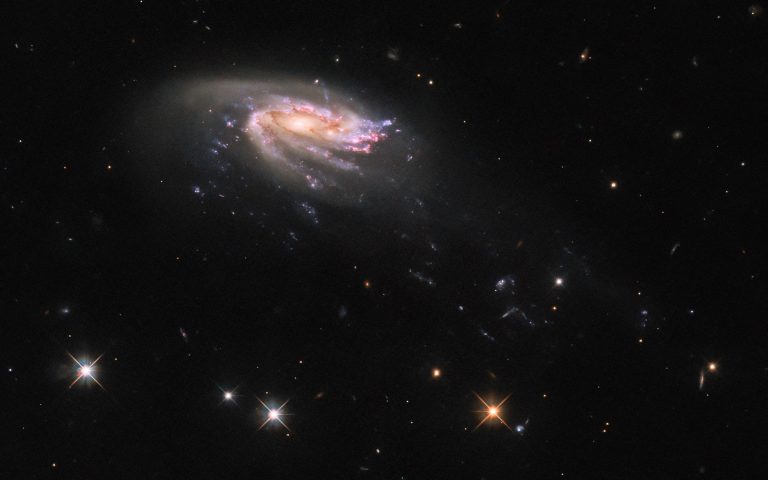
The jellyfish galaxy JO206 trails across this image from the NASA/ESA Hubble Space Telescope, showcasing a colorful star-forming disk surrounded by a pale, luminous cloud of dust. A handful of foreground bright stars with crisscross diffraction spikes stands out against an inky black backdrop at the bottom of the image. JO206 lies over 700 million light-years from Earth in the constellation Aquarius.

Jellyfish galaxies are so-called because of their resemblance to their aquatic namesakes. In the bottom right of this image, long tendrils of bright star formation trail the disk of JO206, just as jellyfish trail tentacles behind them. The tendrils of jellyfish galaxies are formed by the interaction between galaxies and the intra-cluster medium, a tenuous superheated plasma that pervades galaxy clusters. As galaxies move through galaxy clusters, they ram into the intracluster medium, which strips gas from the galaxies and draws it into the long tendrils of star formation.

The tentacles of jellyfish galaxies give astronomers a unique opportunity to study star formation under extreme conditions, far from the influence of the galaxy’s main disk. Surprisingly, Hubble revealed that there are no striking differences between star formation in the disks of jellyfish galaxies and star formation in their tentacles, which suggests the environment of newly formed stars has only a minor influence on their formation.

Text credit: European Space Agency (ESA)
Image credit: ESA/Hubble & NASA, M. Gullieuszik and the GASP team

Media Contact:

Claire Andreoli
NASA’s Goddard Space Flight CenterGreenbelt, MD
[email protected]

By: Andrea Gianopoulos
Originally published at NASA

Join the Movement: Provide Clean Water and Transform Lives

0

Imagine waking up every day without clean water. No refreshing glass to quench your thirst, no hygienic facilities to maintain your well-being. This is the reality for millions of people around the world. But together, we can change that. Introducing Charity Water, a non-profit organization on a mission to bring clean and safe drinking water to every person on the planet.

The Water Crisis

It’s easy to take water for granted when it flows effortlessly from our taps. However, for countless individuals, accessing safe drinking water is a daily struggle. Shockingly, around 1,000 children lose their lives each day due to waterborne diseases and inadequate sanitation. It’s a crisis that demands our attention and action.

Our Solution

Charity: water is committed to making a lasting impact on this global issue. By supporting charity: water’s projects, we’re able to implement simple yet life-changing solutions like drilled wells and spring protections. These initiatives provide sustainable access to clean water, significantly improving health, education, and livelihoods in communities around the world.

100% Transparency

We believe in full transparency. Every single dollar donated to charity: water goes directly towards building clean water projects. Thanks to the remarkable efforts of charity: water, you can rest assured that your contribution is making a tangible difference. Together, we can transform lives and break the cycle of poverty caused by the lack of clean water.

How You Can Help

We need your support to make a lasting impact. By donating to our campaign, no matter how big or small, you become a part of a global movement for change. Your generosity can help save lives and bring hope to those who need it most.

Spread the Word

Join us in spreading the word about this vital cause. Share this article, connect with us on social media, and encourage your friends, family, and colleagues to contribute to our campaign. Together, we can create a ripple effect of positive change, one drop at a time.

The time for action is now. Let’s come together to tackle the water crisis head-on. Your donation to charity: water will transform lives, empower communities, and give countless individuals the gift of clean water. Together, we can make a lasting difference and build a future where everyone has access to this basic necessity.

Donate today and be a catalyst for change. Together, let’s change the world, drop by drop. Click the banner below to donate – anything you can give is a huge help.

By: Dean Marc Co
Originally published at citi.io

Webb Telescope Captures Giant Water Plume Coming From Saturn’s Moon Enceladus

0

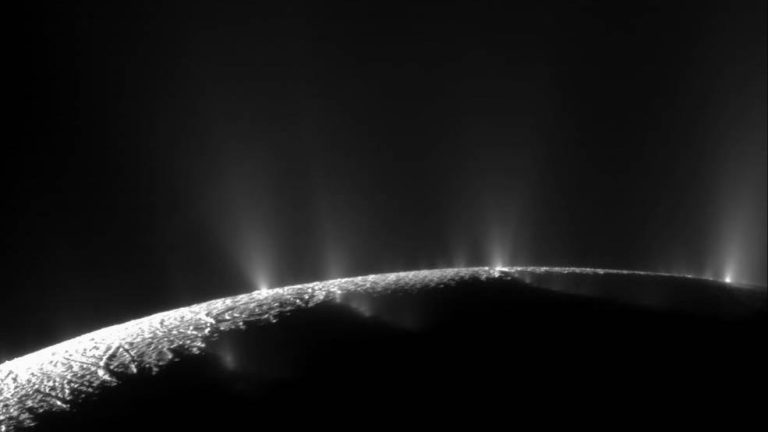
Saturn’s moon Enceladus.
Image credit: NASA/JPL/Space Science Institute.

In images captured from the James Webb Space Telescope, NASA scientists have spotted a massive geyser rocketing immense plumes of water vapor from the southern pole of Saturn‘s moon Enceladus, one of the only potentially-habitable celestial bodies in the solar system. Volcanic activity on Enceladus is launching water vapor 6,000 miles (10,000 km) from its surface, leaving a watery trail as the icy moon makes its way around Saturn. The new images may help researchers plan future missions to the frozen moon in search of habitable conditions or even signs of life.

Enceladus has captured planetary scientists’ attention because it is one of the only bodies in our solar system that could have the potential to sustain life. Below the moon’s icy crust lurks a sub-surface ocean (which is the source of the plume) that contains nitrogen and carbon compounds that are necessary for life.

Enceladus is 79 million miles from Earth, and this is the first time astronomers have captured any celestial body spewing giant plumes of water from such a distance. The Cassini Saturn orbiter took a snapshot of the moon’s dramatic waterworks when it flew by in 2005. The findings also show that Enceladus provides the rest of the moons orbiting Saturn with water, which may be affecting the composition of the entire system of Saturn and its rings.

Christopher Glein, an astronomer at the Southwest Research Institute who was involved in the Cassini mission but not in the current work, told SpaceRef that “it was shocking to actually know that the James Webb telescope can see that plume.” The findings now show that what Cassini captured wasn’t just a one-time occurrence, he adds; Enceladus is consistently shooting giant plumes of water into space.

Geronimo Villanueva, a planetary scientist at NASA Goddard Space Flight Center who led the study, told SpaceRef that when he and his team started the project, they didn’t expect to make any big discoveries. “That changed when we got this data,” he said.

The observations were captured within just four minutes of data. “It was pretty shocking,” Villanueva said. “When you point the Webb telescope and you see the moon, it’s a single pixel. Then you see the plume, which is covering your entire field of view. And it’s just water everywhere.”

“The Webb telescope such powerful instrumentation,” Sarah Faggi, an astronomer at NASA Goddard Space Flight Center who was involved in the work, told SpaceRef. “It’s incredible.”

The images were captured from Webb’s Near-Infrared Spectrograph (NIRSpec), which measures the emission spectra of incoming light to identify the molecular composition of faraway objects. The images showed that as Enceladus makes its 33-hour journey around Saturn, it creates a torus of water vapor collocated with Saturn’s outermost ring. The researchers estimated that about 30 percent of the water stays in the torus, while the rest goes elsewhere in the Saturn system, including to other moons.

“Enceladus is basically spilling out its guts and spewing water all over the place, so it’s going to affect the surface properties and chemistry on lots of moons of Saturn,” Glein said.

The scientists say that the new images will help them gear up for future missions and experiments to explore Enceladus, which will be conducted both on Earth and in space. So far, the researchers haven’t been able to detect any organic compounds in the plume, like carbon compounds and nitrogen compounds, which were detected in the Cassini mission. So, in the near term, astronomers plan to capture even more data with the James Webb Space Telescope in different parts of the orbit to look for these compounds.

“The search for life is a long process,” Villanueva said. But he adds that with these observations, “we can start planning ahead from here. Over the next 10 years, as we build things that go and fly to Enceladus, we can provide better guidance on where to go, where to land, where to make [more] observations.”

By: Natalia Mesa
Originally published at SpaceRef

A Cloudy Approach

0

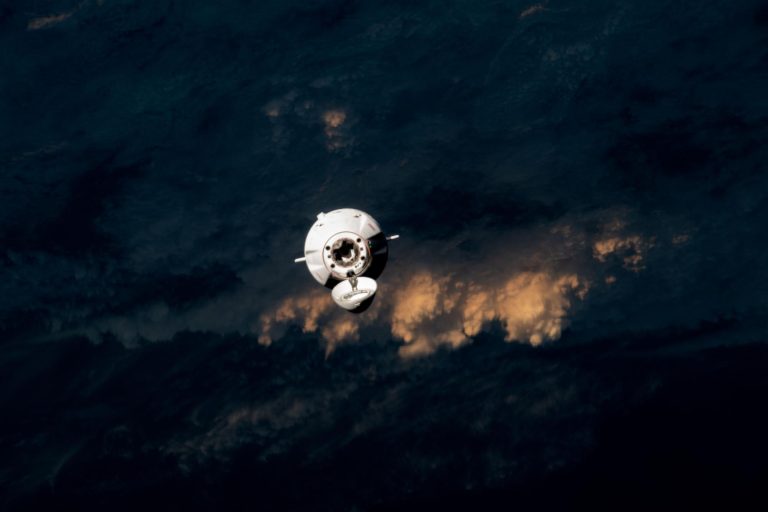
The last rays of an orbital sunset illuminate the cloud tops above the Pacific Ocean off the coast of Japan, providing a dramatic background for the SpaceX CRS-28 Dragon cargo craft as it approached the International Space Station for docking on June 6, 2023.

The uncrewed Dragon spacecraft carried scientific experiments and technology demonstrations, including studies of plant adaptation to stress and genetic structures called telomeres and deployment of satellite projects designed by students in Canada.

Image credit: NASA

By: Monika Luabeya
Originally published at NASA

Professor Michio Kaku visits THE LINE to learn about NEOM’s city of the future

0

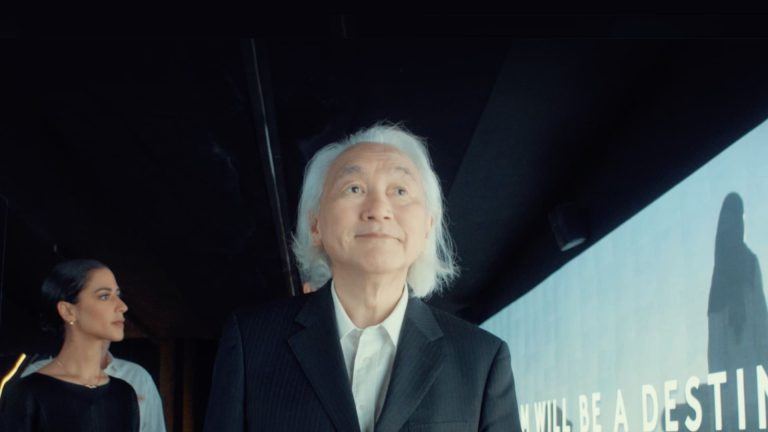
Renowned physicist, best-selling author and television presenter professor Michio Kaku has visited NEOM’s flagship project THE LINE, in Saudi Arabia, to see how the city of the future is coming together.

Accompanied by NEOM Urban Design Executive Director Tarek Qaddumi, THE LINE Executive Director Giles Pendleton and NEOM Senior Architect and Urban Planner Salwa Alkhudairi – professor Kaku saw both the construction site in NEOM and THE LINE exhibition in Riyadh.

His trip was documented in a new film titled ‘Placemakers’, which explores how and why THE LINE is being built and includes insights from professor Kaku himself and those experts building this place of the future.

Speaking in the film, professor Kaku said THE LINE could help tackle the traditional urban challenges of traffic, pollution, inequality and overcrowding – adding: “We can do better, we can create – perhaps out of the desert – a city that would be sustainable, livable.

“THE LINE shows us a new way of doing things. A template by which we can create cities of the future. By which other nations can compare their plans with what is being done here in Saudi Arabia. We are creating the future of the human race.”

In the video, Qaddumi addressed the full ambitions of the city, explaining: “We are working on an urban model that provides unprecedented livability. A model for nature, preservation and sustainability – all while providing a unique environment for economic growth.”

Also looking to the future, Pendleton said: “THE LINE is going to change things for the better because we can implement international best practice into every element of the city. Placemaking to me is about creating the canvas for community.”

And Alkhuadiri explained how the team had learned the lessons from history, stating: “We are working with the best architects and planners from around the world, in order to take all the learnings we’ve inherited from other cities and create a new city from scratch.”

THE LINE is a cognitive city stretching across 170 kilometers, from the epic mountains of NEOM across inspirational desert valleys to the beautiful Red Sea. A mirrored architectural masterpiece towering 500 meters high, but a land-saving 200 meters wide. It will redefine the concept of urban development and what cities of the future will look like.

This is the second episode of Placemakers, the first episode on Trojena having been published last year. Further episodes will follow, highlighting NEOM’s other regions.

Watch THE LINE Placemakers full-length film here (https://www.neom.com/en-us/regions/theline)
Watch the Trojena Placemakers full-length film here (https://www.neom.com/en-us/regions/trojena#placemakers)

The Technical Architecture And Components Of A.I. Systems

0

An effective AI system relies on various technical, infrastructure, network, storage, compute, and service architecture components working together. Here are some of the key components.

Hardware.

– CPUs (Central Processing Units): General-purpose processors that can handle a variety of tasks, including AI workloads.

– GPUs (Graphics Processing Units): Originally designed for graphics rendering, GPUs are now widely used for parallel computation in AI, particularly in training deep learning models.

– TPUs (Tensor Processing Units): Specialised hardware accelerators designed specifically for AI workloads, such as deep learning model training and inference.

– FPGAs (Field-Programmable Gate Arrays): Reconfigurable integrated circuits that can be tailored for specific AI tasks, offering a balance between flexibility and performance.

Storage.

– Local storage: Fast storage devices like SSDs (Solid State Drives) or HDDs (Hard Disk Drives) provide storage for AI systems.

– Distributed storage: Scalable storage solutions like Hadoop HDFS or object storage (e.g., Amazon S3) enable storing and managing large datasets required for AI workloads.

– In-memory storage: High-speed memory storage systems like Redis or Apache Ignite can store frequently accessed data to accelerate AI processing.

Network.

– High-speed networking: Low-latency, high-bandwidth networks are crucial for efficient data transfer and communication between AI system components.

– Load balancing: Distributing AI workloads across multiple servers or clusters to optimize resource utilization and performance.

– Edge computing: Deploying AI models and processing at the network edge, closer to the data sources, can reduce latency and improve responsiveness.

Compute.

Cloud computing: Public or private cloud infrastructure provides scalable computing resources for AI workloads, enabling rapid scaling and efficient resource utilization.

– On-premises data centers: Some organizations may prefer to build and maintain their data centers for AI workloads, especially when dealing with sensitive data or specific regulatory requirements.

– Serverless computing: Serverless platforms, like AWS Lambda or Google Cloud Functions, allow deploying AI models and processing as functions that automatically scale based on demand.

Image credits: Pexels – Manuel Geissinger

Software and frameworks.

– Machine learning frameworks: Libraries and tools like TensorFlow, PyTorch, and scikit-learn make it easier to develop, train, and deploy AI models.

– Data processing and analytics: Tools like Apache Spark, Hadoop, and Pandas enable efficient data processing, transformation, and analysis required for AI workloads.

– Containerization and orchestration: Technologies like Docker and Kubernetes simplify the deployment, management, and scaling of AI applications and services.

Services and APIs.

– AI Platform-as-a-Service (PaaS): Cloud providers offer AI platforms that abstract away underlying infrastructure and provide easy-to-use tools and services for developing, training, and deploying AI models.

– AI APIs: Pre-built AI models and services, such as natural language processing, computer vision, and speech recognition, can be accessed through APIs provided by cloud platforms or specialized AI vendors.

An effective AI system requires a well-integrated combination of these components, tailored to the specific requirements of the AI workload. Additionally, factors like security, privacy, and compliance must be considered to ensure responsible AI development and deployment.

NASA Awards $5 Million To Women’s Colleges Tackling STEM Gender Gap

0

An audience member asks a question at the Engaging Women and Girls in STEM through Data Science event on Wednesday, June 15, 2016, at NASA Headquarters in Washington. The event was held as part of the White House’s United State of Women Summit.
Credits: NASA/Aubrey Gemignani

As part of a Biden/Harris initiative, NASA will award more than $5 million in funding to seven Women’s Colleges and Universities (WCUs) to research and develop strategies that increase retention of women in STEM degree programs and careers.

The agency’s Minority University Research and Education Project (MUREP) created the Women’s Colleges and Universities opportunity to help women overcome obstacles and barriers to working in the fields of science, technology, engineering, and math.

This award seeks to address the significant national gender gap and disparate experiences of women in STEM in the United States, both in higher education and the workforce.

“This is a very exciting first; we’re making strides to close the pervasive gender gap in STEM, and Women’s Colleges and Universities are well-positioned to help drive that positive change,” said NASA Deputy Administrator Pam Melroy, a graduate from Wellesley College. “It’s more important than ever we have brilliant, enthusiastic people entering the workforce and ready to take on the ambitious plans and challenges ahead.”

Created in response to the White House Executive Order 14035 “Diversity, Equity, Inclusion, and Accessibility in the Federal Workforce,” this funding opportunity asked Women’s Colleges and Universities to take advantage of their expertise by developing programs that encompass academics, research, student support, college prep, career prep, mentoring, and more. NASA explores the unknown for all, and values diversity, equity, inclusion, and accessibility for the future STEM and agency workforce.

The gender gap is reflected in education and workforce data. Women earn 59% of undergraduate degrees compared to 41% of men, but only 10% of women’s degrees are in a STEM field as stated by the National Center of Education Statistics. This pattern follows women into the workplace, where they represent about 47% of the workforce, but only 27% of STEM jobs as stated by the U.S. Census Bureau. Among women of color in STEM, fewer than one in 20 are scientists and engineers. At NASA, 26% of the agency’s scientists and engineers are women.

These programs were developed to factor in gender, race, sexual orientation, socio-economic status, and other identities that can play a role in students’ career trajectories. Each awardee also will provide a guidebook of data, instructions, and best practices to serve as a blueprint for other Minority-Serving Institutions and Women’s Colleges seeking to create similar programs.

The selected institutions and their proposed projects are:

  • Agnes Scott College, Decatur, Georgia

Alumnae Network & Career Resources Program – STEM Support Anchored at Agnes Scott College

  • Alverno College, Milwaukee

Alverno College “Launching the Future”: An Intersectional Approach to Boosting Recruitment and Retention of Women in STEM Undergraduate Education

  • Cedar Crest College, Allentown, Pennsylvania

TOWERS – Tackling Obstacles for Women’s Engagement & Retention in STEM at Cedar Crest College

  • College of Saint Mary, Omaha, Nebraska

Project BLOOM for Women in STEM – Bolstering Learning, Opportunities, Outreach, and Mindfulness

  • Salem Academy and College, Winston-Salem, North Carolina

Soar With Salem: A Comprehensive Program to Inspire Women and Girls to Become the Next Generation of STEM Professionals

  • Simmons University, Boston

DREAM-WSTEM (Dynamic Research Education Academy for Mentoring Women in STEM)

  • Smith College, Northampton, Massachusetts

Developing a Pathway to MaRS (Math Resilient Students) in STEM: A Cascading Mentorship Model

MUREP is administered by NASA’s Office of STEM Engagement (OSTEM), which creates opportunities for students to contribute to the agency’s work and grow their confidence in STEM. For more information about OSTEM, visit:
 

https://stem.nasa.gov

-end-

Katherine Brown
Headquarters, Washington
202-358-1288
[email protected]

“A Field Guide To AI: For Business, Institutions, Society & Political Economy” — Your Essential Companion In Navigating the World of Artificial Intelligence.

0

This book is not just another textbook, academic journal, or report. It’s a unique blend—a field guide designed to help you get started and serve as a reminder of the essentials in the domain of Artificial Intellligence. It’s a collection of tidbits, facts, and counterpoints that will enrich your understanding of AI without the hype.

ai-book-banner-ad-001

Whether you are a business professional, a policy-maker, or a curious individual, this comprehensive resource is your key to navigating the complex landscape of AI. From its transformative impact on industries to its societal implications, “A Field Guide To AI” offers a compelling exploration of AI’s role in shaping our world. Gain a deep understanding of the technologies driving AI and how they can revolutionize your organization’s strategies, operations, and decision-making processes.

Discover how AI is reshaping the fabric of society and influencing political economies. Delve into thought-provoking discussions on ethical considerations, data privacy, and the future of work. Empower yourself to make informed decisions and become an active participant in shaping the AI-driven world we live in.

If you are a beginner eager to explore AI without feeling overwhelmed or an expert with a beginner’s mind and heart, this book is for you. It caters to those who seek constant reminders and need to stay informed in the industry. It serves as a must-have resource for anyone—individuals or institutions, businesspeople, laymen, techie, leaders, and students—aiming to make a difference in the world.

“A Field Guide To AI” comes in various formats—you can find it both in physical and electronic formats. It covers everything from comprehensive chapters to concise intros and thought-provoking conclusions. It’s meant to be with you at home, school, the office, or wherever your journey takes you. In a world saturated with information, misinformation, and pseudo-information, this book serves as a reliable baseline for understanding the complexities of AI.

It’s an opportunity to access knowledge that shouldn’t be reserved for the few. Don’t miss your chance to be at the forefront of this transformative journey. Grab your copy of “A Field Guide To AI: For Business, Institutions, Society & Political Economy” today and embrace the limitless possibilities of the AI era.

Originally published at cyberpogo.com