
Home Blog Page 58

NASA’s New Detectors Could Improve Views Of Gamma-Ray Events

0

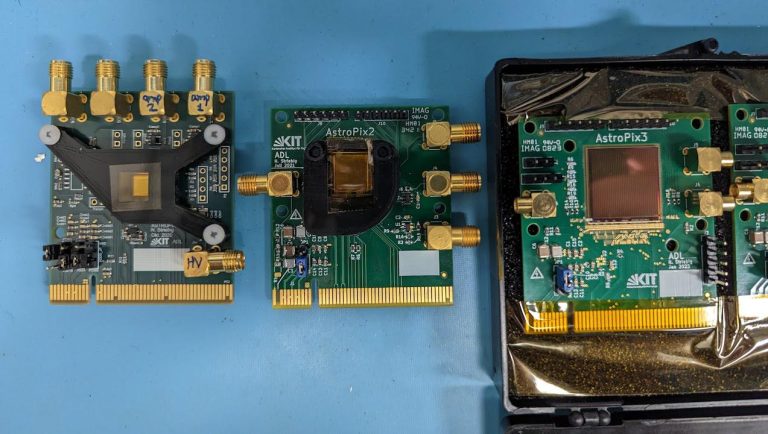
All three versions of AstroPix sensor chips are on display from the oldest on the left to version 3 on the right. Version three, which began testing in April 2023 has bigger pixels and improved functionality. Goddard’s Astropix team includes members around the world working together to develop and test a next generation gamma-ray detector. (Image credit: Regina Caputo)

Using technology similar to that found in smartphone cameras, NASA scientists are developing upgraded sensors to reveal more details about black hole outbursts and exploding stars — all while being less power hungry and easier to mass produce than detectors used today.

“When you think about black holes actively shredding stars, or neutron stars exploding and creating really high-energy bursts of light, you are looking at the most extreme events in the universe,” said research astrophysicist Dr. Regina Caputo. “To observe these events, you need to look at the highest-energy form of light: gamma rays.

Caputo leads an instrument-development effort called AstroPix at NASA’s Goddard Space Flight Center in Greenbelt, Maryland. The silicon pixel sensors in AstroPix — still in development and testing — are reminiscent of the semiconductor sensors that allow smartphone cameras to be so small.

“Gamma rays are notoriously tricky to measure because of the way that the incoming particle interacts with your detector,” said Dr. Amanda Steinhebel, a NASA Postdoctoral Program fellow working with Caputo.

Gamma rays are wavelengths of light more energetic than ultraviolet and X rays, and their photons act more like particles than waves. “Instead of just being absorbed by a sensor like visible light,” Steinhebel said, “gamma rays bounce all around.”

Gamma-ray bursts are the most luminous explosions in the cosmos. Astronomers think most occur when the core of a massive star runs out of nuclear fuel, collapses under its own weight, and forms a black hole, as illustrated in this animation. The black hole then drives jets of particles that drill all the way through the collapsing star at nearly the speed of light. These jets pierce through the star, emitting X-rays and gamma rays (magenta) as they stream into space. They then plow into material surrounding the doomed star and produce a multiwavelength afterglow that gradually fades away. The closer to head-on we view one of these jets, the brighter it appears. Credit: NASA’s Goddard Space Flight Center

NASA’s Fermi Gamma-ray Space Telescope, which has studied the gamma-ray sky since 2008, solved the “bounce” problem in its main instrument by using towers of strip-shaped sensors. This table-sized cube, Fermi’s Large Area Telescope, was itself groundbreaking technology when the mission launched.

Each strip maps a gamma-ray strike in a single-dimension, while layers of strips oriented perpendicular to each other record the second dimension. Gamma rays generate a cascade of energetic strikes through multiple layers, providing a map pointing back to the source.

About the size of a golf bag, a space telescope instrument using AstroPix sensors would require half as many layers as the Fermi strip detector technology, Caputo said.

“It’s easier to tell exactly where particles interact,” Steinhebel said, “because you just identify the point in the grid that it interacted with. Then you use multiple layers to literally trace back the paths that particles took through it.”

AstroPix could record lower-energy gamma rays than current technology, Steinhebel explained, because these photons tend to get lost filtering through the multiple layers of a strip detector. Capturing them would provide more information about what happens during short-lived, energetic events. “These low-energy gamma rays are most common during peak burst brightness,” she explained.

The pixel detectors also consume less electricity to operate, Caputo said, a major upside for future missions planning out their power usage.

Pixelated silicon detectors have been proven in particle accelerator experiments, she said, and their common use and mass production for cell phones and digital cameras make them easier and less expensive to obtain.

Developing different prototypes over multiple years and seeing AstroPix create accurate plots of gamma-ray light has been exhilarating and extremely satisfying, Steinhebel said.

While the team continues to work on developing and improving their technology, Caputo said the next step would be to launch the technology on a short sounding rocket flight for further testing above Earth’s atmosphere.

They hope to benefit a future gamma-ray mission intended to further the study of high-energy universe events.

“We can do such cool science with this,” Caputo said. “I just want to see that happen.”

By: Keith Cowing
Originally published at SpaceRef
Space Funding Boost For International Partnerships And STEM Education

0

The UK Space Agency has announced £6.6 million funding for a range of international science partnerships and STEM education projects.

The UK Space Agency has announced £6.6 million funding for a range of international science partnerships and STEM education projects at the opening of this year’s Space Comm-Expo in Farnborough – one of the UK’s largest space events. 

The new Science and Exploration Bilateral Programme is designed to support science collaborations with international institutions that will progress space research and problem-solving around the world.

The new Space to Learn scheme will boost initiatives dedicated to inspiring young people about space and improve access to STEM careers and learning opportunities all over the country.

Dr Paul Bate, Chief Executive of the UK Space Agency, said:

Successful international partnerships not only support the immediate mission or research area; they help us develop long-term research relationships address the critical challenges we face on Earth and in space.

This new bilateral funding multiplies up our agency’s impact by bringing in international investment. This helps to galvanise global innovation, drive up investment in the UK, deliver new missions and capabilities, and to champion the power of space to improve lives and understand the Universe.

As the UK’s space ambitions increase, investing in STEM programmes is equally critical. We want to make sure that every young person across all communities can be inspired through space, imagining new possibilities and innovations to which they can contribute, drawing on their growing STEM knowledge, and having fun learning along the way.

The first nine projects selected for funding from the bilateral programme will link UK organisations with the US, Japan, Canada and Europe, using £2.3 million UK Space Agency funding to develop collaborative proposals for new space science and exploration missions.

One project will see Imperial College London team with the University of New Hampshire to design magnetometers for NASA’s HelioSwarm mission, which will improve our understanding of space weather by using a “swarm” of nine small spacecraft to measure solar winds.

There is also on work from the University of Cambridge on CosmoCube, a NASA-led radio-cosmology mission that will explore the so-called Dark Ages of the Universe, and a collaboration between Royal Holloway and Indian Space Research to develop crucial radars for the Shukrayaan mission to Venus, due in 2026.

Meanwhile, the Space to Learn programme will channel £4.3 million UK Space Agency funding into four major educational projects.

These include the National Space Academy’s series of 1,000 specialised masterclasses, engaging more than 40,000 students with science career opportunities; the Jon Egging Trust’s Blue Skies initiative delivering 28,000 hours of space-related education resources to students, and the Association for Science and Discovery Centre’s Our World From Space programme, launching this summer across 22 science centres and museums to help schoolchildren and families discover the relevance of UK space science for the future health and sustainability of our home planet.

The funding will also help the European Space Education and Resource Office run its Space Inspirations scheme, which sees regional volunteers from the space sector work with more than one million children across the UK, creating learning experiences that help young people to engage with the space sector in a way that they can really connect with.

Nuview Plans to Map the Earth Using LiDAR Satellites

0

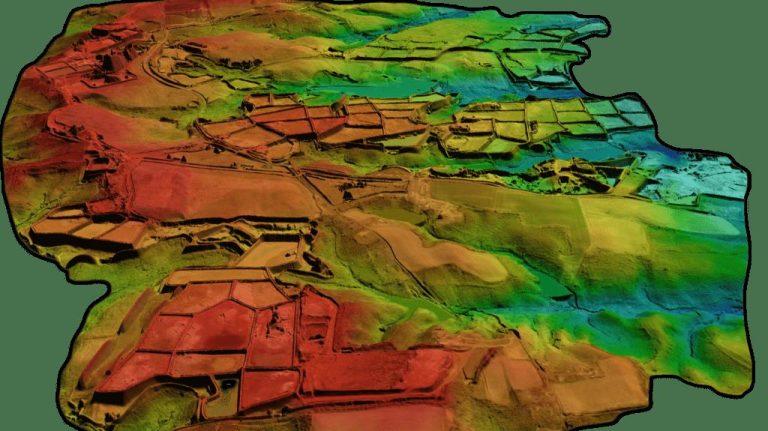
An example of 3D mapping produced by LiDAR.
Image credit: Nuview.

Clouds and darkness: These are the two challenges that bedevil every Earth observation (EO) satellite that relies on visible light cameras. But lasers can pierce both, which is why Nuview, an EO company based in Lake Nona, Florida, is building the world’s first commercial LiDAR satellite constellation to fulfill its goal of mapping the planet in 3D.

Short for “Light Detection And Ranging,” LiDAR uses a pulsed laser system to measure variable distances (in this case) from space to the Earth — it’s the same technology some semiautonomous car manufacturers use to enable their vehicles to map their surroundings, and has also been used to map the Moon. When LiDAR is integrated with GPS data, Nuview expects the result to be a 3D map of the Earth’s surface and above-ground features that can be captured and updated regardless of lighting and cloud-cover conditions. It’s even expected to penetrate vegetation, revealing what’s on the ground beneath.

“At Nuview, our goal is to map the entire Earth once a year, providing unprecedented access to accurate, up-to-date global data powered by 20 satellites in orbit,” Nuview founder and CEO Clint Graumann told SpaceRef. “Traditionally, when LiDAR was used for mapping here on Earth, it’s done with unscalable and expensive platforms like aircraft and drones. Nuview’s technology is significant in that it will allow for large areas to be scanned at once.”

According to Graumann, NuView plans to start launching the first of its satellites in the next 24 to 36 months. “Subsequently, the plan is to launch future satellites in four groups of five, each spaced by 18 months,” he added.

Once Nuview has its 20 LiDAR satellites in service, they will map the Earth from space on an ongoing basis, with the goal of producing a new whole planet map each year.

Last month (on May 22), Nuview just secured its first binding contract, worth $2.75 million, with the US Department of Defense (DoD), through a DoD initiative called National Security Innovation Capital (NSIC) that funds startups’ product development. Nuview also has agreements with organizations in the energy, telecommunications, and agricultural fields, Graumann told SpaceRef.

“Mapping the Earth using LIDAR is an ongoing endeavor for Nuview,” said Graumann. “We are committed to continually advancing our technology and expanding our mapping capabilities. As new advancements emerge and client demands evolve, we will adapt our approach to provide the most up-to-date and accurate geospatial information.”

By: James Careless
Originally published at SpaceRef

NASA To Discuss Conclusions Of Psyche Mission Independent Review Board

0

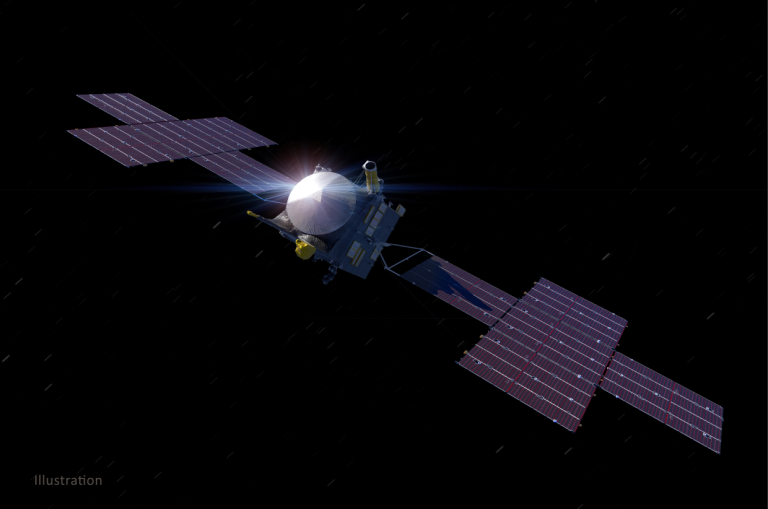
This illustration depicts NASA’s Psyche spacecraft. Set to launch in 2023, the Psyche mission will explore a metal-rich asteroid of the same name that lies in the main asteroid belt between Mars and Jupiter.
Credits: NASA/JPL-Caltech/ASU

NASA will host a media teleconference at 4 p.m. EDT on Monday, June 5, to discuss the follow-up report by the Psyche mission independent review board. The new assessment reviews corrective actions taken following the November 2022 report.

Audio of the media call will stream live at:

https://www.nasa.gov/live

Convened in July 2022 by NASA and the agency’s Jet Propulsion Laboratory (JPL) in Southern California, the board examined factors contributing to the Psyche mission’s request to delay its August 2022 launch. The mission’s new launch period opens Oct. 5, 2023. The spacecraft will investigate a metal-rich asteroid of the same name that may be the partial core of a planetesimal, a building block of rocky planets in our solar system.

Briefing participants include:

  • Nicola Fox, associate administrator for Science Mission Directorate, NASA Headquarters, Washington
  • Lori Glaze, division director for Planetary Sciences, NASA Headquarters
  • Laurie Leshin, director, Jet Propulsion Laboratory in Southern California
  • Thomas Young, chair, independent review board

Media interested in participating in the call should send their full name, media affiliation, email address, and phone number to Erin Morton no later than two hours before the start of the call at: [email protected]. A copy of NASA’s media accreditation policy is available online.

-end-

Gravitational-Wave Detectors Start Next Observing Run To Explore The Secrets Of The Universe

0

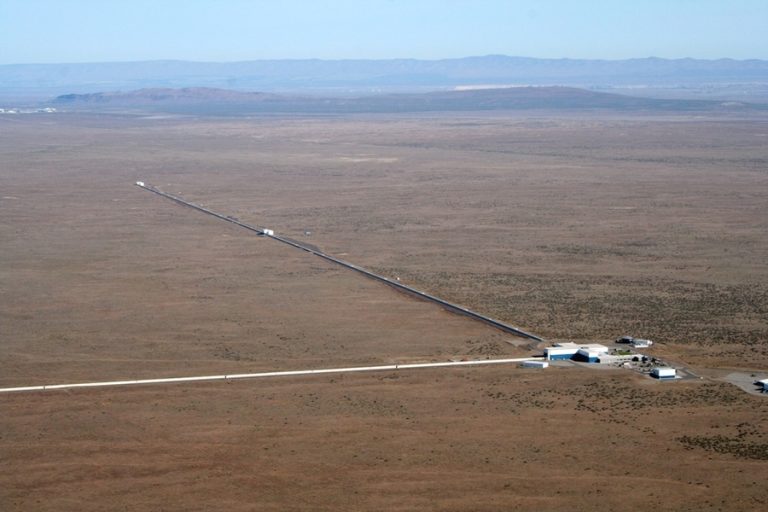
LIGO laboratory detection site near Hanford in eastern Washington.
Image: Caltech/MIT/LIGO Laboratory

The next run will be the most sensitive search yet for gravitational waves.

By: MIT News Office
Originally published at MIT News (https://news.mit.edu/2023/gravitational-wave-detectors-start-next-observing-run-0525)

The following article is adapted from a press release issued by the Laser Interferometer Gravitational-wave Observatory (LIGO) Laboratory, in collaboration with the LIGO Scientific Collaboration and Virgo Collaboration. LIGO is funded by the National Science Foundation (NSF) and operated by Caltech and MIT, which conceived and built the project.

On Wednesday, the LIGO-Virgo-KAGRA (LVK) collaboration began a new observing run with upgraded instruments, new and even more accurate signal models, and more advanced data analysis methods. The LVK collaboration consists of scientists across the globe who use a network of observatories — LIGO in the United States, Virgo in Europe, and KAGRA in Japan — to search for gravitational waves, or ripples in space-time, generated by colliding black holes and other extreme cosmic events.

This observing run, known as O4, promises to take gravitational-wave astronomy to the next level. Beginning on May 24 and lasting 20 months, including up to two months of commissioning breaks, O4 will be the most sensitive search yet for gravitational waves. LIGO will resume operations May 24, while Virgo will join later in the year. KAGRA will join for one month, beginning May 24, rejoining later in the run after some upgrades. 

“Thanks to the work of more than a thousand people around the world over the last few years, we’ll get our deepest glimpse of the gravitational-wave universe yet,” says Jess McIver, the deputy spokesperson for the LIGO Scientific Collaboration (LSC). “A greater reach means we will learn more about black holes and neutron stars and increases the chances we find something new. We’re very excited to see what’s out there.”

The Virgo detector will continue commissioning activities in order to increase its sensitivity before joining O4 later this year. “Over the past few months we have identified various noise sources and have made good progress in sensitivity, but it is not yet at its design goal,” says recently elected Virgo spokesperson Gianluca Gemme. “We are convinced that achieving the best detector sensitivity is the best way to maximize its discovery potential.”

KAGRA is now running with the sensitivity planned for the beginning of O4. Jun’ichi Yokoyama, the chair of KAGRA Scientific Congress, says, “KAGRA is the first 2.5th generation detector in the world which started 20 years after LIGO. We will join O4 for one month and resume commissioning to further improve the sensitivity toward our first detection.”

With the detectors’ increased sensitivity, O4 will observe a larger fraction of the universe than previous observing runs. 

This increased sensitivity will result in a higher rate of observed gravitational-wave signals and in the ability to extract more physical information from the data. This increased signal fidelity will improve scientists’ ability to test Einstein’s theory of general relativity and infer the true population of dead stars in the local universe.

“Data from the previous runs have answered some questions but also created new puzzles. We have discovered that the masses of black holes in our binaries seem to include a cluster at roughly 35 solar masses, but we don’t quite yet know what astrophysical processes are creating that feature, nor whether there are other ‘bumps’ in the mass distribution. More sources will help,” says Salvatore Vitale, an associate professor at MIT, describing the importance of increasing the sensitivity of the gravitational-wave detectors.

The first gravitational-wave signals were detected in 2015. Two years later, LIGO and Virgo detected a merger of two neutron stars, which caused an explosion called a kilonova, subsequently observed by dozens of telescopes around the world. So far, the global network has detected more than 80 black hole mergers, two probable neutron star mergers, and a few events that were most likely black holes merging with neutron stars. During O4, researchers expect to observe even more energetic cosmic events and gain new insights into the nature of the universe.

As in previous observing runs, alerts about gravitational-wave detection candidates will be distributed publicly during O4.

LIGO is funded by the NSF, and operated by Caltech and MIT, which conceived and built the project. Financial support for the Advanced LIGO project was led by NSF with Germany (Max Planck Society), the U.K. (Science and Technology Facilities Council) and Australia (Australian Research Council) making significant commitments and contributions to the project. More than 1,500 scientists from around the world participate in the effort through the LIGO Scientific Collaboration, which includes the GEO Collaboration.

The Virgo Collaboration is currently composed of approximately 850 members from 143 institutions in 15 different (mainly European) countries. The European Gravitational Observatory (EGO) hosts the Virgo detector near Pisa in Italy, and is funded by Centre National de la Recherche Scientifique (CNRS) in France, the Istituto Nazionale di Fisica Nucleare (INFN) in Italy, and the National Institute for Subatomic Physics (Nikhef) in the Netherlands.

KAGRA is the laser interferometer with 3-kilometer-arm-length in Kamioka, Gifu, Japan. The host institute is the Institute for Cosmic Ray Research (ICRR), the University of Tokyo, and the project is co-hosted by the National Astronomical Observatory of Japan (NAOJ) and High Energy Accelerator Research Organization (KEK). The KAGRA collaboration is composed of over 480 members from 115 institutes in 17 countries/regions. Resources for researchers are accessible from http://gwwiki.icrr.u-tokyo.ac.jp/JGWwiki/KAGRA.

Reprinted with permission of MIT News (http://news.mit.edu/)

Lockheed Martin To Collaborate With U.S. Army To Improve Space-Enabled Defense Systems

0

LITTLETON, Colo., May 30, 2023 – Lockheed Martin signed a Cooperative Research and Development Agreement (CRADA) with the U.S. Army Combat Capabilities Development Command’s Aviation and Missile Center (AvMC) to advance Beyond Line of Sight (BLOS) connectivity. Under this CRADA, Lockheed Martin and AvMC will jointly develop and demonstrate space-enabled defense systems.

What It Means: Through this CRADA, Lockheed Martin and the U.S. Army will conduct design, development, integration, and test risk reduction activities utilizing AvMC’s Redstone Arsenal, Alabama-based System Integration Lab (SIL) to identify and develop concepts of operations for linking ground-based platforms to the space domain.

“Lockheed Martin brings a legacy of experience in supporting our tactical warfighters, and we recognize the importance of providing them with next generation capabilities,” said John Schierling, Lockheed Martin director for Tactical Space Programs. “Our collaboration with AvMC will assist in developing a more effective, survivable and affordable battlefield-connected 21st century security technology for our government customers and international allies by connecting platforms with space assets, helping deter future threats.”

What Will Be Tested: The team will investigate capabilities that improve satellite communications (SATCOM) to defense systems, identify overlapping capabilities that can facilitate connectivity, look for capability gaps, conduct hardware-in-the-loop tests, test the connectivity between platforms at various speeds, explore ancillary use of communications systems and more.

Where and When: As work begins, the team will leverage the SIL for its integration, test and analysis tools to support evolving prototypes. The SIL’s advanced modeling and simulation tool suite will enable the team to accelerate the delivery of experimental prototypes and align technical performers across government agencies and industry.

About Lockheed Martin

Headquartered in Bethesda, Maryland, Lockheed Martin Corporation is a global security and aerospace company that employs approximately 116,000 people worldwide and is principally engaged in the research, design, development, manufacture, integration and sustainment of advanced technology systems, products and services.

Please follow @LMNews on Twitter for the latest announcements and news across the corporation, @LMSpace to learn more about the latest technologies, missions and people driving the future of space.

New Mexico Students To Hear From NASA Astronauts Aboard Space Station

0

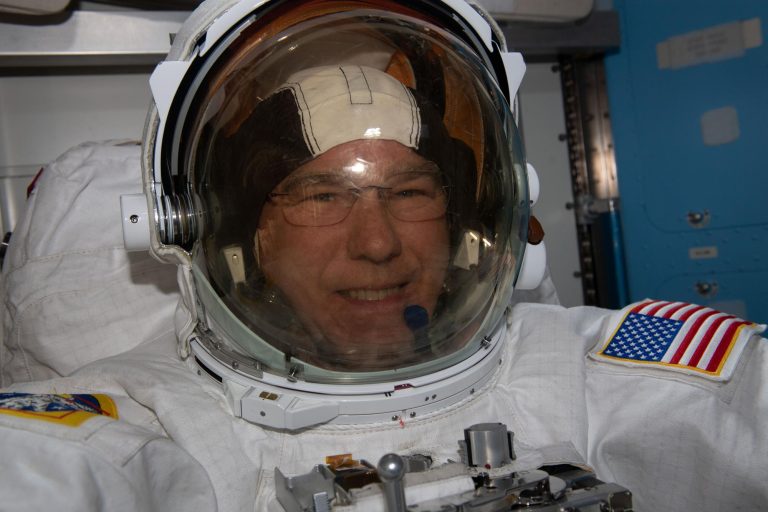
NASA astronaut Steve Bowen prepares for a spacewalk in the International Space Station’s Quest airlock during Expedition 69.
Credits: NASA

Editor’s Note: This advisory was updated on May 27, 2023 to correct the time of the Earth-to-space call.

Students from southern New Mexico schools will have an opportunity to hear from NASA astronauts aboard the International Space Station.

The Earth-to-space call will air live at 12:30 p.m. EDT Tuesday, May 30, on NASA Television, the NASA app, and the agency’s website.

NASA astronauts Steve Bowen and Frank Rubio will answer prerecorded questions from students through a collaboration with the New Mexico Museum of Space History. The museum is dedicated to telling the story of space exploration and has engaged several school districts in southern New Mexico to participate in the downlink. The museum’s educators traveled to each district and presented information about the space station and its Expedition 69 crew, then worked with the students to develop the questions posed to the astronauts.

Media interested in covering the event should respond no later than 5 p.m. on Monday, May 29 to Cathy Harper at: [email protected] or 575-437-2840 x.41153.

For more than 22 years, astronauts have continuously lived and worked aboard the space station, testing technologies, performing science, and developing the skills needed to explore farther from Earth. Astronauts living in space aboard the orbiting laboratory communicate ]with NASA’s Mission Control Center in Houston 24 hours a day through the Space Communications and Navigation (SCaN) Near Space Network.

Important research and technology investigations aboard the International Space Station benefit people on Earth and set the groundwork for future exploration. As part of Artemis, NASA will send astronauts to the Moon to prepare for future human exploration of Mars. Inspiring the next generation of explorers – the Artemis Generation – ensures America will continue to lead in space exploration and discovery.

See videos and lesson plans highlighting research on the International Space Station at:

https://www.nasa.gov/stemonstation

NASA Pursues Lunar Terrain Vehicle Services For Artemis Missions

0

Artist’s concept of NASA’s next-generation Lunar Terrain Vehicle on the surface of the Moon.
Credits: NASA

NASA is seeking industry proposals for a next-generation LTV (Lunar Terrain Vehicle) that will allow astronauts to go farther and conduct more science than ever before as they explore the south polar region of the Moon during Artemis missions.

Artemis astronauts will drive to explore and sample more of the lunar surface using the LTV than they could on foot. NASA will contract LTV as a service from industry rather than owning the rover. Contracting services from industry partners allows NASA to leverage commercial innovation and provide the best value to U.S. taxpayers while achieving its human spaceflight scientific and exploration goals.

“We want to leverage industry’s knowledge and innovation, combined with NASA’s history of successfully operating rovers, to make the best possible surface rover for our astronaut crews and scientific researchers,” said Lara Kearney, manager of NASA’s Extravehicular Activity and Human Surface Mobility program at the agency’s Johnson Space Center in Houston.

The LTV will function like a cross between an Apollo-style lunar rover and a Mars-style uncrewed rover. It will support phases driven by astronauts and phases as an uncrewed mobile science exploration platform, similar to NASA’s Curiosity and Perseverance Mars rovers. This will enable continued performance of science even when crews are not present on the lunar surface. Artemis astronauts will use the LTV to traverse the lunar surface and transport scientific equipment, extending the distances they can cover on each moonwalk.

Under the Lunar Terrain Vehicle Services request for proposals, NASA has provided requirements for companies interested in developing and demonstrating the LTV, including an approach that encourages companies to produce an innovative rover for use by NASA and other commercial customers for multiple years.

Engineers will be able to operate the LTV remotely to transport cargo and scientific payloads between crewed landing sites, enabling additional science returns, resource prospecting, and lunar exploration. This will expand scientific research opportunities on the Moon during uncrewed operations, allow scientists to investigate future surface mission locations, and inform research goals and objectives for each site. 

To handle the unique environment near the lunar South Pole, which includes permanently shadowed regions and extended periods without sunlight, the LTV will need to incorporate several systems to support both crewed and uncrewed operations. Some of the more critical systems include advanced power management, semi-autonomous driving, state-of-the-art communication and navigation systems, and protection from the extreme environment.

As part of the proposals, companies are required to provide end-to-end services, from development and delivery to the lunar surface, to execution of operations. Each rover must be able to carry two suited astronauts, accommodate a robotic arm or mechanism to support science exploration, and survive the extreme temperatures at the lunar South Pole. The company will be asked to successfully demonstrate the LTV in the lunar environment prior to using it in a crewed capacity.  

NASA intends to use the LTV for crewed operations beginning with Artemis V in 2029. Prior to crew arrival, the rover will be used for uncrewed and commercial activities once it lands on the lunar surface.

Proposals for the LTV services contract are due July 10, 2023, with the contract award scheduled for November 2023. This request for proposals incorporates feedback from industry through a draft request for proposals and a previous request for information.

Through Artemis, NASA will send astronauts – including the first woman and first person of color – to explore the Moon for scientific discovery, economic benefits, and to build the foundation for crewed missions to Mars. Together, NASA’s Space Launch System rocket, Orion spacecraft, Gateway lunar orbital outpost, advanced spacesuits and rovers, and human landing systems are the agency’s foundation for deep space exploration.

Learn more about this request for proposals at:

https://www.nasa.gov/jsc/procurement/ltv

-end-

Vanessa Lloyd / Kathryn Hambleton 
Headquarters, Washington 
202-397-0807 / 202-358-1100 
[email protected] / [email protected]  

Tim Hall
Johnson Space Center, Houston
281-483-5111
[email protected]

NASA Sets Coverage For Axiom Mission 2 Departure From Space Station

0

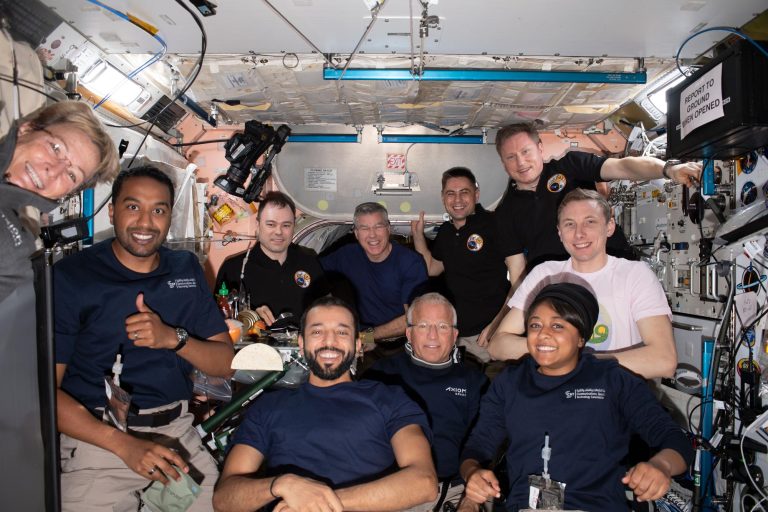
The Axiom Mission-2 and Expedition 69 crew members pose for a portrait together during dinner time aboard the International Space Station. In the center front row, is Expedition 69 crew member and UAE (United Arab Emirates) astronaut Sultan Alneyadi flanked by (from left) Axiom Mission-2 crew members Commander Peggy Whitson, Mission Specialist Ali Alqarni, Pilot John Shoffner, and Mission Specialist Rayyanah Barnawi. In the back (from left) are, Expedition 69 crew members Roscosmos cosmonaut Dmitri Petelin, NASA astronaut Stephen Bowen, Roscosmos cosmonauts Andrey Fedyaev and Sergey Prokopyev, and NASA astronaut Woody Hoburg. Not pictured is NASA astronaut Frank Rubio.
Credits: NASA

NASA will provide live coverage of the undocking and departure of Axiom Mission 2 (Ax-2) private astronaut mission from the International Space Station before crew returns to Earth.

The four-member multinational astronaut crew is scheduled to undock no earlier than 11:05 a.m. EDT Tuesday, May 30, from the space-facing port of the station’s Harmony module in a SpaceX Dragon spacecraft to begin the journey home and splashdown off the coast of Florida.

NASA will begin live coverage of space station joint operations with Axiom Space and SpaceX, starting with hatch closure preparations at 9 a.m. Tuesday, May 30, on NASA Television, the NASA app, and the agency’s website.

Mission teams will monitor weather at the possible splashdown sites prior to undocking to ensure conditions are acceptable for a safe recovery of the spacecraft and Ax-2 astronauts.

Ax-2 Commander Peggy Whitson, Pilot John Shoffner, and Mission Specialists Ali Alqarni and Rayyanah Barnawi, both representing the Kingdom of Saudi Arabia, will complete approximately nine days in space at the conclusion of their mission. Their SpaceX Dragon will return to Earth with more than 300 pounds of cargo, including NASA hardware and data from over 20 different experiments.

NASA’s undocking and departure coverage for Ax-2 is as follows (all times Eastern and subject to change based on operations):

Tuesday, May 30

9 a.m. – NASA coverage begins for 9:10 a.m. hatch closure

10:45 a.m. – NASA coverage resumes for 11:05 a.m. undocking

NASA coverage will end approximately 30 minutes after undocking when space station joint operations end with the Axiom Space and SpaceX mission teams. Axiom Space will resume coverage of Dragon’s re-entry and splashdown on the company’s website.

Axiom Space will resume coverage of Dragon’s re-entry and splashdown on the company’s website.

The Ax-2 mission represents both a culmination of NASA’s efforts to foster a commercial market in low Earth orbit and the beginning of a new era of space exploration that enables more people to fly on more kinds of missions. This partnership is changing the arc of human spaceflight history by opening access to low Earth orbit and the International Space Station to more people, more science, and more commercial opportunities.

-end-

NASA, Rocket Lab Complete Launch Of TROPICS CubeSat Constellation

0

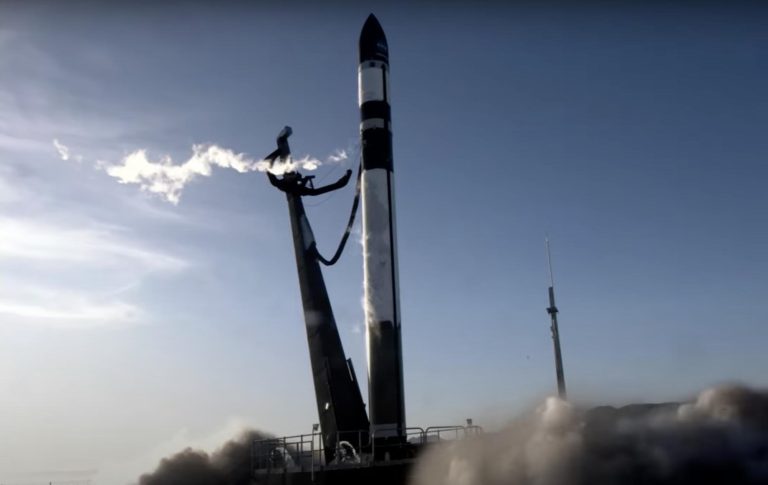
Rocket Lab’s Electron rocket lifts off from Launch Complex 1 at Māhia, New Zealand at 3:46 p.m. NZST May 26, 2023 carrying two TROPICS CubeSats for NASA.
Credits: Rocket Lab

The final pair of NASA’s TROPICS (Time-Resolved Observations of Precipitation structure and storm Intensity with a Constellation of Smallsats) are in orbit after successfully launching at 3:46 p.m. NZST Friday, May 26 (11:46 p.m. EDT Thursday, May 25), completing the constellation.

TROPICS launched aboard an Electron rocket from Rocket Lab’s Launch Complex 1 Pad B in Māhia, New Zealand. The smallsats were deployed at 12:20 a.m. EDT May 26. Signal for the first CubeSat was acquired at 1:16 a.m., and at 2:19 a.m., for the second.

Through this mission, NASA will study tropical cyclones and aims to improve forecasting for hurricanes and typhoons.

“As a lifelong Floridian, I know firsthand how critical it is for millions of Americans to have timely and accurate forecasts for hurricanes. More intense rainfall and increased coastal flooding are devastating livelihoods and taking lives, demonstrating the importance of NASA’s cutting-edge science to help answer questions that nobody else can,” said NASA Administrator Bill Nelson. “With missions like TROPICS, NASA continues to lead the way in getting satellite data more quickly to our partners like the National Hurricane Center and Joint Typhoon Warning Center, providing vital forecasts that help our communities before, during, and after landfall.”

This launch follows a previous successful TROPICS launch with two other small satellites earlier this month.

“As we move into hurricane season for 2023, TROPICS will be in position to provide unprecedented detail on these storms, helping us better understand how they form, intensify, and move across the ocean,” said Karen St. Germain, lead of NASA’s Earth Science Division. “We rely on targeted, innovative missions like this to help create a robust Earth science portfolio.”

TROPICS is a constellation of four identical CubeSats designed to observe tropical cyclones in a unique, inclined low Earth orbit over Earth’s tropics – an orbit that allows them to travel over any given storm about once an hour. Current weather tracking satellites have a timing of about once every six hours.

“We are very excited to have the four satellites launched. We expect the new observing capabilities from TROPICS will improve our understanding of tropical cyclones and our ability to predict their track and intensity,” said William Blackwell, the mission’s principal investigator at MIT’s Lincoln Laboratory in Lexington, Massachusetts.

In addition to Blackwell, the TROPICS team includes researchers from NASA, the National Oceanic and Atmospheric Administration, and several universities and commercial partners. NASA’s Launch Services Program, based at the agency’s Kennedy Space Center in Florida, is managing the launch service.

For more information about NASA’s TROPICS, visit:

https://go.nasa.gov/3h46pJp