
Home Blog Page 61

With Possible Liquid Oceans On Moons Of Uranus, Mission Funding May Soon Follow

0
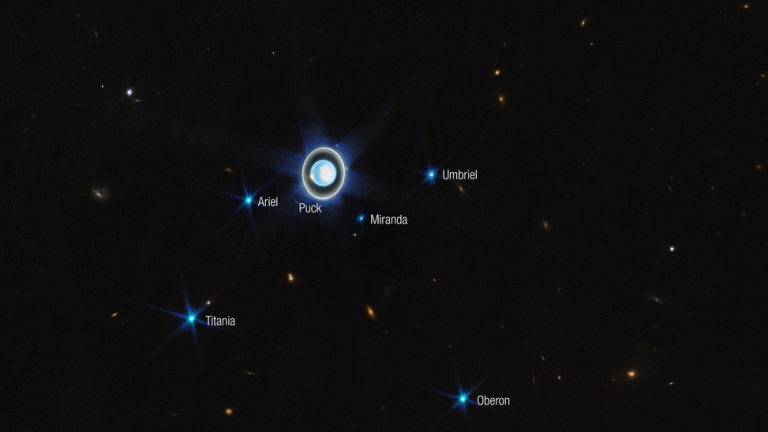
View of the Uranian system with the James Webb Space Telescope’s NIRCam instrument features the planet Uranus as well as six of its 27 known moons (most of which are too small and faint to be seen in this short exposure). A handful of background objects, including many galaxies, are also seen.
Image credit: NASA, ESA, CSA, STScI. Image processing: J. DePasquale (STScI).

The astronautics community has long hoped for a flagship mission to Uranus. And while many factors remain up in the air, recent models suggesting that the moons of the distant gas giant could harbor liquid oceans could bolster their cause. In the meantime, a workshop this summer may provide some hints of NASA’s priorities for future missions.

In short, a new peer-reviewed study in the Journal of Geophysical Research suggests that four of the largest moons of Uranus may have an ocean layer underneath their ice crusts and below their cores. To keep these oceans liquid, the study suggests Ariel, Umbriel, Titania, and Oberon may be able to generate internal heat through radioactive decay. Each moon also has enough insulation (through its ice layer and other means) to slow the loss of heat to space.

The work, however, is based upon a computer model as well as reanalyzed NASA data from Voyager 2’s brief flyby of the system in 1985-86 (as the planet was visible to the spacecraft starting in November 1985, ahead of the January 1986 flyby.) That said, a peer-reviewed study based on Voyager 2 radiation data published earlier this year in Geophysical Research Letters suggests Ariel and/or Miranda may have active oceans releasing materials into space.

While Uranus has been studied many times from afar since the 1980s, including with the top-tier W.M. Keck Observatory and the Hubble Space Telescope, a difficulty arises: No mission has journeyed near that planet for nearly 40 years. None is currently manifested to go, either, which is where the discussions for the decadal survey come in.

Uranus was identified as the top priority by scientists in the 2022 National Academies’ “Origins, Worlds, and Life: A Decadal Strategy for Planetary Science and Astrobiology 2023-2032.” On an interesting note, however, there is a proposed mission to Uranus in the report, but it’s focused on learning about the origins of the planet and its moons — not necessarily the astrobiology.

The mission “will deliver an in-situ atmospheric probe and conduct a multi-year orbital tour that will transform our knowledge of ice giants in general and the Uranian system in particular,” the description of the mission reads in the report. Later estimates have pegged the mission to be at least a $4 billion effort; by comparison, Mars Perseverance (a part of NASA’s Mars Exploration Program), was close to $3 billion.

Some efforts have been brought forward to reduce the cost of a Uranus mission. In 2022, a paper published in The Planetary Science Journal led by Ian Cohen, a space scientist at Johns Hopkins University Applied Physics Laboratory, argued that a New Frontiers-class orbiter could provide a “lower-cost, potentially faster-turnaround mission” than the Uranus Flagship mission currently being proposed.

Regardless of mission cost, Cohen told SpaceRef it would be valuable to have a survey mission out in that system ahead of proposing any landing mission, as it is hard to predict what is out there.

“I think the first step — and something that the Uranus orbiter mission has talked about doing — is trying to use the instruments, particularly the lidar and the plasma instruments, to try to figure out whether or not there is in fact an ocean … before we start jumping to what could the ocean be like,” said Cohen, who also led the Voyager 2 radiation paper studying oceans at Ariel and Miranda.

For now, the flagship is what the community is pursuing at Uranus, should the funding become available. Goals of that mission will include examining the planet’s origin, as well as analyzing its interior, atmosphere, magnetosphere, and satellites and rings. The earliest optimal launch opportunities would be in 2031 and 2032, using Jupiter’s gravity to shorten how long it would take to fly out there, but other options are available at least through 2038.

Kevin Hand, deputy project scientist for Europa at NASA’s Jet Propulsion Laboratory, told SpaceRef that instrument design for such a mission could take into account the new findings, however, to gather in-situ evidence for oceans at the four moons during flybys. The instruments could potentially be based upon successful missions that have reached Jupiter (Galileo and Juno) and Saturn (Cassini), along with the Europa Clipper that is currently in the design phases.

“That may be able to reveal things like oceanic salts on the surface,” Hand said of the Uranus mission. “Perhaps we could have a microwave radiometer that can tell us about the icy surface, or even an ice-penetrating radar. These are all tools that could be useful in this investigation of whether or not there are in fact oceans beneath the icy shells of these worlds.”

Hand added that the radioactivity that perhaps may be fueling the Uranian moons’ oceans — which he said comes from “the abundance of heavy elements during the formation of worlds,” presents a third possibility for keeping oceans liquid in our solar system alone. The other two are proximity to the sun, such as what we see with Earth, and tidal energy like what is present at Europa, near the massive Jupiter.

The Uranus Flagship 2023 workshop

More information on mission design may be coming soon, informed by the new study. In July, the Lunar and Planetary Institute (a part of the Universities Space Research Association) will host the “Uranus Flagship 2023” workshop in Pasadena, California, to discuss potential instrument concepts and scientific investigations for the planet. It is available both virtually and in-person.

“This workshop will advance planning for the Uranus Orbiter and Probe mission called for by the recently released Planetary Science and Astrobiology Decadal Survey,” the description for the three-day event reads. No information is yet available on follow-ups, such as a report, but most such sessions do have public communications of some sort following the panels.

Workshop sessions will fall under three broad categories concerning science on “origins, evolution, and workings of the Uranian system”, along with instrument concepts and requirements, and mission design. Diversity will also be brought forward in a panel discussion.

Cohen, cautioning he is not speaking for NASA, said the workshop will likely take into account not only the new observations, but how to fit the Uranus orbiter in with other agency-wide priorities such as astrophysics or heliophysics research.

“We’re really trying to look into cross-disciplinary approaches … investigations and technologies that could be added to the Europa mission to make it more impactful across the broader science mission directorate at NASA,” Cohen added of community discussions surrounding a potential Uranus mission.

The decadal survey, incidentally, had recommended meaningful funding begin for a Uranus mission in fiscal year 2024; since that spacecraft is not on the current budget manifest, planning could shift to a less ambitious 2028 timeline also available in decadal budget planning, Cohen said.

By Elizabeth Howell
Source SpaceRef
NASA, Rocket Lab Announce Coverage For Second TROPICS Launch

0
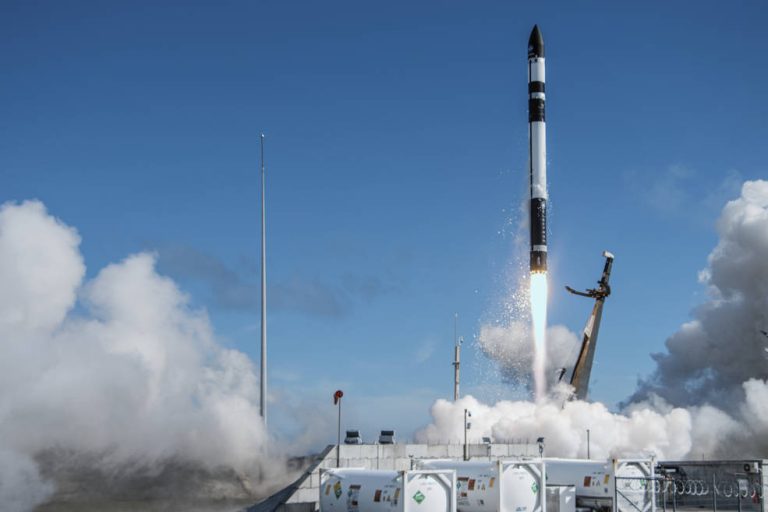
The first pair of TROPICS CubeSats lifts off aboard a Rocket Lab Electron rocket from Launch Complex 1, Pad B, in Māhia, New Zealand earlier in May.
Credits: Rocket Lab

After successfully launching the first pair of small satellites earlier this month from New Zealand, NASA and Rocket Lab are now targeting no earlier than 1:30 a.m. EDT Monday, May 22 (5:30 p.m. NZST), to launch the second pair of storm tracking CubeSats into orbit. 

The agency’s TROPICS (Time-Resolved Observations of Precipitation structure and storm Intensity with a Constellation of Smallsats) mission will launch aboard a Rocket Lab Electron from Launch Complex 1 Pad B in Māhia, New Zealand.

Rocket Lab will provide live coverage beginning approximately 20 minutes before launch. Coverage will air on NASA Television, the NASA app, the agency’s website, and Rocket Lab’s website.

TROPICS is a constellation of four identical CubeSats designed to observe tropical cyclones from low Earth orbit, making observations more frequently than current weather tracking satellites. Gathering data more frequently can help scientists improve weather forecasting models.

NASA will use TROPICS to study tropical cyclones as part of the agency’s Earth Venture Class missions, which select targeted science missions to fill gaps in our overarching understanding of the entire Earth system.

Full coverage of this mission is as follows (all times Eastern):

Monday, May 22

Approximately 1:15 a.m. – Live launch coverage begins

No earlier than 1:30 a.m. – Launch window opens

NASA website launch coverage

Follow countdown coverage on NASA’s launch blog for live updates beginning no earlier than 12 a.m. On demand streaming video and photos of the launch will be available shortly after liftoff on Rocket Lab’s website and Flickr. Imagery also is available on the NASA website.

Watch, engage on social media

Stay connected and receive mission updates by following and tagging these accounts:

Twitter: @NASA_LSP, @NASAEarth, @NASAGoddard, @NASA, @RocketLab

Facebook: NASA, NASA LSP, RocketLabUSA

Instagram: @NASA, @NASAEarth, @RocketLabUSA

The TROPICS team is led by Dr. William Blackwell at MIT’s Lincoln Laboratory in Lexington, Massachusetts, and includes researchers from NASA, the National Oceanic and Atmospheric Administration, and several universities and commercial partners. NASA’s Launch Services Program, based at the agency’s Kennedy Space Center in Florida, is managing the launch service.

For more information about NASA’s TROPICS, visit: https://go.nasa.gov/3h46pJp

Karen Fox / Joshua Finch
Headquarters, Washington
202-358-1257 / 202-358-1100
[email protected][email protected]

Leejay Lockhart
Kennedy Space Center, Florida
321-747-8310
[email protected]

By Roxana Bardan
Source NASA

Moon Over The Southern Atlantic

0

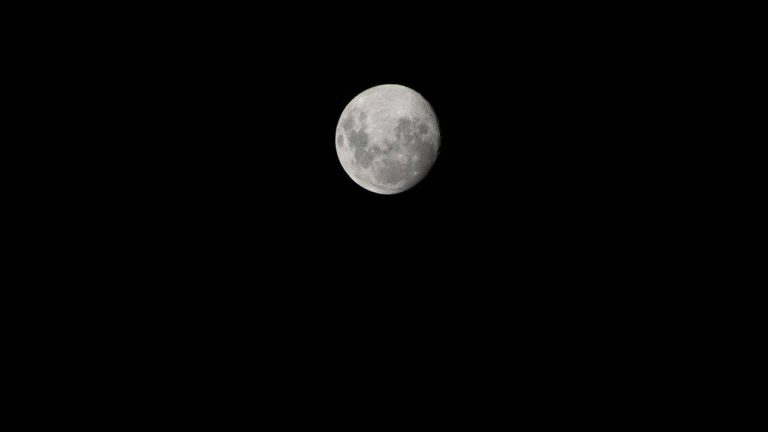
The waxing gibbous Moon stands out against the stark darkness of space on May 3, 2023. This image was taken from the International Space Station as it orbited 268 miles above the southern Atlantic Ocean. During the waxing gibbous phase, most of the Moon is visible and it appears brighter in the sky. 

Image Credit: NASA

By Monika Luabeya
Source NASA

NASA To Select Second Lunar Lander Partner For Artemis Moon Mission

0
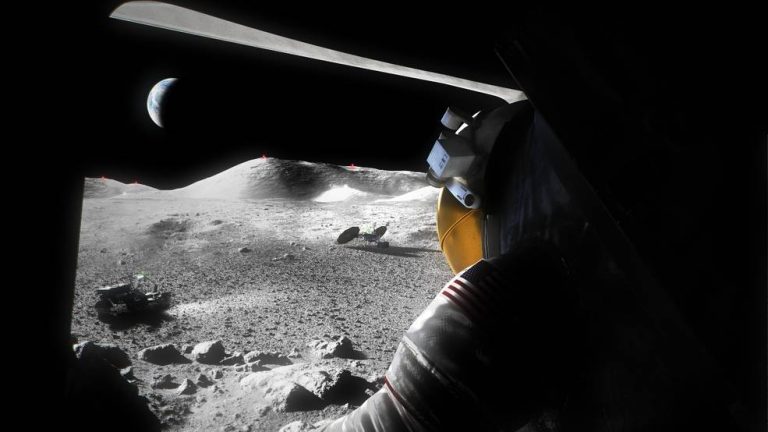
An artist’s concept of a suited Artemis astronaut looking out of a Moon lander hatch across the lunar surface, the Lunar Terrain Vehicle, and other surface elements.
Credits: NASA

During an event at 10 a.m. EDT Friday, May 19, at NASA Headquarters in Washington, the agency will announce the company selected to develop a sustainable human landing system for the Artemis V Moon mission. The human landing system will take astronauts to and from Gateway in lunar orbit to the surface and back to the lunar space station as part of NASA’s return to the Moon for science, exploration, and inspiration.

The announcement will air on NASA Television, the NASA app, and the agency’s website.

NASA participants will include:

  • NASA Administrator Bill Nelson
  • Jim Free, associate administrator, Exploration Systems Development Mission Directorate, NASA Headquarters
  • Lisa Watson-Morgan, manager, Human Landing System Program, NASA’s Marshall Space Flight Center in Huntsville, Alabama

Media are invited to attend in person or participate virtually via teleconference. Media must RSVP no later than two hours prior to the start of the event to Vanessa Lloyd, [email protected]. A copy of NASA’s media accreditation policy is online.

NASA is partnering with industry providers to develop, build, test, and launch innovative and technically advanced landers for the Artemis Generation. The second selected company will design, develop, test, and evaluate a human landing system under the Next-STEP Appendix P broad agency announcement for sustaining lunar development. The agency already is working with SpaceX to develop landers for the Artemis III and Artemis IV missions.

With Artemis, NASA will land the first woman and the first person of color on the lunar surface and establish long-term exploration for scientific discovery and to prepare for human missions to Mars. The agency’s Space Launch System rocket and NASA’s Orion spacecraft, along with the human landing system, next-generation spacesuits, and the lunar spaceship Gateway, are NASA’s foundation for deep space exploration.

For more information about Artemis, visit: https://www.nasa.gov/artemis

Vanessa Lloyd / Kathryn Hambleton
Headquarters, Washington
202-358-1100
[email protected] / [email protected]

Jenalane Rowe
Marshall Space Flight Center, Huntsville, Ala.
256-425-7245
[email protected]

By Roxana Bardan
Source NASA

NASA’s Webb Finds Water, And A New Mystery, in Rare Main Belt Comet

0

The James Webb Space Telescope’s latest discovery is a tale of two detections.

Solar system scientists took NASA’s James Webb Space Telescope on a treasure hunt in the asteroid belt, and what they didn’t find turned out to be as significant as what they did. If a spectrum of possible chemical compounds serves as a map of what to look for, X marked the spot of water vapor on Comet Read – a long-sought clue in the larger mystery of how Earth’s liquid water, and consequently life, first came to be. However, carbon dioxide was missing from the map, though it is present in all other comets. So in addition to continuing to pursue the history of ancient water in the solar system, scientists have an unexpected new quest on their hands, and will be hunting for answers in our cosmic backyard. 

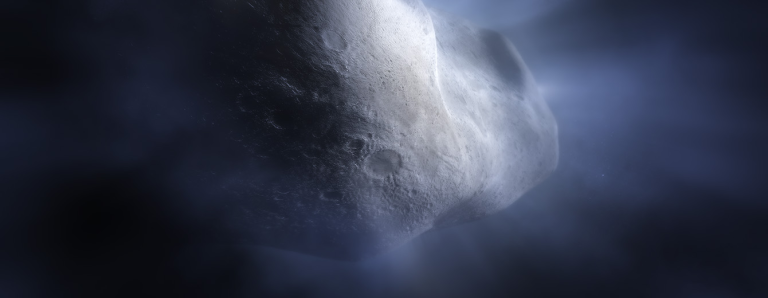
Artist’s Concept of Comet 238P/Read

Full Article

NASA’s James Webb Space Telescope has enabled another long-sought scientific breakthrough, this time for solar system scientists studying the origins of Earth’s abundant water. Using Webb’s NIRSpec (Near-Infrared Spectrograph) instrument, astronomers have confirmed gas – specifically water vapor – around a comet in the main asteroid belt for the first time, indicating that water ice from the primordial solar system can be preserved in that region. However, the successful detection of water comes with a new puzzle: unlike other comets, Comet 238P/Read had no detectable carbon dioxide.

“Our water-soaked world, teeming with life and unique in the universe as far as we know, is something of a mystery – we’re not sure how all this water got here,” said Stefanie Milam, Webb deputy project scientist for planetary science and a co-author on the study reporting the finding. “Understanding the history of water distribution in the solar system will help us to understand other planetary systems, and if they could be on their way to hosting an Earth-like planet,” she added. 

Comet Read is a main belt comet – an object that resides in the main asteroid belt but which periodically displays a halo, or coma, and tail like a comet. Main belt comets themselves are a fairly new classification, and Comet Read was one of the original three comets used to establish the category. Before that, comets were understood to reside in the Kuiper Belt and Oort Cloud, beyond the orbit of Neptune, where their ices could be preserved farther from the Sun. Frozen material that vaporizes as they approach the Sun is what gives comets their distinctive coma and streaming tail, differentiating them from asteroids. Scientists have long speculated that water ice could be preserved in the warmer asteroid belt, inside the orbit of Jupiter, but definitive proof was elusive – until Webb.

“In the past, we’ve seen objects in the main belt with all the characteristics of comets, but only with this precise spectral data from Webb can we say yes, it’s definitely water ice that is creating that effect,” explained astronomer Michael Kelley of the University of Maryland, lead author of the study.

“With Webb’s observations of Comet Read, we can now demonstrate that water ice from the early solar system can be preserved in the asteroid belt,” Kelley said. 

The missing carbon dioxide was a bigger surprise. Typically, carbon dioxide makes up about 10 percent of the volatile material in a comet that can be easily vaporized by the Sun’s heat. The science team presents two possible explanations for the lack of carbon dioxide. One possibility is that Comet Read had carbon dioxide when it formed but has lost that because of warm temperatures. 

“Being in the asteroid belt for a long time could do it – carbon dioxide vaporizes more easily than water ice, and could percolate out over billions of years,” Kelley said. Alternatively, he said, Comet Read may have formed in a particularly warm pocket of the solar system, where no carbon dioxide was available. 

The next step is taking the research beyond Comet Read to see how other main belt comets compare, says astronomer Heidi Hammel of the Association of Universities for Research in Astronomy (AURA), lead for Webb’s Guaranteed Time Observations for solar system objects and co-author of the study. “These objects in the asteroid belt are small and faint, and with Webb we can finally see what is going on with them and draw some conclusions. Do other main belt comets also lack carbon dioxide? Either way it will be exciting to find out,” Hammel said.

Co-author Milam imagines the possibilities of bringing the research even closer to home. “Now that Webb has confirmed there is water preserved as close as the asteroid belt, it would be fascinating to follow up on this discovery with a sample collection mission, and learn what else the main belt comets can tell us.”

The study is published in the journal Nature.

MEDIA CONTACT:

Leah Ramsay
Space Telescope Science Institute, Baltimore, Maryland

Christine Pulliam
Space Telescope Science Institute, Baltimore, Maryland

SCIENCE: Mike Kelley (UMD)

Hazy Sub-Neptune Planet Is Oddly Reflective

0
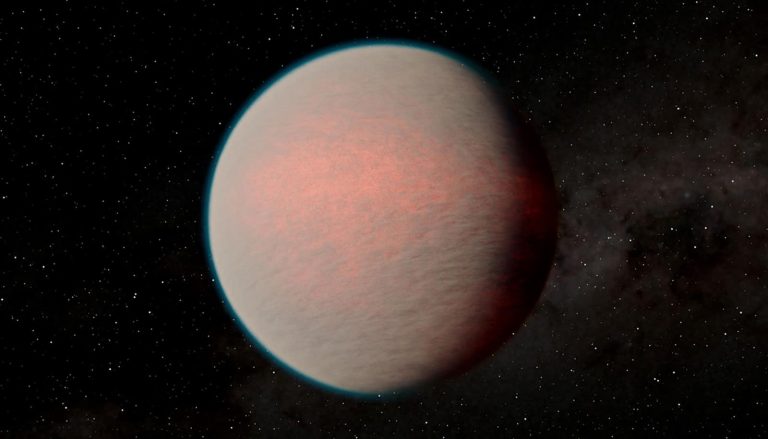
This artist’s concept depicts the planet GJ 1214 b, a “mini-Neptune” with what is likely a steamy, hazy atmosphere. (Credit: R. Hurt (IPAC)/JPL-Caltech/NASA)

For the first time, researchers have measured the light emitted by a sub-Neptune planet’s atmosphere.

For more than a decade, astronomers have been trying to get a closer look at GJ 1214b, an exoplanet 40 light-years away from Earth.

Their biggest obstacle is a thick layer of haze that blankets the planet, shielding it from the probing eyes of space telescopes and stymying efforts to study its atmosphere. But now, NASA’s new JWST has solved that issue. The telescope’s infrared technology allows it to see planetary objects and features that were previously obscured by hazes, clouds, or space dust, aiding astronomers in their search for habitable planets and early galaxies.

A team of researchers from the University of Michigan and University of Maryland used JWST to observe GJ 1214b’s atmosphere by measuring the heat it emits while orbiting its host star. Their results, published in the journal Nature, represent the first time anyone has directly detected the light emitted by a sub-Neptune exoplanet—a category of planets that are larger than Earth but smaller than Neptune.

Though GJ 1214b is far too hot to be habitable, researchers discovered that its atmosphere likely contains water vapor—possibly even significant amounts—and is primarily composed of molecules heavier than hydrogen.

Eliza Kempton, associate professor of astronomy at the University of Maryland and lead author of the study, says the findings mark a turning point in the study of sub-Neptune planets like GJ 1214b.

“I’ve been on a quest to understand GJ 1214b for more than a decade,” she says. “When we received the data for this Nature paper, we could see the light from the planet just disappear when it went behind its host star. That had never before been seen for this planet or for any other planet of its class, so JWST is really delivering on its promise.”

SUB-NEPTUNES AND GJ 1214B

Sub-Neptunes are the most common type of planet in the Milky Way, though none exists in our solar system. Despite the murkiness of GJ 1214b’s atmosphere, the researchers determined the planet was still their best chance of observing a sub-Neptune’s atmosphere because of its bright but small host star.

In their study, they measured the infrared light that GJ 1214b emitted over the course of about 40 hours—the time it takes the planet to orbit its star. As day turns to night, the amount of heat that shifts from one side of a planet to the other depends largely on what its atmosphere is made of. Known as a phase curve observation, this research method opened a new window into the planet’s atmosphere.

University of Michigan graduate student Isaac Malsky, a coauthor of the study, ran three-dimensional models for the planet, testing models with and without clouds and hazes, to see how these aerosols shape the thermal structure of the planet and help interpret the data.

“These new data are extraordinary, and in conjunction with simulations they inform our understanding that GJ 1214 b likely has a metal-enhanced atmosphere. With JWST we were able to see changes in the planet’s brightness over the course of the observation, revealing new slices of the planet throughout its orbit,” Malsky says.

“Running models allows us to test different scenarios and see how they compare to the observations, as well as explore how different effects, like hazes or clouds, influence the planet and manifest in observables.”

By measuring the movement and fluctuation of heat, the researchers determined that GJ 1214b does not have an atmosphere dominated by hydrogen.

“Previously all we knew about this planet was that it was blanketed in thick aerosols. Now with these new findings we can confidently say that the atmosphere is not dominated by hydrogen and helium, like Jupiter, but is primarily composed of heavier species, such as water,” says study coauthor Emily Rauscher, associate professor at the University of Michigan.

IS GJ 1214B A ‘WATER WORLD’?

The question of whether GJ 1214b contains water has long interested astronomers. Previous observations by NASA’s Hubble Space Telescope suggested that GJ 1214b could be a water world—a loose term for any planet that contains a significant amount of water.

The latest JWST data reveal traces of water, methane, or some mix of the two. These substances match a subtle absorption of light seen in the wavelength range observed by JWST. Further studies will be needed to determine the exact makeup of the planet’s atmosphere, but the evidence remains consistent with the possibility of large amounts of water, the researchers say.

“Additionally, it’s possible that GJ 1214 may be what’s known as a ‘water world,’ which means that water makes up a large portion of the planet’s bulk composition,” Malsky says. “This scenario would be consistent with the data collected, and is a fascinating alternative hypothesis.”

SURPRISING REFLECTION

The researchers made another surprising discovery in their study: GJ 1214b is incredibly reflective. The planet was not as hot as expected, which tells researchers that something in the atmosphere is reflecting light.

Kempton says there is plenty of room for follow-up studies, including ones that take a closer look at the high-altitude aerosols that form the haze—or possibly clouds—in GJ 1214 b’s atmosphere. Previously, researchers thought it might be a dark, soot-like substance that absorbs light. However, the discovery that the exoplanet is reflective raises new questions.

“We also were surprised to learn that the aerosols blanketing the planet are highly reflective, much more than anything we were expecting,” Rauscher says. “So while we know more about the planet’s atmosphere, we’ve also discovered a new mystery.”

Source: Emily Nuñez for the University of Maryland, University of Michigan

Original Study DOI: 10.1038/s41586-023-06159-5

By Morgan Sherburne-Michigan
Source Futurity

Are Planets Hiding In Fomalhaut’s Dust Rings?

0
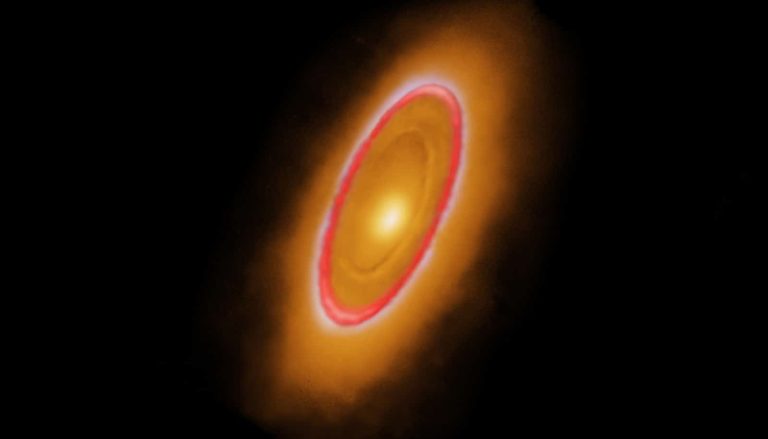
This image shows how the components of the Fomalhaut debris system relate to each other. Observations made with the Atacama Large Millimeter/Submillimeter Array reveal sand-sized grains orbiting the star, chipping away at each other (shown in red). The resulting finer-grained particles, traced by the Hubble Space Telescope and shown here in blue, are blown out of the outer ring by the photons streaming from the star. JWST’s MIRI instrument provides the full picture by revealing warm dust filling the inner part of the Fomalhaut system (orange). This dust is organized into a second ring, indicating the presence of one or more planets nearby. (Credit: Adam Block and András Gáspár/Steward Observatory/U. Arizona)

A new image of the bright, nearby star Fomalhaut reveals new details, including nested rings of dust that hint at the forces of unseen planets.

A team led by University of Arizona astronomers used NASA’s James Webb Space Telescope to image the warm dust around Fomalhaut to study the first asteroid belt ever seen outside of our solar system in infrared light. These belts most likely are carved by the gravitational forces produced by embedded, unseen planets.

“THE BELTS AROUND FOMALHAUT ARE KIND OF A MYSTERY NOVEL: WHERE ARE THE PLANETS?”

To the astronomers’ surprise, the dusty structures are much more complex than the asteroid and Kuiper dust belts of our solar system. There are three nested belts extending out to 14 billion miles, or 23 billion kilometers, from the star; that’s 150 times the distance of Earth from the sun. The scale of the outermost belt is roughly twice the scale of our solar system’s Kuiper belt, which consists of small bodies and cold dust beyond Neptune, the outermost known planet. The inner belts in the Fomalhaut system—which no one had seen before—were revealed by Webb for the first time. The results appear in the journal Nature Astronomy.

The belts encircle the young hot star, which is about 25 light-years from Earth and can be seen with the naked eye as the brightest star in the southern constellation Piscis Austrinus. The dusty belts are the debris from collisions of larger bodies, similar to asteroids and comets, and are frequently described as debris disks. Astronomers first discovered Fomalhaut’s disk in 1983. But there has never been a view as spectacular—or as revealing—as this one.

“I would describe Fomalhaut as the archetype of debris disks found elsewhere in our galaxy, because it has components similar to those we have in our own planetary system,” says lead study author András Gáspár, an assistant astronomer at the University of Arizona’s Steward Observatory. “By looking at the patterns in these rings, we can begin to make a little sketch of what a planetary system ought to look like—if we could actually take a deep enough picture to see the suspected planets.”

The idea of a protoplanetary disk around a star goes back to the late 1700s when astronomers Immanuel Kant and Pierre-Simon Laplace independently developed the theory that the sun and planets formed from a rotating gas cloud that collapsed and flattened due to gravity. Debris disks develop later, following the formation of planets and once the primordial gas has dispersed. As small bodies like asteroids collide, their surfaces are pulverized into huge clouds of dust and other debris. Observations of their dust provide unique clues to the structure of an exoplanetary system, reaching down to Earth-sized planets and even asteroids, which are much too small to see individually.

“Where Webb really excels is that we’re able to physically resolve the thermal glow from dust in those inner regions,” says Schuyler Wolff, an assistant research professor at Steward and a coauthor on the paper. “So, you can see inner belts that we could never see before.”

Hubble, ALMA, and Webb are tag-teaming to assemble a holistic view of the debris disks around a number of stars.

“With Hubble and ALMA, we were able to image a bunch of Kuiper belt analogs, and we’ve learned loads about how outer disks form and evolve,” Wolff says. “But we need Webb to allow us to image a dozen or so asteroid belts elsewhere. We can learn just as much about the inner warm regions of these disks as Hubble and ALMA taught us about the colder outer regions.”

These belts most likely are carved by the gravitational forces produced by unseen planets. Similarly, inside our solar system, Jupiter corrals the asteroid belt; the inner edge of the Kuiper belt is sculpted by Neptune, and the outer edge could be shepherded by yet-unseen bodies beyond it. As Webb images more systems, astronomers will gain a more detailed understanding of the configurations of their planets.

“The belts around Fomalhaut are kind of a mystery novel: Where are the planets?” says team member George Rieke, a professor of astronomy at the University of Arizona who serves as the United States science lead for Webb’s Mid-Infrared Instrument, or MIRI, which made these observations. “I think it’s not a very big leap to say there’s probably a really interesting planetary system around the star.”

“We definitely didn’t expect the more complex structure with the second intermediate belt and then the broader asteroid belt,” adds Wolff. “That structure is very exciting because any time an astronomer sees a gap and rings in a disk, they say, ‘There could be an embedded planet shaping the rings.’”

Webb also imaged what Gáspár dubs “the great dust cloud” that may be evidence for a collision that occurred in the outer ring between two protoplanetary bodies. This is a different feature from a suspected planet first seen inside the outer ring by Hubble in 2008. Subsequent Hubble observations made by Gáspár’s team showed that by 2014 the object had vanished. A plausible interpretation is that this newly discovered feature, like the earlier one, is an expanding cloud of very fine dust particles from two icy bodies that smashed into each other.

Source: University of Arizona

Original Study DOI: 10.1038/s41550-023-01962-6

By Daniel Stolte-Arizona
Source Futurity

Saturn’s Rings Won’t Last Forever

0
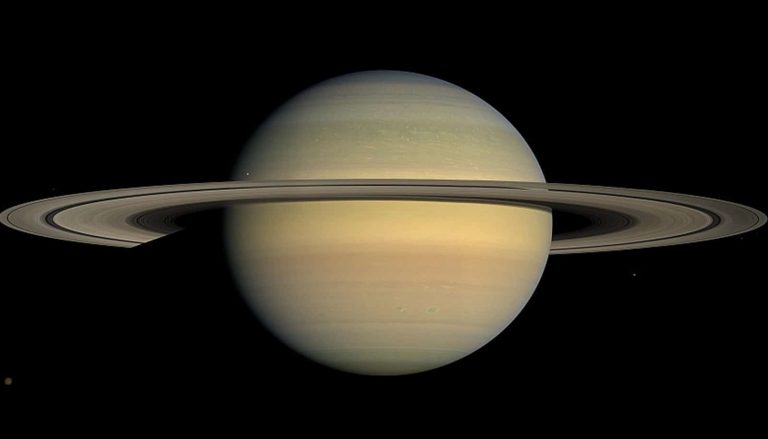
“Our inescapable conclusion is that Saturn’s rings must be relatively young by astronomical standards, just a few hundred million years old,” Richard Durisen says. “If you look at Saturn’s satellite system, there are other hints that something dramatic happened there in the last few hundred million years.” (Credit: NASA/JPL/Space Science Institute)

Saturn’s rings are much younger than scientists once thought—and they’re not here to stay, according to new research.

For decades, there has been debate about the origin of Saturn’s icy rings. But according to two new studies, published in the journal Icarus, (study 1, study 2) the rings are no more than a few hundred million years old—much younger than the planet itself, which formed 4.5 billion years ago.

In fact, the rings may well have formed when dinosaurs were still walking on the Earth, says Richard Durisen, professor emeritus of astronomy at Indiana University.

Durisen and coauthor Paul Estrada, a research scientist at NASA’s Ames Research Center in California’s Silicon Valley, also conclude that the rings will last only another few hundred million years at most.

“Our inescapable conclusion is that Saturn’s rings must be relatively young by astronomical standards, just a few hundred million years old,” Durisen says. “If you look at Saturn’s satellite system, there are other hints that something dramatic happened there in the last few hundred million years.”

Durisen and Estrada have long argued that Saturn’s rings are relatively young, because they expected the rings to be eroded and darkened by the influx of interplanetary meteoroids. However, it wasn’t until data was available from NASA’s 13-year-long Cassini spacecraft mission—particularly its 2017 Grand Finale, consisting of 22 orbits passing between Saturn and its rings—that they were able to use theoretical models to determine the age and longevity of the rings with confidence by computing how the rings change over long periods of time.

Particularly important for their work were Cassini’s measurements of the meteoroid influx rate, the mass of the rings, and the inflow rate of ring material onto Saturn.

The impact of meteoroids not only pollutes the rings, it ultimately leads to ring material drifting inward toward the planet. The theoretical models Durisen and Estrada presented demonstrate that the rings should be losing mass onto the planet at the prodigious rate of many tons per second that Cassini observed, which means that the remaining lifetime of the rings is only another few hundred million years or so.

For the first time, Estrada and Durisen’s detailed computations combine viscous spreading—due to ring particle interactions—with meteoroid effects in simulations designed to span the full lifetime of a ring system like Saturn’s. They demonstrate that meteoroid impacts are what ultimately impose a short lifetime compared with the age of the solar system, given the meteoroid influx rate measured by Cassini.

“We have shown that massive rings like Saturn’s do not last long,” Estrada says. “One can speculate that the relatively puny rings around the other ice and gas giants in our solar system are left-over remnants of rings that were once massive like Saturn’s. Maybe some time in the not-so-distant future, astronomically speaking, after Saturn’s rings are ground down, they will look more like the sparse rings of Uranus.”

Durisen’s decades-long research career centered mostly on the evolution and stability of rotating astrophysical systems of all types, from planets to galaxies. During the two decades before his retirement in 2010, he worked primarily on protoplanetary disks—the rotating disks of gas surrounding new stars from which planets can form. But his interest in Saturn’s rings began as a postdoctoral fellow at NASA Ames in the 1970s, and he has continued to study them ever since.

“In studying the universe, we often think about origins—origins of galaxies, stars, and planets,” Durisen says. “But planets are incredibly active and diverse systems where new things happen all the time. If Saturn’s rings are not as old as the planet, that means something happened in order to form their incredible structure, and that is very exciting to study.”

Durisen is interested to see what future space missions discover about Saturn’s system. Though the planet, composed mostly of helium and hydrogen, probably cannot support life, the conditions on some of its moons may have supported it in the past or even now, he says.

“If we can discover what happened in that system a few hundred million years ago to form the rings, we may just end up discovering why Saturn’s moon Enceladus is spewing out from its deep ocean plumes of water, ice, and even organic material,” Durisen says. “We may perhaps even end up finding the building blocks of life itself on Enceladus.”

Source: Indiana University

Original Study DOI: 10.1016/j.icarus.2022.115221

By Kelsey Cook-Indiana
Source Futurity

Nasa’s Artemis II Moon Crew Available For Interviews In Washington

0
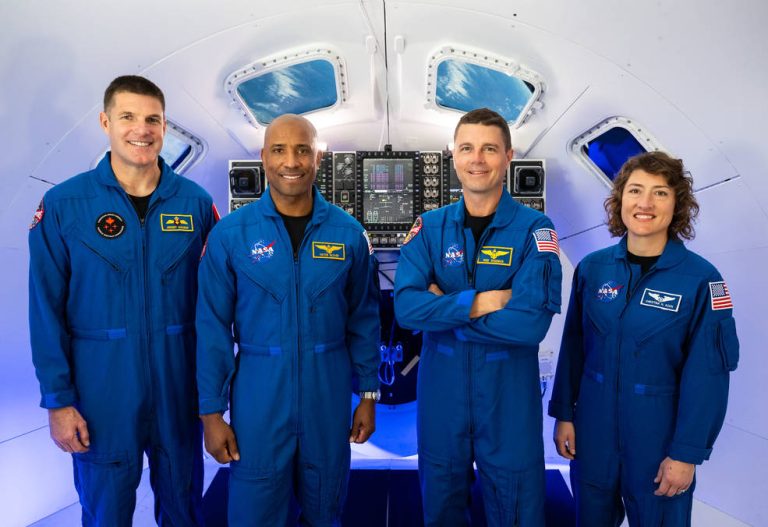
NASA astronauts Reid Wiseman, Victor Glover, and Christina Hammock Koch, and CSA astronaut Jeremy Hansen were announced Monday, April 3, as the four astronauts who will venture around the Moon on Artemis II, the first crewed mission on NASA’s path to establishing a long-term presence at the Moon for science and exploration through Artemis. The crew assignments are as follows: Commander Reid Wiseman, Pilot Victor Glover, Mission Specialist 1 Christina Koch, Mission Specialist 2 Jeremy Hansen.
Credits: NASA

The four astronauts who will fly around the Moon on NASA’s Artemis II will visit Washington Wednesday, May 17, through Friday, May 19, to discuss their upcoming mission and are available for a limited number of in-person media opportunities.

The crew will visit the area to speak with members of Congress, meet with leaders at the Canadian Embassy, visit the Smithsonian’s National Air and Space Museum, and attend several private events.

NASA astronauts Reid Wiseman, Victor Glover, and Christina Hammock Koch, and CSA (Canadian Space Agency) astronaut Jeremy Hansen will be available to answer questions from media during the following activities (all times EDT):

Wednesday, May 17

  • 6 p.m.: Media availability at the Canadian Embassy at 501 Pennsylvania Ave., NW
  • For consideration, members of the media interested in attending the opportunity at the Canadian Embassy must RSVP by 12 p.m., May 16, to: [email protected]

Thursday, May 18

  • 2:30 p.m.: Media availability on Capitol Hill with NASA Administrator Bill Nelson and Sen. Mark Kelly of Arizona, a former NASA astronaut, and CSA President Lisa Campbell
  • Media interested in attending this question-and-answer session must apply by 5 p.m., May 17, to: [email protected]

Artemis II is the first crewed mission on NASA’s path to establishing a long-term lunar presence for science and exploration under Artemis and is the first mission with astronauts to the Moon in more than 50 years. The approximately 10-day Artemis II flight test will launch on the agency’s powerful Space Launch System rocket, prove the Orion spacecraft’s life-support systems, and validate the capabilities and techniques needed for humans to live and work in deep space.

Through Artemis missions, NASA will use innovative technologies to explore more of the lunar surface than ever before and collaborate with commercial and international partners. Then, we will use what we learn on and around the Moon to take the next giant leap: sending the first astronauts to Mars.

Learn more about the Artemis II crew and their mission at: https://www.nasa.gov/specials/artemis-ii

Jackie McGuinness / Rachel Kraft
Headquarters, Washington
202-358-1100
[email protected] / [email protected]

Courtney Beasley
Johnson Space Center, Houston
281-483-5111
[email protected]

By Roxana Bardan
Source NASA

Monitoring Fluctuating Forest Carbon From Space

0
Monitoring Fluctuating Forest Carbon From Space

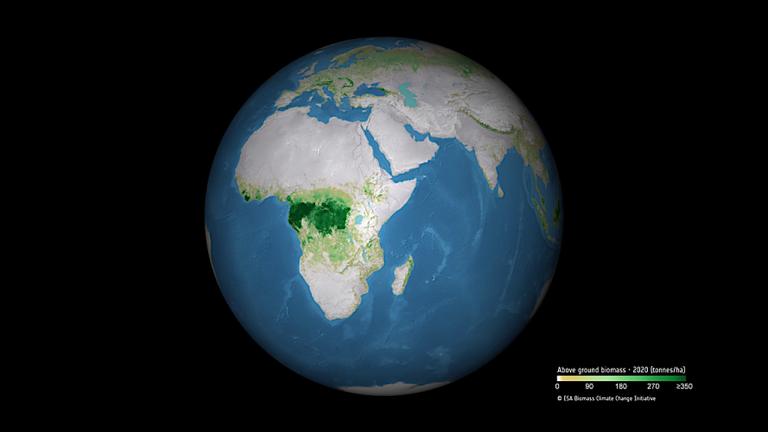
Expanding and restoring forests presents an opportunity for countries to remove carbon from the atmosphere and contribute to national efforts towards achieving net zero. Yet, reliable information that will enable policy-makers and scientists to track changes in forest cover and forest carbon stocks over time at both national and global scale has not been available until now.

The latest iteration – version 4.0 – of ESA’s above ground biomass dataset, which harnesses satellite observations and was developed by scientists working as part of its Climate Change Initiative (CCI), makes it possible for the first-time to robustly monitor fluctuations in the forest carbon stock.

Large-scale, above ground biomass maps already exist. For example the CCI biomass research project team produced global information at 100m spatial resolution for five annual epochs – 2010, 2017, 2018, 2019 and 2020. These maps however, do not allow biomass change to be quantified between years, in part due to different satellites were in orbit in 2010 compared with the later epochs affecting the type and format of the imagery provided and hence the ability to estimate above ground biomass from that data.

The project team, led by Professor Richard Lucas of Aberyswyth University, overcame this problem as part of a collaborative effort between ESA’s Climate Change Initiative and the Japan Aerospace Exploration Agency (JAXA). The latter making dedicated data and processing high-volume L-band SAR data from the Advanced Land Observing Satellite (ALOS and ALOS-2) missions available for inclusion in the global above ground biomass maps.

Professor Lucas explains, “L-band SAR from ALOS, provides excellent penetration of the forest canopy, by combining it with C-band SAR acquisitions from ESA’s Envisat and Sentinel-1 satellites we improve calibration across the different years and this provides the fundamental basis for our consistent high-quality biomass maps.

“The collaboration between ESA’s Climate Change Initiative and JAXA has helped make a significant advance. We now have an Earth observation dataset with more reliable estimates to really investigate and quantify biomass and biomass change at a global level.”

The dataset’s release is timely given the first Global Stocktake (GST) which is set to be completed during COP28 in the United Arab Emirates later this year and aims to review collective progress towards limiting global warming below 2 degrees Celsius, and ideally 1.5 degrees Celsius (relative to the pre-industrial period).

Including the new and more robust global forest biomass data in the stocktake will help to establish – and quantify – with great greater certainty, the net gains and losses of carbon associated with forest growth, loss and degradation. In turn, this will inform and guide the extent of mitigation actions by countries and the global community.

Dr. Maurizio Santoro (GAMMA), part of the ESA biomass project team and key to the new maps’ generation adds that “version 4.0 provides biomass change, along with quality flag indicators for annual increments from 2017 to 2020 while also shedding light at the decadal scale between 2010 and 2020. Adding more years of data to the current time series will enable an even more precise quantification of terrestrial carbon dynamics and provide policy makers with more accurate information relating to carbon reduction decision-making.”

Dr. Takeo Tadono of JAXA, and research manager of the ALOS mission series, adds “On behalf of JAXA, we sincerely appreciate the enormous efforts of ESA’s Climate Change biomass project team in completing the global biomass maps for five time periods. This dataset demonstrates the importance of satellite earth observation and their expected contributions to climate change research and to our understanding of the geospatial distribution of forest carbon storage.”

The new maps are sufficiently robust to be used by policy-makers and climate and carbon cycle scientists. They have been fully validated and uncertainty characterised using ground-based data from various sources including National Forest Inventory (NFI) samples and high quality (typically 100 x 100 m or 1 hectare) research plots from forests representing the world’s major biomes.

The above ground biomass dataset is produced as part of the ESA Climate Change Initiative, which harnesses Earth observation data from ESA and third-party missions to generate a suite of long-term and consistent records to address Essential Climate Variables that are needed to understand and address key aspects of the climate.

The release of this data set has been announced to the global forest community during the GFOI Plenary 2023 at FAO in Rome. To access the data, visit the ESA CCI Open Data Portal.

By Keith Cowing
Source Spaceref