
Home Blog Page 63

Exolaunch Deploys First-Ever 16U Smallsat Into GEO Using Spacex Falcon Heavy

0
The 16U EXOpod containing GS-1 integrated by the Exolaunch team © Exolaunch 2023
SpaceX

Exolaunch (“Exolaunch” or “the Company”), a world leader in launch services, in-space logistics and deployment technologies for small satellites has successfully deployed the first-of-its-kind 16U smallsat into geostationary orbit (GEO) on behalf of Gravity Space. The mission launched on a SpaceX Falcon Heavy on April 30 at 8:26 p.m. ET from Launch Complex 39A (LC-39A) at NASA’s Kennedy Space Center in Cape Canaveral, USA.

The successful deployment of a 16U smallsat into geostationary orbit marks another industry-first in a string of achievements for Exolaunch’s EXOpod deployer. After setting the benchmark as the first and only flight-proven, 16U-capable deployer, EXOpod has demonstrated its ability to operate in ever more demanding missions and higher orbits.

On its first launch using a SpaceX Falcon Heavy, Exolaunch provided its best-in-class mission management, EXOpod deployment system and integration services for Gravity Space’s GS-1 smallsat. The 16U smallsat was built by Space Inventor a satellite manufacturer focusing on providing microsatellites up to 150 kg using a modular and scalable platform combining high performance, reliability and innovation. GS-1 showcases the full extent of Space Inventor’s capabilities in a smallsat platform bristling with state-of-the-art communications equipment and multiple hosted payloads.

Indeed, from its geostationary orbit, GS-1 will use its array of communications equipment to retain a slot reserved for an upcoming communications satellite and preserve the license for its attributed Ku and Ka band frequencies. Among the hosted payloads on GS-1 are instruments designed for Earth observation and scientific experiments, as well as a space situational awareness demonstration payload from Infinite Orbits, all of which will take full advantage of GS-1’s position in its coveted GEO slot.

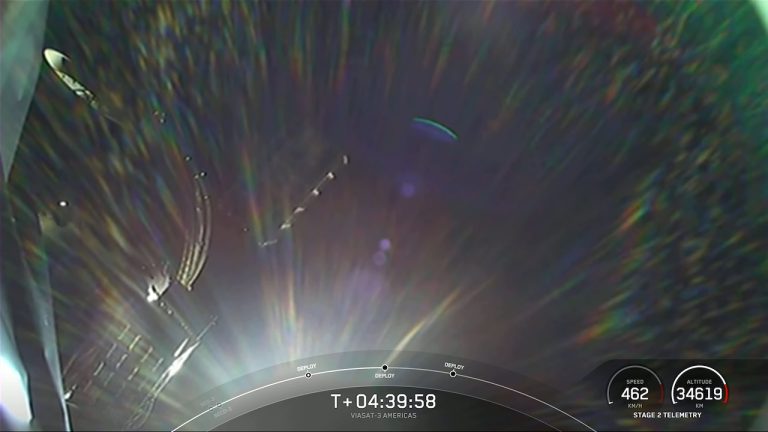
Gravity Space sought Exolaunch as a trusted partner on this mission for its extensive track record of rideshare launches with SpaceX. As a secondary payload on this launch, Gravity Space relied on Exolaunch’s 290 satellites flight heritage to be safely integrated with the main ViaSat-3 Americas mission and deployed in GEO.

Since 2020, Exolaunch provides global customers with industry-leading turnkey services on each Falcon 9 procured under a long-term multi-launch agreement with SpaceX that has been repeatedly extended to include new missions. After nine successive missions together with SpaceX, this Gravity Space mission marks a new milestone for Exolaunch with the addition of Falcon Heavy to its portfolio and a demonstration of the Company’s reliable solutions.

“GS-1 was a real chance for Exolaunch and SpaceX to show how far rideshare has come. Every launch has a ‘first’ aboard, but this mission with Gravity Space pushes the envelope one step farther”, said Michael Tolstoj, Mission Director at Exolaunch. “GEO launches are few and far between for smallsats, so this mission is a huge leap towards realizing Exolaunch’s ambition to make more orbits accessible for our customers!”

“Exolaunch provides a world-class satellite deployment service. They made integrating our spacecraft to their EXOpod straightforward and risk free”, said Mark Thompson, CEO at Gravity Space. “Their knowledge of the interfaces to SpaceX boosters greatly simplified what can be a very complex and costly process. For me, a company that responds immediately with “yes we can do that” is critical to getting the job done efficiently. Overall, a super positive experience working with the Exolaunch team.”

GS-1 was the third launch of 2023 for Exolaunch, closely following the Transporter-7 mission earlier in April. The Company has manifested on every SpaceX Transporter mission this year, as well as with multiple new launch vehicles, and is anticipating to reach and go well beyond the 300 satellites launched milestone not later than this summer.

About Exolaunch

Exolaunch (Germany, USA) is a global leader in rideshare launch services and in-space logistics products and services for the NewSpace industry. With a decade of flight heritage and 291 satellites launched across 20 missions (as of April 2023), Exolaunch leverages industry insight to tailor turnkey solutions that meet customer needs and respond to market trends. Exolaunch fulfils launch contracts for NewSpace industry leaders, the world’s most innovative start-ups, research institutions, government organizations and space agencies around the world. The company develops and manufactures its own flight-proven and industry-leading small satellite separation systems, with the fastest growing heritage on the market. Exolaunch is also developing Reliant, a line of environmentally friendly orbital transfer vehicles (OTVs), for last-mile satellite delivery, in-space logistics and space debris removal. Exolaunch is committed to making space accessible to all and to promoting its safe, sustainable, and responsible use.

To learn more, visit www.exolaunch.com or reach out at [email protected]

For media inquiries, please contact [email protected]

By Keith Cowing
Source SpaceRef
Space Waves Offer New Clues To Space Weather

0
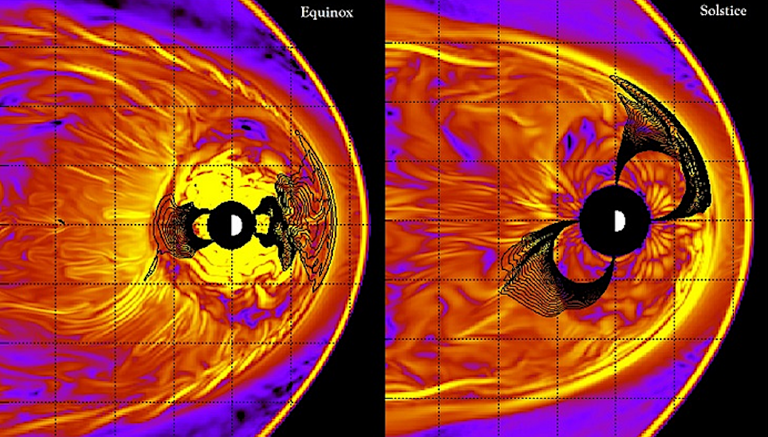
When solar wind hits the magnetosphere, it creates breaking waves known to scientists as Kelvin-Helmholtz waves. This wave activity is seasonal, researchers found; it increases around the spring and fall seasons (equinoxes) and decreases around summer and winter (solstices). CREDIT Illustration: S. Kavosi and H. Nykyri / Embry-Riddle Aeronautical University

More accurate space-weather predictions and safer satellite navigation through radiation belts could someday result from new insights into “space waves,” researchers at Embry-Riddle Aeronautical University reported.

The group’s latest research, published on May 4, 2023, by the journal Nature Communications, shows that seasonal and daily variations in the Earth’s magnetic tilt, toward or away from the Sun, can trigger changes in large-wavelength space waves.

These breaking waves, known as Kelvin-Helmholtz waves, occur at the boundary between the solar wind and the Earth’s magnetic shield. The waves happen much more frequently around the spring and fall seasons, researchers reported, while wave activity is poor around summer and winter.

As plasma or solar wind streams from the Sun at speeds up to 1 million miles per hour, it pushes energy, mass and momentum toward the planet’s magnetic shield. It also whips up space waves.

Fast-moving solar wind can’t pass directly through the Earth’s magnetic shield, so it thunders along the magnetosphere, propelling Kelvin-Helmholtz waves with massive peaks up to 15,000 kilometers (km) high and 40,000 km long.

Astronaut Safety and Satellite Communication

“Through these waves, solar wind plasma particles can propagate into the magnetosphere, leading to variations in radiation belt fluxes of energetic particles—regions of dangerous radiation—that may affect astronaut safety and satellite communications,” said Dr. Shiva Kavosi, a research associate at Embry-Riddle and first author of the “Nature Communications” paper. “On the ground, these events can impact power grids and Global Positioning Systems.”

Describing the properties of space waves and the mechanisms that cause them to intensify is key to understanding and forecasting space weather, Kavosi noted: “Space weather events represent an increasing threat, yet in many cases, we don’t understand exactly what controls it. Any progress we can make in understanding the mechanisms behind space weather disturbances will improve our ability to provide forecasts and warnings.”

In trying to understand the causes of seasonal and diurnal variations of geomagnetic activity, researchers in the field have set forth several different hypotheses. For example, the Russell-McPherron (R-M) effect, first described in 1973, explains why auroras are more frequent and brighter in the spring and fall, based on the interplay of the Earth’s dipole tilt and a small magnetic field near the Sun’s equator.

“We don’t have all the answers yet,” said Dr. Katariina Nykyri, professor of physics and associate director for the Center of Space and Atmospheric Research at Embry-Riddle, “but our paper shows that the R-M effect is not the only explanation for the seasonal variation of geomagnetic activities. Equinox-driven events, based on the Earth’s dipole tilt, and R-M effects could operate simultaneously.”

In the future, Nykyri added, constellations of spacecraft in the solar wind and magnetosphere could more fully explain the complicated, multi-scale physics of space weather phenomena. “Such a system would allow advanced warnings of space weather to inform the operators of rocket launches and electrical power grids,” she said.

The “Nature Communications” paper concludes that “KH waves activity exhibit seasonal and diurnal variations, indicating the critical role of dipole tilt in modulating KHI across the magnetopause as a function of time.”

The research article, “Seasonal and Diurnal Variations of Kelvin-Helmholtz Instability at Terrestrial Magnetopause,” was authored by Embry-Riddle researchers Nykyri and Kavosi; C.J. Farrugia and Jimmy Raedar of the University of New Hampshire, Institute for the Study of Earth, Oceans and Space; and J.R. Johnson of Andrews University. The DOI is 10.1038/s41467-023-37485-x. The public link is https://www.nature.com/articles/s41467-023-37485-x.

The work was supported by NASA grants (numbers 80NSSC18K0661, SA405826326 80NSSC18K1381, 80NSSC22K0304 and 80NSSC22K0515) as well as support from the Magnetospheric Multiscale mission (MMS) at the University of New Hampshire.

About Embry-Riddle Aeronautical University

Reporters worldwide contact Embry-Riddle Aeronautical University for content experts in all aspects of aviation, aviation business, aerospace, engineering and STEM-related fields. Our faculty experts specialize in unmanned and autonomous systems, security and intelligence, air traffic and airport management, astronomy, human factors psychology, meteorology, spaceflight operations, urban air mobility and much more. Visit the Embry-Riddle Newsroom for story ideas.

Embry-Riddle educates 32,750+ students at its residential campuses in Daytona Beach, Florida and Prescott, Arizona, at approximately 110 Worldwide Campus locations and through online degree programs. In 2023, U.S. News & World Report named Embry-Riddle Worldwide the nation’s No. 2 provider of online bachelor’s degree programs. The university has ranked either No. 1 or No. 2 in this category every year since 2016. Our residential campuses hold multiple Top 10 rankings. All of our campuses have been ranked Best for Veterans.

By Keith Cowing
Source SpaceRef

Earth From Space: Farming The Desert

0
Farming The Desert
ESA

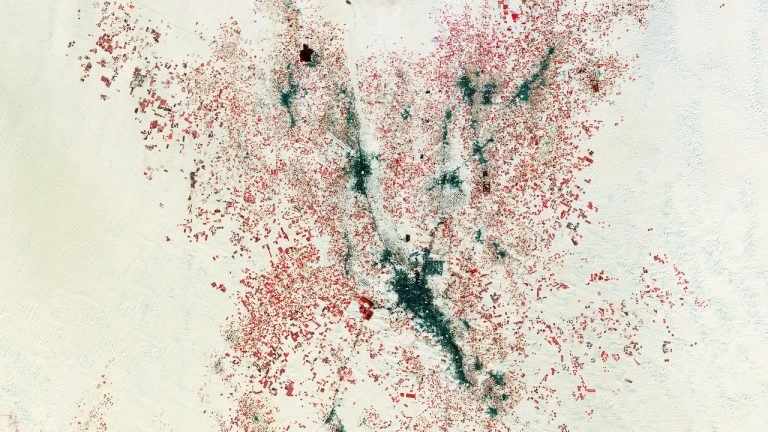
The Copernicus Sentinel-2 mission takes us over El Oued, in northeast Algeria, about 80 km west of the border with Tunisia.

Zoom in to explore this image at its full 10 m resolution or click on the circles to learn more.

Shown as a dark elongated area in the centre of the image, the town of El Oued lies around an oasis in the northern Sahara, in a region that is otherwise an endless sea of sand.

This false-colour image has been processed using the mission’s near-infrared channel to display vegetation in red, with irrigated vegetation shown in bright red and non-irrigated areas appearing in darker red tones. These vegetated areas stand out clearly in the surrounding gold sand dunes shaped by the wind.

Most of the agricultural fields in the image are circular, indicating that central-pivot irrigation systems are being used. A well, drilled in the centre of each circle, supplies water to rotating sprinklers that spray water in a circular pattern. Each of the circles is around 100 m in diameter. The main crops here include potatoes, onions and tomatoes.

Date palms are also very important for the local economy. They are typically grown using traditional methods inside irregular funnel-shaped fields in the sand. They do not need to be irrigated frequently and can be spotted in dark colours throughout the image, such as around El Oued and to the south of the town of Hassani Abdelkrim, northeast of El Oued.

While providing detailed information about Earth’s vegetation, Copernicus Sentinel-2 plays a key role in mapping differences in land cover to understand how it is used and to track changes over time, so useful for monitoring desertification. The mission also provides measurements of water quality and detects changes in water bodies, supporting sustainable water management – a valuable tool for arid areas where water is scarce.

By Keith Cowing
Source Spaceref

Plumes From Popocatépetl Volcano

0

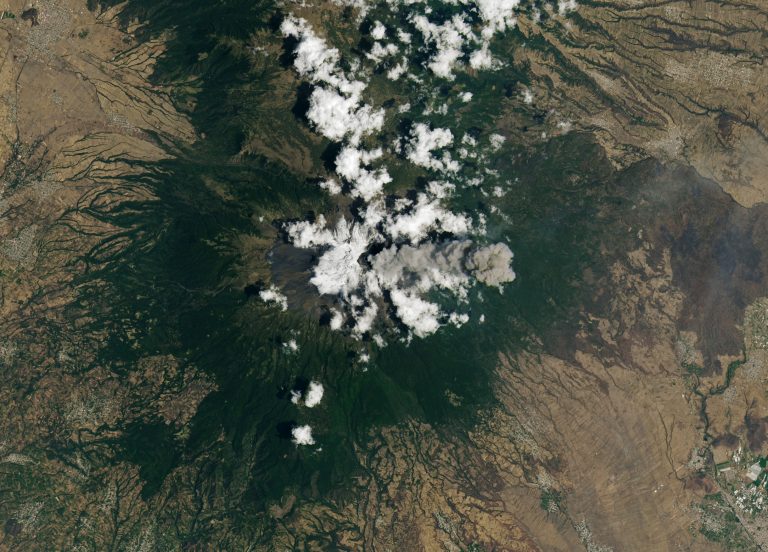
Popocatépetl, one of Mexico’s most active volcanoes, has been erupting since 2005. On April 14, 2023, when this image was acquired by Landsat 8, monitoring systems detected water vapor, volcanic gases, and ash coming from the volcano. Plumes rose as high as 4.5 miles (7.3 kilometers).

Image Credit: NASA/Lauren Dauphin; USGS

By Monika Luabeya
Source NASA

NASA, Rocket Lab Launch First Pair of Storm Observing CubeSats

0
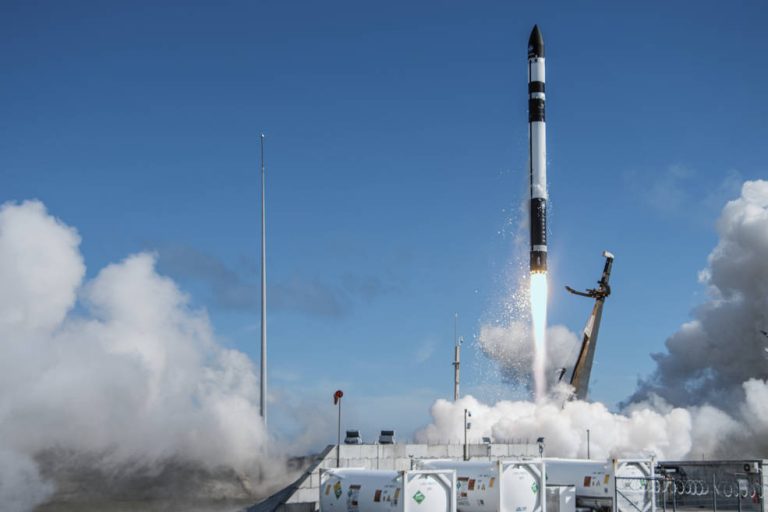
Rocket Lab’s Electron rocket lifts off from Launch Complex 1 at Māhia, New Zealand at 9:00 p.m., carrying two TROPICS CubeSats for NASA.
Credits: Rocket Lab

Two NASA CubeSats designed to study tropical cyclones, including hurricanes and typhoons, are in orbit after successfully launching at 1 p.m. Monday, NZST (9 p.m. EDT Sunday).

The first pair of the agency’s TROPICS (Time-Resolved Observations of Precipitation structure and storm Intensity with a Constellation of Smallsats) lifted off aboard an Electron rocket from Rocket Lab’s Launch Complex 1 Pad B in Māhia, New Zealand. Team members successfully sent commands to the first CubeSat at 1:48 a.m. EDT, May 8. Subsequently, they established communications with the second CubeSat at 6:31 a.m. EDT. 

TROPICS is a constellation of four identical CubeSats designed to observe tropical cyclones in a unique, inclined low Earth orbit over Earth’s tropics – an orbit that allows them to travel over any given storm about once an hour. Current weather tracking satellites have a timing of about once every six hours.

“Providing more frequent imaging will not only improve our situational awareness when a hurricane forms,” said Karen St. Germain, director, Earth Science Division at NASA Headquarters in Washington. “The data will provide information to models that help us determine how a storm is changing over time, which in turn helps to improve forecasts from our partners like the National Hurricane Center and Joint Typhoon Warning Center.”

NASA announced it selected Rocket Lab USA Inc. of Long Beach, California, to provide the launch service for the agency’s TROPICS mission, Nov. 23, 2022, as part of the VADR (Venture-Class Acquisition of Dedicated and Rideshare) contract.

“Today’s launch service marks the first launch completed as part of the VADR contract, a significant milestone as we aim to enable greater access to space for science and technology missions,” said Bradley Smith, director, Launch Services for the Space Operations Mission Directorate at NASA Headquarters. “We look forward to increasing storm tracking capabilities with another launch later this month to complete the TROPICS constellation.”

The second pair of TROPICS CubeSats is planned to launch aboard another Rocket Lab Electron rocket in about two weeks. The second launch will be timed to insert the next two CubeSats into the TROPICS constellation.

“We are extremely proud of all our partners, including MIT Lincoln Labs, Blue Canyon Technologies, KSAT, and Rocket Lab for successfully executing on this first launch.  We look forward to the entire constellation being on-orbit to realize the benefits for the agency, as well as for our colleagues around the world.” said Ben Kim, TROPICS program executive for NASA’s Earth Science Division.

The TROPICS team is led by Principal Investigator Bill Blackwell at Massachusetts Institute of Technology’s Lincoln Laboratory in Lexington, Massachusetts, and includes researchers from NASA, the National Oceanic and Atmospheric Administration, and several universities and commercial partners. NASA’s Launch Services Program, based at the agency’s Kennedy Space Center in Florida, is managing the launch service.

For more information about NASA’s TROPICS, visit: https://go.nasa.gov/3h46pJp

Karen Fox / Kiana Raines
Headquarters, Washington
202-358-1257 / 202-358-1100
[email protected] / [email protected]

Leejay Lockhart
Kennedy Space Center, Florida
321-747-8310
[email protected]

By Abbey Donaldson
Source NASA

New Study Of Uranus’ Large Moons Shows 4 May Hold Water

0
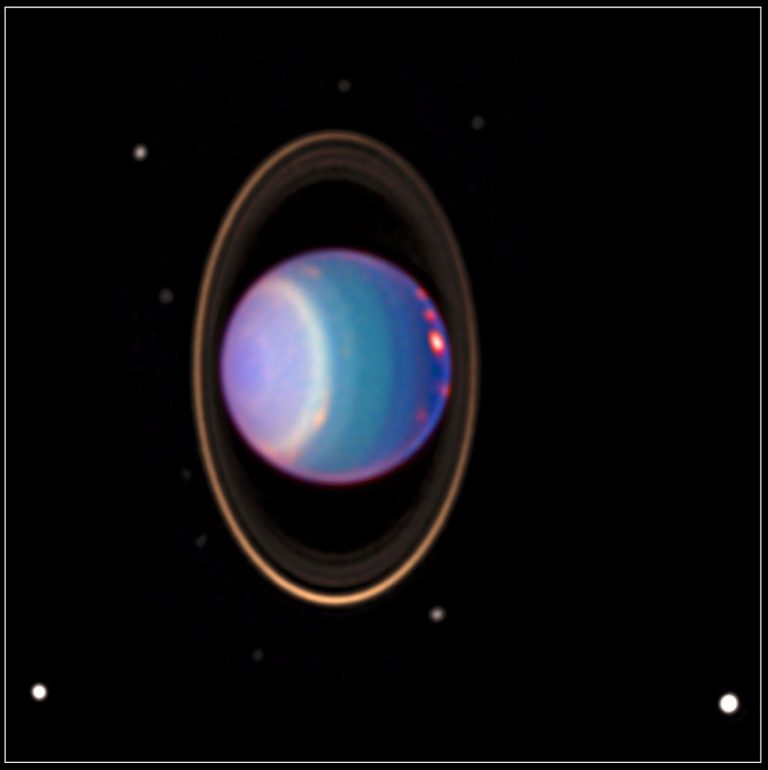
Uranus is surrounded by its four major rings and 10 of its 27 known moons in this color-added view that uses data taken by the Hubble Space Telescope in 1998. A study featuring new modeling shows that four of Uranus’ large moons likely contain internal oceans. Credit: NASA/JPL/STScI

The work is based on new modeling and explores how oceans could exist in unlikely places in our solar system.

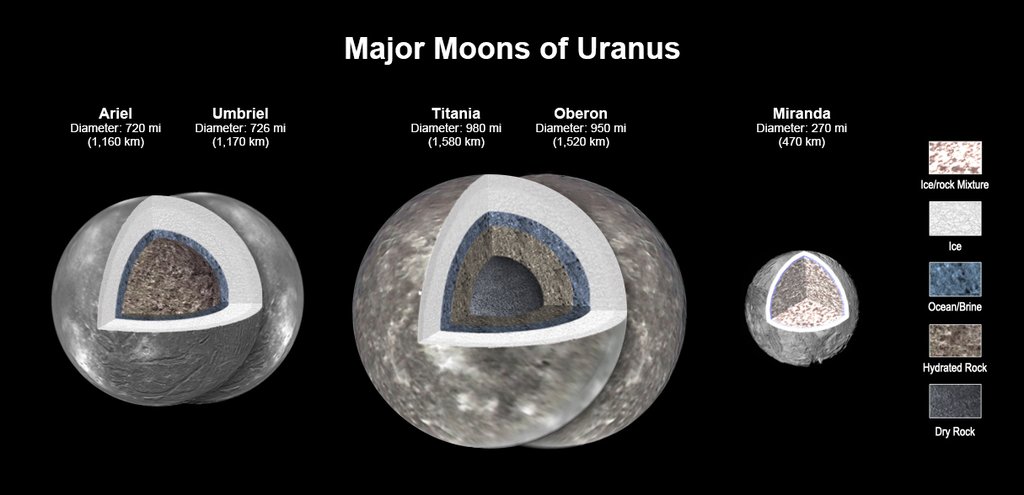
Re-analysis of data from NASA’s Voyager spacecraft, along with new computer modeling, has led NASA scientists to conclude that four of Uranus’ largest moons likely contain an ocean layer between their cores and icy crusts. Their study is the first to detail the evolution of the interior makeup and structure of all five large moons: Ariel, Umbriel, Titania, Oberon, and Miranda. The work suggests four of the moons hold oceans that could be dozens of miles deep.

In all, at least 27 moons circle Uranus, with the four largest ranging from Ariel, at 720 miles (1,160 kilometers) across, to Titania, which is 980 miles (1,580 kilometers) across. Scientists have long thought that Titania, given its size, would be most likely to retain internal heat, caused by radioactive decay. The other moons had previously been widely considered too small to retain the heat necessary to keep an internal ocean from freezing, especially because heating created by the gravitational pull of Uranus is only a minor source of heat.

The National Academies’ 2023 Planetary Science and Astrobiology Decadal Survey prioritized exploring Uranus. In preparation for such a mission, planetary scientists are focusing on the ice giant to bolster their knowledge about the mysterious Uranus system. Published in the Journal of Geophysical Research, the new work could inform how a future mission might investigate the moons, but the paper also has implications that go beyond Uranus, said lead author Julie Castillo-Rogez of NASA’s Jet Propulsion Laboratory in Southern California.

New modeling shows that there likely is an ocean layer in four of Uranus’ major moons: Ariel, Umbriel, Titania, and Oberon. Salty – or briny – oceans lie under the ice and atop layers of water-rich rock and dry rock. Miranda is too small to retain enough heat for an ocean layer.
Credit: NASA/JPL-Caltech

“When it comes to small bodies – dwarf planets and moons – planetary scientists previously have found evidence of oceans in several unlikely places, including the dwarf planets Ceres and Pluto, and Saturn’s moon Mimas,” she said. “So there are mechanisms at play that we don’t fully understand. This paper investigates what those could be and how they are relevant to the many bodies in the solar system that could be rich in water but have limited internal heat.”

The study revisited findings from NASA’s Voyager 2 flybys of Uranus in the 1980s and from ground-based observations. The authors built computer models infused with additional findings from NASA’s Galileo, Cassini, Dawn, and New Horizons (each of which discovered ocean worlds), including insights into the chemistry and the geology of Saturn’s moon Enceladus, Pluto and its moon Charon, and Ceres – all icy bodies around the same size as the Uranian moons.

What Lies Above and Beneath

The researchers used that modeling to gauge how porous the Uranian moons’ surfaces are, finding that they’re likely insulated enough to retain the internal heat that would be needed to host an ocean. In addition, they found what could be a potential heat source in the moons’ rocky mantles, which release hot liquid, and would help an ocean maintain a warm environment – a scenario that is especially likely for Titania and Oberon, where the oceans may even be warm enough to potentially support habitability.

By investigating the composition of the oceans, scientists can learn about materials that might be found on the moons’ icy surfaces as well, depending on whether substances underneath were pushed up from below by geological activity. There is evidence from telescopes that at least one of the moons, Ariel, has material that flowed onto its surface, perhaps from icy volcanoes, relatively recently.

In fact, Miranda, the innermost and fifth largest moon, also hosts surface features that appear to be of recent origin, suggesting it may have held enough heat to maintain an ocean at some point. The recent thermal modeling found that Miranda is unlikely to have hosted water for long: It loses heat too quickly and is probably frozen now.

But internal heat wouldn’t be the only factor contributing to a moon’s subsurface ocean. A key finding in the study suggests that chlorides, as well as ammonia, are likely abundant in the oceans of the icy giant’s largest moons. Ammonia has been long known to act as antifreeze. In addition, the modeling suggests that salts likely present in the water would be another source of antifreeze, maintaining the bodies’ internal oceans.

Of course, there still are a lot of questions about the large moons of Uranus, Castillo-Rogez said, adding that there is plenty more work to be done: “We need to develop new models for different assumptions on the origin of the moons in order to guide planning for future observations.”

Digging into what lies beneath and on the surfaces of these moons will help scientists and engineers choose the best science instruments to survey them. For instance, determining that ammonia and chlorides may be present means that spectrometers, which detect compounds by their reflected light, would need to use a wavelength range that covers both kinds of compounds.

Likewise, they can use that knowledge to design instruments that can probe the deep interior for liquid. Searching for electrical currents that contribute to a moon’s magnetic field is generally the best way to find a deep ocean, as Galileo mission scientists did at Jupiter’s moon Europa. However, the cold water in the interior oceans of moons such as Ariel and Umbriel could make the oceans less able to carry these electrical currents and would present a new kind of challenge for scientists working to figure out what lies beneath.

News Media Contact

Gretchen McCartney
Jet Propulsion Laboratory, Pasadena, Calif.
818-393-6215
[email protected]

Karen Fox / Alana Johnson
NASA Headquarters, Washington
301-286-6284 / 202-358-1501
[email protected] / [email protected]

Webb Looks For Fomalhaut’s Asteroid Belt And Finds Much More

0

Nearby Planetary System Seen in Breathtaking Detail

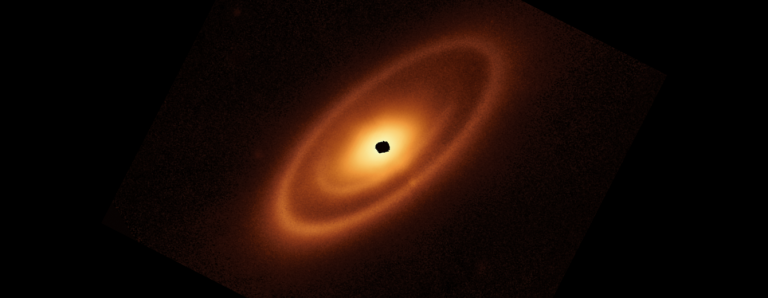
A new Webb Space Telescope image of the bright, nearby star Fomalhaut reveals its planetary system with details never seen before, including nested concentric rings of dust. These belts most likely are carved by the gravitational forces produced by embedded, unseen planets. Similarly, inside our solar system Jupiter corrals the asteroid belt of leftover debris that lies between us and the giant planet. Astronomers first discovered Fomalhaut’s disk in 1983. But there has never been a view as spectacular – or as revealing – as Webb’s.

Fomalhaut Dusty Debris Disk (MIRI Image)

Full Article

Astronomers used NASA’s James Webb Space Telescope to image the warm dust around a nearby young star, Fomalhaut, in order to study the first asteroid belt ever seen outside of our solar system in infrared light. But to their surprise, the dusty structures are much more complex than the asteroid and Kuiper dust belts of our solar system. Overall, there are three nested belts extending out to 14 billion miles (23 billion kilometers) from the star; that’s 150 times the distance of Earth from the Sun. The scale of the outermost belt is roughly twice the scale of our solar system’s Kuiper Belt of small bodies and cold dust beyond Neptune. The inner belts – which had never been seen before – were revealed by Webb for the first time.

The belts encircle the young hot star, which can be seen with the naked eye as the brightest star in the southern constellation Piscis Austrinus. The dusty belts are the debris from collisions of larger bodies, analogous to asteroids and comets, and are frequently described as ‘debris disks.’ “I would describe Fomalhaut as the archetype of debris disks found elsewhere in our galaxy, because it has components similar to those we have in our own planetary system,” said András Gáspár of the University of Arizona in Tucson and lead author of a new paper describing these results. “By looking at the patterns in these rings, we can actually start to make a little sketch of what a planetary system ought to look like — if we could actually take a deep enough picture to see the suspected planets.”

The Hubble Space Telescope and the Herschel Space Observatory, as well as the Atacama Large Millimeter/submillimeter Array (ALMA), have previously taken sharp images of the outermost belt. However, none of them found any structure interior to it. The inner belts have been resolved for the first time by Webb in infrared light. “Where Webb really excels is that we’re able to physically resolve the thermal glow from dust in those inner regions. So you can see inner belts that we could never see before,” said Schuyler Wolff, another member of the team at the University of Arizona. 

Hubble, ALMA, and Webb are tag-teaming to assemble a holistic view of the debris disks around a number of stars. “With Hubble and ALMA, we were able to image a bunch of Kuiper Belt analogs, and we’ve learned loads about how outer disks form and evolve,” said Wolff. “But we need Webb to allow us to image a dozen or so asteroid belts elsewhere. We can learn just as much about the inner warm regions of these disks as Hubble and ALMA taught us about the colder outer regions.”

These belts most likely are carved by the gravitational forces produced by unseen planets. Similarly, inside our solar system Jupiter corrals the asteroid belt, the inner edge of the Kuiper Belt is sculpted by Neptune, and the outer edge could be shepherded by as-yet-unseen bodies beyond it. As Webb images more systems, we will learn about the configurations of their planets.

Fomalhaut’s dust ring was discovered in 1983 in observations made by NASA’s Infrared Astronomical Satellite (IRAS). The existence of the ring has also been inferred from previous and longer-wavelength observations using submillimeter telescopes on Mauna Kea, Hawaii, NASA’s Spitzer Space Telescope, and Caltech’s Submillimeter Observatory.

“The belts around Fomalhaut are kind of a mystery novel: Where are the planets?” said George Rieke, another team member and U.S. science lead for Webb’s Mid-Infrared Instrument (MIRI), which made these observations. “I think it’s not a very big leap to say there’s probably a really interesting planetary system around the star.”

“We definitely didn’t expect the more complex structure with the second intermediate belt and then the broader asteroid belt,” added Wolff. “That structure is very exciting because any time an astronomer sees a gap and rings in a disk, they say, ‘There could be an embedded planet shaping the rings!’”

Webb also imaged what Gáspár dubs “the great dust cloud” that may be evidence for a collision occurring in the outer ring between two protoplanetary bodies. This is a different feature from a suspected planet first seen inside the outer ring by Hubble in 2008. Subsequent Hubble observations showed that by 2014 the object had vanished. A plausible interpretation is that this newly discovered feature, like the earlier one, is an expanding cloud of very fine dust particles from two icy bodies that smashed into each other.

The idea of a protoplanetary disk around a star goes back to the late 1700s when astronomers Immanuel Kant and Pierre-Simon Laplace independently developed the theory that the Sun and planets formed from a rotating gas cloud that collapsed and flattened due to gravity. Debris disks develop later, following the formation of planets and dispersal of the primordial gas in the systems. They show that small bodies like asteroids are colliding catastrophically and pulverizing their surfaces into huge clouds of dust and other debris. Observations of their dust provide unique clues to the structure of an exoplanetary system, reaching down to earth-sized planets and even asteroids, which are much too small to see individually.

The team’s results are being published in the journal Nature Astronomy.

The James Webb Space Telescope is the world’s premier space science observatory. The Fomalhaut observations utilized the Mid-Infrared Instrument (MIRI), which was contributed by NASA and ESA (European Space Agency), with the instrument designed and built by a consortium of nationally funded European Institutes (the MIRI European Consortium) and NASA’s Jet Propulsion Laboratory, in partnership with the University of Arizona. Webb will solve mysteries in our solar system, look beyond to distant worlds around other stars, and probe the mysterious structures and origins of our universe and our place in it. Webb is an international program led by NASA with its partners, ESA, and the Canadian Space Agency.

MEDIA CONTACT:

Ray Villard
Space Telescope Science Institute, Baltimore, Maryland

Christine Pulliam
Space Telescope Science Institute, Baltimore, Maryland

Meet ‘Scary Barbie,’ A Black Hole Tearing Apart A Giant Star

0
Photo by Vecteezy

Astronomers have discovered one of the most luminous, energetic, long-lasting transient objects hidden undetected for years in a mass of computer-gathered telescope data.

“It’s absurd. If you take a typical supernova and multiply it a thousand times, we’re still not at how bright this is—and supernovas are among the most luminous objects in the sky,” says Danny Milisavljevic, an assistant professor of physics and astronomy in Purdue University’s College of Science. “This is the most energetic phenomenon I have ever encountered.”

WHY ‘SCARY BARBIE’?

In astronomy, things that are the most luminous are often the most energetic. Milisavljevic, an expert on stellar life cycles—especially star death—notes that the data points to an extremely anomalous observation.

The object, like all those observed, was assigned a random name when it was discovered. Its name is ZTF20abrbeie, or, as astronomers affectionately call it, “Scary Barbie.” Barbie for its alphanumeric designation and “scary” because, Milisavljevic says, “It’s so much of an outlier; its characteristics are terrifying!”

The object is what is known as a transient—something observed in the sky that either appears and then disappears or changes in some dramatic way over the course of hours or days rather than centuries or millennia. In a new paper accepted for publication in The Astrophysical Journal Letters, Milisavljevic, his graduate student Bhagya Subrayan, and their team analyzed the data to conclude that the bright, long-lived transient is a black hole in the process of consuming a star. Subrayan’s research focuses on big data analysis of sky survey data.

“We think a very supermassive black hole pulled in a star and ripped it apart,” Subrayan says. “The forces around a black hole, called tidal disruption, pull other objects apart in a process called ‘spaghettification.’ We think that’s what happened, but on extreme time scales: The most massive of black holes ripping apart a massive star. The duration is unlike anything we’ve ever seen before, and it produced the most luminous transient in the universe.”

HIDING IN PLAIN SIGHT

If Scary Barbie is so bright and so notable, how did it just now come to light, even though datasets indicate the first observations occurred in 2020?

It hid in plain sight. While it’s bright, it is also extremely far away and in a somewhat neglected corner of the sky. The anomaly was discovered using Milisavljevic’s lab’s AI engine. The Recommender Engine For Intelligent Transient Tracking (REFITT) combs through observations from a number of telescopes around the world, including those made by the Zwicky Transient Facility using the Palomar Observatory in California.

“REFITT does big data analysis,” Milisavljevic says. “It combs through millions of alerts and figures out what interesting things we might want to look at closer. This is a great example. Computers are really good at finding things when we can tell them precisely what to look for. But things like this, anomalous objects, the computer often doesn’t even know to look for. It doesn’t even have a template. This is so different from anything else we’ve ever seen that we hadn’t even gotten around to trying to classify it. It’s been hanging out in the public data for years.”

Once the team and REFITT had identified Scary Barbie as an intriguing opportunity for research, they used data from other telescopes, including the Lick Observatory in California and the W.M. Keck Observatory in Hawaii. Spectrographic analysis from those telescopes helped the team put a name to the odd phenomenon the data reported.

Scary Barbie is not just orders of magnitude brighter and more energetic than any transient scientists have recorded before, but it is also lasting much longer than usual transients do. Most transients last weeks or months, but this one has lasted for more than 800 days—over two years—and latest available data show that it may be visible for years to come.

The actual event itself—the spaghettification of this massive star—may be of much shorter duration, but because the transient is so far away the law of relativity slows down the light as it travels to human eyes, making it seem to last nearly twice as long.

“There are few things in the universe that can be so powerful, reactions that can be this long-lived,” Milisavljevic says. “Discoveries like this really open our eyes to the fact that we are still uncovering mysteries and exploring wonders in the universe—things no one has ever seen before.”

This research was funded in part by the National Science Foundation.

Purdue University

Original Study DOI: 10.48550/arXiv.2302.10932

By Brittany Steff – Purdue
Source Futurity

Exploring The Cosmos Together

0

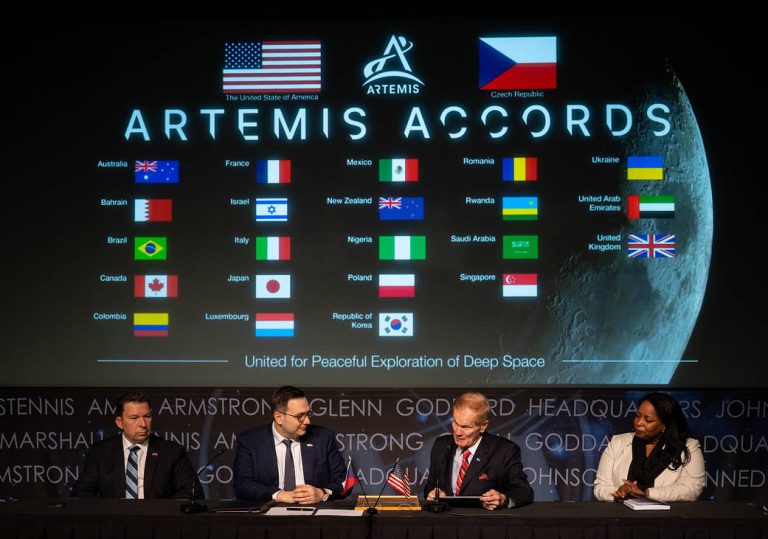
Miloslav Stašek, Ambassador of the Czech Republic to the United States (left), Foreign Affairs Minister for the Czech Republic, Jan Lipavský (second from left), NASA Administrator Bill Nelson (second from right), and Acting Assistant Secretary of State for Oceans and International Environmental and Scientific Affairs Jennifer R. Littlejohn (right), are seen following the signing of the Artemis Accords on Wednesday, May 3, 2023. The Artemis Accords establish a practical set of principles to guide space exploration cooperation among nations, including those participating in NASA’s Artemis program. The Czech Republic is the twenty fourth country to sign the Artemis Accords.

Image Credit: NASA/Joel Kowsky

By Monika Luabeya
Source NASA

Science Release: Hubble Follows Shadow Play Around Planet-forming Disc

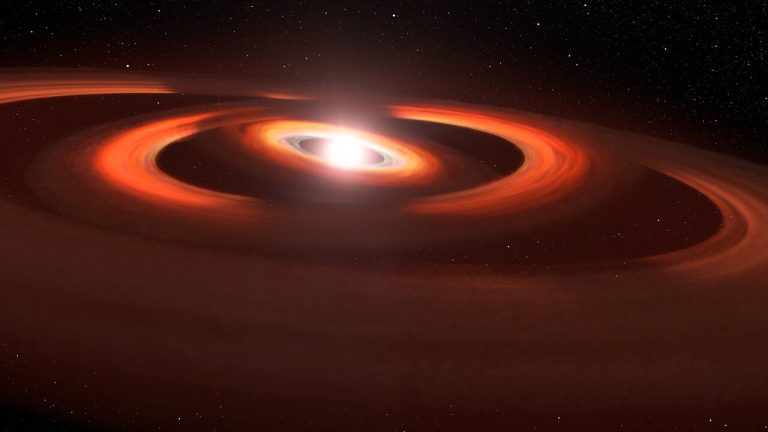
In 2017 astronomers reported discovering a shadow sweeping across the face of a vast pancake-shaped disc of gas and dust surrounding the red dwarf star TW Hydrae. The shadow isn’t from a planet, but from an inner disc slightly inclined relative to the much larger outer disc — causing it to cast a shadow. One explanation is that an unseen planet’s gravity is pulling dust and gas into its inclined orbit. Now, a second shadow — playing a game of peek-a-boo — has emerged in just a few years between observations stored in the MAST archive of the NASA/ESA Hubble Space Telescope. This could be from yet another disc nestled inside the system. The two discs are likely evidence of a pair of planets under construction.

TW Hydrae is less than 10 million years old and resides about 200 light-years away. In its infancy, some 4.6 billion years ago, our Solar System may have resembled the TW Hydrae system. Because the TW Hydrae system is tilted nearly face-on as seen from Earth, it is an optimum target for getting a bird’s-eye view of a planetary construction yard.

The second shadow was discovered in observations obtained on 6 June 2021, as part of a multi-year programme designed to track the shadows in circumstellar discs. John Debes of AURA/STScI for the European Space Agency at the Space Telescope Science Institute in Baltimore, Maryland, compared these latest observations of the TW Hydrae disc to Hubble observations made several years ago.

We found out that the shadow had done something completely different,” said Debes, who is principal investigator and lead author of the study published in The Astrophysical Journal. “When I first looked at the data, I thought something had gone wrong with the observation because it wasn’t what I was expecting. I was flummoxed at first, and all my collaborators were like: what is going on? We really had to scratch our heads and it took us a while to actually figure out an explanation.

“We hatched a theory of what might be causing the changing shadows,” added Rebecca Nealon, a member of the science team at the University of Warwick in the United Kingdom. “But to test this we had to run sophisticated models where we varied the number of discs and their orientations to try to reproduce Hubble’s observations.”

The best solution the team came up with is that there are two misaligned discs casting shadows. They were so close to each other in the earlier observation they were missed. Over time they’ve now separated and split into two shadows. “We’ve never really seen this before on a protoplanetary disc. It makes the system much more complex than we originally thought,” said Debes.

The simplest explanation is that the misaligned discs are likely caused by the gravitational pull of two planets in slightly different orbital planes. Hubble is piecing together a holistic view of the architecture of the system.

The discs may be proxies for planets that are lapping each other as they whirl around the star. It’s sort of like spinning two vinyl records at slightly different speeds. Sometimes the labels will match up but then one gets ahead of the other.

It does suggest that the two planets have to be fairly close to each other. If one was moving much faster than the other, this would have been noticed in earlier observations. It’s like two racing cars that are close to each other, but one slowly overtakes and laps the other,” said Debes.

The suspected planets are located in a region roughly the distance of Jupiter from our Sun. And the shadows complete one rotation around the star about every 15 years — the orbital period that would be expected at that distance from the star.

Also, these two inner discs are inclined by about five to seven degrees relative to the plane of the outer disc. This is comparable to the range of orbital inclinations inside our Solar System. “This is right in line with typical Solar System-style architecture,” said Debes.

The outer disc that the shadows are falling on may extend as far as several times the radius of our Solar System’s Kuiper belt. This larger disc has a curious gap at twice Pluto’s average distance from the Sun. This might be evidence for a third planet in the system.

Any inner planets would be difficult to detect because their light would be lost in the glare of the star. Also, dust in the system would dim their reflected light. ESA’s Gaia space observatory may be able to measure a wobble in the star if Jupiter-mass planets are tugging on it, but this would take years given the long orbital periods.

The TW Hydrae data are from Hubble’s Space Telescope Imaging Spectrograph. The NASA/ESA/CSA James Webb Space Telescope’s infrared vision may also be able to show the shadows in more detail.

More information

The Hubble Space Telescope is a project of international cooperation between ESA and NASA.
Image credit: NASA. ESA, L. Hustak (STScI)

Contacts

John Debes
AURA/STScI for the European Space Agency
Space Telescope Science Institute, Baltimore, Maryland
Email: [email protected]

Bethany Downer
ESA/Hubble Chief Science Communications Officer
Email: [email protected]