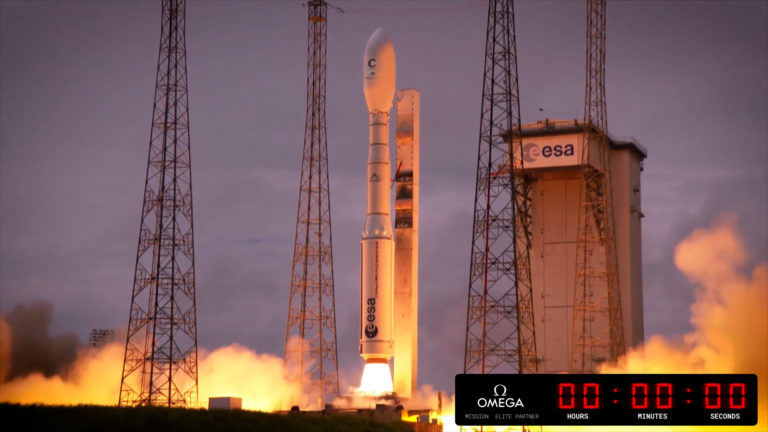
ClearSpace and Arianespace signed a launch contract for ClearSpace-1, the first active debris removal mission that will capture and deorbit a derelict space debris object of more than 100 kg. The launch, scheduled starting as soon as the second-half of 2026, will use the new European light launcher Vega C to release the spacecraft into a sun-synchronous drift orbit for commissioning and critical tests. The servicer spacecraft will then be raised to the client object for rendezvous, capture and subsequent deorbitation through an atmospheric reentry.
The space debris object removed by this mission is the upper part of a Vespa (Vega Secondary Payload Adapter) left in a ‘gradual disposal’ orbit, in compliance with space debris mitigation regulations, during the second flight of a Vega launcher in 2013. Close in mass to a small satellite, the simple shape of this space debris object will allow to demonstrate the technologies of the spacecraft and its quartet of robotic arms, thus opening the way for more challenging missions with multiple captures per flight.
“Above us, there currently are over 34,000 pieces of space debris of more than 10 centimeters each as well as about 6,500 operational satellites in orbit, a number expected to rise to more than 27,000 by the end of the decade. These figures demonstrate the need to find innovative solutions for preserving the benefits of Space for humanity and life on Earth. At Arianespace, we are honored to deliver this mission with Vega C, thus supporting a sustainable use of Space,” said Stéphane Israël, CEO of Arianespace.
“We are very enthusiastic about this deal with Arianespace. This secures ClearSpace’s access to space for our trailblazing space debris removal mission. The ClearSpace-1 mission demonstrates a turning point in the space industry as we urgently need to bring solutions to a fundamental problem: we are putting objects into space quicker than they are being removed”, said Luc Piguet, CEO and Co-founder of ClearSpace. “We look forward to this European collaboration and the potential for more missions in the future.”
In 2019, ESA selected ClearSpace from a field of more than a dozen candidates to lead the first mission to remove an ESA-owned item from orbit. Supported by ESA’s new Space Safety Programme, the mission is being procured as a service contract with a startup-led commercial consortium, to help establish a new market for in-orbit servicing, as well as debris removal.
About ClearSpace
ClearSpace, an in-orbit servicing (IOS) company created in 2018, is intent on revolutionizing how space missions are conducted. ClearSpace is becoming now a global company with dynamic engineering teams in Switzerland, the UK, Germany, Luxembourg and in the United States. ClearSpace is creating the technologies that will support a wide range of IOS applications, from disposal and in-orbit transport to inspection, assembly, manufacturing, repair, and recycling. ClearSpace aims to support institutions and commercial operators alike to enhance sustainable space operations and promote a circular space economy. In 2020, the company was awarded a service contract by the European Space Agency to develop ClearSpace-1, the world’s first mission to remove a piece of debris from orbit. The ClearSpace-1 mission is also supported by Elite Partner Omega. ClearSpace is growing rapidly and is actively engaged in the initial phases of two additional in-orbit servicing missions.
Rocket Lab USA, Inc. (Nasdaq: RKLB) (“Rocket Lab” or “the Company”), a leading launch and space systems company, today successfully completed the first of two dedicated Electron launches to deploy a constellation of tropical cyclone monitoring satellites for NASA.
The ‘Rocket Like a Hurricane’ launch lifted-off on May 8 at 13:00 NZST (01:00 UTC) from Rocket Lab Launch Complex 1 on New Zealand’s Mahia Peninsula deploying two of the four CubeSats that comprise the TROPICS constellation (Time-Resolved Observations of Precipitation structure and storm Intensity with a Constellation of Smallsats). TROPICS will monitor the formation and evolution of tropical cyclones, including hurricanes, and will provide rapidly updating observations of storm intensity.
The constellation, which is part of NASA’s Earth System Science Pathfinder Program, requires launch to 550 kilometers altitude and inclination of about 30 degrees. Each pair of CubeSats must be launched to two specific orbital planes that are equally spaced 180 degrees opposite to maximize the temporal resolution. These unique orbits over Earth’s tropics allow the satellites to travel over any given storm about once an hour compared with current weather tracking satellites that have a timing of about once every six hours.
This high revisit rate aims to help scientists better understand the processes that effect these high-impact storms, ultimately leading to improved modeling and prediction to help protect lives and livelihoods. All four TROPICS satellites need to be deployed into their operational orbit within a 60-day period, a mission requirement made possible with small dedicated launch. With the first batch of TROPICS CubeSats now in orbit, the second launch, called ‘Coming to a Storm Near You,’ is expected to launch on another Electron rocket in approximately two weeks from Launch Complex 1.
“The TROPICS constellation has the real potential to save lives by providing more timely data about storm intensity and providing advance warning to those in storm paths, so it’s an immense privilege to have deployed these spacecraft to their precise orbits before the upcoming storm season,” said Rocket Lab founder and CEO Peter Beck. “We’re grateful to the NASA team for entrusting us with such a critical mission and we look forward to completing the constellation with the second Electron launch in the coming days.”
“We are extremely proud of all our partners, including MIT Lincoln Labs, Blue Canyon Technologies, KSAT, and Rocket Lab for successfully executing on this first launch. We look forward to the entire constellation being on-orbit to realize the benefits for the agency, as well as for our colleagues around the world,” said Ben Kim, TROPICS program executive for NASA’s Earth Science Division.
‘Rocket Like a Hurricane’ was Rocket Lab’s fourth mission for 2023 and the Company’s 36th Electron mission overall. It brings the total number of satellites launched to orbit by Rocket Lab to 161.
Follow Rocket Lab on Twitter @RocketLab for real-time updates about the next TROPICS launch.
ABOUT Rocket Lab
Founded in 2006, Rocket Lab is an end-to-end space company with an established track record of mission success. We deliver reliable launch services, satellite manufacture, spacecraft components, and on-orbit management solutions that make it faster, easier and more affordable to access space. Headquartered in Long Beach, California, Rocket Lab designs and manufactures the Electron small orbital launch vehicle, the Photon satellite platform and the Company is developing the large Neutron launch vehicle for constellation deployment.
Since its first orbital launch in January 2018, Rocket Lab’s Electron launch vehicle has become the second most frequently launched U.S. rocket annually and has delivered 161 satellites to orbit for private and public sector organizations, enabling operations in national security, scientific research, space debris mitigation, Earth observation, climate monitoring, and communications.
Rocket Lab’s Photon spacecraft platform has been selected to support NASA missions to the Moon and Mars, as well as the first private commercial mission to Venus. Rocket Lab has three launch pads at two launch sites, including two launch pads at a private orbital launch site located in New Zealand and a third pad in Virginia. To learn more, visit www.rocketlabusa.com.
A first-hand account from JPL Director Laurie Leshin
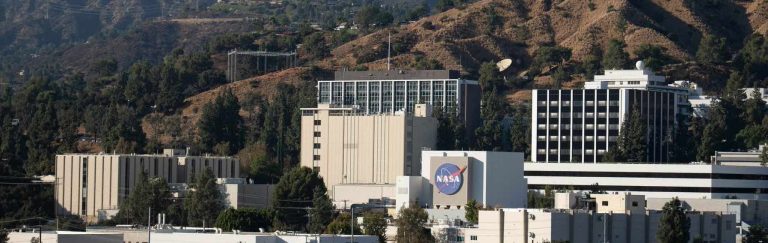
In 2022, a mission being led by NASA’s Jet Propulsion Laboratory (JPL) missed its launch date. Psyche, a mission to an asteroid of the same name, was delayed by a year and ran over budget, causing a ripple effect of delays and budget woes for other JPL-led missions, notably the VERITAS mission to Venus which was delayed indefinitely. According to an independent review panel, workforce and management problems at JPL were at the root of Psyche’s missed launch date.
Dr. Laurie Leshin took over as JPL director shortly after these problems were discovered. On Jan. 6, 2023, she joined an episode of Planetary Radio: Space Policy Edition to talk with The Planetary Society’s chief of space policy, Casey Dreier, about what happened with Psyche, what exactly the problems were — ranging from the effects of the COVID-19 pandemic to outdated human resources policies and competition from private space companies — and what JPL is doing to make sure it can hire, retain, and effectively use the best minds in the space industry.
The original transcript has been condensed and edited for clarity.
Casey Dreier: Dr. Leshin, thank you for joining me today on Space Policy Edition.
Laurie Leshin: It’s great to be with you, Casey.
Casey Dreier: Great having you back. I’d like to dive right into the big topics on this episode: the Psyche Independent Review Board, the mission to the metallic asteroid that was delayed this year, and the larger management challenges facing the Jet Propulsion Laboratory. First, I want to make it clear that you came in just as this was happening.
Laurie Leshin: Yes, three weeks after I got here I figured out we weren’t going to make the launch.
Casey Dreier: The Independent Review Board’s (IRB’s) report about what happened with Psyche included issues with workforce. Is there a workforce problem not just at JPL but in aerospace in general?
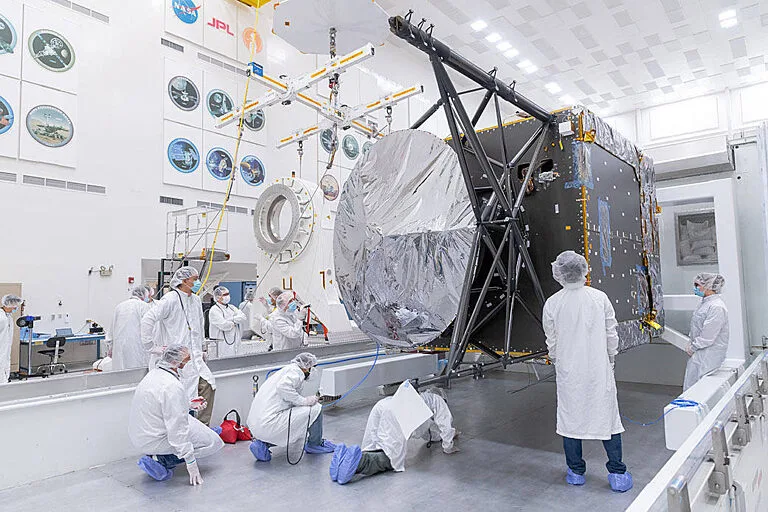
PSYCHE AT JPL Engineers and technicians at the Jet Propulsion Laboratory working on the Psyche spacecraft.Image: NASA/JPL-Caltech
Laurie Leshin: Yes. Every single org we have talked to since the Psyche Independent Review Report came out has said that looking at the slides they could scratch out “JPL” and put “X aerospace company,” or “X NASA center.”
This manifested in such a way that it’s making visible to everyone the challenges that we’re facing across the aerospace sector. There’s fantastic growth of the commercial space sector, the founding of the Space Force and growth in military and intelligence community space work, growth in civilian space work, growth in international space work. There’s no doubt that there’s a huge amount of opportunity out there. And this means that employees in the aerospace sector can be really picky and really think about where they want to go and what they want to do. Frankly, I think that’s going to make us all better. It’s going to make us need to be better employers. It’s going to make us need to have a better employee value proposition.
Casey Dreier: I actually wanted to touch on that very issue. That was one of the key items called out in the report was retention and successful hiring of talented and promising individuals. This strikes me as something of an irony, that for so long NASA has been trying to build a commercial space sector and to make it more vigorous and expansive, but it seems now that there may be some hemorrhaging of talent; the people that NASA paid to train, invested in, and depends on are now being lured into the private sector. It’s not necessarily a bad thing, but it certainly changes the game for you, I imagine.
Laurie Leshin: It does change the game, but in the best possible way. Look, the last time I was at NASA in the 2010-2011 timeframe was when we were starting to really work to support the commercial space sector’s emergence, and guess what? We were wildly successful. So now there’s not only government money in that, but a ton of private money. It means that there are really interesting emerging places to work for people with backgrounds in aerospace. This is, I think, the best possible problem to have.
Frankly, it’s not a bad thing if more people in our business get more different experiences, that there isn’t only one or two places to work. We’ve got to work on making sure this is a great place to work, that we’ve got exciting and challenging and inspiring missions for folks at JPL to work on. That way when someone leaves for a few years, maybe they’ll come back with a different set of experiences that can help us be better.
Casey Dreier: What do you think JPL’s argument is? Why come to work for JPL? How do you pitch yourself as a great place to come and work, or what are you doing to change?
Laurie Leshin: So this is about our mission and our missions. We are fundamentally a research and development organization that’s working to answer the most profound scientific questions that you can ask. Things like, “Are we alone in the universe?” Things like, “How are we going to adapt to and prevent more climate change?” These are really challenging things and we do it at JPL with a specific approach that says, “We don’t want to build the tenth something or even the fifth something. We want to build the first of a kind. We want to build something that’s one of a kind. We want to build something that really drives the frontiers of capabilities for robotic missions,” and that is really inspiring to a lot of folks. We want to fly helicopters on Mars. We want to do that thing that no one’s ever done before. For a lot of folks, that’s going to be really exciting, and we want to do it in a way that frankly, offers people some flexibility, that really respects families, that embraces everyone as who they are. We want to do it with an environment that is truly diverse and inclusive and we’re working on that to make it better. We clearly have great things to work on and we’re working every single day to continue to make this a great place to work.
Casey Dreier: Are there things you can talk about already in terms of what’s changed in terms of how you’re approaching workforce after this, and just in general from what you are bringing to the role?
Laurie Leshin: Well, we’ve been focused in a few areas. One thing that we announced very recently is, believe it or not, we did not have paid parental leave at JPL. We’ve just announced eight weeks of paid parental leave for both parents, and this for after birth, after adoption, or after a new foster child comes into the home. This is basic stuff and I was really pleased that we were able to work with our colleagues at Caltech to get that done. It’s amazing how much of a difference things like that really make to folks, so I’m glad we were able to do that. We’re also getting ready to roll out our diversity, equity, inclusion, and accessibility strategy and it’s a very JPL kind of strategy because it’s really focused on trying to invent the science of all this, to really do experiments so that we can measure how well they work.
Casey Dreier: Well, it strikes me, again, how things that are at first a crisis can actually be this tipping point into action. But at the same time, what has Psyche revealed for JPL management? Because one critique was that there wasn’t enough penetration into the project, that problems didn’t get reported up. How are you using this information to improve management for other missions? Mars Sample Return, for example, is spending more per year than NASA’s entire Heliophysics Division right now. So a delay there because of management issues could be catastrophic to some degree. How has what you’ve learned from Psyche been informing these other areas that are even larger and more complex?
Laurie Leshin: We’re working our way through what we heard from the IRB, and we’ve got a response team that’s being led by one of our most senior leaders. They’re turning these things around and looking at them from all angles and thinking about how to address them. The Psyche team has already addressed everything in the report. They were doing it in real time and that’s one reason why the mission got continued and will launch next October.
One of the big challenges that we’ve addressed is remote work. There was literally no other mission whose development happened during the pandemic as much as Psyche’s did. The mission was confirmed six months before the pandemic started.
So that was a huge challenge for a team, especially a distributed team who was flying around a lot to be together. Even those who were in the same city, they couldn’t all be in the same place. It’s quite clear that the way that we had implemented Return to Lab at JPL, which happened in early May 2022 right before I started, actually was okay. But it was like doing remote and hybrid work in the worst possible way because people would come to the lab and then would sit on WebEx all day because their teammates weren’t here.
Building something that’s one of a kind and first of its kind with large teams diverse in terms of background and expertise is really tough to do when you’re not together pretty much at all. The work we do is most effectively done in the lab — not every day, not every task, but there has to be more of that togetherness.
So we went through and tried to simplify it and make it more consistent. We said to the projects, “We think you should be setting out certain days of the week that people are here.” We gave people time for this adjustment because I’m not going all Elon here, “Everybody get in here by Monday.” We’re not doing that. People need time to get their lives together, but we’ve got to get not just the work done but the job done. We need the teams together more to really do that.
We also do have some people on our team who live elsewhere and work fully remotely. Some teams and some jobs lend themselves to that. But we still need to get the full team together at least quarterly to make sure that people are getting the facetime they need, and to make sure that young people are really building those relationships with more senior mentors.
Casey Dreier: Is it fair to characterize Psyche as an unintended experiment of building a spacecraft in a hybrid remote working environment?
Laurie Leshin: Yes. Let’s never do that again.
Casey Dreier: It’s actually amazing how close it came to launching, all things considered.
Laurie Leshin: Well, I actually think that’s right, Casey. Look, it’s not great that we shipped a spacecraft to Cape Canaveral and then later decided it wasn’t ready for launch. I get why that’s not great, but the truth is that they overcame almost every obstacle against incredible odds. I think we should be honestly celebrating this team for not launching when they shouldn’t have. They raised their hand and said, “We’re not ready and we shouldn’t do this. It’s too big a risk,” and it’s really hard to do that.
The other thing I was really impressed with the IRB for is that it identified the importance of what they called the ‘informal safety net.’ This is the fact that when you’re doing things that are incredibly hard, stuff always happens. Every single day in this lab, people are walking down the hall to their neighbors saying, “I can’t figure this thing out,” or, “Something doesn’t feel right here. What are your thoughts about this?” Or doing it in the cafeteria at the coffee cart. The senior people who know everything lend their expertise informally across every project at this lab and that was obliterated in COVID. We all know that we missed those hallway conversations. What we didn’t realize is how essential they are to being able to launch a spacecraft on time. So that, again, really suggests that more time together in the lab — it doesn’t have to be every person every day — but more time together is really essential.
Casey Dreier: Does it help that other tech companies are also reaching the same conclusion? It seems like a lot of companies are really pushing people to come back.
Laurie Leshin: Yeah. Lots are, including the Googles and the Apples, actually. We’re hearing they’re going back to three days a week and many in the aerospace business are doing the same. When you’re trying to do hard stuff, none of us can do it alone. We’ve got to do it together.
Casey Dreier: One of the questions I have, particularly in relation to Psyche, is, how do you know what is real or systemic in terms of the problems you’re trying to deal with? How much of it was just this bizarre, hopefully once-in-our-lifetimes consequence of a global respiratory virus that’s swept through the world in three years? How do you try to choose? Because I could see overreacting potentially, assuming something is systemic where it’s really just a bizarre reaction or consequence of COVID?
Laurie Leshin: So you’re asking the $64 million question. This is exactly the conversations we’re having internally all the time right now. The truth is that the management within the project didn’t realize what was happening, so there’s no way that at the director level they would’ve realized it. So the worry is we’re going to put in a whole bunch more bureaucracy to deal with management oversight, when in fact, what we need to do is figure out, “How do we just make sure that the people who are on the front lines with the issues are raising them up appropriately internally?”
Yes, I already am doing more in terms of interacting with the projects, just having heard the initial feedback from the IRB. But we’ve got to really get to the root of the challenge and figure out how much of it is COVID related. We’re trying to make that balance and not overcorrect, but I think for that reason, it’s not going to be a one-off set of responses. We’re going to try some things. I’m a big believer in testing as you go and learning along the way and adjusting, not waiting until you have the perfect answer, but actually implementing some things and then assessing how we’re doing and keeping the questions going. I think that’s going to be really essential here.
Casey Dreier: What would you characterize as the most important near-term or immediate challenge that JPL is facing?
Laurie Leshin: For us, we really do need to keep focused on the work ahead of us. The next year, year-and-a-half of work, we’re going to be very busy and we need to stay focused on making sure that work is done and done well, not taking our eye off the ball. So it’s fairly tactical I would say. I think if we do well in the near term, the long term will take care of itself. Not that you don’t have to pay attention to the long term. Of course, we pay attention to it.
INGENUITY ON MARS The Ingenuity Mars helicopter was designed and built at JPL.Image: NASA/JPL-Caltech/Kevin M. Gill
Casey Dreier: Is it fair to say that the most important general long-term policy that benefits not just JPL, but workforce issues with all of NASA is having a clear, inspiring mission that’s boundary pushing at the core?
Laurie Leshin: It is. If the rule for a new mission is, “No new technology, don’t do anything new,” I worry that in the long term that sets us up to drive away our most capable folks. They will go somewhere else and find it in the private sector if they can’t find it through NASA funding. So we work very hard to invest in new technology.
Mars Helicopter is a great example. Mars Pathfinder, too. We would not have Spirit, Opportunity, Curiosity, or Perseverance if it weren’t for that cute little rover that started as a tech demo. That is what we do best at JPL; we think of those slightly crazy things and we figure out how to try them and then it ends up driving the whole program. So if there’s one thing I could wish for in the future, it’s that we would be able to continue to do that, to continue to drive those frontiers. That’s how you attract a great workforce and that’s how you build a great place to work.
Casey Dreier: There’s an interesting tension there that in order to have total cost assurance that you’ll never have something like another Psyche or another cost overrun you want predictability, familiarity, all of the things that were just the opposite of inspiring. So in a sense, you have to lean into the risk in a smart way in order to really provide what you’re talking about. That’s what brings out the best in the workforce. I think that’s an important thing for policymakers to remember or to really embrace, that if you want the government-funded stuff to stay at the forefront of this, failure’s going to have to be by definition part of this.
Laurie Leshin: Failure, and not having exact cost predictability at the very beginning of a new project. We’re in this place right now with Mars Sample Return. Again, it’s the most complex planetary mission ever attempted, and we really want to do it well. We want to make sure we’ve thought it through. So we’re working on those things right now. We’re pushing really hard to have the team try and do that in a cost-constrained way. It’s a huge challenge, but a really exciting one, actually. I couldn’t ask for a better challenge.
Listen to the full interview on Planetary Radio: Space Policy Edition.
This artist’s impression shows a doomed planet skimming the surface of its star. Astronomers used a combination of telescopes to spot the first direct evidence of an aging, bloated sun-like star, like the one pictured here, engulfing its planet. These telescopes included the Zwicky Transient Facility (ZTF) at Caltech’s Palomar Observatory, the W.M. Keck Observatory, and NASA’s NEOWISE mission. Credits: Image: K. Miller/R. Hurt (Caltech/IPAC)
As a star runs out of fuel, it will billow out to a million times its original size, engulfing any matter — and planets — in its wake. Scientists have observed hints of stars just before, and shortly after, the act of consuming entire planets, but they have never caught one in the act until now.
In a study appearing today in Nature, scientists at MIT, Harvard University, Caltech, and elsewhere report that they have observed a star swallowing a planet, for the first time.
The planetary demise appears to have taken place in our own galaxy, some 12,000 light-years away, near the eagle-like constellation Aquila. There, astronomers spotted an outburst from a star that became more than 100 times brighter over just 10 days, before quickly fading away. Curiously, this white-hot flash was followed by a colder, longer-lasting signal. This combination, the scientists deduced, could only have been produced by one event: a star engulfing a nearby planet.
“We were seeing the end-stage of the swallowing,” says lead author Kishalay De, a postdoc in MIT’s Kavli Institute for Astrophysics and Space Research.
What of the planet that perished? The scientists estimate that it was likely a hot, Jupiter-sized world that spiraled close, then was pulled into the dying star’s atmosphere, and, finally, into its core.
A similar fate will befall the Earth, though not for another 5 billion years, when the sun is expected to burn out, and burn up the solar system’s inner planets.
“We are seeing the future of the Earth,” De says. “If some other civilization was observing us from 10,000 light-years away while the sun was engulfing the Earth, they would see the sun suddenly brighten as it ejects some material, then form dust around it, before settling back to what it was.”
The study’s MIT co-authors include Deepto Chakrabarty, Anna-Christina Eilers, Erin Kara, Robert Simcoe, Richard Teague, and Andrew Vanderburg, along with colleagues from Caltech, the Harvard and Smithsonian Center for Astrophysics, and multiple other institutions.
Hot and cold
The team discovered the outburst in May 2020. But it took another year for the astronomers to piece together an explanation for what the outburst could be.
The initial signal showed up in a search of data taken by the Zwicky Transient Facility (ZTF), run at Caltech’s Palomar Observatory in California. The ZTF is a survey that scans the sky for stars that rapidly change in brightness, the pattern of which could be signatures of supernovae, gamma-ray bursts, and other stellar phenomena.
De was looking through ZTF data for signs of eruptions in stellar binaries — systems in which two stars orbit each other, with one pulling mass from the other every so often and brightening briefly as a result.
“One night, I noticed a star that brightened by a factor of 100 over the course of a week, out of nowhere,” De recalls. “It was unlike any stellar outburst I had seen in my life.”
Hoping to nail down the source with more data, De looked to observations of the same star taken by the Keck Observatory in Hawaii. The Keck telescopes take spectroscopic measurements of starlight, which scientists can use to discern a star’s chemical composition.
But what De found further befuddled him. While most binaries give off stellar material such as hydrogen and helium as one star erodes the other, the new source gave off neither. Instead, what De saw were signs of “peculiar molecules” that can only exist at very cold temperatures.
“These molecules are only seen in stars that are very cold,” De says. “And when a star brightens, it usually becomes hotter. So, low temperatures and brightening stars do not go together.”
For the first time, astronomers have caught a star in the act of engulfing its planet, an encounter that will play out in our own solar system in 5 billion years. This rendering shows the gas giant meeting its demise as it spiraled into its parent star. Ultimately, the planet plunged into the core of the star, which triggered the star to expand and brighten. The aging star depicted here, called ZTF SLRN-2020, is roughly 10 billion years old. ZTF SLRN-2020 lies 15,000 light-years away in the constellation Aquila. Credits: Image: K. Miller/R. Hurt (Caltech/IPAC)
“A happy coincidence”
It was then clear that the signal was not of a stellar binary. De decided to wait for more answers to emerge. About a year after his initial discovery, he and his colleagues analyzed observations of the same star, this time taken with an infrared camera at the Palomar Observatory. Within the infrared band, astronomers can see signals of colder material, in contrast to the white-hot, optical emissions that arise from binaries and other extreme stellar events.
“That infrared data made me fall off my chair,” De says. “The source was insanely bright in the near-infrared.”
It seemed that, after its initial hot flash, the star continued to throw out colder energy over the next year. That frigid material was likely gas from the star that shot into space and condensed into dust, cold enough to be detected at infrared wavelengths. This data suggested that the star could be merging with another star rather than brightening as a result of a supernovae explosion.
But when the team further analyzed the data and paired it with measurements taken by NASA’s infrared space telescope, NEOWISE, they came to a much more exciting realization. From the compiled data, they estimated the total amount of energy released by the star since its initial outburst, and found it to be surprisingly small — about 1/1,000 the magnitude of any stellar merger observed in the past.
“That means that whatever merged with the star has to be 1,000 times smaller than any other star we’ve seen,” De says. “And it’s a happy coincidence that the mass of Jupiter is about 1/1,000 the mass of the sun. That’s when we realized: This was a planet, crashing into its star.”
With the pieces in place, the scientists were finally able to explain the initial outburst. The bright, hot flash was likely the final moments of a Jupiter-sized planet being pulled into a dying star’s ballooning atmosphere. As the planet fell into the star’s core, the outer layers of the star blasted away, settling out as cold dust over the next year.
“For decades, we’ve been able to see the before and after,” De says. “Before, when the planets are still orbiting very close to their star, and after, when a planet has already been engulfed, and the star is giant. What we were missing was catching the star in the act, where you have a planet undergoing this fate in real-time. That’s what makes this discovery really exciting.”
This research was supported, in part, by NASA, the U.S. National Science Foundation, and the Heising-Simons Foundation.
Reprinted with permission of MIT News By Jennifer Chu | MIT News Office Source MIT
Foreign Affairs Minister for the Czech Republic, Jan Lipavský, left, signs the Artemis Accords, as NASA Administrator Bill Nelson looks on, Wednesday, May 3, 2023, at The Mary W. Jackson NASA Headquarters building in Washington DC. The Czech Republic is the twenty fourth country to sign the Artemis Accords, which establish a practical set of principles to guide space exploration cooperation among nations participating in NASA’s Artemis program. Credits: NASA/Joel Kowsky
During a ceremony at NASA Headquarters in Washington Wednesday, the Czech Republic became the 24th country to sign the Artemis Accords. NASA Administrator Bill Nelson participated in the signing ceremony for the agency and Foreign Minister Jan Lipavský signed the Artemis Accords on behalf of the Czech Republic.
The Artemis Accords establish a practical set of principles to guide space exploration cooperation among nations, including those participating in NASA’s Artemis program.
“We are living through a golden age of exploration. Gone are the days of one nation exploring the cosmos alone,” said NASA Administrator Bill Nelson. “Along with our fellow Artemis Accords signatories, the United States and Czech Republic are setting a standard for 21st century exploration and use of space. As we explore together, we will explore peacefully, safely, and transparently.”
Acting Assistant Secretary of State for Oceans and International Environmental and Scientific Affairs Jennifer R. Littlejohn and Czech Ambassador to the United States Miloslav Stašek also took part in the ceremony.
“I see it as a historic signature. We are joining our likeminded partners in advancing peaceful, cooperative, and sustainable exploration of space,” said Foreign Minister Jan Lipavský. “Czechia’s space ecosystem has a lot to offer. We believe that this signature will kick-start the development of an institutional and industrial cooperation within the Artemis community, as well as directly between Czechia and the U.S., in the field of space activities.”
NASA, in coordination with the U.S. Department of State, established the Artemis Accords in 2020 along with the other eight original signatories. The Artemis Accords reinforce and implement the 1967 Outer Space Treaty. They also reinforce the commitment by the United States and partner nations to the Registration Convention, the Rescue and Return Agreement, as well as best practices and norms of responsible behavior that NASA and its partners have supported, including the public release of scientific data.
“The Artemis Accords guide us towards a future of optimism and promise,” stated Acting Assistant Secretary of State for Oceans and International Environmental and Scientific Affairs Jennifer R. Littlejohn. “They encourage cooperation and responsible behavior in space. This is a vital foundation for space exploration. Congratulations to the Czech Republic!”
Additional countries will sign the Artemis Accords in the months and years ahead, as NASA continues to work with its international partners to establish a safe, peaceful, and prosperous future in space. Working with both new and existing partners will add new energy and capabilities to ensure the entire world can benefit from our journey of exploration and discovery.
For additional photos from today’s event, visit: https://flic.kr/s/aHBqjACfQs
This new image from NASA’s Hubble Space Telescope shows interacting galaxies known as AM 1214-255. These galaxies contain active galactic nuclei, or AGNs. An AGN is an extraordinarily luminous central region of a galaxy. Its extreme brightness is caused by matter whirling into a supermassive black hole at the galaxy’s heart.
Hubble observed the galaxy closest to the center as part of an AGN survey, with the aim of compiling a dataset about nearby AGNs to be used as a resource for astronomers investigating AGN physics, black holes, host galaxy structure, and more.
Image Credit: NASA, ESA, A. Barth (University of California – Irvine), and J. Dalcanton (University of Washington); Processing: Gladys Kober (NASA/Catholic University of America)
Media Contact:
Claire Andreoli NASA’s Goddard Space Flight Center, Greenbelt, MD [email protected]
More observations will be needed to determine if exoplanet GJ 486 b has an atmosphere.
GJ 486 b is about 30% larger than the Earth and three times as massive, which means it is a rocky world with stronger gravity than Earth. It orbits a red dwarf star in just under 1.5 Earth days. It is too close to its star to be within the habitable zone, with a surface temperature of about 800 degrees Fahrenheit. And yet, Webb observations show hints of water vapor.
The water vapor could be from an atmosphere enveloping the planet, in which case it would need to be continually replenished due to losses from stellar irradiation. But an equally likely possibility is that the water vapor is actually from the outer layer of the planet’s cool host star. Additional Webb observations will help answer the question: Can a rocky planet maintain, or reestablish, an atmosphere in the harsh environment near a red dwarf star?
Exoplanet GJ 486 b (Artist Concept)
Full Article
The most common stars in the universe are red dwarf stars, which means that rocky exoplanets are most likely to be found orbiting such a star. Red dwarf stars are cool, so a planet has to hug it in a tight orbit to stay warm enough to potentially host liquid water (meaning it lies in the habitable zone). Such stars are also active, particularly when they are young, releasing ultraviolet and X-ray radiation that could destroy planetary atmospheres. As a result, one important open question in astronomy is whether a rocky planet could maintain, or reestablish, an atmosphere in such a harsh environment.
To help answer that question, astronomers used NASA’s James Webb Space Telescope to study a rocky exoplanet known as GJ 486 b. It is too close to its star to be within the habitable zone, with a surface temperature of about 800 degrees Fahrenheit (430 degrees Celsius). And yet, their observations using Webb’s Near-Infrared Spectrograph (NIRSpec) show hints of water vapor. If the water vapor is associated with the planet, that would indicate that it has an atmosphere despite its scorching temperature and close proximity to its star. Water vapor has been seen on gaseous exoplanets before, but to date no atmosphere has been definitively detected around a rocky exoplanet. However, the team cautions that the water vapor could be on the star itself – specifically, in cool starspots – and not from the planet at all.
“We see a signal and it’s almost certainly due to water. But we can’t tell yet if that water is part of the planet’s atmosphere, meaning the planet has an atmosphere, or if we’re just seeing a water signature coming from the star,” said Sarah Moran of the University of Arizona in Tucson, lead author of the study.
“Water vapor in an atmosphere on a hot rocky planet would represent a major breakthrough for exoplanet science. But we must be careful and make sure that the star is not the culprit,” added Kevin Stevenson of the Johns Hopkins University Applied Physics Laboratory in Laurel, Maryland, principal investigator on the program.
GJ 486 b is about 30% larger than the Earth and three times as massive, which means it is a rocky world with stronger gravity than Earth. It orbits a red dwarf star in just under 1.5 Earth days. It is expected to be tidally locked, with a permanent day side and a permanent night side.
GJ 486 b transits its star, crossing in front of the star from our point of view. If it has an atmosphere, then when it transits starlight would filter through those gasses, imprinting fingerprints in the light that allow astronomers to decode its composition through a technique called transmission spectroscopy.
The team observed two transits, each lasting about an hour. They then used three different methods to analyze the resulting data. The results from all three are consistent in that they show a mostly flat spectrum with an intriguing rise at the shortest infrared wavelengths. The team ran computer models considering a number of different molecules, and concluded that the most likely source of the signal was water vapor.
While the water vapor could potentially indicate the presence of an atmosphere on GJ 486 b, an equally plausible explanation is water vapor from the star. Surprisingly, even in our own Sun, water vapor can sometimes exist in sunspots because these spots are very cool compared to the surrounding surface of the star. GJ 486 b’s host star is much cooler than the Sun, so even more water vapor would concentrate within its starspots. As a result, it could create a signal that mimics a planetary atmosphere.
“We didn’t observe evidence of the planet crossing any starspots during the transits. But that doesn’t mean that there aren’t spots elsewhere on the star. And that’s exactly the physical scenario that would imprint this water signal into the data and could wind up looking like a planetary atmosphere,” explained Ryan MacDonald of the University of Michigan in Ann Arbor, one of the study’s co-authors.
A water vapor atmosphere would be expected to gradually erode due to stellar heating and irradiation. As a result, if an atmosphere is present, it would likely have to be constantly replenished by volcanoes ejecting steam from the planet’s interior. If the water is indeed in the planet’s atmosphere, additional observations are needed to narrow down how much water is present.
Future Webb observations may shed more light on this system. An upcoming Webb program will use the Mid-Infrared Instrument (MIRI) to observe the planet’s day side. If the planet has no atmosphere, or only a thin atmosphere, then the hottest part of the day side is expected to be directly under the star. However, if the hottest point is shifted, that would indicate an atmosphere that can circulate heat.
Ultimately, observations at shorter infrared wavelengths by another Webb instrument, the Near-Infrared Imager and Slitless Spectrograph (NIRISS), will be needed to differentiate between the planetary atmosphere and starspot scenarios.
“It’s joining multiple instruments together that will really pin down whether or not this planet has an atmosphere,” said Stevenson.
The study is accepted for publication in The Astrophysical Journal Letters.
The James Webb Space Telescope is the world’s premier space science observatory. Webb will solve mysteries in our solar system, look beyond to distant worlds around other stars, and probe the mysterious structures and origins of our universe and our place in it. Webb is an international program led by NASA with its partners, ESA (European Space Agency) and the Canadian Space Agency.
Credits
MEDIA CONTACT:
Christine Pulliam Space Telescope Science Institute, Baltimore, Maryland
SCIENCE: Sarah E. Moran (University of Arizona), Kevin B. Stevenson (APL), Ryan MacDonald (University of Michigan), Jacob A. Lustig-Yaeger (APL)
“So far, we have over 5,000 confirmed exoplanets and over 6,000 potential candidates that don’t conform to what we see in our solar system. That is why we want to look at the early stages of planet formation and examine the disks where exoplanets will eventually form.” (Credit: Alien Vectors by Vecteezy)
Astronomers have presented the most detailed known images of the inner region of a planet-forming disk.
Resembling dusty infrared donuts, the images show unexpected moving structures in the disk around a young, massive star called V1295 Aquilae and confirm mysterious inner emissions reported in previous studies.
The star is six times more massive than the sun and 900 times more luminous. It’s only 100,000 years old; the sun is 4.5 billion years old.
Two images taken one month apart of the inner region of a planet-forming disk. The images show unexpected moving structures in the disk around the young, massive star called V1295 Aquilae, and confirm mysterious inner emissions reported in previous studies. (Credit: Michigan Astronomy)
Here, Noura Ibrahim, a doctoral candidate in astronomy at the University of Michigan and first author of the study in The Astrophysical Journal, explains the findings:
Why should we examine young stars?
Young stars give us the unique opportunity to observe how star systems form. Our understanding of how our solar system formed is limited, let alone systems that don’t look like ours.
With the launch of the Transiting Exoplanet Survey Satellite mission and James Webb Space Telescope, there has been a surge to detect, confirm, and characterize planets beyond our solar system, called exoplanets.
So far, we have over 5,000 confirmed exoplanets and over 6,000 potential candidates that don’t conform to what we see in our solar system. That is why we want to look at the early stages of planet formation and examine the disks where exoplanets will eventually form.
Why are these particular findings important?
We are using the first and only technology that is powerful enough to probe the circumstellar disks at such small scales. Our images and models revealed a more complex story of possibly moving structures and inner emissions, which raise more questions.
Also, we are demonstrating the power of interferometry (using two or more telescopes that work together) to perform cutting edge science at a fraction of the price of space telescopes, which can’t compare with our 50 times better resolution.
How does this paper advance the science and understanding of this field?
We are using interferometry to study protoplanetary disks, which is a relatively broad subfield to begin with. These disks host planet formation and eventually turn into full stellar systems that are similar to our solar system in some aspects and completely different in others. Until recently, we have only been able to image the outer disks using Hubble, ALMA, Keck, or VLT observatories, but the inner disk remained a mystery.
How did you image these inner disks?
To get to the necessary resolving power, the only technique we can use is long-baseline optical interferometry. Interferometry works by combining the light from multiple telescopes that are arranged at a certain distance away from each other.
We use the Center for High Angular Resolution Astronomy Array which is the largest optical and infrared interferometer in the world. The CHARA Array consists of six one meter telescopes arranged in a Y-formation which allows for a maximum resolving power equivalent to a single 331 meter diameter telescope. That’s bigger than The Big House—the University of Michigan stadium.
Our team, led by Professor John Monnier, has designed, built, and commissioned multiple infrared light combiners at the CHARA Array, which combine the light from all six telescopes simultaneously in different wavelength bands. In 2018, the team updated the Michigan InfraRed Combiner (MIRC-X) to add a state-of-the-art sensitive camera that can detect faint infrared light from the dusty disks.
When I joined the UM astronomy PhD program in 2020, I was able to start analyzing observations taken with MIRC-X in 2019 right away. While not obvious from this distance on Earth, V1295 Aql is almost 900 times brighter than the sun and its high luminosity made it a great target for our modeling and imaging goals. I honestly felt a little spoiled, because of how beautiful the data were.
Did anything about these findings challenge conventional wisdom?
Previous models of inner disk emissions theorized that the “cavity” between where the dusty disk ends and the star wasn’t all that dark. We already know that there is transparent dust-free gas in that cavity which would not produce light in infrared.
The dust in the disk we see glows in infrared radiation because it is being heated by the star. At a certain temperature, the heat is too high for the dust to withstand and it gets destroyed, so theoretically, we should not see any emission from the middle because the dust is destroyed. The fact that we do see light from the center, prompts the question of what is creating the opacity that is giving off light.
“I think that getting to be a crewmember on the International Space Station, and getting to serve there over the course of two long-duration stays, we really feel like we are bridge-builders.
“We are actively building the bridge to the Moon and then on to Mars. We, and the science that we do and the operations we conduct, are bringing together these discrete building blocks and putting them on a bridge to prepare us for these long-duration missions. Especially when we go to Mars, I mean, we’re talking about [missions longer than] two years. We’re doing that science, we’re doing those space operations, but we’re serving as human subjects, too. We’ve learned a lot over the past two decades and we continue to learn a lot about what is required to keep our crewmembers healthy, so that not only do they enjoy success in orbit, but we can get them home safely when they return. Being a part of that dream of someday going to Mars and directly contributing to that is very gratifying.
“…I want to encourage all the folks that support the human spaceflight missions — we are all laying building blocks for that journey to the Moon and then to Mars. We [as astronauts] certainly get to be the eyes and hands on the space station in low Earth orbit, and that’s a tremendous privilege, but our contributions are in line with all of the other folks here on Earth that are figuring out propulsion, figuring out logistics, and all the things we need to do to pull off Artemis successfully.”
— Kjell Lindgren, Astronaut, NASA’s Johnson Space Center
Image Credit: NASA Interviewer: NASA / Thalia Patrinos
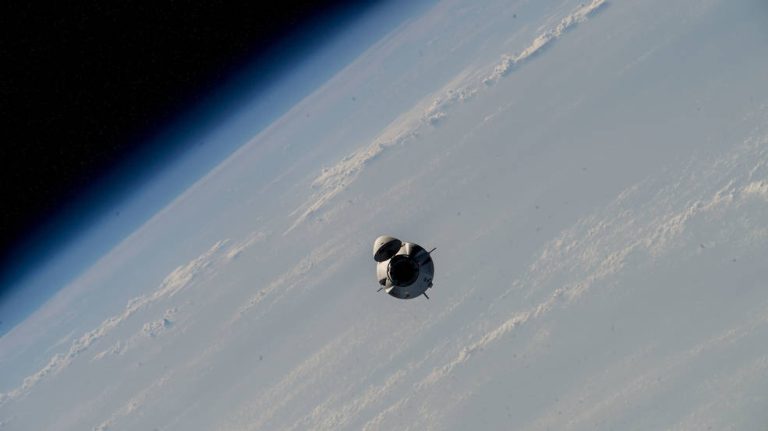
The SpaceX Crew Dragon Endeavour with four Crew-6 members aboard approaches the International Space Station for an automated docking to the Harmony module’s space-facing port. Credits: NASA
Four crew members aboard the International Space Station will relocate their SpaceX Dragon spacecraft’s docking port Saturday, May 6, to make way for the arrival of an upcoming cargo spacecraft.
NASA will provide live coverage of the move beginning at 7 a.m. EDT on NASA Television, the NASA app, and on the agency’s website at: https://www.nasa.gov/live
NASA’s SpaceX Crew-6 crew members NASA astronauts Steve Bowen and Woody Hoburg, UAE (United Arab Emirates) astronaut Sultan Alneyadi, and Roscosmos cosmonaut Andrey Fedyaev will undock from the space-facing port of the station’s Harmony module at 7:10 a.m. The spacecraft will dock again at the station’s forward Harmony port at 7:53 a.m.
The relocation, supported by ground controllers at Mission Control Center at NASA’s Johnson Space Center in Houston and SpaceX in Hawthorne, California, will free up Harmony’s space-facing port for the docking of the next Dragon cargo spacecraft set to launch in June. The zenith port on Harmony allows the Canadarm2 robotic arm easier access to the International Space Station Roll-Out Solar Arrays, or IROSAs, that will arrive SpaceX’s 28th commercial resupply mission for NASA for installation through a series of spacewalks.
This will be the third port relocation of a Dragon crew spacecraft, following previous relocations during the Crew-1 and Crew-2 missions. NASA’s SpaceX Crew-6 mission launched March 2 from NASA’s Kennedy Space Center in Florida and docked to the space station March 3. Crew-6, targeted to return in August, is the sixth rotational crew mission from NASA and SpaceX as a part of the agency’s Commercial Crew Program.
Get breaking news, images and features from the space station on Instagram, Facebook, and Twitter.
Joshua Finch Headquarters, Washington 202-358-1100 [email protected]