Home Blog Page 65

Hubble Captures An Elusive Galaxy Cluster

0
galaxy cluster ACO S520
NASA

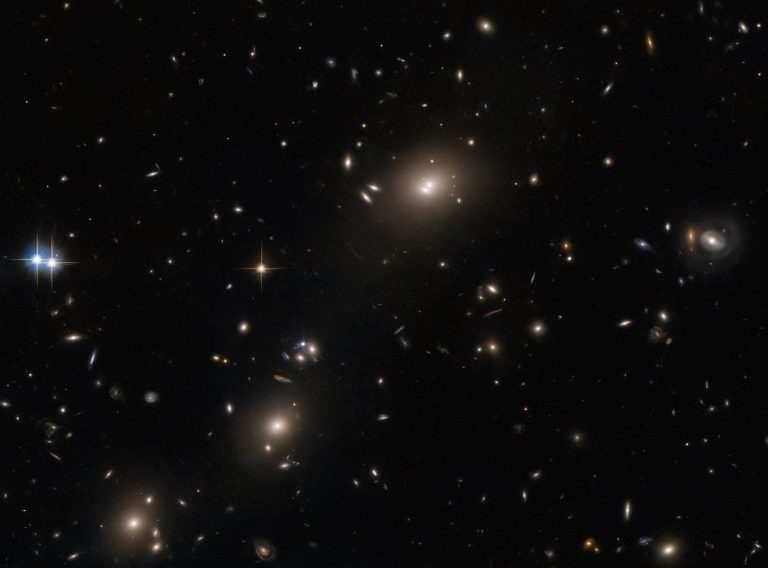
A menagerie of interesting astronomical finds are visible in this image from the NASA/ESA Hubble Space Telescope.

In addition to several large elliptical galaxies, a ring-shaped galaxy is lurking on the right of the image. A pair of bright stars are also visible at the left of the image, notable for their colorful crisscrossing diffraction spikes. This collection of astronomical curiosities is the galaxy cluster ACO S520, located in the constellation Pictor and captured by Hubble’s Advanced Camera for Surveys.

ACO S520 represents one of a series of Hubble observations searching for massive, luminous galaxy clusters that had not been captured by earlier surveys. Astronomers took advantage of occasional gaps in Hubble’s busy schedule to capture images of these barely explored galaxy clusters, revealing a wealth of interesting targets for further study with Hubble and the NASA/ESA/CSA James Webb Space Telescope.

Galaxy clusters are among the largest known objects in the universe. Studying these objects can provide insights into the distribution of dark matter, the mysterious substance that makes up most of the mass of a galaxy cluster.

Text credit: European Space Agency (ESA)
Image credit: ESA/Hubble & NASA, H. Ebeling


By Keith Cowing
Source SpaceRef

NASA’s Super Pressure Balloon: Around The World In 10 Days

0
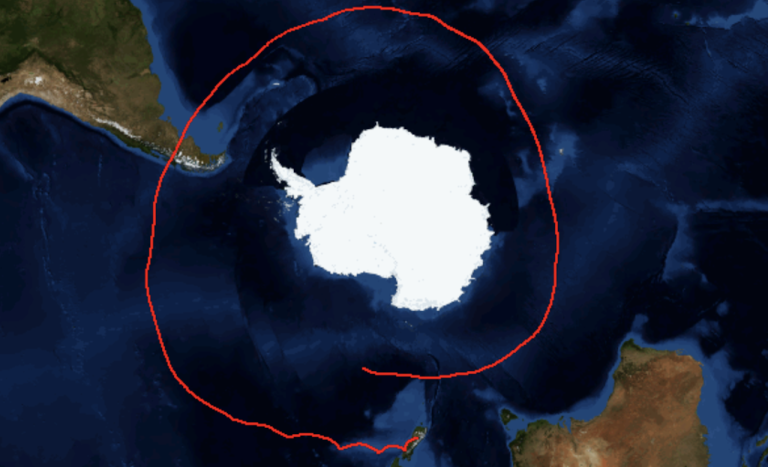
NASA’s super pressure balloon flight track. NASA

NASA’s super pressure balloon completed its first mid-latitude circumnavigation at 11:32 p.m. Wednesday, April 25 (U.S. Eastern Time) after just 10 days of flight.

NASA’s football-stadium-sized scientific super pressure balloon crossed the 169.24 east longitude line at about 11:32 p.m. EDT, April 25, officially completing its first mid-latitude circumnavigation after launch April 15 (U.S. Eastern time) from Wānaka Airport, New Zealand.

NASA achieved the milestone just 10 days, 3 hours, and 50 minutes after launch. The balloon is maintaining a float altitude around 107,000 feet as it continues its globetrotting journey.

“The balloon is performing exactly the way it was engineered to do, maintaining its shape and flying at a stable altitude despite the heating and cooling of the day-night cycle,” said Debbie Fairbrother, NASA’s Scientific Balloon Program chief. “As we continue to test, validate, and qualify this technology for future flights we’re also performing some cutting-edge science.”

The balloon is flying the Super Pressure Balloon Imaging Telescope (SuperBIT) payload, which has already returned brilliant research images from this flight.

Weather permitting, the balloon can be seen from the ground, especially at sunrise and sunset, as it continues on its globetrotting journey. People can track the real-time location of NASA’s super pressure balloon at this website: https://www.csbf.nasa.gov/map/balloon10/flight728NT.htm.

Next up for NASA’s Scientific Balloon Program is another planned super pressure balloon launch from Wānaka to further test the technology while also flying the Extreme Universe Space Observatory 2 (EUSO-2) science mission. EUSO-2, from the University of Chicago, aims to build on data collected during a 2017 mission. EUSO-2 will detect ultra-high energy cosmic-ray particles from beyond our galaxy as they penetrate Earth’s atmosphere. The origins of these particles are not well known, so the data collected from EUSO-2 will help solve this science mystery. Planned launch attempts will be announced on this blog.

For more information on NASA’s Scientific Balloon Program, visit: www.nasa.gov/scientificballoons.

Astronomy & Astrophysics To Remain In Open Access Under Subscribe To Open Model In 2023

0

Astronomy & Astrophysics (A&A) is pleased to announce that it will continue to publish its research in open access for the second consecutive year under the Subscribe to Open (S2O) model. In contrast to other core astronomy journals that have transitioned or will transition to open access via the Gold (APC) route, A&A has chosen a different approach to achieve immediate open access while minimizing any potential disruption to authors or subscribers. This decision reaffirms A&A’s commitment to making its high-quality research easily accessible to the global scientific community, while also ensuring sustainability and financial stability for the journal.

A&A’s Board of Directors and EDP Sciences have confirmed that despite the challenges in maintaining subscriptions under the S2O model, they have decided to continue publishing in open access for another year. This ensures that A&A’s high-quality scientific content remains freely accessible to all readers with no article processing charges (APCs) imposed on authors. Authors retain copyright ownership and comply with institutional and funders open access requirements. The engagement of A&A with the S2O model is a testament to the journal’s commitment to open access and to providing a cost-effective publishing option for many authors, despite the challenges faced by the scholarly publishing industry.

Dr. Thierry Forveille, Editor-in-Chief of A&A, emphasizes the journal’s commitment to open science and to meeting the needs of the astronomical and astrophysical communities. “A&A has been a pioneer in publishing innovative and peer-reviewed scientific content for over 50 years,” he said. “We are happy to continue our open access journey with S2O, which is proving to be an effective and sustainable model for scientific publishing that ensures our content is accessible to all. S2O provides a cost-effective alternative open access model that encourages collaboration and innovation within the scientific community.”

Dr. Agnès Henri, Managing Director, EDP Sciences thanks the library partners and institutions whose support has enabled the continuation of open access publishing for A&A. She also emphasizes the importance of continued support for S2O journals in the years to come. “We hope that as more institutions and readers become familiar with S2O, the renewal process will become easier, allowing us to continue publishing high-quality content under a sustainable and transparent model.”

The S2O model continues to be a transformative and innovative approach to open access publishing, and A&A is continuously reviewing and adapting the model to ensure sustainability. In 2022, A&A introduced a number of subscriber-only benefits to enhance the value of the journal offering. This will be reviewed for the forthcoming years.

About Astronomy & Astrophysics

Astronomy & Astrophysics (A&A) is a peer-reviewed community journal that publishes original research in astronomy and astrophysics. The journal is an international consortium governed by a Board of Directors who set the policies for A&A including general guidelines for publishing, the selection of the Editors, the various financial aspects, as well as membership of new countries.

The Editors are astronomers that are independent of any government or administrative body associated with the journal. A&A promotes diversity and equity in science and embraces open, inclusive, and fair practices that reflect the culture and values of the worldwide community of astronomers. Educational initiatives sponsored by A&A and EDP Sciences, such as the Science Writing for Young Astronomers (SWYA) workshops, educate and develop early career astronomers.

About EDP Sciences

EDP Sciences was established in 1920 by a prestigious academic community of French learned societies seeking to inspire, innovate and inform others by sharing their knowledge. Members of this community included eminent scientists like Marie Curie, Paul Langevin and Louis de Broglie. Today, EDP Sciences publishes high-quality scientific journals, conferences proceeding, books and magazines in a broad range of scientific, technical, and medical disciplines. As well as A&A, EDP Sciences is successfully publishing its Mathematics portfolio in open access through the S2O model.

About A&A’s Subscribe to Open model

Subscribe to Open (S2O) is an alternative subscription model supported by cOAlition S which enables libraries to use their budgets to support open access publishing. Existing subscription workflows and channels are used, and the financial structure of the journal does not change in any other way.

Under the S2O model, existing subscriber institutions are asked to subscribe as usual and as long as the expected subscription income is received, then the journal is published in open access. In this way, institutions secure access for their members, support journals for the common good of the academic community and demonstrate their commitment to equitable open access.

For 2023, A&A articles will be freely available for anyone to access and read. This will be reviewed every year, depending on the level of subscription renewals.

See the A&A S2O FAQs for more details.

For further information, contact:
Charlotte Van Rooyen
Director of Marketing and Communications, EDP Sciences
[email protected]

Flat, Pancake-sized Metalens Images Lunar Surface In An Engineering FirstPenn StateFlat, Pancake-sized Metalens Images Lunar Surface In An Engineering First

0
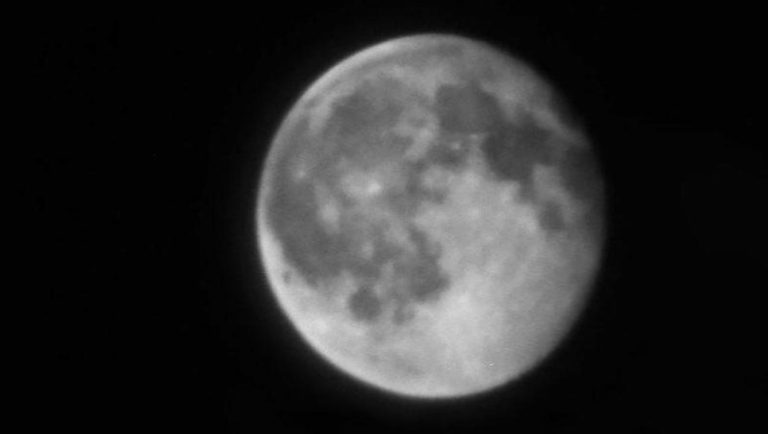
Electrical engineering researchers captured images of the lunar surface using their large-aperture metalens telescope. CREDIT Xingjie Ni

Astronomers and amateurs alike know the bigger the telescope, the more powerful the imaging capability. To keep the power but streamline one of the bulkier components, a Penn State-led research team created the first ultrathin, compact metalens telescope capable of imaging far-away objects, including the moon.

Metalenses comprise tiny, antenna-like surface patterns that can focus light to magnify distant objects in the same way as traditional curved glass lenses, but they have the advantage of being flat. Though small, millimeters-wide metalenses have been developed in the past, the researchers scaled the size of the lens to eight centimeters in diameter, or about four inches wide, making it possible to use in large optical systems, such as telescopes. They published their approach in Nano Letters.

“Traditional camera or telescope lenses have a curved surface of varying thickness, where you have a bump in the middle and thinner edges, which causes the lens to be bulky and heavy,” said corresponding author Xingjie Ni, associate professor of electrical engineering and computer science at Penn State. “Metalenses use nano-structures on the lens instead of curvature to contour light, which allows them to lay flat.”

That is one of the reasons, Ni said, modern cellphone camera lenses protrude from the body of the phone: the thickness of the lenses take up space, though they appear flat since they are hidden behind a glass window.

Metalenses are typically made using electron beam lithography, which involves scanning a focused beam of electrons onto a piece of glass, or other transparent substrate, to create antenna-like patterns point by point. However, the scanning process of the electron beam limits the size of the lens that can be created, as scanning each point is time-consuming and has low throughput.

To create a bigger lens, the researchers adapted a fabrication method known as deep ultraviolet (DUV) photolithography, which is commonly used to produce computer chips.

“DUV photolithography is a high-throughput and high-yield process that can produce many computer chips within seconds,” Ni said. “We found this to be a good fabrication method for metalenses because it allows for much larger pattern sizes while still maintaining small details, which allows the lens to work effectively.”

The researchers modified the method with their own novel procedure, called rotating wafer and stitching. Researchers divided the wafer, on which the metalens was fabricated, into four quadrants, which were further divided into 22 by 22 millimeter regions — smaller than a standard postage stamp. Using a DUV lithography machine at Cornell University, they projected a pattern onto one quadrant through projection lenses, which they then rotated by 90 degrees and projected again. They repeated the rotation until all four quadrants were patterned.

“The process is cost-effective because the masks containing the pattern data for each quadrant can be reused due to the rotation symmetry of the metalens,” Ni said. “This reduces the manufacturing and environmental costs of the method.”

As the size of the metalens increased, the digital files required to process the patterns became significantly larger, which would take a long time for the DUV lithography machine to process. To overcome this issue, the researchers compressed the files using data approximations and by referencing non-unique data.

“We utilized every possible method to reduce the file size,” Ni said. “We identified identical data points and referenced existing ones, gradually reducing the data until we had a usable file to send to the machine for creating the metalens.”

Using the new fabrication method, the researchers developed a single-lens telescope and captured clear images of the lunar surface — achieving greater resolution of objects and much farther imaging distance than previous metalenses. Before the technology can be applied to modern cameras, however, researchers must address the issue of chromatic aberration, which causes image distortion and blurriness when different colors of light, which bend in different directions, enter a lens.

“We are exploring smaller and more sophisticated designs in the visible range, and will compensate for various optical aberrations, including chromatic aberration,” Ni said.

In addition to Ni, coauthors include Lidan Zhang, Shengyuan Chang, Xi Chen, Yimin Ding, Md Tarek Rahman and Yao Duan, all current or former Penn State graduate students in electrical engineering. Mark Stephen, from the NASA-Goddard Space Flight Center, also contributed.

The NASA Early Career Faculty Award, the United States Office of Naval Research and the National Science Foundation supported this work.

By Keith Cowing
Source SpaceRef

Astronomers Detect The Closest Example Yet Of A Black Hole Devouring A Star

0
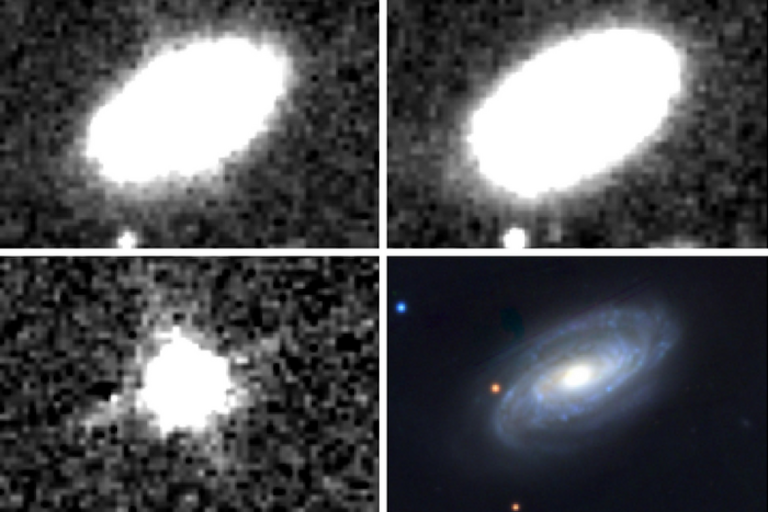
Astronomers at MIT and elsewhere have observed infrared signs of the closest tidal disruption event (TDE) to date. A bright flare was detected from the galaxy NGC 7392 in 2015 (top left panel). Observations of the same galaxy were taken in 2010-2011 (top right), prior to the TDE. The bottom left shows the difference between the first two images, representing the actual, detected TDE. For comparison, the bottom right panel shows the same galaxy in the optical waveband. CREDIT Courtesy of Christos Panagiotou, et al

Once every 10,000 years or so, the center of a galaxy lights up as its supermassive black hole rips apart a passing star. This “tidal disruption event” happens in a literal flash, as the central black hole pulls in stellar material and blasts out huge amounts of radiation in the process.

Astronomers know of around 100 tidal disruption events (TDE) in distant galaxies, based on the burst of light that arrives at telescopes on Earth and in space. Most of this light comes from X-rays and optical radiation.

MIT astronomers, tuning past the conventional X-ray and UV/optical bands, have discovered a new tidal disruption event, shining brightly in infrared. It is one of the first times scientists have directly identified a TDE at infrared wavelengths.

What’s more, the new outburst happens to be the closest tidal disruption event observed to date: The flare was found in NGC 7392, a galaxy that is about 137 million light-years from Earth, which corresponds to a region in our cosmic backyard that is one-fourth the size of the next-closest TDE.

This new flare, labeled WTP14adbjsh, did not stand out in standard X-ray and optical data. The scientists suspect that these traditional surveys missed the nearby TDE, not because it did not emit X-rays and UV light, but because that light was obscured by an enormous amount of dust that absorbed the radiation and gave off heat in the form of infrared energy.

The researchers determined that WTP14adbjsh occurred in a young, star-forming galaxy, in contrast to the majority of TDEs that have been found in quieter galaxies. Scientists expected that star-forming galaxies should host TDEs, as the stars they churn out would provide plenty of fuel for a galaxy’s central black hole to devour. But observations of TDEs in star-forming galaxies were rare until now.

The new study suggests that conventional X-ray and optical surveys may have missed TDEs in star-forming galaxies because these galaxies naturally produce more dust that could obscure any light coming from their core. Searching in the infrared band could reveal many more, previously hidden TDEs in active, star-forming galaxies.

“Finding this nearby TDE means that, statistically, there must be a large population of these events that traditional methods were blind to,” says Christos Panagiotou, a postdoc in MIT’s Kavli Institute for Astrophysics and Space Research. “So, we should try to find these in infrared if we want a complete picture of black holes and their host galaxies.”

A paper detailing the team’s discovery appears today in Astrophysical Journal Letters. Panagiotou’s MIT co-authors are Kishalay De, Megan Masterson, Erin Kara, Michael Calzadilla, Anna-Christina Eilers, Danielle Frostig, Nathan Lourie, and Rob Simcoe, along with Viraj Karambelkar, Mansi Kasliwal, Robert Stein, and Jeffry Zolkower of Caltech, and Aaron Meisner at the National Science Foundation’s National Optical-Infrared Astronomy Research Laboratory.

A flash of possibility

Panagiotou did not intend to search for tidal disruption events. He and his colleagues were looking for signs of general transient sources in observational data, using a search tool developed by De. The team used De’s method to look for potential transient events in archival data taken by NASA’s NEOWISE mission, a space telescope that has made regular scans of the entire sky since 2010, at infrared wavelengths.

The team discovered a bright flash that appeared in the sky near the end of 2014.

“We could see there was nothing at first,” Panagiotou recalls. “Then suddenly, in late 2014, the source got brighter and by 2015 reached a high luminosity, then started going back to its previous quiescence.”

They traced the flash to a galaxy 42 megarparsecs from Earth. The question then was, what set it off? To answer this, the team considered the brightness and timing of the flash, comparing the actual observations with models of various astrophysical processes that could produce a similar flash.

“For instance, supernovae are sources that explode and brighten suddenly, then come back down, on similar timescales to tidal disruption events,” Panagiotou notes. “But supernovae are not as luminous and energetic as what we observed.”

Working through different possibilities of what the burst could be, the scientists were finally able to exclude all but one: The flash was most likely a TDE, and the closest one observed so far.

“It’s a very clean light curve and really follows what we expect the temporal evolution of a TDE should be,” Panagiotou says.

Red or green

From there, the researchers took a closer look at the galaxy where the TDE arose. They gathered data from multiple ground- and space-based telescopes which happened to observe the part of the sky where the galaxy resides, across various wavelengths, including infrared, optical, and X-ray bands. With this accumulated data, the team estimated that the supermassive black hole at the center of the galaxy was about 30 million times as massive as the sun.

“This is almost 10 times larger than the black hole we have at our galactic center, so it’s quite massive, though black holes can get up to 10 billion solar masses,” Panagiotou says.

The team also found that the galaxy itself is actively producing new stars. Star-forming galaxies are a class of “blue” galaxies, in contrast to quieter “red” galaxies that have stopped producing new stars. Star-forming blue galaxies are the most common type of galaxy in the universe.

“Green” galaxies lie somewhere between red and blue, in that, every so often they produce a few stars. Green is the least common galaxy type, but curiously, most TDEs detected to date have been traced to these rarer galaxies. Scientists had struggled to explain these detections, since theory predicts that blue star-forming galaxies should exhibit TDEs, as they would present more stars for black holes to disrupt.

But star-forming galaxies also produce a lot of dust from the interactions between and among stars near a galaxy’s core. This dust is detectable at infrared wavelengths, but it can obscure any X-ray or UV radiation that would otherwise be picked up by optical telescopes. This could explain why astronomers have not detected TDEs in star-forming galaxies using conventional optical methods.

“The fact that optical and X-ray surveys missed this luminous TDE in our own backyard is very illuminating, and demonstrates that these surveys are only giving us a partial census of the total population of TDEs,” says Suvi Gezari, associate astronomer and chair of the Science Staff at the Space Telescope Science Institute in Maryland, who was not involved in the study. “Using infrared surveys to catch the dust echo of obscured TDEs…has already shown us that there is a population of TDEs in dusty, star-forming galaxies that we have been missing.”

This research was supported, in part, by NASA.


By Keith Cowing
Source SpaceRef

Superflare With Massive, High-velocity Prominence Eruption

0
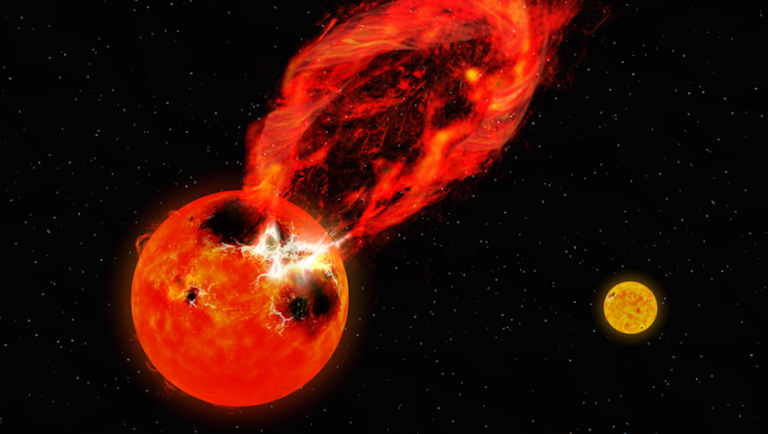
Artist’s impression of the superflare observed on one of the stars in the V1355 Orionis binary star system. The binary companion star is visible in the background on the right.CREDIT NAOJ

A team of Japanese astronomers used simultaneous ground-based and space-based observations to capture a more complete picture of a superflare on a star. The observed flare started with a very massive, high-velocity prominence eruption. These results give us a better idea of how superflares and stellar prominence eruptions occur.

Some stars have been seen releasing superflares over 10 times larger than the largest solar flare ever seen on the Sun. The hot ionized gas released by solar flares can influence the environment around the Earth, referred to as space weather. More powerful superflares must have an even greater impact on the evolution of any planets forming around the star, or the evolution of any life forming on those planets. But the details of how superflares and prominence eruptions on stars occur have been unclear.

A team led by Shun Inoue at Kyoto University used the 3.8-m Seimei Telescope in Japan and the Transiting Exoplanet Survey Satellite (TESS) to monitor the binary star system V1355 Orionis which is known to frequently release large-scale superflares. V1355 Orionis is located 400 light years away in the constellation Orion.

The team succeeded in capturing a superflare with continuous, high temporal resolution observations. Data analysis shows that the superflare originated with a phenomenon known as a prominence eruption. Calculating the velocity of the eruption requires making some assumptions about aspects that aren’t directly observably, but even the most conservative estimates far exceed the escape velocity of the star (347 km/s), indicating that the prominence eruption was capable of breaking free of the star’s gravity and developing into Coronal Mass Ejections (CMEs). The prominence eruption was also one of the most massive ever observed, carrying trillions of tons of material.

These results appeared as Inoue et al. “Detection of a high-velocity prominence eruption leading to a CME associated with a superflare on the RS CVn-type star V1355 Orionis” (open access) in The Astrophysical Journal on April 27, 2023.

By Keith Cowing
Source SpaceRef
Advanced Plant Habitat: Creating Farm-to-Table Meals For The Orbital Age

0

Ushering in the Orbital Age™ requires aligning different solutions to transform low-Earth orbit (LEO) from a dangerous, inhospitable environment into a safe place for private sector experts to create the tech of tomorrow, albeit one several hundred miles higher than professionals are used to. These solutions include how we get to space—answer: the Dream Chaser® spaceplane—but also how we stay in space. Sourcing the vegetables that will be a crucial component of future specialist astronauts’ diets ranks highly on this latter list.

But first, humanity’s shift to the Orbital Age depends on enabling private sector experts to live and work in LEO as comfortably as possible. Requirements to keep people alive in space have not changed. We all need clean air and water, plus a consistent food supply. What does tend to shift is the level of comfort and security accompanying life’s basic necessities. 

And that is Sierra Space’s central focus.

Just as the Dream Chaser team continues making refinements to Tenacity, our first of fleet of spaceplanes, we are also hard at work developing LIFE™, the backbone of our future infrastructure in LEO. (Most recently, a one-third scale test unit passed a stress test with flying colors when our team purposefully inflated it to the point it exploded.) This test demonstrated LIFE can withstand pressures far beyond what would be needed to keep astronauts safe in LEO. But our focus isn’t just on keeping humans alive, but also on helping them thrive. 

And what helps people flourish more than fresh, healthy food?

Unfortunately, nutrition has always been a thorny space issue. Collectively, we have already grown quite adept at handling both oxygen and water demand by developing efficient filtering processes. Plus, rapid advances in power systems, including Sierra Space’s Surface Mount Technology (SMT), can handle the increased requirements of private sector activity in LEO. But what about food? People living and working in LEO still largely require food deliveries from Earth. 

Turns out, dependency on the space version of your favorite meal delivery service not only demonstrates the weakness of the nascent space economy, it’s also a tremendous cost driver. As UConn professor of plant physiology Mary Musgrave once quipped, “Let’s say you take a hamburger with you to space. How much does it cost in terms of fuel to bring that up? It’s $3,000 for your quarter-pounder. It’s expensive to lift weight up into orbit.” Musgrave who has since passed, also helped work on the Biomass Production System in the early 2000’s with Orbital Technologies Corporation (ORBITEC) which was acquired and now a part of Sierra Space. 

The answer to this conundrum? Grow more food in space. The problem is it isn’t as simple as planting a garden in LEO. Just as microgravity dramatically changes the game in medicine and manufacturing, plants also act very differently in microgravity. Now, when we consider what it takes to successfully grow plants, we often concentrate on water, sunlight, and soil. 

What doesn’t make the list? 

Gravity. However, it’s crucial to this process. A plant growth response called gravitopism dictates roots grow downwards and shoots grow upwards, a concept microgravity (literally) turns on its head in LEO. Just ask any astronaut how confusing the lack of gravity can be, and you’ll begin to discern how tough it must be for the poor plants! 

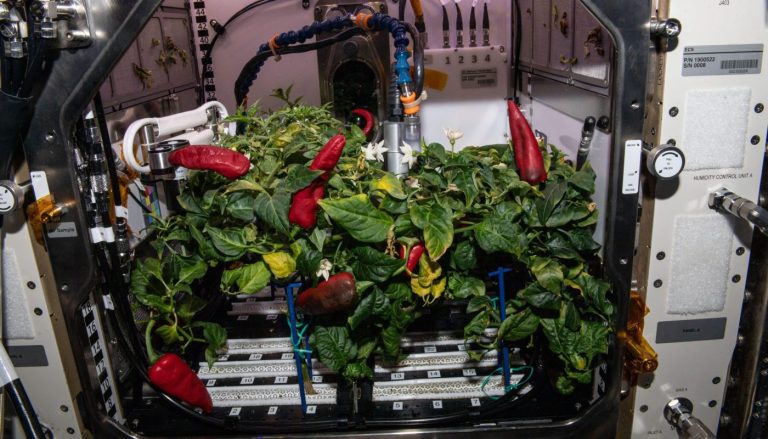
To overcome such challenges, NASA previously partnered with ORBITEC, now part of Sierra Space on the Advanced Plant Habitat (APH). NASA first developed the APH to research growing vegetables in LEO’s unique conditions to provide a reliable food supply. Sierra Space is now heavily involved with the APH, initially deployed to the International Space Station (ISS) in 2017. 

Far from being a hobby garden in LEO, APH is a sophisticated apparatus to test crops and monitor their full growth cycle.

A closed-loop system, it possesses an environmentally controlled growth chamber. That’s a crucial component of researching plants in space as it grants researchers the confidence to determine shifts in growth patterns aren’t caused by lack of light or an errant water delivery system. In fact, APH has more than 180 sensors monitoring items like temperature, oxygen levels, and moisture content—in real time. It can also generate different types of lighting conditions via an innovative design featuring red, blue, green, and broad spectrum white LED lights. 

All this tech is busy unlocking the future of food in space even as you read this article. What’s more, Sierra Space has partnered with NASA on multiple experiments with the APH including PH-01, for comparing plants grown in space with those on earth to assess key differences in photosynthesis and metabolism. The current experiment, PH-03, is also studying epigenetic adaptations in plants grown in space. (Space grown plants will go through their entire life cycle in LEO, with their seeds returned home for study and future replanting back in orbit.) 

This study promises to unlock deeper understandings of how vegetables will contribute to a stable off-world food supply. But like all of Sierra Space’s activities in the Orbital Age, the APH will contribute to life here on earth. Yes, ongoing research using the APH is creating new plant strains with the ability to provide fresh produce for those living and working aboard LIFE Habitats. But these same strains may also thrive terrestrially, especially in areas that have never enjoyed such success. (Agriculture on earth can only improve as new food crops are introduced that can withstand harsh conditions that would cause their traditional earthbound cousins to wither and die.)

Undoubtedly, the APH is just one of many Sierra Space projects running at full speed to truly open up LEO for the benefit of all. If you want to be part of the team making the Orbital Age not just possible—but habitable—please consider joining us today.

European Space And Telecoms Players Sign Partnership Agreement To Bid For IRIS2 Constellation

0

A group of European space and telecommunications players have come together to form a partnership to respond to the European Commission’s call for tender related to the future European satellite constellation IRIS² (Infrastructure for Resilience, Interconnectivity and Security by Satellite). IRIS² aims to bring a new secure and resilient connectivity infrastructure to European governments, businesses and citizens.

The open consortium will be governed by Airbus Defence and Space, Eutelsat, Hispasat, SES and Thales Alenia Space. The consortium will also rely on the core team of the following companies: Deutsche Telekom, OHB, Orange, Hisdesat, Telespazio, and Thales. Together, they will aim to create a state-of-the-art satellite constellation based on a multi-orbit architecture that would be interoperable with the terrestrial ecosystem.

This partnership will set up an integrated best-in-class European space and telecoms team across these companies to leverage the expertise and capabilities in the field of secure satellite communications solutions. The consortium will encourage start-ups, mid-Caps and SMEs to join the partnership, resulting in a more innovative and competitive European space sector where new business models will emerge.

The integrated team aims to foster collaboration among all European space players across the whole connectivity value chain with a view to enabling EU’s strategic autonomy through the delivery of sovereign, secure and resilient government services to protect European citizens. The team will leverage synergies between government and commercial infrastructures. The teaming partners are also well positioned to provide commercial services to bridge the digital divide across European territories and to increase Europe’s global outreach and competitiveness as a space and digital power on the global market.
 
IRIS² will deliver resilient and secure connectivity solutions to governments to protect European citizens and will provide commercial services in the interest of European economies and societies. It will also bolster the EU partnership policy by offering its infrastructure abroad. IRIS² is the EU’s new flagship space programme for a digital, resilient and safer Europe.

Your contact

Beatriz Lozano
External Communications – Airbus Defence and Space
Phone: +49 172 341 38 38
[email protected]

Anita Baltagi
Eutelsat
Phone: +33 (0)6 43 93 01 78
[email protected]

Víctor Inchausti
Hispasat
Phone: +34 667 31 29 48
[email protected]

Suzanne Ong
SES
Phone: +352 710 725 500
[email protected]

Sandrine Bielecki
Thales Alenia Space
Phone: +33 (0)4 92 92 70 94
[email protected]

God Save The King! – In Defence of King Charles III, The Coronation & The Monarchy

0

On the 6th of May, King Charles III will be crowned, an event that has received mixed reactions from the public. Recent surveys have shown that support for the British Monarchy is waning, with many people expressing their dissatisfaction with the institution. 

Personally, I am not in favour of monarchies, as I believe they embody and represent the very thing that discourages people from believing they can fundamentally change their state in life. It’s either you are born immensely privileged or not: when you’re concept of hardship is whether you miss out on tea break in the countryside or not knowing how to feed your children for their next meal.

The monarchy is an ancient institution like it or not. The coronation of King Charles III will happen and the monarchy is still very much a part of the United Kingdom. This is our world, this is our reality.

You may not be in favour of the monarchy and you may be cursing the institution or lamenting the waste of taxpayers’ money on these ceremonies which seem out of place and out of touch in our modern world but in defence of the King and the monarchy, risking the ire of fellow commoners . . .

1. On Inequality – The Lucky Commoners And Other Aristocrats Are Now The Real Monarchs

The monarchy is not responsible for the vast inequality in the world now. Long before we were here, this situation and configuration of society in the form of kings, warlords, invaders, lords, and conquerors have always been in existence. This is hardly new, you win by force, by luck, by wit – be it good or bad. Being born British is already a privilege that many people in the world do not have, and commoners today are luckier than the real monarchs of the past. It is almost taboo to discuss it but much of this wealth is an inheritance by slave ancestors and other conquered peoples.

Nowadays, imagine an intern in a finance company can earn triple or quadruple more than a senior nurse. Someone playing around with other people’s money is earning more than people saving lives. Their worst pains are already the unattainable joys of others.

We now live in a world created by commoners who think they are bigger than monarchs and have illusions of grandeur.

2. Royalty In The UK Is No Longer As It Used To Be

The role of the monarchy has changed over time, with their influence diminishing. It seems that the monarchy today is more about being a celebrity than ruling kingdoms; of carrying on with traditions. They do good, make no mistake. They have causes that fight for the common good, like climate change and other injustices around the world. They are, for all intents and purposes, core to the UK identity.

But they can no longer wage wars, rightly so or not. They can not impose their will unhindered. There are limits and constraints.

Nevertheless, respect and deference are birthrights, earned or otherwise. It is as un-“commoner” as it goes.

3. Get On With Life

People forget that money is made from the spectacle and pageantry of the monarchy. People enjoy watching the monarchy, just as they do with movies or reality TV shows. There is nothing wrong with it. If this is the situation, enjoy it. If you don’t like it, then ignore it.

For example, we vilify Harry. Then don’t buy the book, don’t read about them, don’t watch them. Truth is, everyone is still fascinated by this show. As a commoner, you sometimes need to see royalties flail and fail. It softens the insult of daily hardships. It’s our problem: wanting to see meat and blood on the streets.

By bemoaning the coronation and the ills of the monarchy, you are just cursing the darkness.

In the end, give King Charles III a break or better yet give yourself a break. None of them made anyone’s life miserable directly. At worst, they have been entertainment. At best, it is better to be pseudo-ruled by a real monarch than be subjected to the tyranny of commoner dictator-warlords elsewhere. Stop overthinking. Have a good time. Afford them and everyone else the basic courtesy and dignity that has long been missing in UK life with the deepening woes of daily life. Do yourself a favour.

### End ###

Best Of The Internet: NASA Wins Webby Award, 5 People’s Voice Awards For 2023

0
NASA’s 2023 Webby award-winning entry – for Best Video, Science and Education – is “How Hubble Images Are Made.” Five other NASA projects were People’s Voice winners. Credit: NASA

Among the honorees, the website for NASA’s Jet Propulsion Laboratory picked up a People’s Voice Award, as did the JPL-managed Eyes on Asteroids visualization tool.

NASA has earned one Webby award and five People’s Voice awards in the 27th annual Webby Awards, recognizing excellence on the internet. The award is NASA’s 27th Webby Award since 1998 and represents the agency’s commitment to creating engaging and educational digital communications.

NASA’s 2023 Webby award-winning entry, selected by a panel of judges, is How Hubble Images Are Made (NASA, Webby winner for Best Video, Science and Education). As a cosmic photographer, NASA’s Hubble Space Telescope has taken over a million snapshots documenting the universe. These images illustrate, explain, and inspire us with their grandeur. But how are those images taken and processed? This video explains the answer to that question.

Alongside the juried Webby Awards, which are selected by members of the International Academy of Digital Arts and Sciences (IADAS), the winners of the People’s Voice Awards are determined by a public vote. Five NASA projects received the honor of winning People’s Voice awards:

  • NASA’s Eyes on Asteroids – Visualization of the asteroids in our solar system. NASA/Jet Propulsion Laboratory (People’s Voice Winner, Websites and Mobile Sites, Best Data Visualization)
  • NASA’s James Webb Space Telescope Unfolds the Universe – Keeping the world up to date on how the telescope was launched and deployed. NASA/James Webb Space Telescope (People’s Voice Winner, Social, Social Campaigns, Education and Discovery)
  • NASA’s Jet Propulsion Laboratory Website – The online gateway to one of NASA’s leading centers for Earth science and the robotic exploration of the universe. NASA/Jet Propulsion Laboratory/Caltech (People’s Voice Winner, Websites and Mobile Sites, Science)
  • NASA Social Media – With millions of followers, NASA’s flagship social media accounts provide the agency with a collective audience that spans platforms and diverse groups of people. NASA (People’s Voice Winner, Social, Best Overall Social Presence – Brand)
  • NASA Webb Telescope Launch Through First Images Live Stream Series – A 10-video playlist of major milestone events for the telescope. NASA (People’s Voice Winner, Social, Events and Live Streaming)

Overall, NASA projects were nominated for nine Webby awards this year. The agency’s other nominees included:

  • 29 Days on the Edge – We launched the James Webb Space Telescope. Then we had to unfold it as it embarked on a million-mile journey. NASA (Nominee, Video, Technology)
  • NASA Artemis I Social Campaign – Taking a few million friends along for the ride. NASA (Nominee, Social, Education and Discovery)
  • NASA’s “On a Mission” – Stories about NASA missions, told through the lives of those who make space exploration possible. NASA/Jet Propulsion Laboratory (Nominee, Podcasts, Science and Education)

Two other NASA properties were chosen as honorees. Webby honorees are selected as one of the best on the internet as part of the Webby judging process. The agency’s honorees are:

  • NASA’s Exoplanet Exploration Program – Honored for its approach to building accessibility above and beyond compliance standards. NASA/Jet Propulsion Laboratory (Honoree, Websites and Mobile Sites, Accessible Technology)
  • NASA’s James Webb Space Telescope Unfolds the Universe – The James Webb Space Telescope’s social media program was honored for content that educates and promotes knowledge sharing. NASA/James Webb Space Telescope (Honoree, Social, General Social, Education and Discovery)

About the Webbys

The Webbys are an annual awards competition hosted and presented by the International Academy of Digital Arts and Sciences (IADAS). According to its website, this year’s Webby Awards received nearly 14,000 entries from all 50 states and 70 countries worldwide.

Winners in each category will be honored in an awards ceremony held in New York on May 15, 2023.

See the full list of past NASA Webby Award winners and nominees here.