
Home Blog Page 67

Asteroid’s Comet-Like Tail Is Not Made Of Dust, Solar Observatories Reveal

0
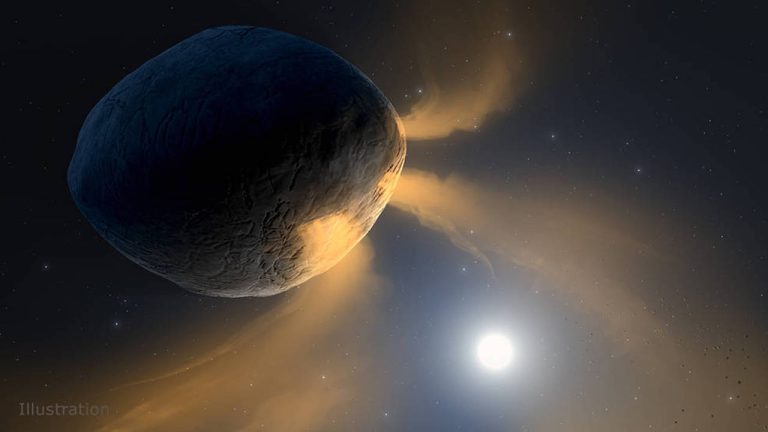
This illustration depicts asteroid Phaethon being heated by the Sun. The asteroid’s surface gets so hot that sodium inside Phaethon’s rock likely vaporizes and vents into space, causing it to brighten like a comet and form a tail. Credits: NASA/JPL-Caltech/IPAC

We have known for a while that asteroid 3200 Phaethon acts like a comet. It brightens and forms a tail when it’s near the Sun, and it is the source of the annual Geminid meteor shower, even though comets are responsible for most meteor showers. Scientists had blamed Phaethon’s comet-like behavior on dust escaping from the asteroid as it’s scorched by the Sun. However, a new study using two NASA solar observatories reveals that Phaethon’s tail is not dusty at all but is actually made of sodium gas.

“Our analysis shows that Phaethon’s comet-like activity cannot be explained by any kind of dust,” said California Institute of Technology PhD student Qicheng Zhang, who is the lead author of a paper published in the Planetary Science Journal reporting the results.

Asteroids, which are mostly rocky, do not usually form tails when they approach the Sun. Comets, however, are a mix of ice and rock, and typically do form tails as the Sun vaporizes their ice, blasting material off their surfaces and leaving a trail along their orbits. When Earth passes through a debris trail, those cometary bits burn up in our atmosphere and produce a swarm of shooting stars – a meteor shower.

After astronomers discovered Phaethon in 1983, they realized that the asteroid’s orbit matched that of the Geminid meteors. This pointed to Phaethon as the source of the annual meteor shower, even though Phaethon was an asteroid and not a comet.

In 2009, NASA’s Solar Terrestrial Relations Observatory (STEREO) spotted a short tail extending from Phaethon as the asteroid reached its closest point to the Sun (or “perihelion”) along its 524-day orbit. Regular telescopes hadn’t seen the tail before because it only forms when Phaethon is too close to the Sun to observe, except with solar observatories. STEREO also saw Phaethon’s tail develop on later solar approaches in 2012 and 2016. The tail’s appearance supported the idea that dust was escaping the asteroid’s surface when heated by the Sun.

However, in 2018, another solar mission imaged part of the Geminid debris trail and found a surprise. Observations from NASA’s Parker Solar Probe showed that the trail contained far more material than Phaethon could possibly shed during its close approaches to the Sun.

Zhang’s team wondered whether something else, other than dust, was behind Phaethon’s comet-like behavior. “Comets often glow brilliantly by sodium emission when very near the Sun, so we suspected sodium could likewise serve a key role in Phaethon’s brightening,” Zhang said.

An earlier study, based on models and lab tests, suggested that the Sun’s intense heat during Phaethon’s close solar approaches could indeed vaporize sodium within the asteroid and drive comet-like activity.

Hoping to find out what the tail is really made of, Zhang looked for it again during Phaethon’s latest perihelion in 2022. He used the Solar and Heliospheric Observatory (SOHO) spacecraft — a joint mission between NASA and the European Space Agency (ESA) – which has color filters that can detect sodium and dust. Zhang’s team also searched archival images from STEREO and SOHO, finding the tail during 18 of Phaethon’s close solar approaches between 1997 and 2022.

In SOHO’s observations, the asteroid’s tail appeared bright in the filter that detects sodium, but it did not appear in the filter that detects dust. In addition, the shape of the tail and the way it brightened as Phaethon passed the Sun matched exactly what scientists would expect if it were made of sodium, but not if it were made of dust.

This evidence indicates that Phaethon’s tail is made of sodium, not dust.

“Not only do we have a really cool result that kind of upends 14 years of thinking about a well-scrutinized object,” said team member Karl Battams of the Naval Research Laboratory, “but we also did this using data from two heliophysics spacecraft – SOHO and STEREO – that were not at all intended to study phenomena like this.”

Zhang and his colleagues now wonder whether some comets discovered by SOHO – and by citizen scientists studying SOHO images as part of the Sungrazer Project – are not comets at all.

“A lot of those other sunskirting ‘comets’ may also not be ‘comets’ in the usual, icy body sense, but may instead be rocky asteroids like Phaethon heated up by the Sun,” Zhang explained.

Still, one important question remains: If Phaethon doesn’t shed much dust, how does the asteroid supply the material for the Geminid meteor shower we see each December?

Zhang’s team suspects that some sort of disruptive event a few thousand years ago – perhaps a piece of the asteroid breaking apart under the stresses of Phaethon’s rotation – caused Phaethon to eject the billion tons of material estimated to make up the Geminid debris stream. But what that event was remains a mystery.

More answers may come from an upcoming Japan Aerospace Exploration Agency (JAXA) mission called DESTINY+ (short for Demonstration and Experiment of Space Technology for Interplanetary voyage Phaethon fLyby and dUst Science). Later this decade, the DESTINY+ spacecraft is expected to fly past Phaethon, imaging its rocky surface and studying any dust that might exist around this enigmatic asteroid.

Sodium Brightening of (3200) Phaethon near Perihelion, The Planetary Science Journal (open access)

By Keith Cowing
Source SpaceRef
A More Precise Model Of Earth’s Ionosphere

0
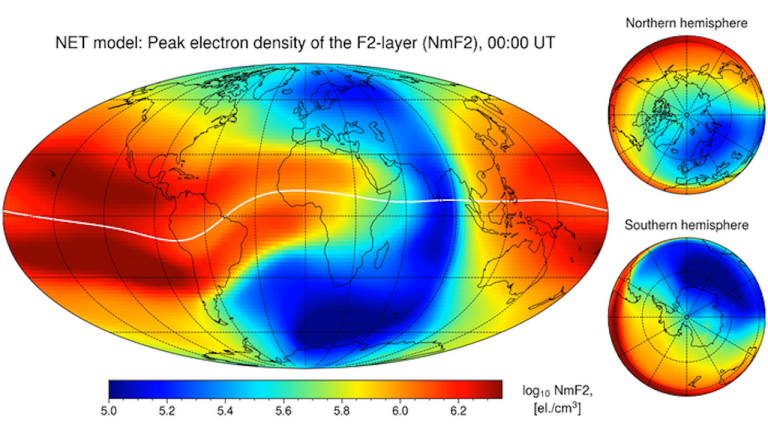
Electron density of the Ionosphere around the Earth for a certain point of time: high values in red, low values in blue. The white line marks the geomagnetic equator. CREDIT CCBY 4.0 Smirnov et al. (2023) – Scientific Reports (https://doi.org/10.1038/s41598-023-28034-z)

The ionosphere – the region of geospace spanning from 60 to 1000 kilometres above the Earth – impairs the propagation of radio signals from global navigation satellite systems (GNSS) with its electrically charged particles.

This is a problem for the ever higher precision required by these systems – both in research and for applications such as autonomous driving or precise orbit determination of satellites. Models of the ionosphere and its uneven, dynamic charge distribution can help correct the signals for ionospheric delays, which are one of the main error sources in GNSS applications. Researchers led by Artem Smirnov and Yuri Shprits of the GFZ German Research Centre for Geosciences have presented a new model of the ionosphere in the journal Nature Scientific Reports, developed on the basis of neural networks and satellite measurement data from 19 years. In particular, it can reconstruct the topside ionosphere, the upper, electron-rich part of the ionosphere much more precisely than before. It is thus also an important basis for progress in ionospheric research, with applications in studies on the propagation of electromagnetic waves or for the analysis of certain space weather events, for example.

Background: Importance and complexity of the ionosphere

The Earth’s ionosphere is the region of the upper atmosphere that extends from about 60 to 1000 kilometres in altitude. Here, charged particles such as electrons and positive ions dominate, caused by the radiation activity of the Sun – hence the name. The ionosphere is important for many scientific and industrial applications because the charged particles influence the propagation of electromagnetic waves such as radio signals. The so-called ionospheric propagation delay of radio signals is one of the most important sources of interference for satellite navigation. This is proportional to the electron density in the space traversed. Therefore, a good knowledge of the electron density can help in correcting the signals. In particular, the upper region of the ionosphere, above 600 kilometres, is of interest, since 80 per cent of the electrons are gathered in this so-called topside ionosphere.

The problem is that the electron density varies greatly – depending on the longitude and latitude above the Earth, the time of day and year, and solar activity. This makes it difficult to reconstruct and predict them, the basis for correcting radio signals, for example.

Previous models

There are various approaches to modelling electron density in the ionosphere, among others, the International Reference Ionosphere Model IRI, which has been recognised since 2014. It is an empirical model that establishes a relationship between input and output variables based on the statistical analysis of observations. However, it still has weaknesses in the important area of the topside ionosphere because of the limited coverage of previously collected observations in that region.

Recently, however, large amounts of data have become available for this area. Therefore, Machine learning (ML) approaches lend themselves to deriving regularities from this, especially for complex non-linear relationships.

New approach using machine learning and neural networks

A team from the GFZ German Research Centre for Geosciences around Artem Smirnov, PhD student and first author of the study, and Yuri Shprits, head of the “Space Physics and Space Weather” section and Professor at University Potsdam, took a new ML-based empirical approach. For this, they used data from satellite missions from 19 years, in particular CHAMP, GRACE and GRACE-FO, which were and are significantly co-operated by the GFZ, and COSMIC. The satellites measured – among other things – the electron density in different height ranges of the ionosphere and cover different annual and local times as well as solar cycles.

With the help of Neural Networks, the researchers then developed a model for the electron density of the topside ionosphere, which they call the NET model. They used the so-called MLP method (Multi-Layer Perceptrons), which iteratively learns the network weights to reproduce the data distributions with very high accuracy.

The researchers tested the model with independent measurements from three other satellite missions.

Evaluation of the new model

“Our model is in remarkable agreement with the measurements: It can reconstruct the electron density very well in all height ranges of the topside ionosphere, all around the Globe, at all times of the year and day, and at different levels of solar activity, and it significantly exceeds the International Reference Ionosphere Model IRI in accuracy. Moreover, it covers space continuously,” first author Artem Smirnov sums up.

Yuri Shprits adds: “This study represents a paradigm shift in ionospheric research because it shows that ionospheric densities can be reconstructed with very high accuracy. The NET model reproduces the effects of numerous physical processes that govern the dynamics of the topside ionosphere and can have broad applications in ionospheric research.”

Possible applications in ionosphere research

The researchers see possible applications, for instance, in wave propagation studies, for calibrating new electron density data sets with often unknown baseline offsets, for tomographic reconstructions in the form of a background model, as well as to analyse specific space weather events and perform long-term ionospheric reconstructions. Furthermore, the developed model can be connected to plasmaspheric altitudes and thus can become a novel topside option for the IRI.

The developed framework allows the seamless incorporation of new data and new data sources. The retraining of the model can be done on a standard PC and can be performed on a regular basis. Overall, the NET model represents a significant improvement over traditional methods and highlights the potential of neural network-based models to provide a more accurate representation of the ionosphere for communication and navigation systems that rely on GNSS.

A novel neural network model of Earth’s topside ionosphere, Scientific Reports (open access)

By Keith Cowing
Source SpaceRef
NASA InSight Study Provides Clearest Look Ever At Martian Core

0

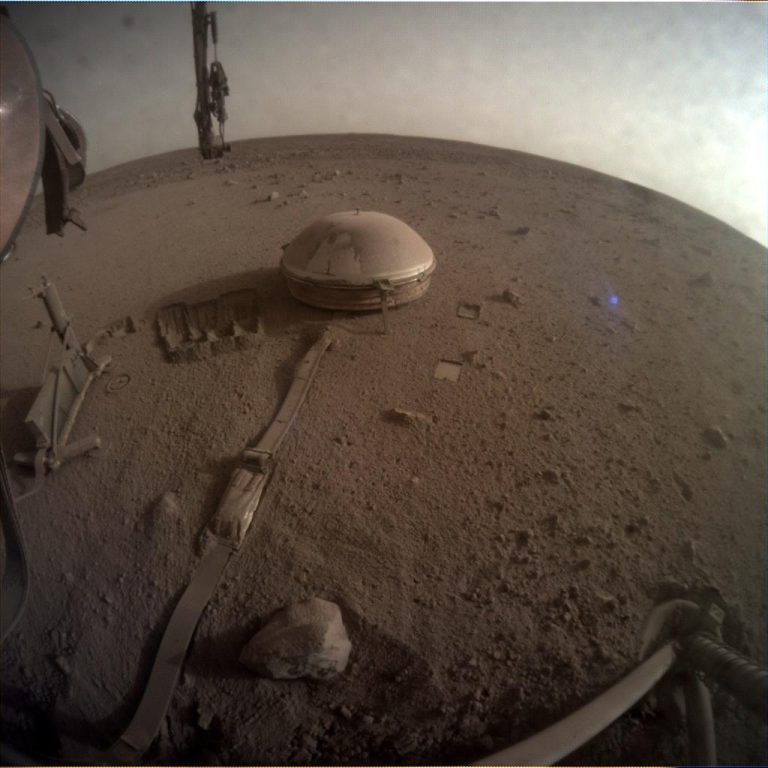
This is one of the last images ever taken by NASA’s InSight Mars lander. Captured on Dec. 11, 2022, the 1,436th Martian day, or sol, of the mission, it shows InSight’s seismometer on the Red Planet’s surface. Credit: NASA/JPL-Caltech Full Image Details

A pair of quakes in 2021 sent seismic waves deep into the Red Planet’s core, giving scientists the best data yet on its size and composition.

While NASA retired its InSight Mars lander in December, the trove of data from its seismometer will be pored over for decades to come. By looking at seismic waves the instrument detected from a pair of temblors in 2021, scientists have been able to deduce that Mars’ liquid iron core is smaller and denser than previously thought.

The findings, which mark the first direct observations ever made of another planet’s core, were detailed in a paper published April 24 in the Proceedings of the National Academies of Sciences. Occurring on Aug. 25 and Sept. 18, 2021, the two temblors were the first identified by the InSight team to have originated on the opposite side of the planet from the lander – so-called farside quakes. The distance proved crucial: The farther a quake happens from InSight, the deeper into the planet its seismic waves can travel before being detected.

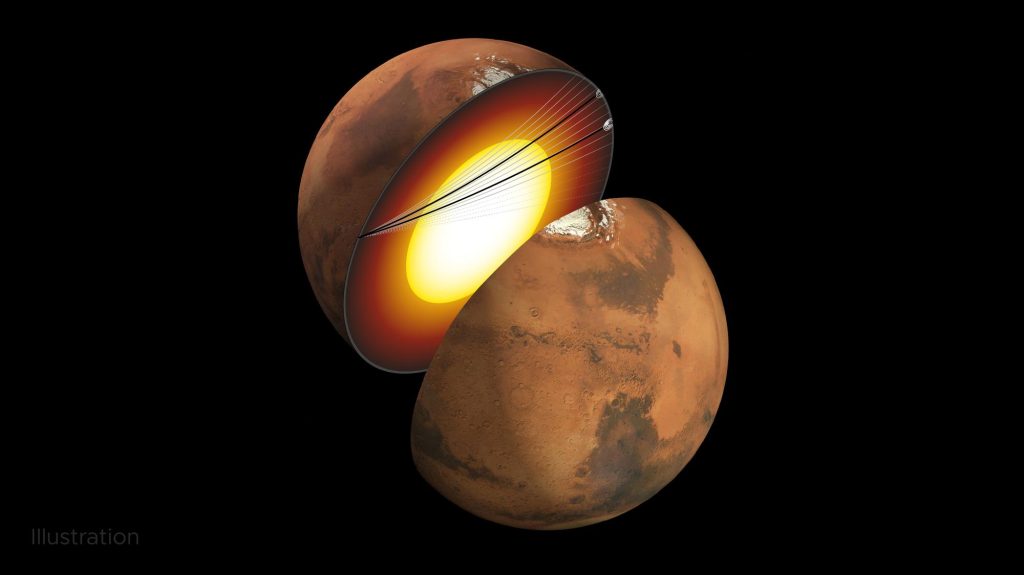
This artist’s concept shows a cutaway of Mars, along with the paths of seismic waves from two separate quakes in 2021. Detected by NASA’s InSight mission, these seismic waves were the first ever identified to enter another planet’s core. Credit: NASA/JPL-Caltech/University of Maryland

“We needed both luck and skill to find, and then use, these quakes,” said lead author Jessica Irving, an Earth scientist at the University of Bristol in the United Kingdom. “Farside quakes are intrinsically harder to detect because a great deal of energy is lost or diverted away as seismic waves travel through the planet.”

Irving noted that the two quakes occurred after the mission had been operating on the Red Planet for well over a full Martian year (about two Earth years), meaning the Marsquake Service – the scientists who initially scrutinize seismographs – had already honed their skills. It also helped that a meteoroid impact caused one of the two quakes; impacts provide a precise location and more accurate data for a seismologist to work with. (Because Mars has no tectonic plates, most marsquakes are caused by faults, or rock fractures, that form in the planet’s crust due to heat and stress.) The quakes’ size was also a factor in the detections.

“These two farside quakes were among the larger ones heard by InSight,” said Bruce Banerdt, InSight’s principal investigator at NASA’s Jet Propulsion Laboratory in Southern California. “If they hadn’t been so big, we couldn’t have detected them.”

One of the challenges in detecting these particular quakes was that they’re in a “shadow zone” – a part of the planet from which seismic waves tend to be refracted away from InSight, making it hard for a quake’s echo to reach the lander unless it is very large. Detecting seismic waves that cross through a shadow zone is exceptionally difficult; it’s all the more impressive that the InSight team did so using just the one seismometer they had on Mars. (In contrast, many seismometers are distributed on Earth.)

“It took a lot of seismological expertise from across the InSight team to tease the signals out from the complex seismograms recorded by the lander,” Irving said.

A previous paper that offered a first glimpse of the planet’s core relied on seismic waves that reflected off its outer boundary, providing less precise data. Detecting seismic waves that actually traveled through the core allows scientists to refine their models of what the core looks like. Based on the findings documented in the new paper, about a fifth of the core is composed of elements such as sulfur, oxygen, carbon, and hydrogen.

“Determining the amount of these elements in a planetary core is important for understanding the conditions in our solar system when planets were forming and how these conditions affected the planets that formed,” said one of the paper’s co-authors, Doyeon Kim of ETH Zurich.

That was always the central goal of InSight’s mission: to study the deep interior of Mars and help scientists understand how all rocky worlds form, including Earth and its Moon.

More About the Mission

JPL manages InSight for NASA’s Science Mission Directorate. InSight is part of NASA’s Discovery Program, managed by the agency’s Marshall Space Flight Center in Huntsville, Alabama. Lockheed Martin Space in Denver built the InSight spacecraft, including its cruise stage and lander, and supported spacecraft operations for the mission.

A number of European partners, including France’s Centre National d’Études Spatiales (CNES) and the German Aerospace Center (DLR), are supporting the InSight mission. CNES provided the Seismic Experiment for Interior Structure (SEIS) instrument to NASA, with the principal investigator at IPGP (Institut de Physique du Globe de Paris). Significant contributions for SEIS came from IPGP; the Max Planck Institute for Solar System Research (MPS) in Germany; the Swiss Federal Institute of Technology (ETH Zurich) in Switzerland; Imperial College London and Oxford University in the United Kingdom; and JPL. The Marsquake Service is headed by ETH Zurich, with significant contributions from IPGP; the University of Bristol; Imperial College; ISAE (Institut Supérieur de l’Aéronautique et de l’Espace); MPS; and JPL. DLR provided the Heat Flow and Physical Properties Package (HP3) instrument, with significant contributions from the Space Research Center (CBK) of the Polish Academy of Sciences and Astronika in Poland. Spain’s Centro de Astrobiología (CAB) supplied the temperature and wind sensors.

Originally published at JPL NASA

Webb Reveals Early-Universe Prequel To Huge Galaxy Cluster

0

Protocluster Confirmed, 650 Million Years after the Big Bang

How did we get here? This fundamental question may be applied on its grandest scale in cosmology, which investigates the history and origin of the universe. Astronomers are able to investigate the early universe and its development like never before with NASA’s James Webb Space Telescope, including the first galaxies. 

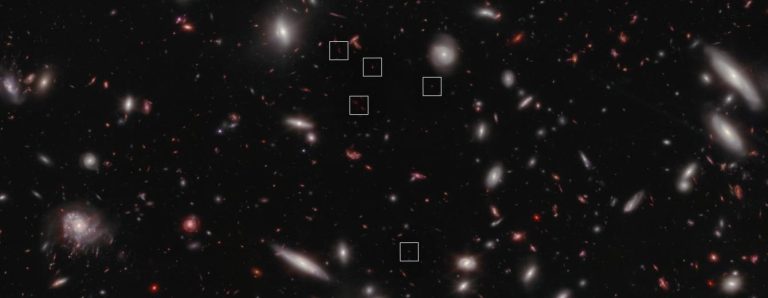
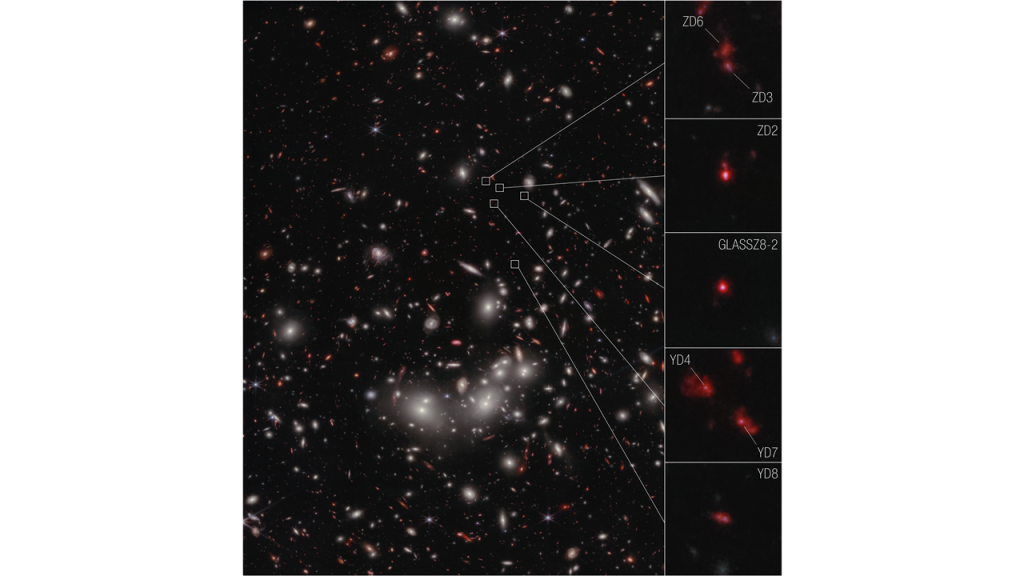
The powerful telescope’s latest findings are the first to spectroscopically confirm distances for a young protocluster of galaxies just 650 million years after the big bang. Astronomers think the protocluster represents the earliest stages of what will develop into a massive conglomeration like the Coma Cluster, which includes thousands of gravitationally bound member galaxies.

Every giant was once a baby, though you may never have seen them at that stage of their development. NASA’s James Webb Space Telescope has begun to shed light on formative years in the history of the universe that have thus far been beyond reach: the formation and assembly of galaxies. For the first time, a protocluster of seven galaxies has been confirmed at a distance that astronomers refer to as redshift 7.9, or a mere 650 million years after the big bang. Based on the data collected, astronomers calculated the nascent cluster’s future development, finding that it will likely grow in size and mass to resemble the Coma Cluster, a monster of the modern universe. 

“This is a very special, unique site of accelerated galaxy evolution, and Webb gave us the unprecedented ability to measure the velocities of these seven galaxies and confidently confirm that they are bound together in a protocluster,” said Takahiro Morishita of IPAC-California Institute of Technology, the lead author of the study published in the Astrophysical Journal Letters.

The precise measurements captured by Webb’s Near-Infrared Spectrograph (NIRSpec) were key to confirming the galaxies’ collective distance and the high velocities at which they are moving within a halo of dark matter – more than two million miles per hour (about one thousand kilometers per second). 

The spectral data allowed astronomers to model and map the future development of the gathering group, all the way to our time in the modern universe. The prediction that the protocluster will eventually resemble the Coma Cluster means that it could eventually be among the densest known galaxy collections, with thousands of members.

“We can see these distant galaxies like small drops of water in different rivers, and we can see that eventually they will all become part of one big, mighty river,” said Benedetta Vulcani of the National Institute of Astrophysics in Italy, another member of the research team. 

Galaxy clusters are the greatest concentrations of mass in the known universe, which can dramatically warp the fabric of spacetime itself. This warping, called gravitational lensing, can have a magnifying effect for objects beyond the cluster, allowing astronomers to look through the cluster like a giant magnifying glass. The research team was able to utilize this effect, looking through Pandora’s Cluster to view the protocluster; even Webb’s powerful instruments need an assist from nature to see so far. 

Exploring how large clusters like Pandora and Coma first came together has been difficult, due to the expansion of the universe stretching light beyond visible wavelengths into the infrared, where astronomers lacked high-resolution data before Webb. Webb’s infrared instruments were developed specifically to fill in these gaps at the beginning of the universe’s story.

The seven galaxies confirmed by Webb were first established as candidates for observation using data from the Hubble Space Telescope’s Frontier Fields program. The program dedicated Hubble time to observations using gravitational lensing, to observe very distant galaxies in detail. However, because Hubble cannot detect light beyond near-infrared, there is only so much detail it can see. Webb picked up the investigation, focusing on the galaxies scouted by Hubble and gathering detailed spectroscopic data in addition to imagery. 

The research team anticipates that future collaboration between Webb and NASA’s Nancy Grace Roman Space Telescope, a high-resolution, wide-field survey mission, will yield even more results on early galaxy clusters. With 200 times Hubble’s infrared field of view in a single shot, Roman will be able to identify more protocluster galaxy candidates, which Webb can follow up to confirm with its spectroscopic instruments. The Roman mission is currently targeted for launch by May 2027.

“It is amazing the science we can now dream of doing, now that we have Webb,” said Tommaso Treu of the University of California, Los Angeles, a member of the protocluster research team. “With this small protocluster of seven galaxies, at this great distance, we had a one hundred percent spectroscopic confirmation rate, demonstrating the future potential for mapping dark matter and filling in the timeline of the universe’s early development.” 

The James Webb Space Telescope is the world’s premier space science observatory. Webb will solve mysteries in our solar system, look beyond to distant worlds around other stars, and probe the mysterious structures and origins of our universe and our place in it. Webb is an international program led by NASA with its partners, ESA (European Space Agency) and the Canadian Space Agency.

Credits

MEDIA CONTACT:

Leah Ramsay
Space Telescope Science Institute, Baltimore, Maryland

Christine Pulliam
Space Telescope Science Institute, Baltimore, Maryland

SCIENCE: Takahiro Morishita (IPAC)

Originally published at Webb Space Telescope

The 7 Best Top-Load And Front-Load Washers

0

Washing machines are typically divided into 2 types. Front-Load and Top-Load. While typically the front-load is the more efficient there are some situations where the top-load is also a good choice. A few of these considerations are price, load capacity, power efficiency and style. Most of the time it does boils down to “Would this look good in my house? Will it fit in with my other appliances?”

Here are some of the best washers and some tips at the end on how to choose your washing machine.

01. BLACK+DECKER – 0.9 Cu. Ft. Top-Load Washer

This portable washer is ideal for those who wash infrequently. It offers 5 cycles from heavy, gentle, normal, rapid and soak. It’s a washing machine that has the bare minimum features you would expect. 

02. Frigidaire – 4.1 cu. ft. Top Load Washer

With 12 wash cycles, a large capacity and a fabric conditioner dispenser, this is one of the top choices if you are with company or family. The MaxFill option allows you to use the maximum allowable water for the ultimate clean.

03. Kenmore – 4.8 cu. ft. Top Load Washer

This washer has a built-in water faucet and impeller. The built-in water faucet allows you to pre-treat your clothes without the need for a laundry room sink. Just like with our previous entry, it also has a fabric conditioner dispenser.

04. Bosch – 2.2 Cu. Ft. Front-Load Washer

Being a front-load washer this will be more efficient (water and energy) thant it’s top-load counterpart. Operationally quiet, LED display and hot & cold water intake, this is a decent choice for a washing machine.

05. Electrolux –  2.4 Cu. Ft. Front-Load Washer

A variety of settings for different set of clothes is what sets this apart from the others. With these presets you would be able to choose the right configuration. The Steam™ technology gently lifts dirt and stains from fibers.  While the LuxCare® Wash System offers a thorough clean with improved wash actions, temperature control and bottom-vent steam options.

06. LG – 4.5 cu. ft. Front Load Washer

This is a Smart Wi-Fi enabled washer from LG. What this basically means is that you’ll be able to tell how much longer the wash is gonna take from your smartphone. It also has the capability to auto-select a compatible drying cycle instead of estimating it by yourself.

07. Samsung – 6.0 cu. ft. Front-Load Washer

This one has a cool feature of having two washers. An example on how you can use the washers at the same time is to put whites on top (top-load), and colors at the bottom (front-load). Or delicates in the top and normal load in the bottom. This washer also has Wi-Fi connectivity, meaning you could monitor its status from your phone.

Before you go and buy your washing machine here are some tips:

  • Top loaders have generally lower price compared to front loaders. 
  • Front loaders are more water and energy efficient
  • Top loaders sometimes have the problem of growing mold. Choosing one that has a mold prevention is a big plus.
  • Most front loaders produce less noise and vibration during cycle
  • Top loaders are easy to add or remove items mid-cycle. But try to avoid doing this as much as possible.

Robots, Humans, Assemble For The Moon

0
ESA-ESRIC Space Resources Challenge
ESA

Robots and humans assembled their brains and artificial intelligence (AI) for Moon exploration at the ESA-ESRIC Space Resources Challenge. A team proved that when it comes to surveying uncharted worlds, working together is the most efficient approach.

12 teams from across Europe and Canada competed to find resources in a mock lunar surface. Over 200 tonnes of lava and rock, a hundred boulders and tricky slopes in a former aircraft hangar mimicked the surface of our Moon. The lighting recreated the long shadows that are projected around the Moon’s South Pole and the teams competing had to deal with a five-second communication delay as if they were 385 000 km away.

The teams developed different strategies traversing the unknown terrain and collecting samples for science analysis during two field tests in the Netherlands and Luxembourg in 2022.

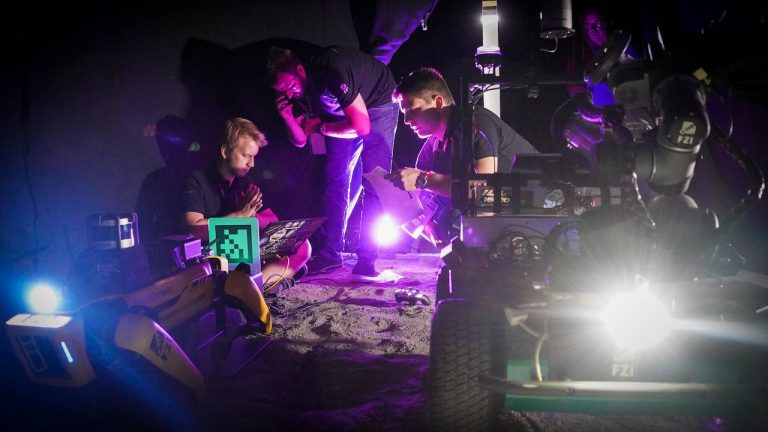
This picture shows members of the Autonomous Robots for In-Situ Surface Exploration team (ARISE) at work to help their four robots complete the mission during the second campaign in Luxembourg, in September 2022.

ARISE won the Space Resources Challenge after their rovers managed to track down their own location in the simulated Moon, finding the safest passages and analysing the composition of the rocks as a potential resource.

Lunar resources such as oxygen, metals, soil and water are likely to play a large role in space economies. Making use of these resources will be crucial for sustainable space exploration, and the Moon is a promising target for extracting resources.

In a simulated lunar treasure hunt, teams made use of swarm robotics, an AI democracy where robots autonomously reach an agreement on how to accomplish their goal. The robots decided where to explore and which instruments were more suitable for each task.

The organisers praised ARISE’s skills at autonomy, mapping and mobility. The winning team was made of a consortium of European organisations, including the FZI Forschungszentrum Informatik, ETH Zurich, and the universities of Zurich, Basel and Bern.

ESA has launched a new campaign to identify technological gaps and find solutions for resource extraction on the Moon. A fresh call for ideas will serve to define the theme of the next edition of the Space Resource Challenge.

ESA’s next astronaut to fly to the International Space Station, Andreas Mogensen, will continue ESA’s ground-breaking research into human and robotic exploration. Andreas first mission, ‘iriss’ proved that humans can control robots from an orbiting space station when he performed tasks through a robot on Earth with millimeter precision. His next mission, Huginn is launching this year and will see Andreas controlling a swarm of robots on Earth from space, pushing the human-robot alliance even further.

The Moon awaits you and your robots.

By Keith Cowing
Source SpaceRef

Making Better Measurements Of The Composition Of Galaxies

0
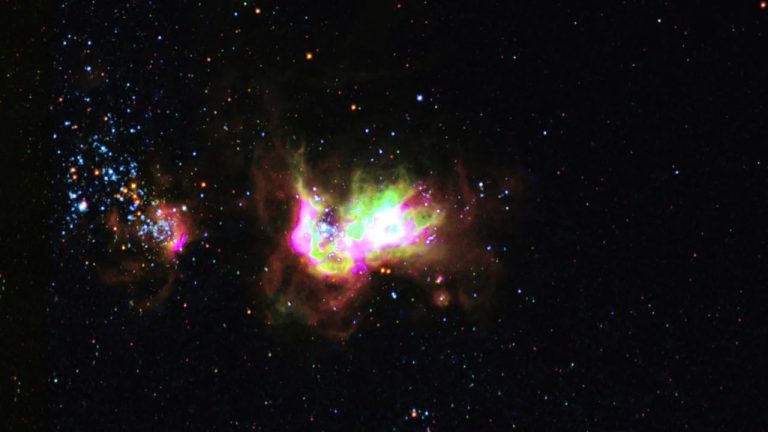
Composite image of dwarf galaxy Markarian 71, 11 million light years from Earth. Optical and infrared observations of Mrk71 resolve a question about two methods used to measure the composition of galaxies and could lead to improved studies with infrared space telescopes. (Hubble Space Telescope)

A study using data from telescopes on Earth and in the sky resolves a problem plaguing astronomers working in the infrared and could help make better observations of the composition of the universe with the James Webb Space Telescope and other instruments. The work is published April 20 in Nature Astronomy.

“We’re trying to measure the composition of gases inside galaxies,” said Yuguang Chen, a postdoctoral researcher working with Professor Tucker Jones in the Department of Physics and Astronomy at the University of California, Davis.

Most elements other than hydrogen, helium and lithium are produced inside stars, so the composition and distribution of heavier elements — especially the ratio of oxygen to hydrogen — can help astronomers understand how many and what kinds of stars are being formed in a distant object.

Astronomers use two methods to measure oxygen in a galaxy, but unfortunately, they give different results. One common method, collisionally excited lines, gives a strong signal, but the results are thought to be sensitive to temperature changes, Chen said. A second method uses a different set of lines, called recombination lines, which are fainter but not thought to be affected by temperature.

The recombination line method consistently produces measurements about double those from collisionally excited lines. Scientists attribute the discrepancy to temperature fluctuations in gas clouds, but this has not been directly proven, Chen said.

Chen, Jones and colleagues used optical and infrared astronomy to measure oxygen abundance in dwarf galaxy Markarian 71, about 11 million light years from Earth. They used archived data from the recently retired SOFIA flying telescope and the retired Herschel Space Observatory, as well as making observations with telescopes at the W.M. Keck Observatory in Mauna Kea, Hawaii.

SOFIA (Stratospheric Observatory For Infrared Astronomy) was a telescope mounted in a Boeing 747 aircraft. By flying at 38,000 to 45,000 feet, the aircraft could get above 99% of the water vapor in Earth’s atmosphere, which effectively blocks infrared light from deep space from reaching ground level. A joint project of NASA and the German space agency, SOFIA made its last operational flight in September 2022 and is now headed for a museum display in Tucson.

The Herschel Space Observatory, named after astronomers William and Caroline Herschel, was an infrared space telescope operated by the European Space Agency. It was active from 2009 to 2013.

A surprising result

With data from these instruments, Chen and Jones examined oxygen abundance in Markarian 71 while correcting for temperature fluctuations. They found that the result from collisionally excited infrared lines was still 50% less than that from the recombination line method, even after eliminating the effect of temperature.

“This result is very surprising to us,” Chen said. There is no consensus on an explanation for the discrepancy, he said. The team plans to look at additional objects to figure out what properties of galaxies correlate with this variation, Chen said.

One of the goals of the James Webb Space Telescope, launched in 2022, is to make infrared observations of the composition of distant galaxies in the first billion years of the universe. The new results provide a framework for making these measurements with the JWST and the Atacama Large Millimeter Array in Chile.

Additional co-authors on the paper are: Ryan Sanders and Erin Huntzinger, UC Davis; Dario Fadder, Jessica Sutter and Robert Minchin, SOFIA Science Center, NASA Ames Research Center; Peter Senchyna, Observatories of the Carnegie Institute for Science, Pasadena; Daniel Stark and Benjamin Weiner, Steward Observatory, University of Arizona; Justin Spilker, Texas A&M University; and Guido Roberts-Borsani, UCLA. The work was financially supported in part by NASA. SOFIA was jointly operated by the Universities Space Research Association, Inc., and the Deutsches SOFIA Institut.

The W.M. Keck Observatory is operated as a scientific partnership among the California Institute of Technology, the University of California, and NASA, with financial support from the W.M. Keck Foundation. The researchers would like to thank the Hawaiian community for the privilege of allowing them to conduct observations on Mauna Kea, which plays a significant cultural and religious role.

Accurate oxygen abundance of interstellar gas in Mrk 71 from optical and infrared spectra, Nature Astronomy

By Keith Cowing
Source SpaceRef

Celebrating Earth Day

0

Former NASA Administrator Charlie Bolden speaks with local students during an Earth Day event, Thursday, April 20, 2023, at Union Station in Washington. The agency’s Earth Day exhibits are a free, public part of yearly celebrations; visitors can participate in hands-on activities and learn about the many ways NASA conducts Earth science.

Image Credit: NASA/Keegan Barber

By Monika Luabeya
Source NASA

NASA, Rocket Lab Set Coverage For Tropical Cyclones Mission

0
NASA’s TROPICS (Time-Resolved Observations of Precipitation structure and storm Intensity with a Constellation of Smallsats) is a mission to study tropical cyclones, such as Hurricane Ian, pictured here as captured by the MODIS instrument on NASA’s Terra on Sept. 27, 2022.
Credits: NASA

NASA and Rocket Lab are targeting 9 p.m. EDT, Sunday, April 30 (1 p.m. New Zealand Standard Time, Monday, May 1), to launch two storm tracking CubeSats into orbit.  

The agency’s TROPICS (Time-Resolved Observations of Precipitation structure and storm Intensity with a Constellation of Smallsats) mission has a two hour launch window from Launch Complex 1 Pad B in Māhia, New Zealand.

Rocket Lab will provide live coverage beginning approximately 20 minutes before launch. Coverage will air on NASA Television, the NASA app, and the agency’s website, as well as the Rocket Lab website.

TROPICS is a constellation of four identical CubeSats designed to observe tropical cyclones from low Earth orbit, making observations more frequently than current weather tracking satellites. Both payloads, each carrying a pair of CubeSats, will launch on a Rocket Lab Electron rocket.

A second launch from Rocket Lab with two additional CubeSats is targeted for Tuesday, May 16 EDT, with exact launch times contingent on the date and time of the first launch.

TROPICS will study tropical cyclones as part of NASA’s Earth System Science Pathfinder Program and should increase understanding of the processes driving rapid changes in storm structure and integrity. NASA plans to have the CubeSats distributed evenly in two low Earth orbital planes about 340 miles (550 kilometers) above the Earth’s surface. TROPICS has the potential to provide roughly hourly observations of a storm’s precipitation, temperature, and humidity, compared to about every six hours with current satellites. Gathering data more frequently can help scientists improve weather forecasting models.

Full coverage of this mission is as follows (all times Eastern):

Friday, April 28

NASA and Rocket Lab will host a media teleconference at 4 p.m. for the TROPICS mission. Audio of the briefing will be livestreamed on NASA’s website.

The teleconference participants will include:

  • Dr. Will McCarty, program scientist, NASA Earth Science Division
  • Ben Kim, program executive, NASA Earth Science Division
  • Dr. William Blackwell, TROPICS principal investigator, MIT Lincoln Laboratory 
  • Bradley Smith, Director, Launch Services for NASA’s Space Operations Mission Directorate
  • Peter Beck, Rocket Lab founder and CEO

To participate, media must RSVP at least two hours prior to the start of the briefing by emailing: [email protected].

Sunday, April 30

Approximately 8:40 p.m. – Live launch coverage begins

9 p.m. – Launch window opens

NASA website launch coverage

Follow countdown coverage on NASA’s launch blog for live updates beginning no earlier than 8 p.m. as the countdown milestones occur. On-demand streaming video and photos of the launch will be available shortly after liftoff on Rocket Lab’s website and Flickr.

Watch, engage on social media

Stay connected and receive mission updates by following and tagging these accounts:

Twitter: @NASA_LSP@NASAEarth@NASAKennedy@NASA@RocketLab

Facebook: NASANASA LSPRocketLabUSA

Instagram: @NASA@NASAEarth@RocketLabUSA

The TROPICS team is led by Blackwell at MIT’s Lincoln Laboratory in Lexington, Massachusetts, and includes researchers from NASA, the National Oceanic and Atmospheric Administration, and several universities and commercial partners. NASA’s Launch Services Program, based at the agency’s Kennedy Space Center in Florida, is managing launch services.

For more information about NASA’s TROPICS, visit: https://go.nasa.gov/3h46pJp

Karen Fox
Headquarters, Washington
202-358-1275
[email protected]

Kiana Raines
Headquarters, Washington
202-358-1100
[email protected]

Leejay Lockhart
Kennedy Space Center, Florida
321-747-8310
[email protected]

By Abbey Donaldson
Source NASA

Astrobotic Purchases Falcon Heavy Launch Services

0
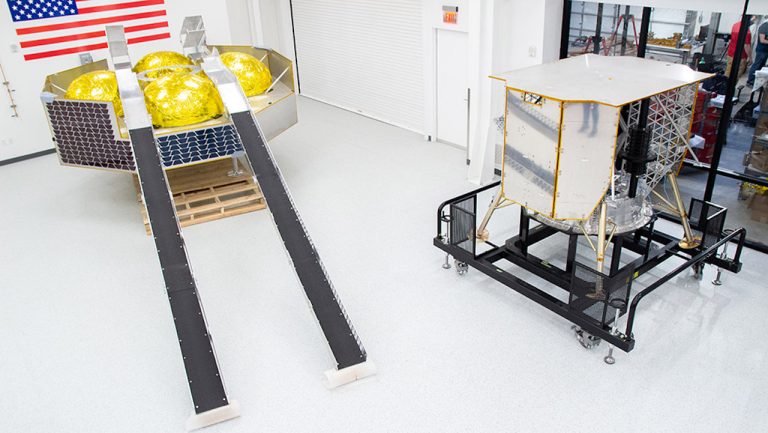
Astrobotic Lander
Astrobotic

Astrobotic announced today during the spring Lunar Surface Innovation Consortium (LSIC) its purchase of launch services aboard a SpaceX Falcon Heavy rocket for its third upcoming lander mission to the Moon. This mission will launch an Astrobotic lander to the Moon’s South Pole in 2026 to deliver payload customer instruments and cargo from around the world.

The lunar south pole is an area of increasing interest and planned activity, and Astrobotic is rising to meet the demand for missions to this key destination with the purchase of a Falcon Heavy to deliver medium-class payloads.

“NASA’s Artemis program is a major effort to establish a U.S. presence at the lunar south pole, and at the same time, international customers are also lining up plans to pioneer new science, exploration, and commercial activities within this region as well,” said Astrobotic CEO, John Thornton. “With all this rising interest, we felt now is the time to announce our next commercial mission to deliver hundreds of kilograms of payload to the lunar south pole.”

This next mission lands at an area of intense interest for science instruments, technology demonstrators, rovers, power systems, and other infrastructure. Astrobotic plans to carry lunar surface payloads, as well as offer satellite deployments for those looking to deploy to other destinations in cislunar space.

“This third mission represents our next step toward making the Moon an accessible destination for those who have sophisticated, long term plans for the south pole,” said Thornton.

Astrobotic’s third lunar mission is targeted to launch in 2026 aboard a Falcon Heavy from SpaceX’s facilities in Kennedy Space Center, Florida.

About Astrobotic

Astrobotic is the Moon company and more. We develop advanced navigation, operation, power, testing, and computing systems for spacecraft. Our fleet of lunar landers and rovers deliver payloads to the Moon for companies, governments, universities, non-profits, and individuals. To date, we have two fully funded lunar lander missions on the books, and more than 60 prior and ongoing NASA and commercial technology contracts worth upwards of $350 million. Astrobotic was founded in 2007 and is headquartered in Pittsburgh, PA. www.astrobotic.com


By Keith Cowing
Source SpaceRef