
Home Blog Page 68

A Message To Meteorite Hunters: Put Down Your Magnets!

0
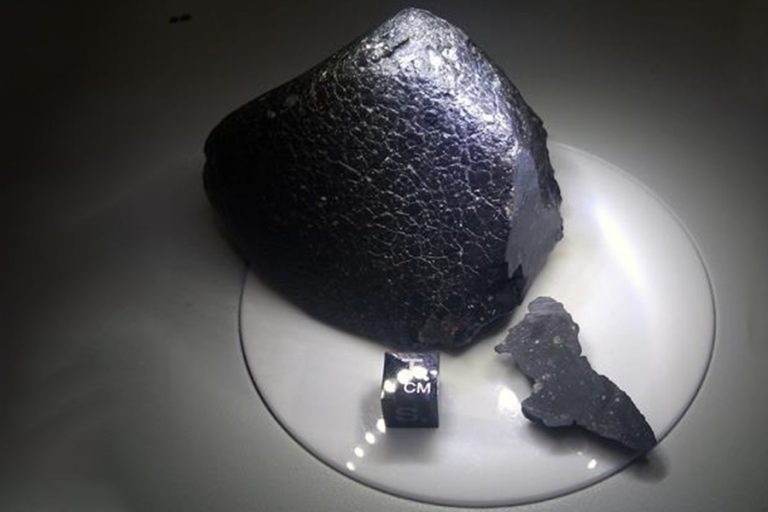
Black Beauty, or NWA 7034, is thought to have formed at a time when the Red Planet harbored a magnetic field, much like the Earth does today. If the rock bears any trace of Mars’ ancient field, this could give scientists valuable clues to the planet’s past climate and composition.
Credits: Image: C Agee, Institute of Meteoritics, UNM; NASA

Each year, thousands of space rocks pierce through the Earth’s atmosphere and hit the ground as meteorites. These fragments of comets and asteroids can land anywhere but are most often spotted in open terrain, such as the deserts of Africa and the Antarctic blue ice, where a meteorite’s blackened exterior can stand out.

Still, these extraterrestrial remnants can resemble Earth rocks, and to tell the difference meteorite hunters often expose their “finds” to hand magnets, which can attract more strongly to metal-rich meteorites than to terrestrial rocks. Meteorite hunters, dealers, collectors, and curators often rely on hand magnets to verify a meteorite’s identity.

But a new MIT study finds that the same magnets used to identify a meteorite usually erase its magnetic memory. They show that exposure to a magnet can reorient a rock’s microscopic grains, undoing their original orientation and any trace of its magnetic origins.

The researchers make their case with Northwest Africa (NWA) 7034, a meteorite known in collectors’ circles as “Black Beauty” for its obsidian exterior. Multiple shards of the meteorite were first discovered in the deserts of northwest Africa, and scientists determined that the rock contained crystals that formed on Mars more than 4.4 billion years ago.

Black Beauty is thought to have formed at a time when the Red Planet harbored a magnetic field, much like the Earth does today. If the rock bears any trace of Mars’ ancient field, this could give scientists valuable clues to the planet’s past climate and composition.

Unfortunately, the MIT team found that multiple samples of Black Beauty have been remagnetized since landing on Earth, and that any hint of an ancient Martian field has been wiped clean.

“There was an incredible record there, and a unique opportunity to understand the early history of Mars’ magnetism,” says study author Benjamin Weiss, professor of planetary sciences at MIT. “But we found it’s all been obliterated by magnets.”

With their new study, appearing this week in the Journal of Geophysical Research: Planets, the researchers hope to raise awareness in the planetary science community about the destructive effects of hand magnets. Weiss’ co-authors are MIT postdoc Foteini Vervelidou and France Lagroix of the Paris Institute of Planetary Physics.

Dead ends

Tens of thousands of meteorites have been discovered to date. Nearly every found meteorite has been traced to about 100 parent bodies across the solar system, including asteroids, the moon, and Mars. Scientists attempting to read the history of these rocks have only recently come to realize that some interpretations were way off the mark, due to the influence of hand magnets.

For instance, samples of Allende, the largest and most studied meteorite on Earth, bear traces of exposure to a strong magnetic field. Scientists assumed this field was evidence that the meteorite formed long ago in a solar nebula that hosted an extremely high magnetic field. Only later did they realize that hand magnets were to blame for the meteorite’s curiously strong pull.

Weiss has also been duped by artificially reset rocks. When he first joined the MIT faculty, he discovered signs of strong magnetism in fallen samples of an asteroid. The findings would have been the first evidence that asteroids can differentiate and form metallic cores like the Earth. But he later discovered, much to his frustration, that the meteorite had been reset by hand magnets.

“There’s a long history of dead ends and confusion over remagnetized rocks,” Weiss says.

For the MIT team, the tipping point came with NWA 7034. In 2014, fellow paleomagnetist Jérôme Gattacceca measured a sample of Black Beauty and found its original magnetism, which was set more than 4.4 billion years ago, had been entirely undone by much stronger hand magnets on Earth. Weiss and Vervelidou recently analyzed numerous other samples of Black Beauty, hoping to find at least one magnetically preserved sample.

“Our initial hope was that by testing as many [samples] of this meteorite as possible, we would end up finding a few non-remagnetized ones,” Vervelidou says. “Once we concluded that all of the samples we studied have been remagnetized, the motivation was to spread the word about the destructive effects of hand magnets.”

Shifting a field

In their new study, the team laid out the ways in which hand magnets can affect a rock’s natural magnetism. They first developed a numerical model, based on the physics of magnetism, to calculate the field surrounding a typical hand magnet and how it affects rocks of various sizes.

They then carried out experiments, exposing samples of the same terrestrial rock to magnetic fields of varying strengths and at various distances, and measured how each sample’s inherent magnetism changed in response. These measurements matched the model’s predictions, showing that the model can be used to determine whether a rock has been remagnetized. The model can also be used to estimate, based on a rock’s magnetization, the depth at which a rock may still be unaffected.

Finally, the team reported their measurements of nine Black Beauty samples and confirmed with their model that every found piece of the meteorite had indeed been exposed to hand magnets.

“What we have in this paper is finally a clear, unambiguous work plan for establishing whether your rock has been hit by a magnet,” Weiss says.

Instead of hand magnets, the researchers are recommending that meteorite hunters, collectors, and museum curators use susceptibility meters — handheld instruments that have been shown to quickly and accurately identify a meteorite without scrambling its magnetic memory.

Weiss acknowledges that susceptibility meters are a hard sell — commercial models are worth several thousand dollars, compared to some hand magnets that cost next to nothing. Within the meteorite trade, he hopes first to convince people upstream, such as museum curators and collectors. From there, word may trickle down to those making discoveries on the ground.

“There’s been this incredible explosion of meteorite diversity and number in the last 20 years or so, and we owe meteorite hunters a thanks for finding these things,” Weiss says. “But the tradeoff, the devil’s bargain, is that often they are using magnets to find them, and are immediately destroying their magnetic record in the process.”

This research was funded, in part, by the European Union’s Horizon 2020 research and innovation program.

Reprinted with permission of MIT News

By Jennifer Chu | MIT News Office
Source MIT
SuperBIT Sees Colliding Antennae Galaxies

0

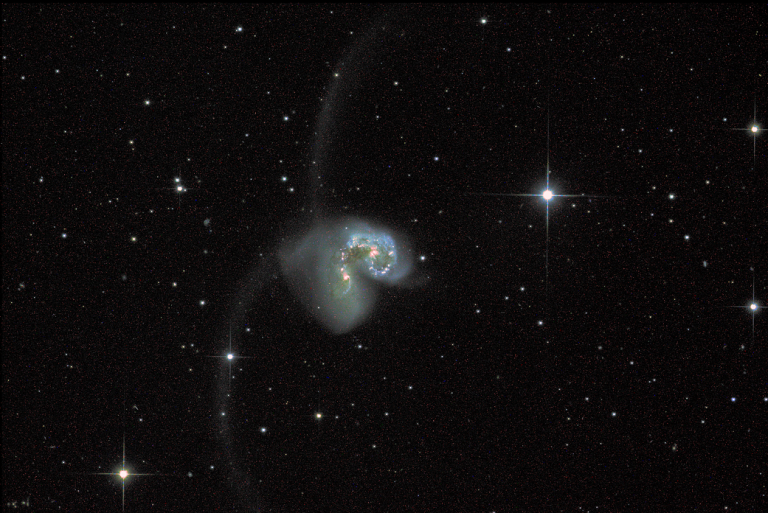
This view of the Antennae Galaxies, two large galaxies colliding 60 million light-years away, is one of the first research images from the Super Pressure Balloon Imaging Telescope (SuperBIT) that launched on a scientific super pressure balloon April 16, 2023 (local time New Zealand). This image and one of the Tarantula Nebula were captured as the balloon-borne telescope floated at 108,000 feet (approximately 20.5 miles or 33 km) above Earth’s surface, allowing scientists to view these scientific targets from a balloon platform in a near-space environment.

The SuperBIT telescope captures images of galaxies in the visible-to-near ultraviolet light spectrum, which is within the Hubble Space Telescope’s capabilities, but with a wider field of view. SuperBIT’s goal is to map dark matter around galaxy clusters by measuring the way these massive objects warp the space around them.

Image Credit: NASA/SuperBIT

By Monika Luabeya
Source NASA

Martian Milestone For Ingenuity

0

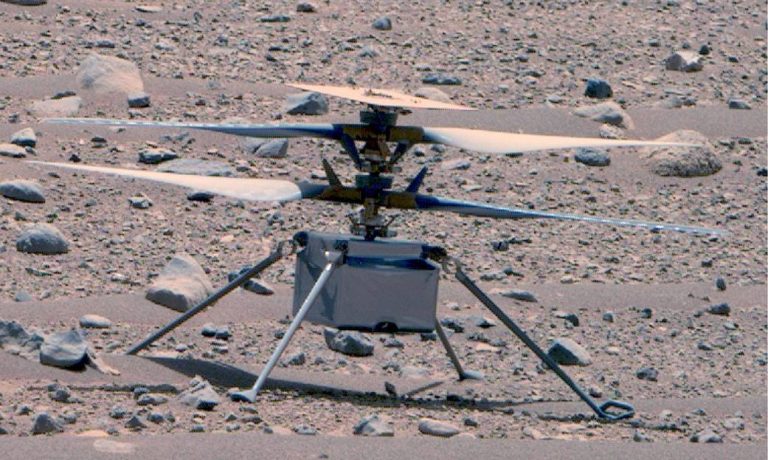
This April 16, 2023, enhanced color image of NASA’s Ingenuity Mars Helicopter is the clearest view of the rotorcraft since its first flight. Ingenuity completed its 50th flight on April 13, 2023; the helicopter’s first flight on Mars was two years ago on April 19, 2021.

This picture was taken by the Mastcam-Z instrument aboard the Perseverance rover. At the time the image was taken, the rover was about 75 feet (23 meters) away.

Image Credit: NASA/JPL-Caltech/ASU/MSSS

By Monika Luabeya
Source NASA

Hubble Celebrates Its 33rd Anniversary With A Peek Into A Nearby Star-Forming Region

0

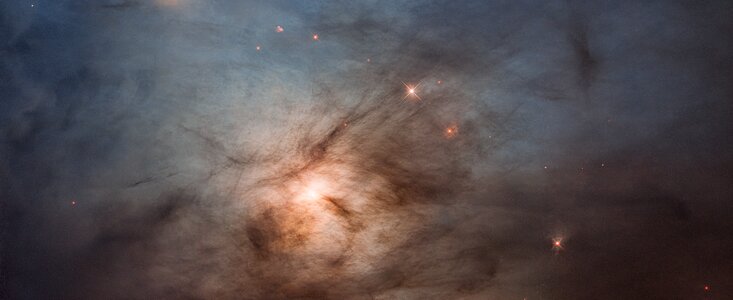
Astronomers are celebrating the NASA/ESA Hubble Space Telescope’s 33rd launch anniversary with an ethereal photo of a nearby star-forming region, NGC 1333. The nebula is in the Perseus molecular cloud, and is located approximately 960 light-years away.

Hubble’s colourful view, showcasing its unique capability to obtain images in light from ultraviolet to near-infrared, unveils an effervescent cauldron of glowing gases and pitch-black dust stirred up and blown around by several hundred newly forming stars embedded within the dark cloud. Even then, Hubble just scratches the surface; most of the star-birthing firestorm is hidden behind clouds of fine dust — essentially soot — that are thicker toward the bottom of the image. The black areas of the image are not empty space, but are filled with obscuring dust.

To capture this image, Hubble peered through a veil of dust on the edge of a giant cloud of cold molecular hydrogen — the raw material for fabricating new stars and planets under the relentless pull of gravity. The image underscores the fact that star formation is a messy process in a rambunctious Universe.

Ferocious stellar winds, likely from the bright blue star at the top of the image, are blowing through a curtain of dust. The fine dust scatters the starlight at blue wavelengths.

Farther down, another bright super-hot star shines through filaments of obscuring dust, looking like the Sun shining through scattered clouds. A diagonal string of fainter accompanying stars looks reddish because the dust is filtering their starlight, allowing more of the red light to get through.

The bottom of the picture presents a keyhole peek deep into the dark nebula. Hubble captures the reddish glow of ionised hydrogen. It looks like the finale of a fireworks display, with several overlapping events. This is caused by pencil-thin jets shooting out from newly forming stars outside the frame of view. These stars are surrounded by circumstellar discs, which may eventually produce planetary systems, and powerful magnetic fields that direct two parallel beams of hot gas deep into space, like a double lightsaber from science fiction films. They sculpt patterns on the hydrogen cocoon, like laser lightshow tracings. The jets are a star’s birth announcement.

This view offers an example of the time when our own Sun and planets formed inside such a dusty molecular cloud, 4.6 billion years ago. Our Sun didn’t form in isolation but was instead embedded inside a mosh pit of frantic stellar birth, perhaps even more energetic and massive than NGC 1333.

Hubble was deployed into orbit around Earth on 25 April 1990 by NASA astronauts aboard the Space Shuttle Discovery. To date, the legendary telescope has taken approximately 1.6 million observations of nearly 52 000 celestial targets. This treasure trove of knowledge about the Universe is stored for public access in the Mikulski Archive for Space Telescopes, at the Space Telescope Science Institute in Baltimore, Maryland, and the European Hubble Space Telescope (eHST) Science Archive, hosted at ESA’s European Space Astronomy Centre (ESAC) in Madrid.

More information

The Hubble Space Telescope is a project of international cooperation between ESA and NASA.

Image Credit: NASA, ESA, STScI

Links

Contacts

Bethany Downer
ESA/Hubble Chief Science Communications Officer
Email: [email protected]

The Real Reason Why People Should Worry About Remote Work

0

As the world recovers post-COVID (and a chain of other natural hazards and human madness) and we try to bring back a semblance of the ‘usual’ way of doing things, there has been much debate whether we should go back to the office or continue with remote work instead.

In this ongoing debate, the real unspeakable truth remains unsaid. Remote Work is Simply Work. Distributed work. In office work. Field work. Customer interfacing work. Clinic work. XYZ work. If work, as it was before, was so great … For the majority of folks … Then …

1. Job First Before Credibility, At Least For The Bosses.

And Trust First, for the rest of us. And Competence. And Integrity. Etc. Only for the rest of us.

Here is a video of Rishi Sunak’s first speech as a Prime Minister.

Sunak said “Trust is earned. And I will earn yours”. You are taking on the role of Prime Minister of the UK and not just any side job. The state and future of the country and the lives of millions of its citizens will be affected by your actions.

It is not a proving ground. The people should trust you already.

It matters not if you end up probably doing an amazing job; it cannot be simply purely a matter of faith. Can most of us just barge in swashbuckling in any big company proclaiming: “Give me the job first as a noob, and I will earn your trust after.” Even big companies have due diligence and vetting processes before appointing people at the top posts.

2. You Don’t Have To Be Competent To Get The Job

A few weeks ago, this video by Led By Donkeys of “MPs For Hire” caused quite a stir. Listen to the videos of ministers being interviewed:

For a people of their supposed calibre, you would expect a degree of sophistication in their speech. But listen to them speak, this is how they speak. Too confident, too arrogant, so full of their so-called achievements. They can’t even get their Zooms right at the first try. If you are the HR manager interviewing them, even for a “low-level” job, would you hire them?

3. You’re Just A Pawn In A Game

After laying off thousands and wiping off billions of dollars in market cap because of aggressive decisions by leadership to prove something and cover their incompetence, they are rewarded like this:

Google is just one of many examples, we are just highlighting them because they are one of the biggest and most prominent companies.

Do you really believe that the world cares that after laying off thousands, these people care about those who lose their jobs?

Do you really mean to say that there is no one else who can do this job for this amount? No one else in the whole world at half the price for a non-founder?

The real reason why we should be worried about remote work is the abusive, incompetent, unaccountable bosses that run countries and companies. Idiots are leading countries and companies and you should be worried.

The New Normal. Is. Simply. The Old Normal.

plus ça change, plus c’est la même chose

This is our world today. Goodness, meritocracy, hard work, grace, love? – none of these matter anymore. These are just feel-good values that we use to fool ourselves. We’re all being played, used, and then disposed of. It doesn’t matter how good or honest you try to be in this world, in the end you’ll only be measured by the money you make. And if you are poor and left behind, you’re as good as dead.

NASA Shares First Moon To Mars Architecture Concept Review Results

0
NASA Shares First Moon to Mars Architecture Concept Review Results. NASA

As NASA builds a blueprint for human exploration throughout the solar system for the benefit of humanity, the agency released Tuesday the outcomes from its first Architecture Concept Review, a robust analysis process designed to align NASA’s Moon to Mars exploration strategy and codify the supporting architecture.

“Our first Architecture Concept Review is a milestone that will help our Moon to Mars strategy unfold through the objectives in missions both near and long term,” said NASA Deputy Administrator Pam Melroy. “We’re aligned with partners toward a future of expanded economic opportunity, scientific discovery, and greater activity on and around the Moon, and with limitless possibilities deeper in the solar system.”

NASA’s Architecture Definition Document written for highly technical audiences, and an associated executive summary, provide a deep dive into NASA’s Moon to Mars architecture approach and development process. Six supporting white papers also released address frequently discussed exploration architecture topics.

“NASA now has a goal-based foundation upon which to build our current and future exploration plans,” said Cathy Koerner, deputy associate administrator for the Exploration Systems Development Mission Directorate at NASA Headquarters in Washington. “Our approach is designed to ensure exploration of the Moon and Mars has staying power.”

NASA’s process answers a call from Vice President Harris, as Chair of the National Space Council, to develop a plan for an initial lunar surface architecture which includes commercial and international partnerships. The agency’s Moon to Mars architecture represents the hardware and operations needed for human missions to the Moon and Mars, and how they function together as system. The architecture is not a mission, a manifest, or a set of requirements, but defines the elements—rockets, spacecraft, rovers, spacesuits, communications relays, and more—that will be incrementally developed and delivered to the Moon and Mars for long-term, human-led scientific discovery in deep space.

NASA released its revised Moon to Mars Objectives in 2022 as guideposts in the agency’s Moon to Mars exploration approach to help space NASA investments, as well as those of the agency’s industry and international space agency partners, toward the Moon and beyond. They cover four broad areas: science; transportation and habitation; lunar and Martian infrastructure; and operations. The objectives were informed by input from U.S. industry, international space agencies, NASA’s workforce, and others.

The agency began developing its Architecture Definition Document in late 2022 as a detailed look at how current objectives are distilled into specific architecture elements. The agency plans yearly Architecture Concept Reviews to incorporate new technological capabilities and evolving objectives.

Under Artemis, NASA has set a vision to explore more of the Moon than ever before. With the crew for Artemis II recently named, the agency plans to return humans to the Moon and establish a cadence of missions starting at the lunar South Pole region. These missions set up a long-term presence to inform future exploration of Mars and other potential destinations in the solar system.

Find NASA’s Moon to Mars architecture documents at: https://www.nasa.gov/moontomarsarchitecture

By Keith Cowing
Source SpaceRef

NASA Selects 10 Scientists For JAXA’s Martian Moons eXploration (MMX) Mission

0
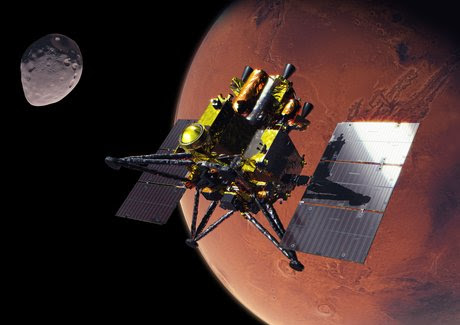
JAXA’s Martian Moons eXploration (MMX) Mission. JAXA

NASA has selected 10 researchers from institutions across the U.S. to join the Science Working Team of the Japan Aerospace Exploration Agency’s Martian Moons eXploration (MMX) mission as NASA-supported participating scientists.

JAXA’s MMX mission, planned to launch in 2024, will visit the two Martian moons, Phobos and Deimos, land on the surface of Phobos, and collect a surface sample. Plans are for the sample to be delivered to Earth in 2029.

Seven of the selected scientists will conduct research using the MMX flight instruments. They are:

  • Olivier Barnouin, Johns Hopkins Applied Physics Laboratory, Laurel, Maryland, will create high resolution digital terrain models of the Martian moons, measuring the properties of surface features, and studying the properties of the Phobos regolith through its interaction with the rover.
  • Matteo Crismani, California State University, San Bernardino, will study the particles of interplanetary dust that strike Mars and their role in the formation of high-altitude ice clouds in the Martian atmosphere.
  • R. Terik Daly, Johns Hopkins Applied Physics Laboratory, Laurel, Maryland, will search for surface changes on Phobos and Deimos by comparing MMX image data with past missions’ imagery of the two moons.
  • Christopher Edwards, Northern Arizona University, Flagstaff, Arizona, will apply a thermophysical model to MMX infrared spectra in order to map the variations in spectral properties and surface roughness across Phobos and Deimos.
  • Abigail Fraeman, NASA’s Jet Propulsion Laboratory, California, will combine data from different MMX instruments to learn more about the moons’ compositions and to test hypotheses about the sources of enigmatic spectral absorptions observed on Phobos.
  • Sander Goossens, NASA’s Goddard Space Flight Center, Greenbelt, Maryland, will use data from the MMX instruments and navigation data from the spacecraft to constrain the moons’ gravity fields, shapes, rotational states, and internal mass distributions.
  • Christine Hartzell, University of Maryland, College Park, Maryland, will explore the physical properties of Phobos’s surface regolith by using rover data to identify regolith clumps and constrain the forces needed to hold them together.

Three of the selected scientists will conduct laboratory analyses of the samples brought back from Phobos. They are:

  • Nicolas Dauphas, University of Chicago, Illinois, will utilize mass spectrometer techniques to determine elemental and isotopic abundances of iron, potassium, and other elements, and to measure ages using rubidium-strontium dating.
  • Jemma Davidson, Arizona State University, Tempe, Arizona, will use microscopy and mass spectrometry methods to analyze opaque minerals in the Phobos samples, to elucidate the origin of Phobos and its later alteration history.
  • Daniel Glavin, NASA’s Goddard Space Flight Center, Greenbelt, Maryland, will study amino acids, cyanides, amines, aldehydes, ketones, and hydroxy and monocarboxylic acids using gas and liquid chromatography mass spectrometry.

In addition to the contributions of the participating scientists, and their teams of co-investigators, NASA is contributing the Mars-moon Exploration with Gamma rays and Neutrons (MEGANE) spectrograph instrument, the Pneumatic Sampler (P-Sampler) technology demonstration, and other support.

A team at Honeybee Robotics sponsored by NASA’s Science Mission Directorate designed and built the P-Sampler. MEGANE, built by the Johns Hopkins University Applied Physics Laboratory, was developed under NASA’s Discovery Program. Both projects are managed by NASA’s Marshall Space Flight Center in Huntsville, Alabama, for the agency’s Science Mission Directorate.

In a separate event on April 17, during the 38th Space Symposium in Colorado Springs, Colorado, NASA and JAXA signed an agreement to formalize their overall MMX cooperation, further strengthening the collaboration between the two agencies.

By Keith Cowing
Source SpaceRef

Could This Copycat Black Hole Be A New Type Of Star?

0
Movie clip showing the gravitational lensing effects caused by no object in an observer’s line of sight, a black hole, and the topological soliton. CREDIT: Pierre Heidmann/Johns Hopkins University.

It looks like a black hole and bends light like a black hole, but it could actually be a new type of star.

Though the mysterious object is a hypothetical mathematical construction, new simulations by Johns Hopkins researchers suggest there could be other celestial bodies in space hiding from even the best telescopes on Earth. The findings are set to publish in Physical Review D.

“We were very surprised,” said Pierre Heidmann, a Johns Hopkins University physicist who led the study. “The object looks identical to a black hole, but there’s light coming out from its dark spot.”

The detection of gravitational waves in 2015 rocked the world of astrophysics because it confirmed the existence of black holes. Inspired by those findings, the Johns Hopkins team set out to explore the possibility of other objects that could produce similar gravitational effects but that could be passing as black holes when observed with ultraprecise sensors on Earth, said co-author and Johns Hopkins physicist Ibrahima Bah.

“How would you tell when you don’t have a black hole? We don’t have a good way to test that,” Bah said. “Studying hypothetical objects like topological solitons will help us figure that out as well.”

The new simulations realistically depict an object the Johns Hopkins team calls a topological soliton. The simulations show an object looking like a blurry photo of a black hole from afar but like something else entirely up close.

The object is hypothetical at this stage. But the fact that the team could construct it using mathematical equations and show what it looks like with simulations suggests there could be other types of celestial bodies in space hiding from even the best telescopes on Earth.

The findings show how the topological soliton distorts space exactly as a black hole does—but behaves unlike a black hole as it scrambles and releases weak light rays that would not escape the strong gravitational force of a true hole.

“Light is strongly bent, but instead of being absorbed like it would in a black hole, it scatters in funky motions until at one point it comes back to you in a chaotic manner,” Heidmann said. “You don’t see a dark spot. You see a lot of blur, which means light is orbiting like crazy around this weird object.”

A black hole’s gravitational field is so intense that light can orbit around it at a certain distance from its center, in the same way that Earth orbits the sun. This distance determines the edge of the hole’s “shadow,” so that any incoming light will fatally hit the region that scientists call the “event horizon.” There, nothing can escape—not even light.

The Hopkins team simulated several scenarios using pictures of outer space as if they had been captured with a camera, placing a black hole and the topological soliton in front of the lens. The results produced distorted pictures because of the gravitational effects of the massive bodies.

“These are the first simulations of astrophysically relevant string theory objects, since we can actually characterize the differences between a topological soliton and a black hole as if an observer was seeing them in the sky,” Heidmann said.

Motivated by various results from string theory, Bah and Heidmann discovered ways to construct topological solitons using Einstein’s theory of general relativity in 2021. While the solitons are not predictions of new objects, they serve as the best models of what new quantum gravity objects could look like compared to black holes.

Scientists have previously created models of boson stars, gravastars, and other hypothetical objects that could exert similar gravitational effects with exotic forms of matter. But the new research accounts for pillar theories of the inner workings of the universe that other models don’t. It uses string theory that reconciles quantum mechanics and Einstein’s theory of gravity, the researchers said.

“It’s the start of a wonderful research program,” Bah said. “We hope in the future to be able to genuinely propose new types of ultracompact stars consisting of new kinds of matter from quantum gravity.”

By Keith Cowing
Source SpaceRef

Aerojet Rocketdyne Delivers Propulsion For Artemis III Mission

0
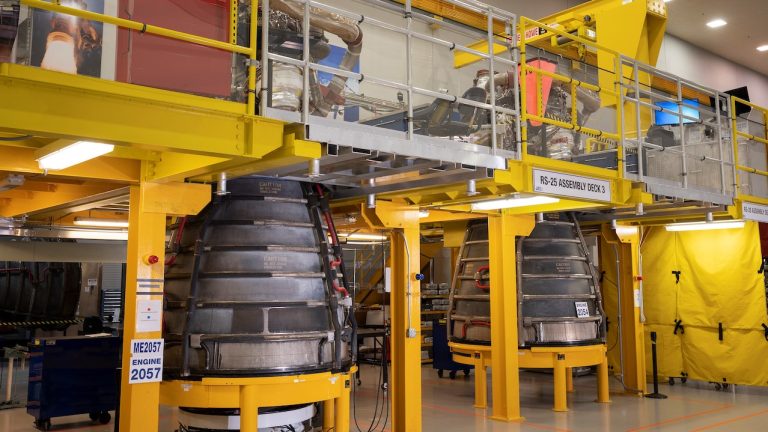
Engines 2057 and 2054 are two of the four engines that will fly on NASA’s Artemis III mission. All four RS-25 engines that will power NASA’s Space Launch System for the Artemis III mission are ready to fly and awaiting integration at Aerojet Rocketdyne’s facility located at NASA’s Stennis Space Center
Aerojet Rocketdyne’

Aerojet Rocketdyne recently completed the four RS-25 engines that will power the core stage of NASA’s super heavy-lift Space Launch System (SLS) rocket during the historic Artemis III mission. Slated for launch around the middle of the decade, Artemis III is a planned lunar landing mission that will return humans to the surface of the Moon for the first time in more than 50 years.

“The Artemis III mission is pivotal in our nation’s goal to return American astronauts to the surface of the Moon, establish a sustained presence there and pave the way for crewed missions to Mars,” said Eileen P. Drake, Aerojet Rocketdyne CEO and president. “As our nation makes this next giant leap in its space program, it is leveraging the extensive knowledge and lessons learned that were gained during our earlier exploration efforts, including the Apollo, Space Shuttle and Artemis I missions. We are truly standing on the shoulders of those who pioneered the exploration of deep space.”

The four RS-25 engines that will power the SLS rocket’s core stage during the Artemis III mission have been upgraded following their service during the shuttle program and will now generate about 2 million pounds of combined thrust. The Artemis III RS-25 engines safely flew 138 individual astronauts to orbit and supported 26 Space Shuttle missions, including:

  • Multiple International Space Station assembly missions
  • STS-95: The flight of then-U.S. Senator John Glenn, one of NASA’s original Mercury astronauts
  • STS-114: The Space Shuttle program’s return to flight following the Columbia accident
  • STS-125: The final Hubble servicing mission

In addition to the RS-25 engines, Aerojet Rocketdyne has delivered all of its other propulsion systems for the Artemis III SLS rocket and a majority of the propulsion systems for the Orion spacecraft.

Additional Aerojet Rocketdyne propulsion on the Artemis III mission includes the RL10 engine and 12 MR-106 reaction control system thrusters that will support the SLS’s second stage, called the Interim Cryogenic Propulsion Stage. Aerojet Rocketdyne also supplies major propulsion elements for NASA’s Orion spacecraft, including the Orion Main Engine; the jettison motor on the Launch Abort System; eight auxiliary engines for trajectory control and positioning on the service module; and 12 reaction control system engines that guide the Orion crew module’s atmospheric re-entry.

Aerojet Rocketdyne’s Artemis III propulsion contributions are designed, built and tested at various sites across the country, including Los Angeles, California; NASA’s Stennis Space Center in Mississippi; West Palm Beach, Florida; Redmond, Washington; Huntsville, Alabama; and Orange, Virginia. The pressurized tanks used for Orion’s life support systems and flotation system for recovery at sea were manufactured and delivered by Aerojet Rocketdyne’s ARDÉ subsidiary, located in Carlstadt, New Jersey.

About Aerojet Rocketdyne: Aerojet Rocketdyne, a subsidiary of Aerojet Rocketdyne Holdings, Inc. (NYSE:AJRD), is a world-recognized aerospace and defense leader that provides propulsion systems and energetics to the space, missile defense and strategic systems, and tactical systems areas, in support of domestic and international customers. For more information, visit www.Rocket.com and www.AerojetRocketdyne.com. Follow Aerojet Rocketdyne and CEO Eileen Drake on Twitter at @AerojetRdyne and @DrakeEileen.

By Keith Cowing
Source SpaceRef

Scientists Get Closer To Detecting ‘Cosmic Dawn’

0
Dawn Vectors by Vecteezy

An array of 350 radio telescopes in the Karoo desert of South Africa is getting closer to detecting the “cosmic dawn”—the era after the Big Bang when stars first ignited and galaxies began to bloom.

A team of scientists has doubled the sensitivity of a radio telescope called the Hydrogen Epoch of Reionization Array (HERA). With this breakthrough, they hope to peer into the secrets of the early universe.

“Over the last couple of decades, teams from around the world have worked towards a first detection of radio waves from the cosmic dawn. While such a detection remains elusive, HERA’s results represent the most precise pursuit to date,” says Adrian Liu, an assistant professor at the physics department and the Trottier Space Institute at McGill University.

650 MILLION YEARS AFTER THE BIG BANG

The array was already the most sensitive radio telescope in the world dedicated to exploring the cosmic dawn. Now the HERA team has improved its sensitivity by a factor of 2.1 for radio waves emitted about 650 million years after the Big Bang and 2.6 for radio waves emitted about 450 million years after the Big Bang.

The work appears in The Astrophysical Journal.

Although the scientists have yet to detect radio emissions from the end of the cosmic dark ages, their results provide clues about the composition of stars and galaxies in the early universe.

So far, their data suggest that early galaxies contained very few elements besides hydrogen and helium, unlike our galaxies today. Today’s stars have a variety of elements, ranging from lithium to uranium, that are heavier than helium.

When the radio dishes are fully online and calibrated, the team hopes to construct a 3D map of the bubbles of ionized and neutral hydrogen—markers for early galaxies—as they evolved from about 200 million years to around 1 billion years after the Big Bang. The map could tell us how early stars and galaxies differed from those we see around us today, and how the universe looked in its adolescence, say the researchers.

COSMIC DAWN BUBBLES

According to the researchers, the fact that the HERA team has not yet detected these signals rules out some theories of how stars evolved in the early universe.

“Our data suggest that early galaxies were about 100 times more luminous in X-rays than today’s galaxies. The lore was that this would be the case, but now we have actual data that bolsters this hypothesis,” says Liu.

The HERA team continues to improve the telescope’s calibration and data analysis in hopes of seeing those bubbles in the early universe. However, filtering out the local radio noise to see the signals from the early universe has not been easy.

“If it’s Swiss cheese, the galaxies make the holes, and we’re looking for the cheese,” says David DeBoer, a research astronomer at the University of California, Berkeley’s Radio Astronomy Laboratory.

“HERA is continuing to improve and set better and better limits,” says Aaron Parsons, associate professor of astronomy at UC Berkeley and principal investigator for HERA. “The fact that we’re able to keep pushing through, and we have new techniques that are continuing to bear fruit for our telescope, is great.”

The HERA collaboration is led by the University of California, Berkeley and includes scientists from across North America, Europe, and South Africa, with support in Canada from Natural Sciences and Engineering Research Council of Canada, Canadian Institute for Advanced Research, Fonds de recherche du Québec—Nature et technologies, and from the Trottier Space Institute at McGill University.

The construction of the array is funded by the National Science Foundation, the Alfred P. Sloan Foundation, and the Gordon and Betty Moore Foundation, with key support from the government of South Africa and the South African Radio Astronomy Observatory (SARAO).

Source: McGill University

Original Study DOI: 10.3847/1538-4357/acaf50

By SHIRLEY CARDENAS-MCGILL
Source Futurity