NASA’s Galileo spacecraft captured this image of the surface of Jupiter’s moon Ganymede. On Earth, similar features form when tectonic faulting breaks the crust. Scientists modeled how fault activity could trigger landslides and make relatively smooth areas on the surfaces of icy moons. Credit: NASA/JPL/Brown University Full Image Details
A new NASA study offers an explanation of how quakes could be the source of the mysteriously smooth terrain on moons circling Jupiter and Saturn.
Many of the ice-encrusted moons orbiting the giant planets in the far reaches of our solar system are known to be geologically active. Jupiter and Saturn have such strong gravity that they stretch and pull the bodies orbiting them, causing moonquakes that can crack the moons’ crusts and surfaces. New research shows for the first time how these quakes may trigger landslides that lead to remarkably smooth terrain.
The study, published in Icarus, outlines the link between quakes and landslides, shedding new light on how icy moon surfaces and textures evolve.
On the surfaces of icy moons such as Europa, Ganymede, and Enceladus, it’s common to see steep ridges surrounded by relatively flat, smooth areas. Scientists have theorized that these spots result from liquid that flows out of icy volcanoes. But how that process works when the surface temperatures are so cold and inhospitable to fluids has remained a mystery.
A simple explanation outlined in the study doesn’t involve liquid on the surface. Scientists measured the dimensions of the steep ridges, which are believed to be tectonic fault scarps (like those on Earth) – steep slopes caused when the surface breaks along a fault line and one side drops. By applying the measurements to seismic models, they estimated the power of past moonquakes and found they could be strong enough to lift debris that then falls downhill, where it spreads out, smoothing the landscape.
This view of Jupiter’s moon Europa was captured in the 1990s by NASA’s Galileo spacecraft. The smooth slopes and nearby rubble may have been produced by landslides. Credit: NASA/JPL-Caltech Full Image Details
Upcoming Investigations
NASA’s upcoming Europa Clipper mission, bound for Jupiter’s moon Europa in 2024, will give the research a significant boost, providing imagery and other science data. After reaching Jupiter in 2030, the spacecraft will orbit the gas giant and conduct about 50 flybys of Europa. The mission has a sophisticated payload of nine science instruments to determine if Europa, which scientists believe contains a deep internal ocean beneath an outer ice shell, has conditions that could be suitable for life.
“It was surprising to find out more about how powerful moonquakes could be and that it could be simple for them to move debris downslope,” said co-author Robert Pappalardo, project scientist of Europa Clipper at JPL, which manages the mission.
Especially surprising were the modeling results for tectonic activity and quakes on Saturn’s moon Enceladus, a body that has less than 3% of the surface area of Europa and about 1/650 that of Earth. “Because of that moon’s small gravity, quakes on tiny Enceladus could be large enough to fling icy debris right off the surface and into space like a wet dog shaking itself off,” Pappalardo said.
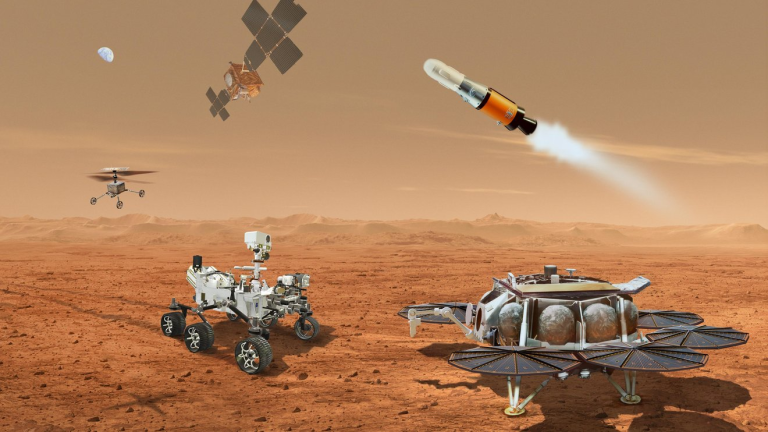
This illustration shows a concept for multiple robots that would team up to ferry to Earth samples of rock and soil collected from the Martian surface by NASA’s Mars Perseverance rover. Credit: NASA/ESA/JPL-Caltech Full Image Details
The board, initiated by NASA, will provide added confidence that the program won’t exceed guidelines following an important upcoming milestone.
NASA will convene a Mars Sample Return (MSR) Program independent review board, or IRB, to perform a review of current plans and goals for one of the most difficult missions humanity has ever undertaken: bringing samples from another planet to study on Earth.
Later this year MSR will approach confirmation, a milestone at which NASA formally establishes the technical, cost, and schedule baselines for a mission. Convening a review board – this is the second IRB for this program – will provide added confidence that the program will not exceed guidelines following confirmation. Such reviews also ensure that NASA is adopting lessons learned from experiences with previous large, strategic science missions.
MSR is a partnership with ESA (European Space Agency). It would be the first mission to return samples from another planet and would include the first launch from the surface of another planet as well as the first in-orbit rendezvous at another planet. Returning scientifically selected samples – the samples currently being gathered by NASA’s Perseverance rover – from Mars would revolutionize our understanding of the Red Planet by bringing them to Earth for study using large and sophisticated instruments. The samples collected by Perseverance during its exploration of an ancient river delta are thought to be the best opportunity to reveal the early evolution of Mars, including the potential for ancient life.
Orlando Figueroa, retired deputy center director for science and technology at NASA’s Goddard Space Flight Center in Greenbelt, Maryland, was recently named chair for this independent review board. The IRB will be tasked with providing an assessment of the current status as well as recommendations to maximize the probability of mission success – scientifically and technically – within guidelines. The board will include experts in relevant science, technical and programmatic fields and is expected to produce a final report in late August.
The most recent Planetary Science Decadal Survey conducted for NASA by the National Academies of Sciences, Engineering and Medicine has stated that completing Mars sample return is the highest scientific priority for NASA’s robotic exploration efforts. The Decadal Survey also stated that the cost for the mission should not be allowed to undermine the long-term programmatic balance of the planetary portfolio. Returning samples from Mars to Earth has been a goal of planetary scientists for decades.
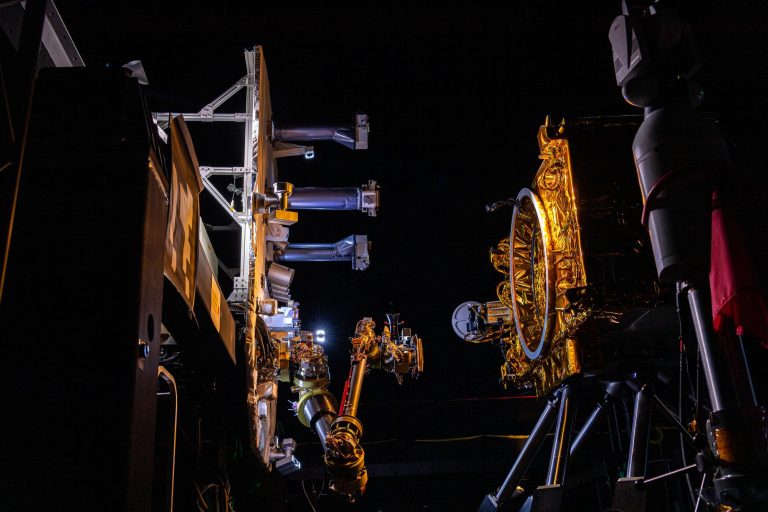
Detail shot of the On-orbit Servicing, Assembly, and Manufacturing 1 (OSAM-1) autocapture test bed during a test of the Robotic Servicing Arm inside the Robotic Operations Center (ROC) at NASA’s Goddard Space Flight Center in Greenbelt, Maryland, on Feb 23, 2023. These tests are critical to developing docking algorithms and procedures for in-space servicing, assembly, and manufacturing (ISAM) missions and services. Credits: NASA/Michael Guinto
NASA announced Wednesday a new consortium focused on making in-space servicing, assembly, and manufacturing (ISAM) capabilities a routine part of space architectures and mission lifecycles.
Through a range of capabilities, ISAM can enable new mission paradigms and extend the life of spacecraft. In-space servicing encompasses activities including spacecraft repair, refueling, relocation, and retrofitting, while assembly and manufacturing includes abilities like 3D printing and assembling components in space. Together, these capacities can enable a more sustainable, robust, and enduring space ecosystem.
NASA’s Space Technology Mission Directorate (STMD) formulated and funds the COnsortium for Space Mobility and ISAM Capabilities (COSMIC). In February 2023, the agency selected The Aerospace Corporation to operate the group. A kickoff meeting is planned for fall 2023.
“We’re looking to foster a nationwide alliance across government, industry, nonprofit research institutions, and academia to ensure the United States is the global leader in ISAM,” said Jim Reuter, associate administrator for STMD at NASA Headquarters in Washington. “This new consortium provides a place for all parties to coordinate and collaborate on capability development, business cases, and mission applications.”
The consortium aligns with the ISAM National Strategy and National ISAM Implementation Plan released in 2022, providing an opportunity for collaboration among government, industry, and academia to pursue common goals in ISAM capability development.
“NASA, government agencies, and industry have invested in robotic ISAM technologies for decades,” said STMD’s Technology Demonstrations Director Trudy Kortes. “Still, it is rare for modern satellites to be designed and built with things like grappling, refueling, and other robotic repairs in mind. We want to change that.”
The consortium builds upon technology maturation and demonstration efforts across sectors, including NASA’s On-Orbit Servicing, Assembly, and Manufacturing missions, the joint Defense Aerospace Projects Research Agency, and SpaceLogistics effort Robotic Servicing of Geostationary Satellites/Mission Robotic Vehicle (RSGS/MRV), SpaceLogistics’ Mission Extension Vehicle (MEV) and other related efforts.
Organizations interested in participating in COSMIC can learn more and sign up for advance notice of future meetings on the consortium’s website:
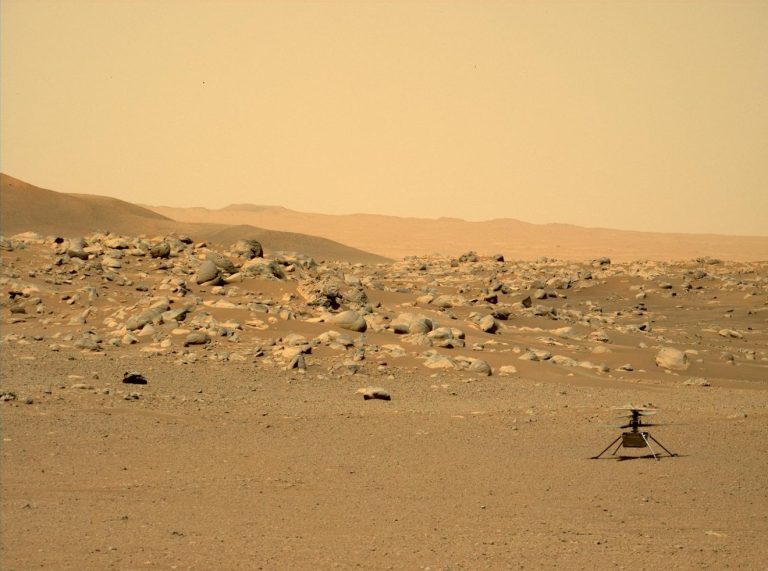
This image of NASA’s Ingenuity Mars Helicopter was taken at “Airfield D” by the Mastcam-Z instrument on the Perseverance rover on June 15, 2021, the 114th Martian day, or sol, of the mission. The rotorcraft completed its 50th flight on April 13, 2023. Credit: NASA/JPL-Caltech/ASU/MSSS Full Image Details
The history-making rotorcraft has recently been negotiating some of the most hazardous terrain it’s encountered on the Red Planet.
NASA’s Ingenuity Mars Helicopter has completed its 50th flight on Mars. The first aircraft on another world reached the half-century mark on April 13, traveling over 1,057.09 feet (322.2 meters) in 145.7 seconds. The helicopter also achieved a new altitude record of 59 feet (18 meters) before alighting near the half-mile-wide (800-meter-wide) “Belva Crater.”
With Flight 50 in the mission logbook, the helicopter team plans to perform another repositioning flight before exploring the “Fall River Pass” region of Jezero Crater.
“Just as the Wright brothers continued their experiments well after that momentous day at Kitty Hawk in 1903, the Ingenuity team continues to pursue and learn from the flight operations of the first aircraft on another world,” said Lori Glaze, director of the Planetary Science Division at NASA Headquarters in Washington.
NASA’s Ingenuity Mars helicopter made history when it achieved the first powered, controlled flight on another planet on April 19, 2021. A little less than two years later, on April 13, 2023, it completed its 50th flight. Here are some highlights from the rotorcraft’s journeys on the Red Planet. Credit: NASA/JPL-Caltech/ASU/MSSS
Ingenuity landed on the Red Planet in February 2021 attached to the belly of NASA’s Mars Perseverance rover and will soon mark the two-year anniversary of its first flight, which took place on April 19, 2021. Designed as a technology demonstration that would fly no more than five times, the helicopter was intended to prove powered, controlled flight on another planet was possible. But Ingenuity exceeded expectations and transitioned into being an operations demonstration.
Every time Ingenuity goes airborne, it covers new ground and offers a perspective no previous planetary mission could achieve. Imagery from the helicopter has not only demonstrated how aircraft could serve as forward scouts for future planetary expeditions, but it has even come in handy for the Perseverance team.
Teddy Tzanetos at NASA’s Jet Propulsion Laboratory provides an update on the agency’s Ingenuity Mars Helicopter and discusses how it’s inspiring future aerial exploration of the Red Planet. Credit: NASA/JPL-Caltech
By testing the helicopter’s limits, engineers are gathering flight data that can be used by engineers working on designs for possible future Mars helicopters. That includes the people designing the Mars Sample Return campaign’s proposed Sample Recovery Helicopters.
Riskier Terrain
Since leaving the relatively flat confines of Jezero Crater’s floor on Jan. 19, Ingenuity has flown 11 times, setting new speed and altitude records of 14.5 mph (6.5 meters per second) and 59 feet (18 meters) along the way.
Although the deep chill of winter and regional dust events (which can block the Sun’s rays from reaching the helicopter’s solar panel) have abated, Ingenuity continues to brown out at night. As a result, the Helicopter Base Station on the rover needs to search for the rotorcraft’s signal each morning at the time Ingenuity is predicted to wake up. And when the helicopter does fly, it now must navigate rugged and relatively uncharted terrain, landing in spots that can be surrounded by hazards.
NASA’s Ingenuity Mars Helicopter is seen here at the starting point of its 47th flight on Mars. The video was captured by the Mastcam-Z imager aboard NASA’s Perseverance rover on March 9, 2023. Credit: NASA/JPL-Caltech/ASU/MSSS
“We are not in Martian Kansas anymore,” said Josh Anderson, Ingenuity operations lead at NASA’s Jet Propulsion Laboratory in Southern California. “We’re flying over the dried-up remnants of an ancient river that is filled with sand dunes, boulders, and rocks, and surrounded by hills that could have us for lunch. And while we recently upgraded the navigation software onboard to help determine safe airfields, every flight is still a white-knuckler.”
Frequent Flyer
Beyond facing more challenging terrain, Ingenuity will also fly at a greater frequency in the coming days because the helicopter needs to remain within electronic earshot of the rover. With its AutoNav capability, Perseverance can travel hundreds of meters each day.
“Ingenuity relies on Perseverance to act as a communications relay between it and mission controllers here at JPL,” said Anderson. “If the rover gets too far ahead or disappears behind a hill, we could lose communications. The rover team has a job to do and a schedule to keep. So it’s imperative Ingenuity keeps up and is in the lead whenever possible.”
Perseverance recently completed exploring “Foel Drygarn,” a scientific target that may contain hydrated silica (which is of strong astrobiological interest). It is currently headed to “Mount Julian,” which will provide a panoramic view into nearby Belva Crater.
Feats of Ingenuity
Built with many off-the-shelf components, such as smartphone processors and cameras, Ingenuity is now 23 Earth months and 45 flights beyond its expected lifetime. The rotorcraft has flown for over 89 minutes and more than 7.1 miles (11.6 kilometers).
“When we first flew, we thought we would be incredibly lucky to eke out five flights,” said Teddy Tzanetos, Ingenuity team lead at JPL. “We have exceeded our expected cumulative flight time since our technology demonstration wrapped by 1,250% and expected distance flown by 2,214%.”
Surpassing expectations like this comes at a cost, however. With some helicopter components showing signs of wear and the terrain becoming more challenging, the Ingenuity team recognizes that every great mission must eventually come to an end. “We have come so far, and we want to go farther,” said Tzanetos. “But we have known since the very beginning our time at Mars was limited, and every operational day is a blessing. Whether Ingenuity’s mission ends tomorrow, next week, or months from now is something no one can predict at present. What I can predict is that when it does, we’ll have one heck of a party.”
More About Ingenuity
The Ingenuity Mars Helicopter was built by JPL, which also manages the project for NASA Headquarters. It is supported by NASA’s Science Mission Directorate. NASA’s Ames Research Center in California’s Silicon Valley and NASA’s Langley Research Center in Hampton, Virginia, provided significant flight performance analysis and technical assistance during Ingenuity’s development. AeroVironment Inc., Qualcomm, and SolAero also provided design assistance and major vehicle components. Lockheed Space designed and manufactured the Mars Helicopter Delivery System.
At NASA Headquarters, Dave Lavery is the program executive for the Ingenuity Mars Helicopter.
DC Agle Jet Propulsion Laboratory, Pasadena, Calif. 818-393-9011 [email protected]
JPL’s website is nominated, along with NASA’s Eyes on Asteroids and the “On a Mission” podcast, which are both produced at JPL. Public voting is open through April 20.
The awards are the highest honor for online communications. Credit: Webby Awards
The last time NASA sent a spacecraft to the Moon that was built to carry people, the internet didn’t exist. Its predecessor was a small network that connected a handful of servers at universities and military bases. That was 1972, and the system had only just developed the capability to send what people were calling “e-mail.” Fifty years later, NASA took the world’s online population to the Moon virtually as the Artemis I mission sent the Orion spacecraft around the Moon in preparation for landing humans there later this decade.
The internet also watched unfolding (literally) developments as members of the James Webb Space Telescope deployed the spacecraft’s components before starting to gather images, which, when they arrived, provided a look back in time 13 billion years. Throughout the year, NASA’s social media spread the news about all of the agency’s programs and people across a variety of platforms that encompassed all forms of digital media: text, imagery, video, audio, and augmented reality.
“Our digital team’s success is one of the best examples of how every day NASA fulfills its mission to explore for the benefit of all and inspire the world through discovery,” said Marc Etkind, NASA’s associate administrator for communications. “With the launch of Artemis I and the first images from the James Webb telescope, last year was one of the biggest years in NASA’s history, and we were happy to share it with the world.”
NASA Nominees
29 Days on the Edge – We launched the James Webb Space Telescope. Then we had to get it working from a million miles away. (Technology video)
How Hubble Images Are Made – As a cosmic photographer, NASA’s Hubble Space Telescope has taken over a million snapshots. Here’s how those images are made. (Science and education video)
NASA’s Eyes on Asteroids – Visualization of the asteroids in our solar system. (Website, best data visualization)
NASA’s Social Media: Creating a Community of Explorers – With millions of followers, NASA’s flagship social media accounts provide the agency with a collective audience that spans platforms and diverse groups of people. (Best Overall Social Presence – Brand)
“On a Mission” podcast series – Stories about NASA missions, told through the lives of those who make space exploration possible. (Science and education podcast)
Members of the public can vote in the People’s Voice Awards alongside the juried Webby Awards. To vote, click on the links to below. (Free registration required.)
NASA Honorees
Two other NASA properties were Webby honorees, which are recognized for their excellence but are not eligible for awards.
NASA’s Exoplanet Exploration Program was honored for its approach to accessible technology, and the James Webb Space Telescope’s social media program was also honored in the general social category.
The Webby Awards are presented by the International Academy of Digital Arts and Sciences which “recognizes excellence in digital creativity, establishing best practices on a yearly basis – continually pushing the standards of web development higher,” according to its website.
Members of the public can vote through 11:59 p.m. PDT April 20 for the People’s Voice awards as part of the Webby Awards. (Free registration required.) Here are the links to vote in each category:
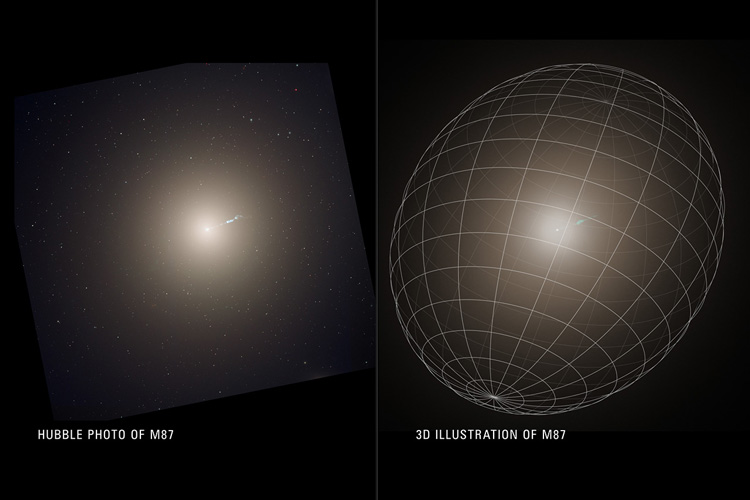
A photo of the huge elliptical galaxy M87 [left] is compared to its three-dimensional shape as gleaned from meticulous observations made with the Hubble and Keck telescopes [right]. Because the galaxy is too far away for astronomers to employ stereoscopic vision, they instead followed the motion of stars around the center of M87, like bees around a hive. This created a three-dimensional view of how stars are distributed within the galaxy. (Illustration by NASA, ESA, Joseph Olmsted/STScI, Frank Summers/STScI; Science by Chung-Pei Ma/UC Berkeley)Seen from Earth, the giant elliptical galaxy M87 is just a two-dimensional blob, though one that appears perfectly symmetrical and thus a favored target of amateur astronomers.
Yet, a new, highly detailed analysis of the motion of stars around its central supermassive black hole — the first black hole to be imaged by the Event Horizon Telescope (EHT) in 2019 — reveals that it’s not as perfect as it looks.
In fact, M87 is highly asymmetrical, like a russet potato. The galaxy’s shortest axis is about three-fourths (72.2%) the length of its long axis, while the intermediate axis is about seven-eighths (84.5%) that of the long axis.
Knowing this, University of California, Berkeley, astronomers were able to determine the mass of the supermassive black hole at the galaxy’s core to a high precision, estimating it at 5.37 billion times the mass of the sun. By comparison, our own Milky Way has at its center a massive black hole only 4 million times the mass of the sun.
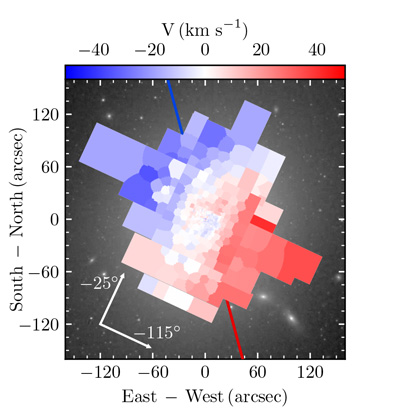
They also were able to measure the rotation of the galaxy, which is a relatively sedate 25 kilometers per second. Interestingly, it is not rotating around any of the galaxy’s major axes, but instead about an axis that is 40 degrees away from the long axis of its 2D image as observed by the Hubble Space Telescope.
To observers, M87 looks like a symmetrical blob of stars. But meticulous measurements by UC Berkeley astronomers revealed the motion of stars within the elliptical galaxy, showing that it is shaped more like a potato, what astronomers call a triaxial galaxy. (Animation by NASA, ESA, Joseph Olmsted/STScI; 3D model by Frank Summers/STScI; Science by Chung-Pei Ma/UC Berkeley)
The stereo reconstruction of the M87 galaxy and the more precise figure for the mass of the central black hole could help astrophysicists learn about a characteristic of the black hole they’ve had no way to determine before for any black hole: its spin.
“Now that we know the direction of the net rotation of stars in M87 and have an updated mass of the black hole, we can combine this information with the amazing data from the EHT team to constrain the spin,” said Chung-Pei Ma, a UC Berkeley professor of astronomy and of physics who led the research team. “This may point toward a certain direction and range of spin for the black hole, which would be remarkable. We are working on this.”
Further analyses to determine the true shape of giant elliptical galaxies — the galaxies with the largest black holes at their cores — will help astronomers understand better how large galaxies and large black holes form and could help astronomers better interpret gravitational wave signals. Ma leads a long-term study of supermassive black holes that is dubbed MASSIVE.
The results were published online March 15 in The Astrophysical Journal Letters (ApJ Letters).
Determining a galaxy’s 3D shape
While spiral galaxies tend to be small, rotate quickly and have a well-recognized pancake shape, giant elliptical galaxies rotate slowly and have a blobby appearance, their 3D shape difficult to discern. Like M87, the largest galaxy in the massive Virgo Cluster of galaxies, giant elliptical galaxies have grown from the merger of many other galaxies. That’s likely the reason M87’s central black hole is so large — it assimilated the central black holes of all the galaxies it swallowed. In all, the galaxy contains about 100 billion stars, 10 times larger than the Milky Way.
The Virgo Cluster of galaxies, with the giant elliptical galaxy M87 at the upper left. Despite its seeming symmetry, a UC Berkeley study shows that M87’s 3D shape is very asymmetric. This determination helps refine estimates of the mass of the supermassive black hole at the galaxy’s center. (Image credit: Fernando Pena)
Ma, UC Berkeley graduate student and lead author Emily Liepold, and Jonelle Walsh at Texas A&M University in College Station were able to determine the 3D shape of M87 thanks to a relatively new precision instrument mounted on the Keck II Telescope, one of the twin 10-meter Keck telescopes atop Mauna Kea, a volcano in Hawai’i. Called the Keck Cosmic Web Imager (KCWI), the integral field spectrometer allowed Ma and her team to measure the spectra of stars in the center of the galaxy.
They pointed the telescope at 62 adjacent locations in the galaxy, completely covering a region about 70,000 light-years across, and recorded the spectra of stars within that region. The observations span the central region — about 3,000 light-years across — where gravity is largely dominated by the supermassive black hole, as well as the outer part dominated by dark matter. Though the telescope cannot resolve individual stars — M87 lies about 53 million light- years from Earth — the spectra can reveal the range of velocities within each pixel of each image, enough information to calculate the gravitational mass they’re orbiting.
“It’s sort of like looking at a swarm of 100 billion bees that are going around in their own happy orbits,” said Ma, the Judy Chandler Webb Professor in the Physical Sciences. “Though we are looking at them from a distance and can’t discern individual bees, we are getting very detailed information about their collective velocities. It’s really the superb sensitivity of this spectrograph that allowed us to map out M87 so comprehensively.”
This is the first time KCWI has been used to reconstruct the geometry of a distant galaxy, and M87 is one of only a handful of giant elliptical galaxies whose 3D structure has been determined. Ma’s team had previously determined the 3D structure of two other giant elliptical galaxies, NGC 1453 and NGC 2693, both harboring smaller black holes than M87.
The researchers took the data obtained during four nights of Keck observations between 2020 and 2022, along with earlier photometric data for M87 from NASA’s Hubble Space Telescope, and compared them to computer model predictions of how stars move around the center of a triaxial galaxy. The best fit to the data — axial ratios of 1 to 0.84 to 0.72 — then allowed them to calculate the black hole mass.
Using the Keck telescope, Berkeley astronomers mapped the velocity of stars around the center of M87 to determine the 3D structure of the galaxy. Blue squares are regions of stars moving toward Earth; red are regions of stars moving away from us. The red-blue line is the rotation axis of the galaxy, displaced by 40 degrees from the major and minor axes of the galaxy as determined from optical images taken by the Hubble Space Telescope. (Image by Emily Liepold, Chung-Pei Ma and Jonelle Walsh)
“The Keck data are so good that we can measure the intrinsic shape of M87 along with the black hole at the same time,” Ma said. “We made the first measurement of the actual 3D shape of the galaxy. And since we allowed the swarm of bees to have a more general shape than just a sphere or disk, we have a more robust dynamical measurement of the mass of the central black hole that is governing the bees’ orbiting velocities.”
The authors dedicated their manuscript to the late astronomer Wallace “Wal” Sargent, who first suggested that a supermassive black hole lurked at the center of M87 and calculated its mass to be about 5 billion solar masses.
“His number is a twiddle with our error bars, which is very interesting to see after decades of work,” said Ma, who credits Sargent with being a mentor when she was a postdoctoral fellow at the California Institute of Technology.
The previous estimate of the mass of the supermassive black hole in M87, published in 2011, was based on a similar analysis of the dynamical movement of stars around the black hole, though that study assumed the galaxy was axisymmetric. The number, 6.14 billion solar masses, is within error bars of the new, more precise estimate. When imaging the black hole four years ago, the EHT scientists estimated the black hole mass to be 6.5 billion solar masses, 21% higher than the new number. Interestingly, the dark matter within the volume of the galaxy they analyzed is much higher than that of the black hole — about 388 billion solar masses, or 67% of the entire mass of M87. Though the identity of dark matter is still a mystery, it makes up about 85% of the mass of the universe.
Jonelle Walsh is with the George P. and Cynthia Woods Mitchell Institute for Fundamental Physics and Astronomy at Texas A&M. The work was funded by the National Science Foundation (AST-1817100, AST-2206307), the Heising-Simons Foundation and the Miller Institute for Basic Research in Science.
The first Lockheed Martin (NYSE: LMT) LM 400, a versatile, mid-sized satellite which can be adapted for military, civil or commercial uses, has successfully completed Electromagnetic Interference/Electromagnetic Compatibility testing. This trial is crucial to ensure that signals from the satellite bus components will not interfere with critical payloads during operations.
The spacecraft, which finished assembly in December, is also working toward completion of rigorous thermal vacuum (TVAC) testing.
“This successful testing of LM 400 helps prove the satellite’s design integrity and operational capabilities,” said Malik Musawwir, Lockheed Martin Space’s satellite center of excellence vice president. “This is a significant accomplishment for this new satellite and the space vehicles that will leverage this platform from our advanced digital LM 400 production line.”
LM 400 Spacecraft: Higher Power, More Mission Flexibility
The agile LM 400 spacecraft enables one platform to perform multiple missions, including remote sensing, communications, imaging, radar and persistent surveillance. Additionally, the scalable and versatile design provides a new level of flexibility and the necessary power to quickly meet a wide range of customer needs and missions, including accelerating demand for more proliferated systems. The spacecraft also benefits from production capabilities such as augmented and virtual reality and artificial intelligence. With increased commonality, LM 400 reduces schedule and cost while also maintaining quality.
Versatility that can host a variety of payloads with limited or no changes in low, medium and geosynchronous earth orbits.
Broad set of missions with pre-defined trim packages to meet specific mission needs.
Joint all-domain operations and joint all-domain command and control with a Modular Open Systems Architecture.
Greater mission adaptability and onboard “Edge” data processing with SmartSat™, Lockheed Martin’s software-defined satellite architecture.
High-rate production capability to meet large constellation needs.
Cost and schedule efficiency enabled by supply chain agreements and automation throughout the product lifecycle, from inventory management to manufacturing and test.
“The LM 400’s digital design allows for multiple versions to be seamlessly produced – including a ‘flat satellite’ that will support rapid launching of up to six stackable space vehicles at a time,” adds Musawwir. “These types of 21st Century Security agile deterrence capabilities will provide our customers with maximum flexibility for their missions.”
The LM 400 is already under several contracts, most recently being named as a satellite bus supporting U.S. Space Force’s planned Missile Track Custody program in medium earth orbit.
Headquartered in Bethesda, Maryland, Lockheed Martin Corporation is a global security and aerospace company that employs approximately 116,000 people worldwide and is principally engaged in the research, design, development, manufacture, integration and sustainment of advanced technology systems, products and services.
Please follow @LMNews on Twitter for the latest announcements and news across the corporation, and @LMSpace to learn more about the latest technologies, missions and people driving the future of space.
Floodwater (dark blue) stands out against the vegetation in agricultural fields around Tulare Lake near Corcoran, California, in this enhanced color image taken by Landsat 8 on March 29, 2023. Heavy rain and snow in the first three months of 2023 have once again brought water to Tulare’s lakebed, but also flooding several nearby towns. 2023 has been the wettest year in the region’s history.
Tulare Lake, in California’s San Joaquin Valley, was once the largest freshwater lake west of the Mississippi River. By 1920, the rivers that fed the lake were dammed and diverted for uses such as irrigation. Since then, the lakebed has been covered with farms that grow a variety of crops.
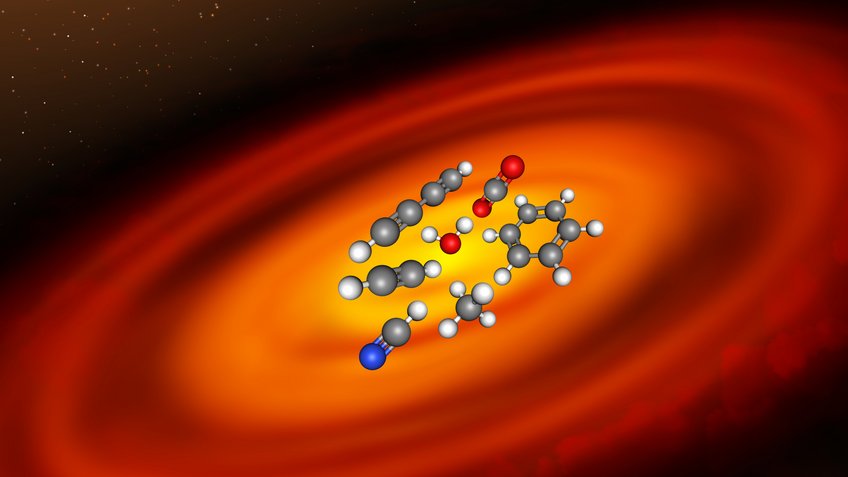
Researchers using the James Webb Space Telescope (JWST) have taken a first look at their data that probe the chemistry of the regions of disks around young stars where rocky planets form. Already at that stage, the data reveal the disks to be chemically diverse and rich in molecules such as water, carbon dioxide, and organic hydrocarbon compounds like benzene as well as tiny grains of carbon and silicates. The ongoing MPIA-led JWST observing program MINDS bringing together several European research institutes promises to provide a revolutionary view on the conditions that precede the birth of planets and, at the same time, determine their compositions.
New observations towards a sample of planet-forming disks around young stars obtained with the Mid-Infrared Instrument (MIRI) on board the James Webb Space Telescope (JWST) provide a first look into how this powerful tool will boost our understanding of terrestrial planet formation. Astronomers from 11 European countries have gathered in the MINDS (MIRI mid-Infrared Disk Survey) project to investigate the conditions in the inner regions of such disks where rocky planets are expected to form from the gas and dust they contain. They take the next step to decipher the conditions of planet-forming disks – a prerequisite to identifying the processes leading to solid bodies, such as planets and comets, that comprise planetary systems.
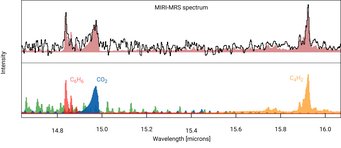
The initial results presented in two articles demonstrate the diversity of cradles of rocky planets. Disks range from environments rich in carbon-bearing compounds, including organic molecules as complex as benzene, to agglomerates containing carbon dioxide and traces of water. Like fingerprints, these chemicals produce uniquely identifiable markers in the spectra the astronomers obtained with their observations. A spectrum is a rainbow-like display of light or, as in this case, e.g., infrared radiation, splitting it into the colours of which it is composed.
“We’re impressed by the quality of the data MIRI produced,” says Thomas Henning, Director at the Max Planck Institute for Astronomy (MPIA) in Heidelberg, Germany. He is the principal investigator (PI) of the JWST Guaranteed Time Observation (GTO) program MINDS. “This wealth of spectral lines does not only reveal the chemical composition of the disk material ultimately evolving into planets and their atmospheres. It also allows us to determine physical conditions like densities and temperatures across and inside those planet-forming disks, directly where the planets grow.”
A dry protoplanetary disk with two kinds of carbon dioxide
“We can now study the chemical components in those disks much more precisely,” says Sierra Grant, a post-doc at the Max Planck Institute for extraterrestrial Physics (MPE) in Garching, Germany. She is the main author of an article analysing a disk around a young low-mass star. “The warm inner disk around GW Lup appears to be rather dry. While we clearly detected molecules containing carbon and oxygen, there is much less water present than expected,” Grant explains.
A gap around the central star devoid of gas would explain the lack of water.“If that hole extended until between the snowlines of water and carbon dioxide, it would explain why we find so little water vapour there,” Grant says. The snowlines indicate ring-like zones at varying distances from the star where the temperatures drop to values where certain chemical species freeze out. The water snowline is closer to the star than the one for carbon dioxide.
Therefore, if a cavity extends beyond the water snowline, the gas outside this perimeter would still contain carbon dioxide but only little water. Any planet forming there would initially be fairly dry. Therefore, small icy objects like comets from the outer planetary system could be the only substantial source of water. On the other hand, if a planet interacting with the disk were responsible for such a gap, this would suggest that the planet would have accumulated water during its formation.
The team also detected for the first time a much rarer version of the carbon dioxide molecule in a protoplanetary disk containing a carbon atom that is slightly heavier than the much more frequent type. In contrast to the “normal” carbon dioxide that merely probes the warmer disk surface, the radiation of the heavier sibling can escape the disk from deeper and cooler layers. The analysis results in temperatures from around 200 Kelvin (-75 degrees Celsius) near the disk mid-plane to approximately 500 Kelvin (+225 degrees Celsius) at its surface.
Rich carbon chemistry in a disk around a very low-mass star
Life seems to require carbon, forming complex compounds. While simple carbon-bearing molecules such as carbon monoxide and carbon dioxide pervade most planet-forming disks, the rich hydrocarbon chemistry of the following disk is quite unusual.
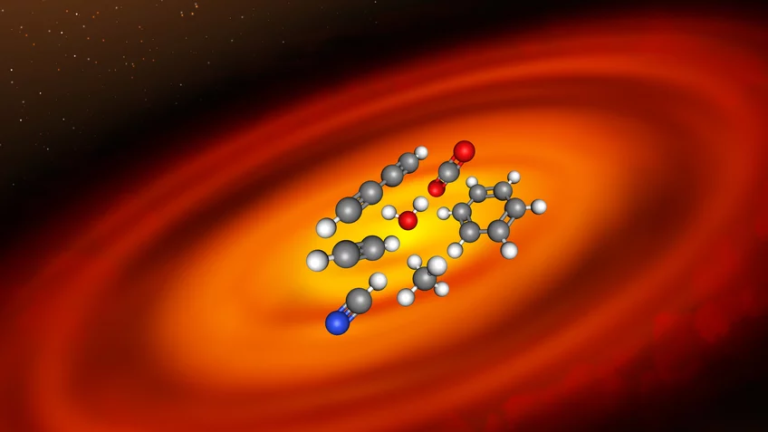
“The spectrum of the disk around the low-mass star J160532 reveals warm hydrogen gas and hydrogen-carbon compounds at temperatures around 230 degrees Celsius,” says Benoît Tabone, CNRS researcher at the Institut d’Astrophysique Spatiale, Paris-Saclay University, France, and the main author of another MINDS study. The strongest spectral signal stems from hot acetylene molecules, each consisting of two carbon and two hydrogen atoms.
Other equally warm gases of organic molecules are diacetylene and benzene, the first detections in a protoplanetary disk, and probably also methane. These detections indicate that this disk contains more carbon than oxygen. Such a mixture in chemical composition could also influence the atmospheres of planets forming there. In contrast, water seems almost absent. Instead, most of the water may be locked up in icy pebbles of the colder outer disk, not traceable by these observations.
Eruptions of young stars produce seeds for planets
Besides gas, solid material is a typical constituent of protoplanetary disks. Much of it consists of silicate grains, basically fine sand. They grow from nanoparticles to randomly structured micron-sized aggregates. When heated, they can assume crystalline structures. A work published by a team led by Ágnes Kóspál (MPIA and Konkoly Observatory, Budapest, Hungary), which is not part of the MINDS program, demonstrates how such crystals may enter the rocky pebbles that eventually build terrestrial planets. Scientists find such crystals also in comets and Earth’s crust.
The team rediscovered crystals detected years ago in the disk around the recurrently erupting star EX Lup, just recovering from a recent outburst. It provided the necessary heat for the crystallisation process. After a period of absence, these crystals now reappeared in their spectra, albeit at much lower temperatures putting them farther away from the star. This rediscovery indicates that repeated outbursts may be essential in providing some of the building blocks of planetary systems.
A golden age of astronomical research
These results show that JWST’s arrival ushers in a new golden age in astronomical research. Already at that early stage, the findings are groundbreaking. “We’re looking forward to what other news JWST will bring,” Henning declares. Altogether, the MINDS program will target the disks of 50 young low-mass stars. “We’re eager to learn about the diversity we’ll find.”
“By refining the models used to interpret the spectra, we will also improve the results at hand. Eventually, we want to exploit JWST’s and MIRI’s full capabilities to examine those planetary cradles,” adds Inga Kamp, a MINDS collaborator and a scientist at Kapteyn Astronomical Institute of the University of Groningen, The Netherlands.
Learning about the formation of planets around very low-mass stars, i.e., stars about five to ten times less massive than the Sun, is particularly rewarding. Rocky planets are over-abundant around those
stars, with many potentially habitable planets already detected. Therefore, the MINDS program promises to clarify some of the key questions about the formation of Earth-like planets and perhaps the emergence of life.
Background information
The James Webb Space Telescope (JWST) is the largest, most powerful telescope ever launched into space. It is an international partnership between NASA, ESA and CSA.
JWST’s Mid-InfraRed Instrument (MIRI), built by a European consortium of research institutions, is a multi-purpose scientific instrument for infrared wavelengths between 5 and 28 microns. It combines an imaging camera with a spectrograph. With the support of industrial partners, MPIA provided the mechanisms of all wavelength-selecting elements, such as filter and grating wheels, and led MIRI’s electrical design.
The MPIA researchers involved in these studies are Th. Henning (PI), J. Bouwman, M. Güdel (also ETH Zürich, Switzerland and University of Vienna, Austria), Á. Kóspál (also Konkoly Observatory, Budapest, Hungary), G. Perotti, M. Samland, S. Scheithauer, J. Schreiber, K. Schwarz
The MINDS consortium consists of the following research institutions:
Max Planck Institute for Astronomy, Heidelberg, Germany; Max Planck Institute for Extraterrestrial Physics, Garching, Germany; Université Paris-Saclay, Orsay and Gif-sur-Yvette, France; Leiden Observatory, The Netherlands; KU Leuven, Belgium; Rijksuniversiteit Groningen, The Netherlands; University of Vienna, Austria; ETH Zürich, Switzerland; Université de Liege, Belgium; Centro de Astrobilogía, CSIC-INTA, Villaneuva de la Cañada and Torrejón de Ardoz, Spain; LESIA, Observatoire de Paris, Meudon, France; INAF, Napoli, Italy; Dublin Institute for Advanced Studies, Ireland; UK Astronomy Technology Centre, Edinburgh, UK; Radboud University, Nijmegen, The Netherlands; Space Research Institute, Graz, Austria; SRON, Groningen and Leiden, The Netherlands; Stockholm University Sweden; DTU Space, Lyngby, Denmark; Onsala Space Observatory, Sweden; Amsterdam University, The Netherlands
As more people live, work and move to cities and urban areas, there’s an increasing demand for compact electric vehicles that are easy to manoeuvre and park in tight spaces. With that in mind, we’ve compiled a list of the top five compact electric vehicles for city driving.
01. Nissan Leaf
The Nissan Leaf is one of the most popular electric vehicles on the market, and it’s no surprise why. It’s compact, affordable, and has a range of up to 150 miles on a single charge (depending on the version), which is suitable for most daily commutes. It’s also very easy to drive and park, making it perfect for city driving. However, the limited fast-charging infrastructure in some areas may make long-distance travel challenging, and the design may not be as appealing to some buyers.
Pros
Affordable price compared to other EVs (From £28,940)
Good range for a compact EV
Easy to drive and park in tight spaces
Cons
The interior feels a bit dated
The battery takes a long time to charge compared to other EVs
02. Fiat 500 EV
The Fiat 500 EV is known for its stylish and iconic design, which sets it apart from other EVs on the market. Its peppy acceleration and nimble handling make it fun to drive, and its decent range of up to 199 miles (depending on the version) makes it suitable for most daily commutes. The fast-charging capability allows for quick recharging on the go. However, the limited rear seat and cargo space compared to other similarly priced EVs may be a drawback for some buyers. The interior quality could also be better, and the price is higher than some other EVs in its class.
Pros
Stylish and iconic design that stands out from other electric vehicles
Peppy acceleration and nimble handling make it fun to drive
Decent range of up to 199 miles (depending on the version) makes it suitable for most daily commutes
Fast-charging capability allows for quick recharging on the go
Cons
Limited rear seat and cargo space compared to other similarly priced electric vehicles
Interior quality could be better
Price is higher than some other electric vehicles in its class
03. Tesla Model 3
The Tesla Model 3 is one of the most popular electric vehicles in the world and for a good reason. It’s sleek, fast, and has a range of up to 353 miles on a single charge (depending on the version) and quick acceleration. While it’s a bit larger than other vehicles on this list, it’s still very easy to manoeuvre and park in the city. Its spacious and luxurious interior, with advanced technology features, has also made it a popular choice for those looking for a high-end EV. However, the higher price compared to some other electric vehicles in its class may be a drawback for some buyers.
Pros
Longest range on this list
Sleek and modern design
Fast acceleration
Cons
Expensive compared to other EVs
Some people find the minimalist interior design lacking in features
04. BMW i3
The BMW i3 is a stylish, sporty, and fun electric vehicle that’s perfect for city driving. It has a range of up to 153 miles on a single charge, and it’s very easy to park thanks to its compact size. Plus, it’s a BMW, so you know it’s going to be fun to drive. However, the limited passenger and cargo space due to its small size may be a drawback for some buyers, and the design may not be as appealing to some.
Pros
Stylish and unique design
Fun to drive
Easy to park in tight spaces
Cons
Expensive compared to other compact EVs
The range is lower than some other vehicles on this list
05. Renault Zoe
The Renault Zoe is a spacious and comfortable EV with ample passenger and cargo space. Its impressive range of up to 245 miles (depending on the version) makes it suitable for longer trips. The quick acceleration and responsive handling make it fun to drive, and it comes with a range of safety features and advanced technology. However, the higher price compared to some other EVs in its class may be a drawback for some buyers. Some may also find the design and styling to be bland or unexciting. The limited fast-charging infrastructure in some areas may also make long-distance travel challenging.
Pros
Spacious and comfortable interior with ample passenger and cargo space
Impressive range of up to 245 miles (depending on the version) makes it suitable for longer trips
Quick acceleration and responsive handling make it fun to drive
Comes with a range of safety features and advanced technology
Cons
Higher price compared to some other electric vehicles in its class
Some may find the design and styling to be bland or unexciting
Limited fast-charging infrastructure in some areas may make long-distance travel challenging
06. Chevrolet Bolt EV
The Chevrolet Bolt EV is a practical and affordable electric vehicle that’s perfect for city driving. It has a range of up to 259 miles on a single charge, which is one of the best on this list. Its spacious interior and ample cargo space make it a practical choice for families and its responsive handling and quick acceleration make it fun to drive; great for long trips as well. However, the higher starting price compared to some other EVs in its class may be a drawback for some buyers.
Pros
Long range for a compact EV
Spacious and comfortable interior
Affordable price compared to other EVs
Cons
The design may not be as sleek or stylish as some other vehicles on this list
The ride can be a bit bumpy on rough roads
07. Kia Niro EV
The Kia Niro EV is a great all-around electric vehicle that’s perfect for city driving. It has a range of up to 239 miles on a single charge, which is very impressive and makes it suitable for longer trips. It’s also very spacious and comfortable, and it has a practical design that’s perfect for families.
Pros
Long range for a compact EV
Spacious and comfortable interior
Practical design for families
Cons
Some people find the design a bit boring or unexciting
The price is a bit higher than some other compact EVs
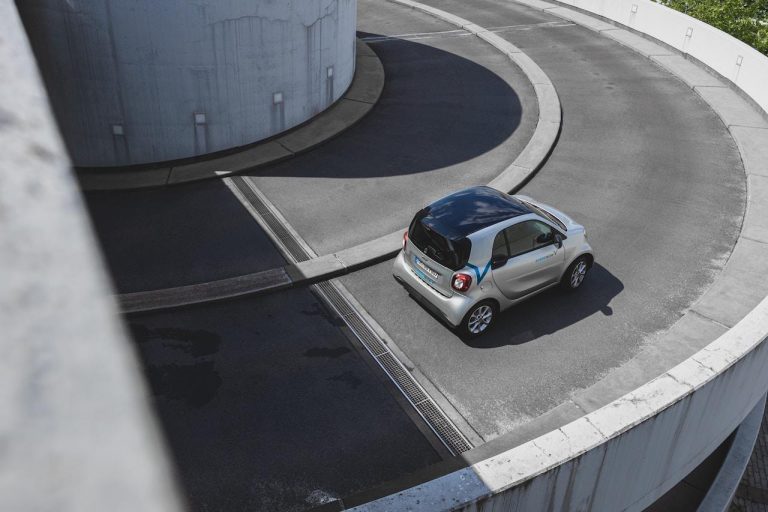
08. smart EQ fourtwo
The smart EQ fourtwo is a compact EV that is perfect for city driving. Its small size makes it easy to manoeuvre in city traffic and park in tight spaces. The quick acceleration and responsive handling make it fun to drive, and its decent range of up to 83 miles makes it suitable for short commutes and city driving. The low starting price also makes it an affordable option for those on a budget. However, the limited passenger and cargo space due to its small size may be a drawback for some buyers. The interior quality could also be better, and the range is limited compared to other similarly priced EVs.
Pros
Compact size makes it easy to manoeuvre in city traffic and park in tight spaces
Quick acceleration and responsive handling make it fun to drive
Decent range of up to 83 miles makes it suitable for short commutes and city driving
Low starting price makes it an affordable option for those on a budget
Cons
Limited passenger and cargo space due to its small size
Interior quality could be better
Limited range compared to other similarly priced electric vehicles
There are plenty of great compact electric vehicles out there for city driving, and these are just a few of the best. When choosing an EV, it’s important to consider your specific needs and preferences, as well as your budget. Whether you’re looking for a practical and affordable option, or something more stylish and luxurious, there’s an electric vehicle out there that’s perfect for you.