

Home Blog Page 71

10 Modern TV Concepts That Look Great In Contemporary Design

0

The newest projects in electronics demonstrate that TVs can become a piece of art and function as a natural part of interior design.

For interior designers, there’s always been a love/hate relationship with TVs.

Modern homes aren’t imaginable without these devices, but successfully incorporating them in an interior can be quite a challenge.

Thankfully, today’s range of TVs offers many options for aesthetics and functionality.

While some designers prefer to hide them from the eyes, there are plenty of modern solutions that turn TVs into their own pieces of art.

1. Objet TV by LG

OBJET

When the house or apartment is a little short on square footage, deciding where to place the TV can be quite a headache.

Luckily, nowadays, there are many creative options available, like the one – offered by LG.

The 65-inch OLED TV resembles a canva, which can be leaned against the wall up to a 5-degree angle. 

This TV is literally a piece of art since it looks like the artwork you would see in a gallery.

With an interchangeable fabric cover created by Danish textile designer Kvadrat, it will look great in any modern home.

2. Atelier by Kwanjun Ryu

ATELIER

A hybrid entertainment system that combines high-end audio and TV in one elegant device – this is how you can describe Atelier.

According to the creative mind behind the project, designer Kwanjun Ryu, it is primarily a speaker aimed at the younger generation that doesn’t care much about TV.

Atelier is designed to be placed close to the floor and can deliver multi-directional, high-resolution sound that surrounds the user with their favorite tunes.

At the touch of a button, the 32-inch screen automatically flips up to reveal a full HD color screen.

This is great for those who don’t want the TV to break up the style of their room. When Atelier is not used in TV mode, there will be no black box to ruin the aesthetic of your interior.

3. Easel by Hyeona Kim & WooSeok Lee 

True to its name – with a futuristic and minimalist aesthetic – this OLED display can easily be installed anywhere from indoors to outdoors, turning any space into your own personal cinema.

You can move the unit around your living space by simply assembling the stand. 

Easel is the work of Hyeona Kim and WooSeok Lee.

EASEL

They came up with the innovative idea during the pandemic.

Inspired by the desire to entertain people while everyone was spending time at home, the 43-inch mobile home display system is both functional and beautiful.

Focusing on harmony with the interior and embodying unique technology, its frame is made of aluminum and plastic in three stunning colors – ivory, wintergreen, and graphite.

4. StandbyME TV by LG

STANDBYME

Another take on modern TV concepts is this device by LG, which is unique, thanks to its TV-on-wheels design.

Since it can be easily moved from room to room, it’s perfect for a private viewing experience.

The wireless TV set includes a built-in battery and a movable stand. Don’t like the stand? No worries! You can also detach the TV screen and use it as a tablet.

5. The Serif by Samsung

SERIF

Your TV doesn’t have to disappear into your room.

When you choose a design like the Serif, it will become the centerpiece of your interior.

Samsung’s creation is made in a way that hides all the cables and connectors in a white chassis.

You can place it on a tabletop or use its set of distinct legs.

6. The Sero by Samsung

SERO

In 2020, Samsung introduced the world to the Sero.

The 43-inch 4K TV is unique for its ability to rotate from landscape to portrait mode.

The look is something you won’t see from other companies – it really is one-of-a-kind.

Samsung’s product is primarily designed to mirror your phone.

So if you are guilty of spending too much time on TikTok and Instagram, perhaps this is the right investment for you.

7. Signature RX by LG

SIGNATURE RX

Imagine a screen that rolls up from within its cabinet. Seems like a scene from a sci-fi movie?

Well, LG has managed to come up with a groundbreaking technology that can do exactly that.

With LG Signature RX, they have reimagined what a TV is capable of. 

The impressive 65-inch 4K OLED TV can be placed even in locations that normally wouldn’t work, like in front of windows.

The image quality is excellent too.

8. Beovision Harmony by Bang & Olufsen

BEOVISION HARMONY

Regardless of whether you choose to place the masterpiece of Bang & Olufsen on the wall or use it free-standing, it will add pure glitz to your home.

Sculpted from wood or fabric and aluminum, this is a TV that certainly catches an eye.

The powerful speakers glide apart, and the television floats into the space” – Beovision certainly takes luxury TVs to new heights.

9. Vitrine transparent OLED by Panasonic

VITRINE TRANSPARENT OLED

One of the most surprising modern TV concepts is the transparent OLED TV by Panasonic.

Designed by Daniel Rybakken for Vitra and the electronics company, the unique project is a pleasure to look at.

When you first lay your eyes on it, the TV looks like a glass cabinet.

When watching content, the items within the frame seem to fade away. 

As Daniel says himself – the model carefully balances between art and design.

10. Mi TV Lux Transparent Edition by Xiaomi

MI TV LUX TRANSPARENT EDITION

Speaking of transparent TVs, it would be a crime not to mention the beautiful work of Xiaomi.

The device includes a 55-inch screen with a 150000:1 static contrast ratio.

What makes it so impressive is the edge-to-edge transparent display, which, at first glance, looks like a simple glass screen.

In fact, you can even see through to the other side!

End Notes

TV is nowadays the centerpiece of almost every home, a place where friends and family gather to relax after a long day.

Through the years, TV screens have gotten bigger and better. It’s difficult to imagine that just a decade ago, flat screens weren’t a thing.

In 2022, it’s not enough for TVs just to be functional – they must also be elegant. These projects prove that it is possible to make the TV a piece of art.

Source: Designwanted

Source: Cyberpogo
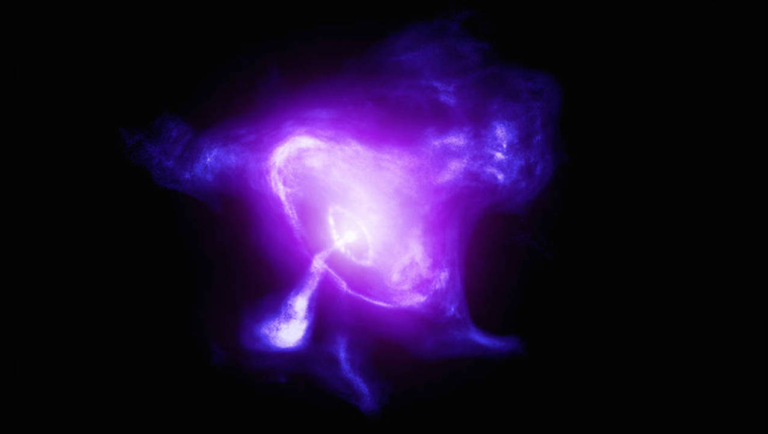
Seeing The Crab Nebula Like Never Before

0
This image of the Crab Nebula combines data from NASA’s Imaging X-ray Polarimetry Explorer (IXPE) in magenta and NASA’s Chandra X-ray Observatory in dark purple. Credits: X-ray (IXPE: NASA), (Chandra: NASA/CXC/SAO) Image processing: NASA/CXC/SAO/K. Arcand & L. Frattare

On Feb. 22, 1971, a sounding rocket lifted off from Wallops Island, Virginia, with specialized sensors aimed at the Crab Nebula, a bright cosmic object 6,500 light-years away.

In those days, before recovering physical tapes from the experiment, scientists first received scientific data on a strip chart recorder, a device that printed signals on paper. Astronomer Martin Weisskopf and his colleagues began their analysis on launch day by measuring the distance between signals using a ruler and pencil.

“What makes science so beautiful and exciting is that for those few moments, you’re seeing something that no one has ever seen before,” said Weisskopf, now an emeritus astronomer at NASA’s Marshall Space Flight Center in Huntsville, Alabama.

Decades later, Weisskopf proposed the development of an Earth-orbiting satellite with powerful instruments that could gather much more detailed measurements of the same kind about the Crab Nebula and other mysterious cosmic objects. That satellite became NASA’s Imaging X-ray Polarimetry Explorer (IXPE), which launched on December 9, 2021.

Now, more than 50 years after the sounding rocket experiment, scientists have used IXPE to create a detailed, nuanced map of the Crab Nebula’s magnetic field, revealing more of its inner workings than ever before. The new results, published in the journal Nature Astronomy (preprint available), help resolve longstanding mysteries about the well-studied Crab Nebula and open new questions for future study.

IXPE data show that the Crab Nebula’s magnetic field resembles that of the Vela Pulsar Wind Nebula, which is also donut-shaped. But at the Crab, scientists were surprised that areas of magnetic field turbulence were more patchy and asymmetrical than expected.

“This is a clear indication that even the more complex models developed in the past, with the use of advanced numerical techniques, do not fully capture the complexity of this object,” said Niccolò Bucciantini, lead author of the study and astronomer at the INAF Arcetri Observatory in Florence, Italy.

A favorite object of study among astronomers, the Crab Nebula resulted from a supernova documented in the year 1054. The explosion left behind a dense object called the Crab Pulsar, about the diameter of Huntsville, Alabama or the length of Manhattan, but with as much mass as about two Suns. The chaotic mess of gases, shock waves, magnetic fields and high-energy light and particles coming from the rotating pulsar is collectively called a “pulsar wind nebula.” These extreme conditions make for a bizarre environment that is not yet thoroughly understood.

Weisskopf and colleagues were hoping to understand this extreme environment in a new way by measuring the polarization of X-rays from the Crab Nebula, which shines brightly in X-rays. X-ray polarization gives scientists clues to the direction where the magnetic field points in different parts of a cosmic object, as well as how well ordered the magnetic field is. The magnetic field’s geometry and turbulence determines how particles get catapulted toward the speed of light.

In the five minutes that the 1971 sounding rocket experiment spent above Earth’s atmosphere, it produced the world’s first X-ray polarization measurements.

Scientists followed up with a satellite called OSO-8 in 1975, which also measured the X-ray polarization of the Crab Nebula. The rocket and the satellite produced generally the same result: That the Crab Nebula has an average polarization of about 20%.

As project scientist of NASA’s Chandra X-Ray Observatory, which launched in 1999, Weisskopf continued his exploration of the Crab Nebula in new ways. With Chandra, “we took beautiful images of the nebula and pulsar, and we could see the jets and the various structures,” he said. Chandra’s X-ray imaging revealed wisp-like structures that move in the nebula, and helped scientists to further understand the relationship between the pulsar’s energy and X-ray emissions.

Nearly every recent large telescope has pointed to the Crab Nebula to better understand this mysterious supernova remnant. But only IXPE can study X-rays from Crab in terms of polarization, a measure of the organization of electromagnetic fields.

“The Crab is one of the most-studied high-energy astrophysical objects in the sky. So it is extremely exciting that we could learn something new about this system by looking through IXPE’s ‘polarized lenses,’” said Michela Negro, a research scientist at NASA Goddard Space Flight Center affiliated with the University of Maryland, Baltimore, and a co-author of the study.

Across the entire nebula, IXPE found about the same average polarization as Weisskopf and colleagues did in the 1970s. But with more sophisticated instruments, IXPE was able to refine the angle of polarization and examine the differences in polarization across the entire object. Scientists see areas of much polarization in the outer regions of the nebula, light-years away from the pulsar, where polarization is lower.

This enabled scientists to investigate not just X-rays from the Crab Nebula but also those coming from the pulsar itself, or the sphere of magnetic fields around it. The findings suggest that those X-rays originate in the outer magnetic field region, called the “wind” region, although exactly where and how is still unknown. Within the magnetic field, shocks generated by the pulsar’s “wind” are propelling particles close to the speed of light.

“I’m very proud of everybody associated with IXPE,” said Weisskopf, who was the mission’s first principal investigator. “Everybody has worked so hard, and it works as advertised.” Reflecting on his work on the 1971 experiment that laid the groundwork for the new results, Weisskopf says, “It’s like somebody said to me, ‘Martin, you did good.’”

About the IXPE mission:

Part of NASA’s Small Explorer mission series, IXPE launched on a Falcon 9 rocket from NASA’s Kennedy Space Center in Florida in December 2021. It now orbits 370 miles, or roughly 595 kilometers, above Earth’s equator. The mission is a partnership between NASA and the Italian Space Agency, with partners and science collaborators in 13 countries. Ball Aerospace, headquartered in Broomfield, Colorado, manages spacecraft operations.

By Keith Cowing
Source SpaceRef

Juno Marks 50 Orbits Around Jupiter

0
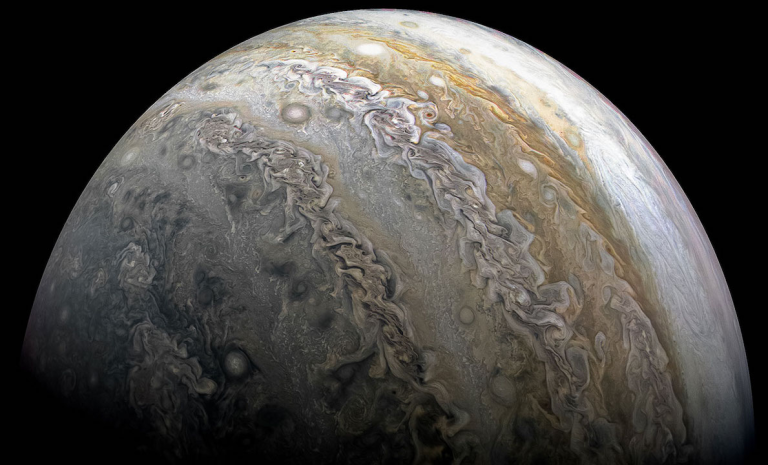
NASA’s Juno mission captured this look at the southern hemisphere of Jupiter on Feb. 17, 2020, during one of the spacecraft’s close approaches to the giant planet. This high-resolution view is a composite of four images captured by the JunoCam imager and assembled by citizen scientist Kevin M. Gill. Credit: NASA, JPL-Caltech, SwRI, MSSS | Image processing by Kevin M. Gill, © CC BY

NASA’s Juno mission completed its 50th close pass by Jupiter on April 8, 2023. Since the spacecraft arrived at the giant planet in 2016, its JunoCam imager has captured spectacular views of Jupiter, and its large moons Ganymede, Europa, and Io. Many of those images were processed by volunteers called citizen scientists.

To mark the 50th close pass, NASA teamed up with Google Arts & Culture to feature a selection of JunoCam images. You can see the Google Arts & Culture feature here.

Also, we created a graphic with 50 images that provide a small sampling of the data Juno has returned so far, including images from several different instruments, and spectacular views of Earth, Jupiter, and Jupiter’s large moons Ganymede, Europa, and Io.

By Keith Cowing
Source SpaceRef

Beyond Gravity Computer Controls Europe’s Jupiter Spacecraft JUICE

0
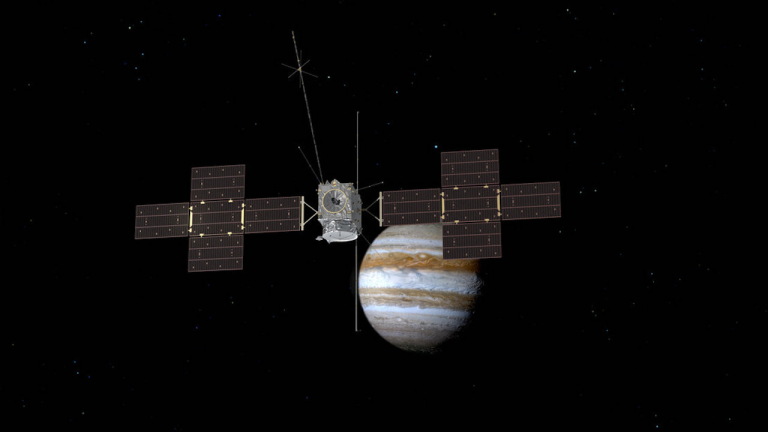
JUICE. ESA

Beyond Gravity, a leading supplier to the space industry, provided key products for Europe’s first mission to Jupiter. The Airbus-built Juice satellite is controlled by a computer and protected by thermal insulation from Beyond Gravity.

The European Juice spacecraft (Jupiter Icy moons Explorer) will study the largest planet in our Solar System, Jupiter. Juice will launch on April 13 aboard an Ariane 5 rocket from Europe’s spaceport in Kourou. The European Space Agency (ESA) mission will investigate Jupiter and three of its largest moons. It will look for water under the ice crust of these moons, which would indicate life-compliant conditions. Beyond Gravity, a leading space supplier, delivered various key products for this mission. “Juice is humankind’s next ambitious mission to the outer Solar System. As a key supplier, we have delivered a wide range of electronic, thermal and mechanical products that make Juice’s exploration of the fascinating planet Jupiter and its moons possible. Together with the launcher structures we are supplying for the Ariane 5 rocket that will take Juice into space, the mission gives us the opportunity to once again showcase the diversity and unmatched reliability of our product portfolio”, says André Wall, CEO Beyond Gravity. The prime contractor of the Juice spacecraft on behalf of ESA is Airbus Defence and Space.

Computer from Beyond Gravity controls Juice spacecraft

Beyond Gravity delivered the data handling subsystem of the Juice spacecraft, which controls the satellite platform (satellite bus) and collects operational data. The subsystem includes the computer, the remote interface unit, and a mass memory. “Our high-performance onboard computer manages the spacecraft position and orbit, ensures that the spacecraft stays healthy, and communicates with the Earth,” explains Anders Linder, EVP Division Satellites at Beyond Gravity. “Yet another ESA mission trusts in our onboard computers, confirming our leading position in this field.” During operation, Juice generates a large amount of data. The mass memory of the spacecraft, developed by DSI Aerospace Technologies, provides storage for the payload and spacecraft telemetry data on-board before transmission to Earth. The remote interface unit from Beyond Gravity is a key component of the data handling subsystem. For instance, it provides a physical interface to Juice’s state-of-art propulsion system, as well as to the system responsible for the spacecraft’s orientation.

Elaborate thermal insulation protects

A new type of thermal insulation will keep the internal temperature of the Juice spacecraft stable. The thermal insulation from Beyond Gravity consists of several layers of ultra-thin special plastic films. They are separated by sophisticated nettings that achieve a highly efficient insulation in the vacuum of space comparable to a brick wall of several meters thickness on Earth. “Our thermal insulation protects Juice from temperatures ranging from plus 250 degrees Celsius during Venus flyby and minus 230 degrees Celsius at Jupiter,” says Anders Linder. The spacecraft weighs about six tons (including fuel). The total mass of the thermal insulation alone is 100 kilograms. In total, more than 500 individual parts of the thermal insulation were installed on the spacecraft, ranging from simple aluminized polyester film inside the satellite to external multilayer insulation consisting of more than 20 layers of coated high temperature capable polyimide film.

Highly radiation and heat resistant antenna

One of the antennas that Juice will use to navigate around Jupiter and communicate back and forth with Earth was built by Beyond Gravity. “The biggest technical challenges for this antenna are the high levels of radiation around Jupiter and the extreme heat at Venus and extreme cold at Jupiter,” explains Anders Linder. “Also, the enormous distance is challenging. Our antenna will send data hundreds of millions of kilometers down to Earth.”

Structural elements for Juice

Beyond Gravity also delivered a number of structural elements for the Juice satellite. These include more than 30 sandwich panels made of aluminum or carbon fibre as well as different types of carbon fibre struts. For some of the aluminum sandwich panels Beyond Gravity provided a special feature: The panels are covered with lead foils. The foils are needed to shield the equipment mounted to the inside of some areas of the spacecraft from the harsh radiative environment. The struts are used to support e.g. Juice’s solar arrays, pressure tanks or communication antennas.

Bye, bye Ariane 5: Last science flight

The Juice satellite will be launched into space on board an Ariane 5 rocket from the European spaceport in Kourou, French Guiana, South America. After more than 25 years of service, this will be the second to last flight of this European launcher rocket, which will be replaced in the future by its successor model Ariane 6. In more than 100 flights Ariane 5 exclusively relied on Beyond Gravity’s payload fairing, computer, antenna and separation system. “We are proud to contribute to one of the most reliable launchers in the world since the very first day,” says Paul Horstink, EVP Division Launchers at Beyond Gravity. The company’s fairing protects the satellite during launch and journey into space. Once in space the Juice spacecraft is placed in orbit with the help of a separation system from Beyond Gravity. After an eight-year journey in space, the probe will arrive at Jupiter in 2031 and help provide humankind with more answers to the mysteries of the universe.

About Juice

European Space Agency’s Jupiter Icy Moons Explorer, Juice, is humankind’s next mission to the outer Solar System. It will make detailed observations of gas giant Jupiter and its three large ocean-bearing moons – Ganymede, Callisto and Europa. Juice will monitor Jupiter’s complex magnetic, radiation and plasma environment in depth and its interplay with the moons, studying the Jupiter system as an archetype for gas giant systems across the Universe. Juice is a mission under ESA leadership with contributions from US Space Agency NASA, Japan’s Space Agency JAXA and the Israeli Space Agency.

By Keith Cowing
Source SpaceRef

Juice Launches On Mission To Explore Jupiter’s Icy Moons

0

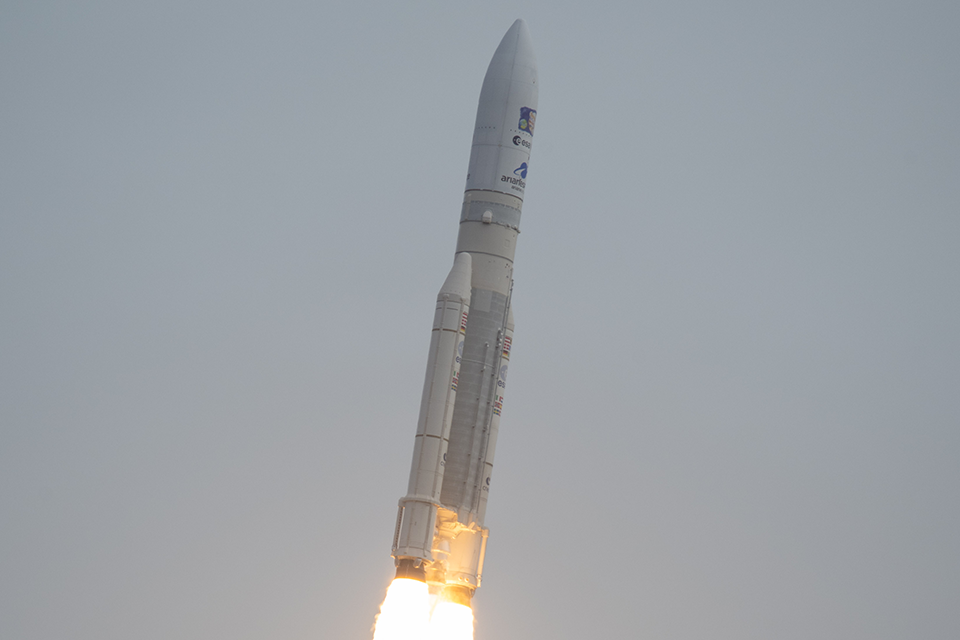
A new era of icy moons exploration is underway following the successful launch of Juice, the Jupiter Icy Moons Explorer. The European Space Agency-led mission blasted off from Kourou, French Guiana atop an Ariane 5 rocket on Friday, April 14 at 8:14 a.m. EDT (12:14 UTC).

Juice will explore Jupiter’s moons Europa, Ganymede, and Callisto, all three of which may harbor subsurface oceans. The mission will investigate whether conditions on these moons may be suitable for past or present life. The results will teach us what to expect on similar icy worlds orbiting distant exoplanets.

Juice Ganymede flyby
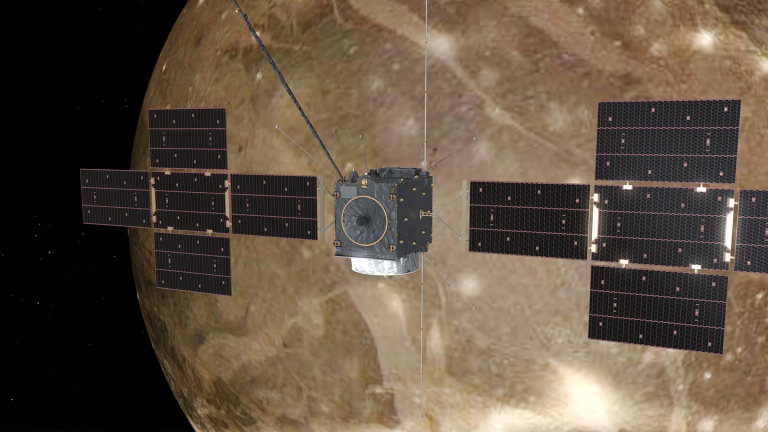
JUICE GANYMEDE FLYBY Juice, the Jupiter Icy Moons Explorer, flies past Jupiter’s moon Ganymede in this artist’s concept by the European Space Agency.Image: ESA / ATG Medialab

“Today the Juice mission embarks on its journey to explore Jupiter’s icy moons,” said Bill Nye, CEO of The Planetary Society. “ESA’s engineers and scientists will bring us discoveries at Ganymede, Europa, and Callisto, igniting the curiosity of people on Earth. Juice will unlock the secrets of these distant worlds — potentially revealing subsurface oceans and expanding our understanding of habitable environments beyond Earth.”

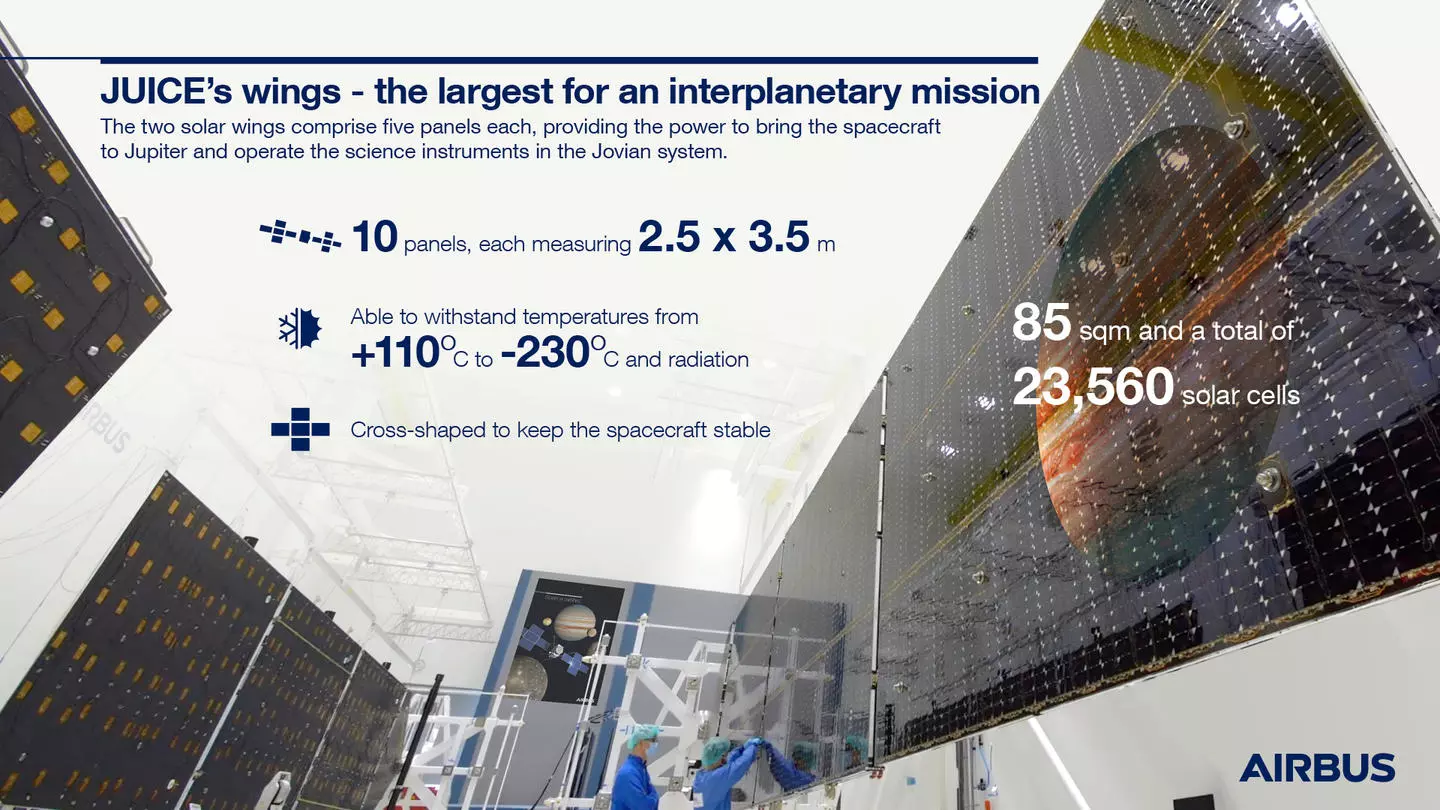
Juice successfully separated from its Ariane 5 rocket about half an hour after liftoff. Roughly an hour and twenty minutes into flight, the spacecraft deployed its dual solar arrays, which have a combined collecting area of 85 square meters (915 square feet). The solar panels will be critical for providing power at Jupiter, where sunlight is 25 times weaker than at Earth.

The spacecraft will unpack more key equipment during the next two-and-a-half weeks, including antennas, probes, and magnetometer booms.

Juice now begins an arduous eight-year journey to Jupiter, during which it will use the gravity of multiple worlds to tweak its orbit. The spacecraft will perform the first-ever Earth-Moon dual flyby in August 2024, followed by a Venus flyby and then two more Earth flybys before reaching Jupiter in 2031.

In orbit around the gas giant, Juice will perform a combined 35 flybys of Europa, Ganymede, and Callisto, studying the worlds with 10 powerful science instruments, a radiation monitor, and a radio experiment. At Europa, Juice will look for elements essential to life as we know it near cracks where the moon’s subsurface ocean may be seeping onto the surface. Farther out at Callisto, Juice will use radar and gravity field data to narrow down some basic facts about the moon’s possible subsurface ocean.

The spacecraft will slip into orbit around Ganymede in December 2034, marking the first time a spacecraft has orbited a moon other than our own. There, it will scan Ganymede’s surface for biosignatures and study how deep the moon’s ocean lies. Ganymede is the only known moon with a magnetic field, which creates auroras visible to the Hubble Space Telescope. Juice will study how this field operates within Jupiter’s larger magnetic field.

The mission will end in 2035 when the spacecraft is intentionally crashed into Ganymede. For more, read our full mission preview here.

To Jupiter And Beyond: Airbus-Built JUICE Begins Its Epic Odyssey

0

Around 13:33 UTC today, JUICE (JUpiter ICy moons Explorer) spread its wings following the Ariane 5 successful lift-off an hour earlier. The ESA spacecraft operations team at the European Space Operations Centre (ESOC) in Darmstadt, Germany, took control of the spacecraft and confirmed reception of the first telemetry and the smooth deployment of the solar arrays. The Airbus-built JUICE is now officially on its way to Jupiter! 

Additional equipment and instruments will be progressively turned on in the next few days and the operations team will run tests to make sure they are all fully operational.

“After years of work, watching this launch live from our sites across Europe was a very emotional moment for all those who have worked on this incredible mission. This is the best of Europe coming together!” said Michael Schöllhorn, CEO Airbus Defence and Space from Kourou. “I’m eager to see the next big thing coming from the European space community.”

JUICE: a European shared success

Bringing together 80 partners across 23 countries and harnessing the brainpower of 2,000+ people, Airbus has designed and built JUICE under contract to the European Space Agency (ESA).

On its over 5 billion kilometre long journey, the 6.2 tonne JUICE spacecraft will make a series of flybys of Callisto, Ganymede and Europa, collecting data to try to understand whether there is any possibility that the moons and their subsurface oceans could host microbial life. Carrying 10 state-of-the-art scientific instruments, including cameras, spectrometers, an ice-penetrating radar, an altimeter, a radio-science experiment, a particle package and various magnetic and electric field sensors, the JUICE spacecraft will complete a unique 4-year tour of the Jupiter system.

JUICE is due to arrive at Jupiter in 2031 after a series of gravity slingshots from Venus and Earth to propel it on its way.

Airbus has a long legacy of supporting the European Space Agency with all its interplanetary missions. These missions present unique challenges which require pushing space technologies to the limit, and JUICE is no exception, with the largest solar arrays ever built for a science mission.

Your contact

Ralph Heinrich
Head of External Communications – Airbus Space Systems
Phone: +49 171 304 9751
[email protected]

Jeremy Close
External Communications – Airbus Space Systems, UK
Phone: +44 776 653 6572
[email protected]

Guilhem Boltz
External Communications – Airbus Space Systems, France
Phone: +33 6 34 78 14 08
[email protected]

Francisco Lechón
External Communications – Airbus Space Systems, Spain
Phone: +34 630 196 993
[email protected]

Jupiter Icy Moon Explorer Begins Journey To Discover New Worlds

0
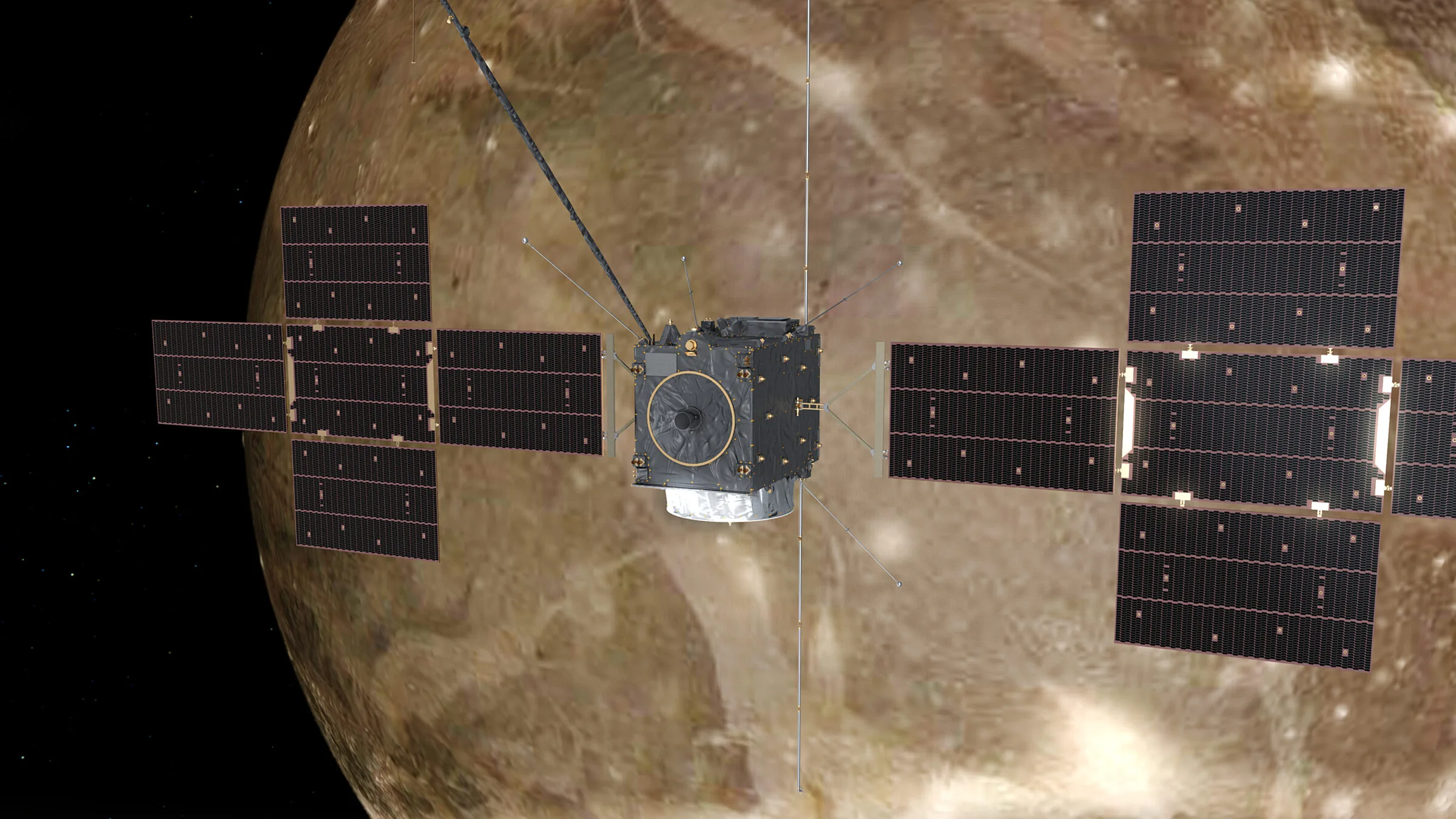
Artist’s impression: JUICE in the Jupiter system. Credit: ESA.

The Jupiter icy moons mission (JUICE) has taken off on its journey to study Jupiter, our largest planet, and investigate whether some of its icy moons are home to conditions that could support life.

Funded by the UK Space Agency, the UK leads on one of the 10 science instruments on board the European Space Agency’s Jupiter Icy Moons Explorer (JUICE) and has contributed to the development of two more.

Blasting off from Kourou in French Guiana at 1:14pm BST on Friday 14 April, JUICE will spend eight years travelling to the Jupiter system. On the way, it will perform fly-bys of Earth and Venus, using the gravitational fields of the planets to generate enough speed to reach Jupiter. One of these will be the first ever lunar-Earth gravity assist manoeuvre.

Secretary of State for Science, Innovation and Technology, Michelle Donelan, said:

The UK Space Agency has invested around £9 million in the JUICE mission to explore Jupiter and its moons. UK tech on the spacecraft illustrates how our world class universities and research institutions are unlocking deep space exploration.

I want the UK’s space sector to continue thriving and encourage STEM learning for the next generation. It’s important that we push the boundaries of science, innovation and technology across the country to support the jobs of the future.

On arrival in 2031, JUICE will circle Jupiter and fly past moons Ganymede, Europa and Callisto, making observations and taking measurements, studying the Jovian system as an archetype for gas giants elsewhere in the universe.

Finally in December 2034, JUICE will transfer into orbit around Ganymede, becoming the first spacecraft ever to orbit a moon other than Earth’s. While up close and personal with Ganymede, the mission will investigate the giant ocean that scientists believe hides under its icy crust, seeking evidence of habitability.

Dr Caroline Harper, Head of Space Science at the UK Space Agency, said:

The launch of JUICE marks years of hard work and collaboration by scientists, engineers and space agencies all over the world, but the journey is far from over.

We look forward to following the spacecraft as it makes its eight-year trip to Jupiter and then as it studies the planet and its moons, using specialised UK-developed science instruments.

We have a large community of research experts in the UK who are eagerly awaiting the data that JUICE will provide. With this information we hope to discover more about the nature of gas giants in space, and their icy moons, bringing us another step closer to understanding the evolution of the Universe.

Ariane 5 rocket launching
JUICE lifting off. Credit: ESA – M. Pédoussaut

The UK Space Agency invested £9 million into the JUICE science payload, by supporting three critical instruments on board, which are:

  • J-MAG (UK-led magnetometer) – Development led by Imperial College London with radiation-hardness and mechanical design contributed by the University of Leicester.
  • JANUS (Italian-led optical camera system) – Imaging sensors developed by Teledyne-e2v in the UK, then tested, calibrated and characterised by Open University.
  • PEP (Swedish-led particle environment package) – Solid-state detectors provided by University College London and radiation design for instrument suite contributed by Aberystwyth University.

Principal Investigator for the J-MAG instrument at Imperial College London, Professor Michele Dougherty, has been involved in JUICE since well before it was selected by ESA in 2014 as the first Large Class mission in its Cosmic Vision Science Programme.

Professor Michele Dougherty, Head of the Department of Physics at Imperial College London, said:

With our instrument’s measurements, we are almost looking inside these worlds. What we’re doing, however, is extremely difficult, as the signals we’re trying to detect are extremely small. It’s like trying to find lots of needles in a haystack, and those needles are changing shape and colour all the time. But we think the results are going to be spectacular.

Space missions are long and slow, so launch only marks the halfway point of this one – because we first started thinking about it 15 years ago, and we’ll be getting the last data in 15 years’ time. But I can’t wait for launch to happen because that’s the next milestone for us – we’ll be on our way to Jupiter.

JUICE is a collaboration between ESA, NASA and the space agencies of Japan and Israel and will consider two key themes from ESA’s Cosmic Vision 2015 – 2025: What are the conditions for planet formation and the emergence of life? And how does the Solar System work?

After taking off on an Ariane 5 launch vehicle from Kourou in French Guiana it is expected to arrive at Jupiter in July 2031 and complete 35 icy moon flybys before arriving at Ganymede – the largest of Jupiter’s moons – by December 2034.

JUICE will spend its eight-year voyage productively; it will pass by Venus to test and calibrate its instruments, gather data and take advantage of the gravity assist to save on fuel. Meanwhile, scientists on the ground will work on finalising software and data modelling in time for arrival at Jupiter.

Chiaki Crews, Research Fellow at the Open University, said:

The JUICE mission aims to answer many exciting questions, including whether the ocean worlds beneath the surfaces of Jupiter’s icy moons could potentially harbour life. One of the many instruments needed to make detailed scientific observations to help answer such questions is a camera.

Our team at the Open University has spent several years testing and optimising a new image sensor for JUICE’s scientific camera, JANUS. A large part of our work was to irradiate test sensors with high doses of radiation, just like it is expected to experience during the JUICE mission lifetime, to check that JANUS will still be able to take images without too much degradation.

We are now very much looking forward to watching the launch, albeit we’ll have to wait patiently for several more years before we’ll see the first images sent back from Jupiter’s moons.

Professor Geraint Jones at University College London’s Mullard Space Science Laboratory, said:

It’s fantastic to see JUICE, carrying the PEP instrument that we contributed to, nearing its launch. We look forward to seeing data from our sensors on the ‘soup’ of ions, electrons and atoms surrounding Jupiter and its moons.

This data will help us, for instance, to understand how particles around Jupiter reach such high energies – energies that could be fatal for an astronaut. We are excited that the mission will shed new light on worlds that could potentially host life.

Professor Emma Bunce, Director of the Institute for Space at the University of Leicester, said:

The JUICE mission represents the next logical step in our exploration of potentially habitable worlds in the outer solar system. The JUICE spacecraft will do that via multiple flybys of Europa, Ganymede and Callisto, and eventually from a dedicated orbit at Ganymede towards the end of the mission.

After many years of hard work from science, engineering, and industry teams, we are so excited that the JUICE mission is finally ready to launch and start its long journey to the Jupiter system. We will patiently await the incredible data that we expect to receive from 2031, and we are confident that it will absolutely be worth the wait!”

Professor Manuel Grande, Head of Solar System Physics at Aberystwyth University’s Department of Physics, said:

The major challenge when visiting the icy moons of Jupiter, in particular Europa, is the extreme radiation environment which would interfere with the spacecraft’s instrumentation and swamp any readings.

The innovative design of the shielding, which was pioneered at Aberystwyth, makes it possible to avoid the effects of radiation on readings and allow for the detection of organic molecules in the neighbourhood of Europa, which is perhaps the most likely site for life in our Solar System after our own Earth.

Daniel Waller, Vice-President at Teledyne e2v, said:

The launch of JUICE with the JANUS optical camera onboard marks a milestone in this important mission. This is our second complementary metal-oxide-semiconductor sensor from our facility in Chelmsford to fly in space in recent months. This sensor will give us sight of both the icy moons and the environment of Jupiter, increasing our understanding of other planets in our solar system.

NRO Exercises Radio Frequency Contract Option With Maxar

0

Maxar Technologies (NYSE:MAXR) (TSX:MAXR), provider of comprehensive space solutions and secure, precise, geospatial intelligence, today announced that Aurora Insight Inc., a company acquired by Maxar in December 2022, has received a Stage II contract extension from the National Reconnaissance Office (NRO) for commercial radio frequency (RF) remote sensing.

Aurora Insight, now part of Maxar’s Earth Intelligence business, was previously awarded the NRO’s Strategic Commercial Enhancements Broad Agency Announcement (BAA) Framework Stage I contract, which focused on the modeling and simulation of its capabilities to support the U.S. government’s current and future commercial RF reconnaissance needs. The Stage II option provides Maxar the opportunity to demonstrate real-world performance of its commercial RF constellation to support U.S. government missions.

Maxar will demonstrate how space-based mapping of the world’s RF environment can enhance and augment existing capabilities. Maxar’s RF measurements span a wide range of frequencies that include LTE, 5G, satellite communications, radars, GPS and other types of signals, and these measurements are being applied to commercial and government use cases. The Stage II award is an important step in getting commercial RF data to U.S. government users.

“We are honored to have the opportunity to demonstrate the value of commercial RF data to support key U.S. government mission needs,” said Tony Frazier, Maxar’s Executive Vice President and General Manager, Public Sector Earth Intelligence. “We are particularly excited to integrate RF capabilities with our industry-leading satellite imagery, 3D data, and analytics.”

Jennifer Alvarez, co-founder and former CEO of Aurora Insight, who now leads Maxar’s RF solutions program, is scheduled to speak on the topic of “Radio Frequency Data – the Soundtrack to a Silent Movie” at the GEOINT 2023 Symposium, taking place May 21-24 in St. Louis, Missouri.

To learn more about Maxar’s RF solutions, visit https://www.maxar.com/products/rf-solutions.

About Maxar

Maxar Technologies (NYSE:MAXR) (TSX:MAXR) is a provider of comprehensive space solutions and secure, precise, geospatial intelligence. We deliver disruptive value to government and commercial customers to help them monitor, understand and navigate our changing planet; deliver global broadband communications; and explore and advance the use of space. Our unique approach combines decades of deep mission understanding and a proven commercial and defense foundation to deploy solutions and deliver insights with unrivaled speed, scale and cost-effectiveness. Maxar’s 4,600 team members in over 20 global locations are inspired to harness the potential of space to help our customers create a better world. Maxar trades on the New York Stock Exchange and Toronto Stock Exchange as MAXR. For more information, visit www.maxar.com.

Forward-Looking Statements

This press release may contain forward-looking statements that reflect management’s current expectations, assumptions and estimates of future performance and economic conditions. Any such forward-looking statements are made in reliance upon the safe harbor provisions of Section 27A of the Securities Act of 1933 and Section 21E of the Securities Exchange Act of 1934. The Company cautions investors that any forward-looking statements are subject to risks and uncertainties that may cause actual results and future trends to differ materially from those matters expressed in or implied by such forward-looking statements, including those included in the Company’s filings with U.S. securities and Canadian regulatory authorities. The Company disclaims any intention or obligation to update or revise any forward-looking statements, whether as a result of new information, future events, or otherwise, other than as may be required under applicable securities law.

Investor Relations Contact:
Jonny Bell
Maxar Investor Relations
1-303-684-5543
[email protected]

Media Contacts:
Brian Wagner
Maxar Communications
1-202-302-8754
[email protected]

Declutter & Organise: Must-Have Spring Cleaning Items for Your Workspace

0

As the spring season rolls around, it’s time to start thinking about decluttering and organizing your workspace. Whether you’re working from home or in an office, having a clean and tidy workspace can help increase productivity and reduce stress. Here are ten recommended items for spring cleaning and organising:

01. Amazon Basics Collapsible Storage Organizer

The Amazon Basics Collapsible Storage Organizer is a versatile storage solution that can help keep your office clutter-free. This organizer is made of durable fabric and features spacious compartments that can be used to store office supplies, paperwork, and more. It can be easily collapsed for storage when not in use, making it a great space-saving option.

BUY ON AMAZON

02. Echogear White Wall Cable Management

Cable clutter can be a major source of frustration in any workspace. The Echogear White Wall Cable Management system is an easy and affordable solution to help keep your cables organized and out of sight. This system includes a cable raceway that can be easily mounted to your wall, allowing you to run cables through it and keep them hidden from view.

BUY ON AMAZON

03. INDRESSME XXXLarge Cotton Rope Basket

A large basket can be a great way to store extra blankets, pillows, or other items that tend to clutter up your workspace. The INDRESSME XXXLarge Cotton Rope Basket is a stylish and functional option that can help keep your workspace tidy. Made of high-quality cotton rope, this basket is durable and can hold a large number of items.

BUY ON AMAZON

04. HBCY Creations 3-Piece Rustic Wooden Desk Organizer

The Rustic Wooden Desk Organizer from HBCY Creations is a great way to keep your desktop clutter-free. This organizer is made of high-quality wood and features multiple compartments that can be used to store pens, notepads, and other office supplies. Its rustic design adds a touch of style to any workspace.

BUY ON AMAZON

05. Adjustable AQQEF Computer Monitor Shelf & Cellphone Organizer

The Adjustable AQQEF Computer Monitor & Cellphone Organizer is a must-have for anyone who wants to keep their workspace tidy and organized. This organizer is made of high-quality plastic to hold your laptop or computer monitor and features compartments that can be used to store pens, pencils, notepads, and even your phone. Its adjustable design allows it to fit on most desks, making it a great option for any workspace.

BUY ON AMAZON

06. KNODEL Waterproof Desk Pad

This desk pad is perfect for protecting your desk from spills and scratches. It’s made of waterproof material, which makes it easy to clean and maintain. Additionally, it comes with a keyboard protector to keep your keyboard clean and free of dust.

BUY ON AMAZON

07. Office Desk Organizer Set

This organizer set is perfect for keeping your desk clutter-free. It is adjustable so you can assemble it to suit your needs; whether rectangular, squarish, combined or apart. It comes with a pencil holder, paperclip holder, and other compartments to keep your office supplies organized and within reach.

BUY ON AMAZON

08. Cable Management Box Organizer

This cable management box is perfect for keeping your cords and cables organized and out of sight. It’s perfect for reducing clutter on your desk and keeping your workspace looking neat and tidy.

BUY ON AMAZON

09. IRIS Letter-Size Portable File Box

Keep your important documents organized and easily accessible with this letter-sized file box. It’s lightweight and portable, making it easy to transport your documents from one place to another.

BUY ON AMAZON

10. Electronics Cleaner Brush & Kit

This brush cleaner kit is perfect for cleaning dust and debris from your phone, keyboard, headset, laptop and other electronics. It has a headphone cleaning pen (folded), screen cleaning spray (push switch), keycap puller, storage case (with a big brush and super fiber cloth), and eyeglasses cloth. It’s designed to reach even the tightest spaces between keys and is easy to use.

BUY ON AMAZON

11. Nicebay Handheld Cordless Vacuum

Keep your workspace clean and tidy with this handheld vacuum. It’s lightweight and easy to use, making it perfect for cleaning up small messes in your office.

BUY ON AMAZON

12. Premium Microfiber Cleaning Cloths

Made of extremely high-quality tightly woven microfiber materials to absorb and remove dust, oil smudges, fingerprints, and dirt. Leaves no scratches, streaks, marks, or lint, perfect for cleaning your laptop screens, mobile phones and other gadgets.

BUY ON AMAZON

Spring is the perfect time to get your office organized and decluttered. With these must-have office items, you can get your workspace looking neat and tidy in no time. Don’t wait any longer to get started on your spring cleaning and organizing!

Source: Cyberpogo

ESA / EU Flight Ticket Opportunities To Test Your New Satellite Technology In Space

0
ESA And The EU Flight Ticket Opportunities To Test Your New Satellite Technology In Space. ESA

The European Commission and the European Space Agency are jointly offering flight ticket opportunities for European companies or organisations to co-fund the launch services to test your new satellite technologies in space.

This Flight Ticket Initiative is designed to give promising technology and service concepts the in-orbit testing needed to reach commercial maturity. Under this scheme, ESA and the EU will co-fund upcoming flights of European launch vehicles for small satellites in a “ready-to-fly” condition.

As a first step, the EU and ESA have now issued a call for Expressions of Interest, open until 15 March 2026. The first of several application cut-off dates will close on 31 May 2023 at 1800 CET and will be followed by a separate procurement process in open competition.

At ESA, the Flight Ticket Initiative is administered under its Boost! programme. Through Boost!, ESA selects and co-funds the development and demonstration of innovative European space transportation services.

By Keith Cowing
Source SpaceRef