
Home Blog Page 72

NASA Study Helps Explain Limit-Breaking Ultra-Luminous X-Ray Sources

0
In this illustration of an ultra-luminous X-ray source, two rivers of hot gas are pulled onto the surface of a neutron star. Strong magnetic fields, shown in green, may change the interaction of matter and light near neutron stars’ surface, increasing how bright they can become. Credit: NASA/JPL-Caltech

These objects are more than 100 times brighter than they should be. Observations by the agency’s NuSTAR X-ray telescope support a possible solution to this puzzle.

Exotic cosmic objects known as ultra-luminous X-ray sources produce about 10 million times more energy than the Sun. They’re so radiant, in fact, that they appear to surpass a physical boundary called the Eddington limit, which puts a cap on how bright an object can be based on its mass. Ultra-luminous X-ray sources (ULXs, for short) regularly exceed this limit by 100 to 500 times, leaving scientists puzzled.

In a recent study published in The Astrophysical Journal, researchers report a first-of-its-kind measurement of a ULX taken with NASA’s Nuclear Spectroscopic Telescope Array (NuSTAR). The finding confirms that these light emitters are indeed as bright as they seem and that they break the Eddington limit. A hypothesis suggests this limit-breaking brightness is due to the ULX’s strong magnetic fields. But scientists can test this idea only through observations: Up to billions of times more powerful than the strongest magnets ever made on Earth, ULX magnetic fields can’t be reproduced in a lab.

Breaking the Limit

Particles of light, called photons, exert a small push on objects they encounter. If a cosmic object like a ULX emits enough light per square foot, the outward push of photons can overwhelm the inward pull of the object’s gravity. When this happens, an object has reached the Eddington limit, and the light from the object will theoretically push away any gas or other material falling toward it.

That switch – when light overwhelms gravity – is significant, because material falling onto a ULX is the source of its brightness. This is something scientists frequently observe in black holes: When their strong gravity pulls in stray gas and dust, those materials can heat up and radiate light. Scientists used to think ULXs must be black holes surrounded by bright coffers of gas. But in 2014, NuSTAR data revealed that a ULX by the name of M82 X-2 is actually a less-massive object called a neutron star. Like black holes, neutron stars form when a star dies and collapses, packing more than the mass of our Sun into an area not much bigger than a mid-size city.

This incredible density also creates a gravitational pull at the neutron star’s surface about 100 trillion times stronger than the gravitational pull on Earth’s surface. Gas and other material dragged in by that gravity accelerate to millions of miles per hour, releasing tremendous energy when they hit the neutron star’s surface. (A marshmallow dropped on the surface of a neutron star would hit it with the energy of a thousand hydrogen bombs.) This produces the high-energy X-ray light NuSTAR detects.

The recent study targeted the same ULX at the heart of the 2014 discovery and found that, like a cosmic parasite, M82 X-2 is stealing about 9 billion trillion tons of material per year from a neighboring star, or about 1 1/2 times the mass of Earth. Knowing the amount of material hitting the neutron star’s surface, scientists can estimate how bright the ULX should be, and their calculations match independent measurements of its brightness. The work confirmed M82 X-2 exceeds the Eddington limit.

No Illusions

If scientists can confirm of the brightness of more ULXs, they may put to bed a lingering hypothesis that would explain the apparent brightness of these objects without ULXs having to exceed the Eddington limit. That hypothesis, based on observations of other cosmic objects, posits that strong winds form a hollow cone around the light source, concentrating most of the emission in one direction. If pointed directly at Earth, the cone could create a sort of optical illusion, making it falsely appear as though the ULX were exceeding the brightness limit.

Even if that’s the case for some ULXs, an alternative hypothesis supported by the new study suggests that strong magnetic fields distort the roughly spherical atoms into elongated, stringy shapes. This would reduce the photons’ ability to push atoms away, ultimately increasing an object’s maximum possible brightness.

“These observations let us see the effects of these incredibly strong magnetic fields that we could never reproduce on Earth with current technology,” said Matteo Bachetti, an astrophysicist with the National Institute of Astrophysics’ Cagliari Observatory in Italy and lead author on the recent study. “This is the beauty of astronomy. Observing the sky, we expand our ability to investigate how the universe works. On the other hand, we cannot really set up experiments to get quick answers; we have to wait for the universe to show us its secrets.”

More About the Mission

A Small Explorer mission led by Caltech and managed by NASA’s Jet Propulsion Laboratory in Southern California for the agency’s Science Mission Directorate in Washington, NuSTAR was developed in partnership with the Danish Technical University and the Italian Space Agency (ASI). The spacecraft was built by Orbital Sciences Corp. in Dulles, Virginia. NuSTAR’s mission operations center is at the University of California, Berkeley, and the official data archive is at NASA’s High Energy Astrophysics Science Archive Research Center at NASA’s Goddard Space Flight Center. ASI provides the mission’s ground station and a mirror data archive. Caltech manages JPL for NASA.

For more information about the NuSTAR mission, visit: https://www.nustar.caltech.edu/

By Keith Cowing
Source SpaceRef

Scientists Use NASA Satellite Data To Determine Belize Coral Reef Risk

0
Researchers at JPL, alongside colleagues in Belize, used 20 years of data from MODIS, an instrument on NASA’s Aqua satellite, to assess risk to Belize’s coral reefs due to human activity and climate change. MODIS captured this image of the Yucatán Peninsula, including Belize, in February 2022. Credits: NASA

Using two decades of NASA satellite measurements stored in the cloud, scientists recently assessed the vulnerability of Belize’s renowned coral reefs to bleaching and collapse. The findings could help management authorities protect the reefs from human impacts such as development, overfishing, pollution, and climate change.

The 185-mile-long (298-kilometer-long) barrier reef system off the coast of Belize encompasses vibrant marine environments that support thousands of animal and plant species and drive the Central American country’s largest industry, tourism. The system is one of about 1,200 UNESCO World Heritage sites around the world.

In a study published in Frontiers in Remote Sensing, the scientists ranked 24 marine protected areas off the Belize coast based on the risks coral face from murky water and rising temperatures. The study also outlined how researchers at NASA’s Jet Propulsion Laboratory in Southern California and counterparts in Belize used free, cloud-based data on Google Earth Engine in their analysis.

“We depend on the reef for so many things, so conserving these resources is important,” said Emil Cherrington, a native Belizean and co-author of the paper. He is a research scientist at the University of Alabama in Huntsville and a co-investigator on the Belize Sustainable Development Goal project, a NASA effort to use Earth observation data to protect the country’s marine ecosystems. “Studies like this are giving the government of Belize more tools for conserving the resources that the country has.”

Easy to Use, Easy to Understand

The hard skeletons of stony coral form the structure of the barrier reef, which keeps Belize’s shallow coastal waters calm and enables marine life to thrive there. Coral needs clear water and consistent temperatures to grow. Changes in both factors can affect the survival of the symbiotic algae that live in the coral and provide food. When the algae leave or die, the coral lose their color, a phenomenon called bleaching. Coral can survive under these conditions, but the changes can put it at greater risk of mortality.

To gather data on water clarity and surface temperature over large areas, researchers turned to the Moderate Resolution Imaging Spectroradiometer (MODIS), which was developed at NASA’s Goddard Space Flight Center in Greenbelt, Maryland, and launched in 2002 as one of several instruments aboard the agency’s Aqua satellite. In addition to being available from NASA, MODIS images and data sets are accessible on Google Earth Engine.

Analyzing MODIS imagery collected from 2002 to 2022, the researchers developed a vulnerability index that characterizes the risk to coral in the marine environments that Belize is managing in order to protect biodiversity. The team examined sea surface temperatures in each protected area and assigned a number from 1 to 6 based on how low or high the averages were relative to the norms. They did the same for water clarity. The 1 to 6 ratings were then combined to get the coral index, from 2 to 12. Higher numbers signify greater risk.

Port Honduras Marine Reserve, a 156-square-mile (40,469-hectare) protected area in southern Belize, showed the highest coral vulnerability score: 10 out of 12. Based on the index, the study also flagged Swallow Caye Wildlife Sanctuary, Sapodilla Cayes Marine Reserve, and Corozal Bay Wildlife Sanctuary as areas for concern.

All the protected areas in the study are included in the Belize Coastal Zone Management Plan, a framework to guide Belize’s government on how to support the sustainable use of the country’s coastal areas. The country’s Coastal Zone Management Authority & Institute, which is tasked with implementing and monitoring policies that govern Belize’s coastal waters, created the last plan in 2016. The new paper, along with other Belize-focused research sponsored through NASA’s Earth Applied Sciences program, will inform the next plan, which is currently being revised, said Samir Rosado, a co-author of the study and a coastal planner at the management authority.

“A lot of our cultural identity arises from the marine areas,” Rosado said. “It’s a measure of pride – wherever Belizeans go, people know the coral reefs.”

What’s Next

The vulnerability index could be used for other reef systems around the world, and it could be modified to incorporate additional water variables such as acidity, said Ileana Callejas, the paper’s lead author and a graduate student at the University of California, Los Angeles. Rising ocean acidity – a consequence of climate change resulting from greater concentrations of dissolved carbon dioxide in the water – threatens coral health.

“We were trying to make the data and our approach as accessible as possible,” said Callejas, who started the research during an internship at JPL. “Our main purpose was to make a toolkit that would be easy to use, that would produce an index that was easy to understand, and that could be used to see which marine protected areas may need closer attention.”

While the historical record and traditional field testing by boat have given coastal management authorities a sense of the most vulnerable areas, satellites can shine light on other spots that may be less accessible or more costly to reach, said Nicole Auil Gomez, a paper co-author and director of the Wildlife Conservation Society’s Belize Country Program.

“It’s going to become more useful in the future in terms of telling us more about areas we already monitor,” she said. “And for areas we don’t monitor, we have some tools now to be able to learn more.”

By Keith Cowing
Source SpaceRef

Untangling The Ocean Biological Carbon Pump

0
Biological Pump and Carbon Exchange Processes (BICEP) project. ESA

They may be microscopic, but their ability to sequester carbon is phenomenal. We are talking phytoplankton – and scientists working on a project funded by ESA are assessing different aspects of the role that these tiny plants play in the ocean carbon cycle to better understand climate processes.

Our oceans play a fundamental role in Earth’s carbon cycle, and therefore in regulating our climate.

Phytoplankton are at the heart of the biological component of the ocean carbon cycle. These tiny marine plants transfer vast amounts of organic carbon from the surface waters to the deep ocean – a process called the ocean biological carbon pump.

Through photosynthesis, phytoplankton absorb carbon in the ocean surface waters and release oxygen. They absorb as much carbon as all the vegetation on land, despite their biomass being several orders of magnitude smaller.

Phytoplankton maintain this high production by turning over much faster than plants on land – and when they die, they sink down into deeper waters, taking the carbon with them.

Shubha Sathyendranath at Plymouth Marine Laboratory in the UK leads the Biological Pump and Carbon Exchange Processes (BICEP) project – a project funded by ESA’s Science for Society Programme.

Dr Sathyendranath explains, “The role that phytoplankton play in the ocean carbon cycle cannot be overstated. They are tiny, but versatile and dynamic, with a huge collective impact. Through BICEP, we are gaining greater insight into the complexities of the processes involved and their magnitude, and we rely on data from satellites, such as ocean colour data, to do this.”

Oceans cover two-thirds of the planet and given phytoplankton’s rapid life cycle, it is impossible to get a global view of what is going on from field observations alone.

Phytoplankton change the colour of the surface waters, which can be observed by satellites such as the Copernicus Sentinel-2 and Sentinel-3 missions.

Dr Sathyendranath adds, “Using satellite datasets from ESA’s Climate Change Initiative, we have been able to generate satellite-based products of different pools and fluxes of biological carbon in the surface ocean.

“These products include phytoplankton primary production, phytoplankton carbon, particulate organic carbon, dissolved organic carbon, particulate inorganic carbon and export production.”

While these products may sound a little complicated, together they increase the scientific understanding of the ocean biological carbon pump and its processes and interactions with the Earth system. In turn, this helps us better understand the processes controlling our delicate climate.

Taking the project a step even further, these data products have been turned into a ‘data cube’. A data cube is a simple way of organising and viewing data that can help to yield insights into patterns and trends that might not be immediately apparent otherwise.

The BICEP time series currently runs from 1998 to 2020, but it is being extended and kept up-to-date.

By Keith Cowing
Source SpaceRef

Webb Reveals Never-Before-Seen Details In Cassiopeia A

0
Cassiopeia A (Cas A) is a supernova remnant located about 11,000 light-years from Earth in the constellation Cassiopeia. It spans approximately 10 light-years. This new image uses data from Webb’s Mid-Infrared Instrument (MIRI) to reveal Cas A in a new light. Credits: NASA, ESA, CSA, D. D. Milisavljevic (Purdue), T. Temim (Princeton), I. De Looze (Ghent University). Image Processing: J. DePasquale (STScI).

The explosion of a star is a dramatic event, but the remains the star leaves behind can be even more dramatic.

A new mid-infrared image from NASA’s James Webb Space Telescope provides one stunning example. It shows the supernova remnant Cassiopeia A (Cas A), created by a stellar explosion 340 years ago from Earth’s perspective.. Cas A is the youngest known remnant from an exploding, massive star in our galaxy, which makes it a unique opportunity to learn more about how such supernovae occur.

“Cas A represents our best opportunity to look at the debris field of an exploded star and run a kind of stellar autopsy to understand what type of star was there beforehand and how that star exploded,” said Danny Milisavljevic of Purdue University in West Lafayette, Indiana, principal investigator of the Webb program that captured these observations.

“Compared to previous infrared images, we see incredible detail that we haven’t been able to access before,” added Tea Temim of Princeton University in Princeton, New Jersey, a co-investigator on the program.

Cassiopeia A is a prototypical supernova remnant that has been widely studied by a number of ground-based and space-based observatories, including NASA’s Chandra X-ray Observatory. The multi-wavelength observations can be combined to provide scientists with a more comprehensive understanding of the remnant.

Dissecting the Image

The striking colors of the new Cas A image, in which infrared light is translated into visible-light wavelengths, hold a wealth of scientific information the team is just beginning to tease out. On the bubble’s exterior, particularly at the top and left, lie curtains of material appearing orange and red due to emission from warm dust. This marks where ejected material from the exploded star is ramming into surrounding circumstellar gas and dust.

Interior to this outer shell lie mottled filaments of bright pink studded with clumps and knots. This represents material from the star itself, which is shining due to a mix of various heavy elements, such as oxygen, argon, and neon, as well as dust emission.

Cassiopeia A (Cas A) is a supernova remnant located about 11,000 light-years from Earth in the constellation Cassiopeia. It spans approximately 10 light-years. This new image uses data from Webb’s Mid-Infrared Instrument (MIRI) to reveal Cas A in a new light. Credits: NASA, ESA, CSA, D. D. Milisavljevic (Purdue), T. Temim (Princeton), I. De Looze (Ghent University). Image Processing: J. DePasquale (STScI).

“We’re still trying to disentangle all these sources of emission,” said Ilse De Looze of Ghent University in Belgium, another co-investigator on the program.

The stellar material can also be seen as fainter wisps near the cavity’s interior.

Perhaps most prominently, a loop represented in green extends across the right side of the central cavity. “We’ve nicknamed it the Green Monster in honor of Fenway Park in Boston. If you look closely, you’ll notice that it’s pockmarked with what look like mini-bubbles,” said Milisavljevic. “The shape and complexity are unexpected and challenging to understand.”

Origins of Cosmic Dust – and Us

Among the science questions that Cas A may help answer is: Where does cosmic dust come from? Observations have found that even very young galaxies in the early universe are suffused with massive quantities of dust. It’s difficult to explain the origins of this dust without invoking supernovae, which spew large quantities of heavy elements (the building blocks of dust) across space.

However, existing observations of supernovae have been unable to conclusively explain the amount of dust we see in those early galaxies. By studying Cas A with Webb, astronomers hope to gain a better understanding of its dust content, which can help inform our understanding of where the building blocks of planets and ourselves are created.

“In Cas A, we can spatially resolve regions that have different gas compositions and look at what types of dust were formed in those regions,” explained Temim.

Supernovae like the one that formed Cas A are crucial for life as we know it. They spread elements like the calcium we find in our bones and the iron in our blood across interstellar space, seeding new generations of stars and planets.

“By understanding the process of exploding stars, we’re reading our own origin story,” said Milisavljevic. “I’m going to spend the rest of my career trying to understand what’s in this data set.”

The Cas A remnant spans about 10 light-years and is located 11,000 light-years away in the constellation Cassiopeia.

Larger image

By Keith Cowing
Source SpaceRef
Swiss Measurement Instruments On The Way To Jupiter In Search For Potential Life

0

Is there a chance that other life exists in our solar system? A new space mission wants to explore this question, among other things with measuring instruments from Switzerland.

The European Space Agency’s Juice space mission is scheduled to launch on 13 April to explore Jupiter, the largest planet in our solar system and three of its more than 80 moons. Juice will carry 10 state-of-the-art instruments, comprising the most powerful remote sensing and geophysical payloads ever flown to the outer solar system. Its main mission will be to explore the huge planet’s three largest icy moons, in the hope of determining whether life is possible under their icy crusts.

Swiss instruments on board

The University of Bern is contributing the NIM mass spectrometer to the Juice mission and is involved in two other instruments: the Submillimetre Wave Instrument (SWI) and the GALA laser altimeter. All three projects are the result of over a decade of research and development in the Swiss capital.

Studying the particles in Jupiter’s icy moons’ atmosphere

The Neutral Ion Mass Spectrometer (NIM) has been developed and built at the Physics Institute of the University of Bern under the direction of Peter Wurz. NIM will study the chemical and isotopic composition and distribution of particles in the atmospheres of Jupiter’s icy moons as well as the physical parameters of these atmospheres, and is part of the larger Particle Environment Package.

Two additional contributions

In addition to NIM, two other instruments with Bernese participation will be on board Juice. Bernese researchers have developed a module for the GALA altimeter, which will study the topography of Jupiter’s moon Ganymede. In addition, the University of Bern has developed the optics and calibration unit for the SWI, which will measure Jupiter’s stratosphere and the atmospheres and surfaces of Jupiter’s icy moons.

Looking for life under the thick ice layer

With the upcoming mission, space researchers want to study the moons Ganymede, Callisto and Europa. The average temperature on the surface of the icy moons is below minus 140 degrees Celsius. Previous missions to Jupiter suggest that there are oceans under the thick ice layer. And where there are oceans, life is theoretically possible. During its roughly eight-year journey to Jupiter, Juice will complete flybys of Venus, Earth and the Earth-Moon system.

Overview of the long journey to Jupiter for ESA’s space mission «Juice».
European Space Agency

Long tradition of space missions

Switzerland, and the University of Bern in particular, has a long tradition in space missions and already played an important role in the first moon landing in 1969. When the second man, Buzz Aldrin, stepped out of the lunar module on 21 July 1969, the first thing he did was to unfurl the Bernese solar wind sail and plant it into the ground on the moon, even before the American flag. With CHEOPS, the University of Bern even shares responsibility with ESA for a whole mission.

Originally published at SwissTech

Source: Cyberpogo

Hubble Sees Possible Runaway Black Hole Creating A Trail Of Stars

0

SUMMARY

A BIZARRE 200,000-LIGHT-YEAR-LONG BRIDGE LINKS A GALAXY TO ITS ESCAPING BLACK HOLE

The universe is so capricious that even the slightest things that might go unnoticed could have profound implications. That’s what happened to Yale astronomer Pieter van Dokkum when he was looking through Hubble Space Telescope images and noticed a suspected blemish that looked like a scratch on photographic film. For Hubble’s electronic cameras, cosmic rays skimming along the detector look like “scratches.” But once spectroscopy was done on the oddball streak van Dokkum realized it was really a 200,000-light-year-long chain of young blue stars located over halfway across the universe! van Dokkum and his colleagues believe that it stretches between a runaway monster back hole and the galaxy it was ejected from. The black hole must be compressing gas along its wake, which condenses to form stars. Nothing like it has ever been seen anywhere else in the universe before.

Runaway Supermassive Black Hole Illustration

FULL ARTICLE

There’s an invisible monster on the loose, barreling through intergalactic space so fast that if it were in our solar system, it could travel from Earth to the Moon in 14 minutes. This supermassive black hole, weighing as much as 20 million Suns, has left behind a never-before-seen 200,000-light-year-long “contrail” of newborn stars, twice the diameter of our Milky Way galaxy. It’s likely the result of a rare, bizarre game of galactic billiards among three massive black holes.

Rather than gobbling up stars ahead of it, like a cosmic Pac-Man, the speedy black hole is plowing into gas in front of it to trigger new star formation along a narrow corridor. The black hole is streaking too fast to take time for a snack. Nothing like it has ever been seen before, but it was captured accidentally by NASA’s Hubble Space Telescope.

“We think we’re seeing a wake behind the black hole where the gas cools and is able to form stars. So, we’re looking at star formation trailing the black hole,” said Pieter van Dokkum of Yale University in New Haven, Connecticut. “What we’re seeing is the aftermath. Like the wake behind a ship we’re seeing the wake behind the black hole.” The trail must have lots of new stars, given that it is almost half as bright as the host galaxy it is linked to.

The black hole lies at one end of the column, which stretches back to its parent galaxy. There is a remarkably bright knot of ionized oxygen at the outermost tip of the column. Researchers believe gas is probably being shocked and heated from the motion of the black hole hitting the gas, or it could be radiation from an accretion disk around the black hole. “Gas in front of it gets shocked because of this supersonic, very high-velocity impact of the black hole moving through the gas. How it works exactly is not really known,” said van Dokkum.

“This is pure serendipity that we stumbled across it,” van Dokkum added. He was looking for globular star clusters in a nearby dwarf galaxy. “I was just scanning through the Hubble image and then I noticed that we have a little streak. I immediately thought, ‘oh, a cosmic ray hitting the camera detector and causing a linear imaging artifact.’ When we eliminated cosmic rays we realized it was still there. It didn’t look like anything we’ve seen before.” 

Because it was so weird, van Dokkum and his team did follow-up spectroscopy with the W. M. Keck Observatories in Hawaii. He describes the star trail as “quite astonishing, very, very bright and very unusual.” This led to the conclusion that he was looking at the aftermath of a black hole flying through a halo of gas surrounding the host galaxy.

This intergalactic skyrocket is likely the result of multiple collisions of supermassive black holes. Astronomers suspect the first two galaxies merged perhaps 50 million years ago. That brought together two supermassive black holes at their centers. They whirled around each other as a binary black hole.

Then another galaxy came along with its own supermassive black hole. This follows the old idiom: “two’s company and three’s a crowd.” The three black holes mixing it up led to a chaotic and unstable configuration. One of the black holes robbed momentum from the other two black holes and got thrown out of the host galaxy. The original binary may have remained intact, or the new interloper black hole may have replaced one of the two that were in the original binary, and kicked out the previous companion.

When the single black hole took off in one direction, the binary black holes shot off in the opposite direction. There is a feature seen on the opposite side of the host galaxy that might be the runaway binary black hole. Circumstantial evidence for this is that there is no sign of an active black hole remaining at the galaxy’s core. The next step is to do follow-up observations with NASA’s James Webb Space Telescope and the Chandra X-ray Observatory to confirm the black hole explanation.

NASA’s upcoming Nancy Grace Roman Space Telescope will have a wide-angle view of the universe with Hubble’s exquisite resolution. As a survey telescope, the Roman observations might find more of these rare and improbable “star streaks” elsewhere in the universe. This may require machine learning using algorithms that are very good at finding specific weird shapes in a sea of other astronomical data, according to van Dokkum. 

The research paper will be published on April 6 in The Astrophysical Journal Letters.

The Hubble Space Telescope is a project of international cooperation between NASA and ESA. NASA’s Goddard Space Flight Center in Greenbelt, Maryland, manages the telescope. The Space Telescope Science Institute (STScI) in Baltimore conducts Hubble science operations. STScI is operated for NASA by the Association of Universities for Research in Astronomy, in Washington, D.C.

ABOUT THIS RELEASE

Credits

RELEASE: NASA, ESA, STScI

MEDIA CONTACT:

Ray Villard
Space Telescope Science Institute, Baltimore, Maryland

SCIENCE CONTACT:

Pieter van Dokkum
Yale University, New Haven, Connecticut

Imad Pasha
Yale University, New Haven, Connecticut

Juice Launch And Mission Preview: What To Expect

0
The European Space Agency is preparing to launch a mission to uncover the secrets of Jupiter’s icy moons.

Juice, the Jupiter Icy Moons Explorer, is currently scheduled to lift off on Thursday, April 13 at 8:15 a.m. EDT (12:15 UTC).

Juice will try to determine if conditions are right for life on the moons Europa, Ganymede, and Callisto, all three of which are believed to harbor subsurface oceans. The answers will guide future explorations of these moons and tell us what conditions we might expect to find on moons orbiting gas giants in other star systems.

The spacecraft won’t arrive at Jupiter until 2031. Orbiting the giant planet, Juice will make repeated flybys of Jupiter’s icy inner moons before settling into orbit around Ganymede in late 2034. Larger than Mercury and the dwarf planet Pluto, Ganymede is the only moon in our Solar System that generates its own magnetic field. Juice will explore the habitability of this fascinating world for nine months before intentionally crashing into its surface, ending the mission.

Is it JUICE or Juice?

Juice was originally JUICE, a complicated acronym for JUpiter ICy moons Explorer. ESA has since simplified the name to Juice, the Jupiter Icy Moons Explorer.

Juice Ganymede flyby
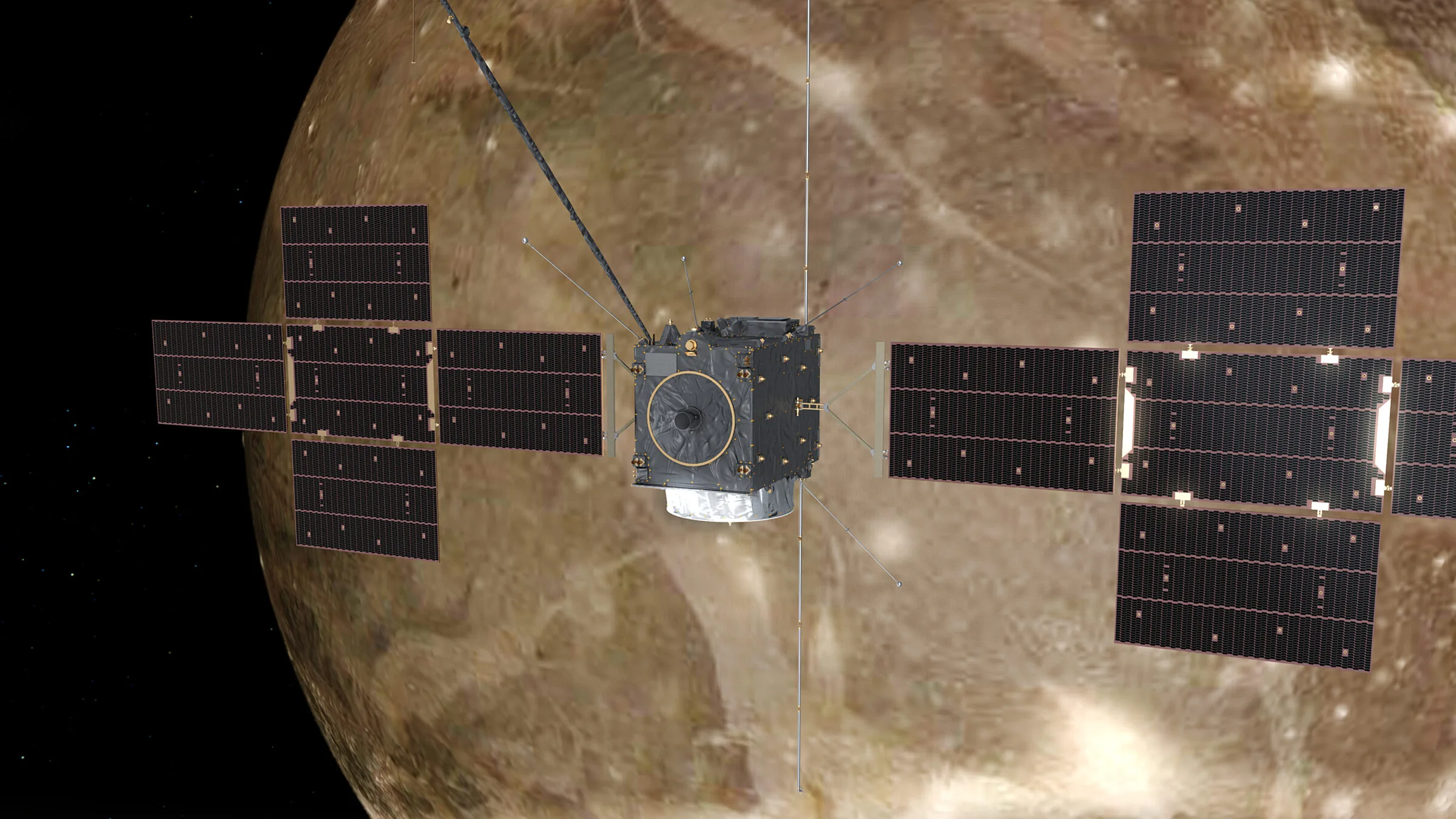
JUICE GANYMEDE FLYBY Juice, the Jupiter Icy Moons Explorer, flies past Jupiter’s moon Ganymede in this artist’s concept by the European Space Agency.Image: ESA / ATG Medialab

Launch

Juice is scheduled to blast off from ESA’s Spaceport in Kourou, French Guiana on April 13, 2023. Its ride to space is the Ariane 5 rocket, which has launched numerous planetary exploration missions over the years including the James Webb Space Telescope. This will be the final ESA mission to launch on an Ariane 5; the Ariane 6 is scheduled to debut later this year.

The Ariane 5’s upper stage will release Juice 28 minutes after liftoff. The spacecraft’s first milestone comes at about 50 minutes into the mission, when its solar arrays will deploy and start feeding power to the vehicle. More deployments of the spacecraft’s antennas, probes, and magnetometer booms will occur within the mission’s first 17 days.

Getting to Jupiter

Juice will use the gravity of multiple worlds to tweak its trajectory and put it on course for Jupiter.

After launch, Juice will orbit the Sun roughly on the same track as Earth. In August 2024, it will perform the first-ever lunar-Earth gravity assist, first flying past the Moon and then Earth one-and-a-half days later. (If Juice’s launch is delayed past April 18, 2023, it will only fly past the Earth.)

From there, Juice will perform three more flybys:

  • Venus flyby in August 2025
  • Earth flyby in September 2026
  • Earth flyby in January 2029

After that, the spacecraft will arrive at Jupiter in July 2031.

JUICE’S JOURNEY TO JUPITER ESA’s Juice, the Jupiter Icy Moons explorer, will use the gravity of multiple worlds to tweak its trajectory and put it on course for Jupiter, where it will arrive in 2031.

Science

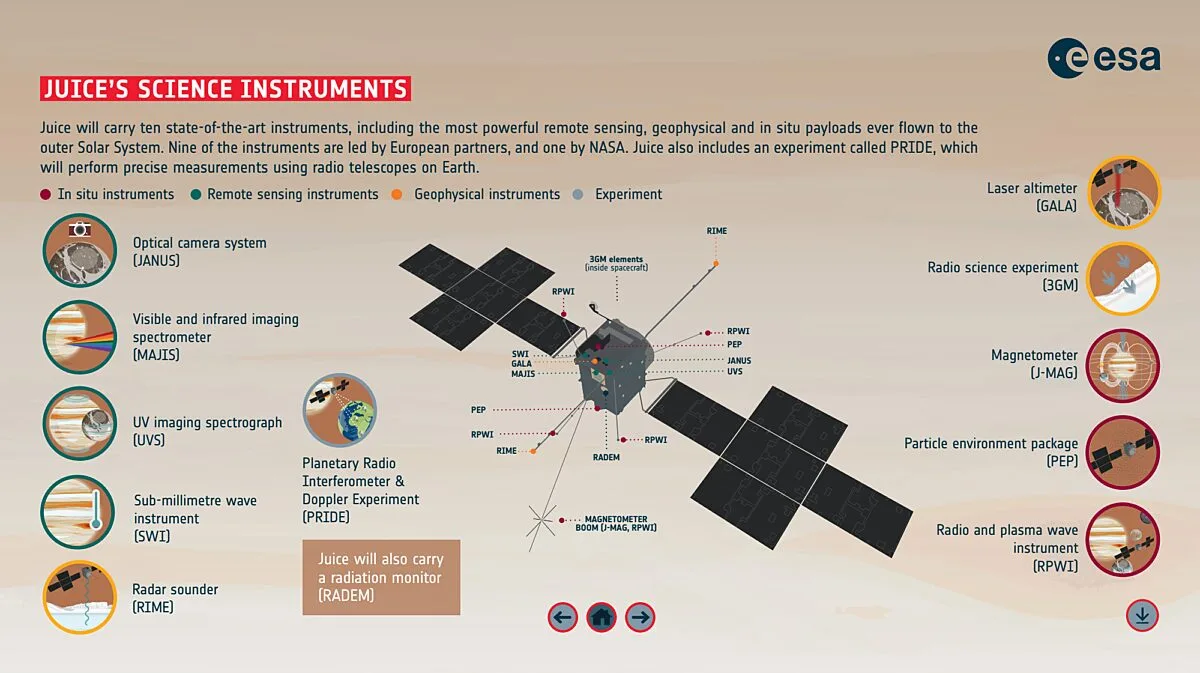
Juice is equipped with 10 science instruments, a radiation monitor, and a radio experiment that together constitute “the most powerful remote sensing, geophysical, and in situ payloads ever flown to the outer Solar System,” according to ESA.

The remote sensing instruments will image the moons in a variety of wavelengths, determining the makeup of ices and minerals on their surfaces and scanning the regions around them for potential water plumes.

The geophysical instruments include an altimeter as well as a radar that will peer beneath the moons’ surfaces to a depth of 9 kilometers (5.6 miles). Juice’s communications system doubles as an experiment that will allow radio telescopes on Earth to measure how the gravity fields of Jupiter and its icy moons tug on the spacecraft.

The in situ instruments will study particles and plasma fields throughout the Jupiter system. Among other things, this will help scientists understand how volcanic activity on Io shapes the region.

Juice's science instruments
JUICE’S SCIENCE INSTRUMENTS Juice, the Jupiter Icy Moons Explorer, is equipped with 10 science instruments, a radiation monitor, and a radio experiment that together constitute “the most powerful remote sensing, geophysical, and in situ payloads ever flown to the outer Solar System,” according to the European Space Agency.Image: ESA

Packed with science instruments, Juice is a beefy spacecraft. Without fuel, it has a mass of 2.4 metric tons (5,300 pounds). The spacecraft’s two cross-shaped solar arrays have a combined area of 85 square meters (915 square feet). The cost of the mission is 1.6 billion euros, equivalent to $1.7 billion.

At Jupiter

Upon arriving at Jupiter, Juice will perform 35 flybys of Europa, Ganymede, and Callisto between July 2031 and November 2034.

The majority of those — 21, to be precise — will be at Callisto, the most heavily cratered world in our Solar System. Callisto may have a deep, subsurface ocean in contact with underlying rock, which could create an environment conducive to life. By studying Callisto’s gravity field and zapping it with radar, Juice should get a better idea of what’s happening beneath the surface.

Juice will fly past Europa twice, focusing on cracks in the moon’s surface where material is possibly being exchanged with the subsurface ocean. The spacecraft will examine these regions for elements essential to life and for substances that could be tied to past or present life. NASA’s Europa Clipper mission is slated to arrive at Jupiter a year earlier in 2030; ESA says the two mission teams meet once a year to compare notes and maximize the science return from both space probes.

Juice’s primary target is Ganymede. The spacecraft will fly past the moon 12 times before entering orbit in December 2034, marking the first time a spacecraft has orbited a moon besides our own.

Ganymede from Juno 2021
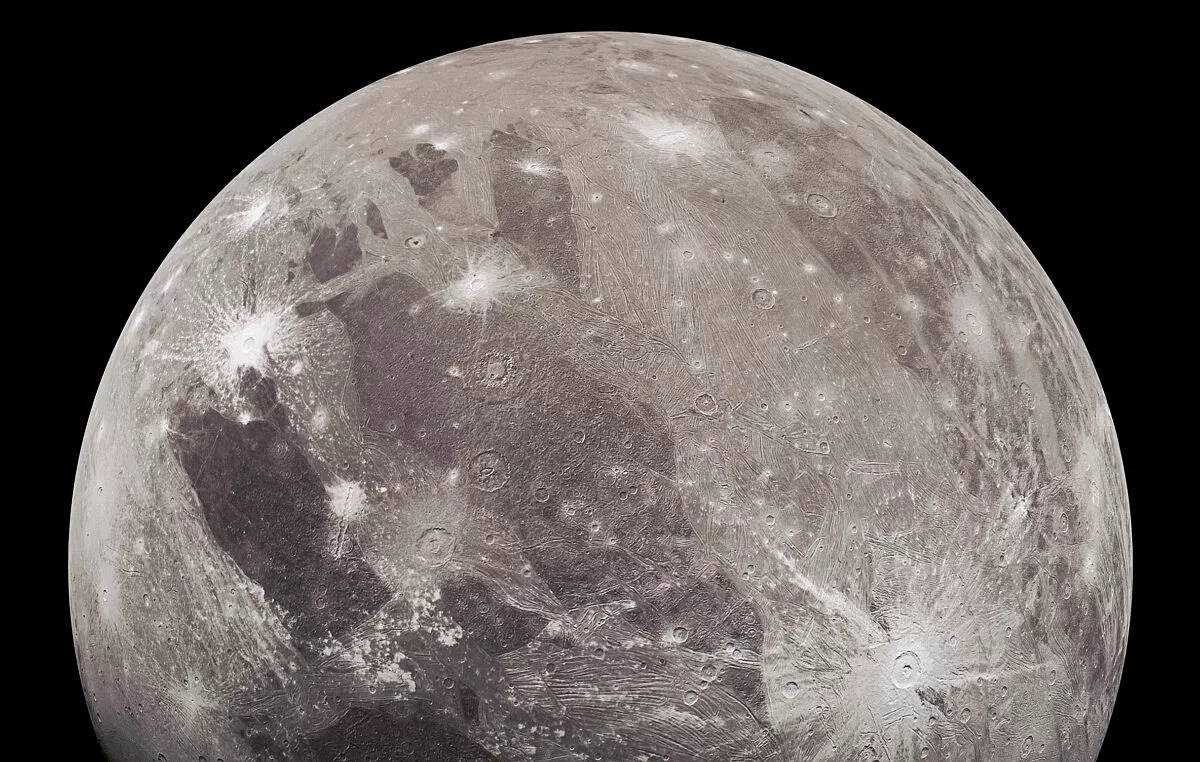
GANYMEDE FROM JUNO 2021 An image of Ganymede obtained by the JunoCam imager during Juno’s June 7, 2021, flyby of Jupiter’s icy moon.Image: NASA/JPL-Caltech/SwRI/MSSS

Ganymede is the only moon known to have a magnetic field, likely created from a molten iron core. The field creates auroras that have been detected by the Hubble Space Telescope. Juice will study this field, which lies within Jupiter’s larger magnetic field, to help scientists understand the complex interactions between both worlds.

Ganymede has a subsurface ocean, but we don’t know where it begins or how deep it is. Juice will attempt to shore up these basic facts, while also studying the moon’s composition and the intriguing bands splashed across the surface. The spacecraft will look for possible biosignatures that might bolster the chances of life developing on icy moons.

In September 2035, ESA will intentionally crash Juice into Ganymede, ending the mission. The spacecraft was not required to be sterilized under planetary protection rules because there is currently no evidence that Ganymede’s subsurface ocean is in contact with the surface. Should Juice find evidence to the contrary during its flybys, ESA says it will reconsider its end-of-mission plans.

By Jason Davis 
Source The Planetary Society

NASA’s Strategy Behind The Blueprint For Moon To Mars Exploration

0
Strategy Behind The Blueprint For Moon To Mars Exploration

As NASA evolves its blueprint for shaping exploration throughout the solar system, the agency is detailing its process to develop a sustainable, resilient path forward for exploration.

In a document published April 5, the agency explains the methodology behind developing NASA’s Moon to Mars objectives that drive its architecture, plans, and efforts to enable long-term human presence and exploration throughout the solar system.

NASA’s Moon to Mars Strategy and Objectives Development provides insight into how NASA developed and refined its Moon to Mars objectives released in 2022, and describes how the agency is establishing an objectives-driven architectural review process to ensure efforts to develop, build, and achieve exploration activities at the Moon and Mars are resilient for decades to come.

NASA’s overall Moon to Mars strategy seeks to develop a roadmap with input from a wide variety of U.S. and global stakeholders to define overarching exploration goals to enable the agency and others to build capabilities to meet those goals, a shift from a capabilities-driven approach to exploration.

Under Artemis, NASA has set a vision to explore more of the Moon than ever before. With the crew for Artemis II recently named, the agency plans to return humans to the Moon and establish a cadence of missions including at the lunar south polar region. These missions set up a long-term presence to inform future exploration of farther destinations, including Mars, and other potential future destinations in the solar system.

The Moon to Mars Strategy and Objectives Development document is available online at: go.nasa.gov/3zzSNhp

By Keith Cowing
Source SpaceRef
Scientists Map Gusty Winds In A Far-Off Neutron Star System

0
MIT astronomers mapped the “disk winds” associated with the accretion disk around Hercules X-1, a system in which a neutron star is drawing material away from a sun-like star, represented as the teal sphere. The findings may offer clues to how supermassive black holes shape entire galaxies.
Credit: Jose-Luis Olivares, MIT. Based on an image of Hercules X-1 by D. Klochkov, European Space Agency.

An accretion disk is a colossal whirlpool of gas and dust that gathers around a black hole or a neutron star like cotton candy as it pulls in material from a nearby star. As the disk spins, it whips up powerful winds that push and pull on the sprawling, rotating plasma. These massive outflows can affect the surroundings of black holes by heating and blowing away the gas and dust around them.

At immense scales, “disk winds” can offer clues to how supermassive black holes shape entire galaxies. Astronomers have observed signs of disk winds in many systems, including accreting black holes and neutron stars. But to date, they’ve only ever glimpsed a very narrow view of this phenomenon.

Now, MIT astronomers have observed a wider swath of winds, in Hercules X-1, a system in which a neutron star is drawing material away from a sun-like star. This neutron star’s accretion disk is unique in that it wobbles, or “precesses,” as it rotates. By taking advantage of this wobble, the astronomers have captured varying perspectives of the rotating disk and created a two-dimensional map of its winds, for the first time.

The new map reveals the wind’s vertical shape and structure, as well as its velocity — around hundreds of kilometers per second, or about a million miles per hour, which is on the milder end of what accretion disks can spin up.

If astronomers can spot more wobbling systems in the future, the team’s mapping technique could help determine how disk winds influence the formation and evolution of stellar systems, and even entire galaxies.

“In the future, we could map disk winds in a range of objects and determine how wind properties change, for instance, with the mass of a black hole, or with how much material it is accreting,” says Peter Kosec, a postdoc in MIT’s Kavli Institute for Astrophysics and Space Research. “That will help determine how black holes and neutron stars influence our universe.”

Kosec is the lead author of a study appearing today in Nature Astronomy. His MIT co-authors include Erin Kara, Daniele Rogantini, and Claude Canizares, along with collaborators from multiple institutions, including the Institute of Astronomy in Cambridge, U.K.

Fixed sight

Disk winds have most often been observed in X-ray binaries — systems in which a black hole or a neutron star is pulling material from a less dense object and generating a white-hot disk of inspiraling matter, along with outflowing wind. Exactly how winds are launched from these systems is unclear. Some theories propose that magnetic fields could shred the disk and expel some of the material outward as wind. Others posit that the neutron star’s radiation could heat and evaporate the disk’s surface in white-hot gusts.  

Clues to a wind’s origins may be deduced from its structure, but the shape and extent of disk winds has been difficult to resolve. Most binaries produce accretion disks that are relatively even in shape, like thin donuts of gas that spins in a single plane. Astronomers who study these disks from far-off satellites or telescopes can only observe the effects of disk winds within a fixed and narrow range, relative to their rotating disk. Any wind that astronomers manage to detect is therefore a small sliver of its larger structure.

“We can only probe the wind properties at a single point, and we’re completely blind to everything around that point,” Kosec notes.

In 2020, he and his colleagues realized that one binary system could offer a wider view of disk winds. Hercules X-1 has stood out from most known X-ray binaries for its warped accretion disk, which wobbles as it rotates around the system’s central neutron star.

“The disk is really wobbling over time every 35 days, and the winds are originating somewhere in the disk and crossing our line of sight at different heights above the disk with time,” Kosec explains. “That’s a very unique property of this system which allows us to better understand its vertical wind properties.”

A warped wobble

In the new study, the researchers observed Hercules X-1 using two X-ray telescopes — the European Space Agency’s XMM Newton and NASA’s Chandra Observatory.

“What we measure is an X-ray spectrum, which means the amount of X-ray photons that arrive at our detectors, versus their energy. We measure the absorption lines, or the lack of X-ray light at very specific energies,” Kosec says. “From the ratio of how strong the different lines are, we can determine the temperature, velocity, and the amount of plasma within the disk wind.”

With Hercules X-1’s warped disk, astronomers were able to see the line of the disk moving up and down as it wobbled and rotated, similar to the way a warped record appears to oscillate when seen from edge-on. The effect was such that the researchers could observe signs of disk winds at changing heights with respect to the disk, rather than at a single, fixed height above a uniformly rotating disk.

By measuring X-ray emissions and the absorption lines as the disk wobbled and rotated over time, the researchers could scan properties such as the temperature and density of winds at various heights with respect to its disk and construct a two-dimensional map of the wind’s vertical structure.

“What we see is that the wind rises from the disk, at an angle of about 12 degrees with respect to the disk as it expands in space,” Kosec says. “It’s also getting colder and more clumpy, and weaker at greater heights above the disk.”

The team plans to compare their observations with theoretical simulations of various wind-launching mechanisms, to see which could best explain the wind’s origins. Further out, they hope to discover more warped and wobbling systems, and map their disk wind structures. Then, scientists could have a broader view of disk winds, and how such outflows influence their surroundings — particularly at much larger scales.

“How do supermassive black holes affect the shape and structure of galaxies?” poses Erin Kara, the Class of 1958 Career Development Assistant Professor of Physics at MIT. “One of the leading hypotheses is that disk winds, launched from a black hole, can affect how galaxies look. Now we can get a more detailed picture of how these winds are launched, and what they look like.”

This research was supported, in part, by NASA.

Reprinted with permission of MIT News
By Jennifer Chu | MIT News Office
Source MIT

Schulz, Snoopy Visit NASA Headquarters

0

NASA Administrator Bill Nelson (left), Jeannie Schulz, widow of Peanuts creator Charles M. Schulz, and Snoopy are all smiles during a Wednesday, April 5, 2023, visit to NASA Headquarters in Washington. As part of the visit, Schulz showed the flown Artemis I Snoopy zero gravity indicator before it goes to its final home for display at the Schulz Museum in Santa Rosa, California.

Schulz was awarded a NASA Exceptional Achievement Medal by Administrator Nelson at an “Our Blue Planet” concert at the John F. Kennedy Center for the Performing Arts. Snoopy rode along as the zero-gravity indicator on NASA’s Artemis I mission as part of a partnership with the agency.

Image Credit: NASA/Joel Kowsky

By Monika Luabeya
Source NASA